Scarlet elf cup
Sarcoscypha coccineasyn. Peziza coccinea, Lachnea coccinea, Plectania coccinea, Helvella coccinea, Geopyxis coccinea, Macroscyphus coccineus
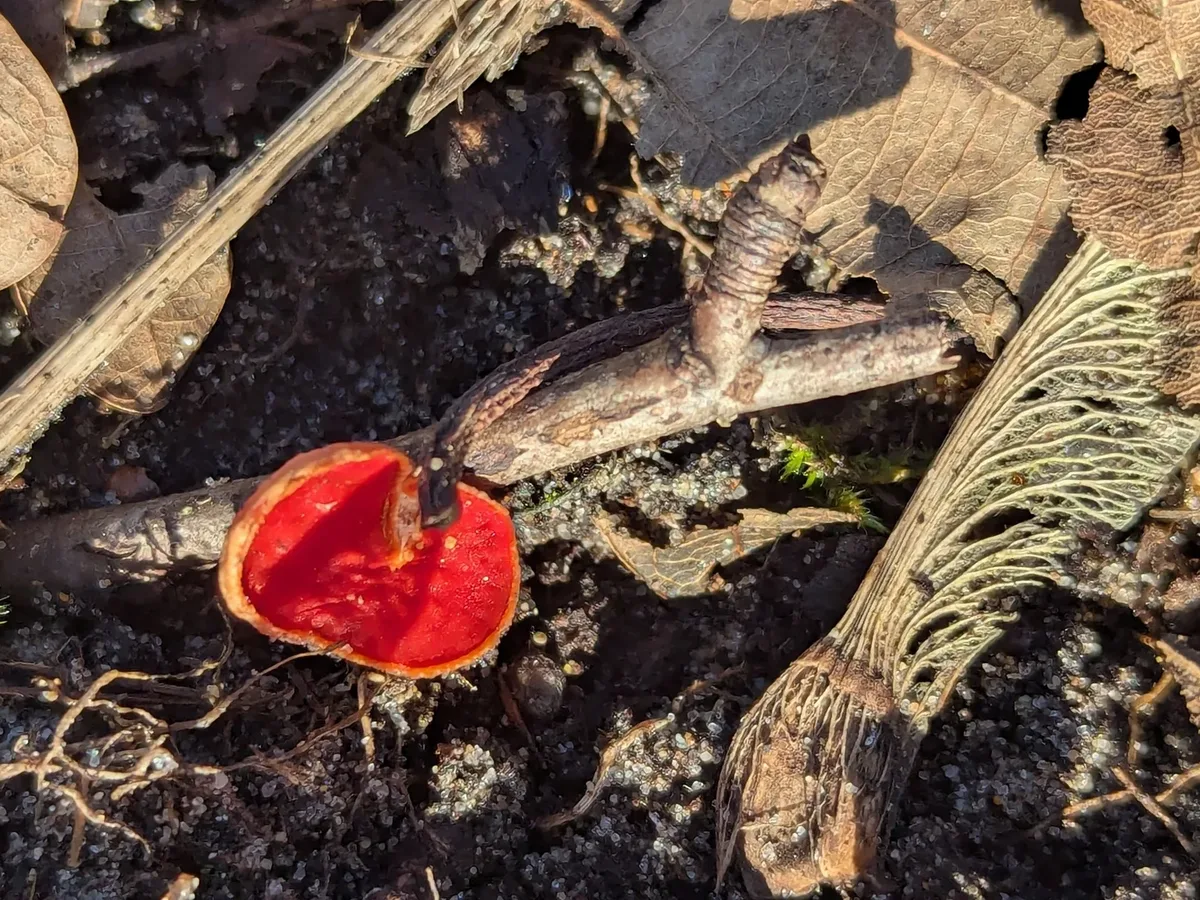 © Michel Langeveld (CC BY)
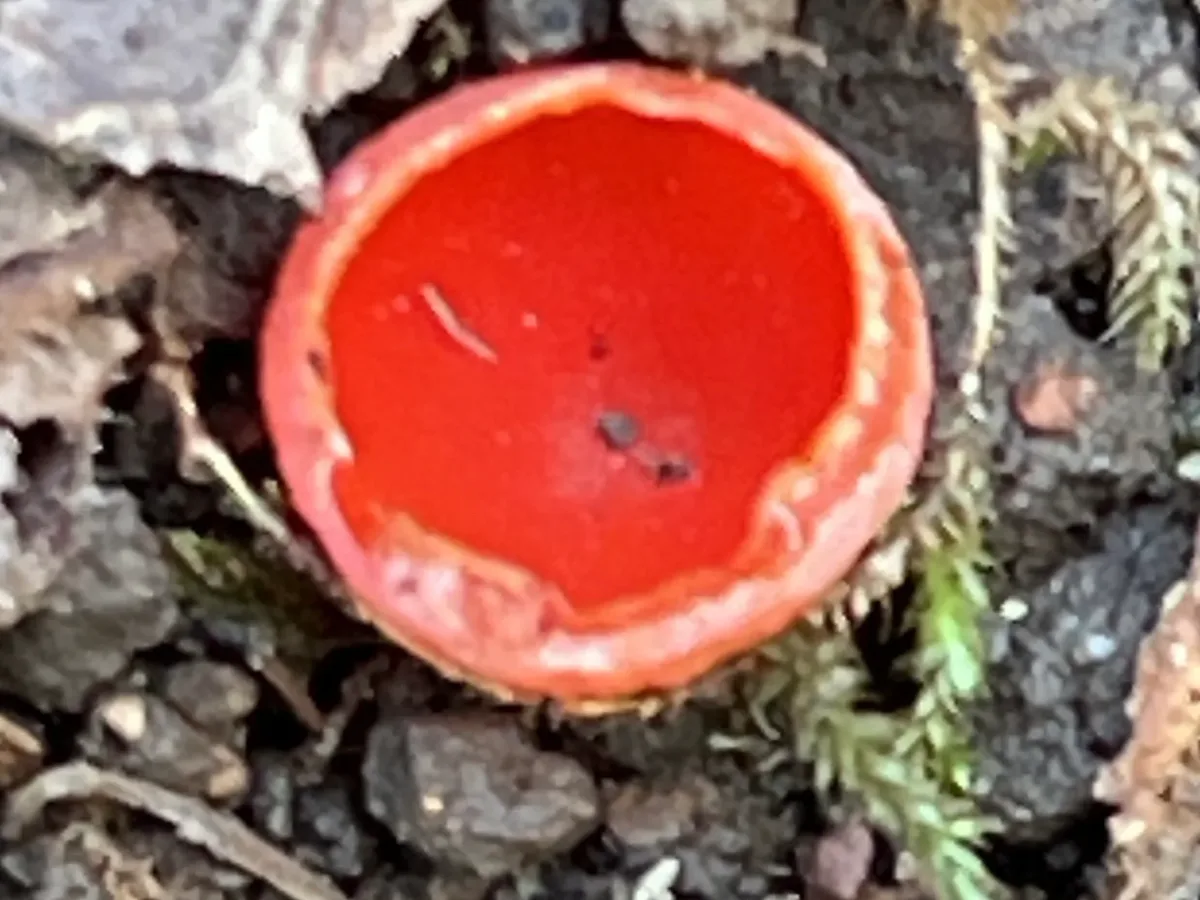 © joqatana (CC BY)
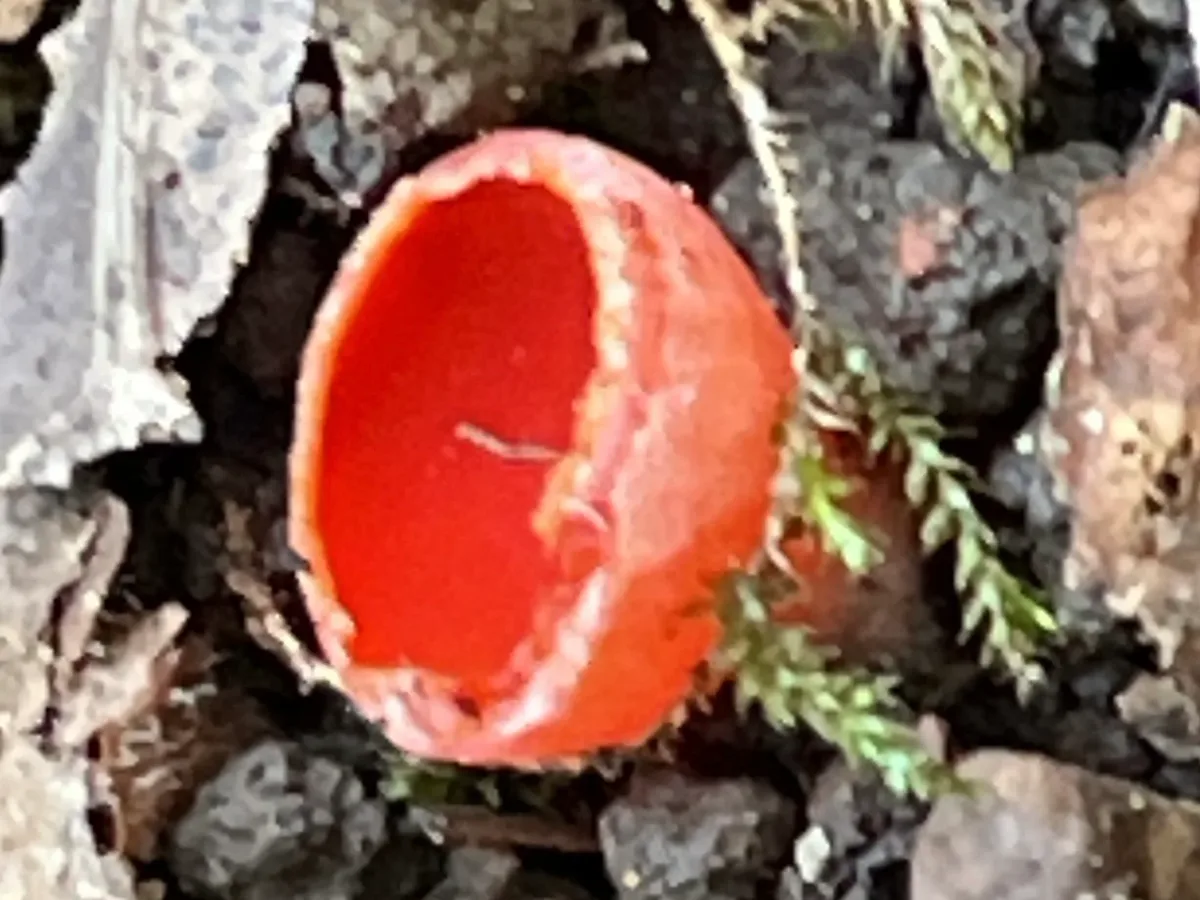 © joqatana (CC BY)
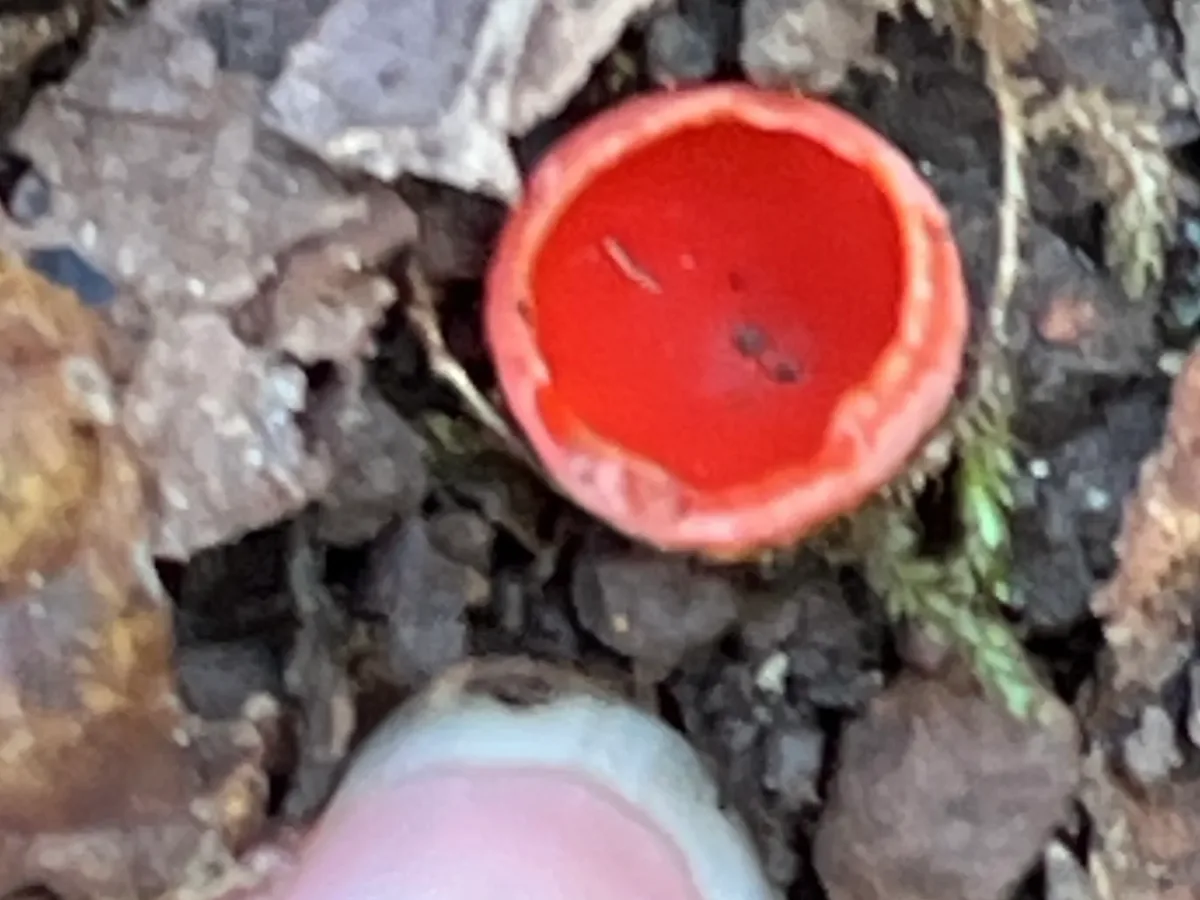 © joqatana (CC BY)
 © joqatana (CC BY)
 © joqatana (CC BY)© Michel Langeveld (CC BY)© joqatana (CC BY)
Edible only with the right preparation - or safe for some people but not others. Learn the caveats first.
How to recognise it
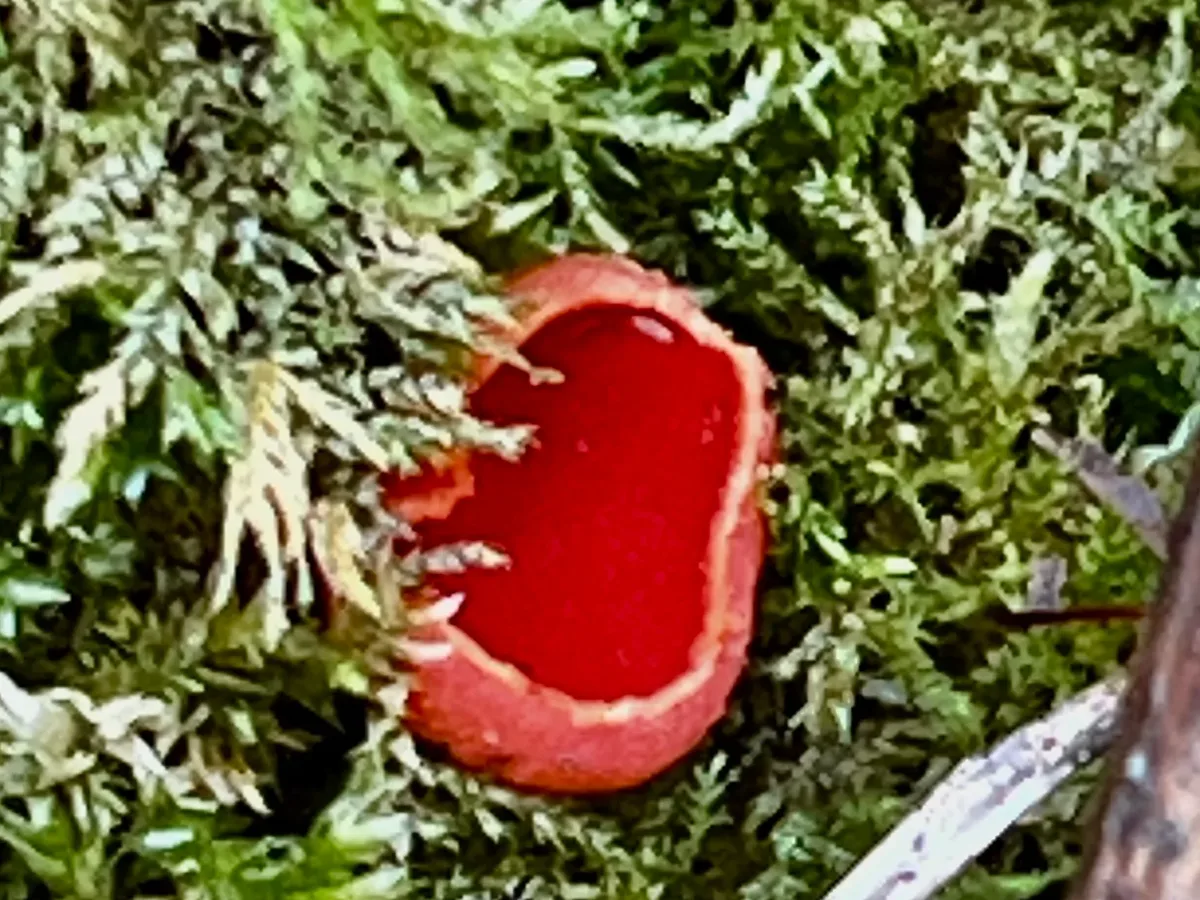
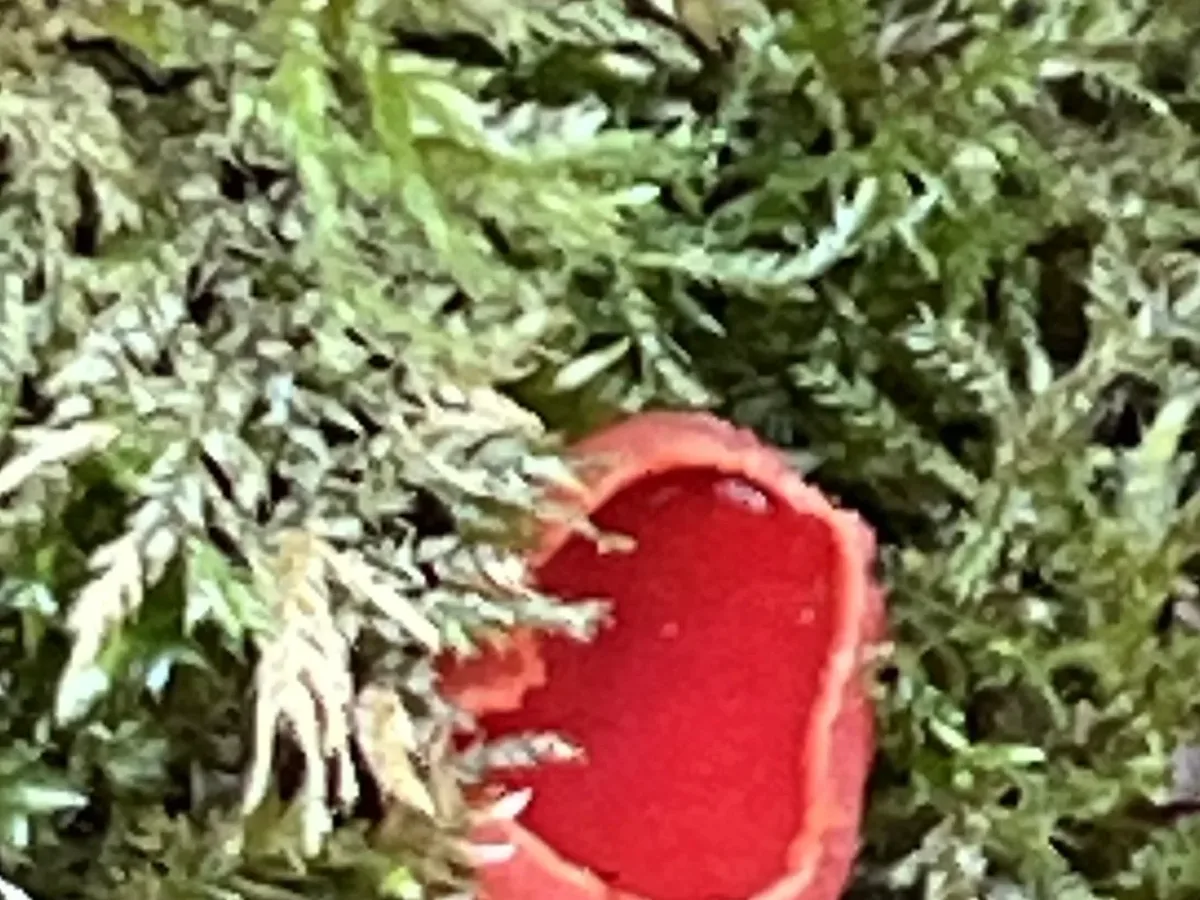
Sarcoscypha coccinea is unmistakable when seen: a brilliant scarlet cup, 2-6 cm across, sitting on or just above dead wood or leaf litter in the bleakest weeks of winter.
Cap
Young fruitbodies are closed and deeply cup-shaped like a goblet or thimble. As they mature they flatten to a shallow bowl, and in older specimens the margin becomes irregular and lobed.
The vivid inner surface - the hymenium, where spores are produced - is smooth and an intense, almost lacquer-like crimson or scarlet-red, fading toward orange when dry.
By contrast, the outer surface is much paler: whitish to pinkish-buff with a finely felty texture produced by densely packed, tightly appressed straight or gently curved white hairs visible under a hand lens.
This hair character is diagnostic: in S. coccinea the hairs are straight and do not intertwine, distinguishing it microscopically from S. austriaca (coiled, corkscrew hairs) and S. jurana (intermediate).
Stem
The stem is very short (0.5-4 cm), stout, and often buried in the substrate, making the cup appear sessile.
Flesh
Flesh is thin, waxy, brittle, and white throughout. No ring or volva.
Spores are large, elongate-elliptical, smooth, hyaline, 26-40 × 10-13 µm, with small lipid droplets at each end.
Note: S. austriaca, S. jurana, and S. dudleyi are virtually inseparable from S. coccinea by eye alone; all require microscopy for certainty, though none is toxic.
Where & when it grows
Habitat
Found in damp deciduous and mixed woodland, particularly in sheltered valleys, along stream banks, on mossy slopes, and in other persistently humid microhabitats.
The fungus is a saprotroph, decomposing dead woody debris - most commonly the fallen, often buried twigs and thin branches of hazel, elm, willow, alder, and bramble. It favours wood that has been lying on the ground long enough to be colonised by mosses, since the moss mat retains moisture around the substrate.
The cups often appear to be growing directly from bare soil or moss because the twig they colonise is hidden beneath leaf litter.
Characteristic habitats include woodland edges, old coppice woodland, hedgerows with shaded damp bases, and streamsides.
It is widespread across temperate Europe and is also recorded in North America, though on the west coast. In eastern North America, S. austriaca and S. dudleyi are more commonly encountered.
When
One of the earliest fungi of the year. Fruiting bodies appear from January through April across most of central and western Europe, peaking in February and March.
In milder Atlantic areas - the British Isles, western France, northern Iberia - it may appear as early as December following mild, wet weather. In mountain areas or areas with a more continental climate, fruiting is compressed into March-April.
The fungus is cold-tolerant, and cups can often be found partially or fully buried under a light dusting of snow with no apparent harm.
It disappears as temperatures warm and the spring flush of leaves begins to shade and dry out the woodland floor.
How it grows
Sarcoscypha coccinea is a saprotrophic ascomycete. The mycelium lives within dead deciduous woody debris, breaking down cellulose and lignin.
It typically fruits gregariously, with several to many cups arising from the same piece of buried or surface wood, sometimes in dense clusters.
Spore release is active. Mature asci forcibly discharge ascospores in coordinated puffs when the cup is disturbed or subjected to air movement - a process sometimes visible as a faint 'smoke' rising from a disturbed cup.
Individual fruitbodies are short-lived, lasting one to three weeks before fading, shrivelling, and darkening.
Fruiting conditions
Requires persistently cool, moist conditions. Fruits in late winter and early spring, tolerating near-freezing soil temperatures. Optimal fruiting follows periods of mild, wet weather (above 2°C) after cold winters. Does not fruit in warm or dry conditions.
Look-alikes
The most likely confusion is with sibling species Sarcoscypha austriaca, S. jurana, and S. dudleyi, which are essentially identical in the field.
Separation requires microscopy:
- S. austriaca has spirally coiled hairs on the outer surface and characteristically truncate spore poles.
- S. coccinea has straight, non-intertwining hairs and smoothly rounded spore poles.
- S. jurana is intermediate.
- S. dudleyi (more common in North America) has straight hairs but spores with a conspicuous complete mucilaginous sheath.
This distinction is academic for foragers in Europe since none of these species is known to be toxic.
Other superficially similar cup fungi:
- Aleuria aurantia (orange peel fungus) is superficially similar in shape but is bright orange-yellow rather than scarlet-red, and fruits in autumn on bare disturbed soil rather than on wood.
- Caloscypha fulgens is orange to orange-yellow with a greenish-blue reaction on the outer surface when bruised, found near conifers in spring at altitude.
- Otidea species are ear-shaped and yellowish-ochre to orange-brown.
- Peziza species are brown, grey, or violet.
No deadly lookalikes are known for this group.
Orange to orange-yellow inside; outer surface bruises or ages to a distinctive greenish-blue or olive colour - never seen in Sarcoscypha. Associated with conifer debris and spring snowmelt in mountain habitats. Not dangerous.
Similar cup shape but bright orange to orange-yellow rather than scarlet-red. Grows on bare, compacted, or disturbed soil (paths, roadsides, burnt ground) rather than on woody debris. Fruits mainly in autumn (September-November), not winter-spring. Not dangerous.
Ear-shaped or rabbit-ear cups, never fully circular; yellowish-ochre to orange-brown, not scarlet. Typically fruits in summer and autumn on woodland soil. Not dangerous.
Macroscopically nearly identical; cannot be reliably separated in the field. Microscopy required: S. austriaca has spirally coiled (corkscrew) hairs on the outer surface; S. coccinea has straight, non-intertwining hairs. Spore poles of S. austriaca are truncate and saddle-shaped; S. coccinea poles are smoothly rounded. Both are similarly edible only when cooked; edibility of both is disputed in some field guides.
Primarily a North American species (rare in Europe), also scarlet-cupped and indistinguishable in the field. Microscopy: spores have two large oil droplets and a conspicuous complete mucilaginous sheath surrounding the entire spore; hairs are straight and non-tangled. None of the Sarcoscypha sibling species is known to be toxic.
A third sibling species found in Europe, also scarlet-cupped and virtually indistinguishable in the field without microscopy. Key microscopic difference: spores are completely surrounded by a mucilaginous envelope. Outer hairs intermediate between S. coccinea (straight) and S. austriaca (coiled). Considered similarly cook-safe.
In the kitchen
Picking & cleaning
Scarlet elf cups are best harvested young to medium-aged, when the cup is still well-formed and the inner surface is firm and bright. Older cups become flaccid, waterlogged, and lose their texture.
Because they grow on buried wood, collecting often means following the cup down to its short buried stem with a careful twist. Harvest sparingly - populations can be modest and the species is Red-Listed in several European countries.
Because of their thin flesh and high water content they are delicate and transport poorly; use a rigid container rather than a bag.
- Clean away any adhering leaf litter or moss with a soft brush.
- Use them the same day if possible.
- Do not eat raw; cook thoroughly before consuming.
Cooking
Scarlet elf cups are more prized for their extraordinary visual appeal than their flavour, which is mild, faintly earthy, and slightly gelatinous. They must always be cooked before eating.
A brief sauté in butter with a pinch of salt retains their shape and colour better than boiling, which bleaches the vivid red. Some cooks blanch them briefly in salted water, then refresh in cold water to preserve colour before using.
They make a striking garnish for spring dishes - asparagus, wild garlic, fresh herbs, and soft cheeses complement them well. Avoid prolonged cooking, which collapses the thin flesh.
Because yields are modest and texture not especially prized, many foragers simply enjoy finding them and take only a few for a garnish or decoration.
Good to know
Sarcoscypha coccinea must always be cooked before eating. Raw or undercooked specimens have caused mild gastrointestinal upset in some individuals, and some current field guides now list the species as inedible or 'suspect.' It should not be eaten raw.
When thoroughly cooked it is considered safe, and no confirmed reports of serious toxicity are on record.
Nonetheless, because edibility is disputed among authorities, conservative consumption is advised:
- Cook thoroughly.
- Start with small quantities.
- Do not eat if in any doubt.
Individuals with sensitive digestion should avoid it.
No toxic or deadly lookalikes exist in Europe. The closely related S. austriaca, S. jurana, and S. dudleyi share the same uncertain but cook-safe edibility profile.
A reference guide - never an edibility guarantee. When in doubt, leave it out.