Shimofuri-shimeji
Sarcodon aspratussyn. Hydnum aspratum, Sarcodon asprellus
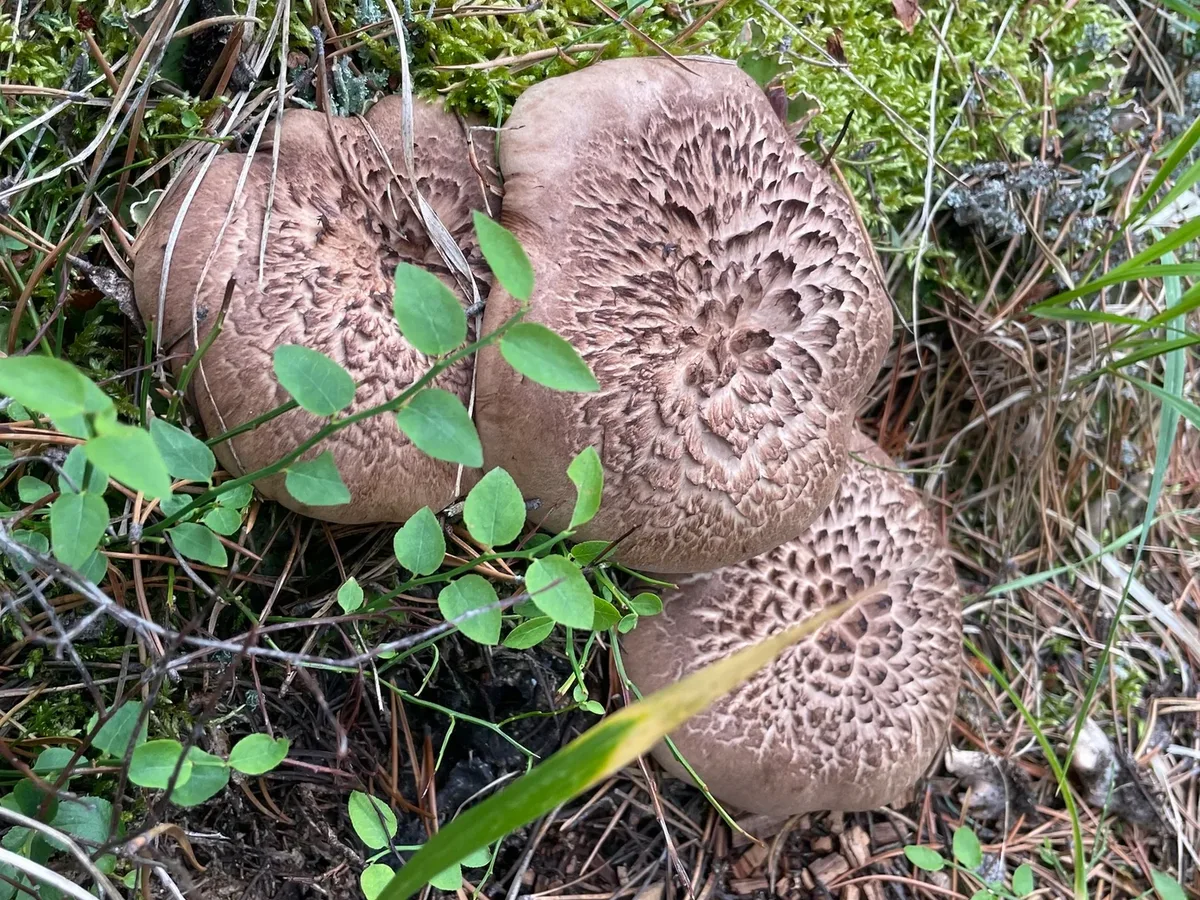 Nick Bédard (CC0)
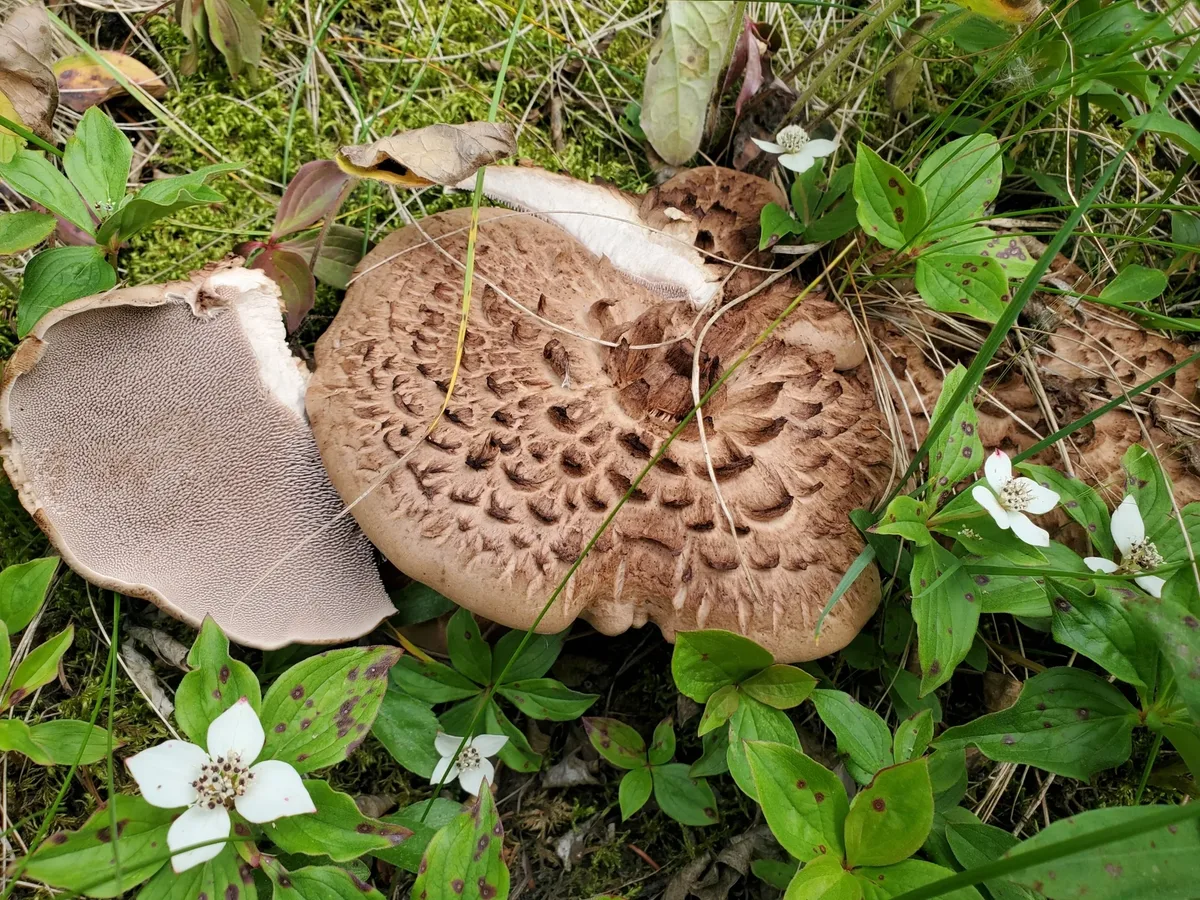 © J Straka (CC BY)
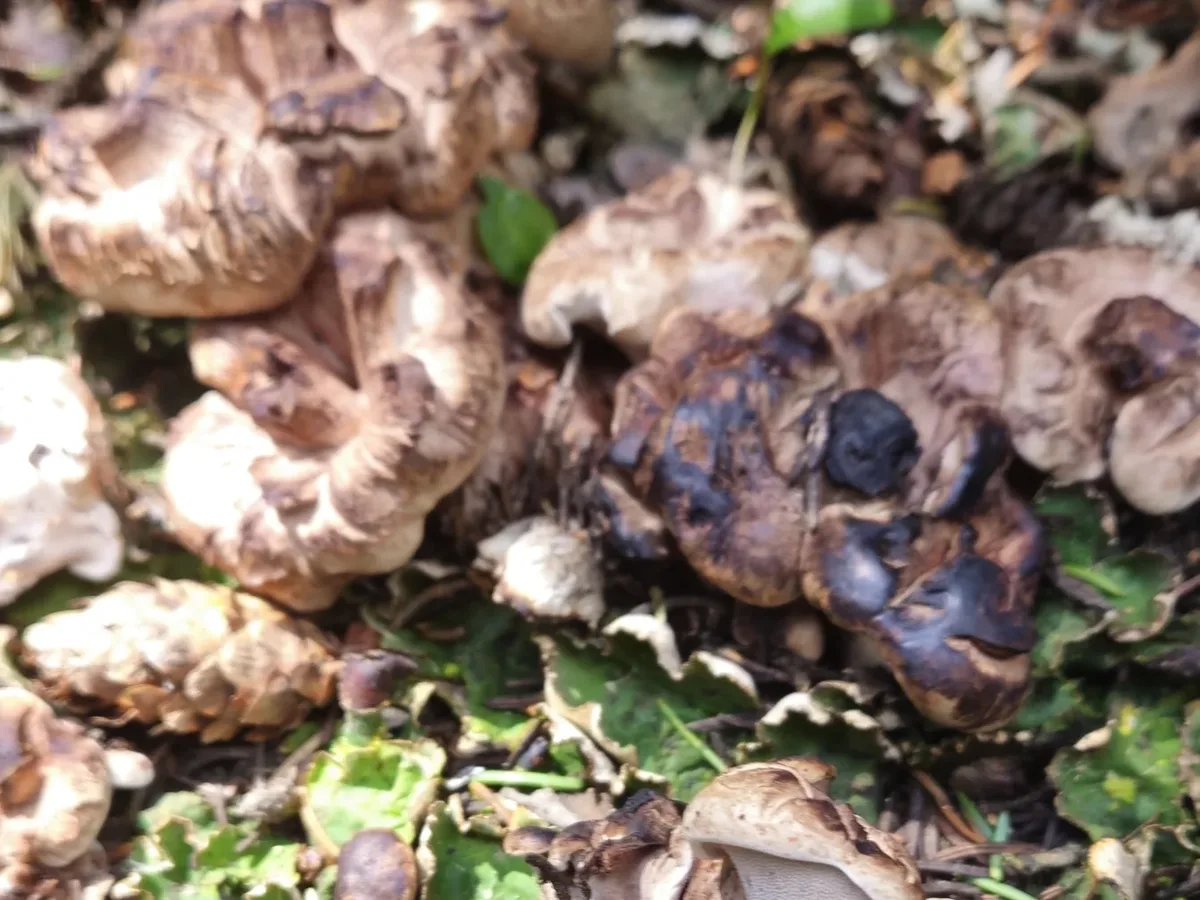 © Alexis Murray (CC BY)
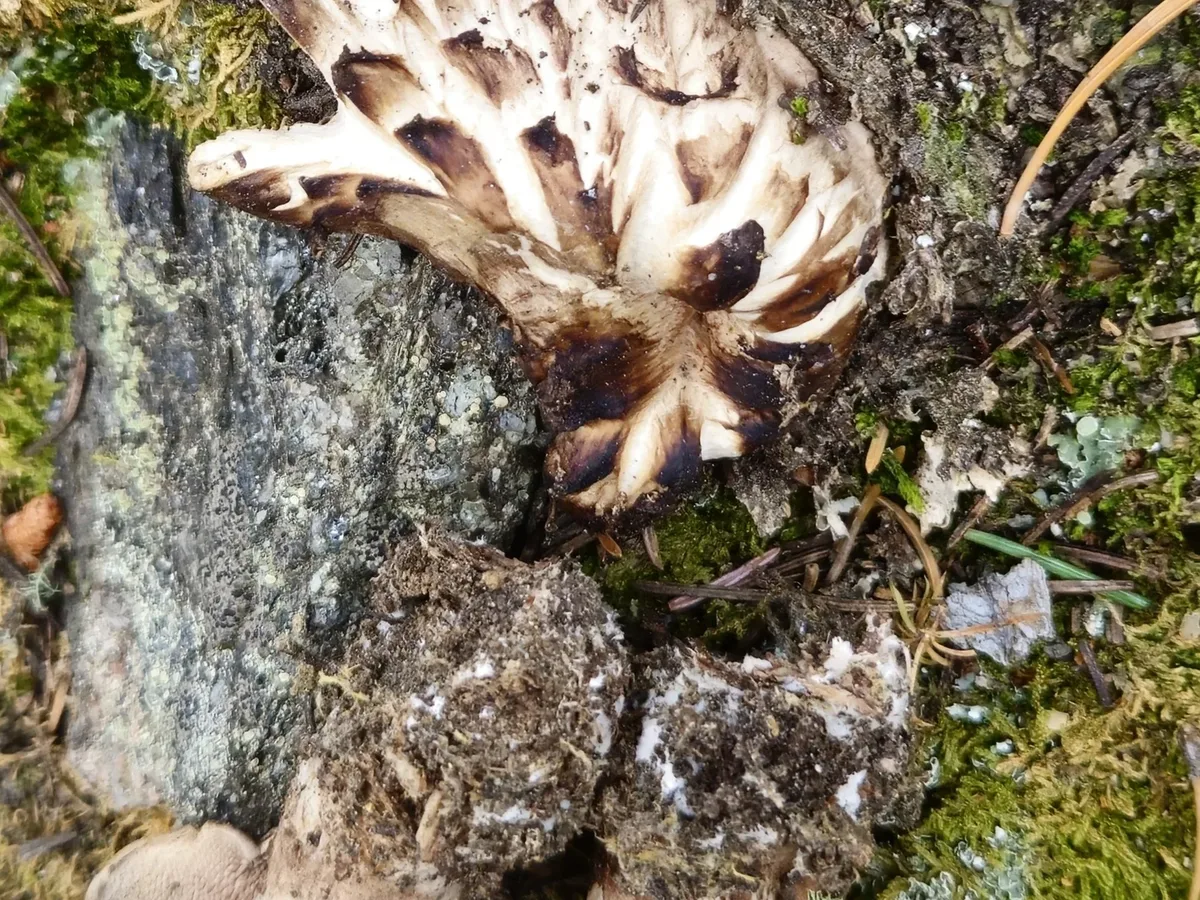 © Alexis Murray (CC BY)
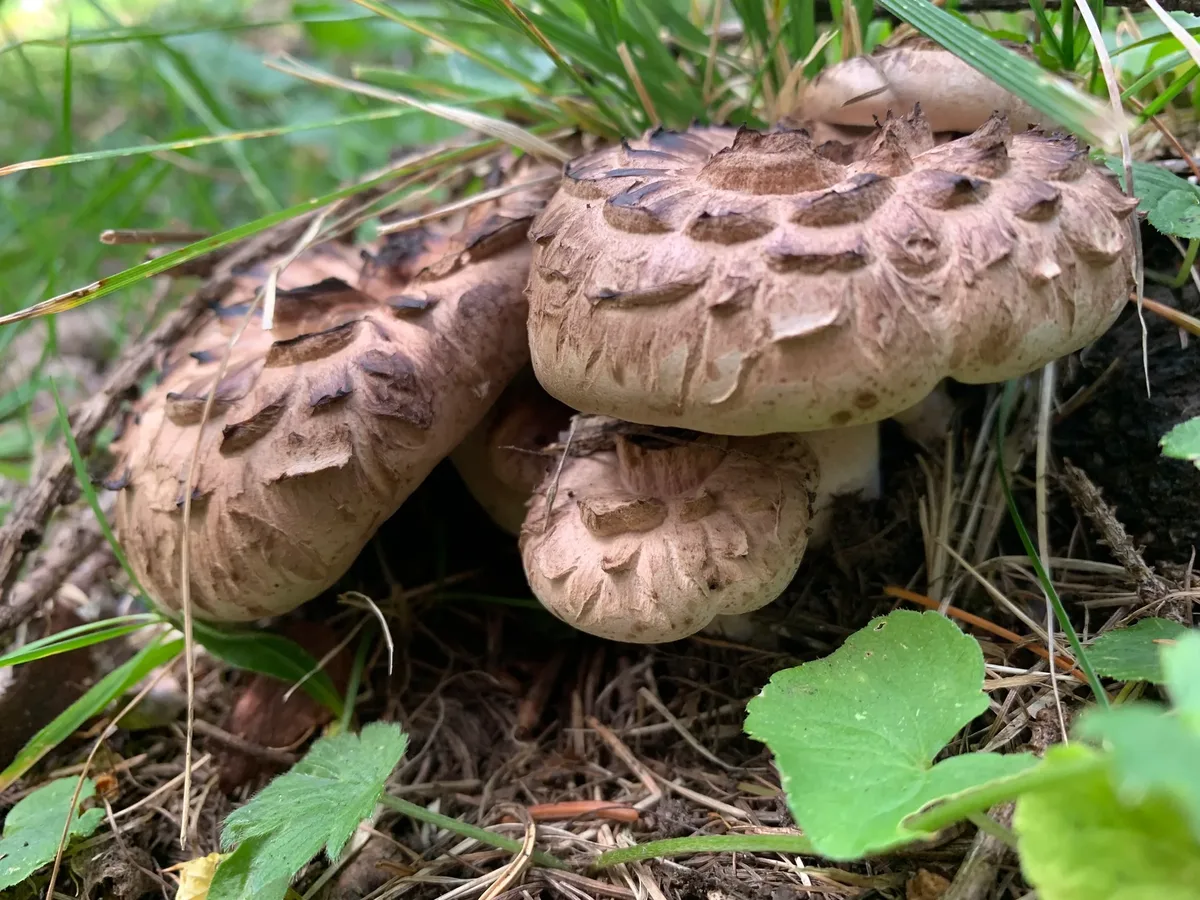 © Manuela Fiorini (CC BY)
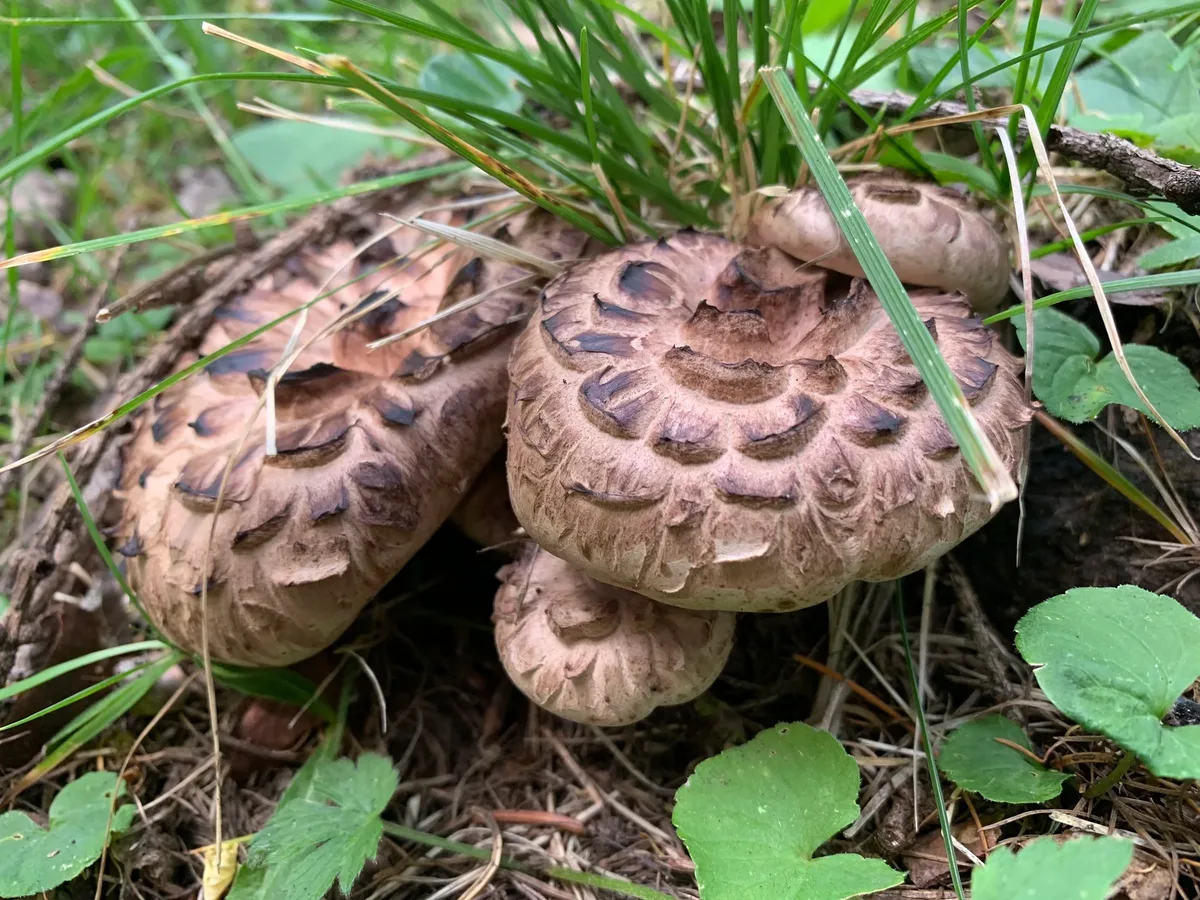 © Manuela Fiorini (CC BY)
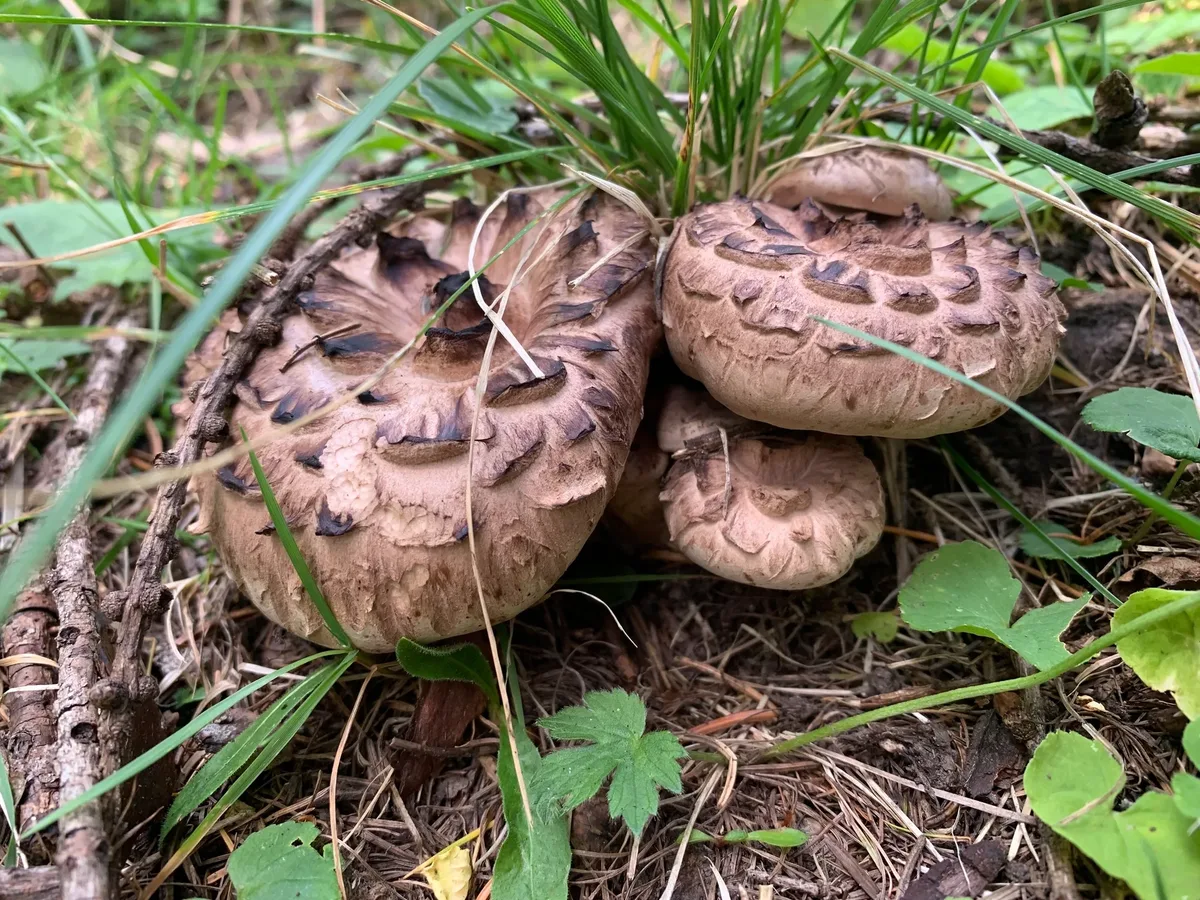 © Manuela Fiorini (CC BY)
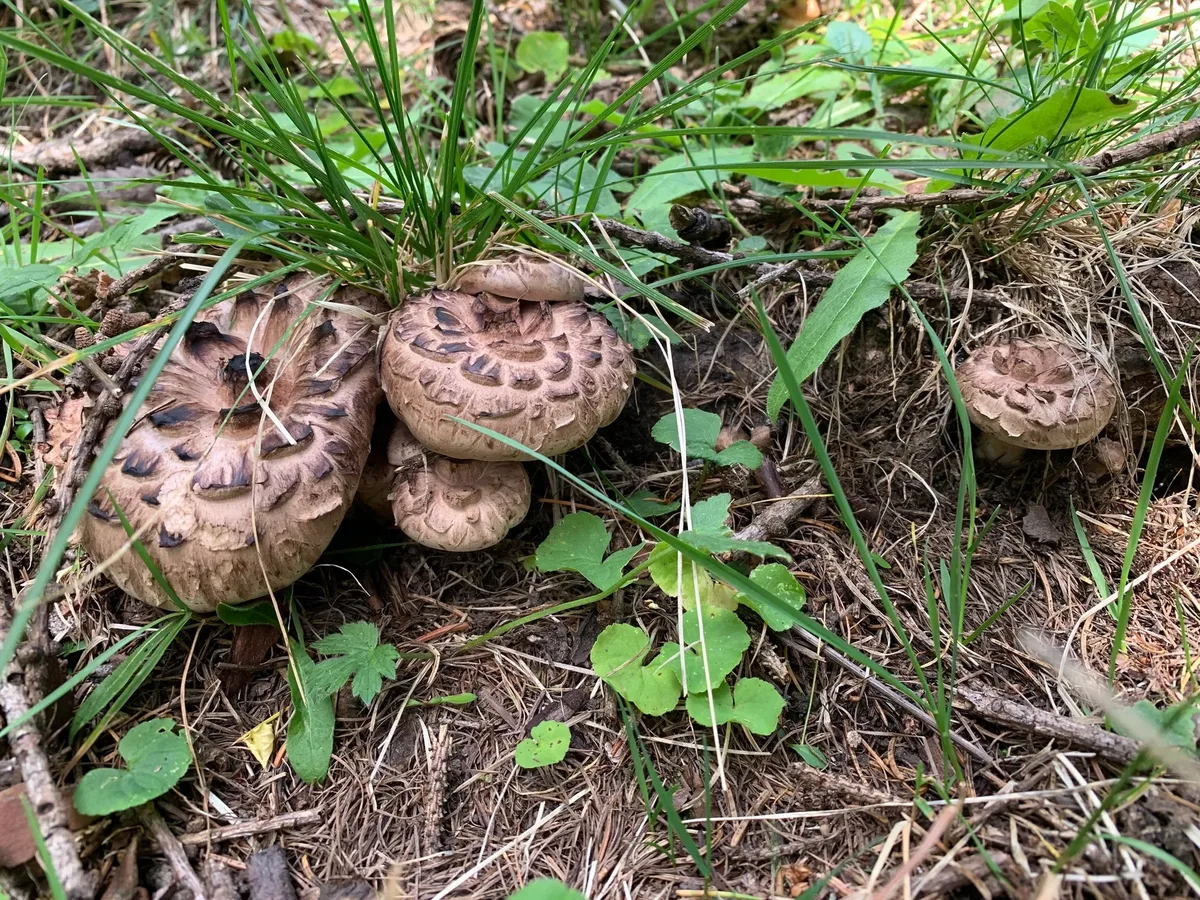 © Manuela Fiorini (CC BY)Nick Bédard (CC0)© J Straka (CC BY)
Edible only with the right preparation - or safe for some people but not others. Learn the caveats first.
How to recognise it
Cap
The cap reaches 5-20 cm and begins convex with a central umbo, later flattening and becoming irregularly wavy.
The dry surface is clothed in dark brown to grey-brown overlapping fibrous scales against a paler grey-brown ground - the shimofuri (frost-marbled) patterning that gives the species its Japanese name.
Gills / Pores
The underside bears the defining feature of the genus: dense, crowded spines (teeth) 5-15 mm long that run slightly down the stem (decurrent).
They begin pale grey and darken to brownish-grey with age.
Stem
The stem is 3-10 cm x 1-4 cm, solid, firm, and greyish-brown. When the base of the stem or the flesh near it is cut, it often shows a blue-green to blue-grey reaction.
No ring or volva is present.
Flesh
The flesh is whitish-grey, firm, and notably bitter, increasingly so in older specimens.
The spore print is brown, and the spores are coarsely warty.
Where & when it grows
Habitat
Strictly ectomycorrhizal.
In Japan and Korea, it most commonly partners with Japanese red pine (Pinus densiflora) and Japanese black pine (Pinus thunbergii) in pine-dominated or mixed conifer-broadleaf forests. It also associates with oaks (Quercus) at the forest-oak ecotone and with Abies and Picea at higher elevations.
It grows on well-drained, acidic soils, often on mossy forest floors or along forest paths, either singly or in small scattered groups.
The range covers Japan, Korea, and parts of eastern and southwestern China (Yunnan, Sichuan), extending to the Russian Far East.
When
Fruiting begins in late summer (August) and runs through autumn until early November.
The peak in Japan and Korea falls in September to mid-October, when cooling air temperatures follow the last of the summer rains - the same seasonal window that brings out matsutake and other autumn mycorrhizal species in the same forests.
Populations at higher elevations fruit somewhat later as the cold settles in more slowly.
How it grows
Grows singly or in scattered groups, never in dense clusters.
Like all mycorrhizal fungi, it cannot be cultivated - it lives as an intimate partner with its host trees, weaving a mycelial network through the soil that may persist in the same stand for many years before a fruiting body ever appears.
This is why it favours established, older forest stands where those partnerships have had decades to settle in.
The fruiting bodies emerge at or just below the soil surface, often partly nestled in moss or leaf litter, as if the forest floor is simply making room for them.
Fruiting conditions
Mycorrhizal; fruiting is triggered by cooler autumn temperatures following late-summer rainfall. Soil temperatures dropping below approximately 18 degrees C after adequate summer moisture are the primary drivers. Flush lag of 7-14 days after triggering rain is typical for this growth rate and mycorrhizal habit.
Look-alikes
The most likely confusion in East Asia is with Sarcodon imbricatus (hawk's wing / scaly tooth), which shares the scaly cap and toothed underside.
S. imbricatus typically has larger, more prominent dark scales on the cap and a larger overall fruiting body. Both are bitter and require blanching before eating.
Hydnellum species share the tooth-bearing underside but are typically smaller, tougher, and have vividly coloured or zoned flesh, often with red guttation drops when fresh; they are inedible to mildly toxic and should not be collected for eating.
Phellodon species similarly have teeth but are much tougher and cork-like.
No genuinely deadly species are commonly mistaken for Sarcodon aspratus by an observer who verifies the toothed underside, but any tooth fungus with vividly coloured flesh or strong chemical smell should be avoided.
Hydnellum species share the toothed underside but differ markedly: they have tough, corky, vividly zoned or coloured flesh (often red, orange, or dark brown in cross-section), and H. peckii produces vivid red guttation droplets when fresh. All Hydnellum are inedible and some have mild toxicity. The flesh of Sarcodon aspratus is pale whitish-grey and firm, not corky or zoned.
Sarcodon imbricatus has larger, more boldly raised dark brown scales on the cap and is typically a larger mushroom overall. Both species have toothed undersides and can show blue-green basal colour reactions. Both are bitter and require blanching before eating. S. imbricatus is the more widely known species in European literature; S. aspratus is the characteristic East Asian representative.
Phellodon species are much tougher and cork-like in texture, typically smaller, with strongly zoned grey to black caps. The flesh is fibrous-tough rather than firm-fleshy. All Phellodon are inedible. They lack the overlapping fibrous scales of Sarcodon aspratus.
In the kitchen
Picking & cleaning
Collect young to medium-aged specimens for the best flavour and least bitterness: old specimens are often too bitter to be palatable even after preparation.
Cut the stem cleanly at the base with a knife to avoid disturbing the mycelium network. Brush off soil and debris in the field.
Avoid collecting waterlogged specimens, as the texture deteriorates.
In Japan, this species is sold in specialist markets, prized for its distinctive marbled cap appearance and firm texture.
Cooking
Traditional Japanese preparation begins with blanching: drop cleaned pieces into boiling water for 2-3 minutes, drain, and repeat once or twice with fresh water to draw out the bitterness.
After blanching, the mushroom has a mild earthy-nutty flavour and firm texture. It is used in:
- takikomi gohan (seasoned rice cooked with mushrooms, dashi, soy, and mirin)
- simmered in dashi-based soups and nabemono (hot pot)
- stir-fried with vegetables and soy sauce
Its firm, meaty texture holds up well to longer cooking times. It is not typically dried, as drying can concentrate and intensify bitterness.
Good to know
Sarcodon aspratus is not considered toxic and contains no known lethal or severe toxins.
However, the bitter compounds it contains, including atromentin-related pigments common in tooth fungi, can cause mild gastrointestinal discomfort if eaten without adequate preparation, particularly in large quantities or from older specimens.
Blanching or parboiling in two or more changes of water is the traditional Japanese preparation step and substantially reduces both bitterness and potential GI irritation. Never eat raw.
Careful identification is essential. Confirm:
- the scaly grey-brown cap
- decurrent pale-then-darkening teeth
- blue-green basal staining when cut
- brown spore print
Avoid Hydnellum species, which share the toothed underside but are inedible.
A reference guide - never an edibility guarantee. When in doubt, leave it out.