Sanghuang Bracket
Sanghuangporus weigelaesyn. Phellinus weigelae, Inonotus weigelae
 Atlas of Living Australia (CC0)
 Atlas of Living Australia (CC0)
 Atlas of Living Australia (CC0)Atlas of Living Australia (CC0)Atlas of Living Australia (CC0)
Not poisonous, but not worth eating - too tough, bitter, or bland for the pot.
How to recognise it
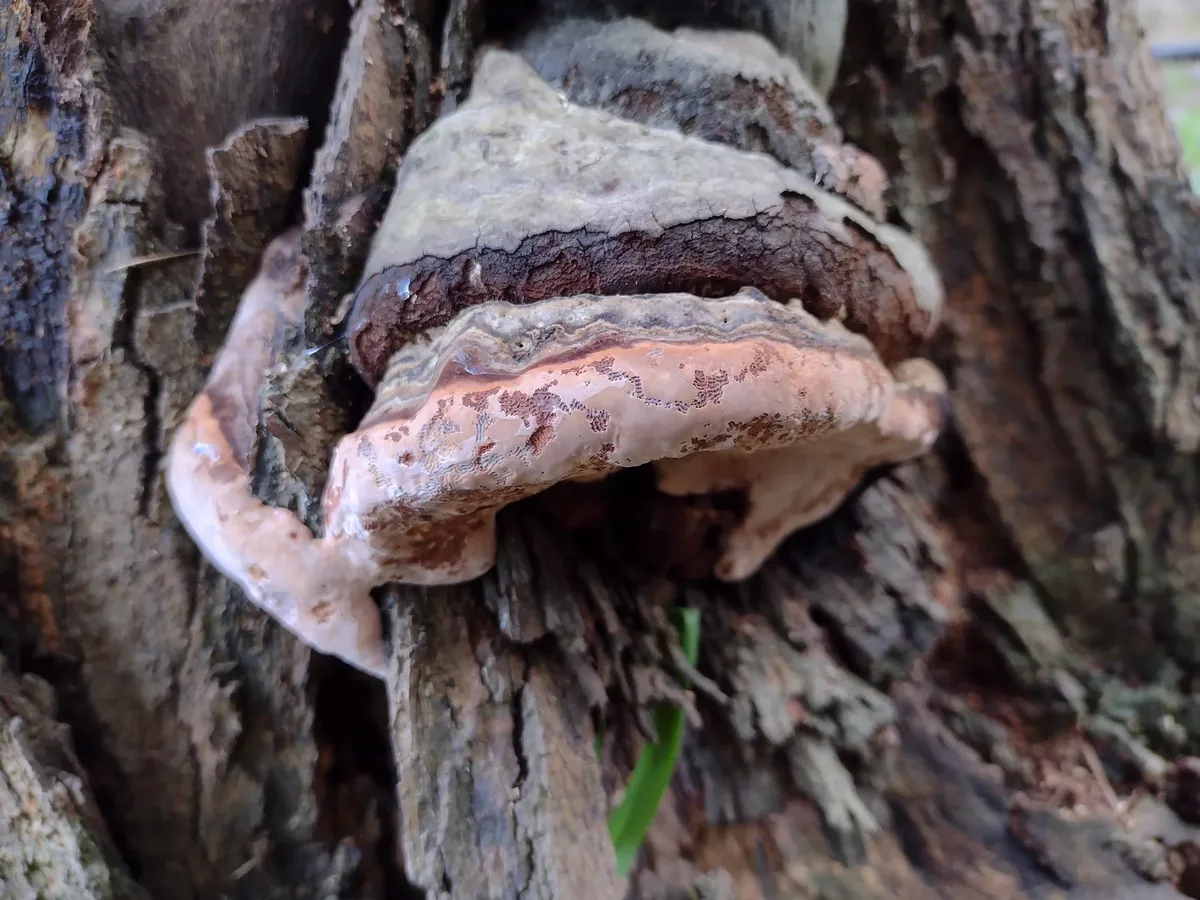
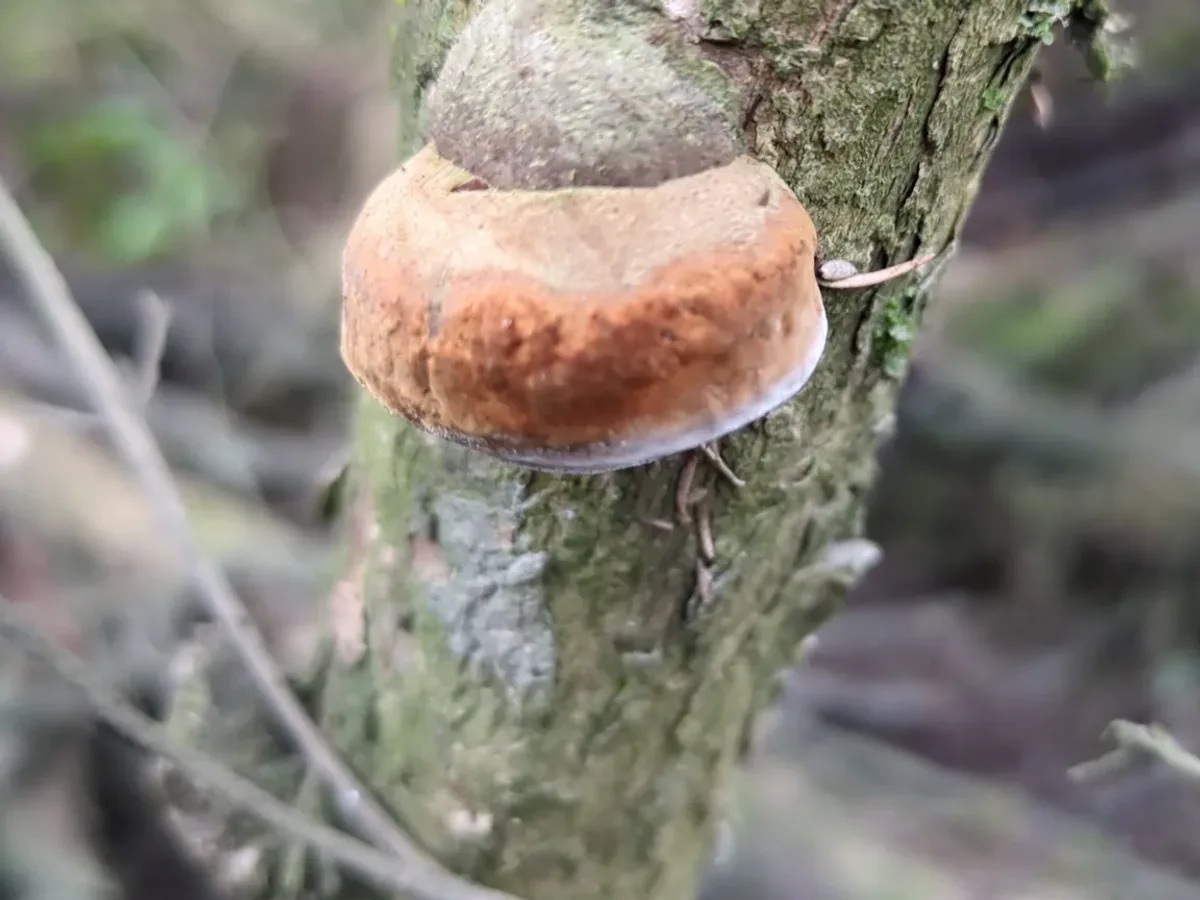
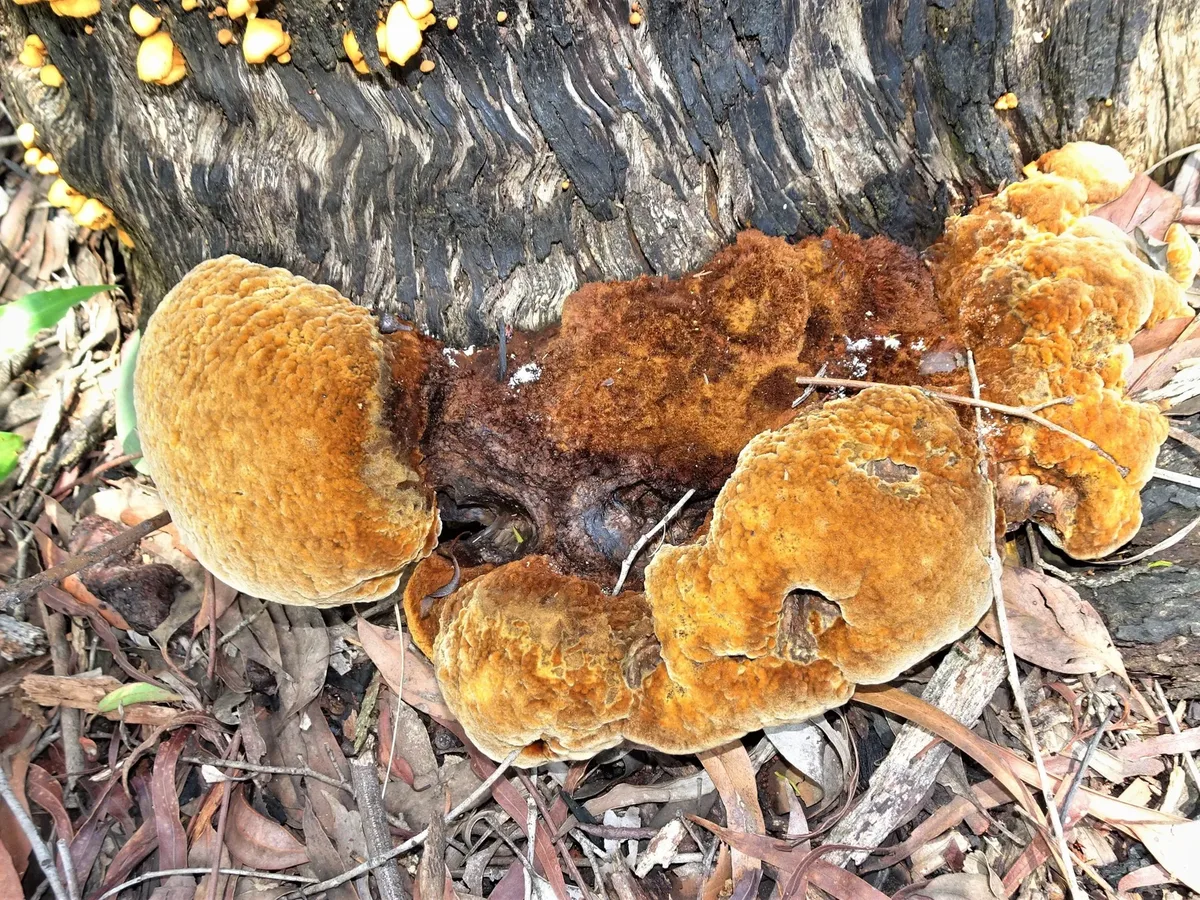
Sanghuangporus weigelae is a classic bracket polypore of the sanghuang type - hard, woody, perennial, and dominated by warm rusty-brown tones that deepen to near-black on the oldest parts of the cap. The fruitbody attaches directly to its host with no stem, projecting outward as a shelf or hoof-shaped conk anywhere from 3 to 15 cm across.
Cap
The most conspicuous feature on an actively growing specimen is the vivid ochre-yellow to golden-orange border running around the leading edge of the cap. This is where new tissue is being laid down each season, and the colour is distinctive against the dark crusty older surface.
As the cap ages, concentric rings record successive years of growth, and the outer crust weathers to dark brown or blackish, often cracking.
Pores
Flip the bracket over and you find the pore surface: a dense, cinnamon-brown layer of minute pores (about 5-7 per millimetre), completely unlike anything with gills or teeth.
Flesh
The flesh in cross-section is hard, corky, stratified, and uniformly rusty-brown - a structure that immediately rules out anything edible or soft.
The spore print, rarely obtained from a dried specimen, is pale buff to ochre.
Where & when it grows
Habitat
This species has a notably specific host preference - the ornamental and wild shrubs of the genus Weigela and close relatives in the family Caprifoliaceae. This narrow host range is one of the defining features separating S. weigelae from the better-known sanghuang bracket species that colonise mulberry (Morus) trees.
Look for the conk growing from the trunks or major branches of Weigela shrubs in woodland edges, garden hedgerows, or the scrubby margins of secondary forest in East and Northeast Asia.
The fungus causes a white rot, selectively breaking down the lignin in its host's wood while leaving paler, fibrous cellulose behind - the rotting wood has a characteristic stringy, bleached appearance in its advanced stages.
A single bracket can persist and enlarge over many years, so mature specimens on older shrubs are not uncommon.
When
As a perennial polypore, S. weigelae does not follow the seasonal rhythm of annual cap mushrooms. The bracket is present and visible at every season, accumulating new layers of pore tubes beneath the old ones year by year.
What does have a seasonal character is growth. The bright golden growing margin appears and expands during the warmer, wetter months of spring through early autumn, and spore production is concentrated in summer.
In the East Asian climate where this species occurs, the active growth window corresponds roughly to late April through September. Visiting in summer gives the best chance of finding a bracket with its yellow margin still fresh and unmistakable.
How it grows
Fruitbodies are solitary, or two or three brackets may emerge from the same host at different points on the stem or branches.
Growth is slow and perennial. Each season adds a new tube layer, and the age of a conk can be estimated by counting stratified pore layers in cross-section. A mature bracket several centimetres thick may be five to ten years old.
The same host shrub may carry one or more brackets for many years, until the plant dies or the wood is exhausted. Unlike annual gilled mushrooms, there is no sudden flush triggered by rain.
Fruiting conditions
Perennial wood-decay bracket; no rain-triggered flush. The bracket grows continuously during warm months and persists year-round. Season and moisture affect only the rate of marginal growth, not fruitbody initiation.
Look-alikes
The sanghuang group - Sanghuangporus and the related Phellinus/Inonotus complex - contains numerous species that are superficially similar: all are hard, brown, bracket-shaped, and grow on woody hosts. Most likely confusions are with other members of the genus or with closely related conks on different hosts, all of which are equally inedible and harmless.
These share the general growth form and colour scheme:
- Phellinus linteus sensu stricto (mulberry-host sanghuang)
- Sanghuangporus vaninii
- Inonotus obliquus (chaga, on birch)
None are deadly.
The best distinguishing feature for S. weigelae is its host: Weigela shrubs. Other Phellinus-type brackets on nearby oaks, birch, or poplar are different species.
The true chaga (Inonotus obliquus) produces a black, sterile sclerotium-like mass on birch with a very different texture. No deadly species is realistically confused with this bracket.
Grows on birch as a charcoal-black, irregularly lumpy sterile sclerotium protruding from the trunk - very different appearance from a zonate bracket with a golden margin. The fertile pore-bearing stage is hidden under the bark and rarely seen. Inedible as a bracket but widely used in tea preparations.
Very closely related; grows on Morus (mulberry) rather than Weigela. Cap surface, pore size, and colour are nearly identical. Host tree is the most reliable separator in the field. Both are inedible woody brackets.
A widespread bracket polypore on willows and other hardwoods with the same hoof-shape and rusty-brown zonate surface. Distinguished by slightly larger pores (4-6 per mm), a broader host range, and microscopic characters (different setal dimensions); host and geography help separate them. Both inedible.
Colonises Salix (willow) and poplar rather than Weigela. The bracket form and colouration are similar; again, host identity is the key field character.
In the kitchen
Picking & cleaning
Do not collect this species for food. The fruitbody is entirely composed of hard, woody, corky tissue without any culinary value.
Sanghuangporus species have a long history of use in East Asian traditional medicine - dried and simmered to prepare decoctions - and the genus has received substantial pharmacological attention for immunomodulatory polysaccharides. But this is specialist ethnopharmacological use, not foraging for the table.
Taking brackets from wild plants is also ecologically disruptive given the slow perennial growth and limited host range. If you encounter this species, enjoy it in place.
Good to know
Sanghuangporus weigelae is not poisonous. The fruitbody contains no known toxins and has no record of causing harm. It is, however, inedible in a culinary sense: the flesh is too hard and woody to chew or digest.
The sole safety note is conceptual - do not conflate this species with edible mushrooms simply because the genus is discussed in medicinal contexts. Traditional medicine preparations use specific extracts after prolonged decocting, not raw or simply cooked fruiting bodies eaten as food.
No medical use should be self-administered without professional guidance, and no foraged bracket should be consumed as a meal.
A reference guide - never an edibility guarantee. When in doubt, leave it out.