Crab brittlegill
Russula xerampelinasyn. Russula erythropus, Russula graveolens, Agaricus xerampelinus, Russula xerampelina var. elaeodes
 © Manuela Fiorini (CC BY)
 © Bjørn Eidhammer (CC BY)
 © Jonas Heggedal (CC BY)
 © Bjørn Eidhammer (CC BY)
 © Manuela Fiorini (CC BY)
 © Manuela Fiorini (CC BY)
 © Manuela Fiorini (CC BY)
 © Manuela Fiorini (CC BY)© Manuela Fiorini (CC BY)© Bjørn Eidhammer (CC BY)
Good to eat, once you have identified it with certainty and cooked it through.
Never eat a mushroom you are not 100% sure of - check the look-alikes below, and always cook wild mushrooms.
How to recognise it
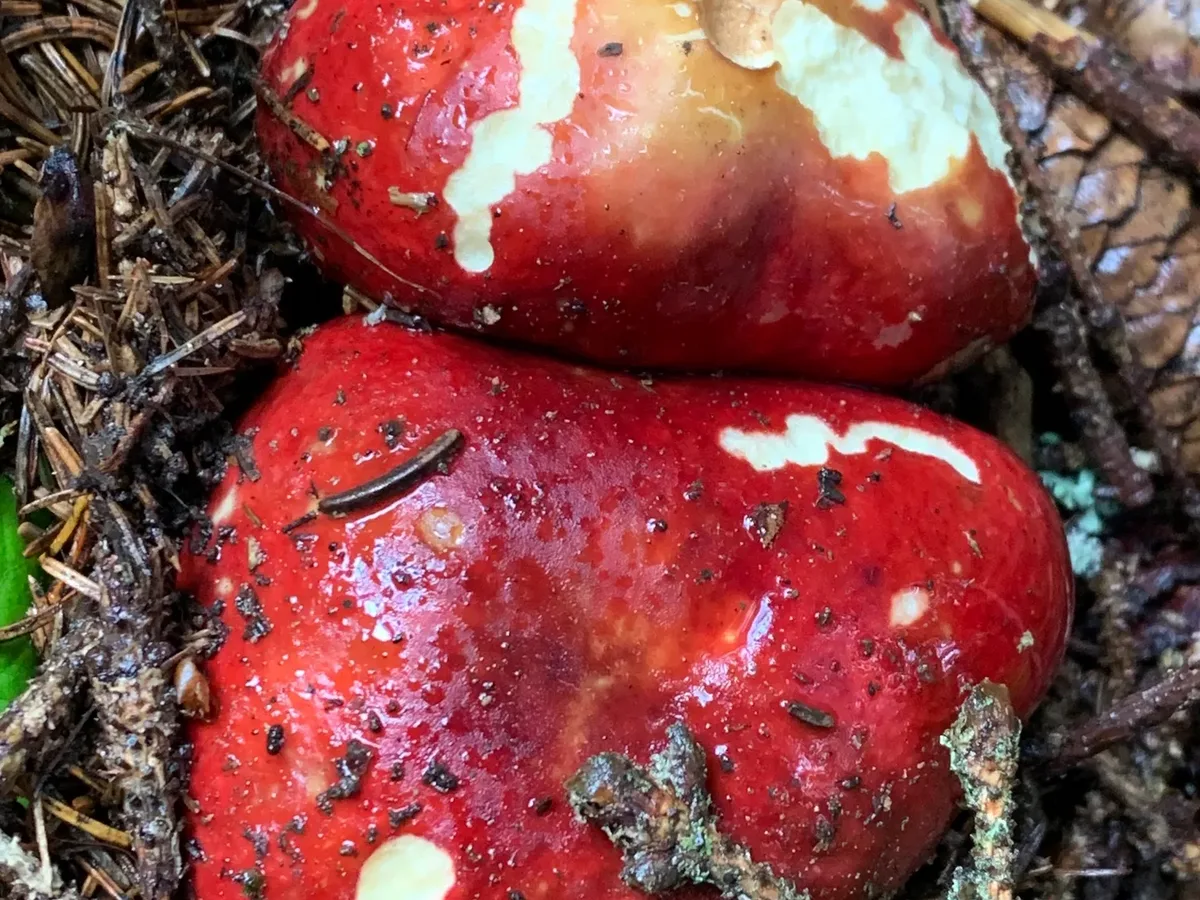
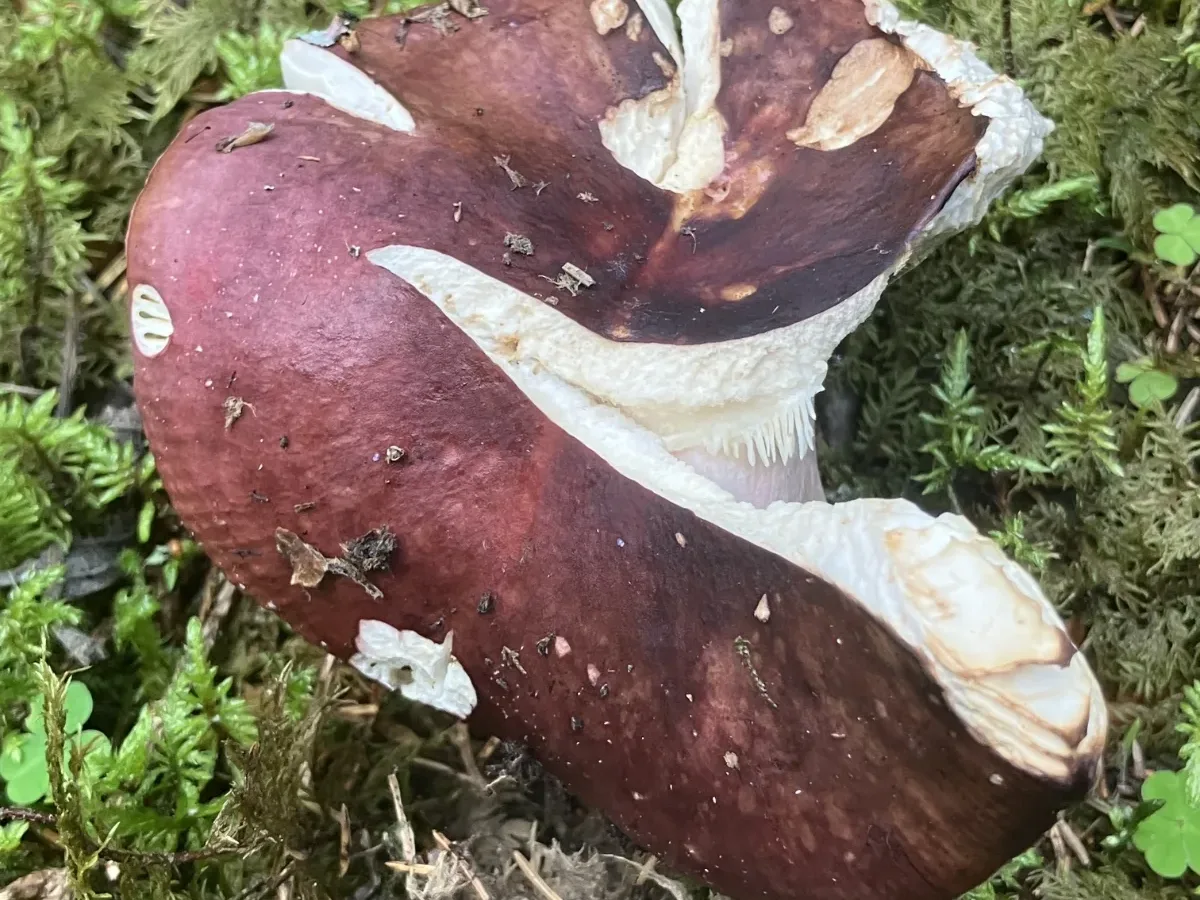
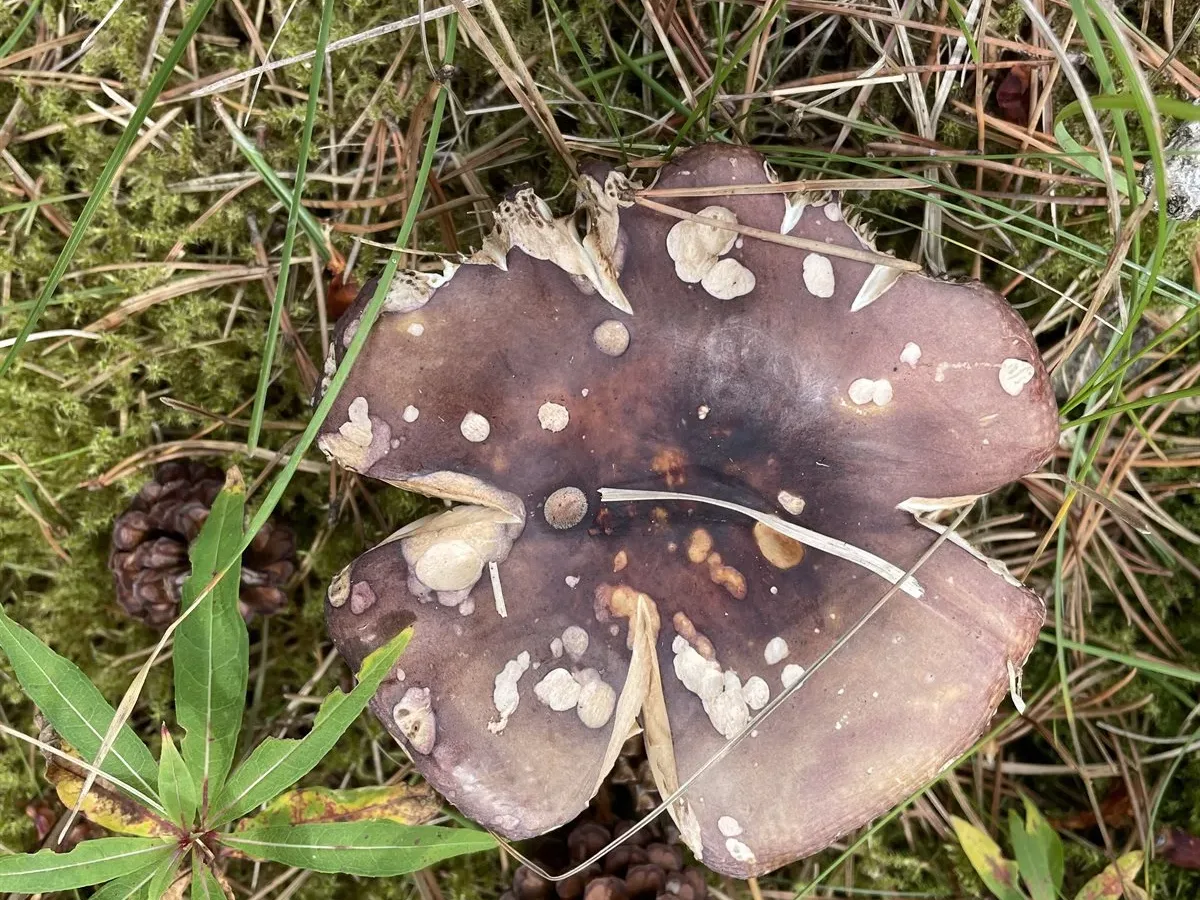
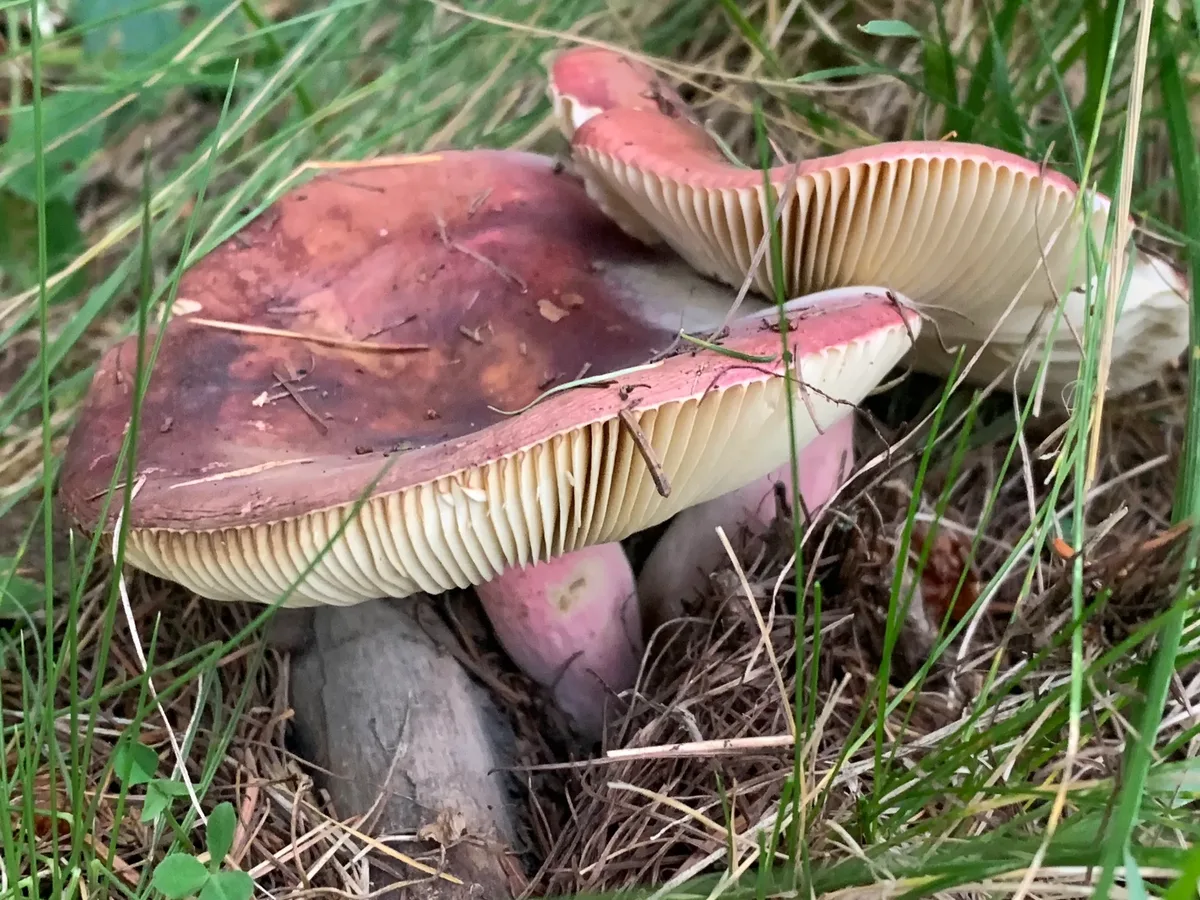
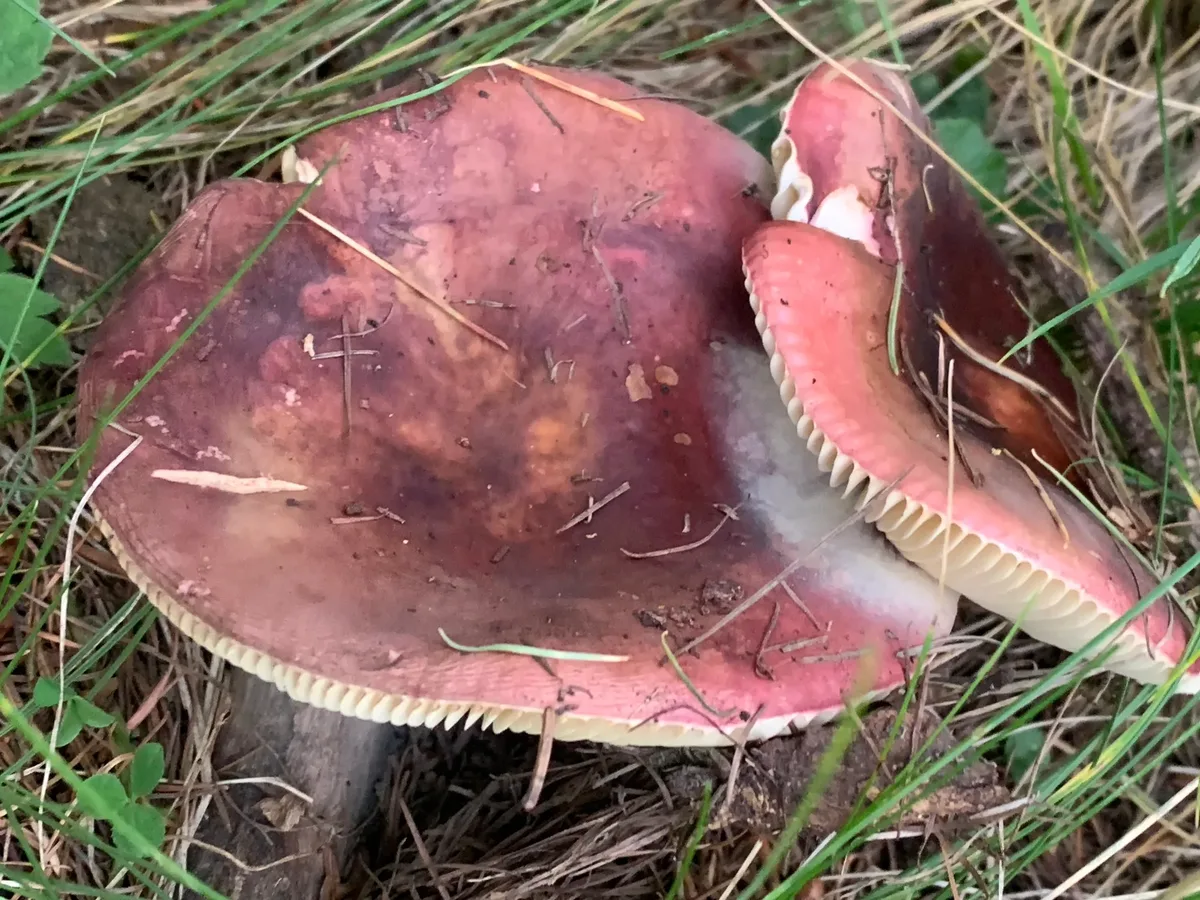
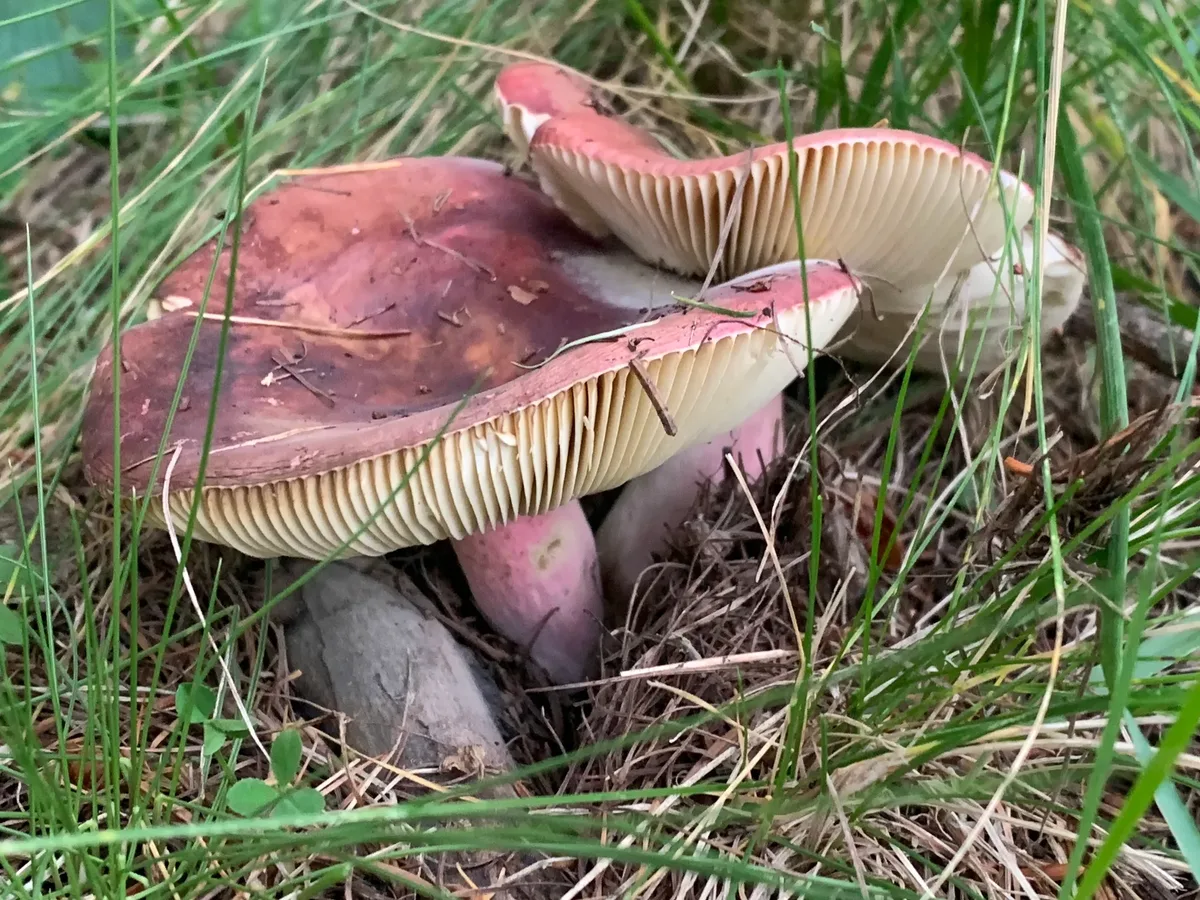
Russula xerampelina is a medium to large brittlegill with some of the most variable colouring in the genus - anything from deep crimson, wine-purple, or dark vinaceous to pinkish-buff or brownish-olive can turn up within the same stand of trees.
Cap
The cap (5-12 cm) opens convex and gradually flattens, sometimes becoming shallowly funnelled with age. The surface is smooth and slightly greasy in rain, and the cuticle peels fairly easily from the margin inward by up to half the radius.
Gills
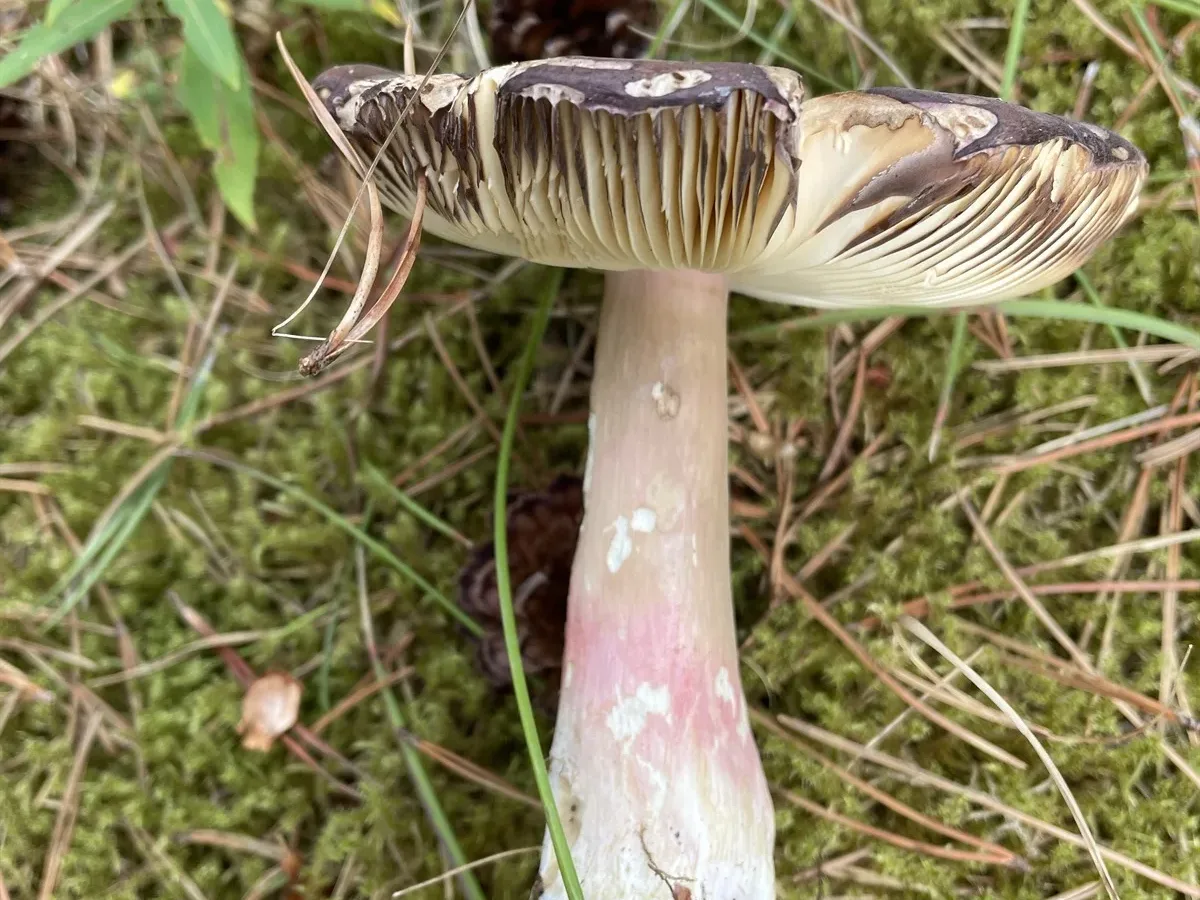
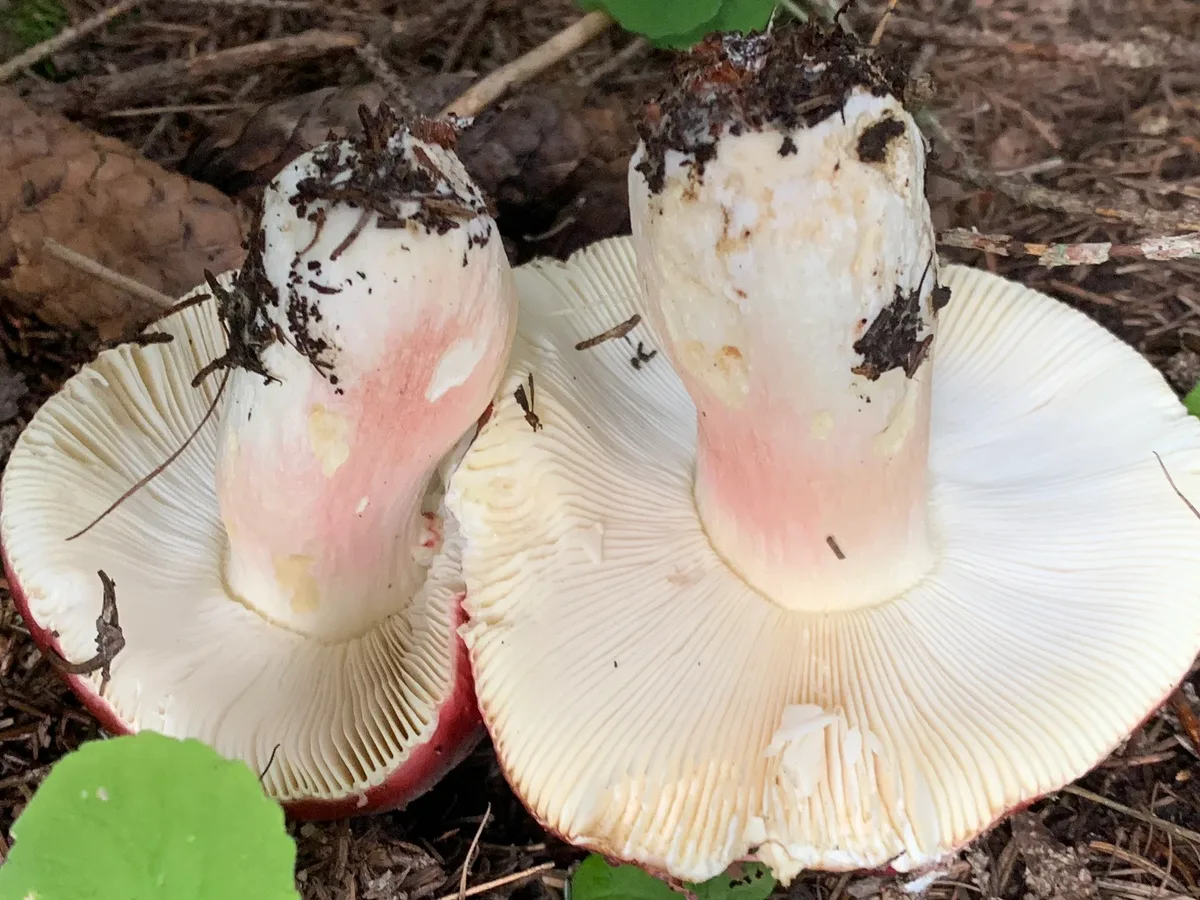
The gills are pale cream to distinctly pale ochre-yellow - noticeably yellower than in most red-capped russulas - broad, moderately crowded, and occasionally spotted rusty in older specimens.
Stem
The robust stem (4-9 × 1.5-2.5 cm) looks white externally, but cut it at the base and wait 30-60 seconds: the flesh turns yellow-ochre to brownish-ochre, a reaction so consistent it is one of the most trustworthy field diagnostics in the whole genus.
Flesh
The flesh itself is white and firm, with the chalky-brittle texture characteristic of all russulas.
Smell & taste
Then there is the smell. The odour of fresh cooked crab or shrimp - unmistakable once encountered - strengthens as the mushroom dries or ages, and it is what gives the species every one of its common names in every language.
The spore print is pale ochre (cream-yellow).
Where & when it grows
Habitat
Russula xerampelina is a mycorrhizal forest species tightly bound to conifers. It lives as an underground partner with the roots of spruce and pine, trading mineral nutrients for the tree's sugars in a relationship that may persist for many years beneath the forest floor.
In Europe it favours Norway spruce (Picea abies) and Scots pine (Pinus sylvestris), colonising boreal and montane forests on acidic, humus-rich to sandy soils, especially where the bilberry-moss understory typical of Scandinavian spruce forest is well established.
Look for it on slopes and flatter ground where moss coverage is good, often near paths, and in mixed spruce-birch or pine-birch woodland. It is rarely if ever found far from conifers, even when growing superficially beneath a broadleaf canopy.
Across North America the species (or its close relatives) grows under a range of conifers including Abies and various Pinus and Picea species.
When
The crab brittlegill fruits from mid-July through to the first hard frosts, with a reliable peak from late August through October in boreal and temperate Europe.
It is one of the dominant Russula species in productive spruce forests after warm, wet late-summer weather. In Scandinavia it is a cornerstone of the autumn mushroom season.
The season may extend into November in milder maritime Atlantic climates.
How it grows
Fruitbodies appear singly or in small groups scattered across the forest floor among moss and leaf litter. The mycelium lives unseen underground, sometimes for many years, before sending up mushrooms when conditions are right.
After substantial rain followed by warm days (soil temperature roughly 8-16 °C), flushes can be prolific.
The caps often push up still partly buried in moss, and the deep red colour peeping through the green is one of the more satisfying things to spot on an autumn walk through spruce forest.
Fruiting conditions
Flushes reliably after warm late-summer or early-autumn rains when soil temperature has dropped into the 8-15 °C range. In Scandinavia this typically aligns with August-September rains following the first cooler nights. Like most boreal Russula species it is sensitive to soil drying and does not persist well through drought.
Look-alikes
The most important lookalikes are other red-capped Russula species, but Russula xerampelina is distinguished by the unique combination of:
- 1powerful crab/shrimp odour
- 2stem flesh turning yellow-ochre when cut or bruised
- 3pale ochre (cream-yellow) spore print
Russula emetica (sickener) has a white spore print, no shellfish odour, white non-staining stem, and a hot acrid taste.
Russula nobilis/mairei has white gills and white spore print, is beech-associated, and lacks the shellfish smell.
Russula badia (smells faintly of cedar or fruity, bitter taste) and Russula sardonia (very acrid, stem flushed lilac-violet) lack the seafood odour and stem staining.
Russula erythropoda is closely related and may be a variant or synonym.
Young Amanita muscaria buttons can appear reddish and egg-shaped. They always have white universal veil patches or fragments, develop a ring on the stem, and have a volva at the base - none of which is present in Russula - and must not be eaten.
The critical test: cut the stem base, wait 60 seconds, and smell. If the flesh turns yellow-ochre and smells of shellfish, identification is reliable.
Cortinarius rubellus and related deadly webcaps grow in conifer forests, can show reddish-brown to tawny-red caps, and may superficially resemble a Russula at a glance. They have a cobweb-like cortina veil on young specimens, rusty-brown gills (not cream-ochre), rusty-brown spore print, fibrous (not chalky-brittle) flesh, and no shellfish odour. They contain orellanine, a deadly kidney toxin with delayed onset of 2-3 weeks. Never eat a reddish forest mushroom without confirming the Russula triple test: shellfish smell + yellow-ochre stem staining + pale ochre spore print.
Russula nobilis (syn. R. mairei) grows strictly under beech, has white gills, white spore print, acrid taste, no shellfish smell, and stem flesh that does not stain yellow-ochre. Causes gastrointestinal upset.
Russula nigricans has widely-spaced gills, flesh that turns red then black when cut (not yellow-ochre), white spore print, and no shellfish odour. Inedible.
Russula badia has a faint cedar or fruity odour (not shellfish), very bitter taste, pale ochre spore print, and stem flesh that does not turn yellow-ochre. Inedible due to bitterness.
Young button-stage Amanita muscaria can appear reddish and egg-shaped in the ground. It always has a universal veil (white cottony patches on the cap and volva remnants at the stem base), develops a ring on the stem, and has free white gills. Cut open, the interior is uniform white without any yellow-ochre staining and has no shellfish smell. Toxic and must not be eaten; a poisonous species capable of causing serious illness.
Russula sardonia has a strong acrid taste, yellowish spore print, and stem flesh often flushed lilac-violet. Found under pine. No shellfish odour; stem does not stain yellow-ochre. Inedible.
Russula emetica has a pure white (not ochre) spore print, bright white gills, white stem flesh that does not stain yellow-ochre when cut, a strongly acrid-hot taste, and no shellfish odour. It grows predominantly under conifers on boggy ground. Causes gastrointestinal illness if eaten.
In the kitchen
Picking & cleaning
Select young to middle-aged specimens before the gills show heavy ochre spotting and before the flesh has begun to soften.
The cap should be firm and the shellfish odour fresh and prominent - a stale or ammoniacal smell is a sign the mushroom is past its best.
Cut cleanly at the base with a knife; the stem base staining yellow-ochre confirms your identification on the spot.
Avoid pale, bleached, or very old individuals that may be harder to distinguish from confusable species. The firm flesh transports well in a basket.
As with all Russula species, never mix with unknown or unconfirmed species in the same container.
Cooking
The crab brittlegill has a mild, pleasant flavour with a subtle seafood nuance that deepens on cooking. The firm, brittle flesh holds its shape moderately well in heat.
It is best sautéed in butter or olive oil over moderate-high heat until golden; the shellfish character pairs well with garlic, parsley, cream sauces, and pasta.
It combines well with other forest mushrooms in mixed dishes, works nicely in risotto, and makes a good mushroom soup.
- Drying concentrates the crab aroma markedly, and dried powder makes an interesting seasoning.
- Blanching and marinating in vinegar is also traditional in some Nordic and Eastern European kitchens.
Avoid prolonged boiling as the flavour disperses into the cooking liquid.
Good to know
Russula xerampelina is considered a safe, edible species when correctly identified, but the genus Russula contains several species that cause gastrointestinal illness (e.g., Russula emetica, Russula subnigricans). Never rely on colour alone.
The triple test must all be confirmed before consuming:
- 1shellfish odour
- 2ochre-staining stem flesh
- 3pale ochre spore print
If any one character is absent or uncertain, do not eat the specimen.
Always cook thoroughly; Russula species should not be eaten raw.
A reference guide - never an edibility guarantee. When in doubt, leave it out.