Wine brittlegill
Russula vinosasyn. Russula obscura, Russula obscura (Romell) Peck
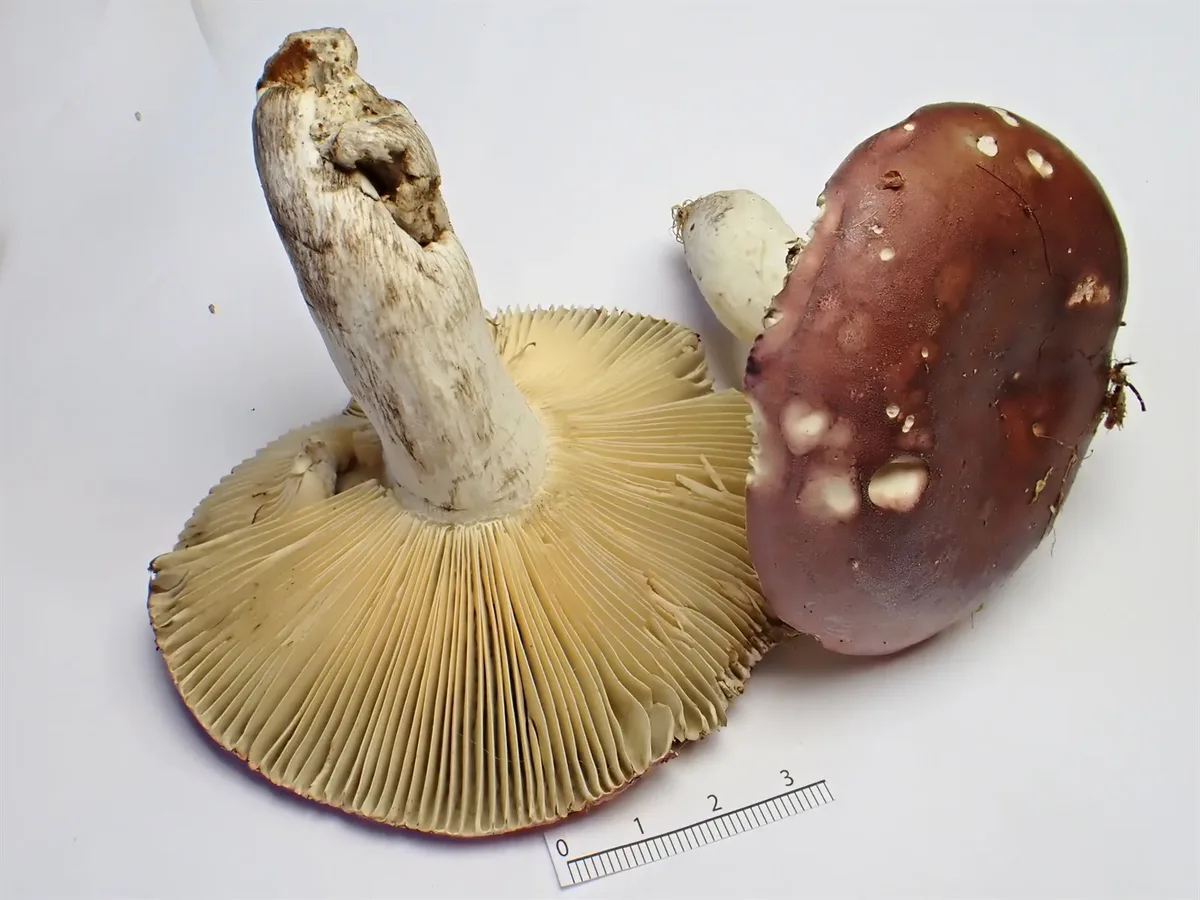 © Inger-Lise Fonneland (CC BY)
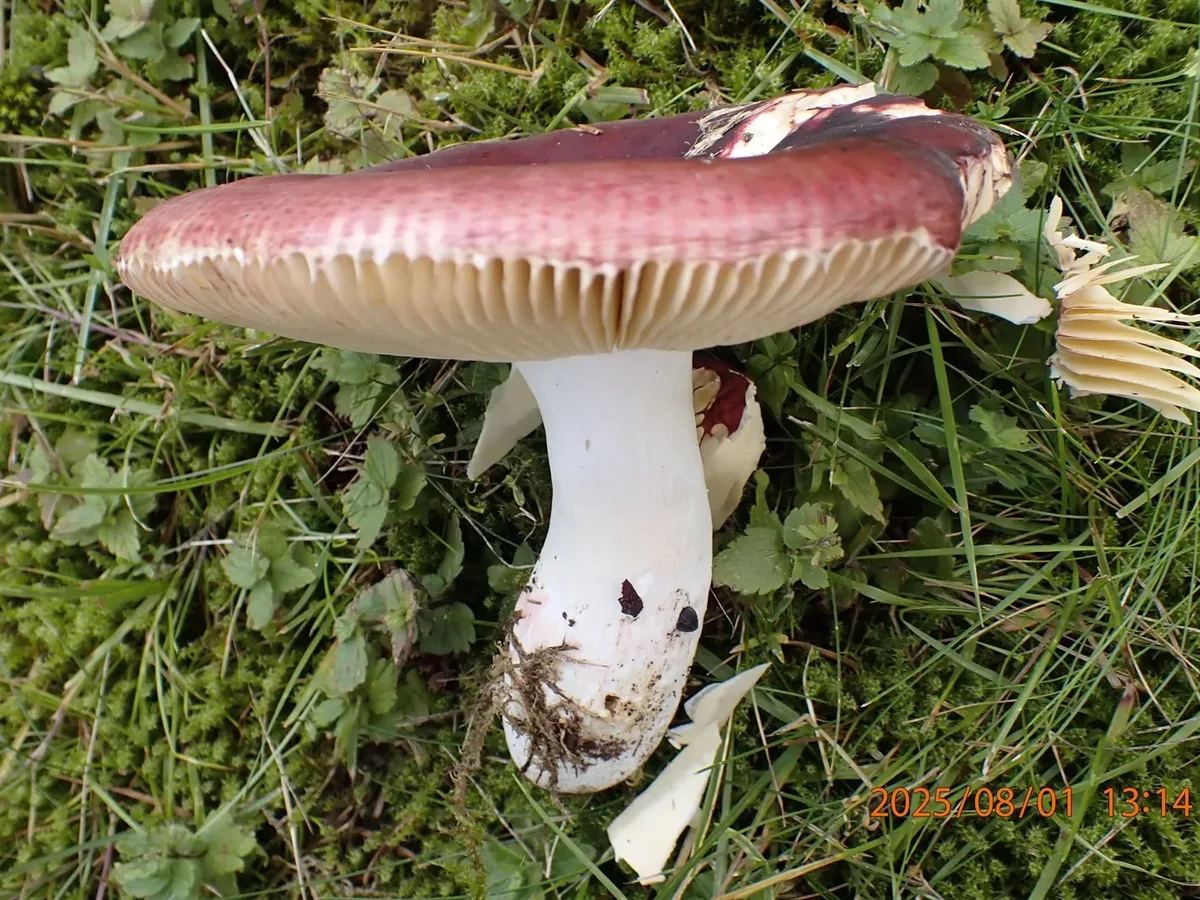 © Tove Jacobsen (CC BY)
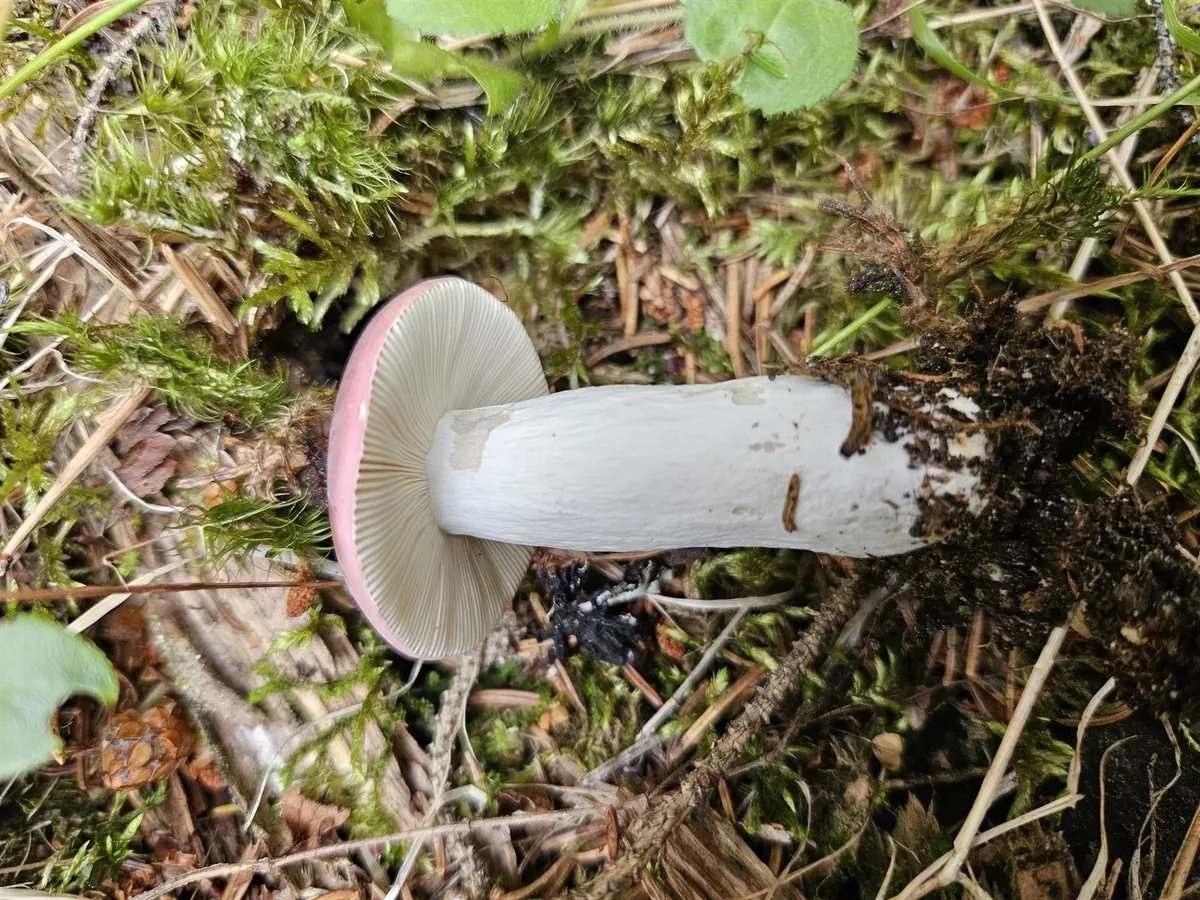 © Bente Rian (CC BY)
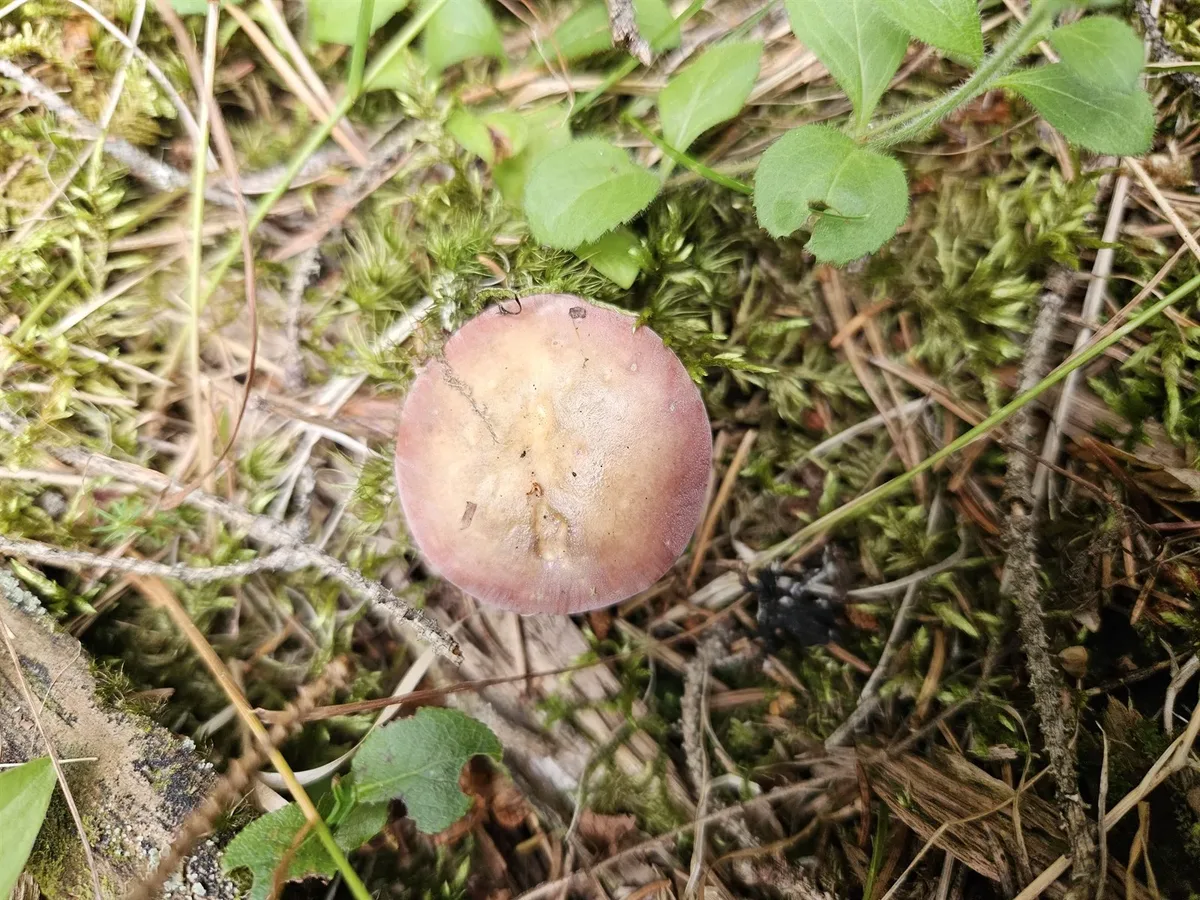 © Bente Rian (CC BY)
 © Ulrik Andreassen (CC BY)
 © Hans Andreas Sagstuen (CC BY)
 © Hans Andreas Sagstuen (CC BY)
 © Tove Jacobsen (CC BY)© Inger-Lise Fonneland (CC BY)© Tove Jacobsen (CC BY)
Good to eat, once you have identified it with certainty and cooked it through.
Never eat a mushroom you are not 100% sure of - check the look-alikes below, and always cook wild mushrooms.
How to recognise it
Russula vinosa is a medium to large brittlegill recognised by its combination of dark wine-red to purplish-brown cap, white flesh that slowly grays to blackish when cut, and strictly mild (non-acrid) taste.
Cap
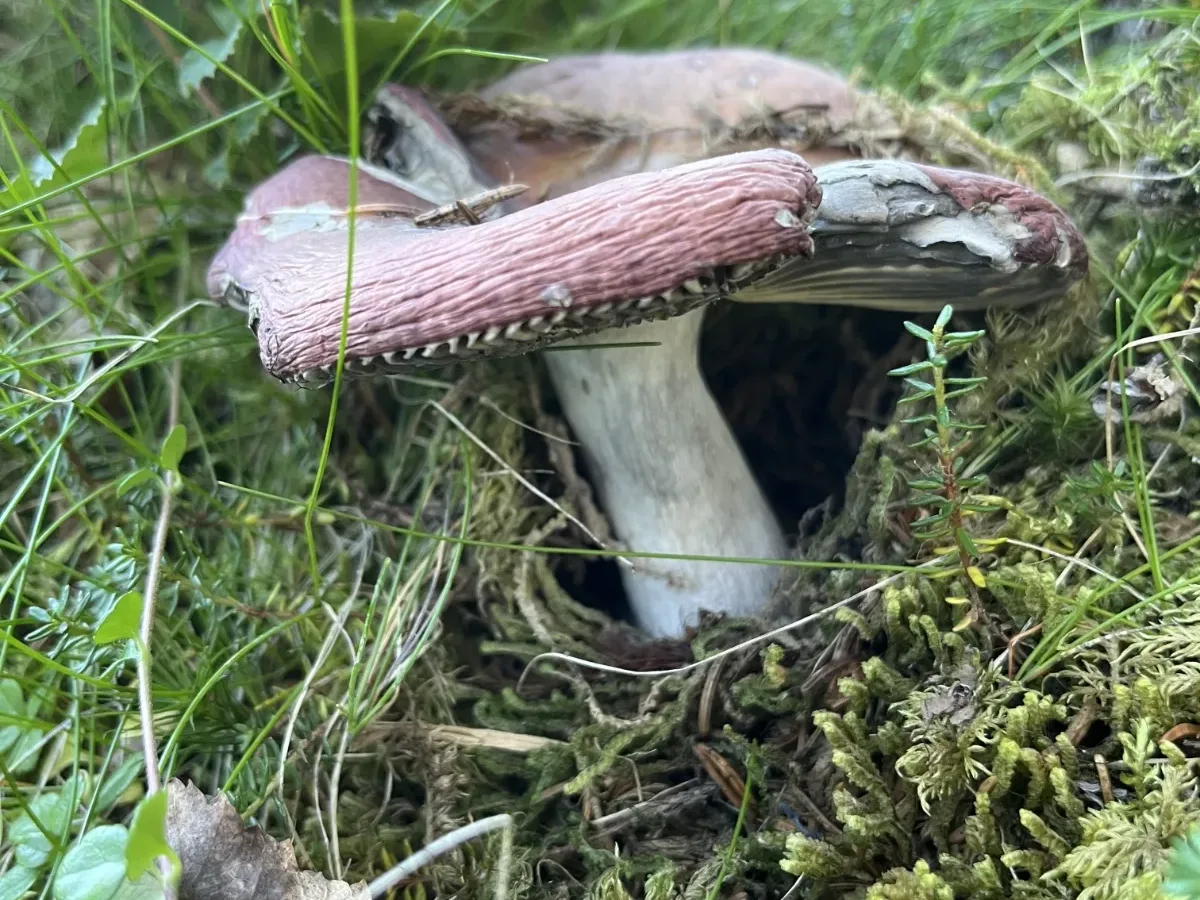
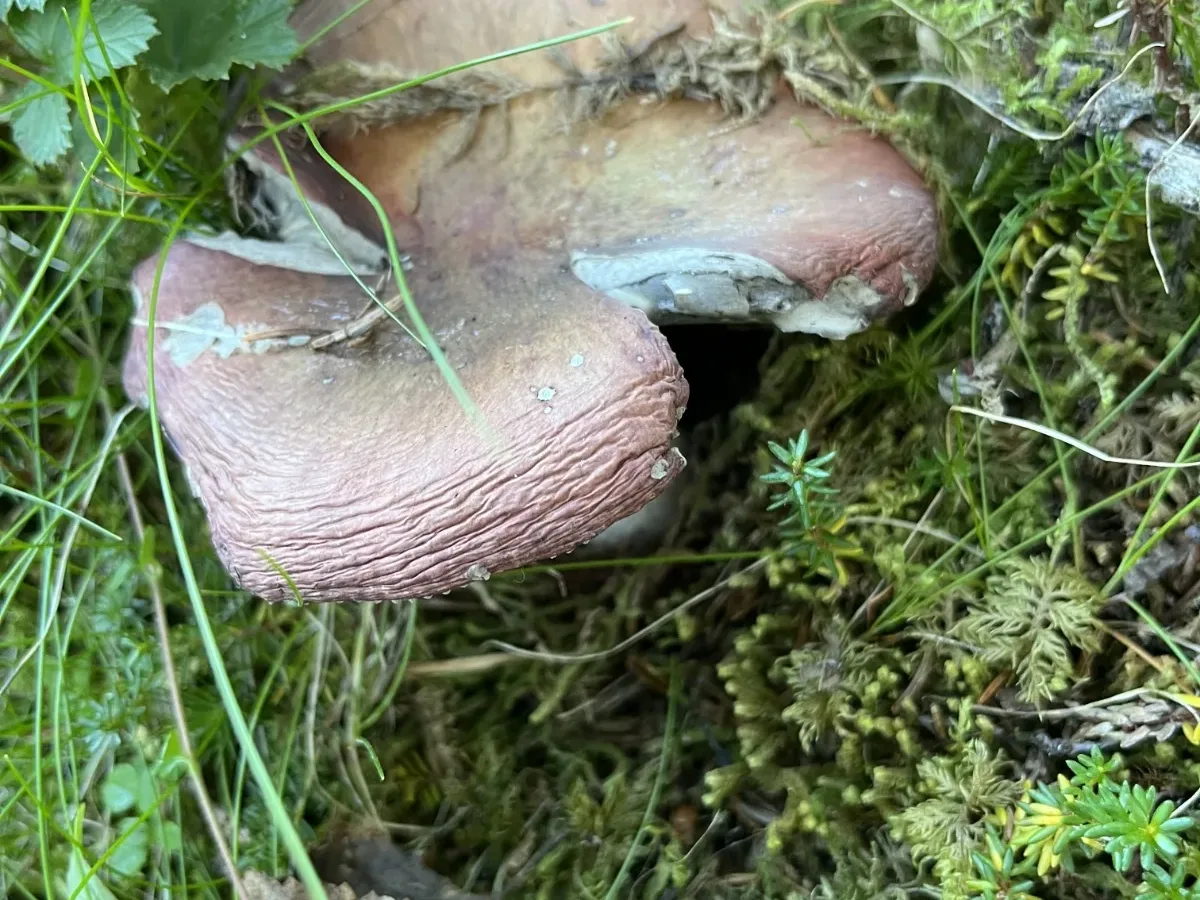
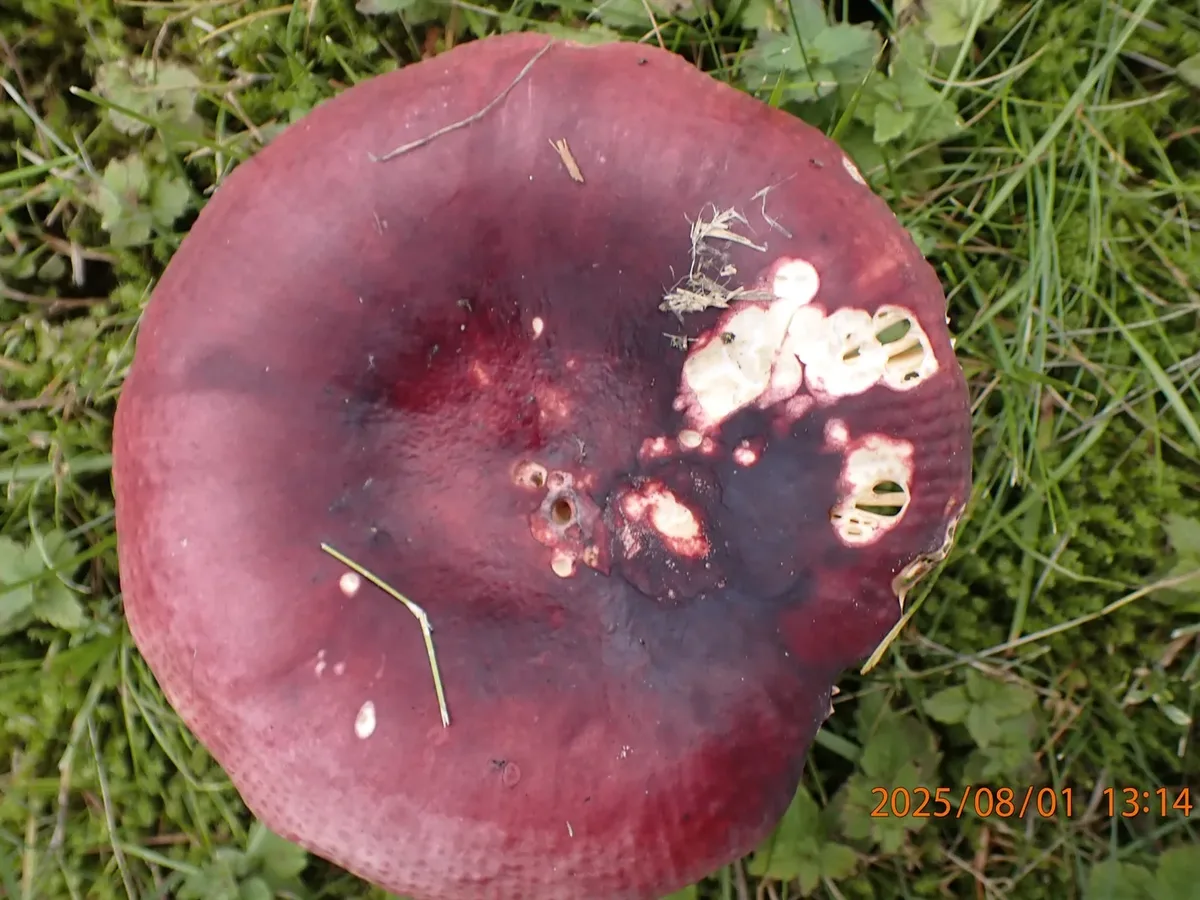
The cap (5-10 cm) opens convex and broadens to a shallow funnel shape. The colour ranges from deep vinous purple through dark reddish-brown and sometimes olive-brown toward the centre; the margin may be slightly paler reddish.
The cuticle is slightly greasy in wet weather and peels readily from the margin inward for about a third of the radius.
Gills / Pores
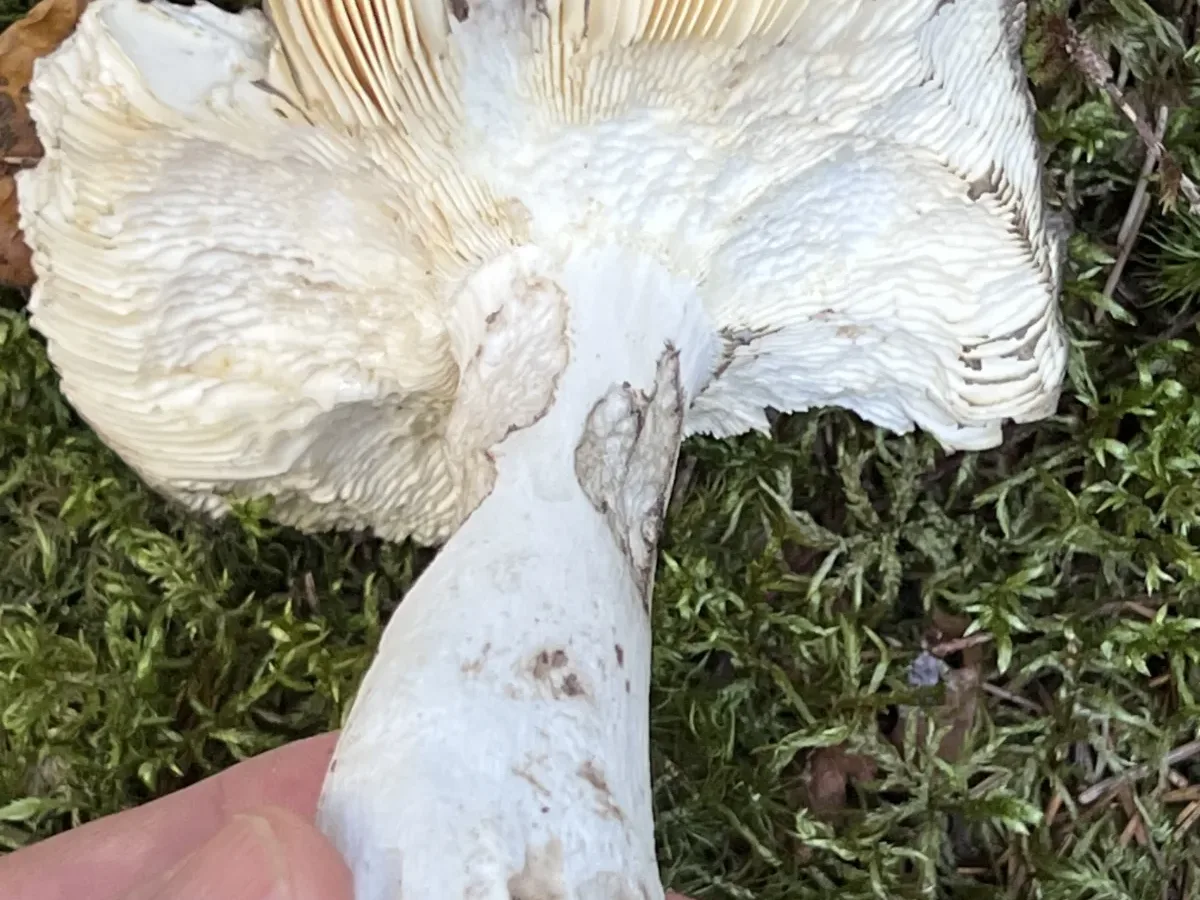
The gills are adnate, white to cream, becoming pale ochre as spores mature, and are brittle in the characteristic Russula manner - they snap cleanly rather than bending or stringing.
Spore print pale cream to pale ochre (Romagnesi IIa-IIb).
Stem
The stem is white to ivory, often flushed very faintly pinkish, stout and cylindrical, with no ring, no skirt, and no volva at the base - absence of these structures is essential to separate it from dangerous Amanita species.
Flesh
The flesh is white and firm in youth, becoming spongy in age, and critically it turns grey and then greyish-black when cut, within roughly 15-30 minutes.
This graying-to-black reaction, while dramatic in appearance, is an entirely harmless enzymatic oxidation analogous to a cut apple browning.
Smell & taste
Smell mild and faintly pleasant; taste mild throughout - not peppery, not acrid, not bitter.
Where & when it grows
Habitat
R. vinosa is a specialist of boreal and montane conifer-dominated forest.
Its primary ectomycorrhizal partners are Norway spruce (Picea abies) and Scots pine (Pinus sylvestris). It also associates with Siberian spruce and silver fir in more easterly or montane settings, and occasionally with downy birch where birch co-occurs with spruce.
Look for it in mature, closed-canopy spruce and spruce-pine forest with a mossy, bilberry-rich ground layer and slightly acidic, moist (but not waterlogged) soils.
It often fruits at the base of old spruce trunks, in moss-covered hollows, or along the edges of forest bogs.
In Fennoscandia it is a characteristic and fairly common species of the boreal forest zone; it becomes more scattered and montane in the Alps and Carpathians.
When
R. vinosa is a mid-to-late summer and autumn species.
In Fennoscandia it typically begins appearing in late July, peaks through August and September, and can persist into October.
It broadly coincides with the main boreal mushroom season - the same conditions (cool soil temperatures, residual summer moisture) that bring boletes and chanterelles also bring this species.
In alpine zones fruiting may be compressed into August and early September.
How it grows
Solitary to scattered, rarely clustered, always in association with ectomycorrhizal host conifers.
Young buttons emerge as rounded, dark purplish spheres, almost black before the cap expands.
Growth is moderately paced; fruiting bodies take several days to fully expand and may persist 1-2 weeks in cool conditions before softening and collapsing.
Not typically gregarious, though multiple specimens may appear within a few square metres when conditions are right.
Fruiting conditions
Standard boreal mycorrhizal Russula fruiting trigger: at least 20 mm rainfall over the preceding two weeks combined with soil temperatures in the 8-17 °C range, with a flush lag of 7-16 days. In sheltered spruce forest the soil moisture is buffered, so fruiting can continue into drier late-summer periods longer than in open sites.
Look-alikes
Several species can be confused with R. vinosa; one of these (Amanita phalloides) is potentially deadly, though the structural differences are decisive once known.
The most important comparison is with Amanita phalloides (Death cap). In some forms the death cap has an olivaceous-brown to brownish-purple cap that can superficially resemble a dark Russula, especially at a quick glance.
The death cap ALWAYS has a membranous ring on the stem and a cup-like volva at the stem base (dig up the whole mushroom to check). Its gills and flesh are white and do NOT blacken; the flesh is fibrous, not brittle - it can be pulled into strands. A Russula has NONE of these structures.
Among Russula species, the most similar are:
- Russula atropurpurea (Purple brittlegill) - cap very dark purple-black, slightly acrid taste, also mild forms exist, but no graying reaction in fresh flesh; found under deciduous trees especially oak and beech rather than conifers.
- Russula firmula - cap dark purple to brownish-purple, under spruce; flesh does not gray, mild to slightly acrid.
- Russula torulosa - cap dark purple-red, firm, under pine; flesh does not gray; taste acrid to mild; potentially toxic in large quantities raw.
- Russula decolorans (Copper brittlegill) - cap copper-red to orange-brown rather than vinous purple; flesh also grays to black; under spruce; edible.
The graying reaction combined with the dark wine-red to purple cap and conifer forest habitat is the key cluster for confident identification of R. vinosa.
The death cap always has a membranous ring on the stem and a cup-like volva at the base - dig up the whole mushroom to check the base. Its flesh is white, does NOT blacken, and is fibrous (can be pulled into strands). A Russula has no ring, no volva, and crumbles brittlely. Never collect a dark-capped mushroom without checking the stem base.
Cap copper-orange to brick-red, rarely as dark-purple as R. vinosa; flesh also grays to blackish; under spruce on drier acidic ground; spore print deeper ochre. Also edible. Distinguish by cap colour (copper/orange vs wine-red/purple) and spore print shade.
Milkcaps exude a milky or watery latex from broken gills or flesh - Russula produces no latex at all. If you see any liquid ooze when a gill is snapped, it is not a Russula.
Cap dark purple-red to purplish-mauve, often with a bloom; primarily under pine; flesh does NOT gray; taste often distinctly acrid to bitter; spore print cream to ochre. Acrid forms should not be eaten. Absence of the graying reaction and bitter-acrid taste separates it from R. vinosa.
Cap very dark purple to almost black, occasionally with brownish centre; found under oak and beech, not conifers; flesh does NOT gray on cutting; taste often slightly acrid. Not edible. Habitat difference (deciduous vs conifer) is the clearest field distinction.
In the kitchen
Picking & cleaning
Cut at the base with a knife rather than pulling, to preserve the mycelium.
Before collecting, perform the standard Russula field tests:
- 1Break the stem - it should crumble or snap cleanly without stringing into fibres (if fibres form, it is NOT a Russula).
- 2Press the gills - they should break brittlely like chalk.
- 3Taste a tiny piece of raw cap and spit it out - if the taste is mild or very slightly sweetish, the species is edible; if it burns or is acrid, leave it.
For R. vinosa specifically, look for the combination of dark wine-red cap, mild taste, and the graying flesh reaction.
Clean away debris, check for insect larvae in the stem and cap from the base upward - older specimens are often heavily infested. Young to medium-aged specimens are best quality.
Cooking
Trim the base and peel the cap cuticle (it comes off easily). Remove insect-damaged portions.
The flesh is firm in young specimens and holds up well to heat.
- Sauté in butter or oil with garlic and herbs; add to soups, stews, risotto, or mixed mushroom dishes.
- In Scandinavia it is sometimes salted (brined) alongside other robust autumn mushrooms.
- Drying is possible but the brittle texture makes the dried product fragile.
The flesh darkens dramatically when cooked but this is harmless and does not affect flavour.
Flavour is mild and pleasant, best appreciated in combination with more flavourful wild mushrooms rather than alone.
Good to know
Russula vinosa is a good edible with no known toxicity and a long tradition of use in Scandinavia and Finland.
The graying-to-black reaction of the flesh is alarming in appearance but is a harmless enzymatic oxidation. Cooked dishes may show darkened flesh, which is safe but visually distinctive.
The critical safety rule is to confirm you have a Russula (brittle, non-fibrous flesh; no ring; no volva) before eating any dark-capped specimen in the forest - the deadly Amanita phalloides can share a superficially similar cap colour.
- Always dig up the whole fruiting body and verify the absence of ring and volva at the stem base.
- Confirm a mild (non-acrid) taste by nibbling a tiny raw piece and spitting it out; acrid or burning Russulas should not be eaten as they cause gastrointestinal distress.
R. vinosa specifically must show the mild taste, the wine-red to purplish cap, and the flesh-graying reaction for a confident ID.
A reference guide - never an edibility guarantee. When in doubt, leave it out.