Bloodred brittlegill
Russula sanguinariasyn. Agaricus sanguinarius Schumach., Russula sanguinaria (Schumach.) Sacc.
 © Björn Sothmann (CC BY-SA)
 © Allar Antson (CC BY-SA)
 © Björn Sothmann (CC BY-SA)© Björn Sothmann (CC BY-SA)© Allar Antson (CC BY-SA)
Edible only with the right preparation - or safe for some people but not others. Learn the caveats first.
How to recognise it
Cap
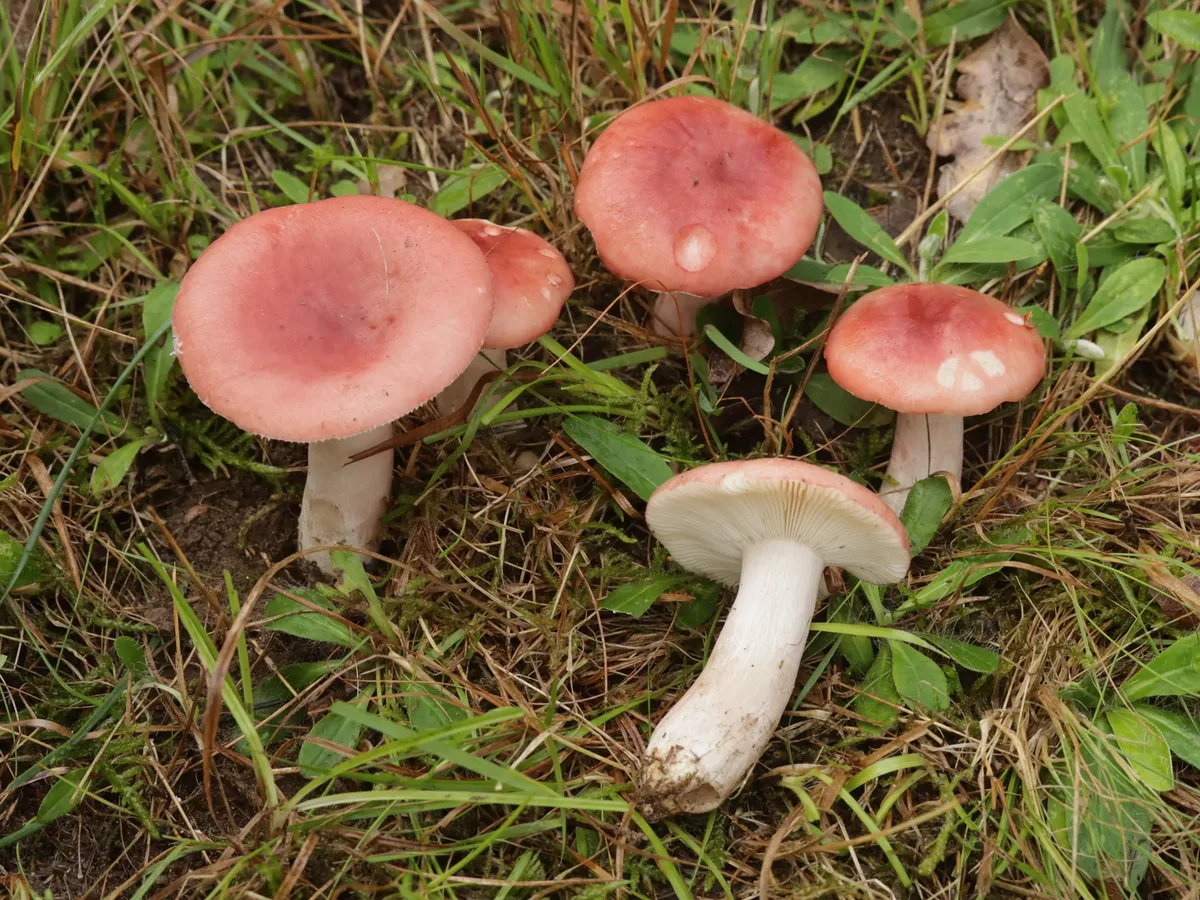
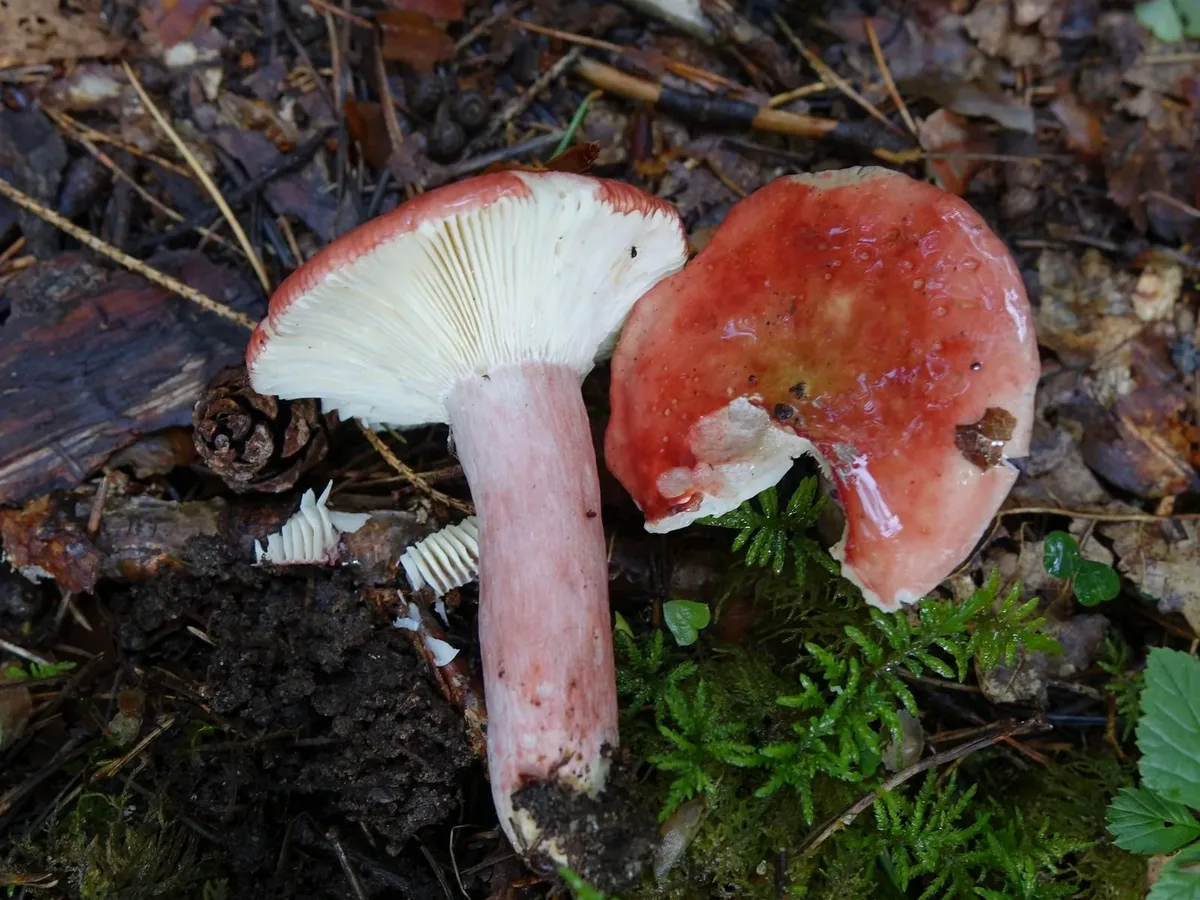
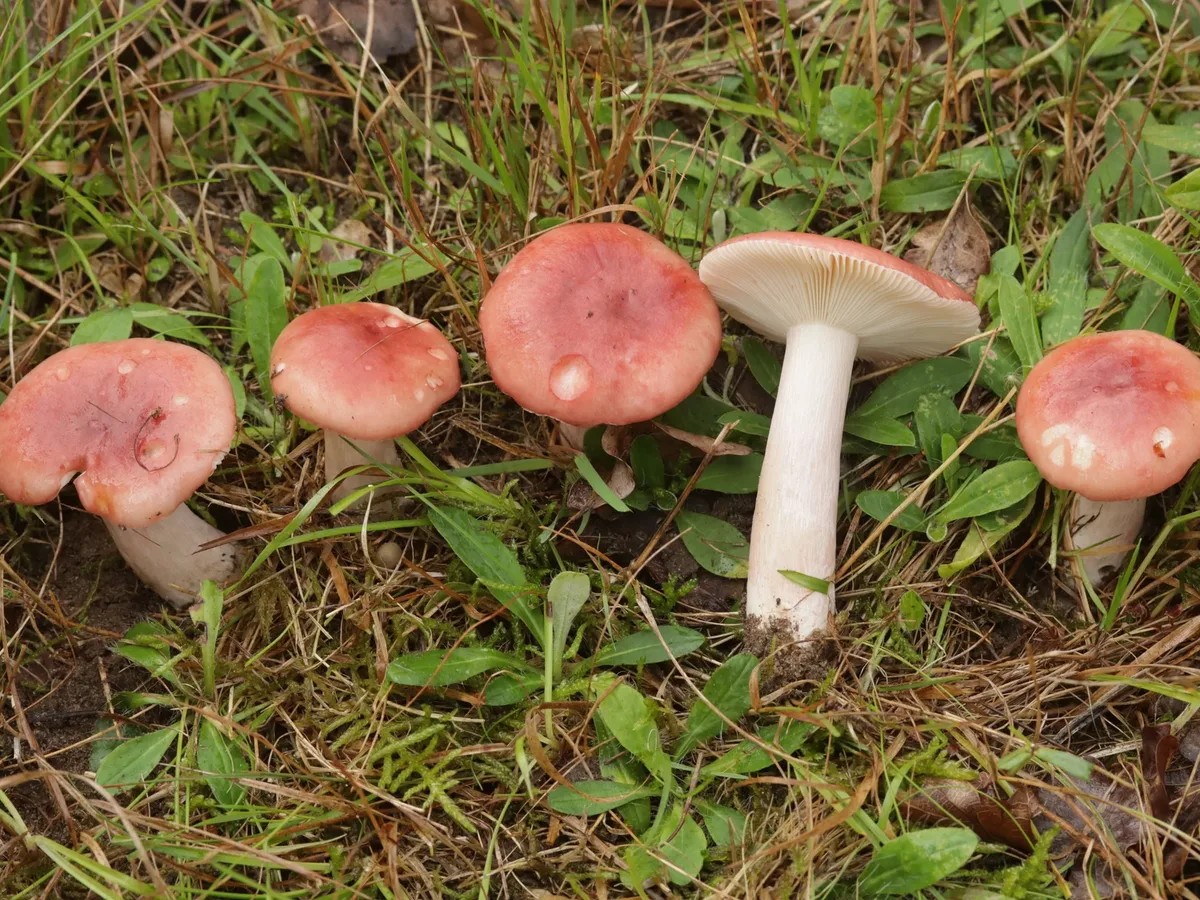
Russula sanguinaria announces itself with a saturated blood-red to deep crimson cap, 4-10 cm across, that stands out vividly against the brown needle duff of conifer forest.
The cap begins convex, flattens, and becomes shallowly funnelled with age; the surface is smooth and slightly tacky when wet.
Colour can fade toward the margin in wet conditions or in old specimens, shifting to salmon or pale pinkish-red.
The cuticle peels about one-third of the way from the margin toward the centre - a helpful structural confirmation when establishing genus.
Gills
Underneath, the gills are white to pale cream, moderately crowded, brittle, and snap cleanly without bending - the chalk-like gill texture is the defining trait of all Russula.
Stem
The stem is white, sometimes flushed pink-red where exposed, firm when young, and carries no ring and no volva at any stage.
Smell & taste
A small piece bitten and chewed reveals the definitive character: the flesh becomes persistently and sharply acrid, burning the tongue like a mild pepper - this acridity, combined with the blood-red cap, puts the identification well within the acrid red Russula group and rules out immediate consumption.
Why it's dangerous
Russula sanguinaria poses a moderate gastrointestinal poisoning hazard. It is not life-threatening to healthy adults under normal circumstances: no fatalities are on record from R. sanguinaria or the wider group of acrid brittlegills, and the toxin mechanism (direct mucosal irritation) does not involve hepatotoxic or nephrotoxic pathways.
However, the experience of being poisoned by it is unpleasant and should not be dismissed.
Children, the elderly, and individuals with compromised digestive systems, inflammatory bowel conditions, or other GI vulnerabilities may experience substantially more severe symptoms than a healthy adult. Vomiting and diarrhoea that are merely uncomfortable for a robust adult can become medically significant in these groups, particularly if fluid and electrolyte losses are not promptly replaced.
The primary mechanism of harm is rapid-onset GI distress (nausea, vomiting, abdominal cramps, watery diarrhoea) beginning within 30 minutes to 2 hours of ingestion, with the main risk being dehydration if fluid intake is not maintained during the symptomatic period.
A secondary and less obvious hazard is the species' role as a distractor: its vivid blood-red colouring makes it conspicuous and visually compelling in conifer forest, and foragers drawn toward it - or who spend time examining red-capped mushrooms in the same patch - may also encounter other species growing nearby.
In the same conifer forest habitat, more dangerous red-capped fungi such as early-stage Amanita muscaria and, in European contexts, certain other Amanita species can occur. Misidentifying a dangerous species as 'just another red Russula' because of visual similarity is a documented error pattern. Always identify every specimen individually and completely, not by proximity to a known species.
If symptoms following ingestion last more than 12 hours, or are accompanied by any neurological signs - confusion, visual disturbance, unusual sleepiness, muscle twitching, or altered consciousness - treat this as a medical emergency. These signs are inconsistent with pure sesquiterpene GI irritation and indicate a different, more serious poisoning from a different fungal species, requiring immediate medical attention.
Toxin
The acridity is produced by sesquiterpene compounds including acrid lactones and related aldehydes present in the cellular sap. Unlike some other poisoning mechanisms, these are direct gastrointestinal irritants rather than delayed-action systemic toxins.
They act on the mucous membranes of the stomach and small intestine, triggering rapid onset nausea and vomiting.
There are no known cases of fatal poisoning from R. sanguinaria or other acrid russulas in otherwise healthy adults.
Symptoms
Onset is rapid, typically 30 minutes to 2 hours after ingestion: nausea, profuse vomiting, stomach cramping, and watery diarrhoea.
Symptoms usually resolve within 6-12 hours with supportive care (fluid replacement). No hepatotoxic or nephrotoxic effects are associated with this toxin group.
If symptoms persist beyond 12 hours or are accompanied by neurological signs, seek medical attention immediately as this would suggest a different, more serious poisoning from a different species.
Staying safe
Russula sanguinaria is poisonous by mouth and must not be eaten.
The acridity signals the presence of sesquiterpene irritants (primarily acrid lactiferous compounds and aldehydes) that cause gastrointestinal upset - nausea, vomiting, abdominal cramps, and diarrhoea - typically within 30 minutes to 2 hours of ingestion.
These compounds are not reliably inactivated by boiling or frying; some traditional preparations (prolonged parboiling with water changes) reduce but may not eliminate the risk.
Symptoms are self-limiting and not life-threatening in healthy adults, but can be severe in children, the elderly, or anyone with a compromised digestive system.
The species presents an additional, more serious hazard as a distraction: its bold colour and russula-type fruiting location in conifer forest brings foragers into an environment where a misidentification of a different mushroom as 'just another red cap' could prove dangerous.
Always excavate the entire stem and confirm the absence of a volva and ring before putting any red-capped conifer-forest mushroom in a basket.
Where & when it grows
Habitat
This species is tied to conifer forest in the Pacific Northwest, growing from the soil within the mycorrhizal root zone of Abies (true firs), Picea (spruce), Tsuga (hemlock) and Pinus.
It cannot grow on dead wood or away from living host trees because the underground mycelium must maintain an active exchange of nutrients with tree roots.
Look for it on acidic, well-drained soils with a deep needle-duff layer, at elevations from sea-level coastal Sitka spruce forest up through montane and subalpine fir zones. In wet coastal drainages it can appear abundantly; in dry interior stands it favours moister north-facing slopes.
When
Fruiting is primarily a late-summer and autumn event triggered by soaking rain after the summer dry spell, once soil temperatures at depth fall below roughly 16 °C.
The first caps typically emerge in late July or August, with the main flush concentrated from late August through October. In mild maritime-influenced sites fruiting may extend into November. Hard frost ends the season abruptly.
Because the species is mycorrhizal, it does not flush on decaying wood or compost - always in the mineral and humus soil of a living conifer stand.
How it grows
Grows singly or in scattered troops on the forest floor, never in tight clusters and never on wood.
Individual caps arise independently over an extended period as conditions fluctuate; a single area under mature firs can produce successive small flushes across several weeks after autumn rains.
The fruit bodies emerge relatively quickly - caps can reach full size within five to seven days of rain.
Fruiting conditions
Mycorrhizal; flushes follow sustained autumn rainfall once summer drought breaks and soil temperatures cool below ~16 °C. Conifer needle duff needs to be well-wetted before caps emerge. Individual caps appear within 5-10 days of soaking rain. Season ends with hard frost.
Look-alikes
- The sickener (Russula emetica) is the closest look-alike within the acrid red Russula group: it shares a blood-red to scarlet cap and acrid taste, but typically has a white stem without any pink flush and grows preferentially under birch or in Sphagnum bogs. The distinction matters little for safety as both are acrid and should not be eaten.
- Russula xerampelina (shrimp mushroom) overlaps in colour range - dark red to wine-purple - but has a characteristic shrimp or crab odour, mild (non-acrid) taste, and turns dark brownish-grey on handling; it is edible and the taste test quickly separates the two.
- Russula sardonia is another acrid red species with a lilac-flushed gills and often a more purple-red cap, growing under pine; also not for eating.
The most dangerous confusion error is mistaking any red-capped mushroom in this habitat for a young Amanita muscaria (fly agaric), which grows in the same conifer forests.
Young fly agarics emerge as egg-shaped buttons with the red cap enclosed in white veil tissue - dig up a putative Russula button and check: a volva (sac or girdled bulb at the base) and a ring on the stem immediately identify an Amanita; a Russula has neither at any growth stage.
A closely related and sometimes confused species, differing mainly in host association (R. sanguinea is more consistently linked to Scots pine and two-needle pines) and subtle spore ornamentation. Both are acrid and not for eating. Some authorities treat the two as conspecific. The distinction is of academic rather than safety significance.
Young fly agarics emerge as white egg-shaped buttons that split to reveal a red cap - in the button stage they can superficially resemble a red-capped forest mushroom. Always excavate the full stem: Amanita has a sac-like volva at the stem base and a ring on the stem; Russula has neither. A. muscaria causes ibotenic acid/muscimol poisoning (delirium, agitation, altered consciousness) - serious but rarely fatal in adults.
Another acrid, pine-associated russula with a dark purplish-red to wine-red cap, but distinctively has gills that flush lilac to pale violet, and a pink-flushed stem. Taste is violently acrid. Also not edible; distinguishable by the lilac-tinted gills and purple-red (not pure blood-red) overall colouration.
Shares deep red to wine-purple cap colours and grows under conifers in the same Pacific Northwest forests. Key differences: R. xerampelina smells distinctly of cooked shrimp or crab (especially when dried or rubbed), its flesh browns and darkens on handling, its taste is mild and non-acrid, and it is edible. A taste test immediately separates them: R. sanguinaria is sharply peppery; R. xerampelina is mild.
Very similar: scarlet to blood-red cap, acrid taste, white spore print, brittle white gills. R. emetica typically has a pure white stem without any pink flush and favours boggy birch or Sphagnum habitats rather than dry conifer forest. Both are acrid and poisonous; the distinction matters for identification study but not for safety - neither should be eaten.
A reference guide - never an edibility guarantee. When in doubt, leave it out.