Romell's brittlegill
Russula romelliisyn. Russula romellii Maire
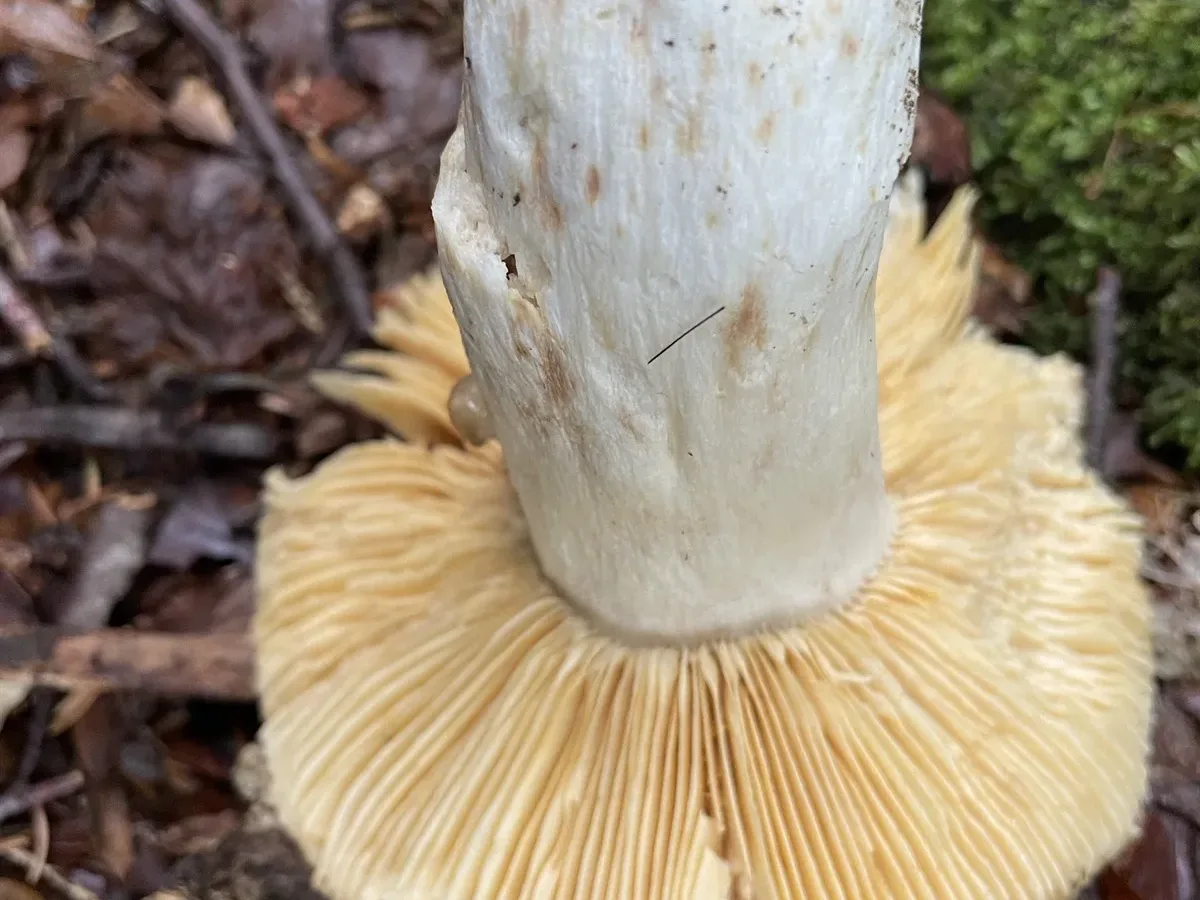 © Bjørn Eidhammer (CC BY)
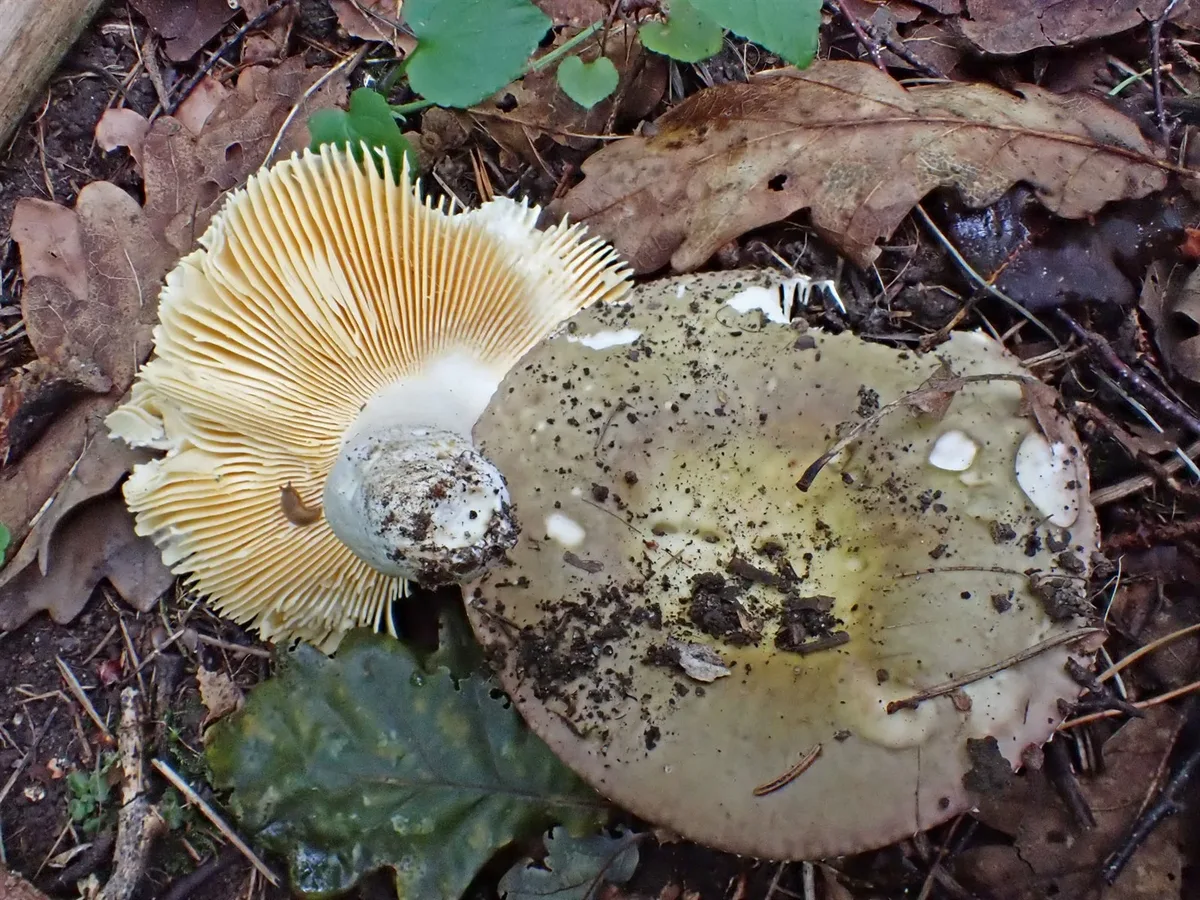 © Inger-Lise Fonneland (CC BY)
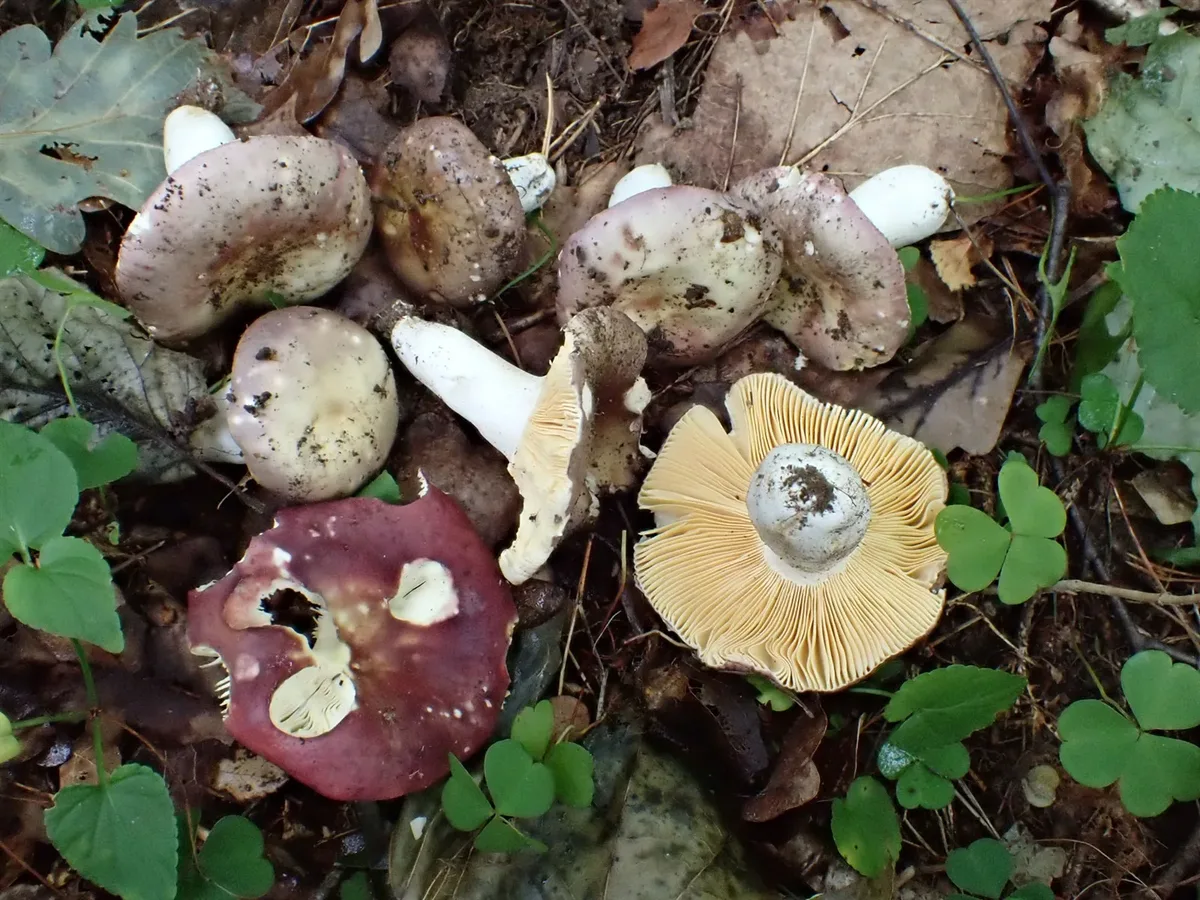 © Inger-Lise Fonneland (CC BY)
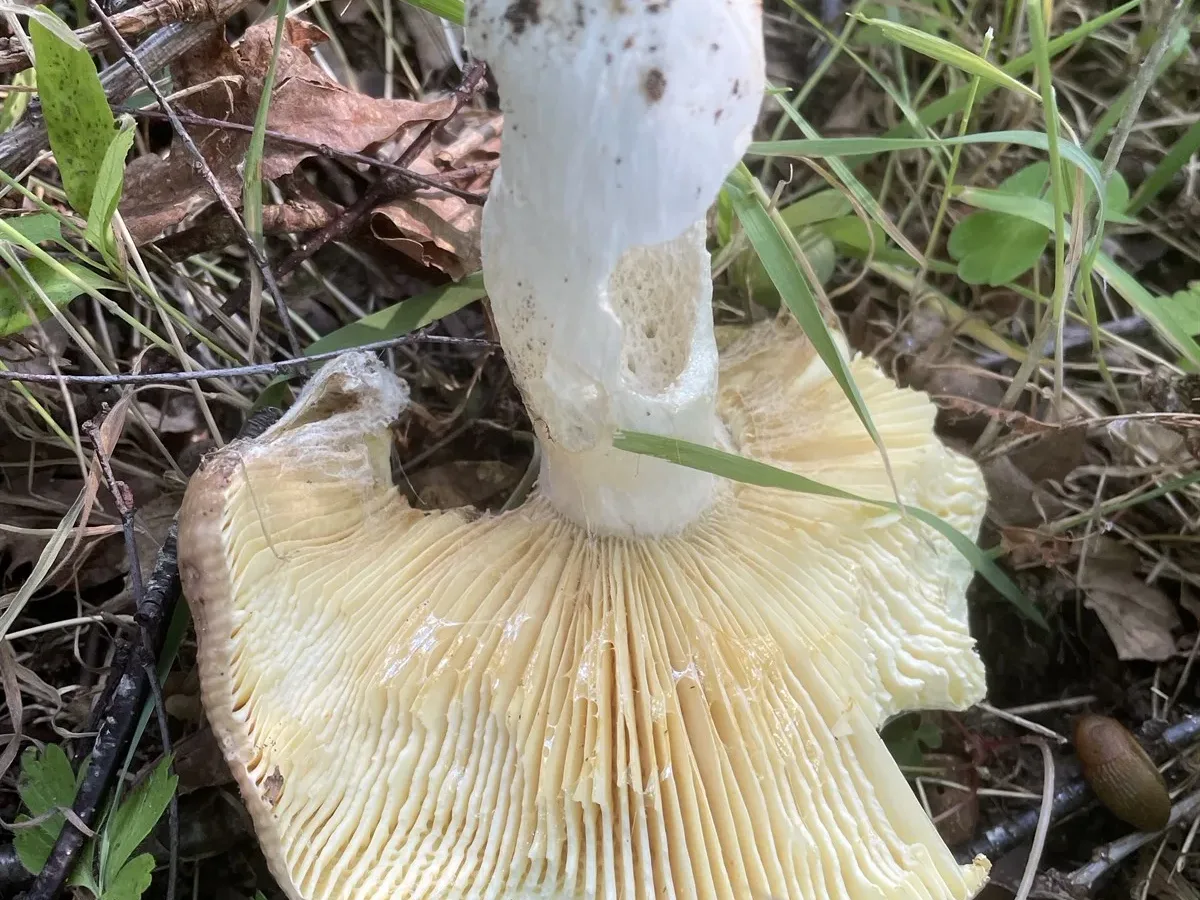 © Bjørn Eidhammer (CC BY)© Bjørn Eidhammer (CC BY)© Inger-Lise Fonneland (CC BY)
Good to eat, once you have identified it with certainty and cooked it through.
Never eat a mushroom you are not 100% sure of - check the look-alikes below, and always cook wild mushrooms.
How to recognise it
Russula romellii is a robust, medium to large brittlegill distinguished primarily by its deep wine-red to purplish-vinaceous cap and its consistently mild taste.
Cap
The cap (6-12 cm) begins broadly convex and expands to flat or shallowly depressed; the cuticle is smooth, slightly sticky in wet conditions, and easily peeled inward for up to half the cap radius, a useful check for the genus.
The dominant colour is deep vinaceous-red or purplish-red, richest at the margin, often fading in older or weather-exposed specimens to dull rosy-flesh or pinkish-ochre at the centre while the edge retains colour - creating a subtly two-toned appearance.
This fading pattern is diagnostically useful because acrid purple Russulas (such as R. atropurpurea) tend to retain colour more uniformly.
Gills
The gills are white then pale cream-yellow, brittle and crumbling if pressed rather than bending flexibly.
Stem
The stem is white, solid when young, and firm to the touch; it does not discolour when handled.
Flesh
Flesh is white throughout, does not change colour when cut or on prolonged exposure to air.
Spore print is pale cream to light ochre.
Smell & taste
The smell is mild and pleasant, sometimes with a faint fruity note; the taste is mild and agreeable - tasting a tiny piece (then spitting it out before swallowing) should reveal no acrid, hot or bitter sensation.
Where & when it grows
Habitat
R. romellii is a faithful companion of established broadleaf woodland in central and western Europe.
It forms ectomycorrhizal partnerships most frequently with oak and beech, and to a lesser extent with hornbeam, sweet chestnut and hazel.
The ideal substrate is a fertile, loamy, mildly acidic to near-neutral woodland soil with good leaf-litter development - the well-structured soils of ancient oak and beech parks and forests.
It is rarely found in purely coniferous plantations, though it may appear at the edges of mixed stands where broadleaf hosts are present.
Lowland and submontane elevations up to about 800-1000 m are typical; it is less common in subalpine forest.
When
Fruiting runs from mid-summer through autumn, typically from July to October, with the main flush in August and September after warm humid weather.
In warm lowland oak woods in western France, the British Isles and Germany it can appear from late June following summer rain.
Like most Russulas it responds to the combination of adequate soil moisture and sufficient warmth - soil temperatures in the 12-20 °C range, with at least 15-20 mm of rainfall in the preceding 10-14 days, favour fruiting.
It may persist into October in mild autumns but becomes quickly soft and insect-riddled with falling temperatures.
How it grows
Fruitbodies arise singly or in small scattered groups on the woodland floor, never in tightly clustered bunches (which would suggest other genera).
What you see above ground is just the seasonal expression of a mycelium that may have been threading through the soil and trading nutrients with its host tree for years, before the right combination of warmth and rain coaxed it into fruiting.
The caps push up through leaf litter and loamy soil with the cuticle intact, reaching full size within 4-7 days under good conditions.
The firm flesh is relatively slow to become waterlogged or mushy compared to some Russulas, so specimens can persist in reasonable condition for 5-10 days before rotting or becoming heavily insect-damaged.
Fruiting conditions
Responds to warm, humid summer and early-autumn conditions; 15 mm or more of rainfall in the preceding 14 days combined with soil temperatures of 12-20 °C promotes fruiting. Flush lag of 5-14 days after triggering rainfall is typical. In well-established oak-beech woodland with deep litter the mycelium buffers against short dry spells, allowing some fruiting even after modest rain.
Look-alikes
The most important species-level confusions are with other purplish-red or vinaceous Russulas, some of which are acrid and cause gastrointestinal upset.
- Russula atropurpurea (dark purple brittlegill) is very similar in colour but typically has a darker, almost blackish-purple cap centre and a distinctly acrid taste - distinguishing the two is critical and always comes down to the taste test, since colour alone is unreliable.
- Russula sardonia (primrose brittlegill) has a similarly vinaceous-purple cap but pinkish or lilac-tinted gills, a strong, acrid-peppery taste, and is associated with pine rather than broadleaves.
- Russula queletii has a purplish-red cap and stem, distinctly fruity smell (gooseberry-like), and acrid flesh; it grows under spruce and fir.
- Russula fragilis is smaller, more fragile, with a variable purplish cap and mildly acrid to bitter taste.
None of these confused species are deadly, but gastrointestinal distress (vomiting, diarrhoea) from eating acrid Russulas is well documented.
More critically for absolute novices: any white-gilled, broadly-capped mushroom in woodland should be cross-checked against Amanita species.
The death cap (Amanita phalloides) and destroying angel (Amanita virosa) both share woodland habitat but look quite different from R. romellii - they have greenish to white caps, a ring on the stem, and a distinct sac-like volva at the swollen base, none of which Russula ever has.
Learning these structural differences is the most important safety step for a new forager.
Deadly amatoxin poisoning. Cap is greenish-olive to pale ochre-green, not vinaceous, but absolute beginners should learn the critical structural differences. Amanita phalloides has a prominent ring (skirt) on the upper stem and a distinct sac-like volva (bag) at the swollen stem base buried in soil - Russula species NEVER have a ring or volva. Russula romellii has brittle, crumbling gills and flesh, a tapering plain stem base, and peelable cuticle. Before eating any white-gilled woodland mushroom, always dig out the stem base to check for a basal sac.
Realistic visual confusion with R. romellii is unlikely: A. virosa is entirely white to ivory throughout, whereas R. romellii has a deep vinaceous-purple cap with white flesh. This entry is retained as a genus-level structural check, not because the two are genuinely similar. The critical structural separators that apply to any Russula: Russula species never have a ring on the stem or a sac-like volva at the base - both of which are present in A. virosa. Before consuming any white-gilled woodland mushroom, always dig out the stem base and confirm no ring and no basal sac are present.
Cap very similar - dark purplish-red - but often with a blackish-purple centre; the most reliable separator is taste: R. atropurpurea is distinctly acrid and peppery when a tiny piece is chewed, causing a burning sensation. R. romellii is always mild. If the taste is acrid, discard immediately.
Much smaller (cap 2-6 cm), more fragile, thin-fleshed, with a variable lilac to purplish-pink cap; mildly acrid to bitter taste; occurs throughout broadleaf and conifer woodland. The small size alone usually separates it from the robust R. romellii.
Similar purplish cap and often with a reddish stem flush; gives off a strong fruity gooseberry-like smell (R. romellii has only a faint pleasant smell); acrid taste; grows under spruce and fir, not under oak or beech. Inedible.
Purplish cap but note the gills: they are tinged lilac or pinkish-ochre rather than pure white/cream in R. romellii. Taste is fiercely acrid. Associated with pine, not oak or beech - habitat is a key first pointer.
In the kitchen
Picking & cleaning
Select young to mid-aged, firm specimens.
- Snap or twist the stem at the base and check the flesh immediately - it should be white and compact, not hollow or maggot-tunnelled.
- Russulas as a genus have uniquely brittle, crumbly gills that shatter when rubbed rather than bending, and snap-crackle flesh rather than fibrous or elastic tissue; confirming this genus character is the first step.
- Slice the stem lengthways to check for insect larvae, which are common in older specimens of R. romellii.
- Confirm a mild taste with a tiny sample - any acrid or bitter sensation means the specimen should be rejected.
- The pale cream-ochre spore print (obtainable from a cut cap left on paper for 30-60 minutes) is a useful confirmatory check for the genus and species.
Cooking
A good edible with firm, pleasantly flavoured white flesh and a mild, faintly nutty taste that holds up well to heat.
The cap cuticle can be peeled for a cleaner presentation but is not strictly necessary. Young, firm specimens are best - older ones become hollow, soft and insect-riddled.
- Sauté in butter with garlic and fresh herbs.
- Use in pasta sauces, omelettes, risotto or mixed-mushroom soups.
- The firm flesh makes it suitable for light pickling as well.
As with all Russulas it must be cooked before eating - raw consumption can cause gastric irritation even in mild-tasting species.
Avoid eating very large quantities at a single sitting, as is prudent with any wild mushroom eaten for the first time.
Good to know
Russula romellii is edible and considered safe once correctly identified, with no known toxins.
The key identification steps are:
- 1Confirm the Russula genus - brittle crumbling gills and flesh, no ring, no volva, no milk latex.
- 2Confirm a wine-red to purplish-red cap that peels readily.
- 3Confirm a mild, non-acrid taste on a tiny chewed-and-spat sample.
- 4Confirm white, non-blackening flesh.
If any of these steps fails - especially if the taste is peppery, hot or acrid - discard the specimen. The taste test is essential because several purplish Russulas with a near-identical appearance are unpleasantly acrid and will cause vomiting and diarrhoea.
For novice foragers, the priority safety check before tasting anything is to rule out Amanita species:
- Check for a stem ring (Russula never has one).
- Check the stem base by gently scraping away soil (Russula has a simple tapering base, never a basal sac or volva).
The deadly Amanita species are white-gilled woodland mushrooms, and the overlap in broad appearance makes this genus-level exclusion essential.
As with all wild mushrooms, cook thoroughly, try a small amount the first time, and do not gather in areas that may be contaminated by pesticides or pollutants.
A reference guide - never an edibility guarantee. When in doubt, leave it out.