Russula pilocystidiata
Russula pilocystidiatasyn. Russula pilocystidiata Lebel & Horak
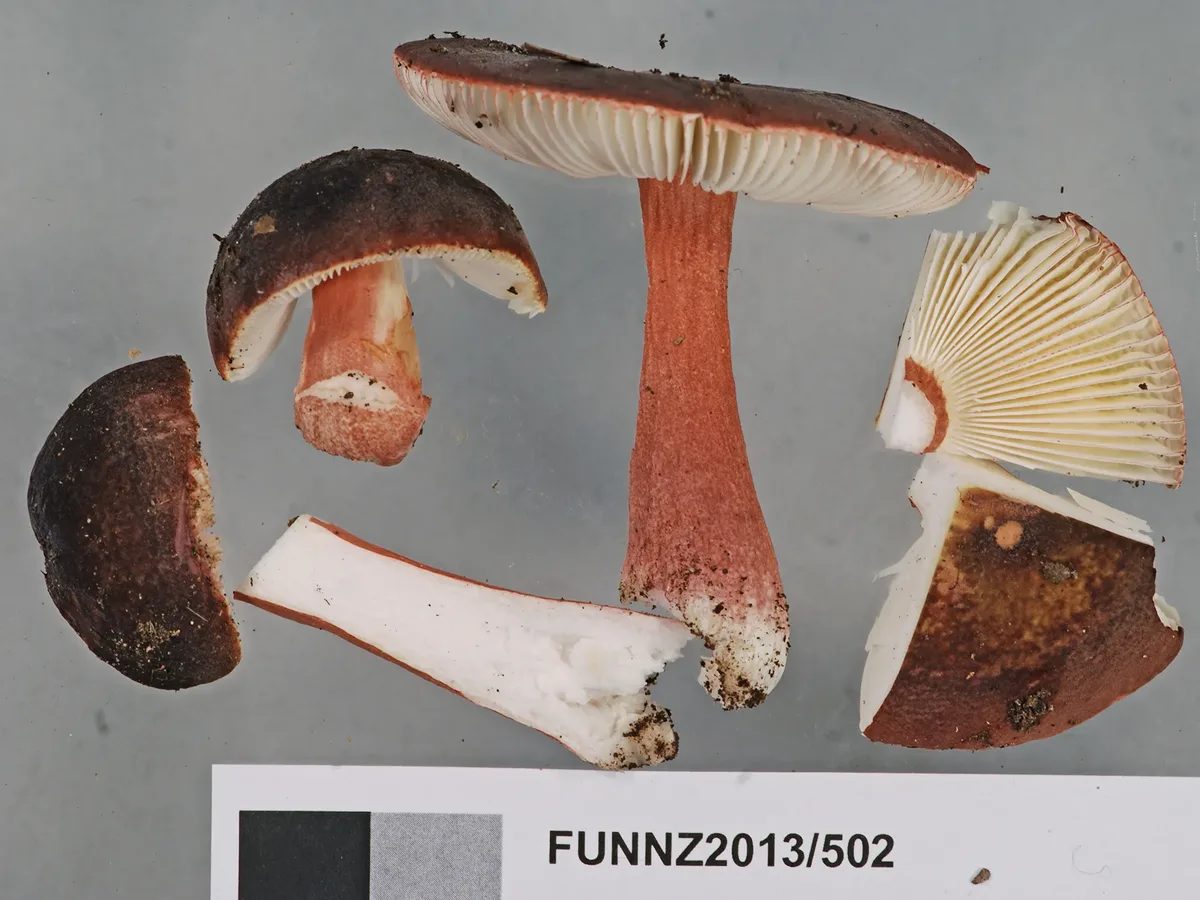 © Jerry Cooper (CC BY)
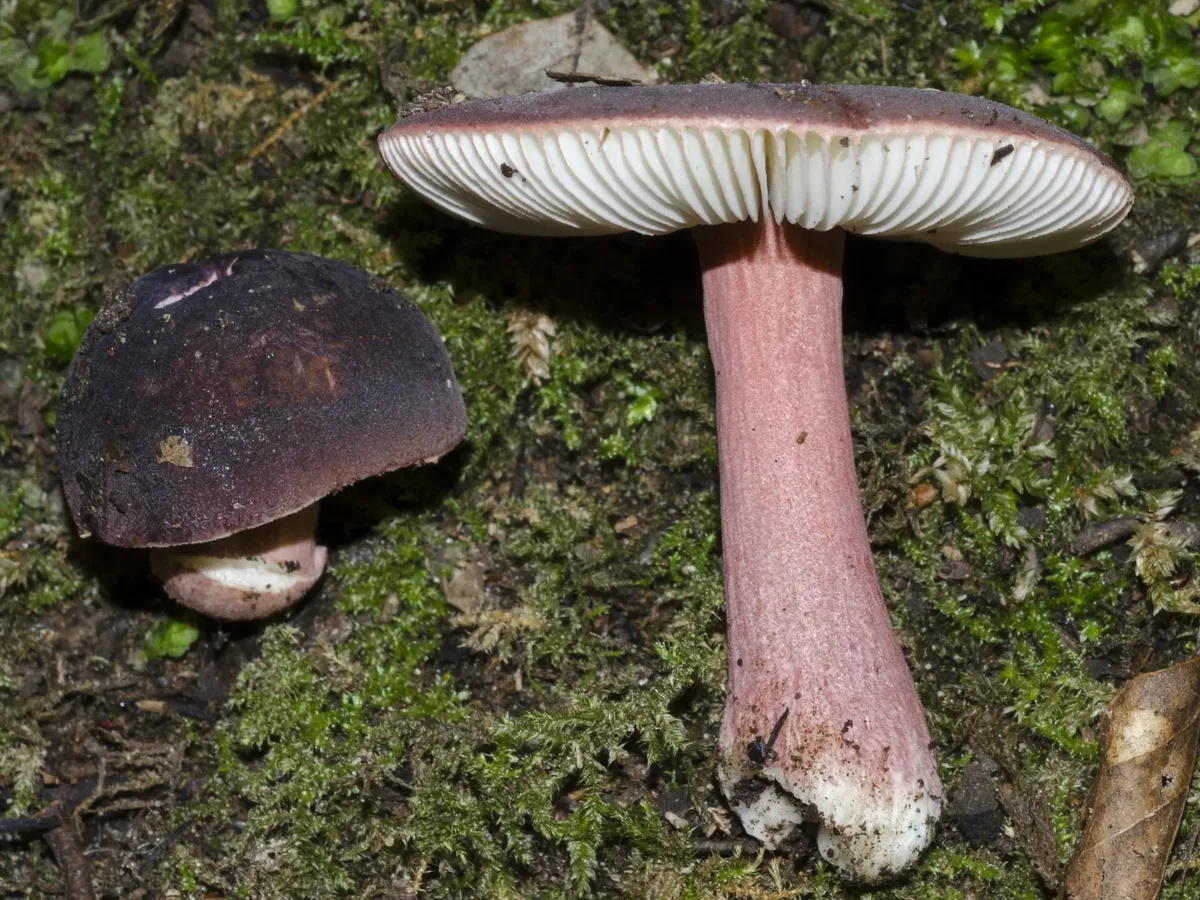 © Jerry Cooper (CC BY)© Jerry Cooper (CC BY)© Jerry Cooper (CC BY)
Edible only with the right preparation - or safe for some people but not others. Learn the caveats first.
Never eat a mushroom you are not 100% sure of - check the look-alikes below, and always cook wild mushrooms.
How to recognise it
Cap
Russula pilocystidiata is a modest-looking, pale-capped brittlegill - white to cream or pale buff, without the bold reds, violets, or greens that make many of its relatives instantly recognisable.
The cap runs 4-10 cm across, starting out tightly convex and becoming flatter and often shallowly bowl-shaped as it ages, with a surface that feels slightly sticky in wet weather and dull and smooth when dry.
The very faint pinkish or ivory tint that some specimens develop is not a reliable field marker, and the colour shifts over time toward ochre-buff in old, weathered material.
What the cap does not tell you is almost more informative than what it does: the diagnostic character of this species is entirely microscopic. The species name pilocystidiata refers to distinctive piloid cystidia - elongated, hair-like, thick-walled cells with narrowly tapering tips - that line the cap cuticle surface (pileipellis) and are visible only under a compound microscope.
In the field this translates to a matte, slightly dusty-looking cap surface with no special macroscopic markings; a definitive identification requires a spore print, a microscope, and specialist knowledge.
Gills
The gills are white to pale cream, moderately crowded, and absolutely brittle - running a fingertip across them confirms the hallmark Russula quality: they snap and crumble like chalk rather than flexing.
Stem
The stem is white, clean, dry, solid when young and spongy-hollow with age, and has no ring and no volva at any stage.
Flesh
The flesh is white, stays white on cutting, and is reported as mild to faintly unpleasant in smell; taste varies among collections.
Where & when it grows
Habitat
Every Russula species is an obligate ectomycorrhizal partner: its underground mycelium is physically woven through the root tips of living trees, trading mineral nutrients and water for plant-derived sugars in a relationship that sustains both partners. Russula pilocystidiata operates the same way in the native sclerophyll forests and cool-temperate rainforest margins of southeastern Australia.
Look for it in Victoria's central highlands, the ranges of New South Wales, and in Tasmania - in tall, wet eucalyptus forest where mountain ash (Eucalyptus regnans), messmate (E. obliqua), and alpine ash (E. delegatensis) dominate, and at cooler-elevation margins where myrtle beech (Nothofagus cunninghamii) meets eucalypt.
The forest floor needed is one with well-developed deep leaf litter and humus on mildly acidic to neutral soil.
It will not colonise any of the following, because its entire life depends on established native forest:
- cleared land
- heavily logged regrowth without re-established trees
- planted exotic woodland
- soil lacking a mycorrhizal host
Fruiting bodies appear singly or in small, loose, scattered groups, never in the tight clusters characteristic of saprotrophic fungi.
When
The fruiting season follows the same Southern Hemisphere rhythm as all ectomycorrhizal fungi of southeastern Australian native forest: autumn through early winter, broadly March to July, with peak activity in April and May.
The triggering logic is straightforward - fruiting requires two coincident conditions:
- 1soil temperatures falling below approximately 15 °C as summer heat dissipates
- 2adequate rainfall penetrating the litter and rewetting the soil profile (at least 15-20 mm over two weeks)
When both conditions occur together, fruiting bodies typically emerge within seven to fourteen days.
At lower-elevation coastal sites the season may be compressed into May and June; at higher elevations in the Victorian Alps and Tasmanian highlands, fruiting can begin in March and persist into July.
The Australian summer is not a time to look for this species - it is entirely absent during the hot, dry months.
How it grows
Russula pilocystidiata grows singly or in small scattered troops, emerging directly from the soil among leaf litter and humus. Dense clustering and growth from decaying wood are never features of ectomycorrhizal Russula species.
The fruitbody develops from a firm, white button that pushes up through the litter layer, occasionally emerging partially buried. The cap expands and flattens over roughly five to ten days under suitable conditions.
Because the underlying mycelial network is perennial and anchored to long-lived native tree roots, the same microsites can produce fruiting bodies across multiple successive years when autumn conditions are favourable.
The visible mushroom is only the reproductive tip of an organism that lives most of its life underground as an intricate fungal-tree partnership.
Fruiting conditions
Southern Hemisphere autumn species. Fruiting is initiated when soil temperatures fall below approximately 15 °C following the summer dry period and adequate autumn rainfall (15+ mm over 14 days) rewets the soil profile. Flush lag from triggering rain to emergent fruitbodies is typically 7-14 days. Peak fruiting April-June; may extend to July at cooler, wetter, or higher-altitude sites in Tasmania and the Victorian highlands.
Look-alikes
Russula pilocystidiata is a white to pale cream-capped Russula in a region where white to pale-capped mushrooms present genuine identification challenges and deadly risks.
Within the genus, multiple white, ivory, or pale buff-capped Russula species occur in southeastern Australian native forest, and many are only reliably distinguished by microscopy.
Russula delica (milk-white brittlegill), a European species with a similar pale white cap, is not established in Australia but illustrates the type. Other native Australian pale Russula species - some undescribed - share the same habitat and season; none is known to be deadly, but many are poorly documented for edibility.
The most critical lookalike risk is entirely outside the genus: the deadly death cap (Amanita phalloides), introduced into southeastern Australia and spreading wherever oaks and other exotic trees grow (and into some native forest associations), has an egg stage and immature fruiting body that is white to pale greenish-white and lacks obvious distinguishing features for the untrained eye.
More broadly, various native Australian Amanita species with pale caps grow in the same eucalyptus forest habitat and their toxicological profiles are incompletely characterised.
Any pale-capped, white-gilled, white-stemmed mushroom in Australian native forest demands a mandatory structural inspection:
- 1dig up the entire stem and check for a volva (membranous sac or girdled bulb at the base)
- 2check for a ring (skirt) on the stem
- 3check whether the gills are free (not attached to the stem)
Any one of those three features - volva, ring, or free gills - means the mushroom is an Amanita, not a Russula, and it must not be eaten. Russula pilocystidiata has none of those features, but this check must be active, not assumed.
The death cap is introduced and spreading in southeastern Australia around planted oaks, ornamental trees, and increasingly in adjacent native forest. Immature or pale specimens have a white to pale greenish-white cap without obvious green tones and a mild smell - dangerous for novices expecting an obvious distinctive odour or colour. The death cap always has: a membranous, sac-like volva at the stem base, a skirt-like ring on the upper stem, and free gills (not attached to the stem). Russula pilocystidiata has none of these. Dig up the entire stem base and confirm there is no volva before touching any pale-capped forest mushroom in Australia. The death cap's amatoxins cause no immediate warning symptoms and initial gastrointestinal effects clear, giving a false sense of recovery before fatal liver failure sets in 1-7 days later. There is no antidote.
Multiple native Australian Amanita species occur in eucalyptus forest and can have white to pale cream or buff caps. Their toxicology is incompletely characterised and some may be seriously dangerous. All Amanita species share the structural trio of: volva (or swollen base) at the stem base, usually a ring on the stem, and free gills that do not attach to the stem. Russula pilocystidiata has none of these: no volva, no ring, and gills attached to the stem. The chalk-brittle snap of Russula flesh versus the fibrous pull-apart of Amanita flesh is also a reliable confirmation. Always perform this structural check; never eat an unconfirmed white-capped woodland mushroom.
Several pale-capped Russula species - some described, some not yet formally named - occur in southeastern Australian eucalypt forests and are macroscopically similar to R. pilocystidiata. None is known to be deadly, but edibility varies and some may cause gastrointestinal upset if consumed. Definitive identification of R. pilocystidiata from its pale-capped relatives requires microscopic examination of the piloid cystidia on the cap cuticle. In the field, all share the chalk-brittle gill texture and lack of ring and volva. Treat all unidentified pale Russula species in Australian native forest as unknown edibility unless confirmed by a specialist.
The European milk-white brittlegill and its relatives have white to cream caps and pale gills, but are typically larger (cap 6-20 cm), have gills with a characteristic greenish tinge at the tips, and a faintly fishy or herring-like smell. Russula delica is not established in Australia; however, any pale-capped Russula imported or found in exotic woodland settings should be considered separately. R. delica is regarded as inedible to mildly toxic (GI irritant); this comparison illustrates that pale-capped russulas should never be assumed safe without proper identification.
In the kitchen
Picking & cleaning
Russula pilocystidiata is NOT recommended for the table - see safety notes below.
If handling a specimen for educational or scientific purposes, always extract the entire stem from the soil so the base can be inspected for a volva (membranous sac or girdled swelling). No Russula species has a volva, and confirming its absence is an essential step when working with any white-capped woodland mushroom in Australian forest.
Confirm also the chalk-brittle snap of the flesh: press a piece between your fingers - Russula flesh crumbles like chalk, while Amanita flesh pulls apart in fibrous strands.
Do not eat this species without a confirmed expert identification and without certainty that no deadly Amanita can be confused with it. Under no circumstances rely solely on the pale white cap colour as identification.
Cooking
Not recommended. Russula pilocystidiata has no established culinary tradition and insufficient documented edibility to warrant use as a food species.
Even if a future study establishes safety, a reliable identification to species level - requiring microscopy - would be necessary before any culinary use.
Do not cook or eat this species on the basis of pale cap colour and brittle gills alone.
Good to know
Russula pilocystidiata should be treated as an unknown-edibility species and not collected for food. Its edibility has not been established in the mycological literature - it is a specialised scientific description known primarily from herbarium collections and taxonomic monographs, not a species with a foraging tradition or documented culinary use.
This does not mean it is known to be toxic: there are no documented poisonings attributed to it, and there are no known toxins. However, the conservative and correct response to insufficient safety data is caution rather than assumption of edibility.
Beyond the unknown status of the species itself, the identification challenge is significant. R. pilocystidiata is definitively distinguished from related pale-capped Russula species only by microscopic examination of the piloid cystidia on the cap cuticle surface. A field collector without a microscope and specialist training cannot be certain of the identification.
The most serious risk in its habitat is the potential for confusion with white-capped Amanita species, including the introduced death cap (Amanita phalloides). Death cap amatoxins cause delayed-onset (6-24 hour) liver and kidney failure that is frequently lethal; the mushroom has a mild, even pleasant taste that provides absolutely no warning.
The structural separation from Russula is clear on careful inspection but requires active checking: Amanita has a volva at base, a ring on stem, and free gills; Russula has none of these.
Do not eat any pale-capped, white-gilled, white-stemmed mushroom from Australian native forest without a confirmed expert identification and a complete structural safety check. If in any doubt, leave the mushroom in the forest.
A reference guide - never an edibility guarantee. When in doubt, leave it out.