Blood brittlegill
Russula persanguinea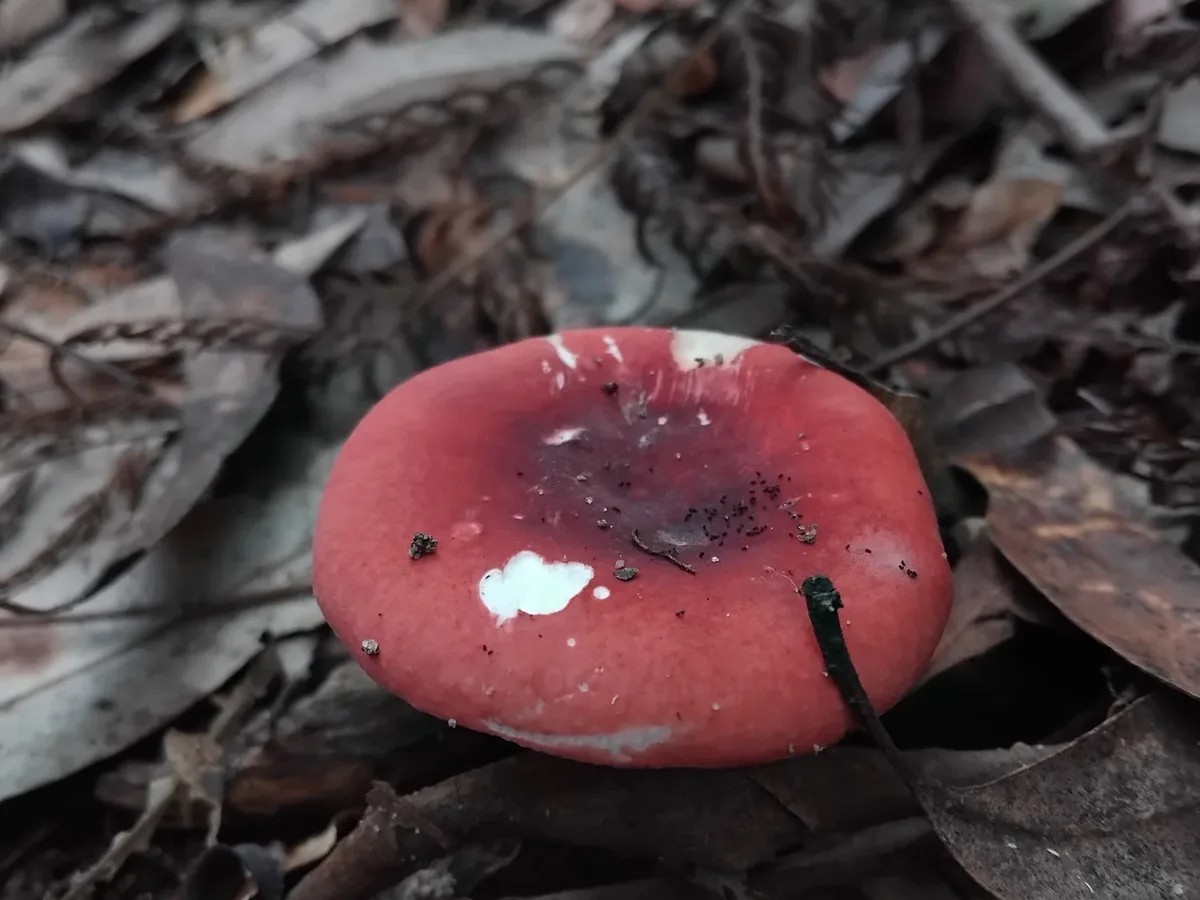 © Sofia Zvolanek (CC BY)
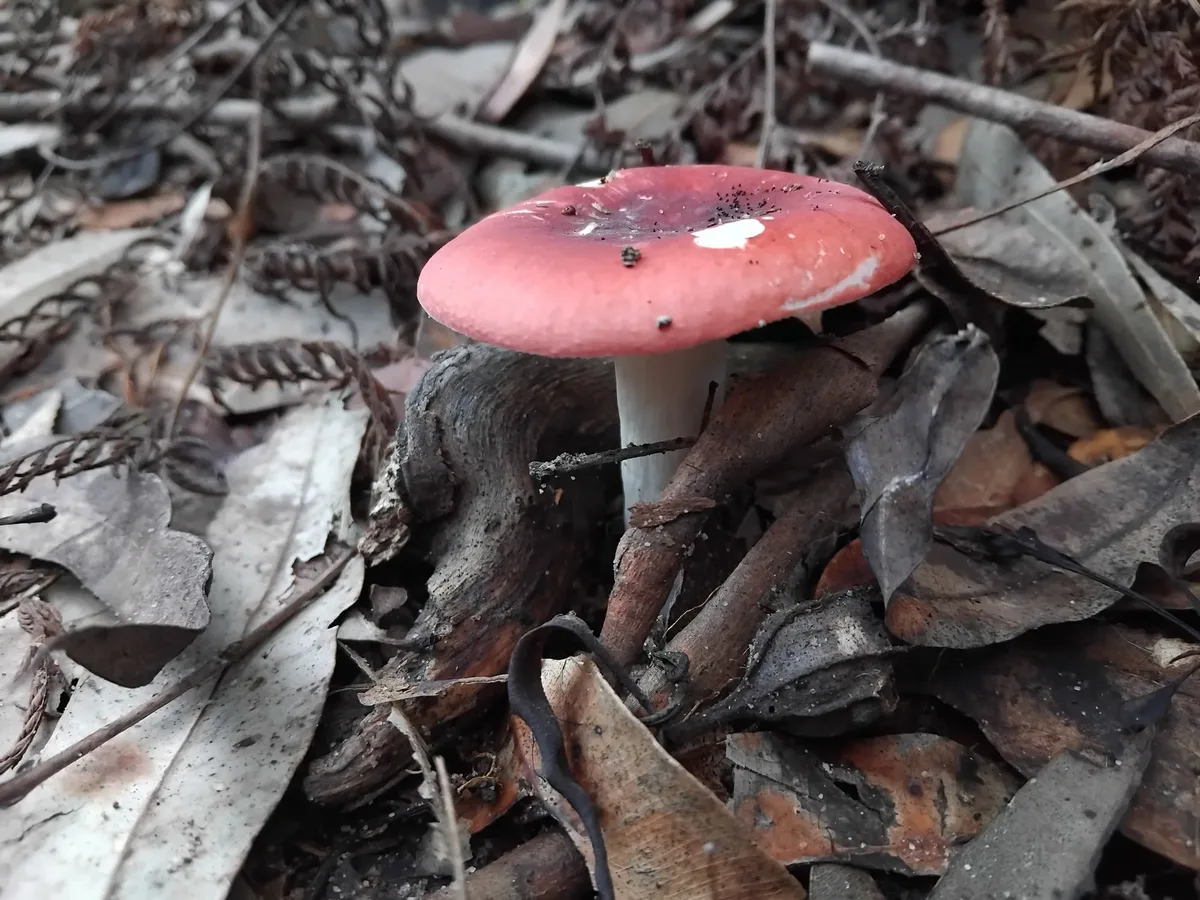 © Sofia Zvolanek (CC BY)
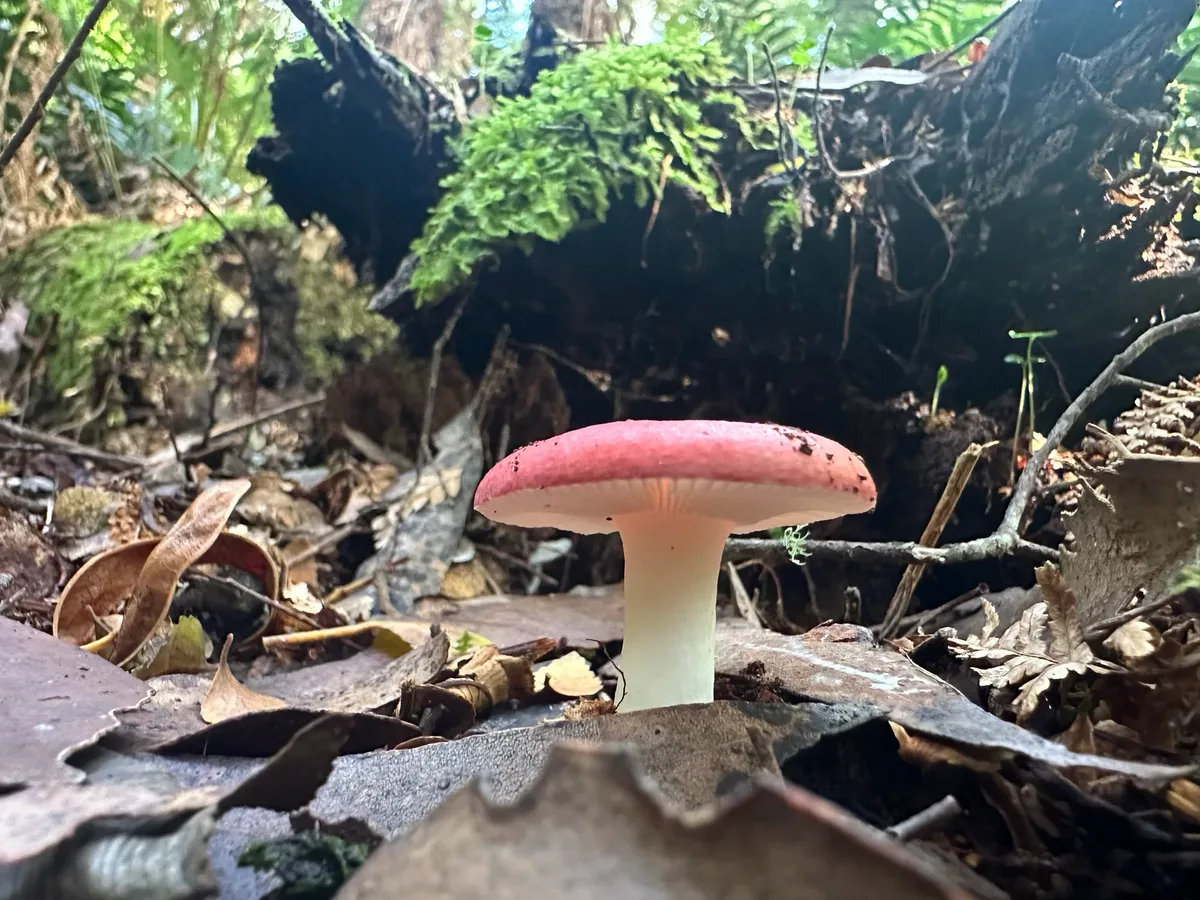 © Geoff Shuetrim (CC BY)
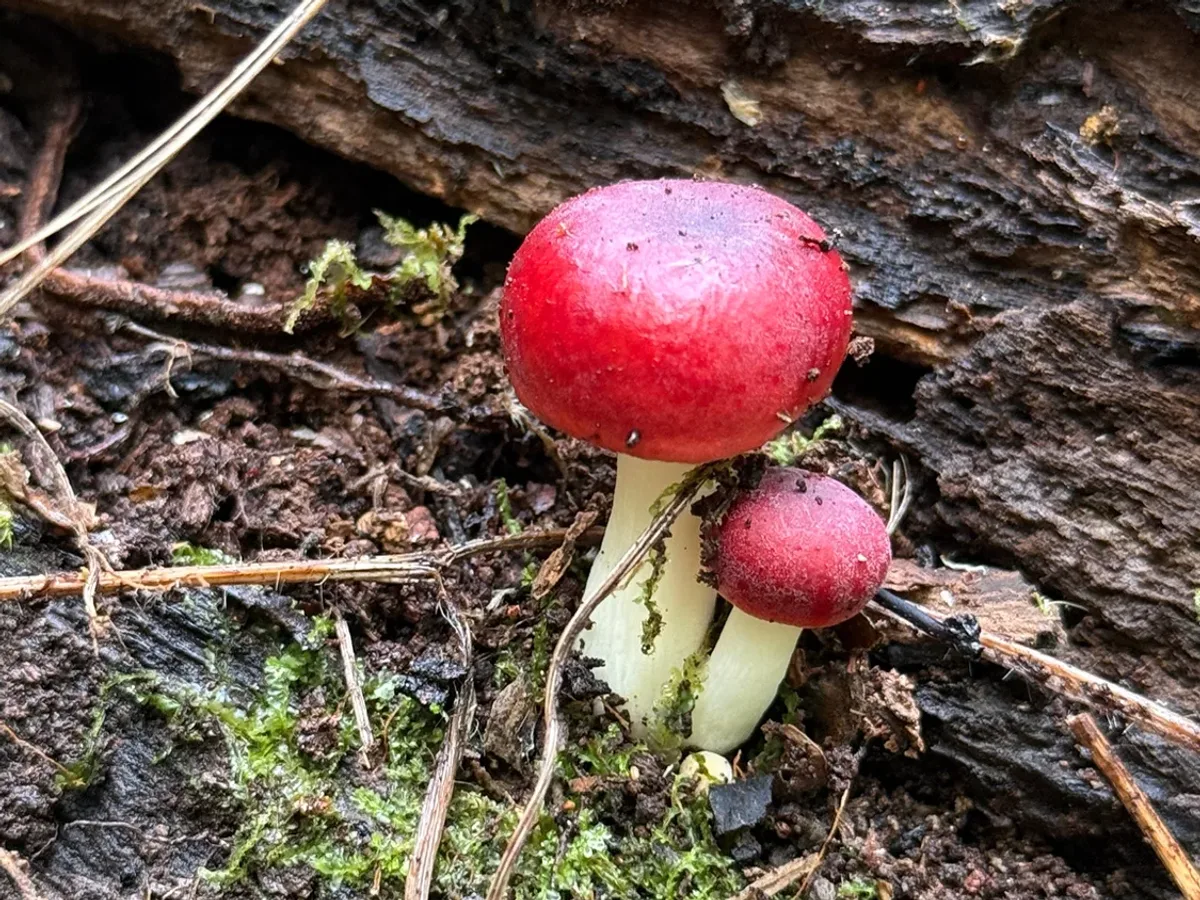 © Lukas Krug (CC BY)
 © Lukas Krug (CC BY)
 © Elspeth Swan (CC BY)
 © Elspeth Swan (CC BY)
 © Sofia Zvolanek (CC BY)© Sofia Zvolanek (CC BY)© Sofia Zvolanek (CC BY)
Edible only with the right preparation - or safe for some people but not others. Learn the caveats first.
Never eat a mushroom you are not 100% sure of - check the look-alikes below, and always cook wild mushrooms.
How to recognise it
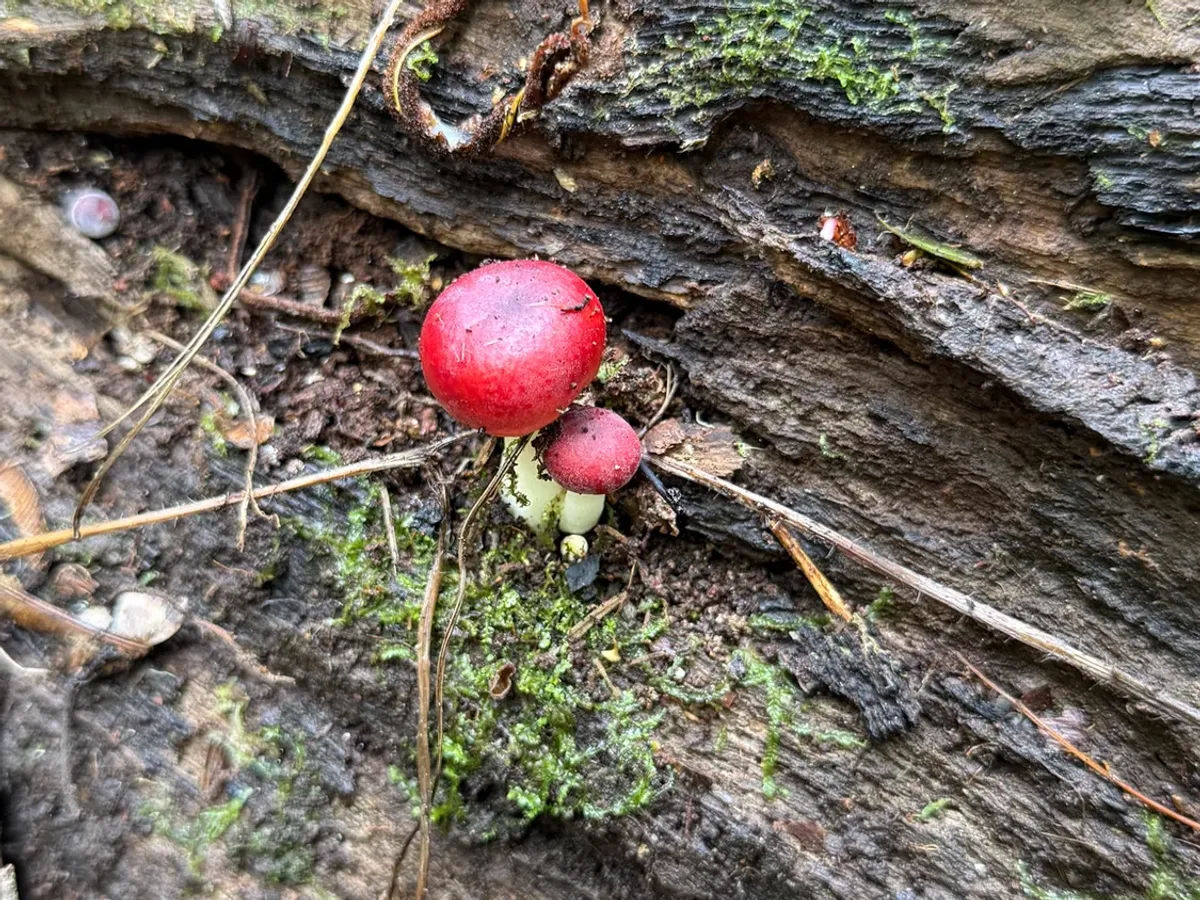
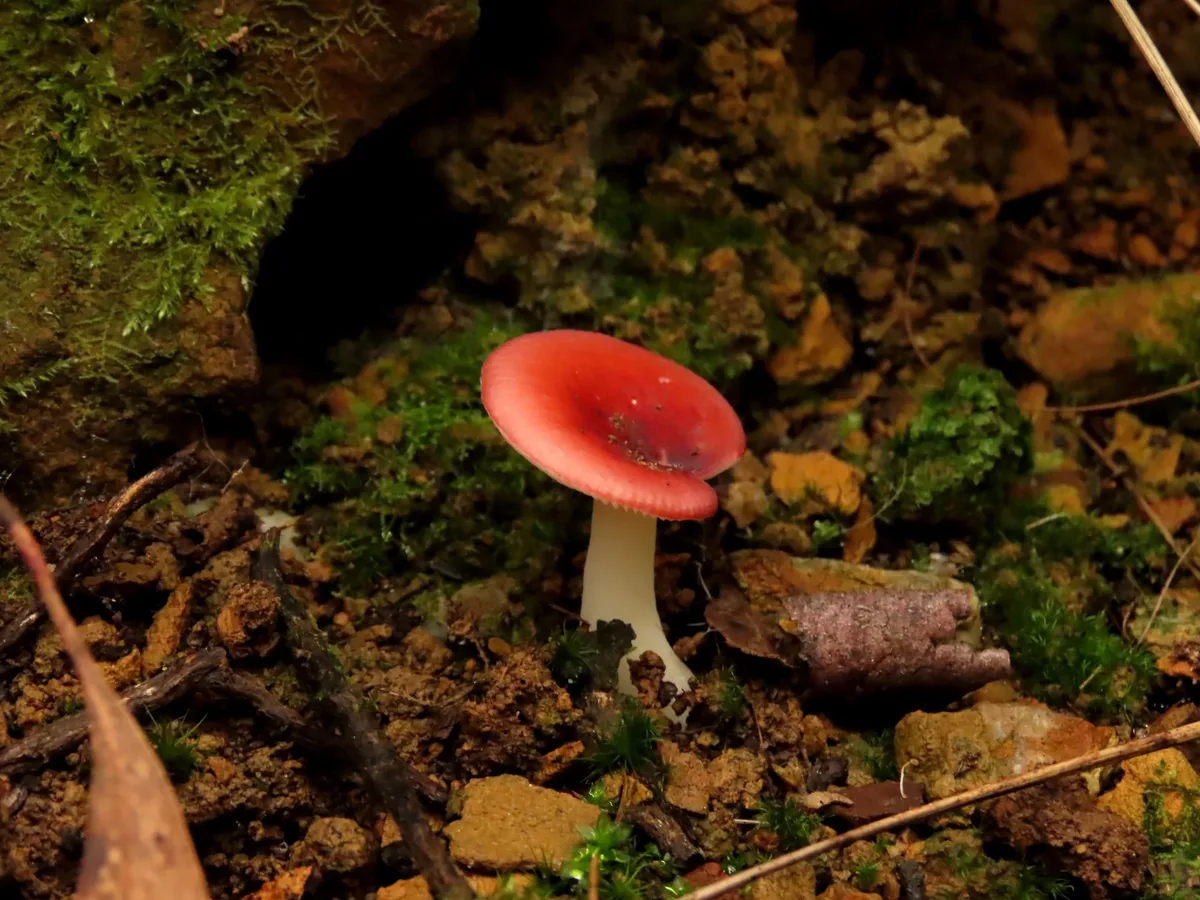
Russula persanguinea is a medium to large brittlegill with one of the deepest, most uniform blood-red to crimson caps of any Australian Russula - the name persanguinea (Latin: very blood-red) makes the point plainly.
Cap
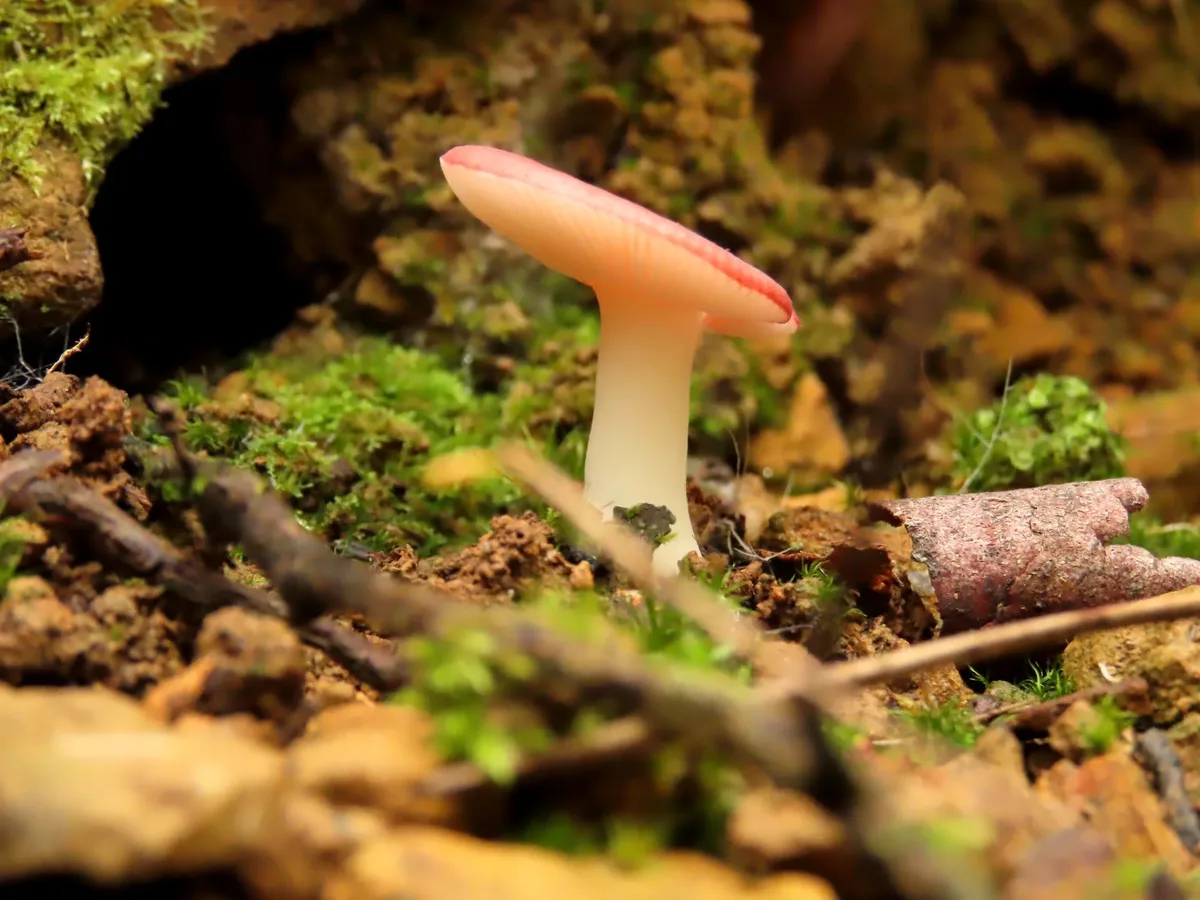
The cap runs 4-12 cm across, starting out convex and firm, then flattening and often sinking slightly at the centre as it matures.
In wet weather the surface is smooth and just faintly tacky. Older specimens may fade to pinkish or ochre at the margin, but a fresh cap holds a reliable, saturated deep red.
The cuticle peels away in strips for roughly one-third to half the radius from the margin - a normal brittlegill trait worth confirming.
Gills
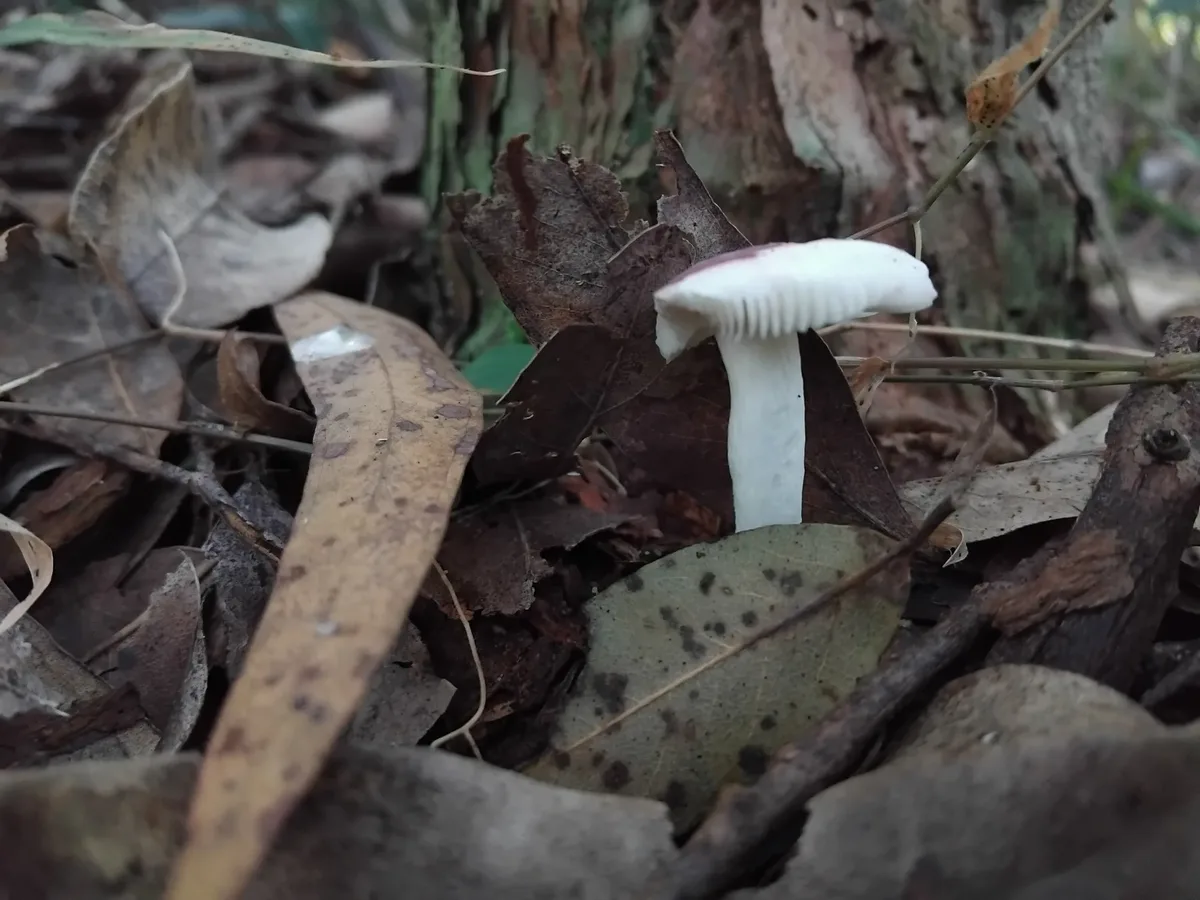
White to pale cream throughout (never yellow), moderately crowded, and adnate.
Stem
White, 3-8 cm tall, dry, and solid when young, turning spongy with age.
Flesh
Cut the flesh and it stays white - only a thin reddish layer sits directly beneath the cuticle.
Smell & taste
Taste is variable: many specimens are mild or barely perceptible, while others develop a slowly building hot or acrid character on the tongue.
Spore print white to very pale cream.
Why it's dangerous
The primary danger with Russula persanguinea is the real possibility of misidentification with a deadly Amanita species in the same Australian eucalypt habitat.
Amanita phalloides (death cap), which is present and spreading in southeastern Australia, causes fatal amatoxin poisoning: delayed-onset (6-24 hours) liver and kidney failure that is frequently lethal without transplantation.
The structural differences from Russula are clear on careful inspection but can be missed by inexperienced collectors, especially with immature or partially embedded fruitbodies.
Never eat a red to pale mushroom from Australian forest without performing all structural checks and the taste test.
Toxin
The relevant toxic principle in acrid Russula species is a group of heat-labile sesquiterpene compounds, collectively responsible for the burning, acrid taste.
These are gastrointestinal irritants. Ingesting acrid material causes dose-dependent nausea, vomiting, and diarrhoea within 30 minutes to 3 hours.
The compounds are largely destroyed by thorough cooking, but this approach is not recommended for R. persanguinea, given the combined uncertainty of taste variability and the presence of deadly Amanita in the same habitat.
Symptoms
Gastrointestinal irritation: nausea, vomiting, abdominal cramps, diarrhoea, typically beginning 30 minutes to 3 hours after consumption of raw or inadequately cooked acrid material.
Symptoms are self-limiting in most cases and resolve within 12-24 hours with supportive care. Severity is dose-dependent. No systemic organ toxicity from the sesquiterpene irritants themselves.
Seek urgent medical advice if Amanita poisoning cannot be excluded, as amatoxin poisoning has a deceptive lag period before severe organ damage.
Staying safe
Russula persanguinea is classified as requiring caution for two reasons.
- 1The taste is variable among specimens. Many are mild, but a proportion show slowly developing acrid or hot character, a marker for gastrointestinal irritants; consuming an acrid Russula will cause nausea, vomiting, and diarrhoea. Only mild-tasting specimens should be considered for consumption, and even then with care.
- 2The broader context of red-capped mushroom identification in Australian eucalypt forest demands vigilance: introduced deadly Amanita species (death cap, fly agaric) are present in southeastern Australia, and the consequences of misidentification are severe.
Before any use, always:
- perform the chalk-brittle snap test
- confirm absence of any ring and volva
- verify adnate (not free) gills
- do the taste test
Do not eat any specimen that fails any of these checks.
Where & when it grows
Habitat
Russula persanguinea lives underground as mycelium woven through the root tips of its tree partners - a mycorrhizal relationship that feeds the forest as much as the fungus.
Its partners here are the towering eucalypts of southeastern Australia: mountain ash (E. regnans), messmate (E. obliqua), and alpine ash (E. delegatensis), among others.
Look for it in moist sclerophyll forest and wetter woodland types where leaf litter and duff have built up over years.
Victoria's central highlands and the ranges of New South Wales and Tasmania are its heartland; it also turns up at cool temperate rainforest margins where myrtle beech (Nothofagus cunninghamii) grows alongside eucalypt. It does not venture into dry mallee or arid woodland.
When
Fruiting runs through the Southern Hemisphere autumn and into early winter - broadly March to July - mirroring the autumn season of its relatives in the northern hemisphere.
The peak is typically April and May, once the autumn rains arrive and soil temperatures dip below 15 °C. At cooler montane sites, fruitbodies can hold on into June.
A warm, dry autumn pushes things back noticeably. Expect a flush to follow within 7-14 days of a decent rainfall event (15 mm or more) once the soil has begun to cool.
How it grows
Usually solitary or scattered, occasionally in loose groups of two to five.
Fruitbodies push up through eucalypt leaf litter and are often partially buried - young caps can be nearly hidden under the duff, their red flush the only hint of what lies beneath.
Once triggered by rain, growth is moderately quick: caps reach full size over roughly 5-8 days. In good rainfall years, productive sites can carry a surprisingly high density of fruitings.
Fruiting conditions
Autumn fruiting is triggered when the summer drought breaks: a rainfall event of at least 15 mm combined with soil temperatures falling below 15 degrees C initiates fruiting, with full fruitbody emergence typically 7-14 days later. Deep eucalypt leaf litter insulates soil temperature and retains moisture, extending the productive fruiting period through early winter months.
Look-alikes
Several red-capped species can be confused with Russula persanguinea in Australian eucalypt forest.
Other red Russula species in Australia (including undescribed or poorly known species) may be indistinguishable in the field. Some may be acrid and toxic (causing gastrointestinal upset), others mild and edible; in the absence of a confirmed identification with taste test, all should be treated with caution.
The taste test is the single most useful field separator: mild taste is a prerequisite for consumption, but given the variability in R. persanguinea itself, extra caution is warranted.
Amanita muscaria (fly agaric) is established as an introduced species in southeastern Australia wherever pine plantations, ornamental birch, or introduced conifers have been planted. Young buttons of A. muscaria can appear red and rounded before the characteristic white warts become prominent (warts can be washed off by rain).
However, Amanita has fibrous flesh that does not snap like chalk, a prominent ring (skirt) on the stem, a swollen base with a volva, and free gills.
Amanita phalloides (death cap) is also introduced in southeastern Australia. While typically olive-green to greenish-yellow, pale or unusual colour forms exist. It has amatoxins capable of causing fatal liver failure. It has a volva, ring, and free white gills - entirely different from the brittle, gills-adnate structure of Russula.
Amanita xanthocephala (gilded Amanita) is a native Australian Amanita associated with eucalypt. While typically yellow-orange, colour variation occurs.
Always confirm brittleness of flesh and absence of volva and ring, to separate from any Amanita.
Introduced and spreading in southeastern Australia; typically olive-green to greenish-yellow but pale or unusual colour variants exist. Has a volva (sack-like base), ring on stem, free white gills, and fibrous flesh -- none present in Russula. Contains amatoxins causing fatal liver failure with delayed onset of 6-24 hours. Always confirm chalk-brittle snap, absence of ring, and absence of volva before eating any forest mushroom.
Introduced to southeastern Australia near planted conifers and ornamental birch; also spreading into eucalypt forest. Young red buttons lack prominent warts (washed off by rain) and could mislead a novice. Differs from R. persanguinea by: fibrous (non-brittle) flesh, ring or skirt on stem, basal volva or swollen base, free gills. Contains ibotenic acid and muscimol causing neurological toxicity. Snap the flesh to confirm brittleness before any use.
Multiple undescribed or poorly characterised red Russula species occur in Australian eucalypt forest and may be indistinguishable from R. persanguinea in the field. Some are acrid and cause GI upset. The taste test on each individual specimen is essential: any hot, burning, or acrid sensation means the specimen must not be eaten. Brittle chalk-snap flesh and pale cream spore print confirm genus.
Native Australian Amanita associated with eucalypt. Typically ochre-yellow to orange-yellow cap; variable colour forms can approach red-orange. Has a ring, volva, free gills, and non-brittle flesh -- conclusively different from Russula's chalk-snap and adnate gills. Not regarded as deadly but should not be consumed; treat as suspect if uncertain.
A reference guide - never an edibility guarantee. When in doubt, leave it out.