Wine-purple Russula
Russula lenkunya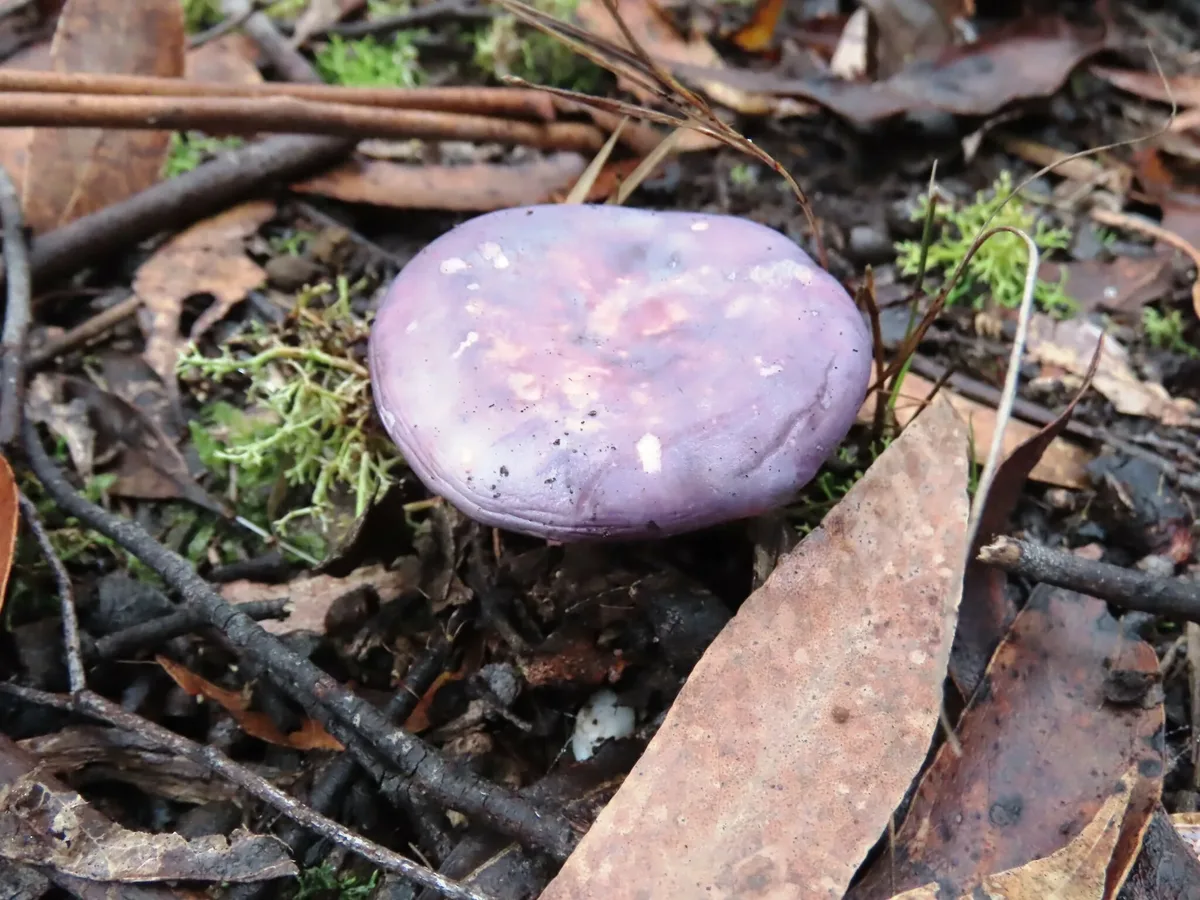 © Elspeth Swan (CC BY)
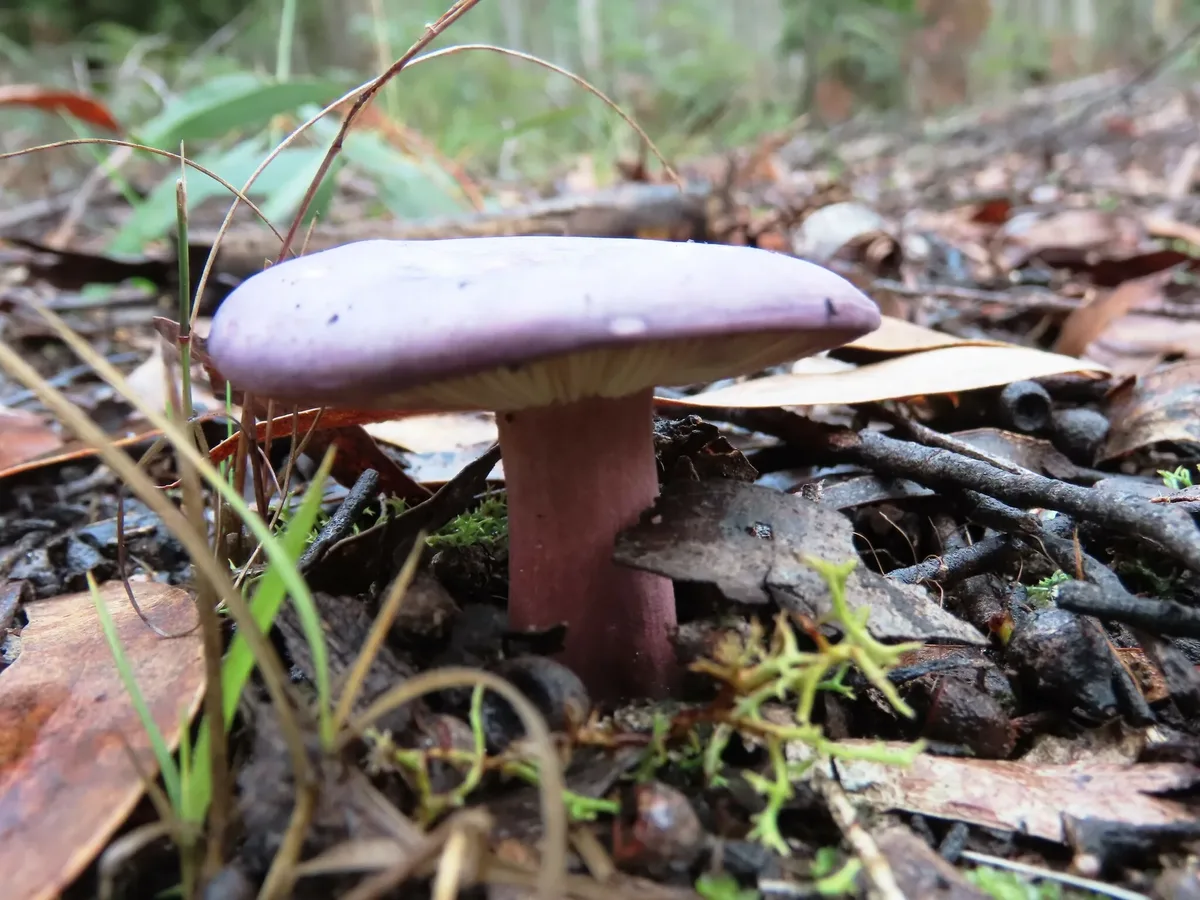 © Elspeth Swan (CC BY)
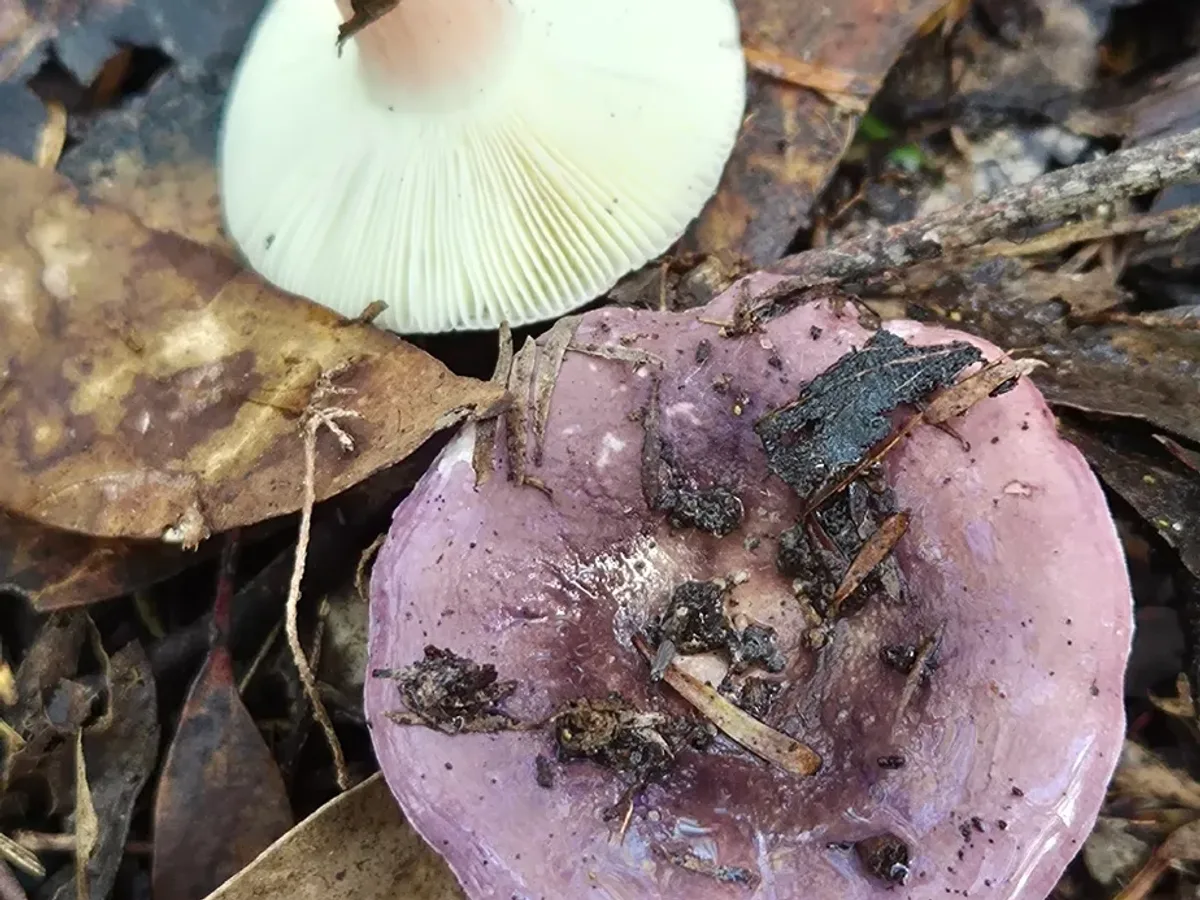 Eileen Laidlaw (CC0)
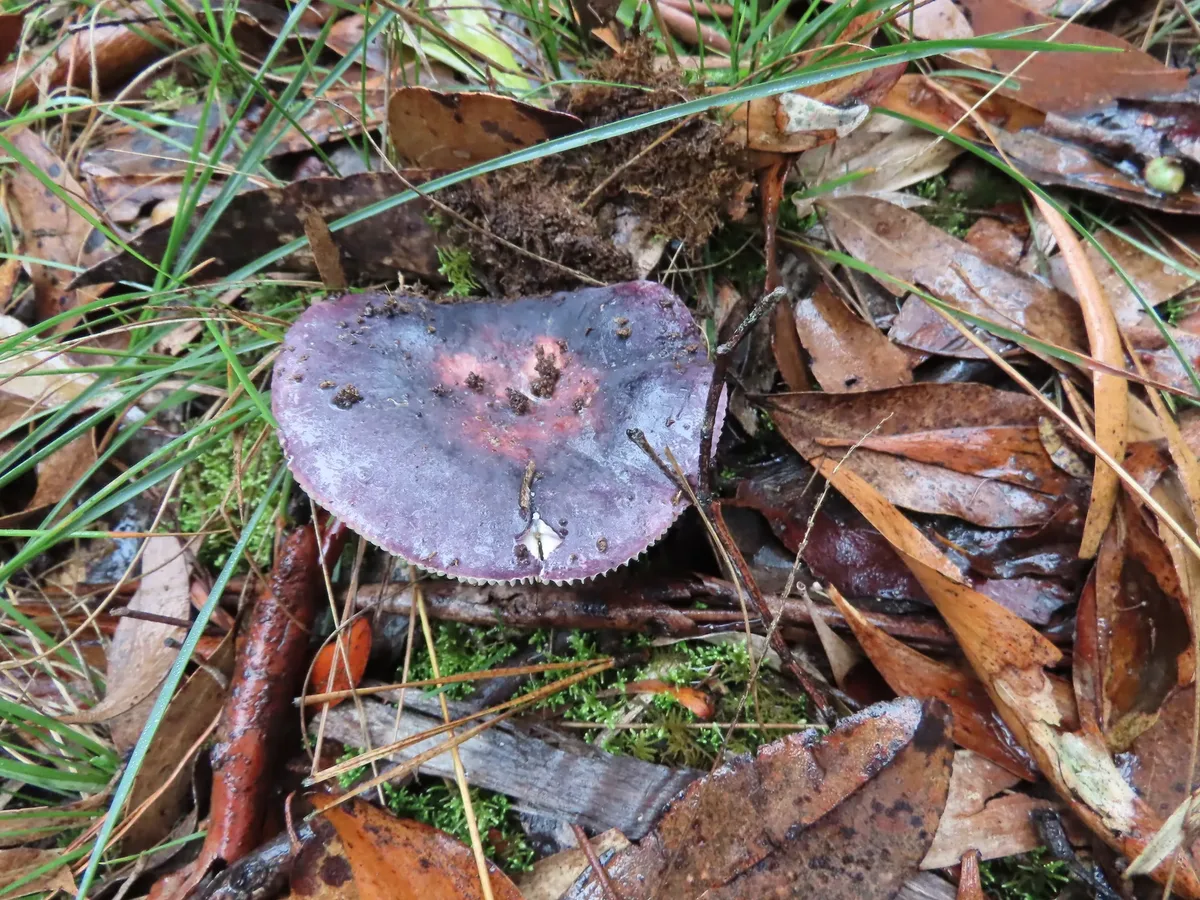 © Elspeth Swan (CC BY)
 © Elspeth Swan (CC BY)
 © Elspeth Swan (CC BY)© Elspeth Swan (CC BY)© Elspeth Swan (CC BY)
Edible only with the right preparation - or safe for some people but not others. Learn the caveats first.
Never eat a mushroom you are not 100% sure of - check the look-alikes below, and always cook wild mushrooms.
How to recognise it
Russula lenkunya is immediately attractive in the field.
Cap
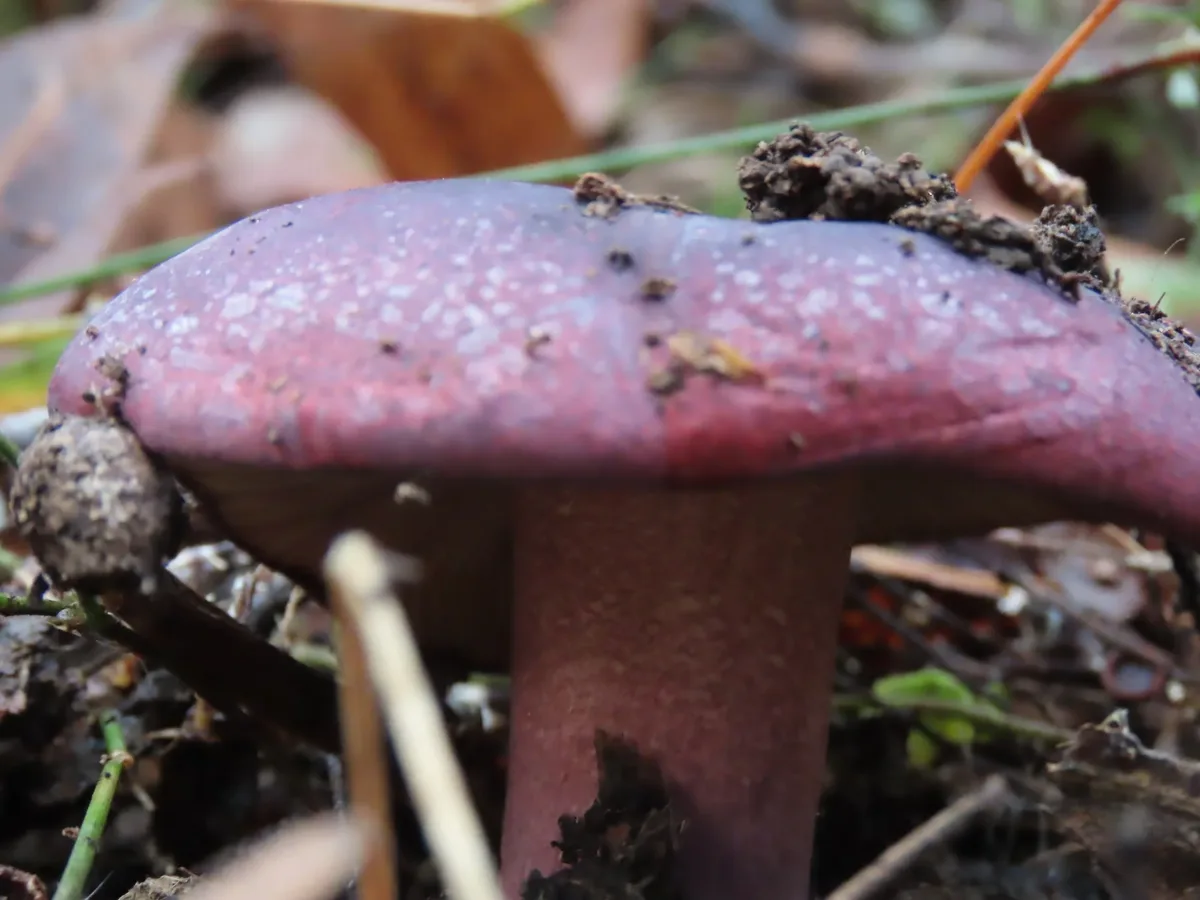
Its cap is a deep, saturated wine-purple to reddish-claret, a colour that sits somewhere between the rich purplish-red of a good Pinot Noir and a dried rose petal.
The cap runs 4-10 cm across, starting out convex with an incurved margin and progressively flattening, often sinking into a gentle depression at the centre as it matures.
The surface is smooth and slightly tacky in wet weather, drying to a matt or lightly lustrous finish; the cuticle peels away from the margin for roughly a third to half the radius, a useful confirmation of the genus.
In older or dried-out specimens the colours can fade noticeably - the deep wine-red bleaches to pale lilac or dull pinkish-buff - so fresh specimens are always easiest to identify.
A thin purplish-red layer under the cuticle (visible when the cap skin is peeled back) confirms the pigment is superficial; the flesh beneath is entirely white.
Flesh
That white, chalky flesh is the defining Russula character: press it with a fingernail and it snaps clean, like a piece of chalk or a piece of bone, rather than pulling into fibres as the flesh of an Amanita or Cortinarius would.
Gills
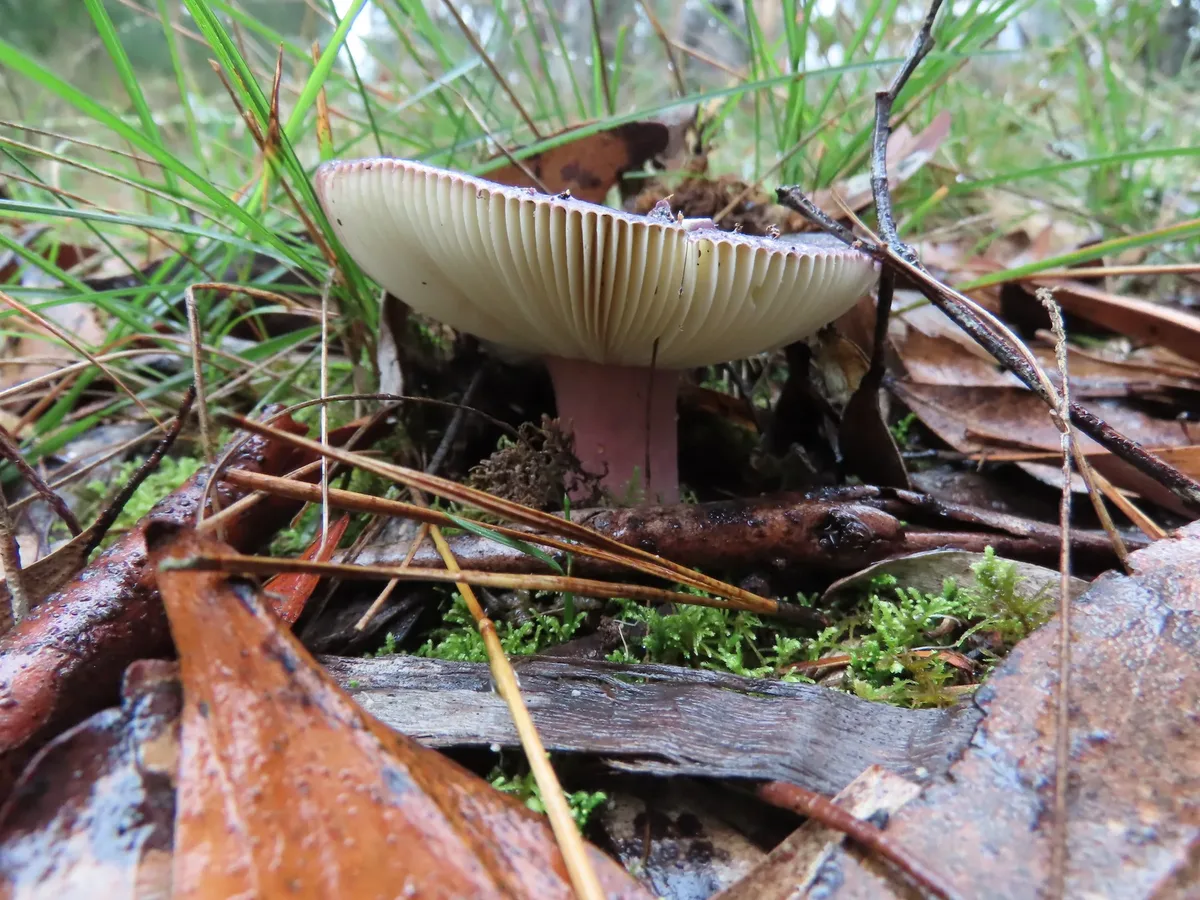
The gills are white to pale cream, moderately crowded, attached to the stem, and equally brittle.
Stem
The stem is white (sometimes with a faint lilac flush toward the top), 3-8 cm tall, dry, smooth, and without any ring or skirt, and without any volva or bulbous sac at the base.
Taste
Taste is mild and pleasant - not acrid, not peppery, not bitter.
Where & when it grows
Habitat
Russula lenkunya is a forest species in the fullest sense: it is tied to living trees by an underground ectomycorrhizal partnership and will never be found on dead wood, on compost, or in open grassland.
In New Zealand, where the species was first described, it favours the ancient Nothofagus (southern beech) forests that once covered much of the South Island and extend into the lower North Island. Hosts include:
- red beech (N. fusca)
- silver beech (N. menziesii)
- black beech (N. solandri)
- hard beech (N. truncata)
In southeastern Australia it has been recorded in moist sclerophyll forest and the cool temperate forest margins where myrtle beech (Nothofagus cunninghamii) mingles with towering eucalypts such as mountain ash (Eucalyptus regnans) and messmate (E. obliqua).
Look for fruitbodies on the forest floor among deep, slightly acid leaf litter and humus, singly or in small scattered groups, always within the root zone of the host tree.
The beech forests of New Zealand and the wet sclerophyll forests of Victoria and Tasmania, where cool, moist conditions persist through the autumn months, are ideal habitat.
When
The fruiting season mirrors autumn in the Southern Hemisphere - roughly March through July. Like most ectomycorrhizal Russula species, R. lenkunya responds to the combination of cooling soils and renewed soil moisture after the summer dry period.
In New Zealand beech forest this typically means April to June. In southeastern Australia the first significant autumn rains in March or April trigger the initial flush, with peak production through April and May.
Expect fruitbodies to push up through the leaf litter about seven to fourteen days after a soaking rain event of fifteen millimetres or more, once the soil temperature has started to fall toward 15 °C.
At cooler montane and subalpine beech forest sites the season extends into June and occasionally July.
A warm, dry autumn suppresses and delays fruiting; successive wet periods in a cool autumn can produce multiple flushes from the same patch.
How it grows
Fruitbodies appear singly or in scattered groups of two to five across the forest floor, never in tight clusters and never on wood.
Young caps can be partially buried in the duff, the wine-purple colour betraying their presence before the cap fully emerges. Once above ground, a cap typically reaches full size over five to eight days.
The underground mycelium that produces them is long-lived, and a productive site in a patch of southern beech or old-growth eucalypt will usually fruit again in the same spot year after year, making it worth recording locations.
Because the fungus is inseparable from its living tree partner, any mushroom with this appearance found far from Nothofagus or eucalypt - in a lawn, on open ground, on a stump - would demand careful re-examination of the identification.
Fruiting conditions
Southern Hemisphere autumn fruiting: triggered when the summer drought breaks and soils cool below 15 °C. A rainfall event of at least 15 mm combined with cooling temperatures initiates fruiting, with fruitbodies emerging 7-14 days later. Ectomycorrhizal with Nothofagus and Eucalyptus; productive sites recur annually in the same locations.
Look-alikes
The wine-purple cap colour is reasonably distinctive within the beech and eucalypt forest flora of Australia and New Zealand, but several important confusions are possible and one is potentially lethal.
The greatest danger is with introduced deadly Amanita species. The death cap (Amanita phalloides) is firmly established in New Zealand (particularly around Wellington and the North Island) and is spreading in southeastern Australia.
While it is typically olive-green to greenish-yellow, pale or unusual colour forms can appear, and a novice who sees 'white gills, white stem, forest floor' may not look further.
The decisive structural checks are:
- the death cap ALWAYS has a membranous sac-like volva at the stem base
- usually a ring (skirt) on the stem
- free (not attached) gills
- fibrous flesh that does not snap
R. lenkunya has none of these features.
The fly agaric (Amanita muscaria) is established in New Zealand and southeastern Australia; it typically has a red cap with white warts, but young buttons can appear pale or rounded before warts develop and warts can be washed off by rain. Again: check for ring, volva, free gills, and non-brittle fibrous flesh.
Within the genus Russula, the most relevant confusions in this region are with other purple or reddish-capped brittlegills, several of which remain undescribed or poorly characterised in the Australian-NZ flora. Some acrid red or purple Russula species cause gastrointestinal upset; the taste test (spit it out, wait thirty seconds - no heat or acrid bite permitted) is the key separator, since R. lenkunya is mild.
Cortinarius species (webcaps), some of which are lethally nephrotoxic, grow in the same Nothofagus forests of New Zealand and eucalypt forests of Australia; they have fibrous non-brittle flesh, a cobweb-like cortina veil leaving rusty fibrils on the stem, and a rusty-cinnamon spore print - entirely different from Russula's chalk-snap, brittle gills, and white spore print.
Cortinarius species (webcaps) grow in Nothofagus forests in New Zealand and eucalypt forests in Australia; some contain orellanine, a cumulative kidney toxin causing fatal renal failure weeks after ingestion and very long after any possible symptoms appear. Distinguished from R. lenkunya by: fibrous flesh that tears rather than snapping; cobweb-like cortina veil leaving rusty-brown fibrils on the stem in young specimens; rusty cinnamon-brown spore print; and gills that turn rusty-brown with age from spore deposit. R. lenkunya has chalk-snap brittle flesh, no cortina, and a white to pale cream spore print. These differences are absolute - confirm all of them.
Introduced and established in New Zealand and spreading in southeastern Australia. Typically olive-green to greenish-yellow but pale or unusual forms exist; also shares white gills and white stem with R. lenkunya. Decisively different: has a membranous sac-like volva at the stem base, a ring (skirt) on the stem, free (not attached) gills, and fibrous flesh that does not snap. Contains amatoxins causing fatal liver failure after a 6-24 hour symptom-free period; mild taste gives no warning. Always lift the full stem and confirm no volva and no ring before putting any white-gilled forest mushroom in the basket.
Introduced and widespread in New Zealand and parts of southeastern Australia wherever pines, birches, or ornamental introduced trees are planted. Classic form is red with white warts, but young buttons may be pale and rounded before warts develop, and warts can be washed off by heavy rain. Differs from R. lenkunya by: prominent ring on stem, swollen base with volval girdles (not clean), free gills, and fibrous non-brittle flesh. Contains ibotenic acid and muscimol causing neurological toxicity. The structural checks (ring + volva + free gills + non-brittle flesh) remain decisive.
Several purple, violet, or reddish Russula species occur in Australian and New Zealand forests, some undescribed or poorly studied; a proportion of these are acrid and cause gastrointestinal upset (nausea, vomiting, diarrhoea). All share the chalk-snap brittle flesh and white to pale cream spore print of R. lenkunya. The taste test is the key separator: chew a small piece, hold it on the tongue for thirty seconds, and spit it out. Any burning, hot, or peppery sensation means the specimen must not be eaten. R. lenkunya is consistently mild.
A native Australian Amanita associated with eucalypt forest; typically ochre-yellow to orange but colour variation occurs. Distinguishable from R. lenkunya by all structural Amanita features: ring on stem, volva or swollen base with girdles, free (not attached) gills, and fibrous non-brittle flesh. Not regarded as deadly but should not be consumed. Colour alone (orange vs wine-purple) usually distinguishes it, but always apply the structural check.
In the kitchen
Picking & cleaning
Harvest by gently twisting and lifting the fruitbody so the entire stem comes free, then immediately inspect the base. This check is not optional - it is the single most important safety action.
A volva (membranous sac or girdled bulb at the base) would indicate a deadly Amanita, not a Russula; no Russula of any species has one.
Confirm also that:
- the stem carries no ring or skirt
- the gills crumble brittlely when touched (rather than bending or being greasy)
- the flesh snaps cleanly like chalk when broken
Perform the taste test: bite off a small piece of cap, hold it on the tongue for thirty seconds, then spit it out.
Russula lenkunya is mild - a faint pleasant or neutral note with no heat, burning, or pepperiness whatsoever. Any hot or acrid sensation means the specimen should not be eaten.
Choose firm, young to middle-aged caps; old specimens become spongy and are quickly colonised by fungus fly larvae.
Carry the harvest in a breathable container rather than a plastic bag, which accelerates deterioration.
Cooking
The firm, white, mildly flavoured flesh of Russula lenkunya lends itself to all the standard preparations for edible brittlegills.
- 1Peel the cap cuticle (it strips away easily from the margin).
- 2Slice the cap.
- 3Sauté over moderate-to-high heat in butter or olive oil with garlic, fresh herbs, and a pinch of salt until golden at the edges.
The flesh holds its shape well without becoming watery or mushy.
Use in pasta sauces, omelettes, risotto, soups, and mixed mushroom dishes.
The mild flavour makes it a background note rather than the star ingredient, benefiting from the company of more assertively flavoured fungi or bold seasoning.
Never eat raw. Discard any specimens showing any hot or acrid taste before cooking.
Good to know
Russula lenkunya is regarded as an edible species with no documented toxicity; its mild, non-acrid taste is consistent with safe edibility in the way understood across the genus.
That said, several important caveats apply to anyone foraging this species in the field.
- 1The genuine safety risk in beech and eucalypt forest in Australia and New Zealand comes from misidentification rather than from R. lenkunya itself. The death cap (Amanita phalloides) is present in New Zealand and spreading in southeastern Australia; it contains amatoxins that cause fatal liver and kidney failure with a deceptively mild presentation in the first 6-24 hours - the initial mild taste gives no warning whatsoever. Before any forest mushroom goes into the basket, the complete structural check must be completed: lift the full stem, confirm no volva and no ring, confirm attached brittle crumbling gills and chalk-snap white flesh.
- 2The taxonomy of southern-hemisphere Russula remains incompletely resolved, and multiple species sharing similar purple or reddish colouring likely coexist in the same forests.
- 3Even verified edible Russula species should always be eaten cooked and never raw, as raw material can cause gastrointestinal discomfort.
On a first use, start with a modest portion and wait several hours before eating more.
If any doubt about the identification remains, do not eat it - consult a local mycological society (such as the New Zealand Fungal Network or the Fungimap network in Australia) before proceeding.
A reference guide - never an edibility guarantee. When in doubt, leave it out.