Green-capped Russula
Russula iterika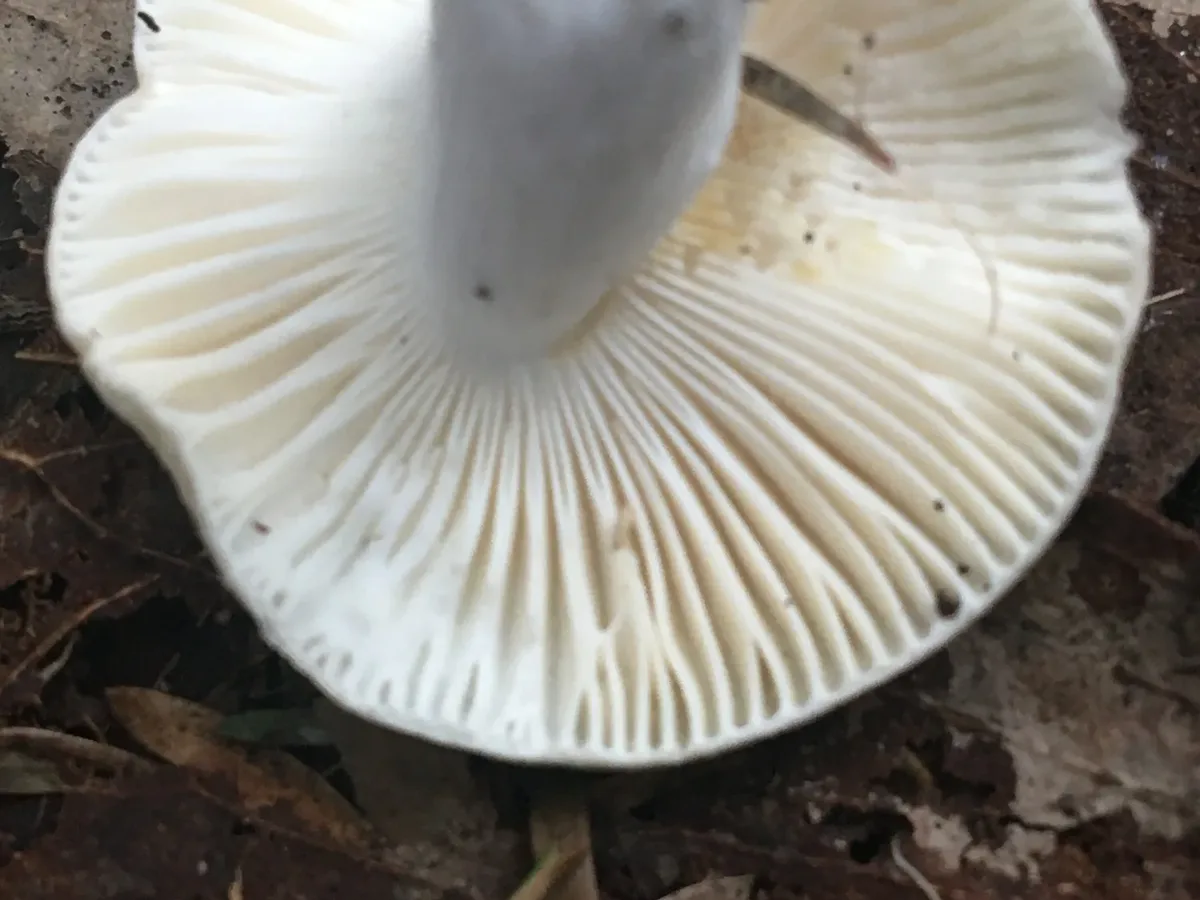 Eileen Laidlaw (CC0)
 Eileen Laidlaw (CC0)
 © prossington (CC BY)
 © prossington (CC BY)
 © prossington (CC BY)
 © prossington (CC BY)Eileen Laidlaw (CC0)Eileen Laidlaw (CC0)
Edible only with the right preparation - or safe for some people but not others. Learn the caveats first.
Never eat a mushroom you are not 100% sure of - check the look-alikes below, and always cook wild mushrooms.
How to recognise it
Russula iterika is a medium to large brittlegill native to eastern Australia, distinguished chiefly by its green to olive-green cap - a coloration that places it among a small group of green-capped Russula species worldwide.
Cap
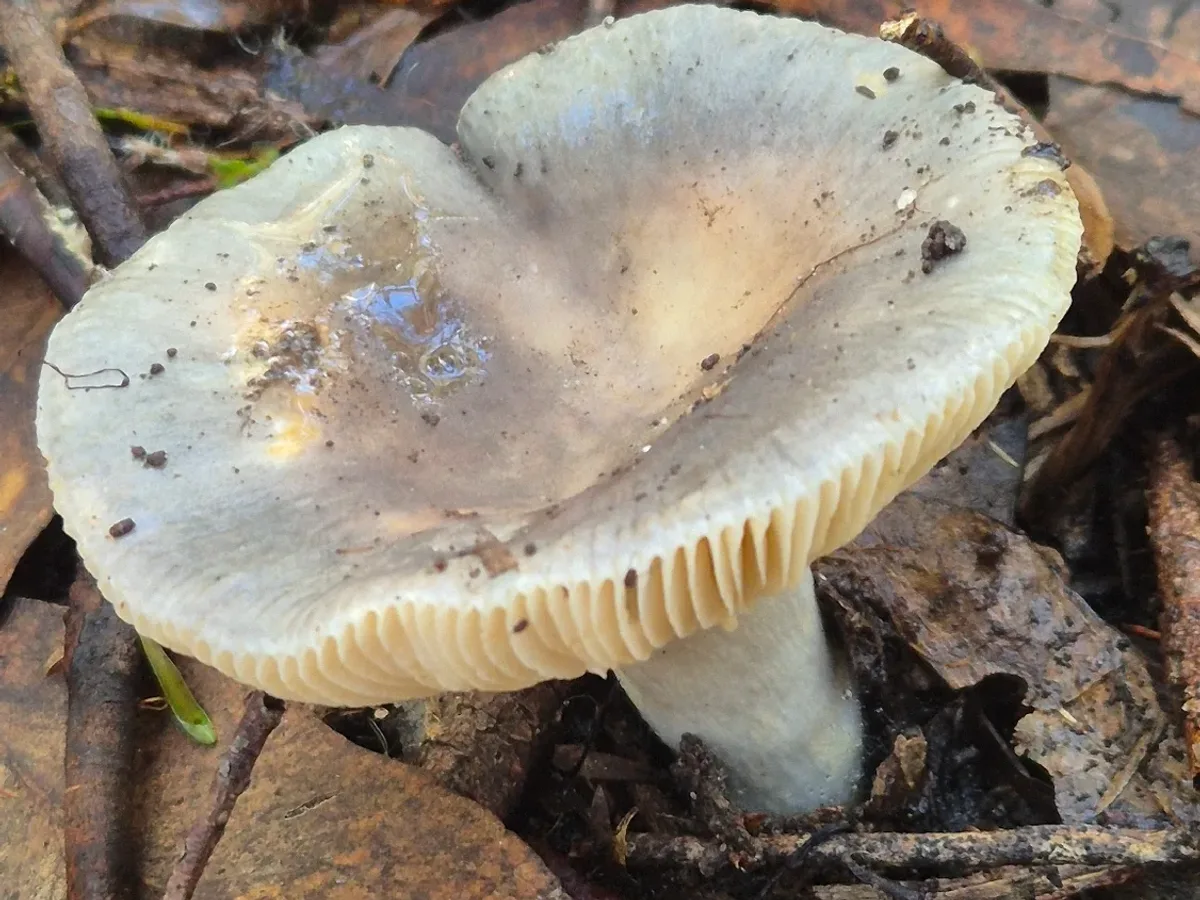
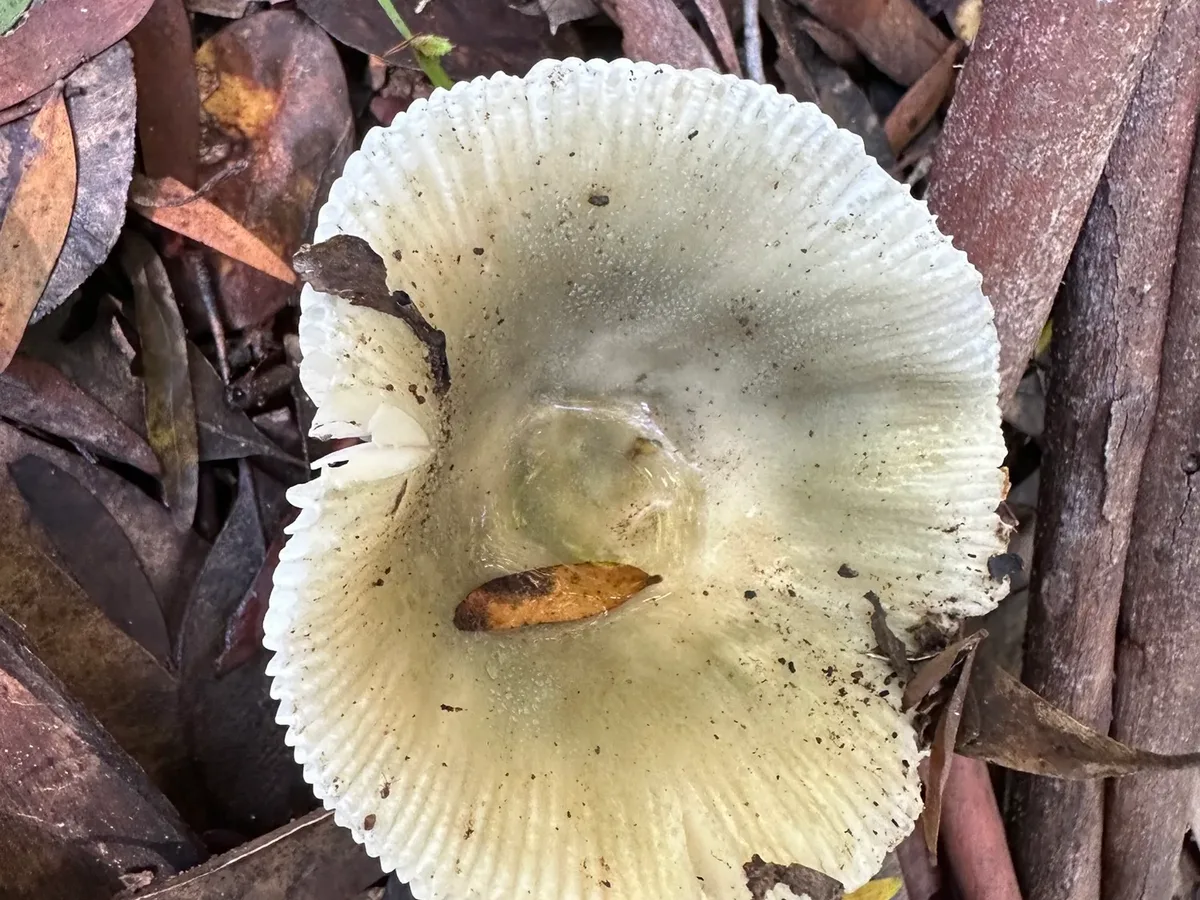
The cap begins as a firm, rounded dome and opens to a broad, nearly flat disc 5-12 cm across, with the cuticle peeling back readily to about a third of the radius.
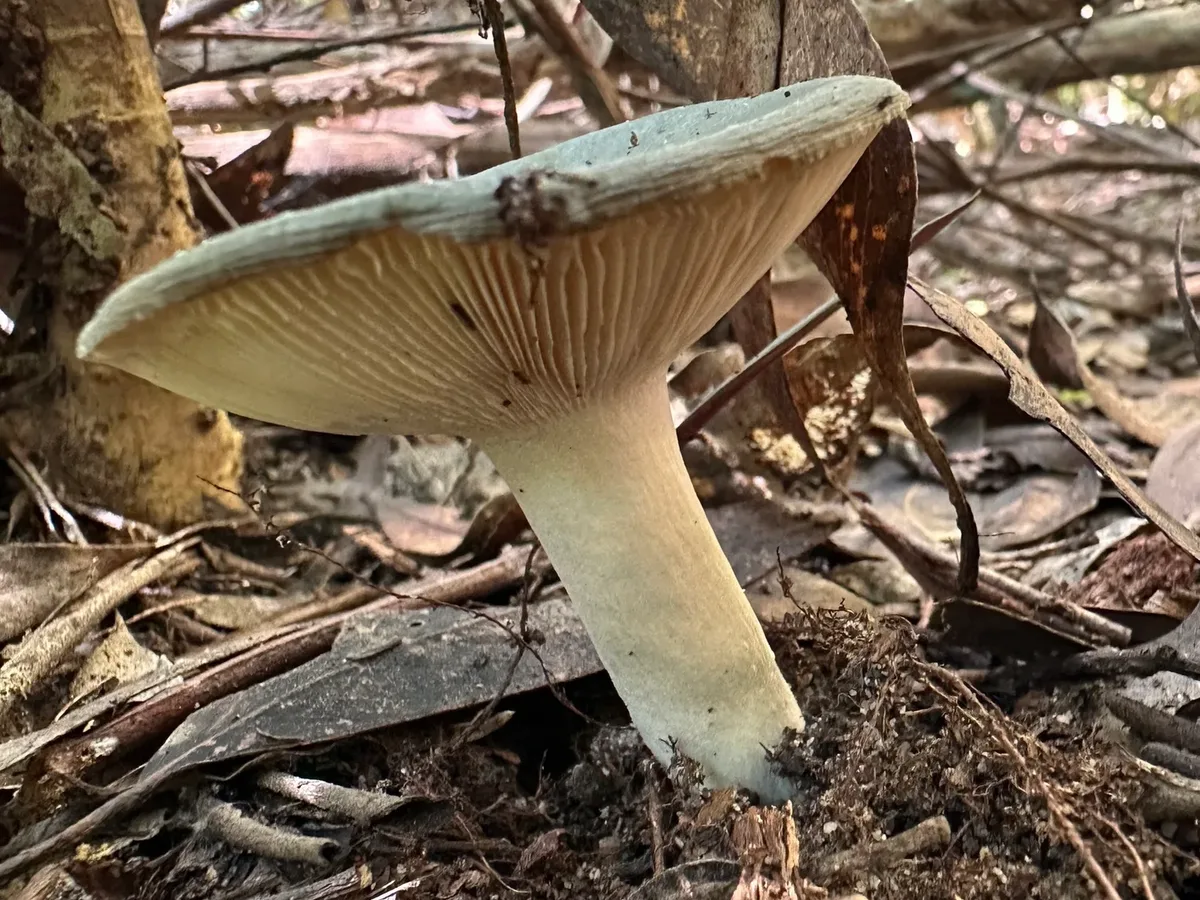
The surface is smooth and slightly slippery after rain, and the colour varies from vivid grass-green when young and fresh to olive-yellow or dull yellowish-green as the cap matures and dries.
Gills
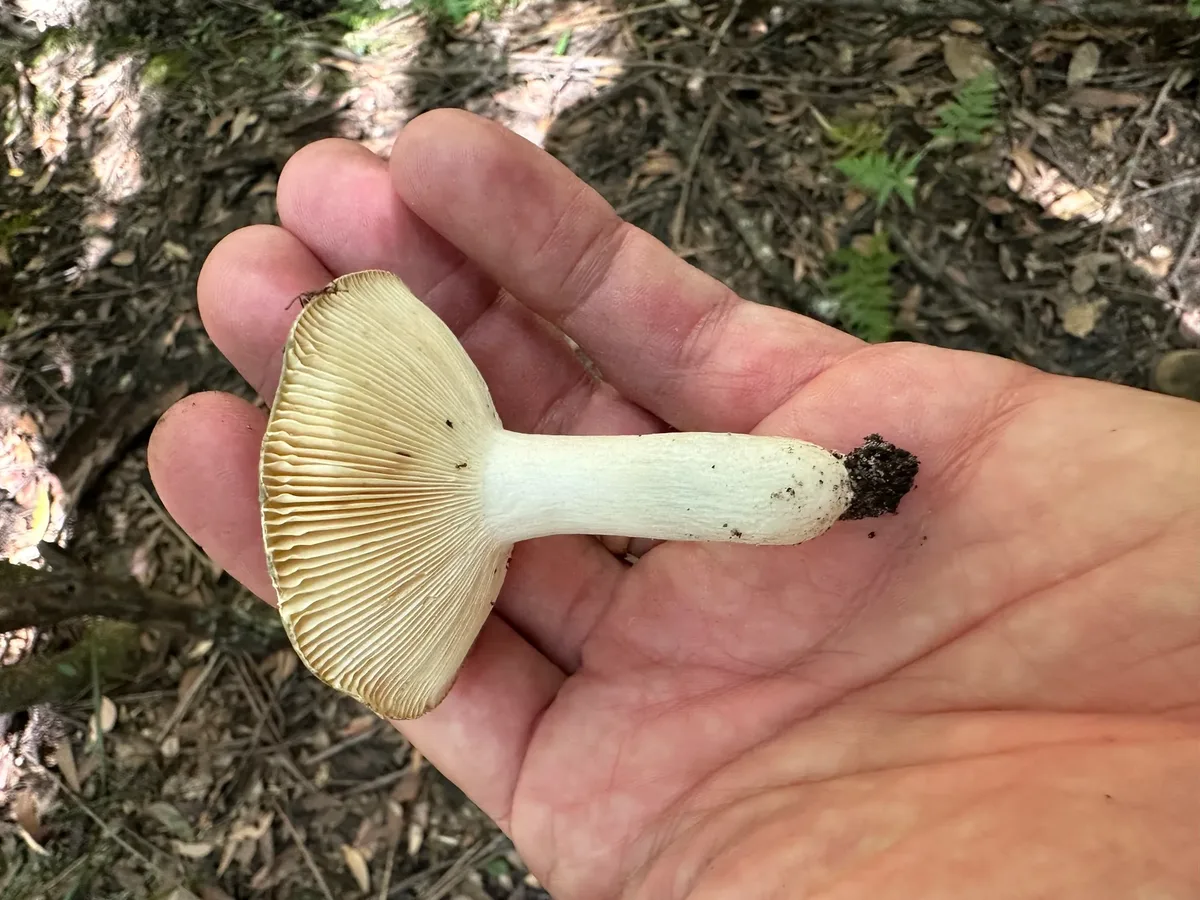
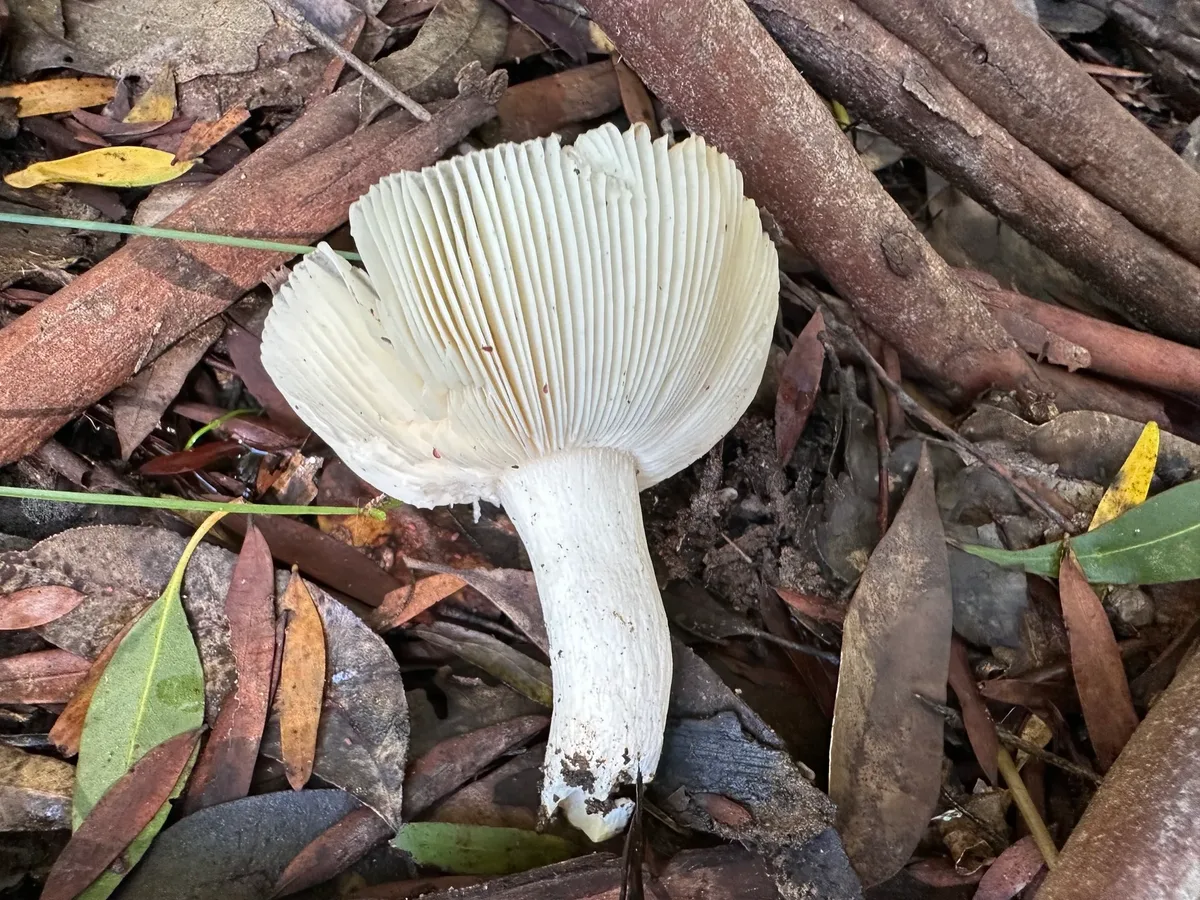
The underside carries white to pale cream gills that are moderately crowded and - critically - brittle: press them and they crumble into dry fragments rather than bending, a trait that defines the entire Russula genus and is one of the most important separating features from dangerous look-alikes.
Stem
The stem is white, cylindrical, firm when young and softening with age, with a smooth dry surface.
There is no ring on the stem and no volva or basal sac at the base: these two absences are the most important safety facts about this mushroom.
Flesh
The flesh is white, firm, and odour-neutral, with a mild, non-acrid taste - neither bitter nor peppery.
Spore print white.
Where & when it grows
Habitat
Russula iterika is an Australian endemic, tied by its ectomycorrhizal biology to native eucalypt-dominated vegetation.
It fruits from the soil within the root zones of Eucalyptus and Corymbia trees in dry and moist sclerophyll forest, grassy eucalypt woodland, and related native vegetation in eastern and southeastern Australia. New South Wales, Victoria, and the ACT represent the core of its known range.
The forest floor habitat is characteristically one of leaf litter and humus over acidic to neutral soils, often where the canopy is open enough for light to reach the ground in patches.
Because it is obligately mycorrhizal it cannot grow without a living tree partner, so it will never appear on rotting wood, compost, or open ground away from native trees.
Finding a green-capped Russula fruiting in native eucalypt woodland in autumn is the expected context for this species.
When
This is an autumn and early-winter mushroom in the Southern Hemisphere. Fruitbodies emerge from roughly March through to July, peaking in April-May as the intense Australian summer heat subsides and meaningful autumn rainfall begins to penetrate the soil.
The underlying soil temperature at fruiting time is typically between about 8°C and 16°C - the cooling trajectory of autumn rather than the warming of spring is the cue.
After a significant rain event of 20 mm or more over a fortnight, expect new caps to push through the litter within 7-14 days if soils are in the right temperature range.
At higher-elevation or wetter sites in southeastern Victoria and the ACT, fruiting can persist into June or early July. The species does not appear in the hot, dry summer months.
How it grows
Grows singly or in small scattered groups on the forest floor, always within the rooting zone of a host eucalypt or corymbia tree.
It does not:
- Cluster tightly
- Fruit on wood
- Appear in cleared or heavily disturbed ground where native tree root systems are absent
As an ectomycorrhizal species, the visible fruitbodies are the temporary reproductive structures of an extensive underground mycelium that lives in intimate contact with the fine roots of host trees - a partnership in which the fungus supplies mineral nutrients and the tree supplies photosynthate.
The same location may produce fruitbodies in successive autumn seasons as long as the host trees remain healthy and conditions are suitable.
Fruiting conditions
Southern Hemisphere autumn species; fruiting triggered by post-summer cooling combined with autumn rainfall. Soil temperatures falling through the 8-16 °C range after 20+ mm of rain over a fortnight prompt fruitbody emergence within one to two weeks. Peak April-May; extends into June-July at higher-elevation or wetter sites.
Look-alikes
The single most dangerous confusion in Australia is with the death cap, Amanita phalloides, which can show a very similar olive-green to grass-green cap, white gills, and pale stem.
The death cap grows in Australian cities and suburbs wherever introduced oak trees are planted - suburbs of Melbourne, Canberra, and Adelaide are documented hotspots.
The death cap is one of the world's most lethal fungi: a single mushroom contains enough amatoxin to kill an adult.
The separating features are absolute and must all be checked. Amanita phalloides:
- Always has a membranous sac-like volva at the base, partially buried in the soil
- Usually has a skirt-like ring on the stem
- Has free gills (not attached to the stem)
- Has flesh that is fibrous rather than chalky-brittle
- Grows only near introduced oak or chestnut trees, not in native eucalypt bush
Russula iterika has NO volva, NO ring, attached brittle gills that crumble, chalky flesh, and grows only in native eucalypt woodland.
Within Russula, the acrid green-capped species Russula virescens (a European import concept rarely applicable in Australia), and various locally occurring Russula with greenish-yellow caps that are acrid-tasting and cause gastrointestinal upset, are separable by their sharply peppery taste - a small fragment chewed and immediately spat will reveal this. R. iterika is mild-tasting.
No currently documented Australian Russula is known to be lethally toxic, but the genus contains dangerous species elsewhere (e.g. Russula subnigricans in East Asia), so 'it is a Russula' is never on its own a guarantee of safety: always confirm the habitat, the non-acrid taste, and most critically the absence of ring and volva.
The most dangerous confusion: the death cap can show an olive-green to grass-green cap strikingly similar in colour to Russula iterika, and is also white-gilled and pale-stemmed. It is the world's most lethal mushroom, reliably fatal from a single specimen and mild-tasting (a taste test will NOT protect you). The death cap ALWAYS has a membranous sac-like volva partially buried at the base of the stem and usually a skirt-like ring on the stem; its gills are free (not attached to the stem) and its flesh is fibrous, tearing in strands rather than breaking with a chalky snap. Russula iterika has NO volva, NO ring, attached gills that crumble when pressed, and flesh that breaks clean across like chalk. The death cap in Australia grows only under introduced oak and chestnut trees in suburbs and parks, not in native eucalypt bush. Excavate the full stem base on every green-capped specimen before collecting.
While typically brown-capped in its northern hemisphere form, Amanita pantherina and related species occur in Australia and can occasionally show pale or washed-out caps. Any Amanita in the same region has a ring, a volva, and free flexible gills - three features entirely absent in Russula iterika. The panther cap causes severe anticholinergic poisoning and is potentially fatal. Always confirm no ring and no volva.
Various Australian Russula species may show greenish or yellowish-green caps and cause gastrointestinal upset if eaten. These are separable from R. iterika by a sharply acrid, peppery taste: a tiny fragment chewed and immediately spat on the tongue will produce a burning sensation. Russula iterika has a consistently mild taste. Acrid Russula species are not lethal but should not be consumed.
A large, ring-bearing mushroom that can occur in Australian lawns and disturbed ground and causes severe gastrointestinal poisoning. It has a prominent ring on a tall stem, pink-to-green-tinged gills at maturity producing a green spore print, and a scaly white-brownish cap. None of these features match Russula iterika (which has a smooth green cap, no ring, no volva, white brittle gills, and a white spore print). Separation is straightforward on close inspection.
In the kitchen
Picking & cleaning
Select firm, young to mid-aged caps; older specimens become soft, discolour, and are prone to maggot infestation.
Cut or twist the stem at the base and always extract the full stem length to inspect the very base. Confirming the complete absence of a volva (a membranous sac or girdled bulb) at the base is non-negotiable before any green-capped mushroom in Australia is considered for the table, because the death cap (Amanita phalloides) - which grows in Australia under introduced oak and chestnut trees - can show a very similar olive-green cap and is deadly.
When you have the stem free, check:
- 1No ring on the stem at any point
- 2No volva, sac, or sheathing base
- 3Gills are white and brittle - they crumble when pressed, never flex
- 4Flesh is white and does not change colour on cutting
- 5Taste of a tiny chewed-then-spat fragment is mild, not acrid
All five checks should be positive for R. iterika. If any doubt remains, do not eat.
Cooking
Russula iterika is a mild-tasting, firm-fleshed mushroom suitable for general cooking once correctly identified. It holds its texture reasonably well when sauteed in butter or oil and is suited to stir-fries, soups, pasta dishes, and omelettes.
The stems can be used but are firmer than the caps; discard any soggy or maggot-affected tissue.
Thorough cooking is always advisable - never eat wild mushrooms raw.
The cap cuticle can be peeled away before cooking if desired, though it is not necessary. Always cook from fresh; russulas do not dry as well as boletes or chanterelles.
Good to know
Russula iterika is considered edible and no toxicity has been documented for it.
However, the safety context in Australia demands exceptional care, because the death cap (Amanita phalloides) shares the same geographical region, can closely mimic its olive-green cap colour, and kills reliably and quickly even when consumed in small quantities.
The death cap is mild-tasting - a taste test will not detect it.
The only reliable field separation is structural. Excavate the full base of the stem and confirm:
- No sac-like volva
- No ring on the stem
- Gills are brittle and attached rather than free and flexible
These checks must be done on every individual specimen before it enters the basket, because a single death cap mixed into a harvest of edible mushrooms can be fatal.
Russula iterika occurs in native eucalypt bush; the death cap occurs primarily in suburban and planted parks under exotic oaks. Collecting in undisturbed native eucalypt woodland away from introduced oak trees significantly reduces the risk, but is not a substitute for correct structural identification.
If any specimen shows a ring, a volva, or free flexible gills, discard the entire harvest and seek medical advice if any has been consumed.
In Australia, the Poisons Information Centre is 13 11 26.
A reference guide - never an edibility guarantee. When in doubt, leave it out.