Short-Stemmed Russula
Russula brevipessyn. Russula brevipes Peck, Russula brevipes var. acrior Shaffer, Russula delica sensu auct. amer. (misapplied)
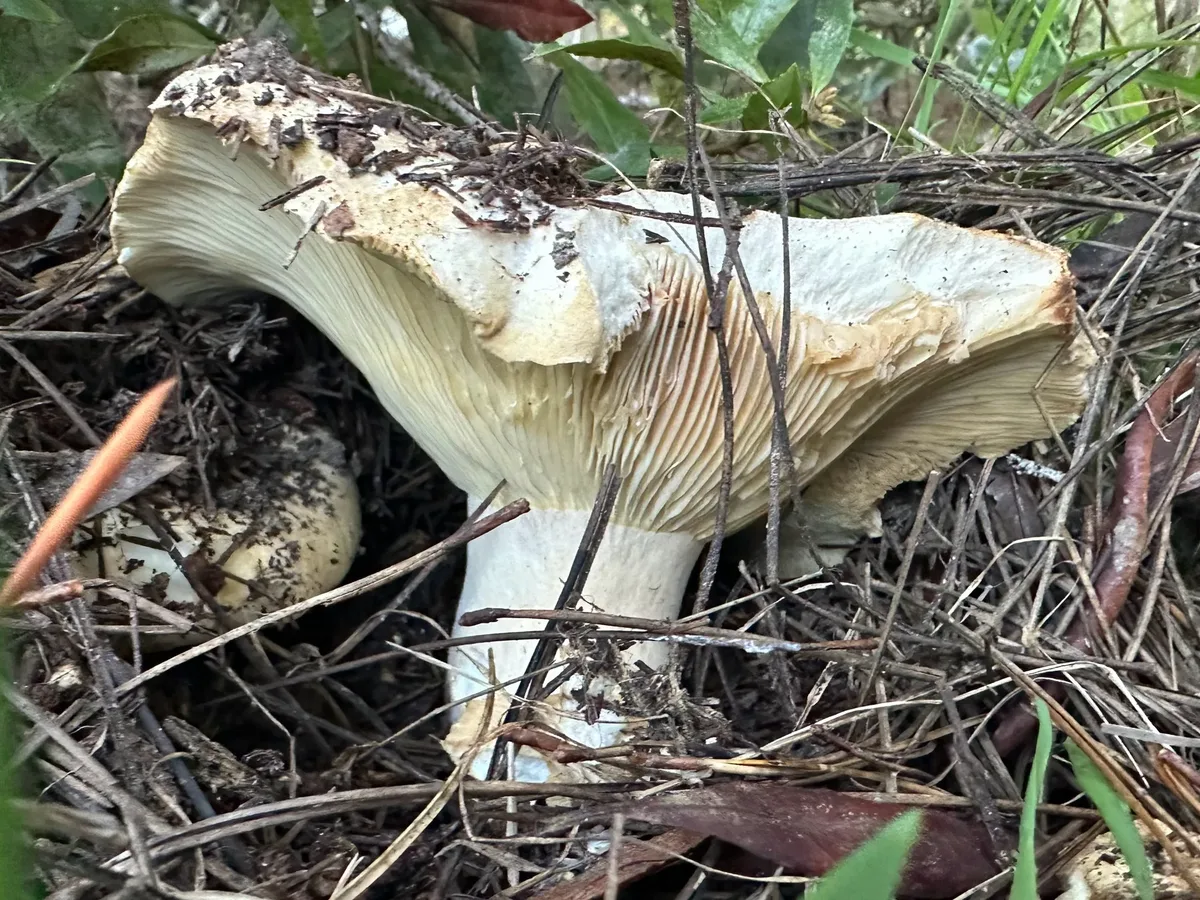 © Kyle Elshoff (CC BY)
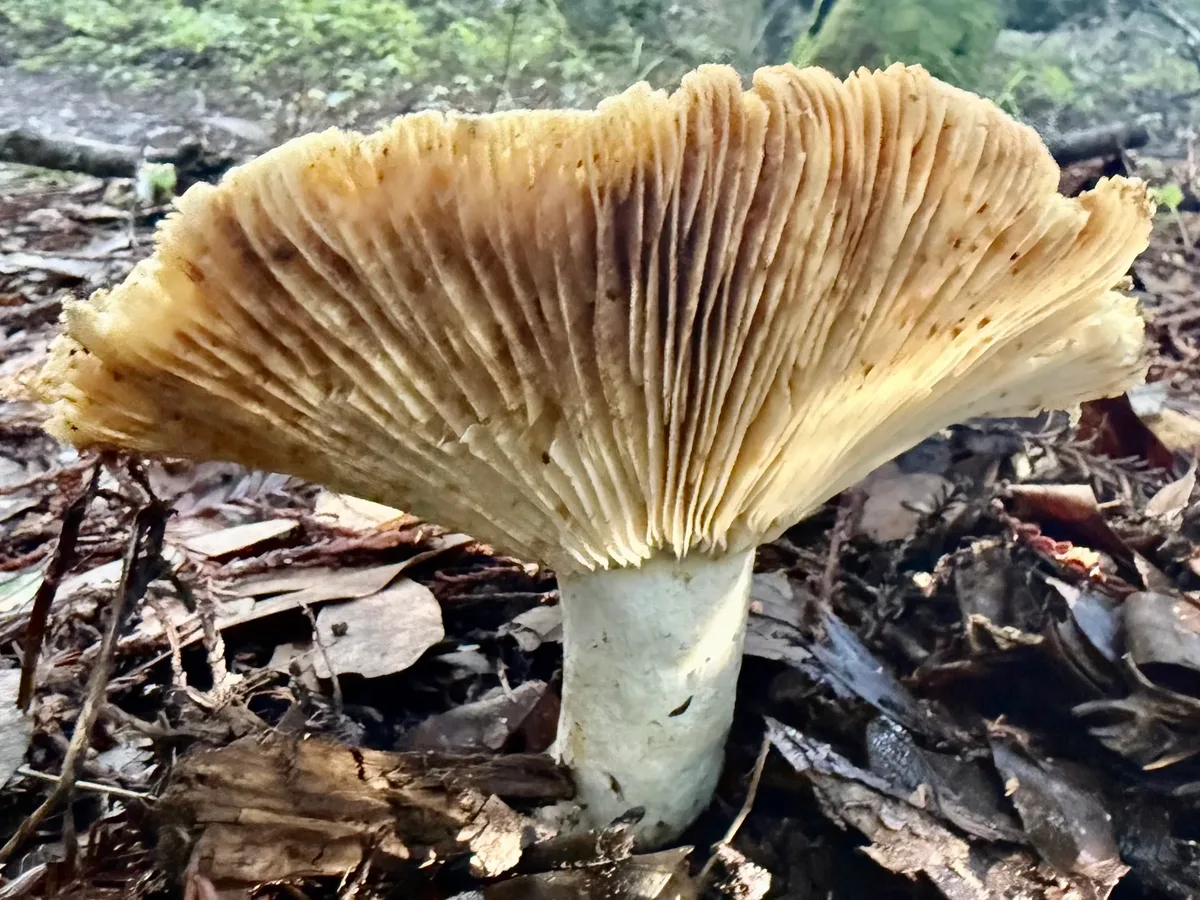 Chuck Wilson (CC0)
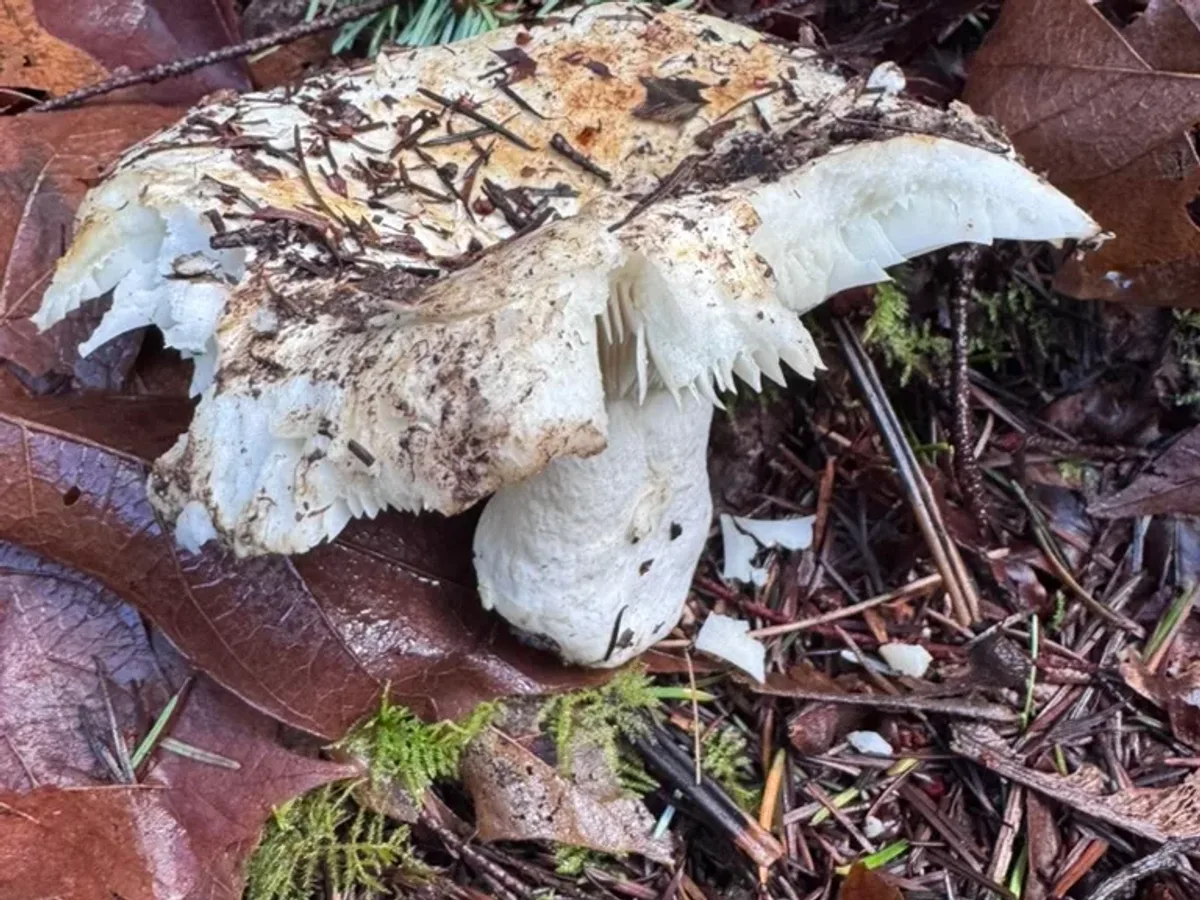 © dpcmiller (CC BY)
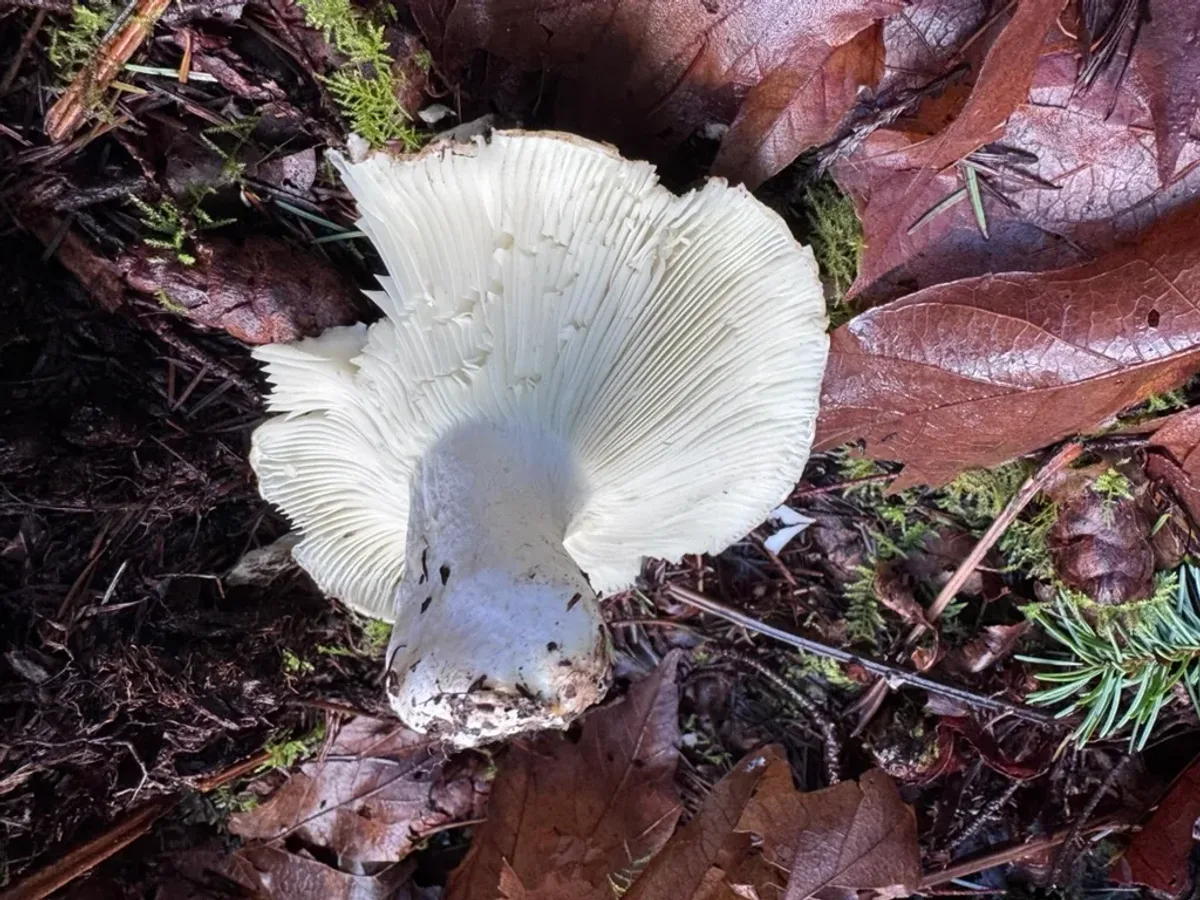 © dpcmiller (CC BY)
 Chuck Wilson (CC0)
 Chuck Wilson (CC0)
 Chuck Wilson (CC0)© Kyle Elshoff (CC BY)Chuck Wilson (CC0)
Good to eat, once you have identified it with certainty and cooked it through.
Never eat a mushroom you are not 100% sure of - check the look-alikes below, and always cook wild mushrooms.
How to recognise it
Russula brevipes is one of the most massive brittlegills in North America, with caps that routinely exceed 20 cm across and a build that is distinctly stouter and more deeply vase-shaped than its European counterpart Russula delica.
Cap
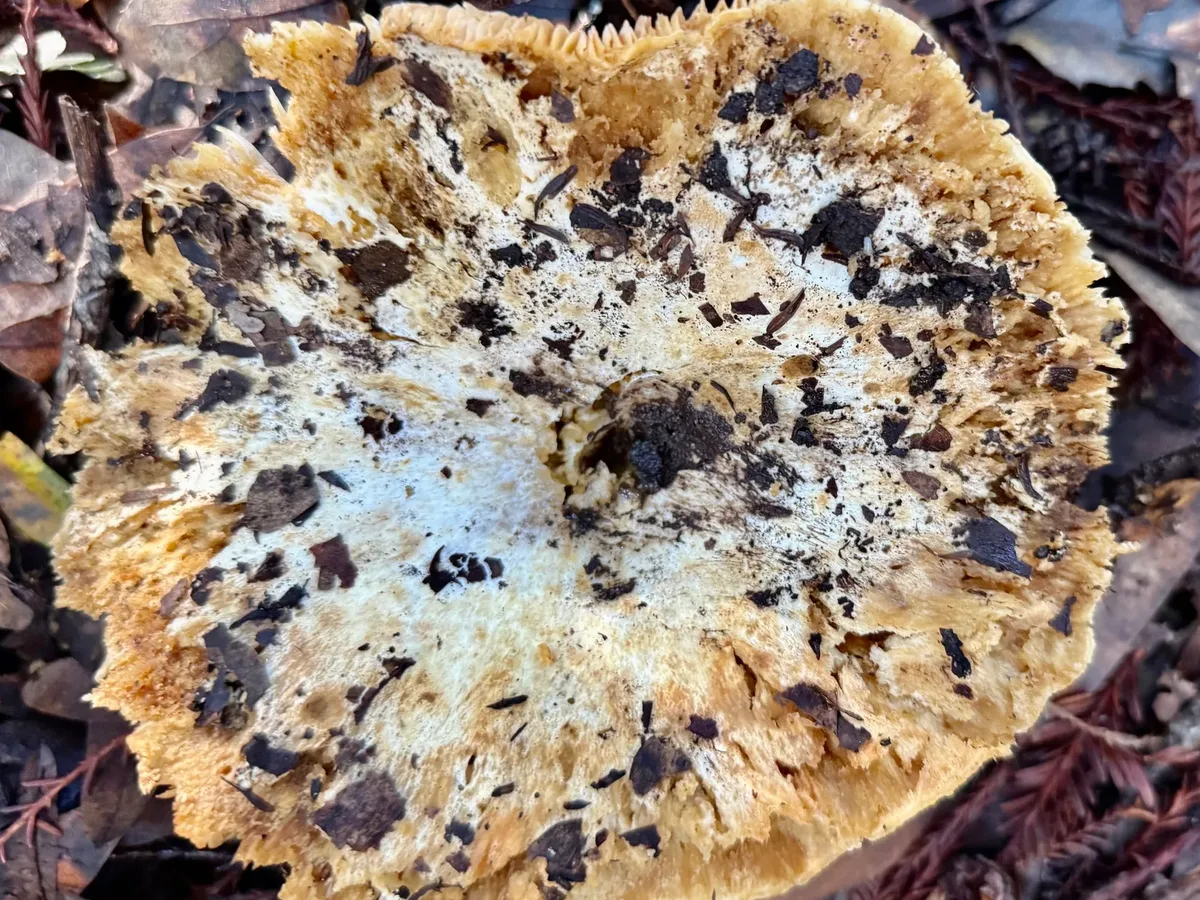
The cap starts off as a buried white dome barely distinguishable from a potato or puffball, then flattens and sinks into a broad, deep funnel - sometimes so steeply so that the centre collects debris and water.
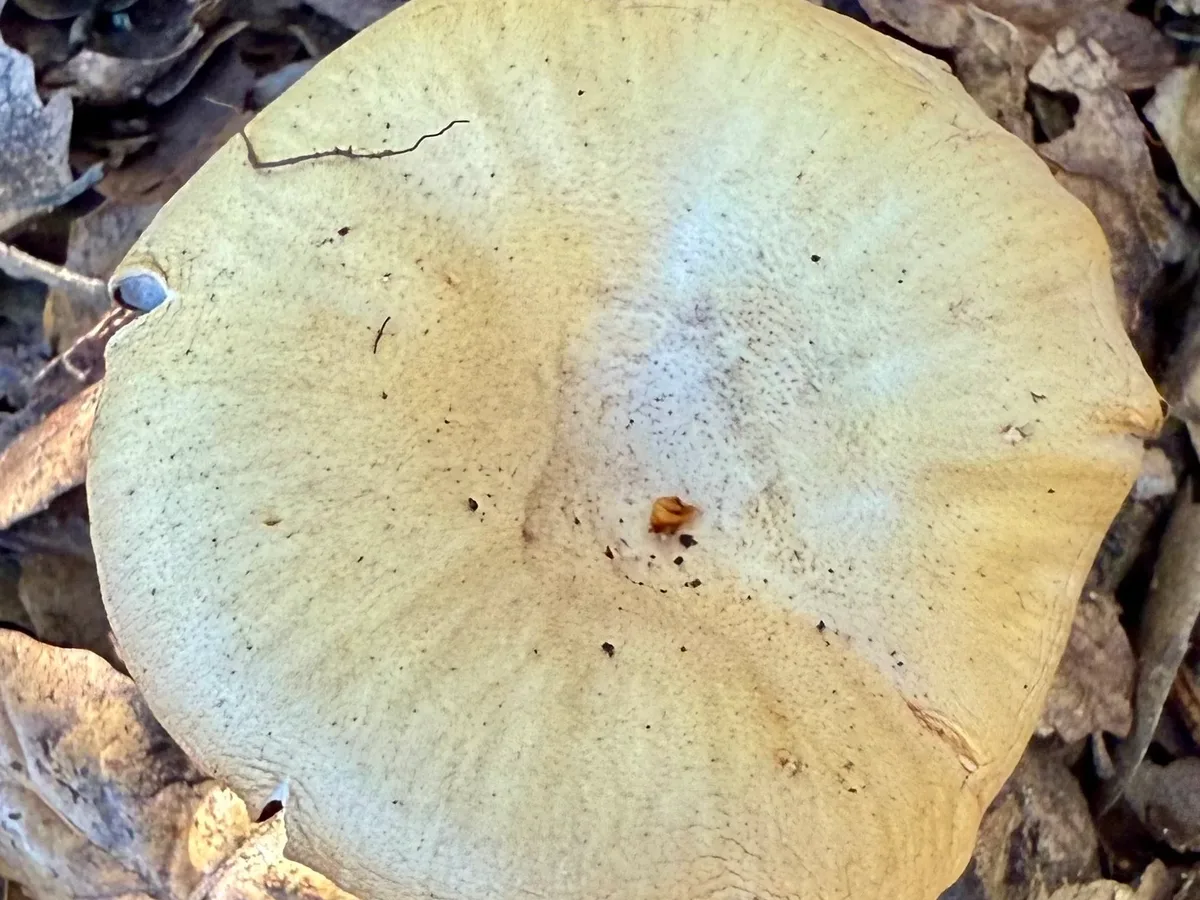
The colour is predominantly white to cream, often developing ochre or tan staining at the centre or across the whole surface in age; specimens found in good condition in the forest are often mottled buff and cream rather than pure white.
The margin stays enrolled for a long time and may remain wavy or irregular even at full expansion.
Flesh
The flesh is impressively thick and dense, white throughout, with no colour change whatsoever on cutting or bruising - a critical negative character that rules out both Lactarius (which bleeds latex) and bluing boletes.
Gills / Pores
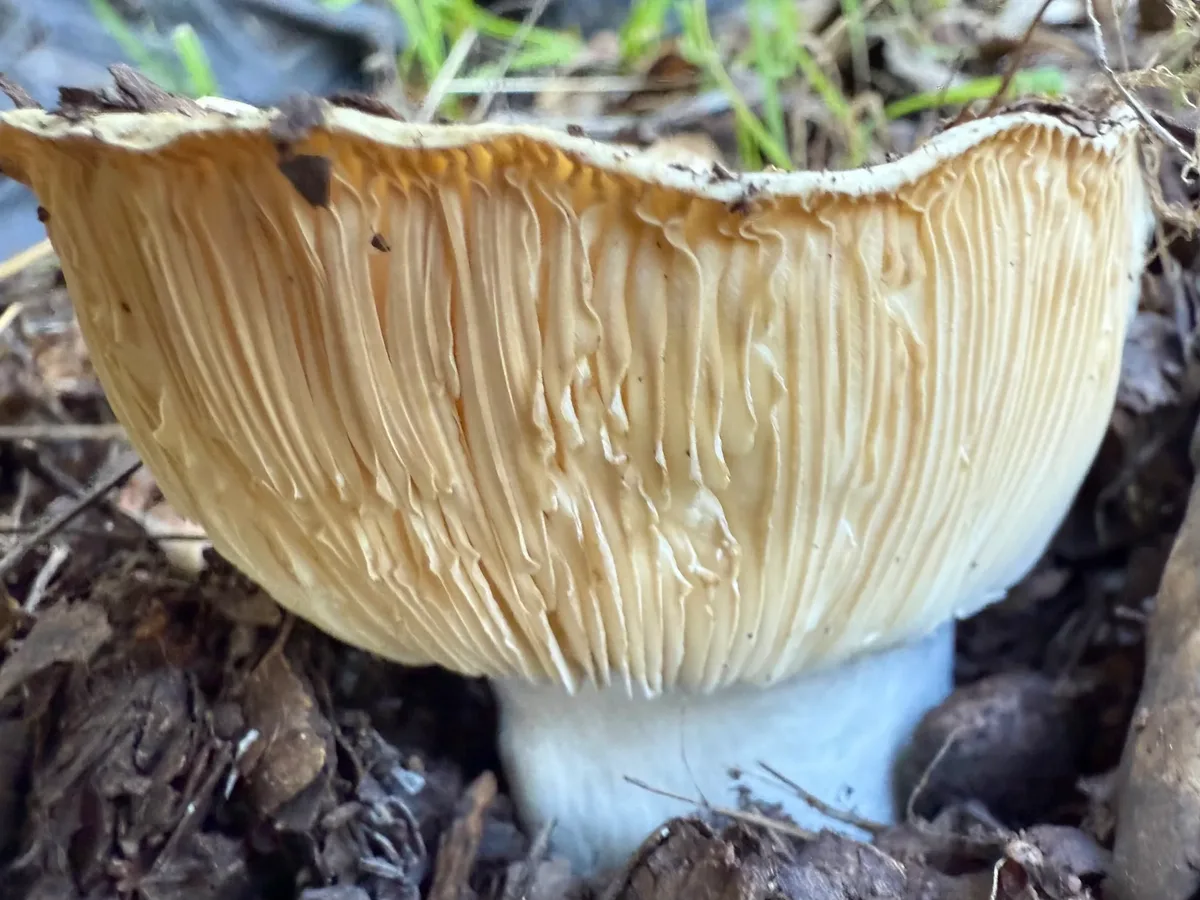
The gills are white, crowded, somewhat narrow, and decurrent, running slightly down the stem. They are brittle in the Russula manner - rub them and they crumble rather than bending.
Stem
The stem is the feature that gives the species its name: unusually short for the large cap, stubby and barrel-like, white, solid, and very firm. There is no ring or volva at any stage.
Smell & taste
The smell is mild to faintly pleasant. A small piece of raw flesh chewed and immediately spat out should taste mild or very faintly acidic - not burning, not powerfully acrid.
The spore print is white to very pale cream.
Microscopically, the spores are large (up to 12 µm), broadly ellipsoid to subglobose, with isolated amyloid warts and short partial ridges that do not form a complete reticulum.
Where & when it grows
Habitat
Russula brevipes is a quintessential mycorrhizal partner of Pacific Northwest conifers. It is most abundant in the old-growth and second-growth conifer forests that define the region:
- Douglas-fir, Sitka spruce, and western hemlock in the fog-belt coastal ranges
- true firs and mountain hemlock in the Cascades
- ponderosa pine in the drier east-slope forests
The relationship is strongly conifer-biased in the PNW, though in eastern North America the species also associates with spruce and fir in the boreal-transition zone.
It is characteristic of well-established forest, where it occupies the deep needle-duff and mineral soil horizon directly below the litter layer.
Its tendency to fruit partly buried in this duff is not incidental - the fruiting body actually develops below the surface and emerges slowly, which is why half-emerged caps with the still-enrolled margin are a typical field encounter.
In logged areas and young second growth, its frequency drops markedly; it favours mature stands where the ectomycorrhizal web is well established.
When
In the Pacific Northwest the season aligns with the return of autumn rains after the long summer dry season - one of the most reliable ecological pulses in the region.
The first significant autumn rain event (typically September) triggers a flush of mycorrhizal fruiting that includes R. brevipes among its early participants.
Fruiting continues in waves through October and November, often the single most abundant large white mushroom in coastal conifer forest during peak season. In mild wet winters it can persist into December.
Individual fruiting bodies are relatively long-lived - the dense, firm flesh resists decay - and old specimens in various stages of browning and collapse are common markers of productive patches.
In higher-elevation Cascade forests the season compresses into September-October.
How it grows
Solitary to scattered across the root zone of host trees, rarely forming tight clusters.
Growth begins entirely underground. The developing button is entirely enclosed in duff or soil, and is first detectable as a slight mound or small crack in the surface.
The cap slowly pushes upward, the margin remaining enrolled until the stipe elongates enough to lift the cap free. This subterranean button stage can superficially resemble a buried Amanita egg, making the base check mandatory.
Once emerged, the cap expands relatively slowly over one to two weeks, and the fruiting body may persist in the forest for a further two weeks before collapsing.
Russula brevipes is also the primary host for Hypomyces lactifluorum, the 'lobster mushroom' parasite. When infected, the entire surface is coated in a brilliant orange-red ascomycete crust that completely alters the appearance, distorts the shape, and, paradoxically, improves the flavour and is itself edible.
Fruiting conditions
In the Pacific Northwest, fruiting is triggered by the return of autumn rains after the summer drought - typically the first significant rain event of September that rehydrates the duff layer and cools soil temperatures below 16 °C. The 14-day rainfall threshold is higher than for many mushrooms (30+ mm) because the thick needle-duff must be fully rewetted before hyphal activity resumes. Individual fruiting bodies develop slowly (one to two weeks) and persist for a further two weeks; productive patches can yield multiple flushes across the October-November window as successive rain events arrive.
Look-alikes
The lookalike landscape for Russula brevipes centres on two zones of risk:
- large white mushrooms partially buried in conifer duff, where the deadly Amanita species overlap
- other large white funnel-shaped fruiters (Lactarius and related species)
The most dangerous confusion in the Pacific Northwest is with Amanita smithiana, a large, white Amanita of conifer forests in the PNW that causes severe nephrotoxic kidney failure.
It is white overall, emerging from soil in conifer duff, with a relatively large cap and short stout build that can superficially suggest R. brevipes when the buried button is partly emerged.
Amanita smithiana has a ragged, floury-mealy odour, a shaggy-scaly or powdery white cap, a ring on the stem, and a basal bulb enclosed in a loose universal veil remnant. Russula brevipes has no ring, no volva or bulb, and smooth to very finely pruinose cap surface.
The distinction is life-critical: A. smithiana poisoning causes delayed-onset kidney failure requiring dialysis, and deaths have occurred.
Amanita phalloides (death cap) is established in the Pacific Northwest and grows in the same conifer forests. Its buried button stage - a white, oval egg in the soil - can resemble a sub-emerged Russula cap.
Once expanded, A. phalloides shows an olive-green to yellow-brown cap, free gills, a skirt-like ring on the stem, and a volva. Russula brevipes is always white, has decurrent attached gills, and no ring or volva at any stage.
Lactarius piperatus and Lactarius subvellereus are large, white, funnel-shaped milkcaps that share the same broadly infundibuliform profile as R. brevipes in the same forest types.
The latex test is definitive: nick or break a gill - Lactarius species instantly exude white milk (latex); Russula brevipes produces none whatsoever.
L. piperatus has extremely crowded, narrow gills and an intensely acrid burning taste; taste-testing a tiny piece and spitting is a useful confirmation but should not be the primary check.
A lobster-mushroom-parasitised R. brevipes (covered in orange Hypomyces lactifluorum crust) is unrecognisable as a Russula in appearance but is safe to eat. The orange crust is completely diagnostic - no deadly species mimics this appearance.
Russula delica is the European counterpart: very similar in size, shape, and colour, with overlapping taxonomy in older literature. It is mainly European and does not occur in the Pacific Northwest.
Established in PNW (introduced, spreading). Buried buttons are white, oval, and egg-like in the soil - they can be confused with any emerging pale cap. Once expanded, the death cap has an olive-green to yellow-brown cap, a membranous volva (sac) at the base, a skirt-like ring on the stem, and free gills (not decurrent). R. brevipes is white throughout, has decurrent crowded gills, and absolutely no ring or volva. The death cap's mild taste is not a reliable safety check - always dig up the entire base. Contains amatoxins; lethal in small amounts.
The western destroying angel is pure white in all stages, growing in PNW and California under oak and pine. Its egg stage in the soil is completely white and could be confused with an emerging R. brevipes button. Once expanded: pure white cap, ring on stem, membranous white volva at base, free gills. R. brevipes has no ring, no volva, and attached-decurrent gills. Contains lethal amatoxins.
Amanita smithiana is a large, white Amanita of PNW conifer forests that causes severe delayed-onset kidney failure (nephrotoxic amino acids) and has caused deaths. It is white overall, emerging from conifer duff, and partially buried buttons can superficially resemble R. brevipes. Key differences: A. smithiana has a distinctly mealy-floury smell, a ragged or shaggy-scaly white cap surface, a visible ring on the stem, and a basal bulb enclosed in a loose volval sheath. Russula brevipes has NO ring, NO volva, NO basal bulb, and a smooth to finely pruinose cap. Always fully excavate the stem base and confirm the absence of a ring and volva before consuming any large white mushroom from PNW conifer duff. This is a life-critical check.
Not a separate mushroom but R. brevipes (or a Lactarius species) completely colonised by the ascomycete parasite Hypomyces lactifluorum, resulting in a distorted, firm, brilliant orange-red fruiting body with no visible gills. The lobster mushroom is safe to eat and widely enjoyed; the complete orange coating is completely unlike any deadly species. Include here as a note: some foragers are alarmed by the appearance or uncertain of the host. If in doubt, remember that no deadly Amanita is ever parasitised to produce an orange crust of this type.
The European ecological equivalent; considered a distinct species by modern taxonomy. R. delica is primarily European and does not occur in the Pacific Northwest. In areas of overlap in older literature the names were sometimes used interchangeably. R. brevipes tends to be larger, more deeply infundibuliform, and associated with North American conifers. No safety concern between the two - both are edible - but accurate naming matters for documentation.
Large, white, funnel-shaped - very similar overall profile. The definitive test: nick or break a gill; L. piperatus immediately weeps copious white latex (milk); R. brevipes produces no latex whatsoever. Gills in L. piperatus are extremely narrow and densely crowded; taste is intensely acrid-burning. Not deadly, but causes severe gastrointestinal irritation if eaten raw.
Another large white milkcap of North American conifer forests. Cap surface is distinctly velvety-felty (versus smooth to pruinose in R. brevipes). Gills exude white latex when cut or broken - R. brevipes never does. Acrid taste. Not deadly but an irritant species.
In the kitchen
Picking & cleaning
Select firm, young to mid-aged specimens with white, unbroken flesh.
Because the cap is often partially buried, insert a knife blade into the soil beside the stem and cut downward, then lever the fruiting body free. Do not rip it, as this tears roots and leaves embedded base material that may seed future confusion.
Always fully expose the base of the stem: pull aside duff and examine down to where the stem meets the soil.
The presence of a volva (membranous cup or sac) at the base means the specimen is a deadly Amanita - do not eat it. Russula brevipes has a cleanly tapered or abruptly terminating stem base with no cup, no ring, and no basal bulb.
Cross-section the flesh in the field: confirm it is uniformly white with no colour change, no zones of colour, and no latex.
The gills should crumble when rubbed - if they bend and are flexible and greasy, you may have a Lactarius.
Carry in a rigid, wide basket; the brittle flesh bruises easily.
Lobster-mushroom specimens (orange-coated R. brevipes or Lactarius) are safe to collect as a separate prize and should be transported separately to avoid orange staining of other specimens.
Cooking
Russula brevipes is edible but unremarkable on the plate. The flesh is dense and holds its shape well, but it is relatively mild and can be watery.
It is best suited to long, high-heat cooking to drive off moisture: slice thickly and sear in a very hot pan with butter or oil until golden and lightly caramelised on the cut surfaces, then season aggressively.
It absorbs other flavours well and is useful in mixed-mushroom preparations, soups, and stews where it provides bulk and texture. Discard old, waterlogged or insect-damaged specimens.
The lobster mushroom form (bright orange, parasitised specimens) is firmer, denser, has a subtly seafood-like flavour, and is considered superior to the unparasitised species. Cook it the same way, but note that the orange surface colour fades somewhat on heating.
Always cook thoroughly; never eat raw.
Good to know
Russula brevipes is genuinely edible with a long history of safe consumption in North America, but it is bland and watery and is generally regarded as a low-priority edible.
Some collections of var. acrior have a mildly acrid raw taste that may cause mild gastrointestinal discomfort if eaten raw or undercooked. As with all Russula species, thorough cooking is recommended.
The lobster mushroom form (R. brevipes parasitised by Hypomyces lactifluorum) is widely eaten and considered better-tasting than the plain species.
The overriding safety concern is not the species itself but the risk of confusing its buried button stage with Amanita smithiana (nephrotoxic, PNW conifer forest, deadly) or A. phalloides (deadly, PNW).
The identification protocol must be applied every time without exception:
- 1Fully excavate the stem base and confirm no volva, no ring, no basal bulb - this step is life-critical.
- 2Cut the gills and confirm no latex.
- 3Confirm the flesh is white, unchanging, and dense, with no ring on the stem.
Never collect any white, large, partially buried mushroom from conifer duff without completing all three checks. Never eat wild mushrooms raw.
A reference guide - never an edibility guarantee. When in doubt, leave it out.