Charming Brittlegill
Russula amoenasyn. Russula amoena Quél., Russula velenovskyi auct. (misapplied in part)
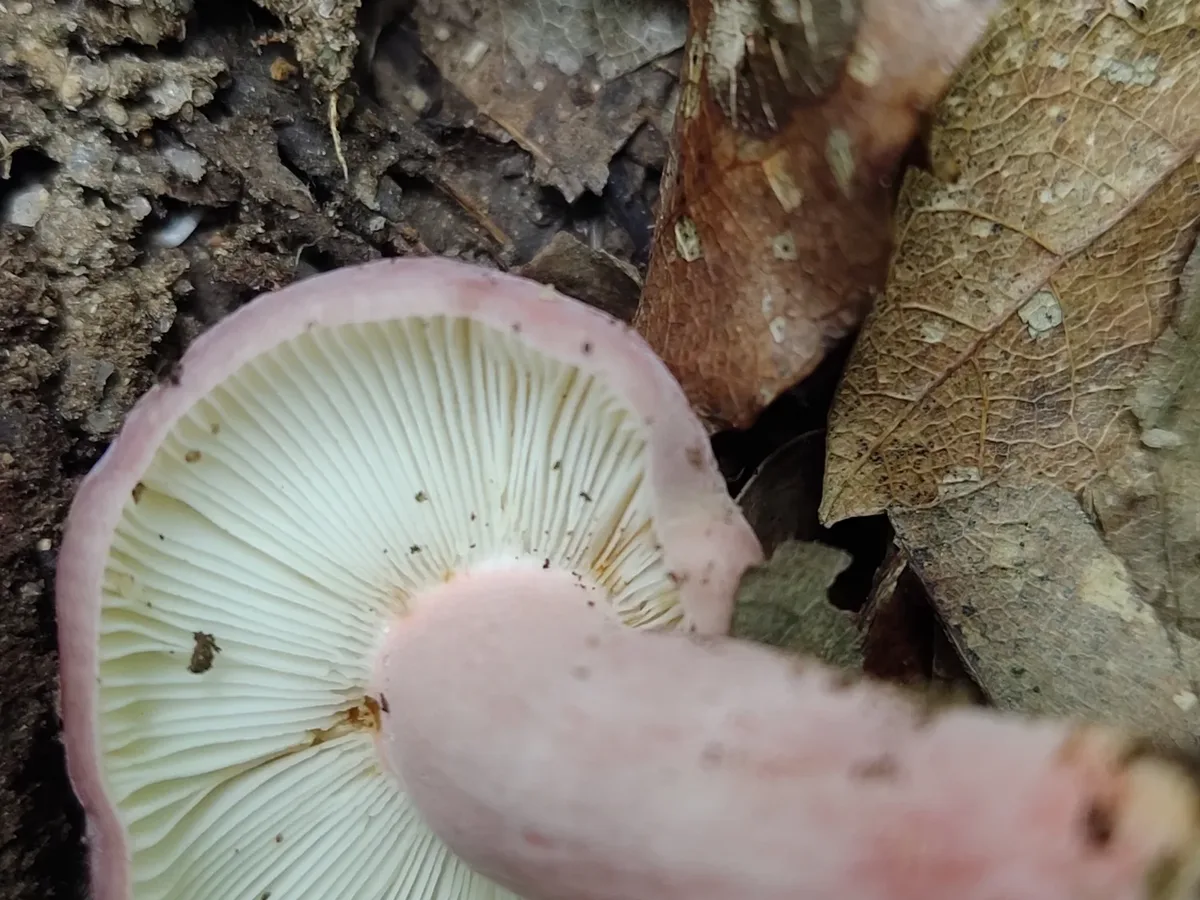 © Carminda Santos (CC BY)
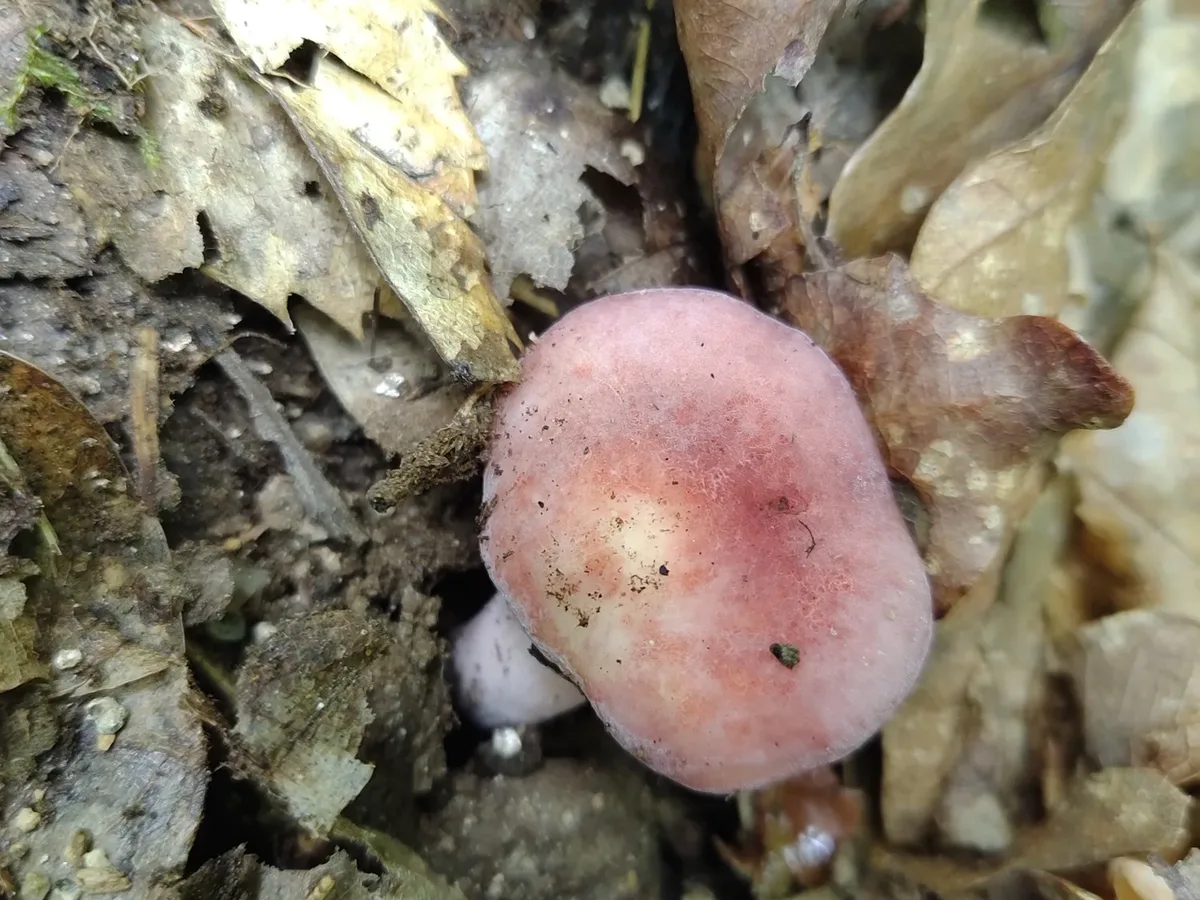 © Carminda Santos (CC BY)© Carminda Santos (CC BY)© Carminda Santos (CC BY)
Good to eat, once you have identified it with certainty and cooked it through.
Never eat a mushroom you are not 100% sure of - check the look-alikes below, and always cook wild mushrooms.
How to recognise it
Russula amoena is a medium-sized, firm-fleshed brittlegill distinguished above all by its handsome violet, lilac or wine-purple cap tones - a colouration that sets it apart from the majority of dull-capped woodland Russulas.
Cap
The cap ranges from 4-9 cm and changes shape from a hemisphere through convex to broadly flat, often with a gentle central depression developing as the fruitbody ages.
The surface is distinctly viscid in wet weather and dries to a matte or faintly velvety finish. Its colour - a blend of violet-purple, bluish-lilac, olive-violet and wine-purple - is typically deepest at the disc and fades through lilac-grey toward the margin, which becomes finely ribbed or warty at maturity.
The cuticle can be peeled about a third of the way to the centre, a moderately useful test but not diagnostic alone since many Russulas share it.
Gills
The crowded, white to cream gills are the key genus marker: they are glass-brittle and shatter cleanly when pressed (a flake breaks off rather than bending), and they produce a white to faintly cream spore print.
Stem
The white stem is firm and cylindrical, sometimes showing a slight violet tinge at its very apex when fresh.
Flesh
Flesh is white, firm, non-bluing and produces no milk (milk is the diagnostic of Lactarius, not Russula).
Smell & taste
The smell is mild and distinctly pleasant - faintly fruity or honey-apricot in character. The taste of a tiny chewed fragment is mild, non-peppery and non-acrid, which is critical for safety determination.
Where & when it grows
Habitat
Russula amoena lives as a mycorrhizal partner of deciduous trees - its mycelium threads through the soil and knits with the fine roots of its host, trading mineral nutrients for the sugars the tree produces above.
It is most at home in mature oak and beech woodland on moderately acid to neutral soils, but it also pairs with hornbeam, sweet chestnut and hazel.
In central-western Europe it has a reputation as a thermophilous species - one that favours sheltered, warmer conditions - and it is correspondingly commonest in the oceanic and sub-continental zones of France, the Benelux countries, Germany and central Europe.
Within its preferred woodland it grows on the soil surface among fallen leaves, singly or in small scattered groups rather than dense clusters. Look for it in well-established, structurally mature woodland rather than young plantations.
When
Russula amoena belongs to the summer and autumn cohort of brittlegills, rarely appearing before late July in central Europe and reaching its peak through August and September.
Fruitbodies emerge when the conditions underground are right: soil temperatures in the range of roughly 12-20 °C, combined with sustained moisture from at least 10-20 mm of rain, prompt the mycelium to push up its caps - usually with a lag of one to two weeks after a warm, wet spell.
In warmer, more southerly sites fruitbodies can persist into October, and mild autumns occasionally extend the season further. The species is absent or very scarce in purely northern coniferous forest zones.
How it grows
Fruitbodies arise singly or scattered in small groups on the woodland floor, often partly hidden under leaf litter.
Like all Russulas, the entire fruiting body shapes itself underground before the cap breaks the surface - what you find in the leaf litter is the finished product of a process that has been quietly underway for days.
The flesh is firm and fairly durable early in the season but becomes soft, spongy and unappealing with age. Like most Russulas it is prone to larval infestation - slice the stem base lengthways before collecting to check.
Fruiting conditions
Fruits after warm, humid summer and early-autumn weather in broadleaf woodland. Requires sustained soil moisture and moderate warmth; responds to summer rain events with a flush lag of roughly one to two weeks as is typical of mycorrhizal Russulas.
Look-alikes
Several Russula species share violet, purple or lilac cap tones and could be confused with R. amoena:
- Russula ionochlora (formerly included under R. amoena by some authors) has a similar cap colour but slightly firmer gills and slightly different habitat preferences; it is equally mild and edible.
- Russula lilacina has rich pinkish-lilac cap tones but tends to a more slender habit and grows predominantly under alder.
- Russula violacea and R. azurea are further violet-capped species of similar edibility.
A forager familiar with the genus will recognize the shared mild-taste, white-spore pattern across this group.
More importantly, beginners sometimes confuse any firm-fleshed, pale-gilled woodland mushroom with Amanita species at a glance - a catastrophic error.
Amanita phalloides (death cap) and A. virosa (destroying angel) are white-gilled but have:
- a clear ring on the stem
- a membranous sac (volva) at the swollen, buried stem base
- tough, fibrous flesh that does not shatter
The caps are greenish to white, not violet. Neither feature is present in any Russula.
Confirming the genus is the single most important safety step.
Deadly - contains amatoxins that cause lethal liver and kidney failure days after ingestion. Distinguished from R. amoena by the sac-like volva (bag) at the swollen base (often underground - dig it up to check), a clearly defined ring (annulus) on the upper stem, a greenish to olive-yellow cap without brittle gills, and tough fibrous flesh that does not crumble. Russula has none of these features. Always unearth the stem base before eating any pale-gilled woodland mushroom.
Confusion with R. amoena is implausible in practice: Amanita virosa is pure white throughout (cap, gills, stem, flesh) while R. amoena displays an unmistakable violet, lilac or wine-purple cap. The entry is retained as a genus-level structural reminder. A. virosa carries the same amatoxin profile as death cap - lethal liver failure days after ingestion. The structural checks that rule out any Amanita are absolute: look for a sac-like volva at the buried stem base and a ring on the upper stem. Both are absent in all Russula. Additionally, Amanita flesh is fibrous and does not shatter; Russula gills crumble and fragment when pressed. Colour alone is never sufficient - always verify volva and ring by unearthing the stem base before collecting any pale-gilled woodland mushroom.
Edible; cap blue-violet, often more purely azure without olive, associated specifically with spruce and silver fir in montane mixed forest. The conifer habitat preference and purer blue-violet hue help separate it from the broadleaf-associated R. amoena. Mild taste.
Very similar, also edible; cap typically shows more green-olive tones mixed into the lilac and the gills may be slightly more resistant. The two were sometimes treated as conspecific. Both have mild taste and white spore print; no safety distinction, only taxonomic.
Edible; rich pinkish-lilac cap, slender habit, predominantly associated with alder in wet woodland. Cap surface tends more uniformly pink-lilac without the olive tones common in R. amoena. Mild taste; no safety concern.
In the kitchen
Picking & cleaning
Select young to mid-aged, firm specimens.
The key verification steps are:
- 1Confirm the brittle, shattering gills - true Russula gills crumble and fragment, never flex.
- 2Press gently on the cap flesh to confirm brittleness.
- 3Chew a tiny fragment - if the taste is mild and not peppery or burning after 30 seconds, proceed (always spit it out).
- 4Check the stem base for any ring remnants or a sac-like volva - their presence means you have an Amanita, not a Russula, and you must discard the specimen immediately.
Russula never has a ring, a volva, or tough fibrous flesh. Slice the stem to check for insect damage before carrying the mushroom.
Cooking
Russula amoena is a good edible with firm, white flesh, mild flavour and a pleasant fruity background aroma that holds well through cooking.
Its texture - firmer and more robust than many Russulas - makes it suitable for:
- Sautéeing in butter
- Adding to risottos
- Using in mixed-mushroom sauces
- Incorporating in omelettes
As with all Russulas it should be cooked and not eaten raw.
The cap skin can be left on or peeled as preferred; peeling is easy as the cuticle strips readily. Discard any soft, maggoty, or insect-damaged portions.
The flavour is relatively subtle and benefits from combination with other ingredients rather than solo preparation.
Good to know
Russula amoena is mild-tasting and has no known toxins.
The primary safety rule across the entire genus Russula:
- Mild taste = safe in Europe (with one critical caveat noted below).
- Acrid, peppery, hot, or burning taste = reject the specimen immediately, as acrid Russulas (R. emetica and many relatives) cause gastrointestinal upset.
Perform the taste test only after genus identification is secure - brittle, shattering gills plus absence of ring and volva.
The 'no deadly Russula in Europe' reassurance is real but geographic: Russula subnigricans of East Asia causes fatal rhabdomyolysis, so the mild-taste rule is strictly a European and North American guideline. Globally, Russula must always be identified to species.
The most important danger with this species is misidentification as an Amanita at the beginner level: always check for the volva and ring (absent in all Russulas) before eating any pale-gilled woodland mushroom.
When trying R. amoena for the first time, cook it thoroughly and eat a small portion only.
A reference guide - never an edibility guarantee. When in doubt, leave it out.