Black-and-white brittlegill
Russula albonigrasyn. Agaricus alboniger Krombh., Russula albonigra (Krombh.) Fr., Russula adusta var. albonigra (Krombh.) Cooke
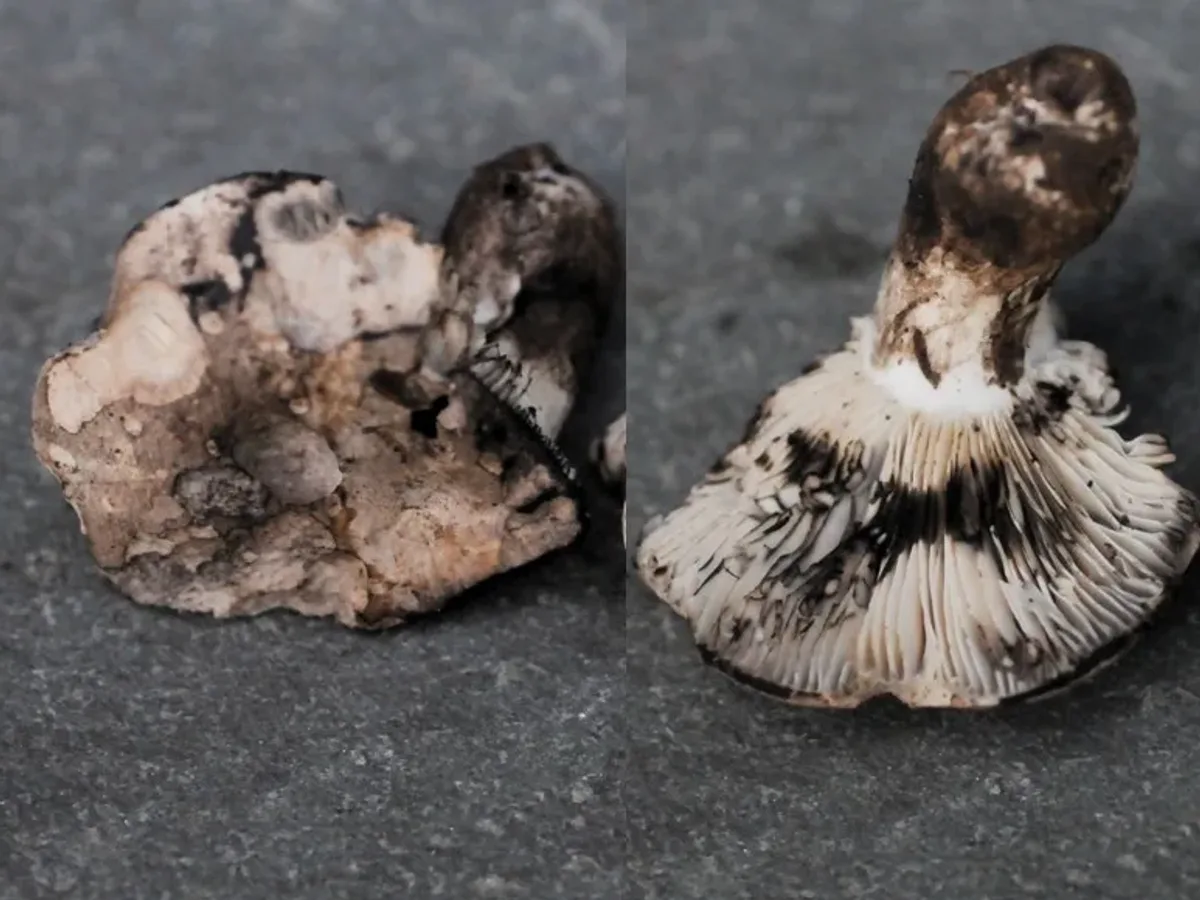 © Perry Gunnar Larsen (CC BY)
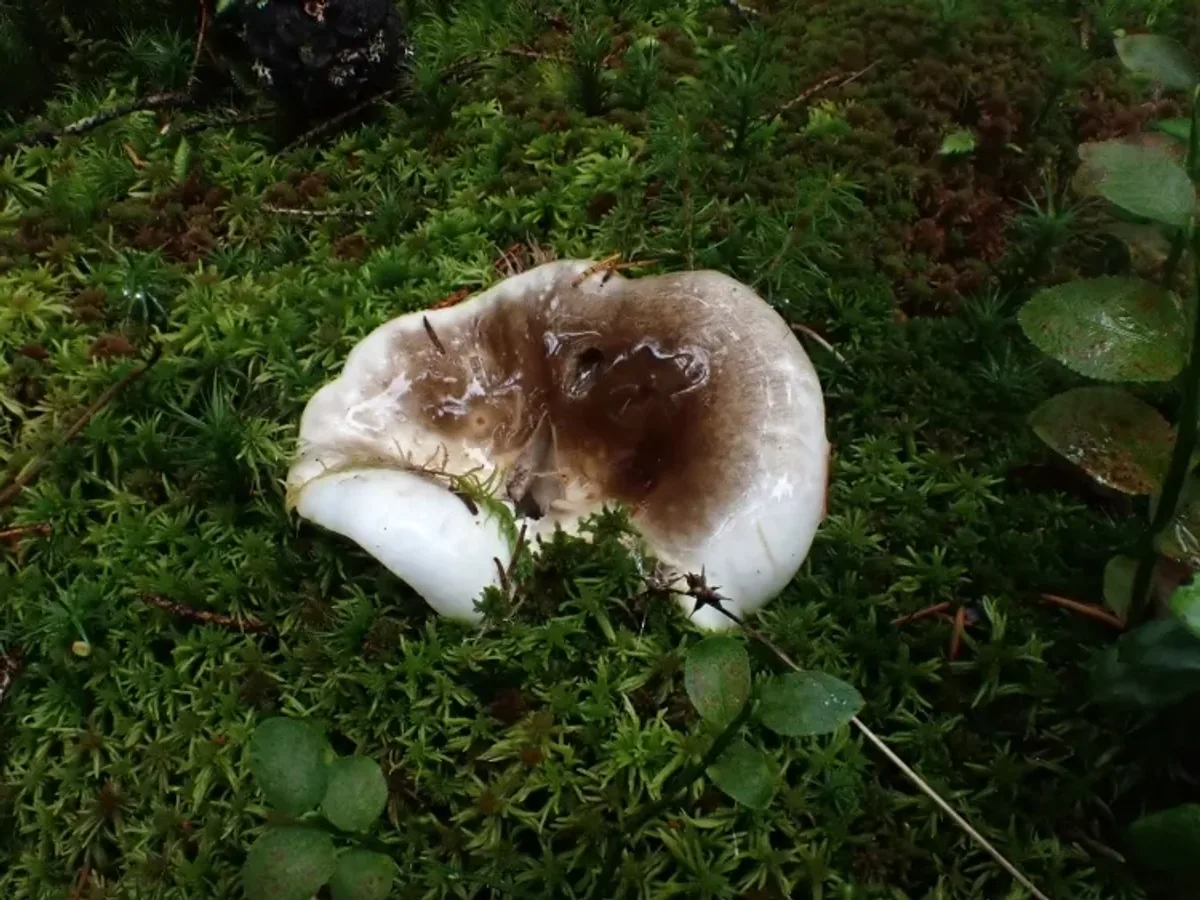 © Morten Pettersen (CC BY)
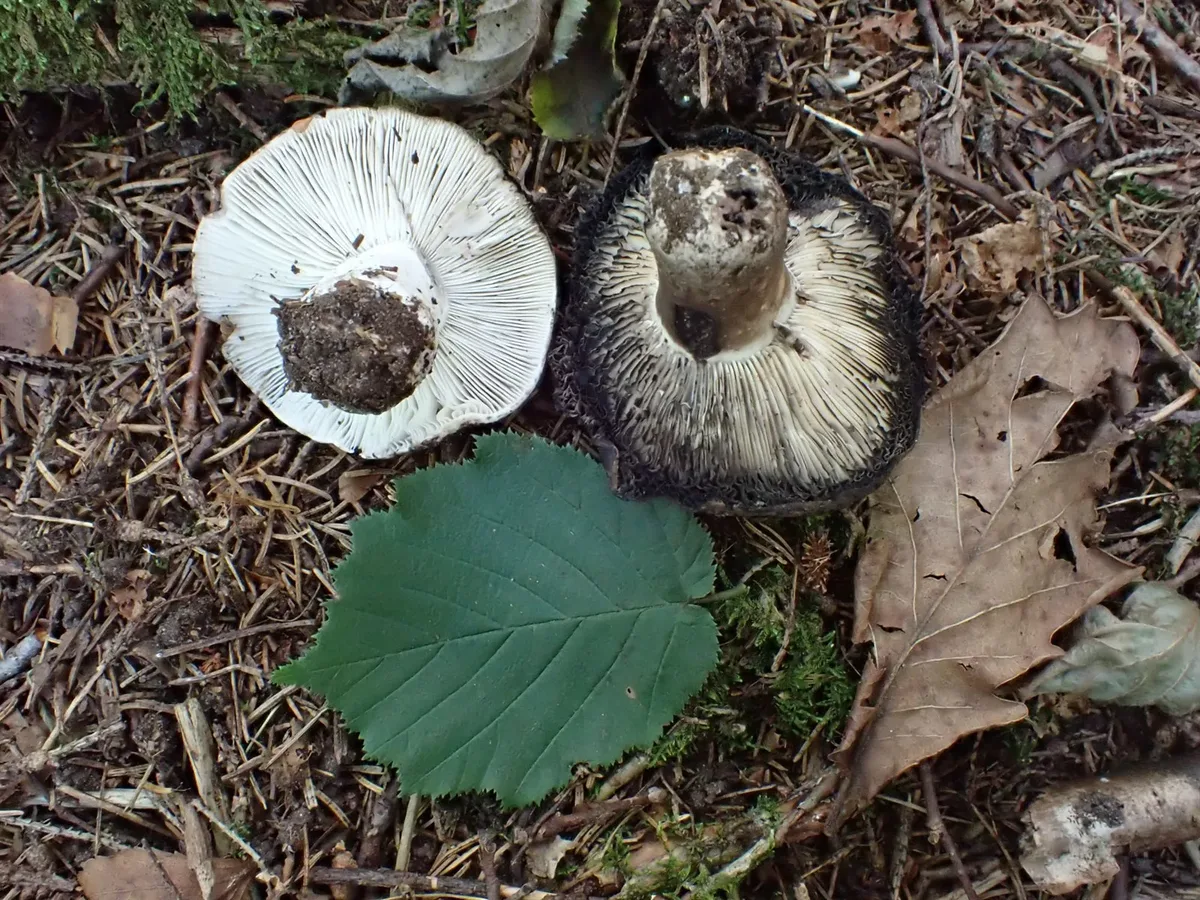 © Inger-Lise Fonneland (CC BY)
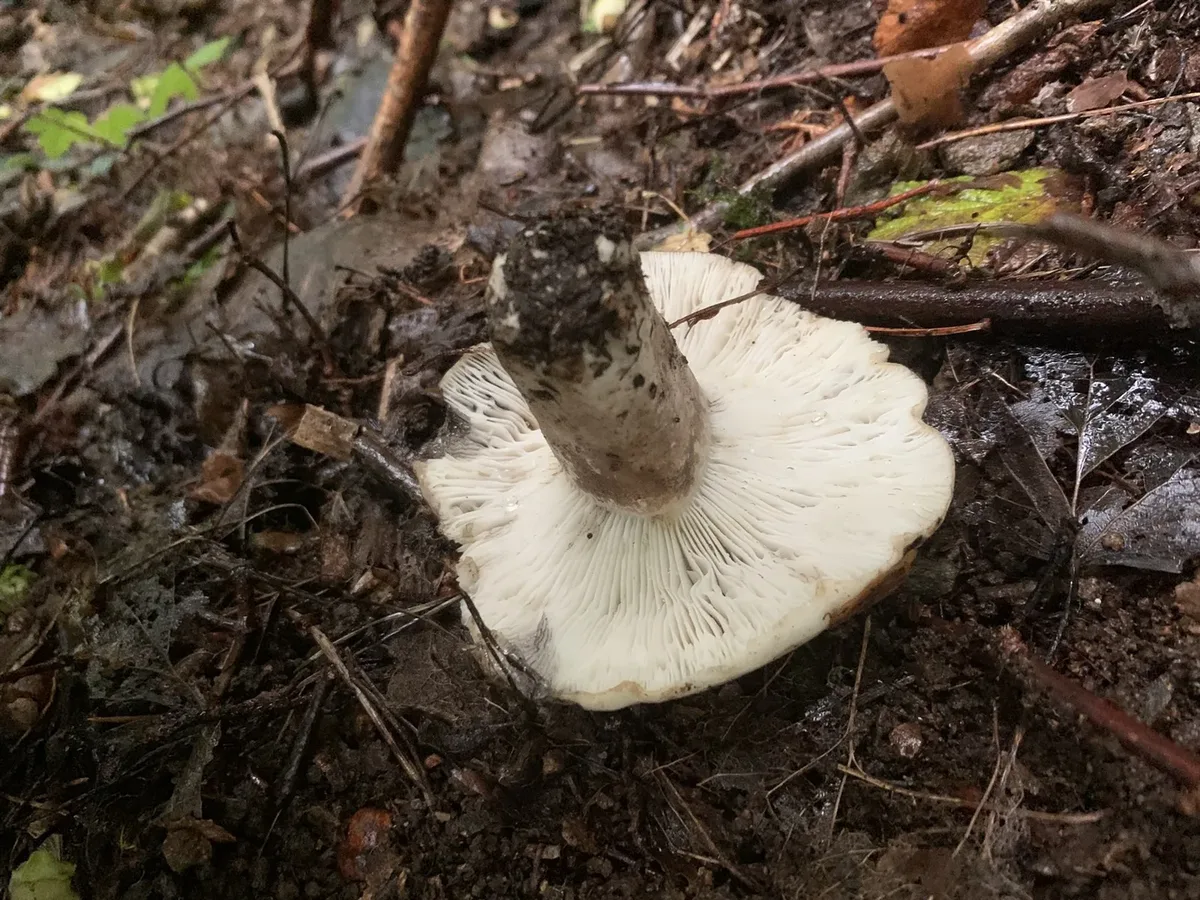 © John Bjarne Jordal (CC BY)
 © John Bjarne Jordal (CC BY)
 © Daniel Ghyselinck (CC BY)
 © Anders Røynstrand (CC BY)
 © Anders Røynstrand (CC BY)© Perry Gunnar Larsen (CC BY)© Morten Pettersen (CC BY)
Edible only with the right preparation - or safe for some people but not others. Learn the caveats first.
Never eat a mushroom you are not 100% sure of - check the look-alikes below, and always cook wild mushrooms.
How to recognise it
Russula albonigra is a large, robust brittlegill with a distinctive blackening reaction that, once learned, is almost unmistakable - but that very similarity to related species makes careful field checking essential.
Cap
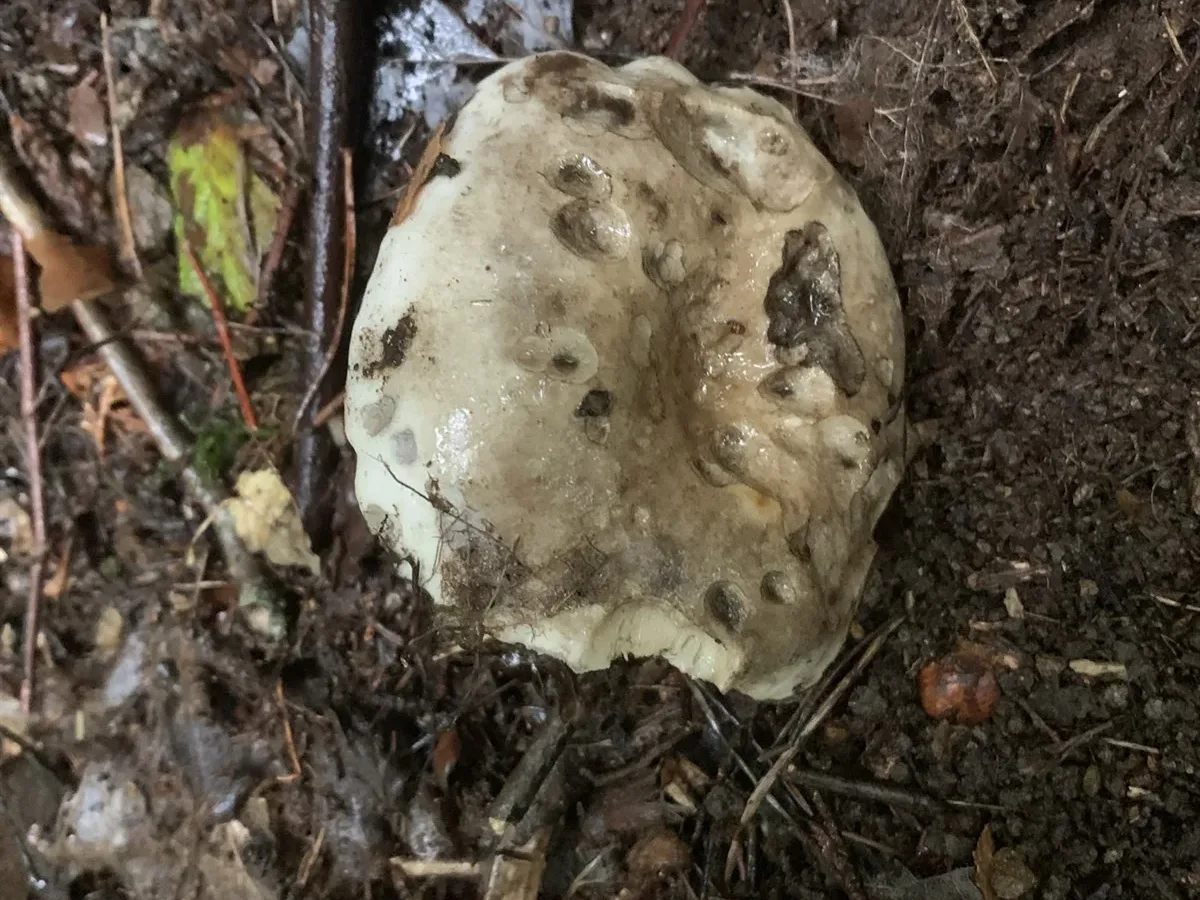
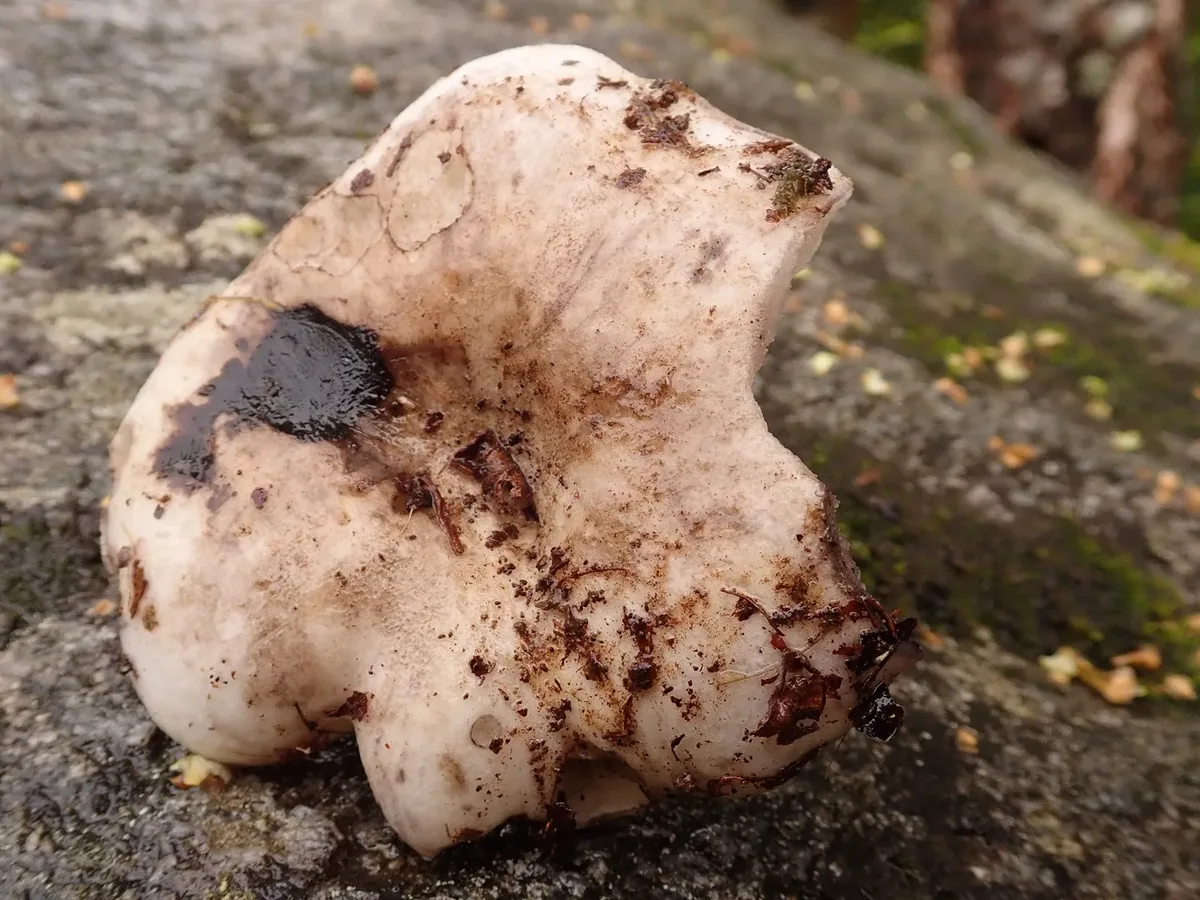
The cap begins white to dirty-white, smooth, dry, and dome-shaped; over time it flattens and develops a broad central depression, eventually becoming shallowly funnel-shaped and reaching 18 cm across.
As it ages - or as soon as the surface is bruised, scratched, or cut - it darkens rapidly: first to sooty grey, then to coal black. This blackening spreads through the entire fruitbody, including the gills, stem, and flesh.
The critical diagnostic: this colour change moves directly from white through grey to black, with NO intermediate red or pink phase. That direct-to-black transition is the single most important character distinguishing R. albonigra from the similar Russula nigricans (which turns pink first) - and getting this distinction right matters, because R. nigricans is irritant and R. albonigra has its own safety considerations.
Gills
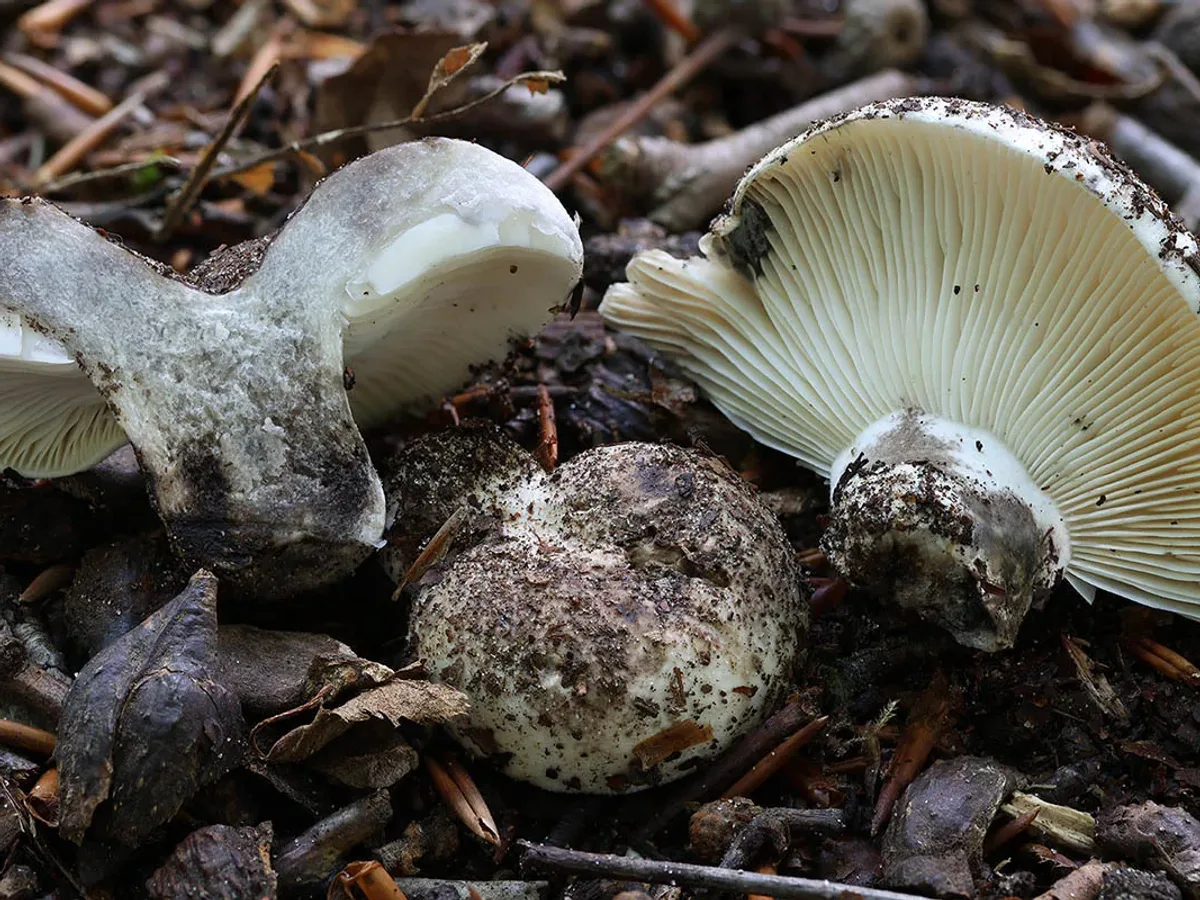
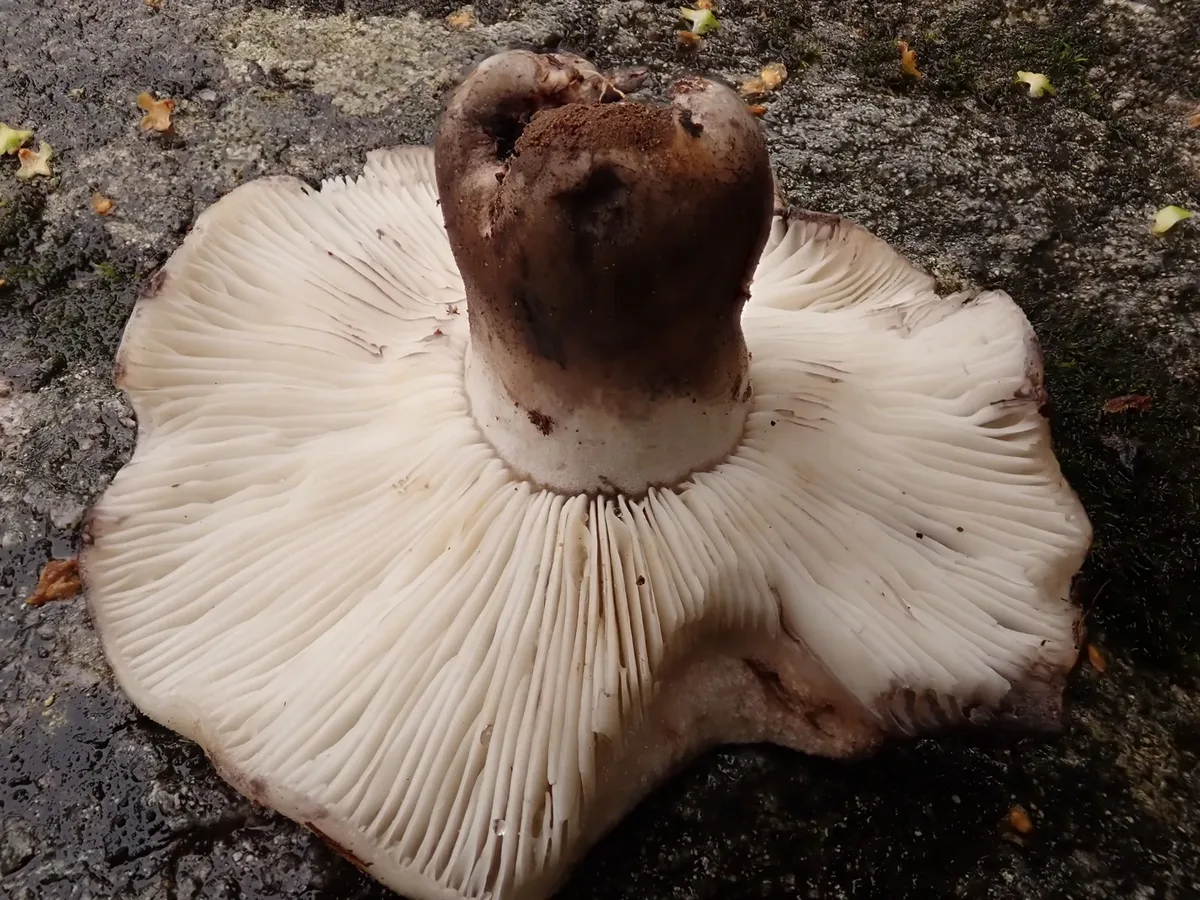
The gills deserve close inspection: they are thick, blunt-edged, and widely spaced for a Russula - a structural quality that gives them an almost waxy, plate-like appearance. They begin white and slowly darken in parallel with the cap.
Stem
The stem is stout and solid, white when fresh, blackening from the base upward as the fruitbody ages.
Flesh
The flesh is white, firm, and dense, lacking the crumbly texture of many smaller Russula species; when a cross-section is cut and held in air it moves gradually from white to grey-brown to black over 20-60 minutes.
Smell & taste
The smell is mild to slightly acidic, and the raw taste is mild to mildly acrid on prolonged chewing - neither strongly pleasant nor harshly burning.
Spore print is white.
Under the microscope, spores are broadly ellipsoid, 7-9.5 × 5.5-8 µm, with isolated low warts and short ridges that do not form a complete network, strongly amyloid (turn blue-black in Melzer's reagent), consistent with placement in section Nigricantes.
Why it's dangerous
The direct danger from R. albonigra is modest - it is an irritant species that causes gastrointestinal upset but is not acutely deadly in its own right based on available documentation.
The serious danger is context-dependent: in East Asian forests, it overlaps with Russula subnigricans, a species documented to cause fatal rhabdomyolysis, and field distinction between the two is unreliable for non-specialists.
Any forager in East Asia encountering blackening Russula species must treat them as potentially deadly until expert-verified. This species should never be collected for eating in East or Southeast Asia by anyone without expert-level familiarity with the local blackening Russula complex.
Toxin
The irritant compounds in Russula albonigra belong to the sesquiterpene aldehyde class that characterises acrid species across the Russula and Lactarius genera. These compounds cause burning and irritation of the oral mucosa and gastrointestinal lining when the mushroom is consumed raw or insufficiently cooked.
No single well-characterised unique toxin has been isolated from R. albonigra specifically; the irritant effect is part of the broader pattern seen across the section Nigricantes and related sections.
The direct toxicity from R. albonigra itself is low - the greater safety concern is misidentification for Russula subnigricans, which contains cycloprop-2-ene carboxylic acid and causes rhabdomyolysis.
Symptoms
If consumed raw or undercooked:
- Burning sensation in the mouth and throat
- Nausea
- Gastrointestinal cramping
- Vomiting
- Diarrhoea
Symptoms from R. albonigra itself are generally self-limiting and resolve without specific treatment within hours.
HOWEVER: if a patient in East Asia presents with gastrointestinal symptoms after consuming a blackening Russula, Russula subnigricans poisoning must be ruled out by a clinician, as that species causes rhabdomyolysis - a life-threatening breakdown of skeletal muscle leading to myoglobinuria and acute renal failure.
The onset of rhabdomyolysis symptoms (muscle pain, weakness, dark or tea-coloured urine) may be delayed 24-48 hours after ingestion. Seek immediate emergency medical care for any suspected Russula subnigricans ingestion.
Staying safe
Russula albonigra is classified as caution because:
- 1The raw flesh contains irritant sesquiterpene compounds that cause gastrointestinal upset.
- 2It is of poor culinary quality even when cooked.
- 3It shares habitat and superficial appearance in East Asia with Russula subnigricans - a deadly species that has caused multiple fatalities.
In the primary range of this species (East and Southeast Asia), the rule is clear: do not consume any blackening Russula without expert-level identification confidence.
The colour-change test (direct white-to-black = R. albonigra; pink intermediate = R. nigricans; subtle reddening or uncertain = treat as potentially R. subnigricans) is a necessary but not always sufficient field check. Old, partially blackened specimens are especially ambiguous.
- If there is any uncertainty about which blackening Russula you have, do not eat it.
- Never eat any Russula species raw.
- Always confirm the absence of a volva and ring before eating any pale, large-capped mushroom from forest soil.
Where & when it grows
Habitat
Russula albonigra is a widespread ectomycorrhizal partner of broadleaved and coniferous trees across the Northern Hemisphere.
In its East Asian primary range it is most reliably found in montane mixed forests where Castanopsis, Quercus (including subtropical oaks), and various conifers such as Pinus yunnanensis, Picea, Abies, and Tsuga grow together - habitats common across Yunnan, Sichuan, Guizhou, Hunan, Taiwan, and into Japan and the Korean Peninsula.
Elevations of 400-2000 m are typical in East Asia; the species tolerates a range of soil types from mildly acidic to neutral.
In Europe and North America (where it also occurs) the habitat is broadly similar: beech, oak, hornbeam, and mixed conifer forests on mineral soils in established woodland. The species shows no strong preference for primary versus secondary forest, and can appear in parks and roadside plantings with large enough tree hosts.
Fruiting bodies arise singly or scattered - never in dense clusters - which combined with their habit of partially burying in leaf litter means they can be overlooked until blackening draws attention to them.
Old black specimens decompose slowly and their dark staining on the litter layer persists for weeks, serving as a useful indicator of productive patches for future visits. Look for the telltale coal-black remnants of prior fruiting bodies as a scouting signal.
When
The main fruiting season runs from July through November in temperate northern hemisphere forests, with the peak flush coinciding with late summer and early autumn rain events - typically August to October.
In cooler montane settings in East Asia, fruiting begins later (August-September) and may persist into November.
Individual fruiting bodies develop slowly and are long-lasting compared to many agarics, remaining firm and identifiable for a week or more under cool, stable conditions before blackening and decaying.
The species is one of the more thermally tolerant members of the blackening Russula complex and may continue fruiting later into autumn than many congeners.
How it grows
Solitary to loosely scattered; never forming tight clusters or rings.
The fruitbody develops in the litter layer or at the soil interface, often partially buried in the button stage, the white cap pushing through leaf litter as the stem elongates.
Growth is relatively slow - a single cap may take 10-14 days to reach full size. Fruitbodies are firm and heavy for their size, and the dense flesh resists insect colonisation longer than softer-fleshed species.
Old specimens blacken completely and then decompose over several weeks, leaving a flattened disc of blackened tissue on the forest floor that can be mistaken for dried mud until the gill structure is examined.
Fruiting conditions
Fruiting triggered by late-summer and autumn rainfall events combined with cooling soil temperatures below approximately 18 °C. Fruitbodies develop slowly over 10-14 days and persist on the forest floor for weeks before fully decomposing; old blackened specimens serve as prospecting indicators for subsequent seasons.
Look-alikes
Russula albonigra sits within a group of large, blackening Russula species that overlap in appearance and habitat and must be carefully distinguished from one another - some non-edible, some deadly.
Russula nigricans (Blackening brittlegill) is the most frequently confused species across the Northern Hemisphere and the most important distinction to master. It shows a clear, conspicuous pinking-to-red phase in cut flesh before it blackens (visible within 10-30 seconds of cutting), whereas R. albonigra moves directly from white to grey-black with NO intermediate reddening. Both have thick, widely-spaced gills and a similarly robust stature. This colour-change test is fast and reliable in fresh specimens.
Russula adusta (Singed brittlegill) is smaller, greyish-brown even when young, and has flesh that turns slowly brownish-grey without a pink phase - similar to R. albonigra's direct blackening, but browner rather than coal black, and the cap is brown from the outset rather than white. Gills are somewhat more crowded. Also inedible.
Russula subnigricans (DEADLY) is the most dangerous lookalike and a critical safety concern in East and Southeast Asia, where it overlaps directly with R. albonigra. It is a smaller species (cap 4-10 cm), with a darker grey-brown cap from a very early stage, somewhat more crowded gills, and flesh that shows a very slight reddening in some specimens before darkening - but this reddening is faint and can be missed.
Russula subnigricans causes fatal rhabdomyolysis (muscle destruction leading to kidney failure) in documented cases in China and Japan, including deaths in healthy adults. The toxic mechanism involves cycloprop-2-ene carboxylic acid. In the absence of expert confirmation, ANY small-to-medium blackening Russula in East Asian forests should be treated as potentially R. subnigricans and NOT consumed.
Amanita buttons (death cap and destroying angel) are a danger for any large pale mushroom in the same habitat. Always excavate the stem base of any white ground mushroom and confirm the absence of a volva, ring, and free gills before drawing conclusions. Russula species have NO volva, NO ring, and gills that are not free from the stem.
Russula subnigricans is smaller (cap 4-10 cm), has a darker grey-brown cap from an early stage, and somewhat more crowded gills. Its flesh may show a very faint, brief reddening on cut before darkening - unlike R. albonigra's direct white-to-black change - but this subtle difference is not reliable in the field. R. subnigricans causes fatal rhabdomyolysis (documented deaths in China and Japan); it cannot be safely distinguished from R. albonigra by non-specialists in the field. Do NOT consume any blackening Russula in East Asian forests without expert verification.
Buried Amanita phalloides buttons can resemble any large, pale mushroom emerging from the soil. The key check is always: excavate the full stem base and look for a sac-like volva (membranous cup). Amanita phalloides also has a skirt-like ring on the stem and free gills. Russula albonigra has NO volva, NO ring, and gills that are attached to the stem. This check is life-critical.
Pure white throughout with a white silky cap and a well-developed volva at the base. The ring on the stem is delicate but usually present. Gills free, white, close. A young unexpanded A. virosa button in the soil can appear as a white dome - always excavate the full base. No Russula species ever possesses a volva or ring.
Russula nigricans is the most important and common confusion species across the Northern Hemisphere. The single most reliable field test: cut through the stem and watch the cut surface for 30 seconds. R. nigricans develops an unmistakable red-to-pink flush within 10-30 seconds of cutting before slowly turning grey and then black. R. albonigra shows NO reddening whatsoever - the cut surface goes directly from white to grey-brown to black. Both species are inedible; the distinction has no culinary value but is essential for accurate identification records.
Russula adusta is typically smaller, with a brownish-grey cap from the start rather than white. Its flesh does not pink on cutting (similar to R. albonigra) but turns brownish rather than coal black, and the colour change is slower. Gills are somewhat more crowded. Also inedible; no safety concern beyond misidentification leading to consumption of a poor-flavoured species.
A reference guide - never an edibility guarantee. When in doubt, leave it out.