White areolate brittlegill
Russula alboareolata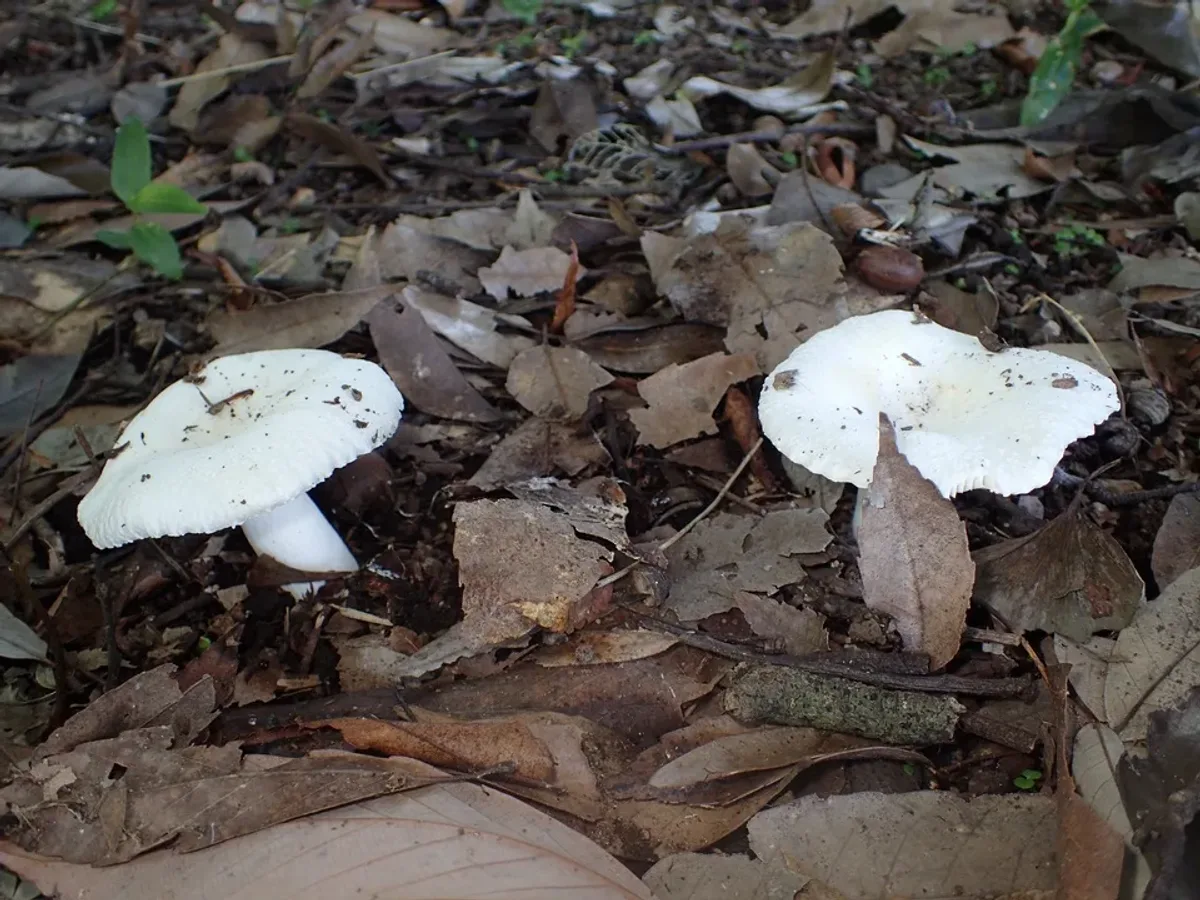 © lxjfx (CC BY-SA)
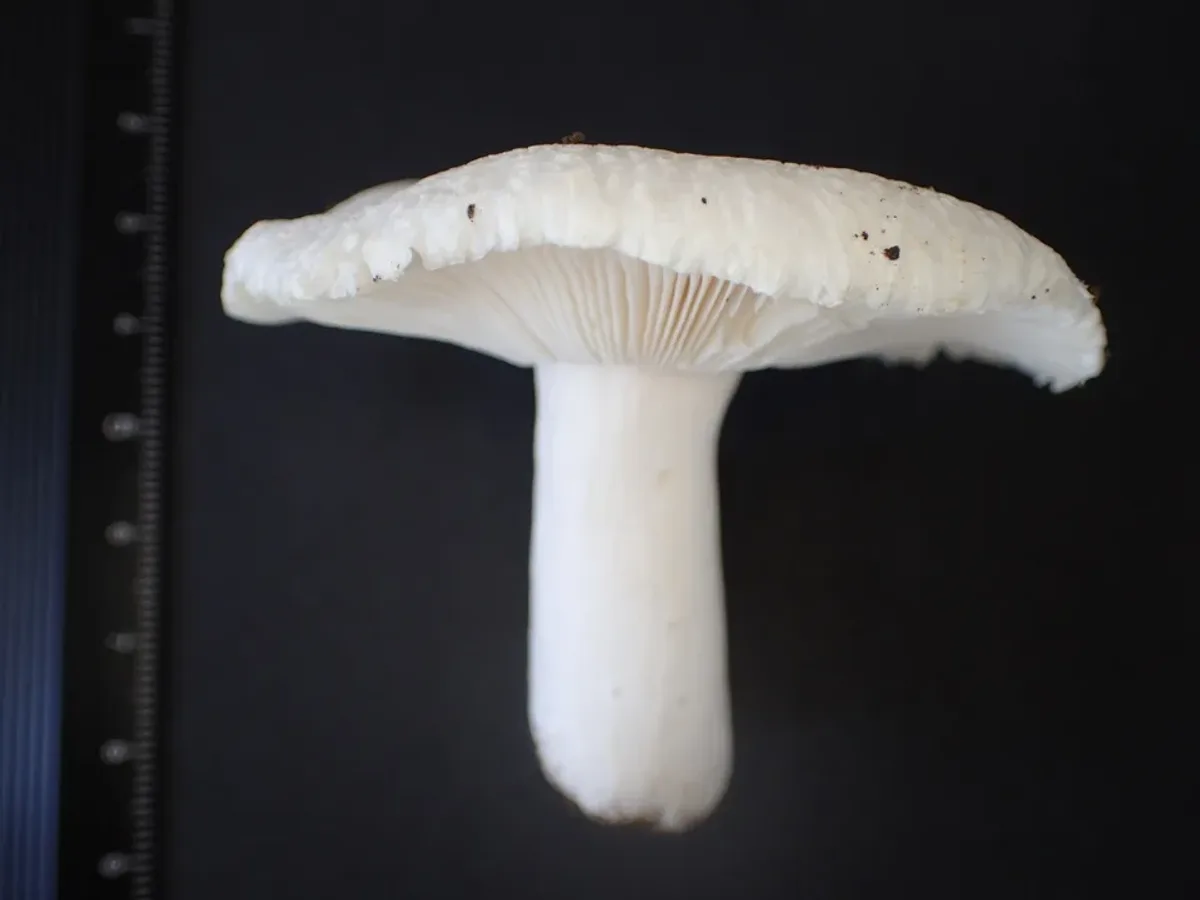 © lxjfx (CC BY-SA)© lxjfx (CC BY-SA)© lxjfx (CC BY-SA)
Good to eat, once you have identified it with certainty and cooked it through.
Never eat a mushroom you are not 100% sure of - check the look-alikes below, and always cook wild mushrooms.
How to recognise it
Russula alboareolata is a medium-sized brittlegill whose most striking feature is right there in its name.
Cap
The pale cream to whitish cap develops a network of irregular angular cracks - areoles - as it expands and matures, giving the surface a look somewhere between cracked plaster and a sun-baked mudflat. This texture is the species' single most reliable field mark.
The cap (5-10 cm) opens convex and gradually flattens, eventually becoming shallowly funnelled at the centre; the cuticle is dry, non-viscid, and the cracking grows more pronounced in dry or warm weather.
Gills / Pores
Beneath the cap, the gills are white to cream, moderately crowded, and brittle in the characteristic Russula manner - snap a gill and it breaks cleanly, like chalk, without releasing any milky liquid.
That absence of latex immediately separates this species from all Lactarius and Lactifluus milkcaps.
Stem
The stem is white, smooth, and fairly stout: solid and firm when young.
Flesh
The flesh is white throughout, chalky-brittle, and when cut it neither stains nor weeps.
Smell & taste
The odour is mild and slightly pleasant, sometimes faintly floury.
Importantly, the taste is mild and not acrid or burning - mildness matters here, because many superficially similar pale Russulas sting the tongue and are inedible.
Spore print white to faintly cream.
Where & when it grows
Habitat
This species inhabits warm-temperate and subtropical deciduous forest in East and Southeast Asia, with the core range in Japan.
It is an ectomycorrhizal partner of Fagaceae - particularly the evergreen and deciduous oaks (Quercus spp.), Castanopsis, chestnut (Castanea), and beech (Fagus crenata) that dominate the satoyama and mountain broadleaf forests of Honshu, Shikoku, and Kyushu.
Look for it on the humus-rich, moderately acidic forest floors beneath mature oaks, where the leaf-litter layer is well developed.
It prefers moderate moisture and does not typically occur in waterlogged or very dry microsites. It can also be encountered in mixed broadleaf-conifer forest where Fagaceae remain co-dominant.
When
In Japan, Russula alboareolata belongs to the late-summer and autumn mushroom wave that follows the wet, humid conditions of the rainy season.
Fruiting typically begins in July and peaks through August, September, and into October as temperatures gradually cool.
In the warmer, lower-elevation forests of western and southern Japan and in subtropical East Asian habitats, fruiting can extend later into autumn.
The species benefits from the sustained warmth and humidity of the post-monsoon period - conditions that drive one of the most productive wild mushroom seasons in the region.
How it grows
Fruitbodies appear singly or scattered in small numbers among leaf litter, often quietly emerging from the accumulated debris of deciduous broadleaf trees rather than in conspicuous clusters.
As a mycorrhizal species living in long partnership with its host trees, it does not form dense tufts.
Young buttons are rounded and entirely white; the characteristic areolate cracking of the cap surface develops gradually as the cap expands.
Fruitbodies can persist for one to two weeks under cool, moist conditions before decaying.
Fruiting conditions
Typical of warm-temperate East Asian Russula fruiting: triggered by the humid warmth of post-monsoon summer conditions when soil temperatures remain above 16 °C. Sustained rainfall during July-August followed by a short dry interval then more rain produces reliable flushes. In Japan this aligns with the end of tsuyu (the rainy season) and the hot, humid weeks of late July through September.
Look-alikes
The most critical lookalike risk for any white-capped mushroom in Asian forests is the destroying angel group (Amanita virosa, Amanita verna, Amanita bisporigera), which are deadly.
These Amanita species are superficially pale and may appear in the same forest. They are distinguished from Russula alboareolata by:
- 1a membranous ring (skirt) on the upper stem;
- 2a cup-like volva at the stem base, often buried in soil - always dig up the stem base to check;
- 3gills that are free from the stem (not attached);
- 4fibrous, non-brittle flesh that bends rather than snapping like chalk;
- 5no areolate cap cracking in typical specimens.
Russula species have chalky-brittle flesh, no ring, no volva, and attached gills - but beginners must physically confirm the stem base.
Among Russula itself, Russula delica and the delica-group (R. chloroides, R. pallidospora) are white-capped and can resemble R. alboareolata, but R. delica has closely crowded, somewhat decurrent gills, lacks areolate cap cracking, has a mild to slightly acrid taste, and typically a more funnel-shaped mature cap.
Russula albiceps and other white Russulas from East Asia should be distinguished by checking cap texture (areolate vs. smooth), spore print colour, and taste.
The pale-capped Tricholoma species also occur in the same oak forests; they have non-brittle flesh, and many have a distinct mealy or unpleasant odour.
Amanita virosa and related destroying angels (A. verna, A. bisporigera, A. exitialis) are pure white and deadly - containing amatoxins that cause fatal liver and kidney failure with no antidote. They are distinguished from Russula by: a membranous ring (annulus) on the upper stem; a cup-like volva at the stem base (dig up the base to check - it is often buried); free gills (not attached to the stem); and non-brittle, fibrous flesh that bends rather than snapping cleanly. Russula have NO ring, NO volva, attached gills, and chalky-brittle flesh. Never eat any white mushroom without checking the stem base for a volva.
Russula nigricans starts whitish then turns greyish and finally coal-black throughout; its gills are unusually widely spaced (a key character); the flesh reddens then blackens when cut. Very different from R. alboareolata which stays white. Inedible to mildly toxic.
White Tricholoma species such as T. album occur in the same oak forests and have a similar white colouration. They are distinguished by: non-brittle, fibrous flesh (does not snap like chalk); sinuate gills notched at the stem junction; mealy or unpleasant chemical odour; and a taste that is often acrid, bitter, or chemical. Some Tricholoma species are toxic. Russula flesh snaps cleanly; Tricholoma flesh tears.
Russula delica is also white-capped and mycorrhizal with broadleaf trees, but has a more strongly funnel-shaped mature cap, closely crowded gills that are slightly decurrent onto the stem, a smooth (not areolate) cap surface, and a taste that ranges from mild to slightly acrid. It is inedible or of poor quality. The areolate surface cracking of R. alboareolata is absent in R. delica.
In the kitchen
Picking & cleaning
Select young to middle-aged specimens before the flesh has softened or the cap has become heavily weathered.
The firm, dry, areolate cap and mild taste together are the primary identity confirmations. Always taste a tiny piece of the raw flesh (chew briefly and spit) - it must be mild, not burning or acrid.
Cut cleanly at the stem base with a knife. Collect only specimens where the areolate cap surface and white colouration are clear; avoid very old or waterlogged specimens.
As with all pale-capped mushrooms, exercise rigorous caution. Inspect each specimen for gills that are free from the stem and for any trace of a ring, volva, or skirt at the stem base - these structures indicate Amanita, which should never be eaten without expert verification.
Cooking
The flavour of Russula alboareolata is mild and pleasant, lacking the strong individual character of species like R. xerampelina but suitable as part of mixed wild mushroom dishes.
The firm, brittle flesh holds reasonable texture when briefly sautéed in butter or sesame oil. In Japanese cuisine it is used in:
- miso soup
- simmered dishes (nimono)
- stir-fries
- rice dishes (takikomi gohan)
The mild taste means it benefits from cooking with flavourful aromatics such as dashi, soy, or garlic. Avoid prolonged boiling, which softens the flesh considerably.
As with all Russula species, eat cooked - raw consumption of Russulas is inadvisable as many species contain heat-labile gastric irritants even in edible species.
Good to know
Russula alboareolata is recorded as edible in Japanese mycological literature with no reported toxicity and a mild, pleasant flavour.
However, as with all pale-capped mushrooms in ectomycorrhizal forest, the single greatest safety requirement is to rule out Amanita before eating.
- Always dig up the entire fruitbody and examine the stem base for a volva (cup-like structure).
- If any membranous sheath, bag, or cup is present at the base, do not eat the mushroom - it is an Amanita and potentially lethal.
- Russula have no ring, no volva, and chalky-brittle flesh that snaps cleanly.
- The mild (non-acrid) taste should be confirmed by nibbling and spitting a small piece of raw flesh.
Do not consume any Russula with an acrid or burning taste.
A reference guide - never an edibility guarantee. When in doubt, leave it out.