Green brittlegill
Russula aerugineasyn. Russula xerampelina
 Carl Guyer (CC0)
 © gailhampshire (CC BY 2.0)
 © Мирослав Соболев (CC BY)
 © Мирослав Соболев (CC BY)
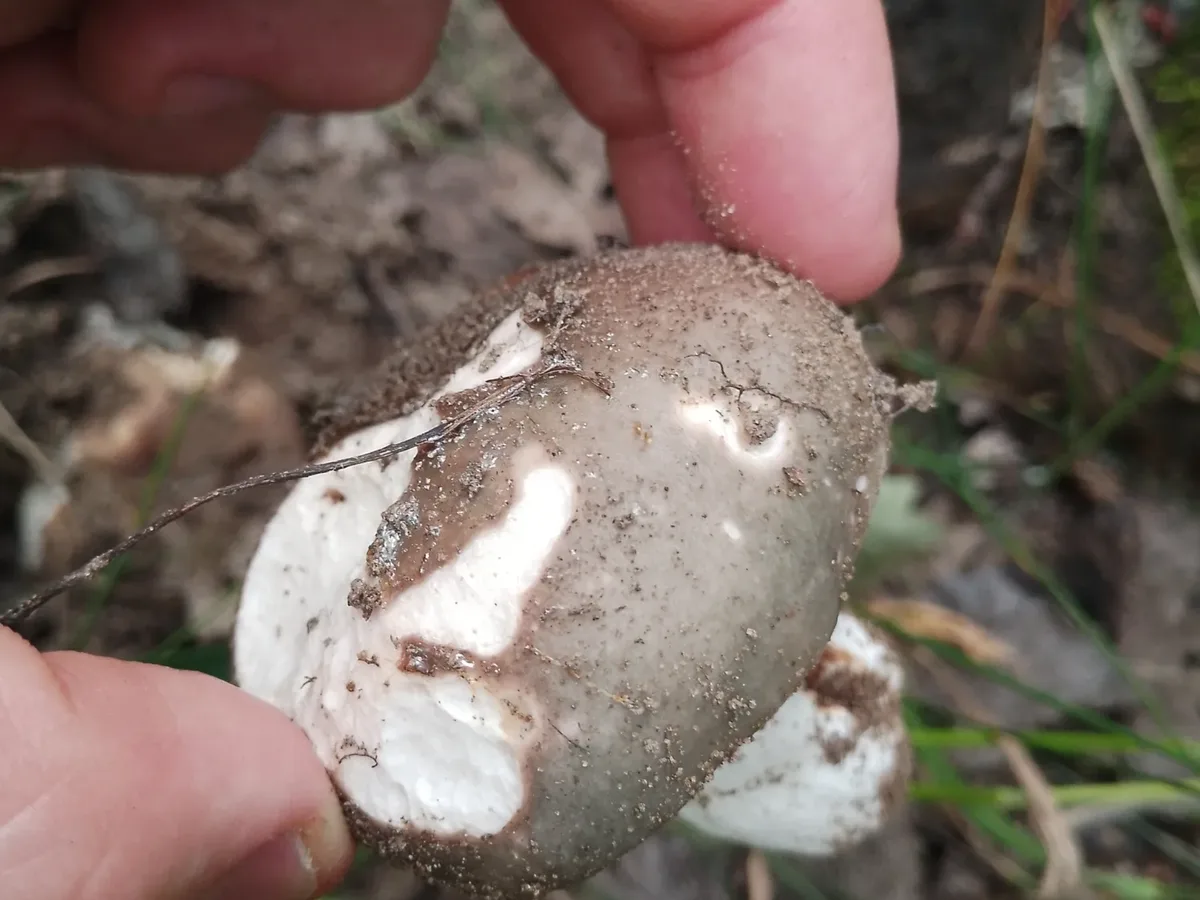 © Мирослав Соболев (CC BY)
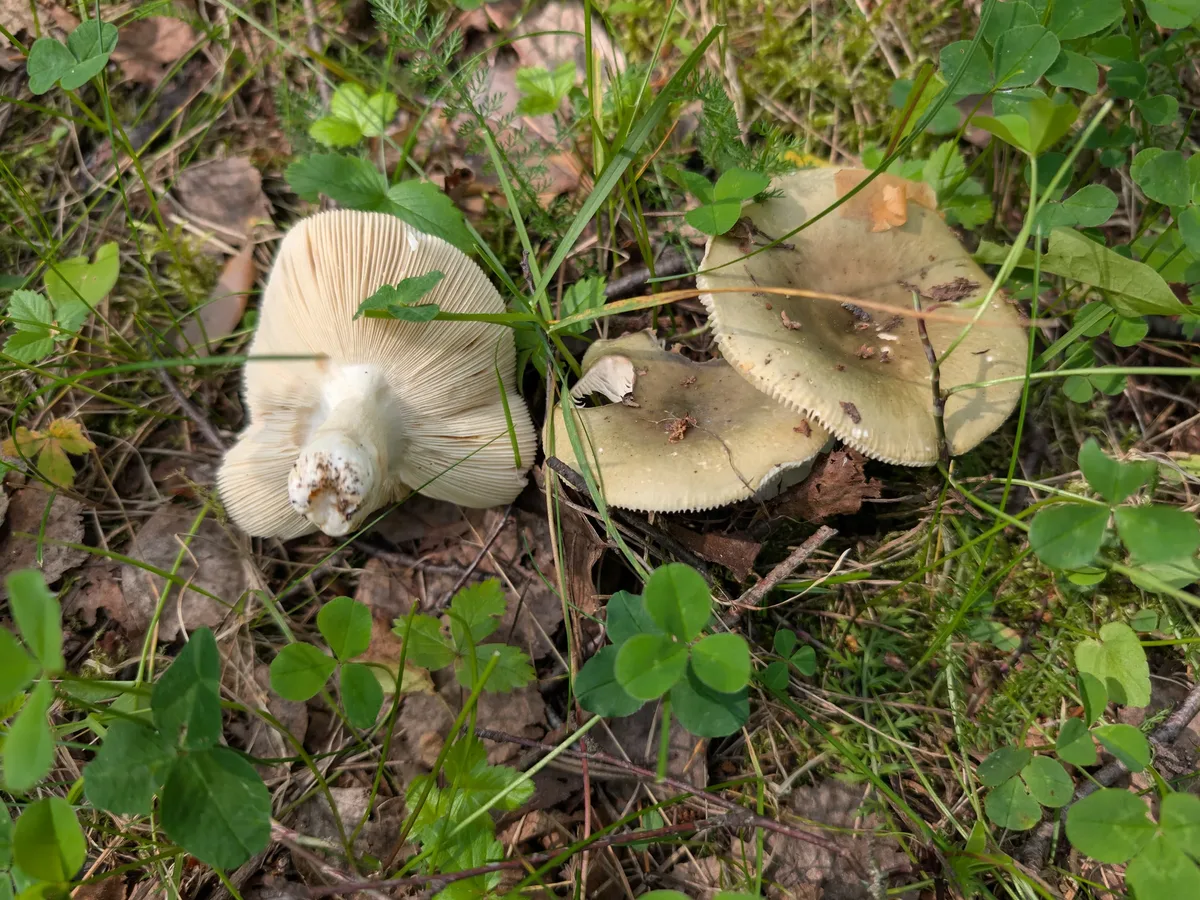 © Petri Roponen (CC BY-SA)
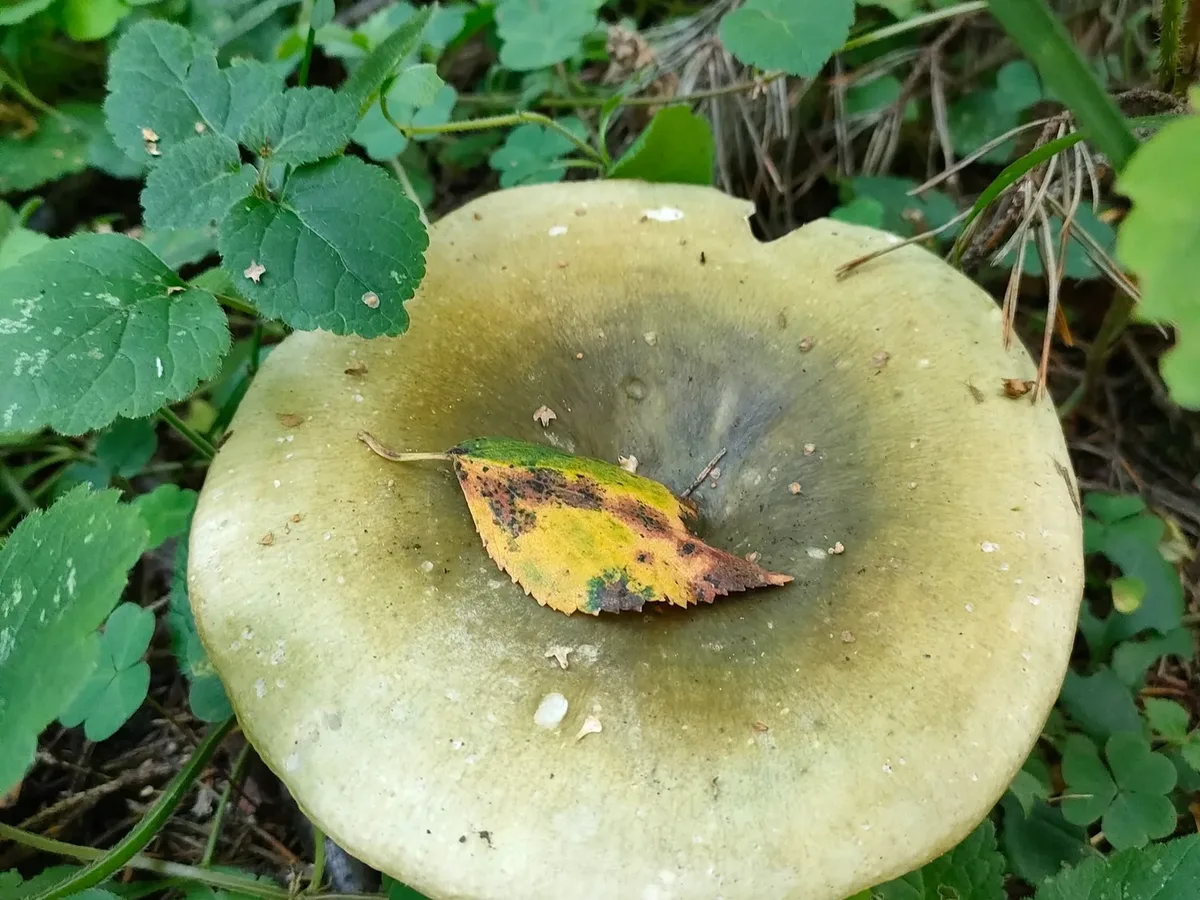 Капрал Натурал (CC0)
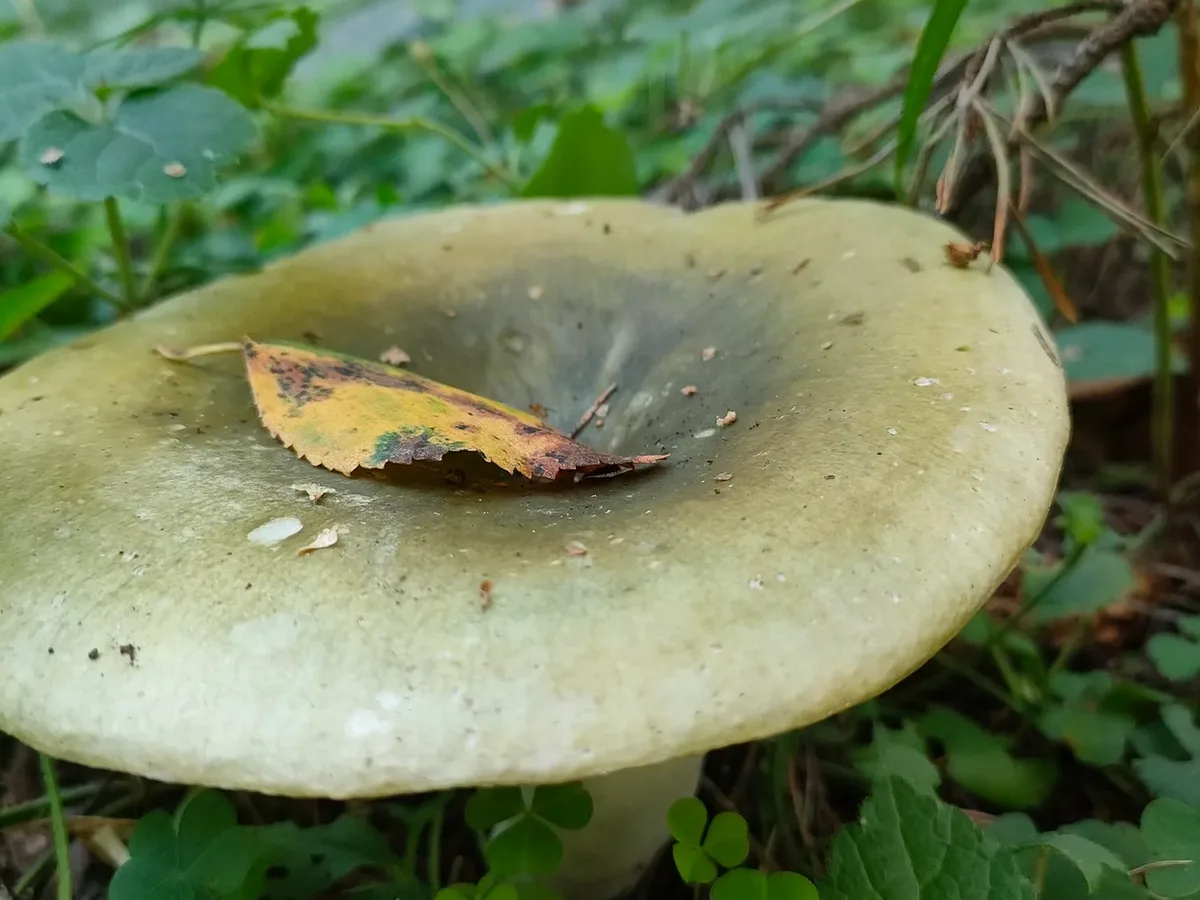 Капрал Натурал (CC0)
 Капрал Натурал (CC0)
 Капрал Натурал (CC0)
 © gailhampshire (CC BY 2.0)
 © Alex Sosnovshchenko (CC BY 4.0)
 Matt Kenne (CC0)
 © reagan peschke (CC BY 4.0)Carl Guyer (CC0)© gailhampshire (CC BY 2.0)
Good to eat, once you have identified it with certainty and cooked it through.
Never eat a mushroom you are not 100% sure of - check the look-alikes below, and always cook wild mushrooms.
How to recognise it
Cap
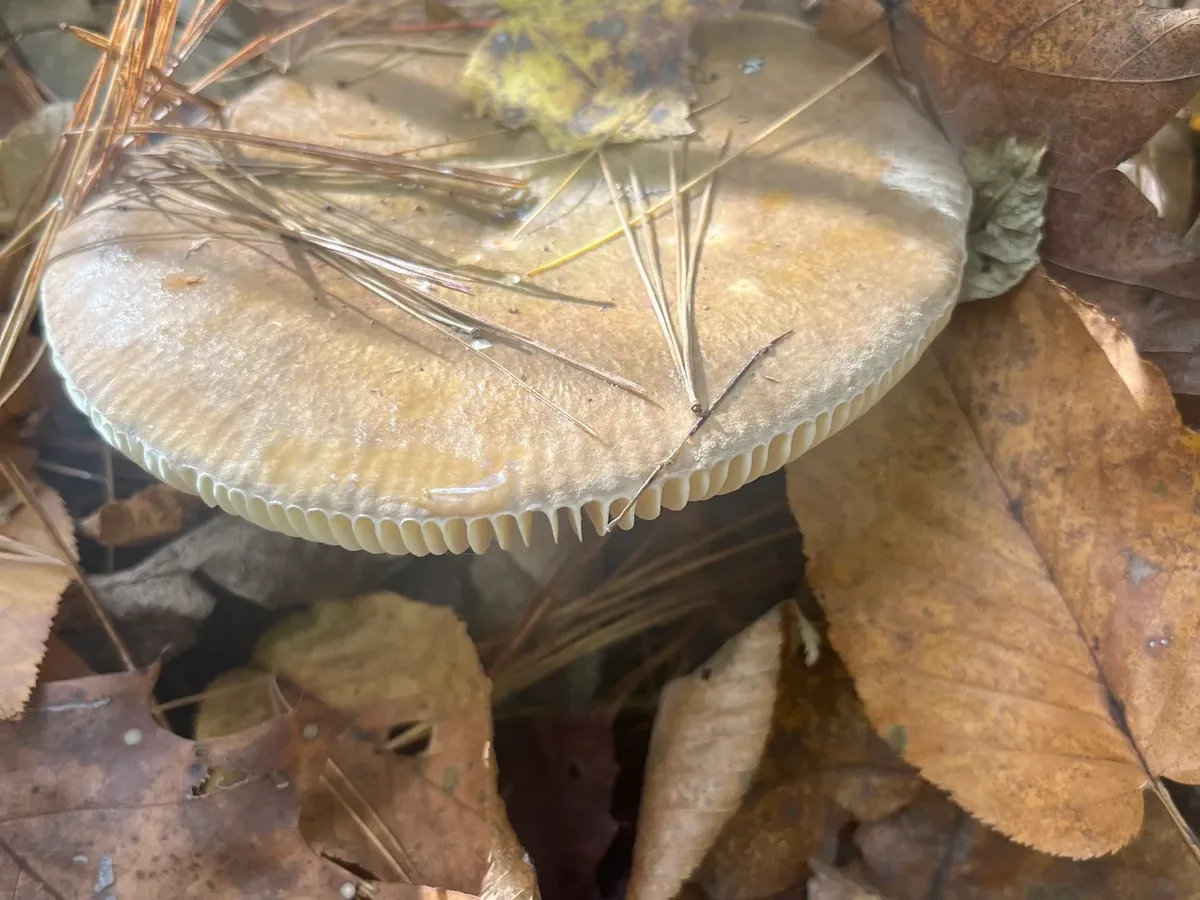
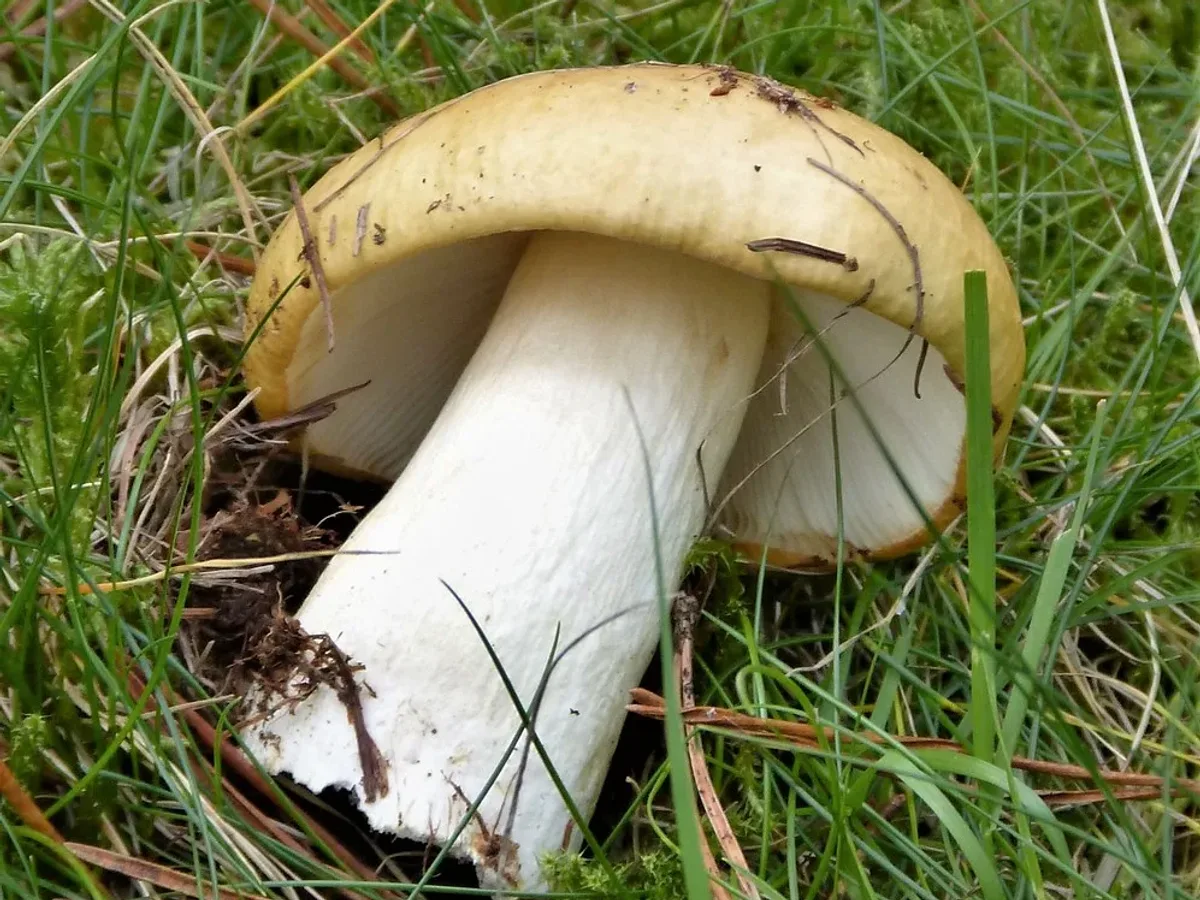
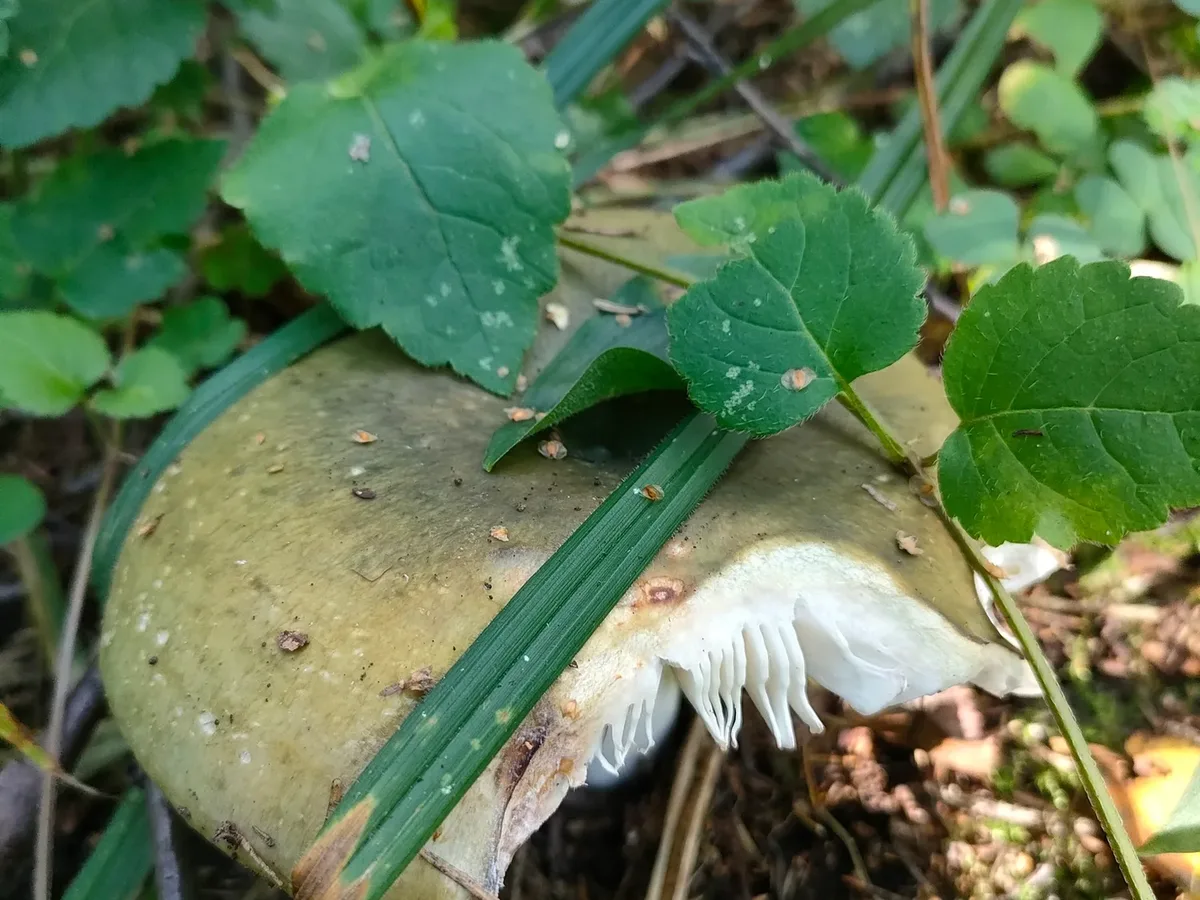
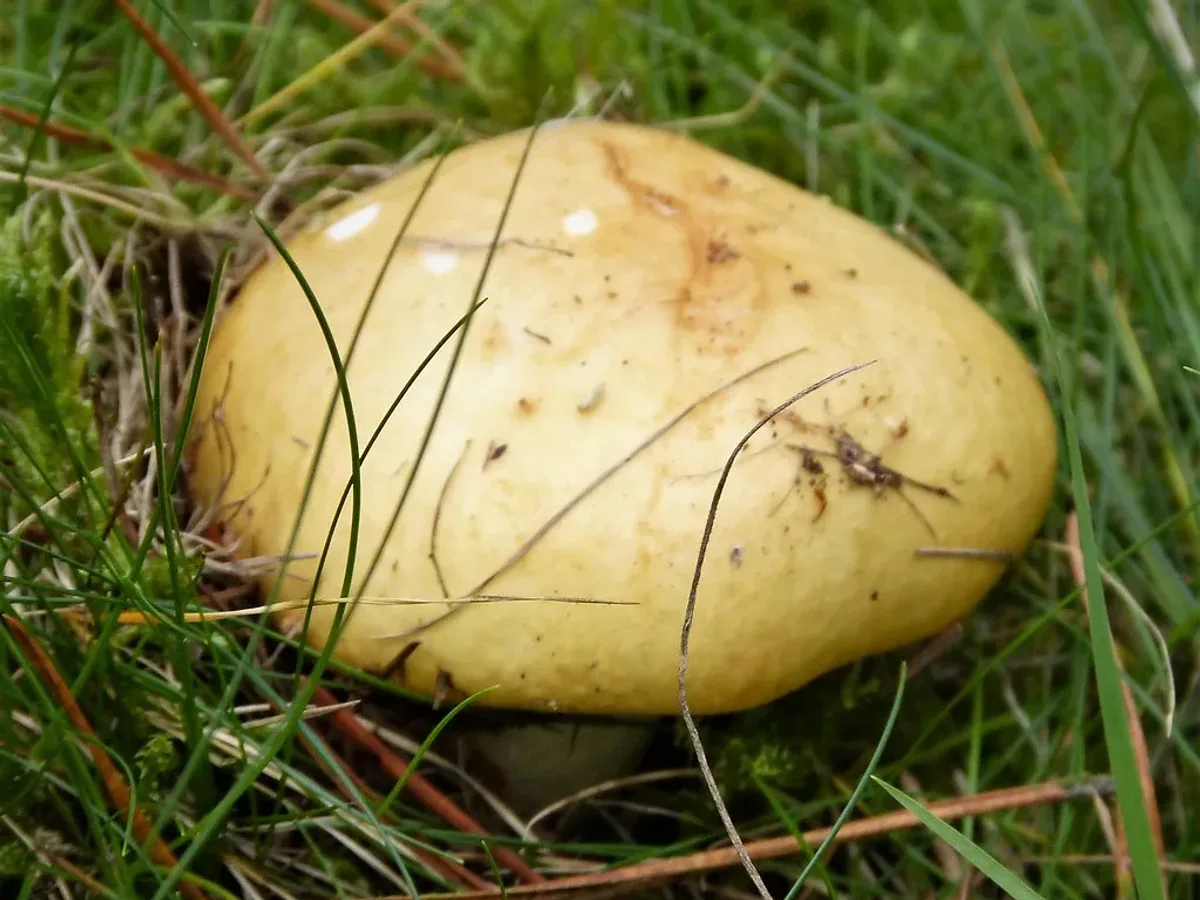
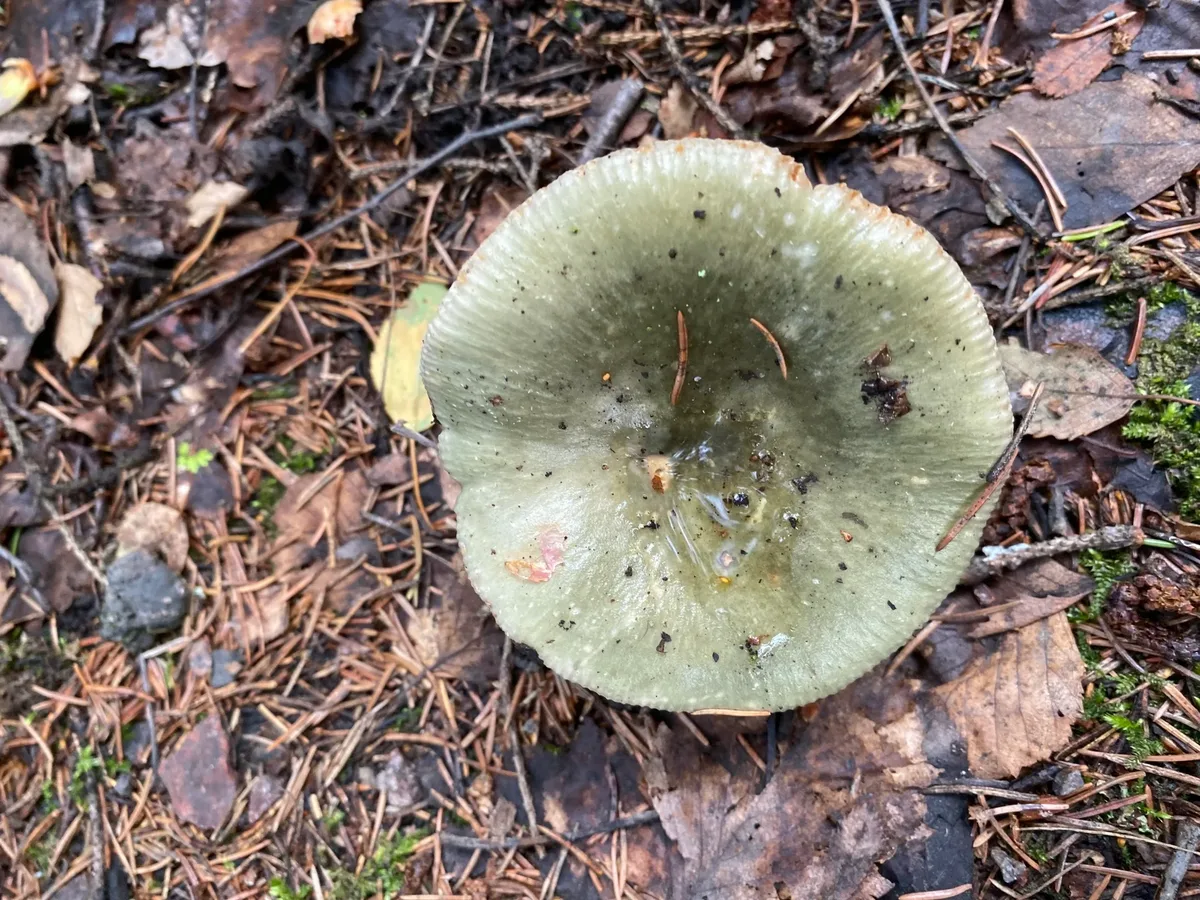
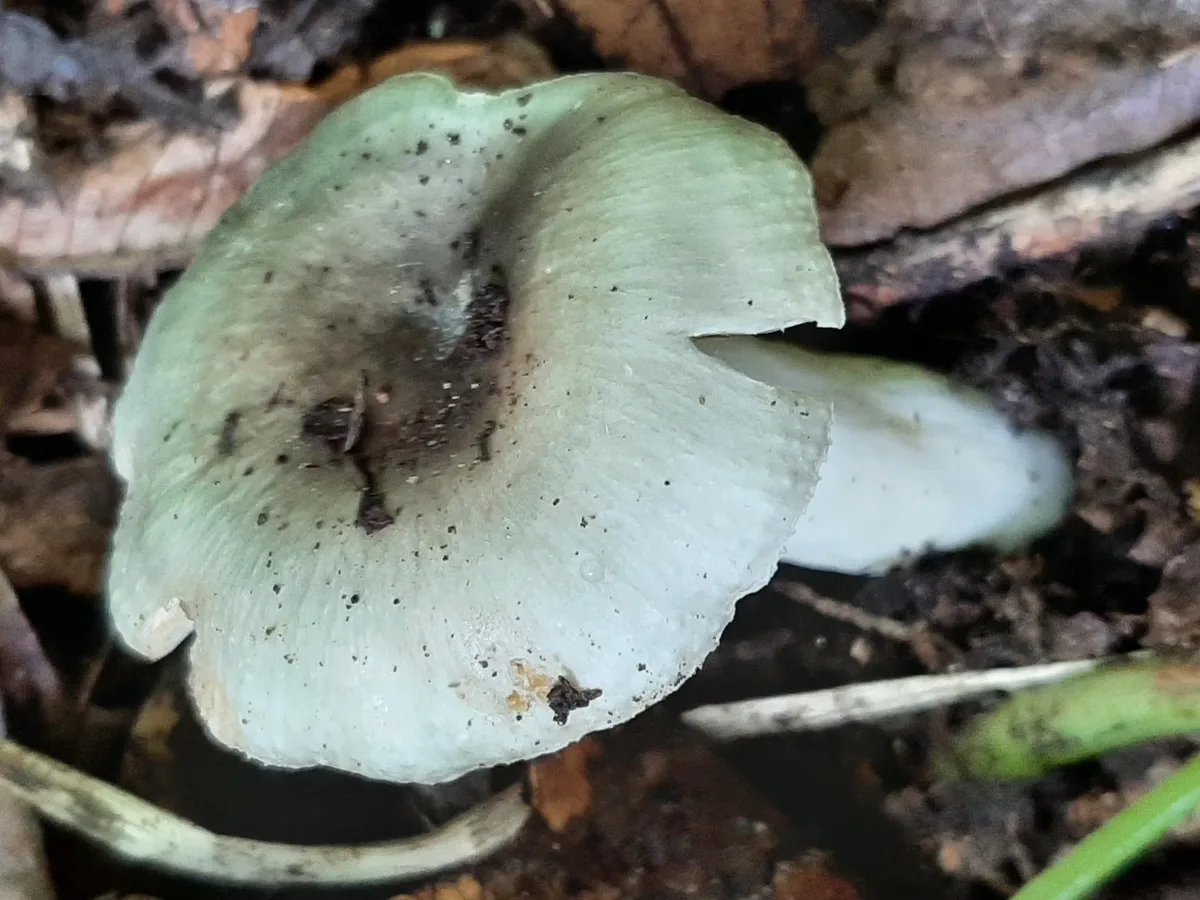
Russula aeruginea announces itself in shades of green that have no real equivalent among edible Nordic mushrooms - cap colours ranging from pale grey-green through fresh grass-green to a deeper blue-green, typically with a noticeably darker, more saturated centre and a margin that fades and develops a short, blunt ribbing as the fruitbody matures.
Caps measure 6-10 cm across; in damp weather the surface is distinctly viscid and glossy, often with adhering soil or leaf fragments. In dry conditions it dries to a matt, somewhat silky finish.
The cuticle peels cleanly from the margin inward, lifting off perhaps halfway to the centre - a minor party trick that is worth practising, because it becomes part of your 'russula fingerprint'.
Gills
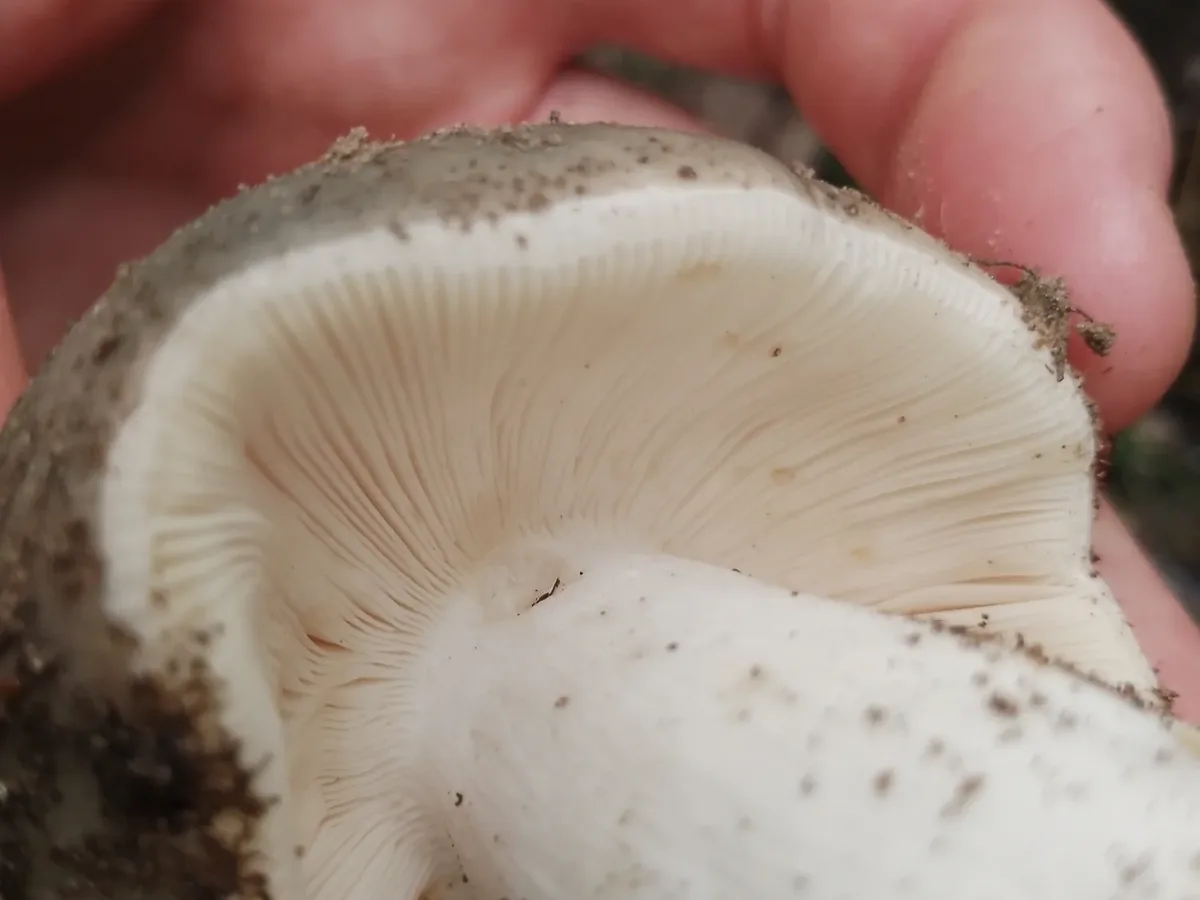
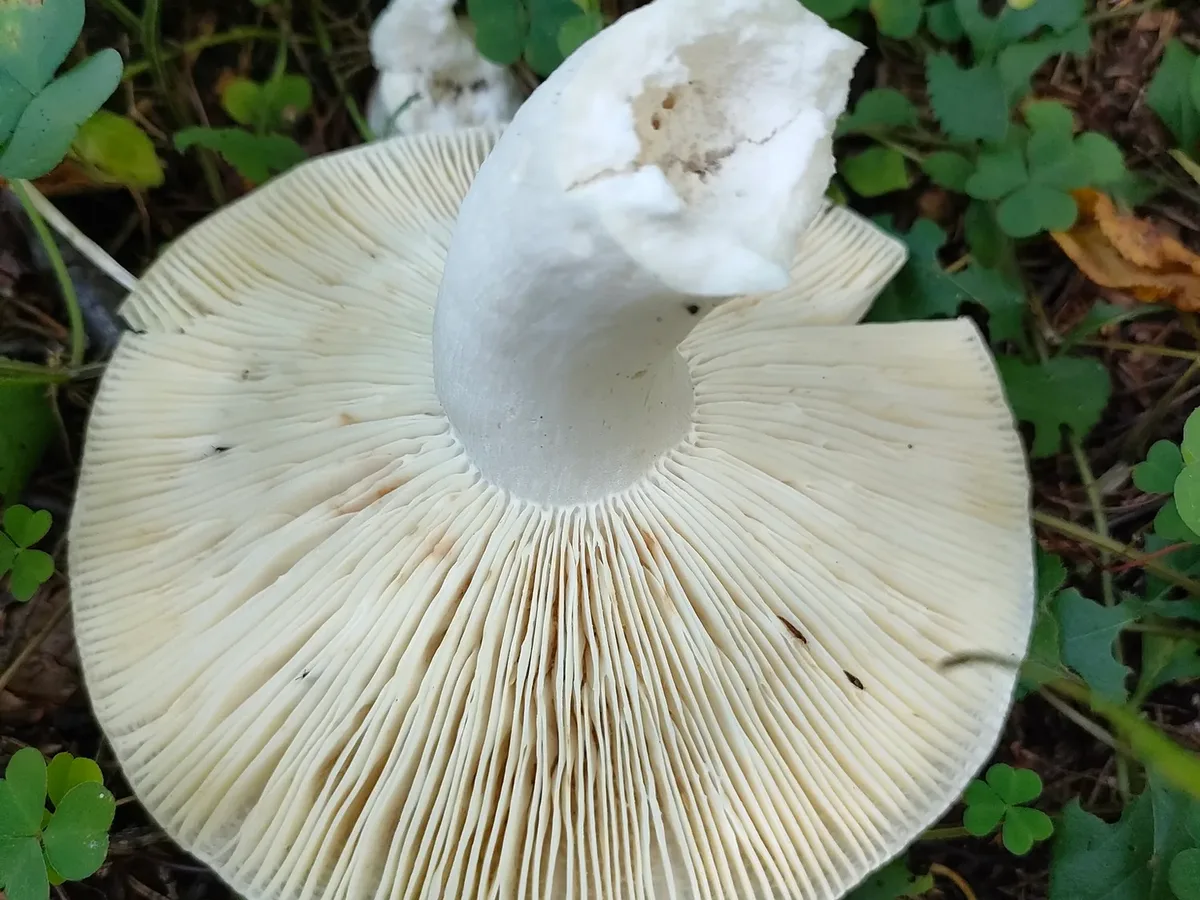
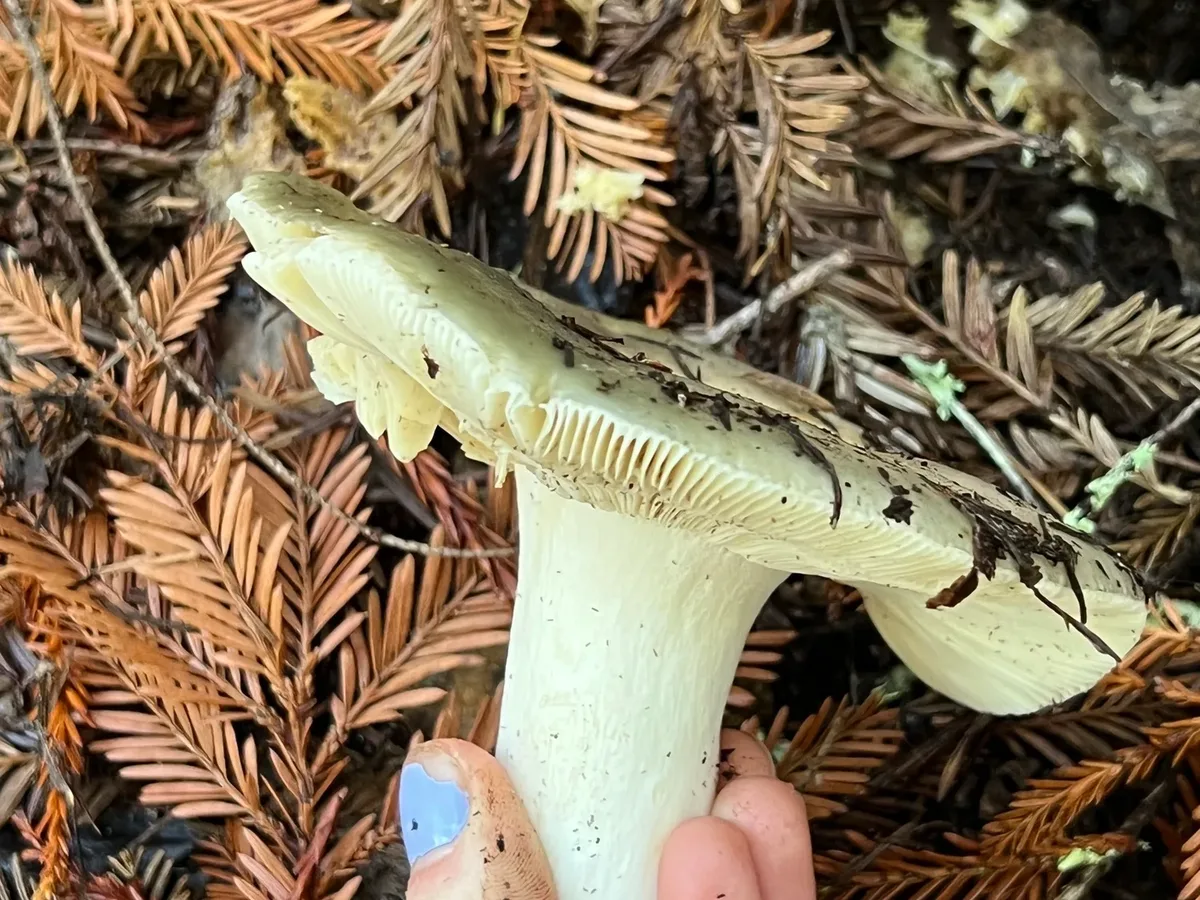
Beneath the cap, the gills are crowded, fairly narrow, and attach directly to the stem; they begin creamy-white and slowly acquire a yellowish tone with age, sometimes developing irregular brown spotting where they have been bruised or where insect larvae have been active.
Stem
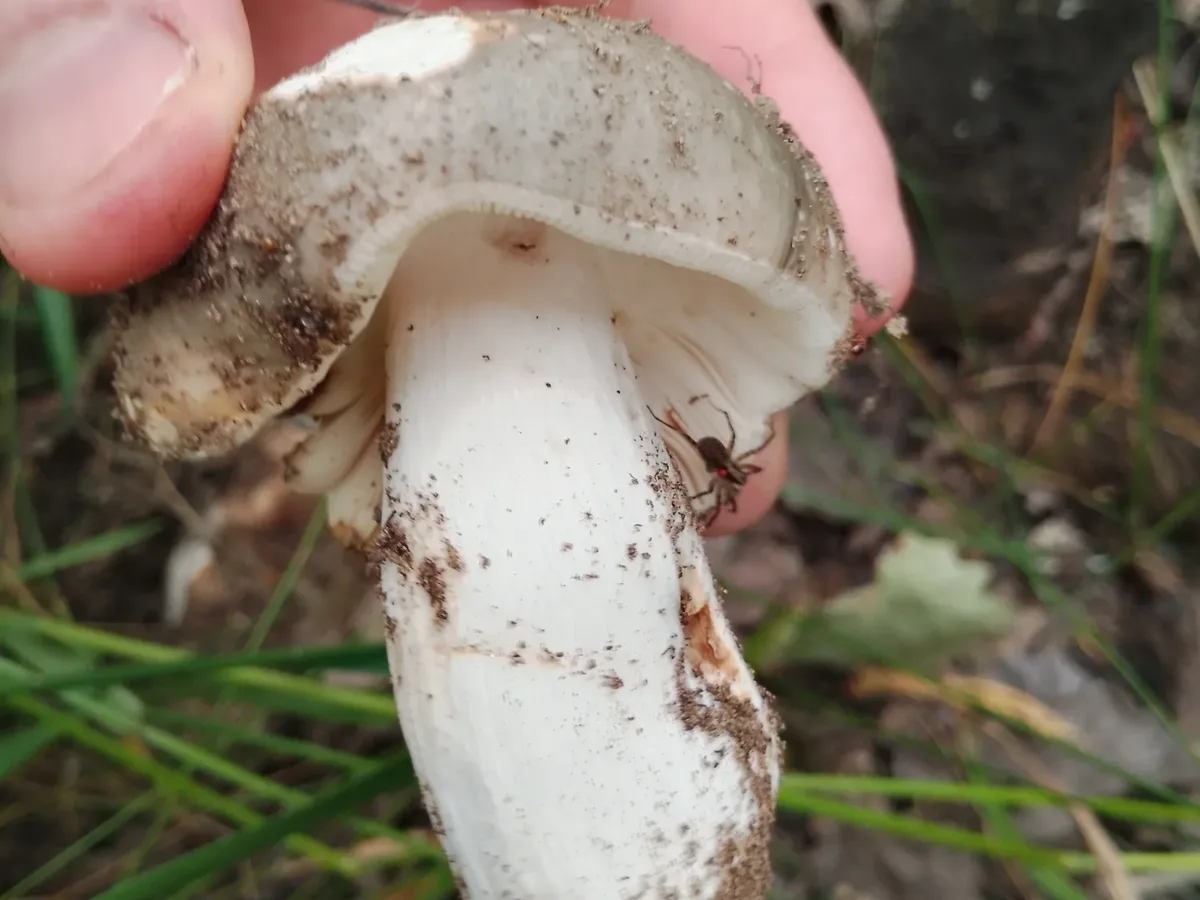
The stem is stout and straight, typically 4-8 cm tall and 1-2 cm wide, white to faintly cream, occasionally showing brown tints at the base. It has no ring, no skirt, and no bag-like volva - three absences that become critical when comparing with Amanita species.
Flesh
The flesh is brilliant white, dense, brittle in the distinctive way unique to the genus: snap a piece and it fractures cleanly, like chalk or hard cheese. It does not string, it does not pull into fibres, and it releases no fluid.
Smell & taste
The taste is mild to very faintly acrid when very fresh and raw, settling to neutral when cooked.
Where & when it grows
Habitat
Russula aeruginea is a strict mycorrhizal partner, incapable of living without a living tree host.
In the Nordic landscape it gravitates most strongly to birch - Betula pendula and Betula pubescens - but forms productive associations with spruce (Picea abies) too, and is occasionally reported under aspen and pine in mixed stands.
The relationship is obligate for both partners at the juvenile stage: the fungal hyphae envelop the fine root tips of the tree, forming a sheath (the ectomycorrhizal mantle) and extending a web of mycelium out into the surrounding soil.
The tree gains access to phosphorus, nitrogen, and water from soil pores too fine for its own roots to reach; the fungus receives photosynthetically fixed carbon sugars it cannot produce itself.
This is not a recent arrangement - the lineage of ectomycorrhizal Russulales has co-evolved with northern forest trees for tens of millions of years.
You will find the green brittlegill most reliably in:
- birch-dominated forests
- mixed birch-spruce stands
- older parks with large birches
- roadside copses
It copes with both acidic and moderately rich soils. Look under birches growing on the edges of clearings or along streams, where the combination of light and moisture tends to favour fruiting.
When
The green brittlegill fruits from early summer through to the first hard frosts of autumn, with the bulk of its production concentrated between late June and late September in Scandinavia.
Like most mycorrhizal russulas, it fruits in flushes rather than continuously: the underground mycelium responds to a combination of accumulated soil warmth (at least 10-12 °C at root depth) and soil moisture delivered by late-summer or early-autumn rains.
A flush typically emerges 7-14 days after rain, emerging fastest when nights are warm and the soil holds moisture without waterlogging.
Early-season caps appearing in June and July tend to be smaller and are sometimes more acrid; the main flush through August and September produces the largest, most robust fruitbodies.
After the first sharp ground frosts, fruiting ceases for the year, though the mycelium lives on below the frost line, ready to resume the partnership when the soil warms again the following spring. In unusually warm autumns it can push new caps well into October.
How it grows
The fruitbody of Russula aeruginea develops entirely underground before breaking the soil surface, beginning as a dense, egg-shaped primordium enclosed in a thin skin of undifferentiated tissue.
As the cap expands it pushes through the leaf litter or moss, initially convex and button-like, the margin tightly inrolled, the surface uniformly coloured and deeply viscid.
Over the following days the cap flattens and then becomes slightly depressed at the centre in older specimens, the margin ribbing appearing last as the outer tissue dries and the gill edges press outward.
The whole cycle from primordia to full-sized fruitbody can take as little as 4-7 days under ideal warm, humid conditions - famously fast compared with polypores or chanterelles.
The brittleness of the flesh reflects its unusual cellular architecture. Unlike most fleshy fungi, which are built from interwoven filamentous hyphae, the Russula flesh contains large, rounded, thin-walled cells called sphaerocysts scattered through the hyphal matrix.
These spherical cells act like tiny ball bearings - they give the flesh a rigid-but-crumbly texture and mean that when mechanical pressure is applied, the tissue fractures abruptly rather than bending.
The mycelium persisting between flushes can fruit the same general patch year after year, often for decades, as long as the host tree survives.
Fruiting conditions
Conservative standard mycology estimate for a summer-autumn mycorrhizal russula; the guide gives no quantitative fruiting triggers.
Look-alikes
The green colouration of Russula aeruginea creates a dangerous overlap in appearance with the death cap, Amanita phalloides, one of the world's most lethal mushrooms. This similarity is the single most important safety fact about this species.
The death cap frequently has a greenish to olive-greenish cap - the colour alone cannot distinguish the two. The structural differences are absolute and reliable.
The death cap always carries:
- 1a membranous ring (skirt) partway up the stem, which may be tattered but leaves clear remnants on mature specimens;
- 2a stocking-like volva at the very base of the stem - a cup or bag of white tissue that encloses the base and is often partly buried in soil.
Russula aeruginea has neither structure. The stem base of a russula is clean and cylindrical, with no trace of a bag or sheath.
Additionally, the death cap flesh tears into fine fibres when pulled lengthwise (like mozzarella); russula flesh fractures brittlely and does not string. The death cap's gills remain permanently white even in old age; russula gills yellow slightly.
A second, non-deadly comparison group is the milkcaps (Lactarius species), which share the same forest habitat. If you break a gill or cut the stem of a milkcap, a milky white or coloured latex seeps out within seconds. Russula aeruginea produces no latex whatsoever.
Both comparisons are confirmed by structure, never by colour alone.
The death cap always has a ring on the stem and a stocking/volva at the base, white gills, and can be torn into fibres; the russula has neither a ring nor a stocking and crumbles brittlely. Always pick up the whole mushroom including the stem base.
Milkcaps exude a milky latex when broken; the green brittlegill has no latex.
In the kitchen
Picking & cleaning
Approach the green brittlegill with the full Russula protocol.
First, confirm genus: grip the stem and twist - it will not unravel into threads. Break the cap edge - it snaps cleanly. There is no milky fluid, no latex, no anise or floury smell.
Having confirmed it is a russula, apply the raw-taste test: bite off a small piece of the raw gill, chew for ten seconds, then spit. If the taste is mild or neutral, this is one of the edible group. If it builds to a sharp, burning acridity over that ten seconds, the individual specimen is too acrid to eat - leave it, or try another.
This test is genus-specific and should not be applied to any other group of fungi.
Before cutting, carefully lever the entire fruitbody from the ground with a knife tip to expose the full stem base. The base should be cleanly cylindrical with no swelling, no cup-shaped sheath, and no membrane around it - confirming it is not an Amanita.
Good picking technique:
- cut cleanly just above ground level once you are satisfied with the identification;
- carry in a basket (not a plastic bag) to allow spores to disperse and to keep the flesh in good condition.
Young, firm caps in the 5-8 cm range are the best table mushrooms; older caps with heavy brown gill-spotting or soft, waterlogged flesh are worth leaving behind.
Cooking
The green brittlegill has a mild, pleasant flavour with a firm, slightly grainy texture that holds shape well in the pan - a consequence of its sphaerocyst-rich flesh, which resists dissolving into mush even with extended heat.
The raw specimen can have a faintly acrid edge (though well within the 'mild' threshold for edible russulas), and this fully disappears on cooking.
High-heat methods suit it best: slice caps 5-8 mm thick and fry in butter or neutral oil over medium-high heat until the edges are golden and any released moisture has evaporated, about 6-8 minutes. The flesh does not shrink dramatically, making portion estimation easy.
It absorbs aromatics readily - garlic, thyme, and a splash of white wine at the end of frying work well.
Because the flavour is mild rather than intense, it benefits from pairing with more assertive mushrooms: chanterelles, ceps, or trumpet chanterelles all complement it without overpowering.
It is well-suited to omelettes, creamy sauces, and mushroom soups where its texture contributes body without muddying more distinctive flavours.
Drying is possible but the texture becomes somewhat granular; fresh or briefly blanched-then-frozen results are better. Like all edible wild mushrooms, it should be cooked thoroughly - not eaten raw in quantity.
Good to know
Russula aeruginea is edible and does not contain the amatoxins, phallotoxins, or ibotenic acid found in dangerous Amanita species.
It belongs to the mild-tasting fraction of the genus; the raw-taste test (bite, chew ten seconds, spit) reliably separates mild edible russulas from the acrid inedible ones.
However, the overriding safety obligation when collecting this species is accurate Amanita exclusion. Before eating any green or greenish mushroom from a Nordic forest, the picker must have physically verified:
- 1the complete absence of a ring on the stem;
- 2the complete absence of a volva at the stem base - which requires digging up the whole fruitbody, not cutting it at ground level;
- 3the brittle, non-fibrous fracture of the flesh.
Missing any one of these checks is not acceptable.
The death cap is implicated in the majority of fatal mushroom poisonings worldwide; a single cap contains enough amatoxin to cause fatal liver failure in an adult.
Amatoxin poisoning is characterised by a deceptive symptom-free period of 6-24 hours after ingestion, followed by violent gastrointestinal onset and, in severe cases, progressive liver and kidney failure over days. There is no effective antidote for late-stage poisoning.
If there is any doubt after structural examination, do not eat the mushroom. Certainty, not probability, is the standard required here.
A reference guide - never an edibility guarantee. When in doubt, leave it out.