Winecork brittlegill
Russula adustasyn. Agaricus adustus Pers., Russula adusta var. adusta
 © Else Landsem (CC BY)
 © Rob van Kruining (CC BY)
 © Carl Ramirez (CC BY)
 © Andrey Loria (CC BY)
 © Andrey Loria (CC BY)
 © Rob van Kruining (CC BY)© Else Landsem (CC BY)© Rob van Kruining (CC BY)
Edible only with the right preparation - or safe for some people but not others. Learn the caveats first.
Never eat a mushroom you are not 100% sure of - check the look-alikes below, and always cook wild mushrooms.
How to recognise it
The Winecork brittlegill is among the largest and most distinctively coloured of the European blackening russulas.
Cap
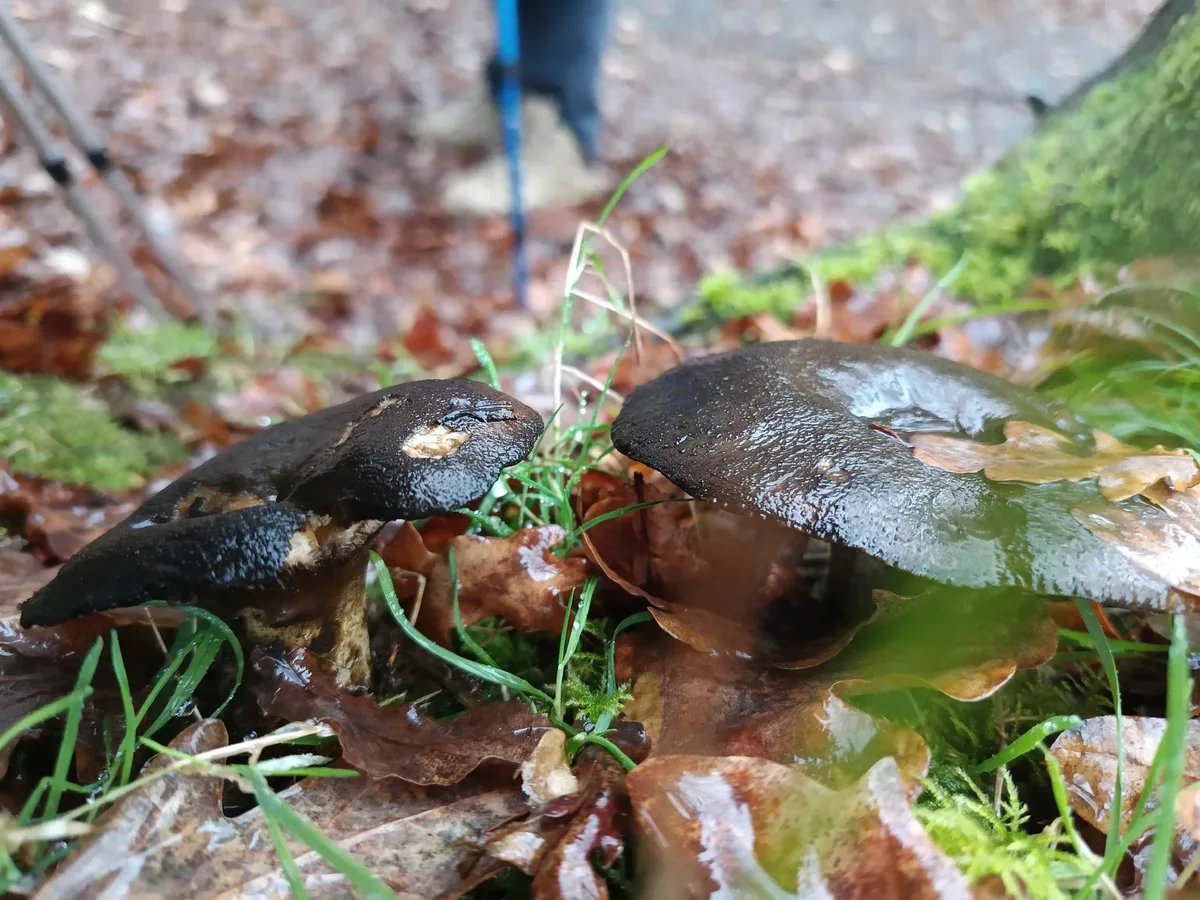
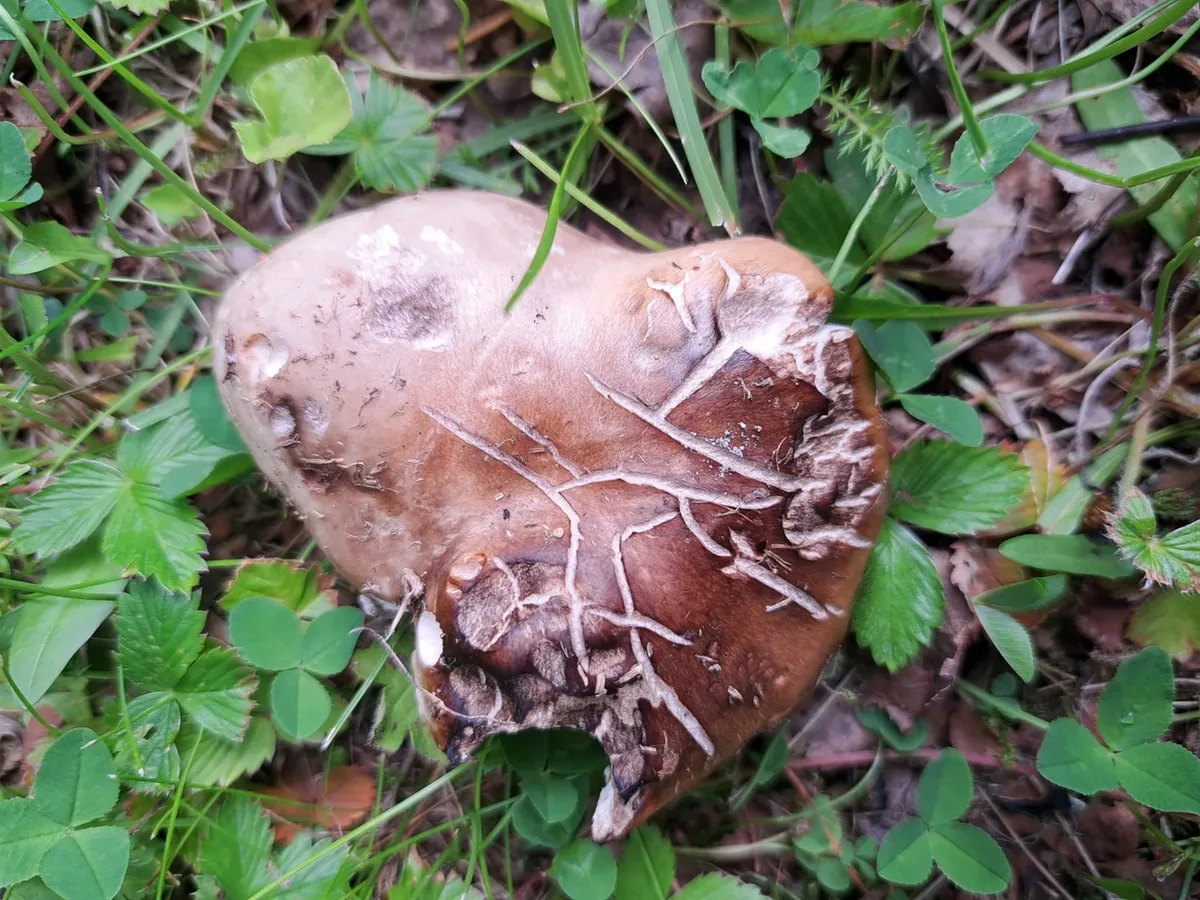
Young caps are white to ivory or pale brownish-buff - at this stage the most dangerous because the blackening cue has not yet appeared - then progressively darken through smoky greys to a sooty brownish-black as the fruit body ages.
A single colony often shows every stage at once: pure-white buttons alongside fully sooty mature caps, making the darkening trajectory visible in the field.
The cap is 5-15 cm, convex then broadly funnel-shaped; the surface is dry and matt rather than viscid, and the cuticle barely peels.
Gills
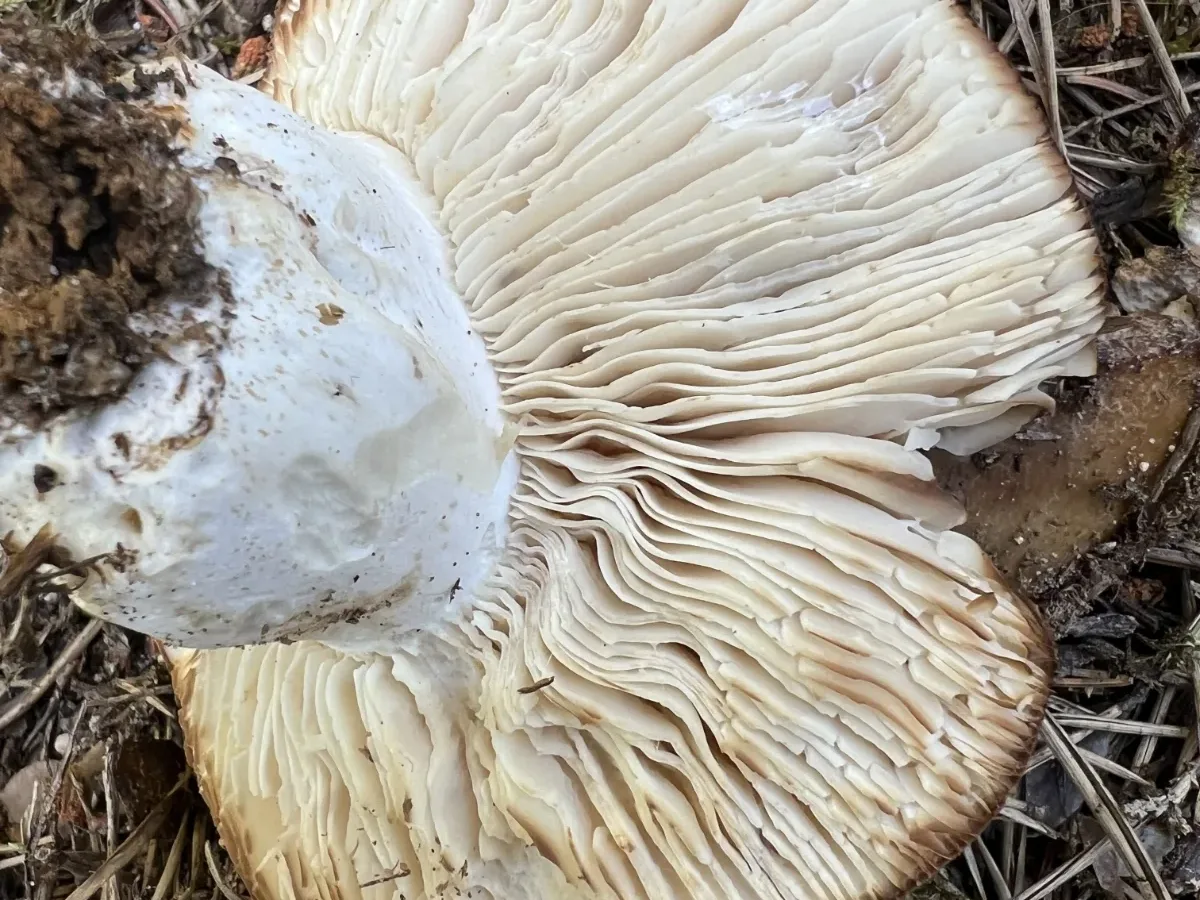
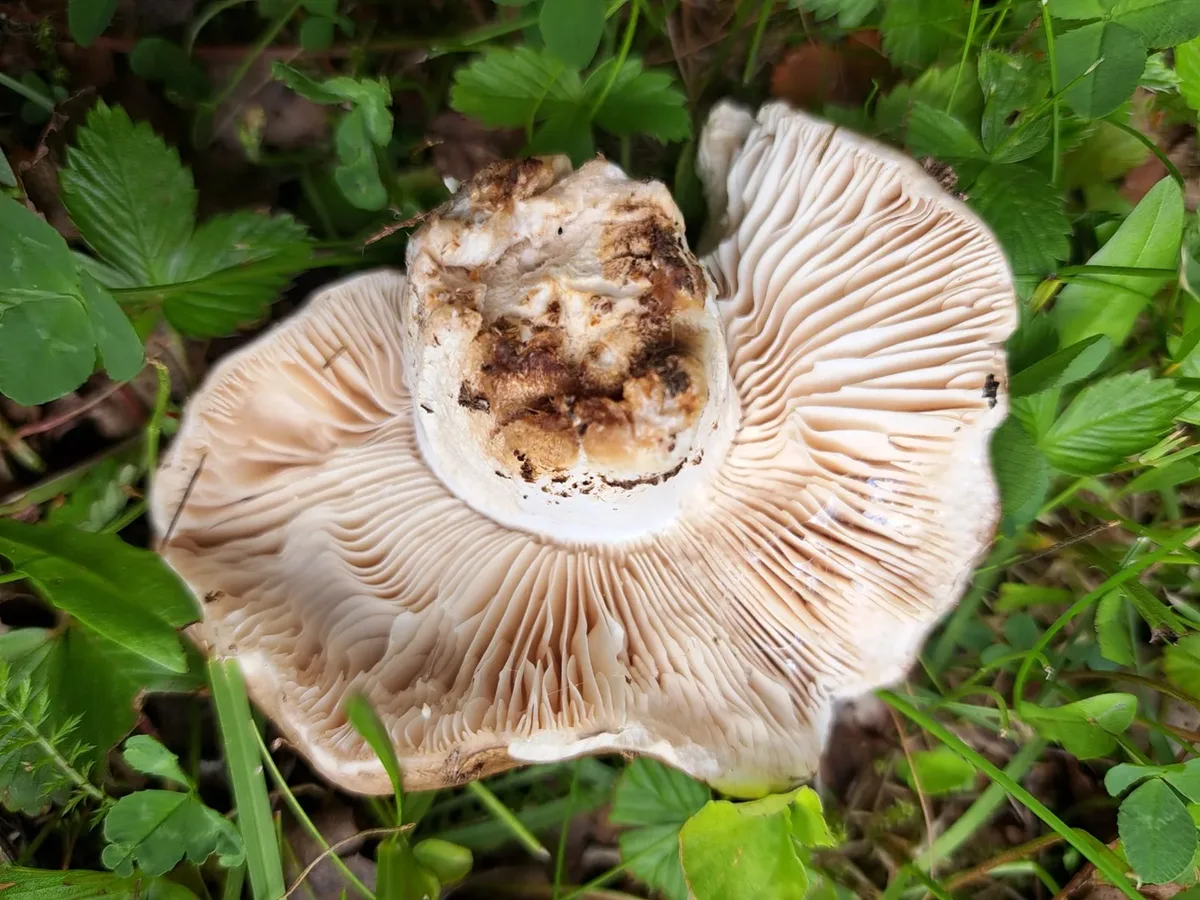
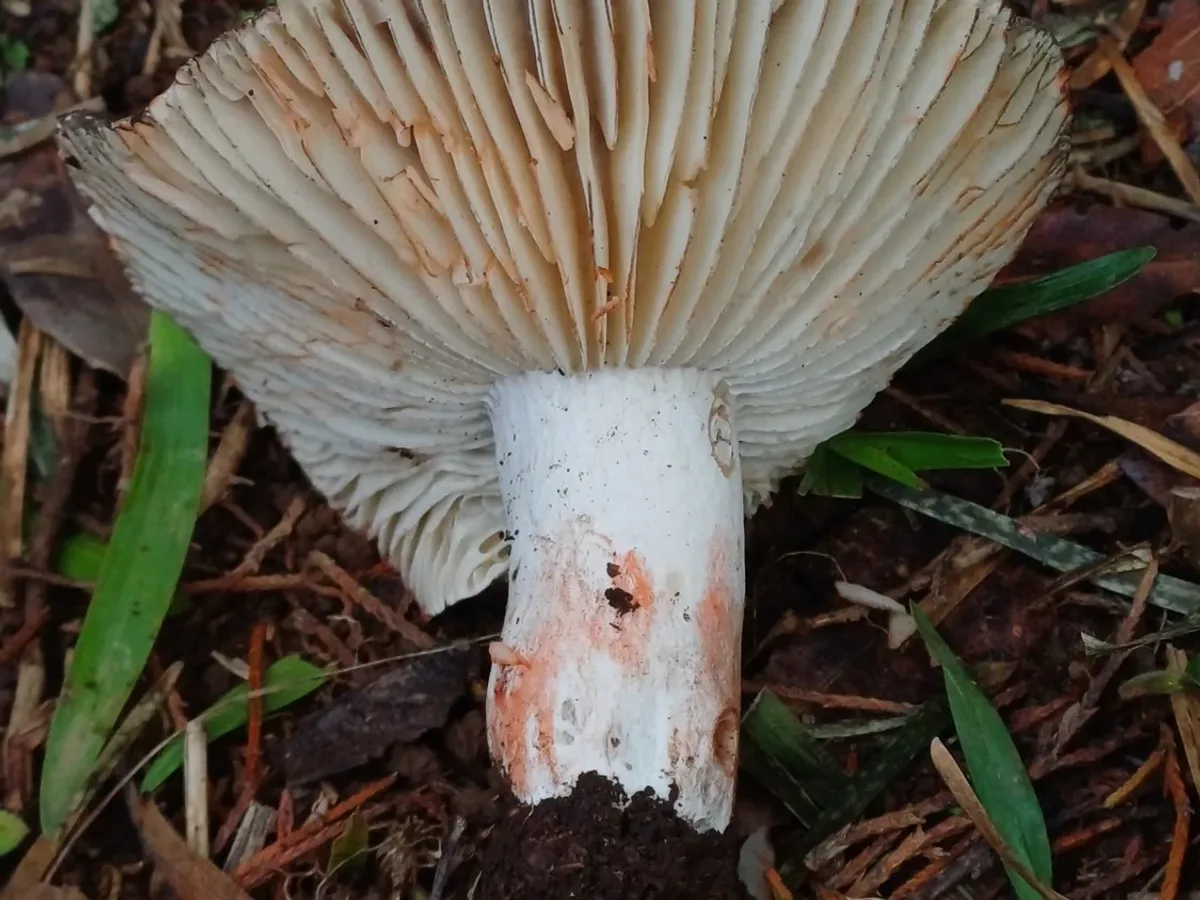
Gills are white, fairly crowded, brittle in the characteristic Russula fashion (they crumble when rubbed rather than bending), and darken to grey then black with age.
Stem
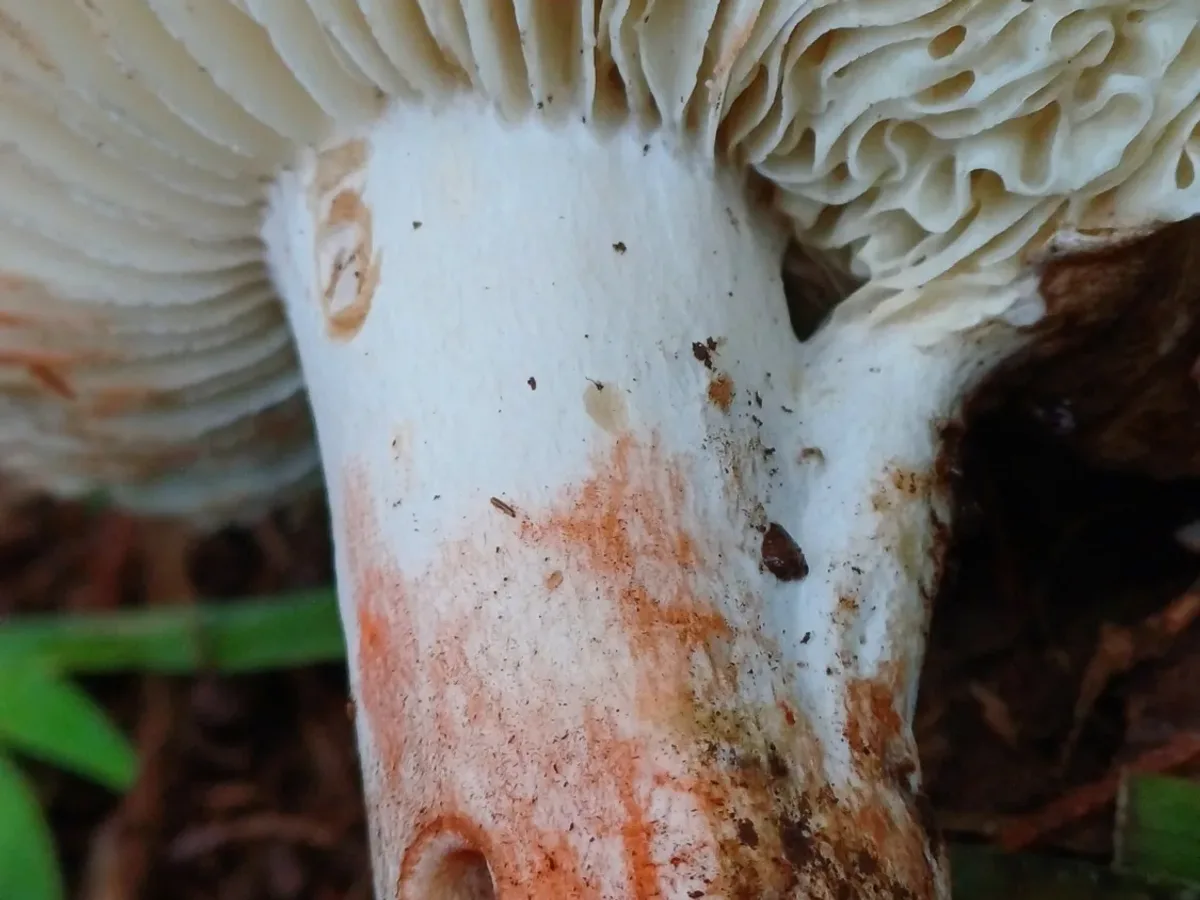
The stem is stout and white, also blackening from the base up.
Flesh
Crucially, the flesh turns reddish when cut before eventually going grey to black - a slow reaction distinguishing it from the similar blackening species Russula nigricans (whose flesh reddens more quickly and strongly).
Smell & taste
The smell is mild but musty, like old corks. The taste is distinctly and sharply acrid, which is in itself a signal to reject the species for the table.
Why it's dangerous
Not directly lethal in typical exposures, but the species is problematic for two reasons.
- 1The GI symptoms are unpleasant and occasionally severe enough to require medical attention for rehydration.
- 2More importantly, the young white stage of the fruit body creates a genuine identification hazard in the field: novices who are aware that 'russulas are safe' may fail to correctly identify young white specimens and confuse them with visually similar deadly white Amanitas.
The safest protocol is to avoid collecting any pale-capped woodland gilled mushroom unless you can positively confirm the absence of a volva and ring at the base, the brittle chalky flesh texture, and a white to cream spore print - and even then, the acrid taste of R. adusta correctly indicates rejection.
Toxin
The acrid compounds in Russula adusta are phenolic or sesquiterpene-based irritants common to the acrid russulas (specific compounds not fully characterised). They cause localised irritation of the mucous membranes and gastrointestinal tract.
The toxin is partially heat-labile in some acrid russulas, but cooking does not reliably render R. adusta safe or palatable. The species is considered inedible on grounds of both toxicity and quality.
Symptoms
Raw or inadequately cooked specimens cause burning of the mouth and throat, nausea, vomiting, abdominal cramping and diarrhoea.
Symptoms typically begin within 30 minutes to 2 hours of ingestion and resolve within 24 hours without specific treatment.
Serious systemic toxicity has not been documented; the primary risk is dehydration from fluid loss in vulnerable individuals (children, elderly, those with GI conditions).
Unlike the amatoxin-containing Amanitas, there is no latent phase and no liver or kidney involvement.
Staying safe
Russula adusta is classified as inedible-to-mildly-toxic and should not be eaten. Beyond its own limited toxicity, it is worth knowing for the dangerous confusion potential of its young white stage with deadly white Amanitas.
The safety lesson it teaches: always dig up the entire stem of any white-capped woodland mushroom and inspect the base.
- A volva or ring = potential deadly Amanita.
- Brittle crumbling flesh and acrid taste = likely acrid russula (reject).
Neither test is sufficient alone, but together they cover the most lethal confusions.
Where & when it grows
Habitat
Grows in mixed and coniferous woodland, forming ectomycorrhizal partnerships primarily with spruce and pine but also with beech, oak and birch across central and western Europe.
It appears among needle litter and leaf litter alike, and is one of the more drought-tolerant russulas - you may find it fruiting in moderate dry spells when the more moisture-demanding species have retreated.
Large gregarious troops on acidic, well-drained forest soils are characteristic.
When
Fruiting begins in midsummer - July in a warm year - and runs through to mid-October or beyond.
The main flush is August through early October across central and western Europe, when soils are still warm but autumn moisture arrives.
Because it partners with both conifers and broadleaves, it can hold on later into the season than many mushrooms, sometimes persisting into early November when frosts are gentle.
How it grows
Grows singly or, more commonly, in large scattered troops among needle or leaf litter on forest floors.
Like all ectomycorrhizal fungi, it is always rooted beneath a living host tree - the mycelium forms a partnership with tree roots that may persist for many years underground, invisible until conditions are right for it to fruit.
It does not grow on wood and will not appear in open grassland. Young fruit bodies are firm and robust; with age and wet weather they soften, darken, and decay fairly quickly.
Fruiting conditions
A drought-tolerant mycorrhizal russula that fruits after moderate summer-autumn rainfall once soils exceed about 8 °C. Large troops appear 7-14 days after meaningful rain events; the species can persist through drier spells when more moisture-sensitive russulas are absent.
Look-alikes
Three categories of confusion are relevant.
- 1Most dangerous: young white caps of Russula adusta before blackening begins can be superficially mistaken by a novice for a white-capped Amanita, including the deadly death cap (Amanita phalloides) in its white form, or the equally deadly destroying angel (Amanita virosa). Any white-capped woodland gilled mushroom must be assessed for the presence of a volva and ring before any other identification - R. adusta has neither, its gills are brittle-crumbling rather than free and smooth, and its flesh snaps like chalk rather than tearing into fibres.
- 2Russula nigricans, the blackening brittlegill, is the closest lookalike in appearance, also large, pale-then-blackening, and with an acrid taste - it can be distinguished by its very widely spaced, thick gills (fewer and much more broadly separated than R. adusta's) and by its flesh, which turns a more vivid red on cutting before going black; it too is inedible.
- 3Russula albonigra, another close relative in the blackening group, is very similar but has smaller, more crowded gills and flesh that blackens almost directly without a preceding red phase; it is also acrid and inedible.
All three blackening russulas share the acrid taste and should be rejected regardless of fine identification.
The death cap occurs in the same woodland habitats and, in its white/pale form, can look superficially similar to a young white Russula adusta before blackening appears. The death cap ALWAYS has a membranous volva (sac or girdling ring at the base of the stem) and usually a ring (skirt) on the stem; its gills are free, white, smooth and non-brittle, and its flesh tears into fibres rather than snapping like chalk. R. adusta has no volva, no ring, brittle crumbling gills, and chalk-like flesh. Always dig up the whole stem and inspect the base before any white-capped woodland mushroom reaches the basket.
Pure white, deadly, and grows in similar woodland. The destroying angel has a conspicuous silky-white ring on the stem and a bag-like volva buried at the base; its gills are free, white and non-brittle; its flesh is fibrous and has a faint sweet or honey-like smell. R. adusta has no ring, no volva, brittle snapping flesh, and a musty wine-cork smell. The acrid taste of R. adusta (spit immediately) is an additional signal to reject, but do not rely on taste to detect Amanita amatoxins - they are tasteless.
The most frequent lookalike within the blackening-russula group. R. nigricans has very thick, widely spaced, distant gills (much fewer, more broadly separated than R. adusta's moderately crowded gills), and its flesh turns a more immediate, vivid red on cutting before going black. Both are acrid and inedible. R. adusta generally has more numerous, narrower gills and a flesh colour change that is slower and less dramatically red.
Lactarius turpis is a large, dark olive-brownish to blackish-brown capped milkcap that grows in similar woodland and can darken with age. The critical distinction: break a gill or piece of flesh on a milkcap and a milky latex immediately exudes; Russula adusta produces no latex whatsoever. The latex on L. turpis is white. Both are inedible or of very poor quality.
Another close relative in the blackening group. R. albonigra has a very similar cap but its flesh blackens almost immediately on cutting without a distinct preceding red phase, and it has a characteristically menthol-like or camphorous smell. Both species are acrid and inedible; neither poses a significant safety risk relative to each other, but the white young stage of both demands the same Amanita exclusion protocol.
A reference guide - never an edibility guarantee. When in doubt, leave it out.