Royoungia truffle bolete
Royoungia boletoides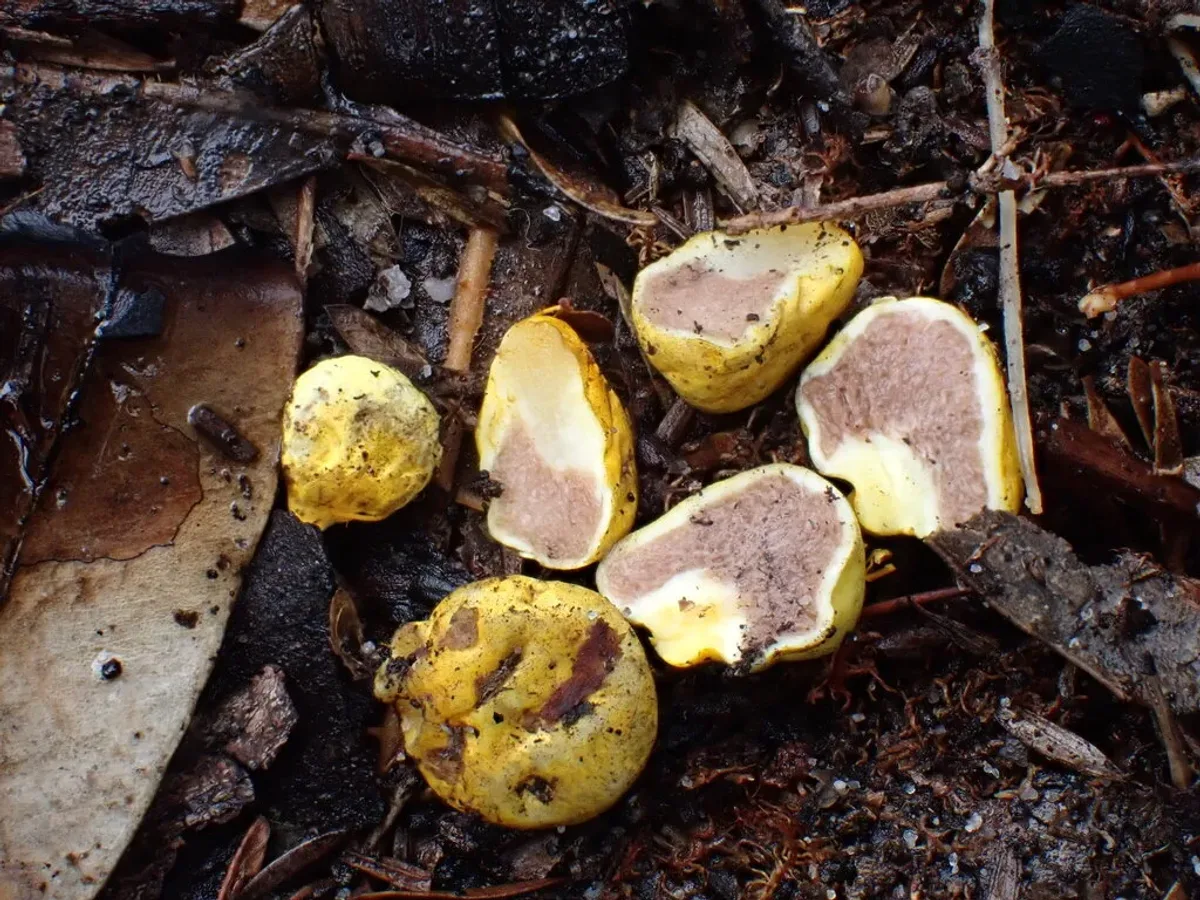 (c) Todd Huang, some rights reserved (CC BY)
 (c) Todd Huang, some rights reserved (CC BY)
 (c) Todd Huang, some rights reserved (CC BY)(c) Todd Huang, some rights reserved (CC BY)(c) Todd Huang, some rights reserved (CC BY)
Not poisonous, but not worth eating - too tough, bitter, or bland for the pot.
How to recognise it
Royoungia boletoides is one of those fungi that reveals evolution caught mid-stride: it belongs unmistakably to the bolete lineage, yet its fruiting body never opens.
Where a porcini unfurls its cap and exposes a neat pore surface to the air, Royoungia keeps its spore mass permanently enclosed in a tough outer skin - a strategy called sequestration that has evolved independently many times in the Boletales.
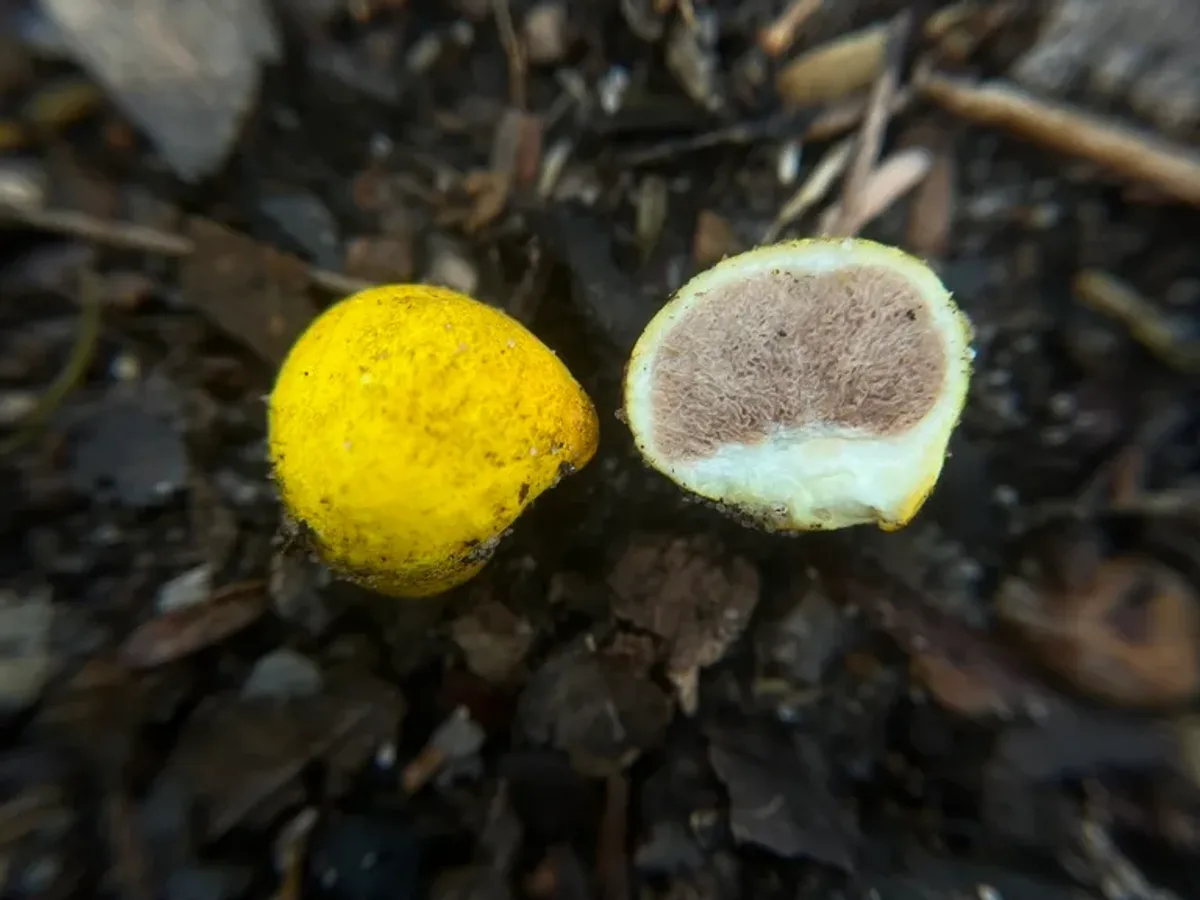
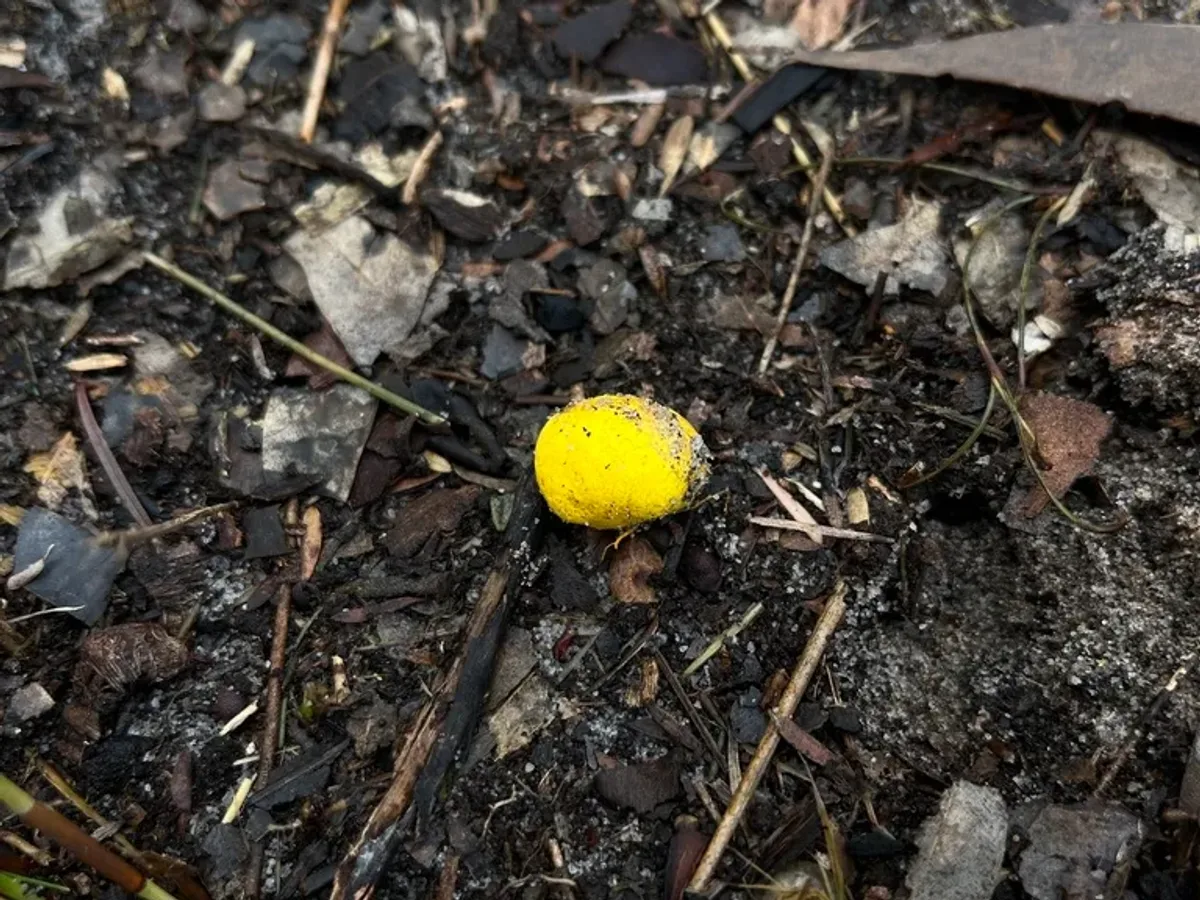
The result is a small, roughly potato-shaped or lobed body, 2-6 cm across, that sits at or just below the soil surface. The outer peridium is pale buff to ochre-brown or tawny, dry, and finely felty, occasionally cracking into irregular patches with age.
There is no cap, no free pore layer, no stipe: just a closed orb attached to the soil by mycelial cords.
The interior is the giveaway. Cut it open and you find a chambered gleba - a sponge-like matrix of tiny locules whose walls are lined with the boletoid hymenium (spore-bearing tissue).
In young specimens the gleba is cream to pale yellow; as spores ripen it progresses through olive-yellow to dull olive-brown to nearly black.
A vestigial columella - a pale internal column - may survive at the base of young specimens, the ghost of an ancestral stipe that evolution has been slowly reducing.
Spores are olive-brown in mass and fusiform (cigar-shaped) under the microscope, typical of the Boletaceae.
Where & when it grows
Habitat
Royoungia boletoides occupies a specialised ecological niche: it is a hypogeous (underground-fruiting) ectomycorrhizal fungus of eucalyptus forests in southeastern and southwestern Australia.
Ectomycorrhizal means the fungus threads its mycelium around the fine root tips of eucalypts without penetrating the cells, forming a dense sheath. Both partners benefit - the tree gains enhanced water and mineral uptake, the fungus receives photosynthetic sugars.
This underground partnership also explains why the fruiting body fruits below the surface: there is no evolutionary advantage to raising a stalk into the air when the spores are not being windborne but instead consumed and defecated by animals.
The primary dispersers of Royoungia boletoides are specialist hypogeous-fungi foragers: long-nosed potoroos (Potorous tridactylus), bettongs, bandicoots, and woylies (Bettongia penicillata) dig up and eat the glebas, passing spores through their guts and depositing them - complete with fertilising dung - across the forest floor.
This mutualism is so tightly woven into the ecology of Australian eucalypt forest that the decline of these small marsupials, through habitat loss and predation by introduced foxes and cats, is now a matter of conservation concern for the fungi that depend on them.
Look for Royoungia boletoides in undisturbed dry and wet sclerophyll forest with deep leaf litter, on freely draining acidic soils, typically within the root zone of mature eucalypts. It is most often discovered accidentally - turned up by animal diggings or by carefully sifting leaf litter and shallow topsoil.
When
Being hypogeous, Royoungia boletoides is somewhat buffered from the day-to-day weather swings that dictate above-ground fruiting: the surrounding soil insulates the developing gleba and keeps it moist longer than any exposed mushroom cap.
Nonetheless, fruiting aligns broadly with the Southern Hemisphere autumn - March through July - when soil temperatures are cooling from summer highs and seasonal rains begin to penetrate the litter layer. April and May are typically the most productive months across most of its range.
Because the fruiting bodies ripen slowly and remain enclosed, they persist in the soil for weeks after an above-ground mushroom cap would have decayed, so the effective window for finding them is longer than the season implies.
At higher elevations (Victorian Alps foothills, ranges in southern Western Australia) fruiting can begin in March; in warmer lowland sites it may be primarily a May-June phenomenon.
How it grows
Royoungia boletoides grows solitary to scattered in the topsoil and litter layer, never clustered or on wood. It emerges from mycelial cords radiating from the root network of eucalyptus trees, usually within 2-5 m of a mature tree trunk.
Fruiting bodies develop entirely underground and push to the surface only partly. The top of the fruitbody may be level with or slightly above the mineral soil but is almost always covered by leaf litter.
Animal diggings - characteristic shallow scrapes with scratch marks left by potoroos or bandicoots - are a reliable sign that hypogeous fungi are present. Finding Royoungia boletoides often means looking in fresh diggings or carefully parting the litter in promising habitat.
Fruiting conditions
Hypogeous fruiting bodies develop more slowly than above-ground mushrooms and are buffered from surface conditions by surrounding soil. A rainfall of 20+ mm over the preceding two weeks combined with cooling soil temperatures (8-16 °C) is the inferred trigger, consistent with the autumn season (March-July in the Southern Hemisphere). Flush lag is longer than for epigeous boletes - 14-28 days - because the enclosed gleba matures slowly underground. These parameters are estimates derived from the known season and general ectomycorrhizal bolete ecology; no specific phenological study of Royoungia boletoides fruiting triggers has been published.
Look-alikes
Because Royoungia boletoides fruits underground and has a closed, truffle-like form, the most realistic confusions are with other hypogeous fungi in Australian eucalypt forest rather than with epigeous (above-ground) boletes.
- Mesophellia species are the most common hypogeous Boletales in Australian eucalypt forest; they have a similar closed form but their gleba typically lacks the chambered bolete architecture and may have a more powdery or cottony texture.
- Austrogautieria species (also Boletales) have a similar sequestrate form but their spores and gleba texture differ under microscopy.
- True truffles (Tuber spp. introduced to Australia, or native Genea and Peziza relatives) can occupy similar habitat but belong to the Ascomycota, and their gleba has a marbled or veined appearance rather than the chamber-and-wall (poroid) structure of Royoungia.
- Gautieriales species such as Chondrogaster pachysporus occur in southeastern Australia and may appear superficially similar.
Confident identification of Royoungia boletoides versus related sequestrate boletes requires microscopic examination of spore morphology and gleba architecture; field identification to species level is not reliable.
No deadly species are known to be specifically confused with Royoungia boletoides.
Austrogautieria species (family Gautieriales, order Boletales) are sequestrate fungi of Australian eucalypt forest with a similar external appearance. They tend to have a paler, whitish to cream peridium and a gleba that does not develop the olive-brown pigmentation characteristic of mature Royoungia. Spore morphology differs substantially; microscopy is needed for reliable species-level separation.
Cultivated or introduced Tuber species (true truffles, Ascomycota) may occur near truffle farms or planted Quercus and Corylus in Australia, but Royoungia boletoides fruits in native eucalyptus forest, not near imported oaks or hazels. The interior gleba of Tuber species has a distinctive marbled, veined pattern (asci in chambers) versus the poroid, chambered bolete architecture of Royoungia. True truffles have no ring-like outer layers around spore sacs.
Mesophellia species are among the most abundant hypogeous Boletales in Australian eucalypt forest and are the most frequent confusion with Royoungia boletoides. Both are closed, truffle-like bodies in similar habitats. Mesophellia typically has a thicker, more woody or cartilaginous peridium and a gleba that becomes dry and powdery to cottony at maturity rather than retaining the chambered, poroid architecture of Royoungia. Microscopy of spores is the definitive separator; Mesophellia spores differ in shape and ornamentation.
Chondrogaster and related Boletales sequestrate genera occur in eastern Australian forests. They share the closed form and hypogeous habitat but differ in gleba texture, colour progression on maturity, and microscopic characters. None are recorded as edible or toxic. Reliable differentiation requires comparison of gleba structure and spore morphology.
In the kitchen
Picking & cleaning
Royoungia boletoides has no established edibility record and no culinary use. It should not be collected for food.
Its value is entirely ecological - as ectomycorrhizal partner of eucalypts and as a food source for critically important marsupial dispersers - and as a subject of mycological interest.
If you find one, the most useful actions are:
- 1Photograph it in situ, showing the surrounding habitat and any animal diggings.
- 2Carefully note GPS coordinates.
- 3Report the find to a herbarium, iNaturalist, or Atlas of Living Australia, where records of this uncommon species contribute to understanding its range and ecology.
Good to know
Royoungia boletoides has no documented edibility. It has never been evaluated as food, and no traditional or modern foraging literature records it as edible.
The inedible classification reflects the complete absence of any record of safe consumption rather than documented toxicity: no poisoning cases are attributable to this species, but equally no safety data exist.
Its sequestrate form makes accidental consumption by a forager seeking edible fungi unlikely, since it does not resemble the familiar above-ground boletes most people collect.
The correct classification is inedible (not poisonous), and it should be left untouched except for observation and scientific recording.
As with any hypogeous fungus, specimens that have been underground for an extended time may be decomposed or contaminated. Such specimens should not be handled carelessly or tasted even out of curiosity.
A reference guide - never an edibility guarantee. When in doubt, leave it out.