Beautiful clavaria
Ramaria formosasyn. Clavaria formosa Pers., Clavariella formosa (Pers.) P.Karst., Corallium formosum (Pers.) Henn.
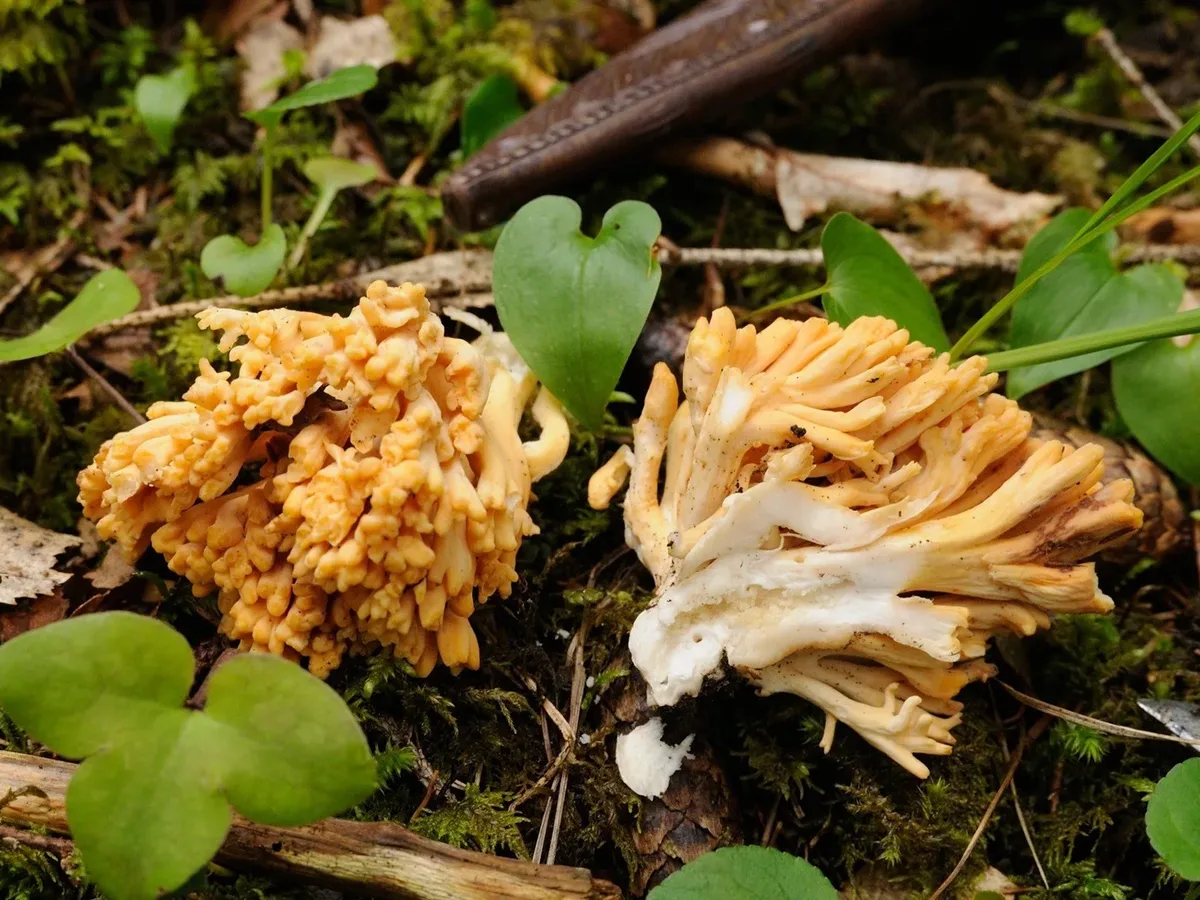 © Unknown (CC BY-SA)
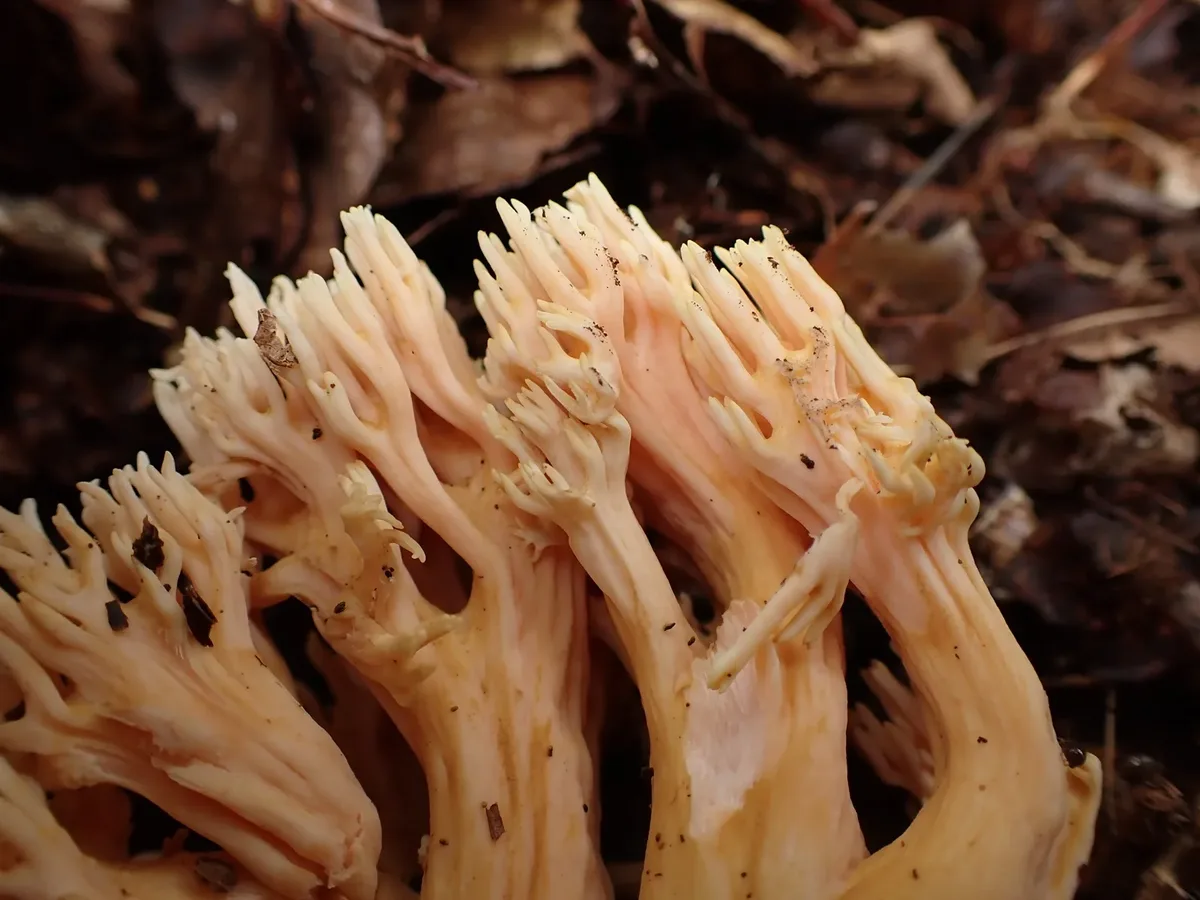 © Rune Solvang (CC BY)
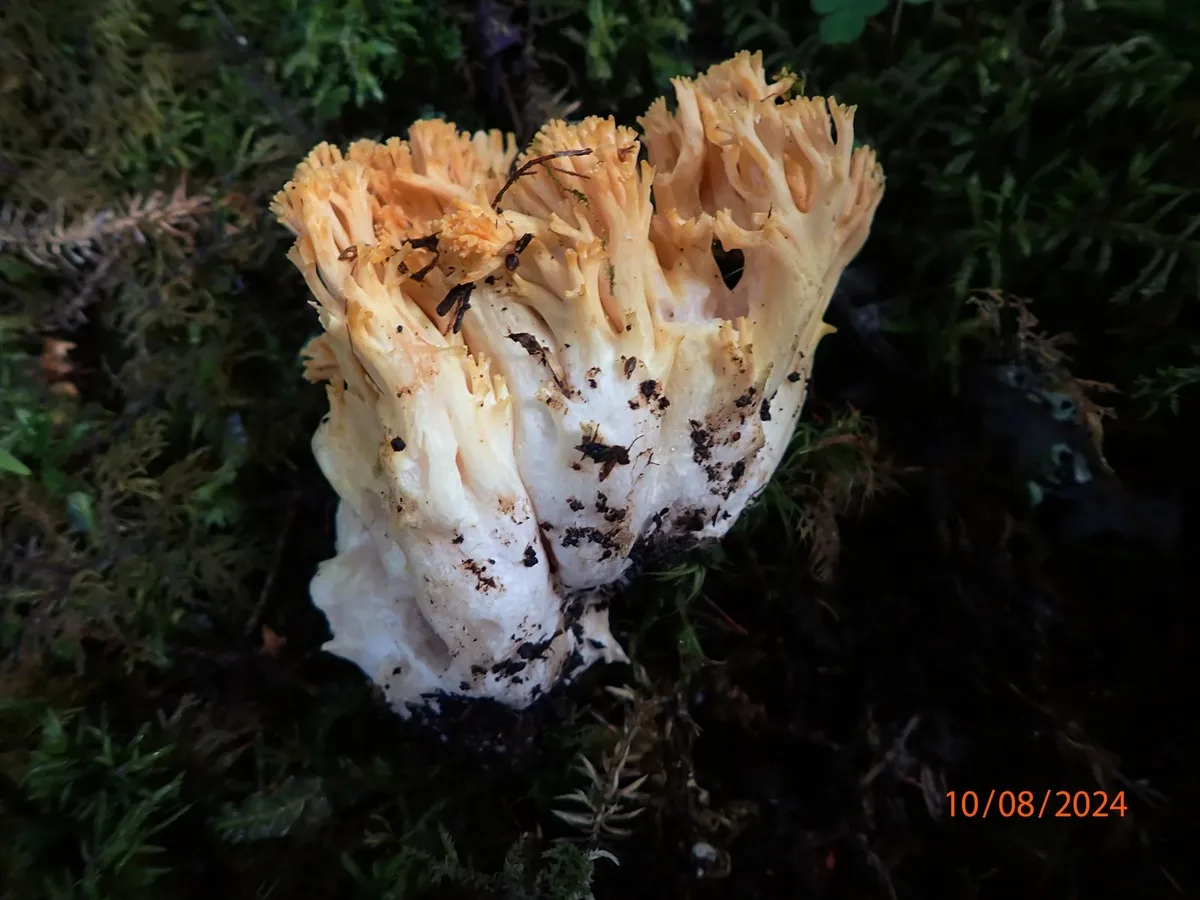 © Tove Jacobsen (CC BY)
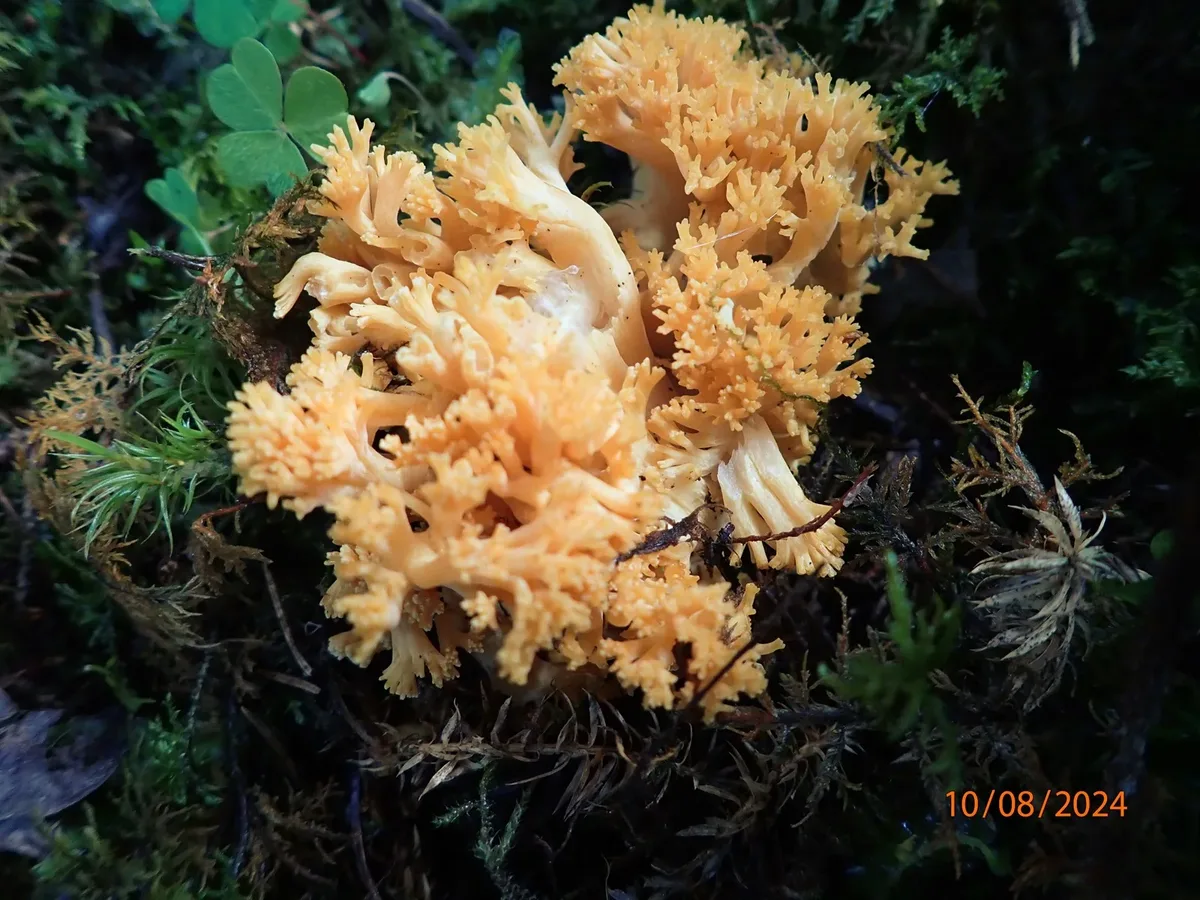 © Tove Jacobsen (CC BY)
 © Rune Solvang (CC BY)© Unknown (CC BY-SA)© Rune Solvang (CC BY)
Edible only with the right preparation - or safe for some people but not others. Learn the caveats first.
How to recognise it
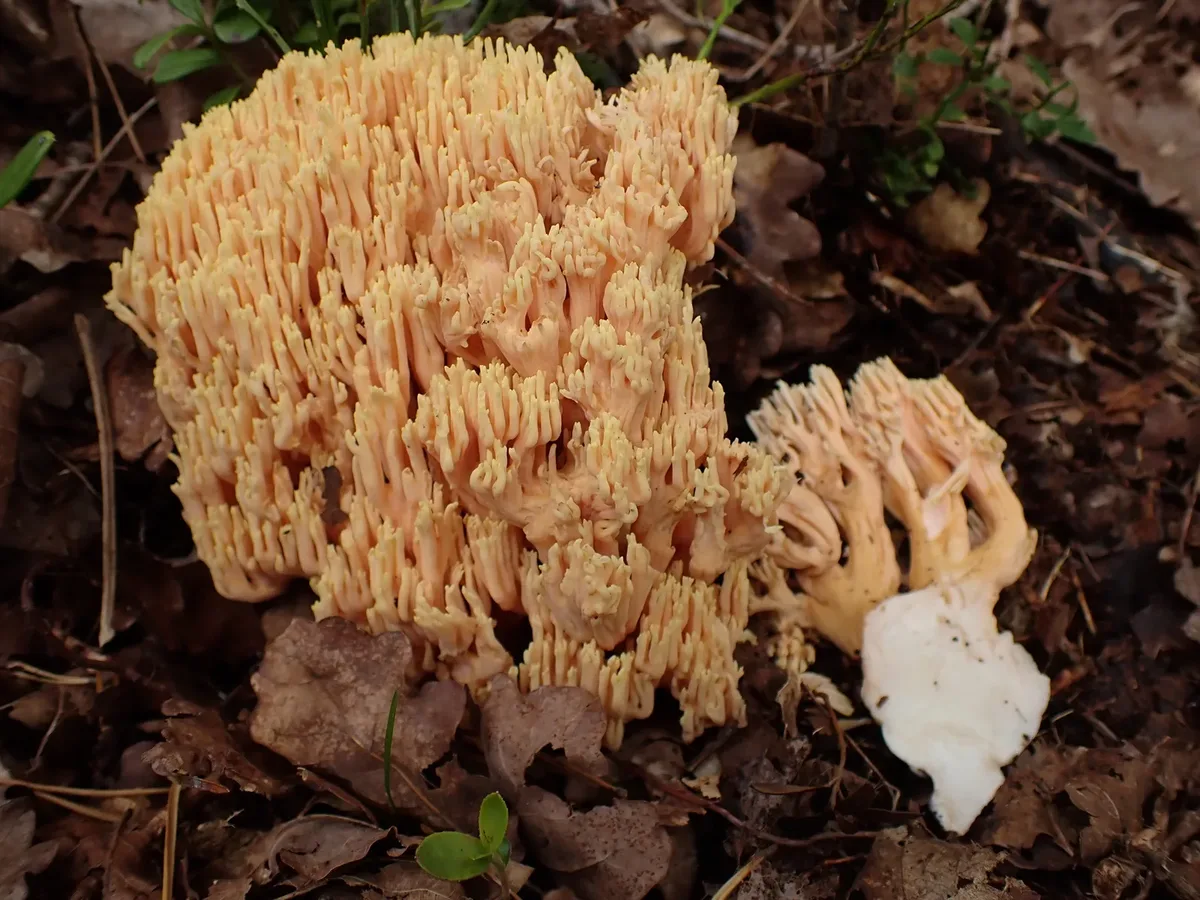
Ramaria formosa is one of the most arresting sights in a European autumn woodland - a bush-like mass of branching coral rising 10-30 cm tall and nearly as wide from the forest floor.
The stout white-to-cream basal trunk (3-7 cm across) divides almost at once into a dense, repeatedly forking network of salmon-pink to pale coral-orange branches, sometimes edged with apricot or peach at their peak. The whole structure looks uncannily like a sea coral stranded among the leaf litter. Fleshy and surprisingly brittle, the branches snap cleanly rather than bending.
The single most important field mark is the branch-tip color: in fresh, young specimens the tips are a clear lemon-yellow to pale straw-yellow, distinctly paler than the salmon body - that yellow-tipped-on-pink contrast is the key character separating this poisonous species from edible Ramaria relatives.
As fruitbodies age or after heavy rain, they fade overall to buff or ochre and the contrasting tip color becomes less distinct, making older specimens harder to read and more hazardous to collect.
Flesh is white, firm, and stays white when cut. The smell is faint, slightly mealy. The taste begins mild but develops a bitter, acrid edge - a useful cue, though not a reliable safety screen on its own.
Spore print ochre-yellow to rusty ochre. Spores 8-15 × 4-6 µm, cylindric-ellipsoid, surface finely warted-striate (warts in confluent lines), pale ochre under the microscope.
Why it's dangerous
Moderate. Not deadly in healthy adults, but can cause serious dehydration and electrolyte disturbance - particularly with large ingestion or in vulnerable individuals (children, elderly, pregnant women, those with cardiovascular or renal disease).
The greatest risk is misidentification as the edible Ramaria botrytis and consumption of significant quantities. Medical evaluation is advisable for any suspected ingestion in vulnerable individuals.
Toxin
The toxic compounds identified in Ramaria formosa are:
- Emodin, an anthraquinone known for its laxative and gastrointestinal irritant properties, which has been isolated from this species.
- Sesquiterpene compounds designated ramarin A and B; their specific role in toxicity is still under investigation.
These findings supersede older literature that proposed hydrocyanic acid derivatives as causative agents - that hypothesis has not been confirmed by modern analytical chemistry.
The cathartic syndrome is consistent with irritant compounds affecting gastrointestinal motility and mucosa. Importantly, the toxins are heat-stable and are not destroyed by cooking or boiling.
Symptoms
After a latency period of 1-3 hours:
- Profuse, watery diarrhea (often the predominant symptom)
- Intestinal cramps and colic
- Nausea and, less commonly, vomiting
- Weakness and prostration from fluid loss
Symptoms typically resolve within 24 hours. Fever is not typical. No hepatotoxic or nephrotoxic effects have been documented.
In children, the elderly, or those with pre-existing conditions, dehydration can become serious and warrants medical attendance.
Staying safe
Ramaria formosa contains confirmed gastrointestinal toxins, including emodin (an anthraquinone with laxative properties) and sesquiterpene compounds (ramarin A and B).
Symptoms typically begin 1-3 hours after ingestion and consist of profuse watery diarrhea, intestinal cramps, nausea, and sometimes vomiting. In healthy adults the illness is self-limiting and resolves within 24 hours, but it can cause significant fluid and electrolyte loss - particularly dangerous in children, the elderly, or immunocompromised individuals.
Cooking does not neutralize the toxins - no reliable detoxification method exists. Modern mycological consensus and all contemporary European poison control guidance classify it as poisonous and advise against consumption under any preparation method. It is NOT deadly, but it is not safe to eat.
The yellow-tipped branches are the critical warning sign: any Ramaria with salmon-orange or pink branches and pale yellow tips in European woodland is almost certainly R. formosa and must not be eaten.
If accidental ingestion occurs, seek medical advice; supportive care with fluid replacement is the standard treatment. There is no specific antidote.
Where & when it grows
Habitat
Ramaria formosa lives its quiet underground life as a mycorrhizal partner, threading its mycelium through the roots of broadleaved trees - above all European beech (Fagus sylvatica) and oaks (Quercus spp.). When conditions are right, that partnership surfaces in spectacular fashion among the deep leaf litter of old, shaded forest.
Look for it in mature beech woodland on mildly calcareous to neutral soils: humid ravines, north-facing slopes, and the shadier recesses of ancient mixed woodland are its favourite haunts.
It also occurs, less commonly, with hornbeam (Carpinus betulus), sweet chestnut (Castanea sativa), and lime (Tilia spp.).
Unlike some coral fungi that adapt to a range of tree cover, R. formosa is a decidedly warm-temperate, lowland-to-submontane broadleaved woodland specialist and is largely absent from boreal or montane conifer forests.
When
The main fruiting window runs from late August through October across central Europe, peaking in September and early October. The trigger is a familiar autumn pattern: the first steady rains after the summer dry period, meeting soils that have started to cool.
Cooler nights combined with that autumnal moisture seem to prompt the mycelium to finally push its coral towers above the leaf litter.
Regional timing varies:
- Southern Europe (France, Italy, Iberia): fruitbodies can appear as late as November in a mild year.
- Scandinavia and northern Germany: August and September are the most reliable months.
Fruitbodies are short-lived and frost-sensitive; once hard frosts arrive, good specimens quickly become unreadable.
How it grows
The mycelium lives on underground year-round, threaded invisibly through the roots of its tree partners, waiting. Once the right combination of moisture and dropping temperatures arrives, fruitbodies develop with quiet speed.
The stipe pushes up first; then the branches fork and fork again over several days, the tips extending outward before the main body fully expands. The whole structure, from nothing to full size, takes roughly 5-10 days under good conditions - a genuinely fast assembly for a fungus of this size.
But the same fragility that makes it so striking makes it sensitive: even moderate desiccation stalls growth and shrivels the tips, and a hard frost ends the season abruptly.
Fruiting conditions
Fruiting is triggered by late-summer/autumn rainfall after soil temperatures drop below approximately 18°C. A sustained period of moderate moisture (20+ mm over 14 days) combined with declining air temperatures typically produces good flushes. The lag between triggering rain and emergence of mature fruitbodies is approximately 7-14 days. Fruitbodies are frost-sensitive and deteriorate rapidly once temperatures fall below 0°C.
Look-alikes
The most dangerous confusion is with Ramaria botrytis (Cauliflower coral / Pink-tipped coral), a choice edible. R. botrytis has branch tips that are distinctly wine-red to carmine-pink or deep mauve-pink - never yellow - and its main branches are paler, whitish-cream to very pale pinkish-buff rather than the richer salmon-orange of R. formosa.
The tip color contrast is the single most important field character: yellow tips = R. formosa (do not eat).
Other corals to know:
- Ramaria aurea (Golden coral): bright yellow throughout all branches and tips, edible with caution; it lacks the pink coloration entirely.
- Ramaria flava (Yellow coral): similarly all-yellow.
- Ramaria pallida (Pale coral): uniformly whitish to pale cream, also considered mildly toxic.
- Clavariadelphus pistillaris (Giant club): an unbranched single club.
- Ramaria araiospora (North America): also shows red to orange-red tips and salmon branches; some authorities consider it similarly toxic.
As a general rule: pink-bodied branching corals with yellow or yellowish tips in European broadleaved woodland should be treated as R. formosa until proven otherwise.
Ramaria botrytis is the most important confusion species because it is a choice edible. Key separation: R. botrytis has branch tips that are distinctly wine-red, carmine-pink, or deep mauve-pink - never yellow. Its main branches are paler, whitish-cream to very pale pinkish-buff. R. formosa has salmon-pink to coral-orange branches with clear lemon-yellow to pale straw-yellow tips. The tip color contrast is decisive: yellow tips = R. formosa, do not eat. R. botrytis tends to be broader and more cauliflower-like in overall outline.
An entirely unbranched, single club-shaped fruiting body, ochre-buff to pinkish-buff, 10-30 cm tall. Young specimens could be mistaken for the unbranched base of Ramaria formosa before branching develops. Distinguishable by its complete lack of branching at any stage. Considered edible with caution.
Uniformly bright golden-yellow to egg-yolk-yellow throughout all branches and tips. Entirely lacks the salmon-pink or coral-orange coloration of R. formosa. Edible with caution; some sources note mild GI effects in some individuals.
Uniformly whitish to pale cream or slightly lilac-tinged, lacking any orange, pink, or salmon coloration; considered mildly toxic. Distinguished from R. formosa by its pale coloration throughout.
North American species with pinkish-red to orange-red tips and salmon-orange branches, closely resembling R. formosa. Considered similarly toxic or suspect. In Europe this species is absent; confusion is only relevant in Pacific Northwest and eastern North America.
Uniformly pale to medium yellow throughout, lacking any pink or salmon pigment. Branches and tips are concolorous or tips only slightly paler. Generally considered edible but may cause mild GI upset in some individuals.
A reference guide - never an edibility guarantee. When in doubt, leave it out.