Ramaria flavobrunnescens
Ramaria flavobrunnescenssyn. Clavaria flavobrunnescens
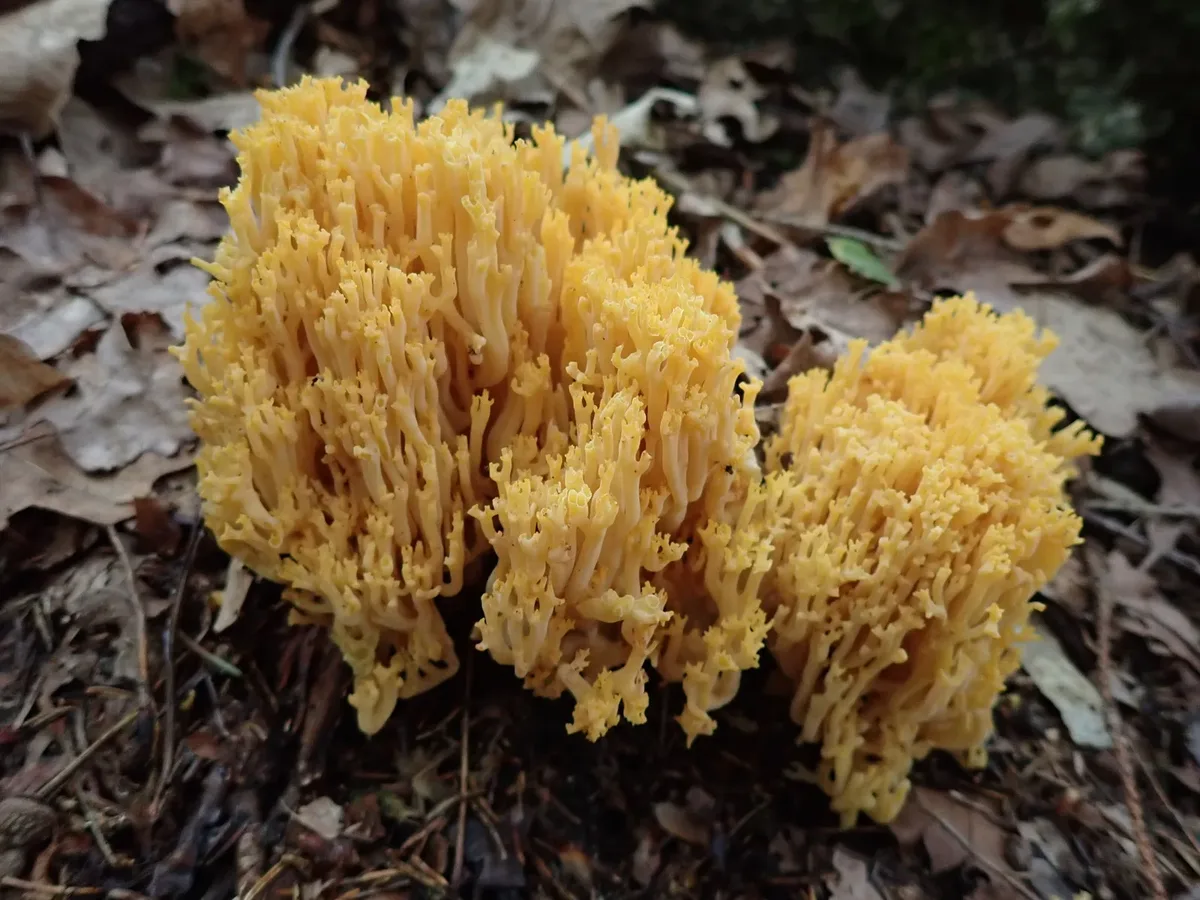 © Rune Solvang (CC BY)
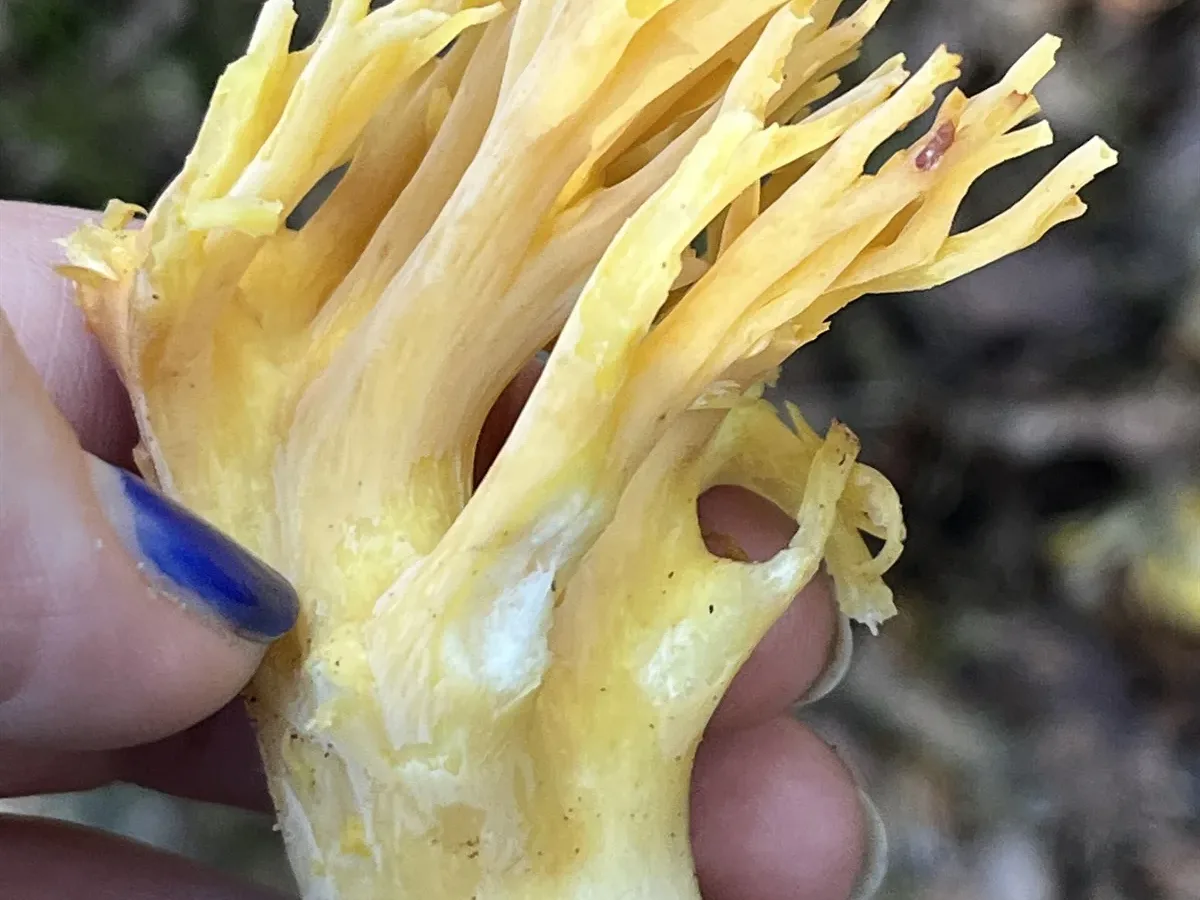 © Karen Ferris (CC BY-SA)
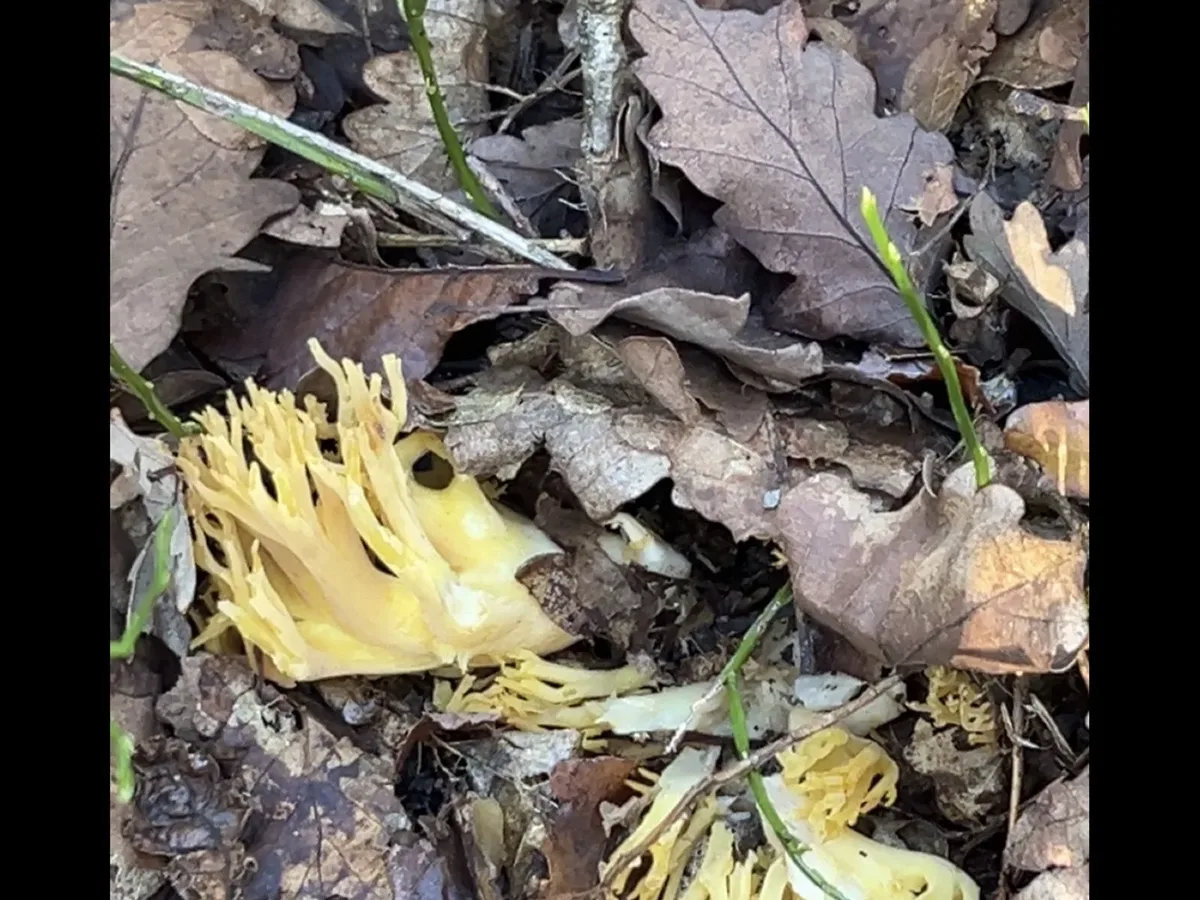 © Karen Ferris (CC BY-SA)
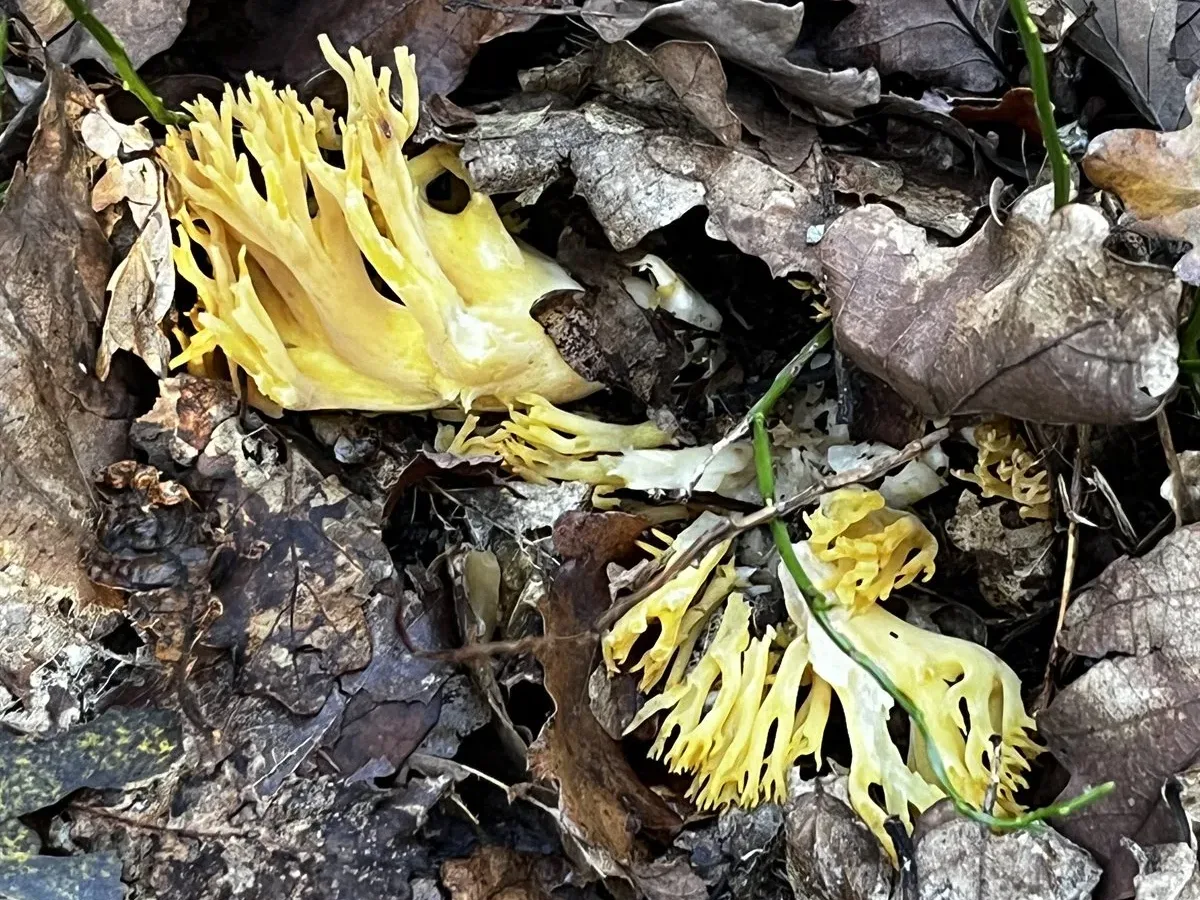 © Karen Ferris (CC BY-SA)
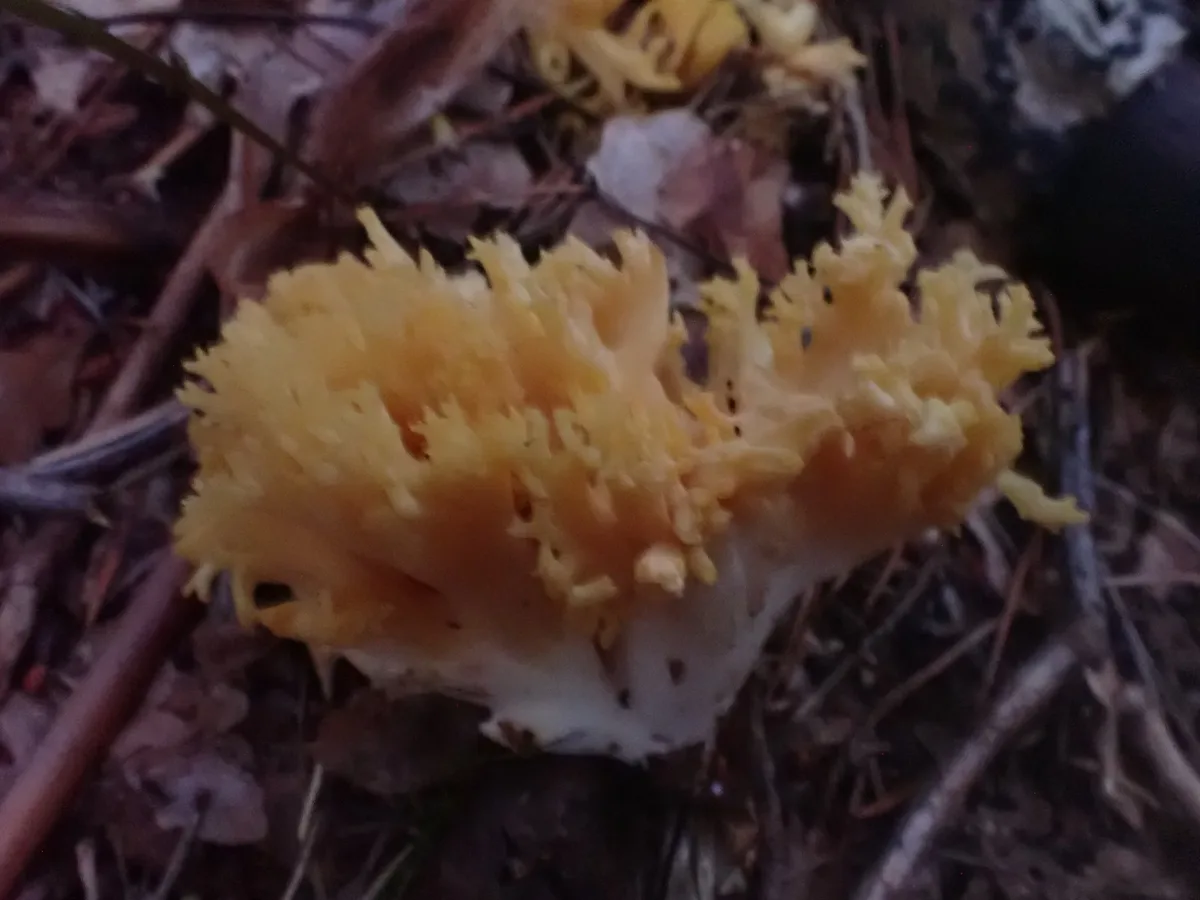 © Rune Solvang (CC BY)
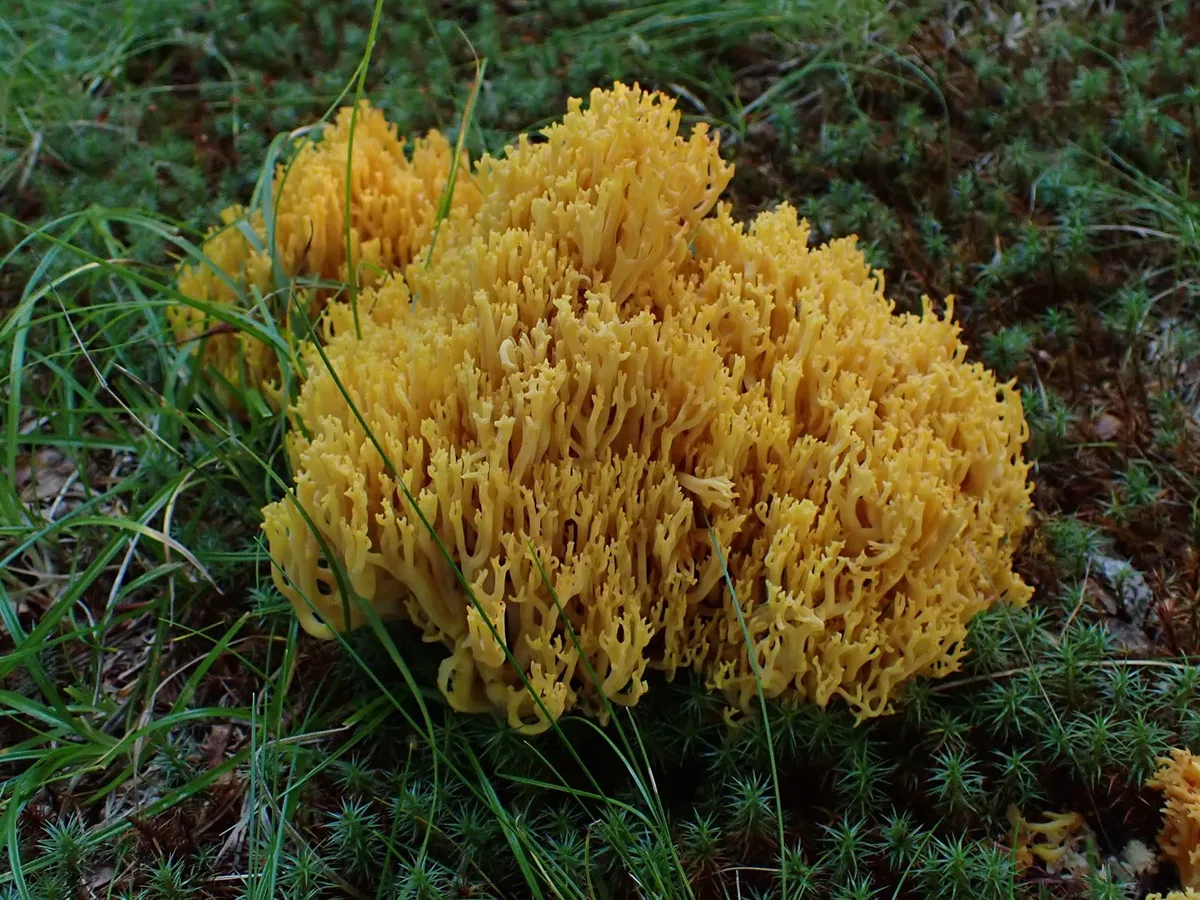 © Rune Solvang (CC BY)
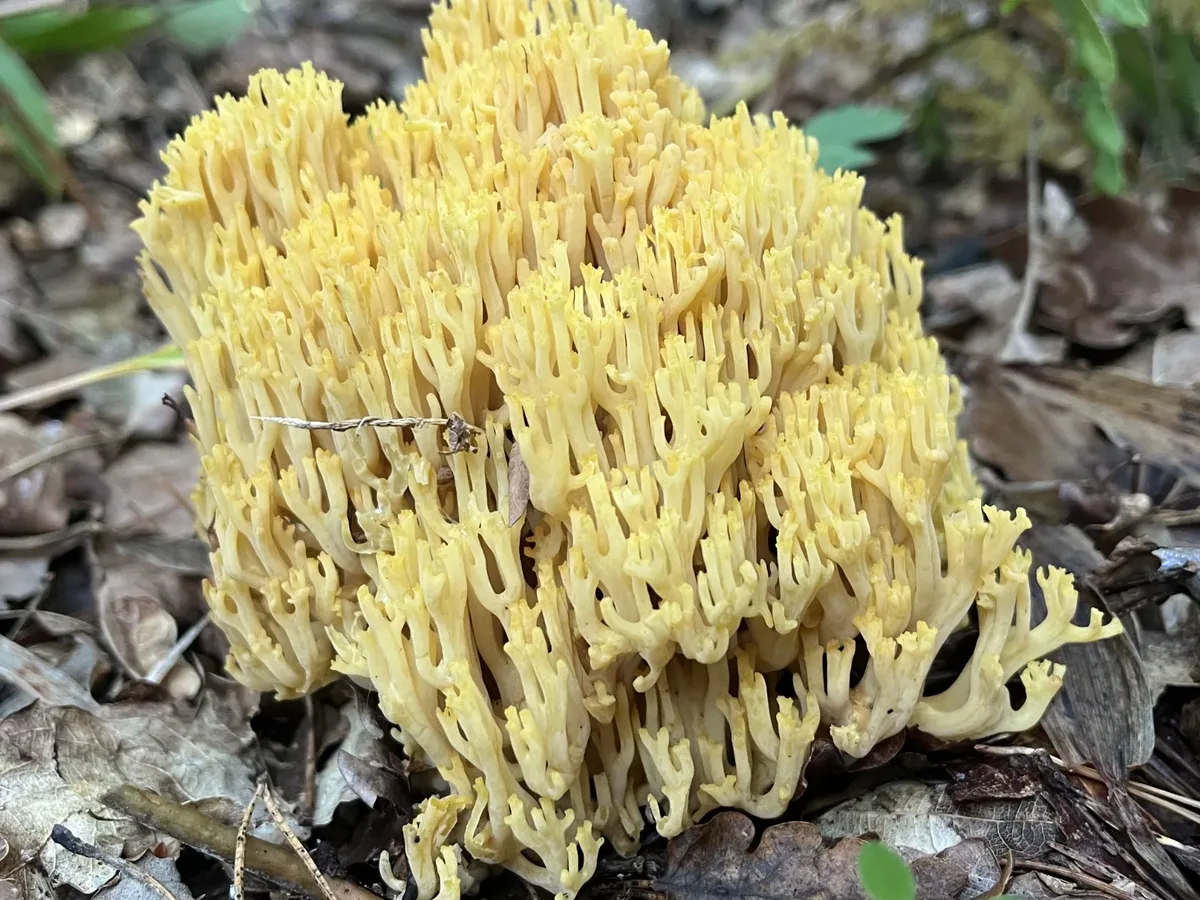 © Hallvard Holtung (CC BY)© Rune Solvang (CC BY)© Karen Ferris (CC BY-SA)
Edible only with the right preparation - or safe for some people but not others. Learn the caveats first.
How to recognise it
Ramaria flavobrunnescens is a medium-sized coral fungus whose most telling feature is built into its name: it starts yellow and turns brown.
When young it emerges as a pale yellow to golden-yellow branched mass, resembling a small underwater coral or a highly branched sea fan. The upper branches are the brightest, and the colour tends to deepen and brown from the tips downward as the fruiting body matures, until an old specimen is a dull tawny-brown throughout.
The base is always the palest part - whitish to pale cream, stout and compact, with the dense repeated branching rising from it.
Branches are round in cross-section (terete), not flattened, and divide repeatedly in roughly equal forks.
The flesh inside is white and firm, and does not discolour when cut.
Spores, visible as a deposit on leaves or paper placed beneath the fruiting body, are ochraceous-yellow to pale orange-buff. Under a hand lens or microscope the spore surface shows fine longitudinal striations or warts - a useful genus-level confirmation that rules out similarly branched but smooth-spored fungi.
Where & when it grows
Habitat
This species is rooted in the cool, humid forests of southern South America, particularly the Valdivian temperate rainforest and Nothofagus-dominated mixed forests of the Chilean Lake District, Araucania, the Los Rios and Los Lagos regions, and adjacent Patagonian Argentina.
It grows from the soil or among moss and leaf litter, always in close mycorrhizal partnership with southern beech trees (Nothofagus species) or with introduced conifers in plantation settings.
The forest character it favours is dense, moist and shaded - places where the canopy keeps the ground cool and the humus layer stays damp for extended periods. It is not usually found in open grassland, disturbed ground or sunny clearings.
On the eastern (Argentine) side of the Andes it occurs in the Andean-Patagonian forest belt under the same Nothofagus hosts. Across the plantation landscape of central Chile it also colonises Pinus radiata stands.
When
Autumn is the season for this species in the Southern Hemisphere, roughly corresponding to March through June, with the core of abundance in April and May.
The trigger is the classic Ramaria pattern: the sharp decline in soil temperature following summer, combined with the first sustained autumn rains. Cool, moist soil (roughly 8-15 °C) after a period of rain typically prompts fruiting within one to three weeks.
In the milder, wetter coastal zones of south-central Chile, fruiting can persist into July.
The same mycorrhizal network - which persists perennially in the soil and roots - can produce a new crop at or near the same spot in following years, making known sites worth revisiting each autumn.
How it grows
Fruiting bodies arise singly or in loose groups of two to several individuals from shared or adjacent mycelial networks. They do not form tight clusters like some saprotrophic species, but when conditions are right multiple fruiting bodies can appear within a small area beneath a single tree.
The basal stump is perennial in the mycelial sense - only the annual aboveground crop is visible. Growth from initial emergence to full size typically takes five to ten days under suitable conditions.
The branching pattern is sympodial: each branch divides into roughly equal forks repeatedly, giving the typical coral shape.
As the fruiting body ages it loses the bright yellow colour from the base upward, and the flesh softens and eventually deteriorates. Very old specimens may collapse into a brown, odorous mass.
Fruiting conditions
Southern Hemisphere autumn species (peak April-May in Chile/Patagonia). Fruiting triggered by cooling soils after late-summer heat combined with sustained autumn rainfall. Mycorrhizal fruiting bodies develop over one to two weeks and the same site may re-fruit in subsequent years. Field estimates; not strict thresholds.
Look-alikes
The greatest identification challenge with Ramaria flavobrunnescens is separating it from the many other yellow, ochre, or brownish coral fungi in the Ramaria genus, several of which are known to cause gastrointestinal illness.
- Ramaria formosa, the salmon coral, has distinctly salmon-pink to flesh-pink branch tips contrasting with a paler base, whereas R. flavobrunnescens is yellow tending to brown without a strongly pink-tipped phase.
- Ramaria flava is brighter, more uniformly sulphur-yellow and larger, associated with European conifer forests, less common in South America.
- Ramaria pallida is paler - whitish to pale buff - often with lavender-tinged tips.
- Clavulina coralloides (white coral) is whitish to grey-white, has a distinct comb-like tip structure, and lacks the yellow pigment entirely.
- Sparassis crispa might be confused from a distance but is built from flat, crisped, ribbon-like lobes rather than round branches, and is far larger.
None of the common confusions are known to be lethally toxic, but several Ramaria species (especially R. formosa) consistently cause nausea, vomiting and diarrhoea, and many others have uncertain toxicity.
The safe working rule is to treat the entire Ramaria genus with caution unless a species is definitively known to be safe in your specific region.
Can be confused from a distance as a pale, branched mass. But Sparassis is built from flat, crisped, ribbon-like lobes - not round branches - and always grows fused to a conifer trunk or root, not from open soil or leaf litter. Much larger (to 40+ cm). A choice edible; no danger from confusion once the flat-lobe structure is confirmed.
Whitish to pale buff with lavender-tinted tips when fresh - noticeably paler overall and lacks the yellow pigment of R. flavobrunnescens. Also a suspected GI irritant and not recommended for consumption.
Has distinctly salmon-pink to flesh-pink upper branches and tips contrasting with a paler yellowish-white base - the pink-tipped phase is quite different from R. flavobrunnescens's all-yellow-to-brown colouring. Both cause GI illness; R. formosa is one of the better-documented toxic Ramaria. Never eat either.
Brighter and more uniformly sulphur-yellow to lemon-yellow throughout, larger (to 20 cm), and less prone to browning. Primarily a European species (less common in South America). Also suspected GI irritant; do not eat.
White to whitish-grey, with a distinctive comb-like or crested tip morphology that differs from the even-forked branches of Ramaria. Lacks yellow or brown pigments. Not toxic, but also not typically eaten. Different genus confirmed by smooth (not warty-striate) spores.
In the kitchen
Picking & cleaning
This species is not an established or recommended edible and should not be collected for the table.
If it is collected for identification or scientific purposes, use the same care as with any woodland specimen:
- Carry in an open-weave basket or paper bag to preserve morphology.
- Note the substrate and host tree.
- Record the colour at the time of collection, since colour shifts rapidly after picking.
Do not taste raw. Wash hands after handling any Ramaria, as some compounds in the genus are mildly irritating to mucous membranes.
Good to know
Ramaria flavobrunnescens is classified as a caution species because its edibility is not established: there are no well-documented records of safe human consumption, and it belongs to a genus (Ramaria) that contains multiple species known to cause gastrointestinal illness.
While the species itself has not been confirmed toxic by rigorous study, the absence of evidence of safety is not the same as evidence of safety - particularly in a genus with such a mixed record.
The GI-irritant species within Ramaria (notably R. formosa, R. flaccida and related taxa) cause nausea, vomiting and diarrhoea, symptoms that can be severe especially in children or vulnerable individuals. Do not eat this species.
The primary practical danger is misidentification: Ramaria are notoriously difficult to identify even for experienced mycologists because colour shifts quickly after collection, and the defining features (spore dimensions and surface texture, chemical reactions, host association) often require microscopic examination.
If you encounter coral fungi in Nothofagus forest and wish to forage, treat any yellow-to-brown branching coral as R. flavobrunnescens until proven otherwise, and leave it.
No first aid beyond standard GI-irritant management is known for Ramaria poisoning, but if ingestion of any Ramaria is followed by persistent vomiting, diarrhoea or other symptoms, seek medical attention and bring a sample of the mushroom.
A reference guide - never an edibility guarantee. When in doubt, leave it out.