Yellow coral
Ramaria flavasyn. Clavaria flava Schaeff., Ramaria flava var. flava, Merisma flavum (Schaeff.) Spreng.
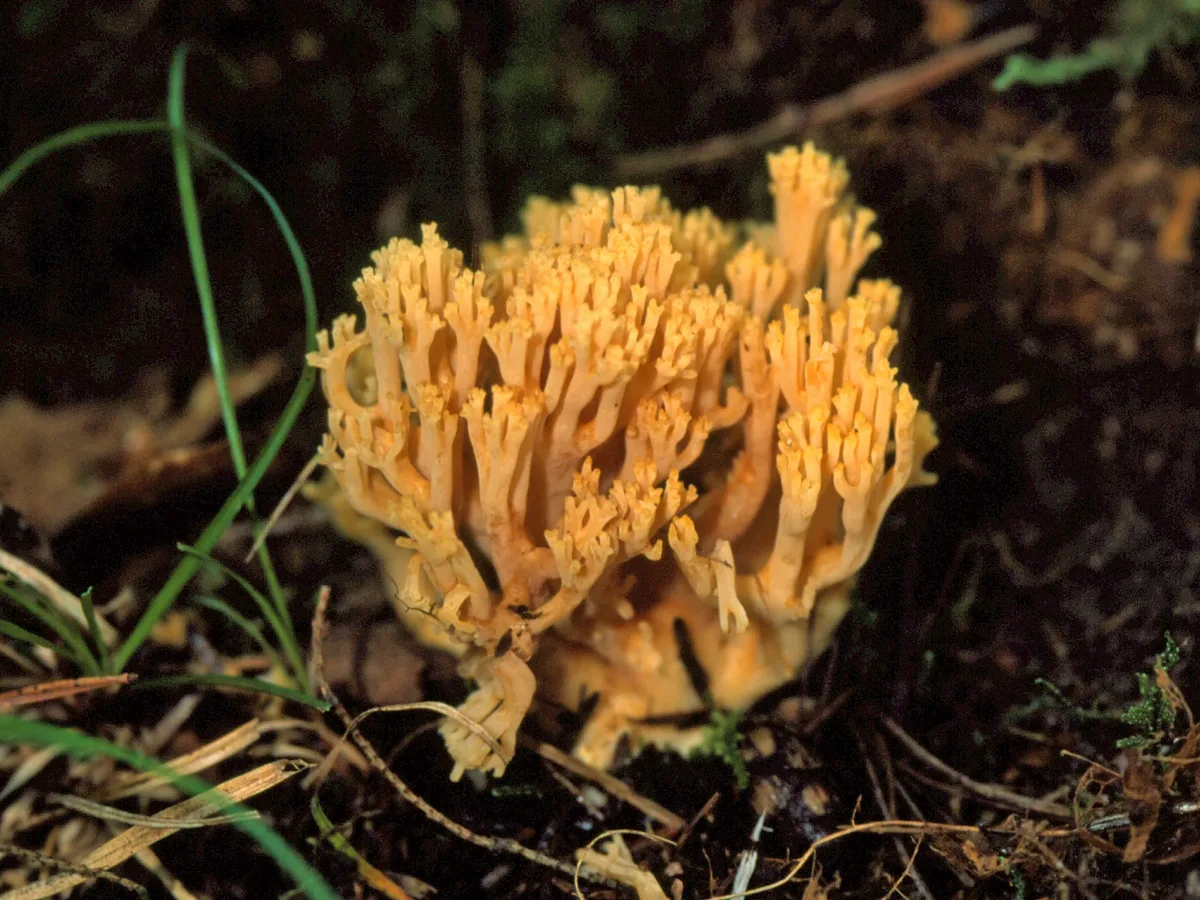 Cornell University Plant Pathology Herbarium (CUP-) (CC0)
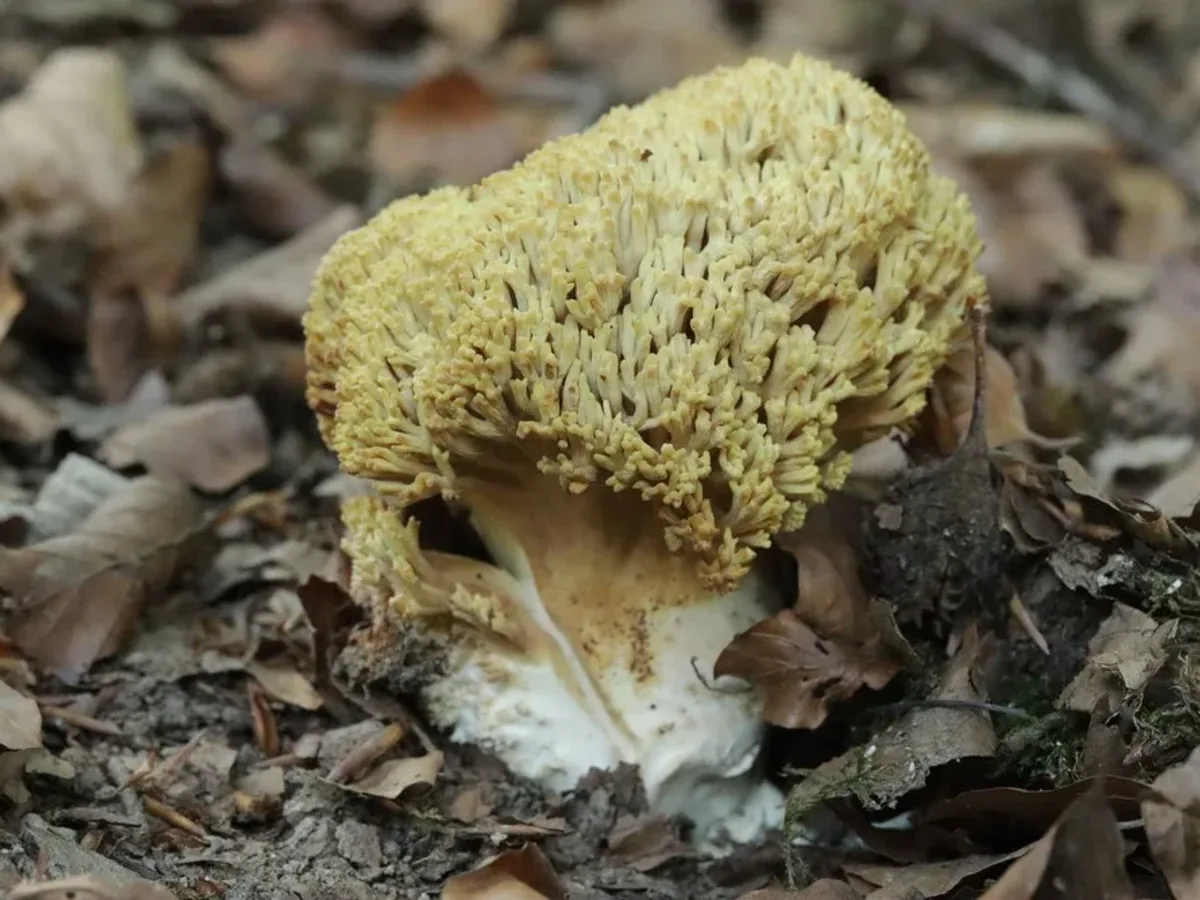 © Björn Sothmann (CC BY-SA)
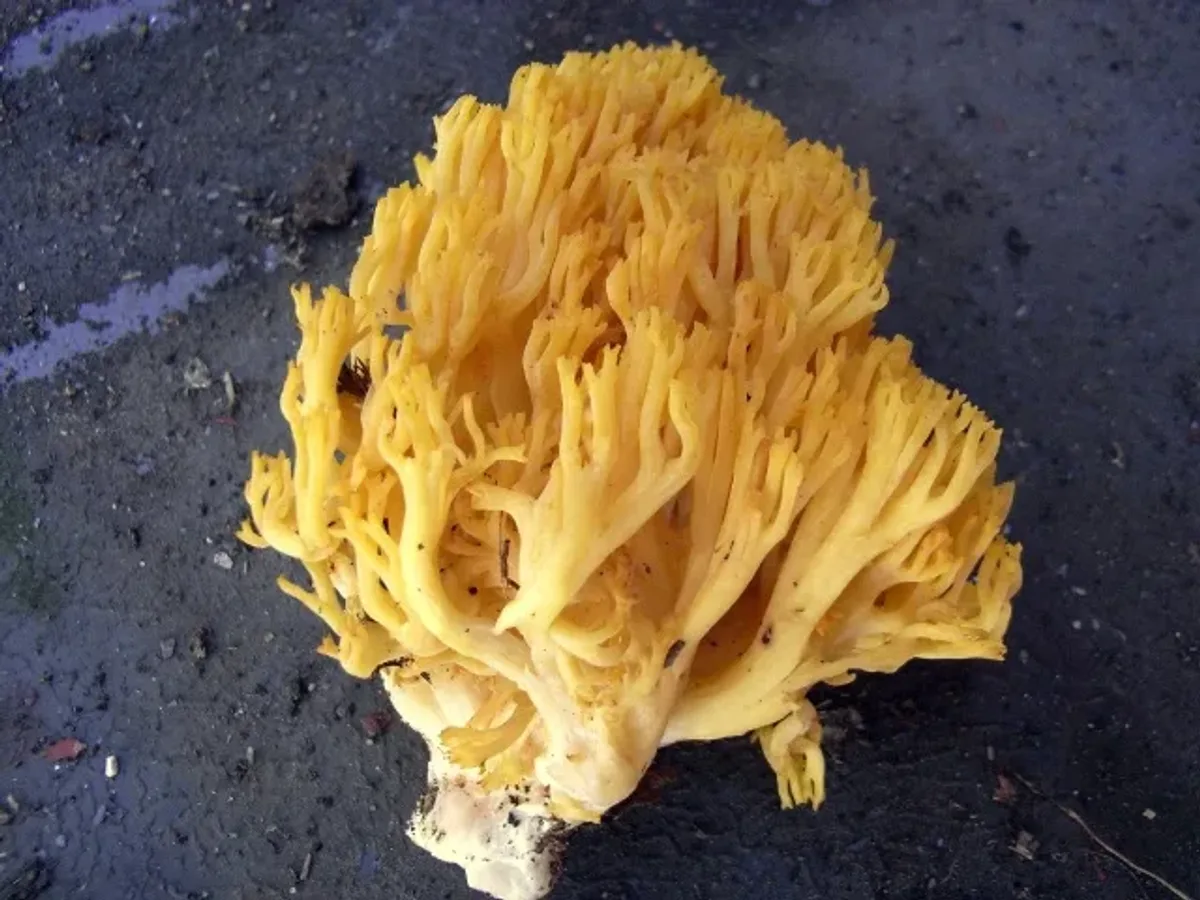 © Reidun Braathen (CC BY)
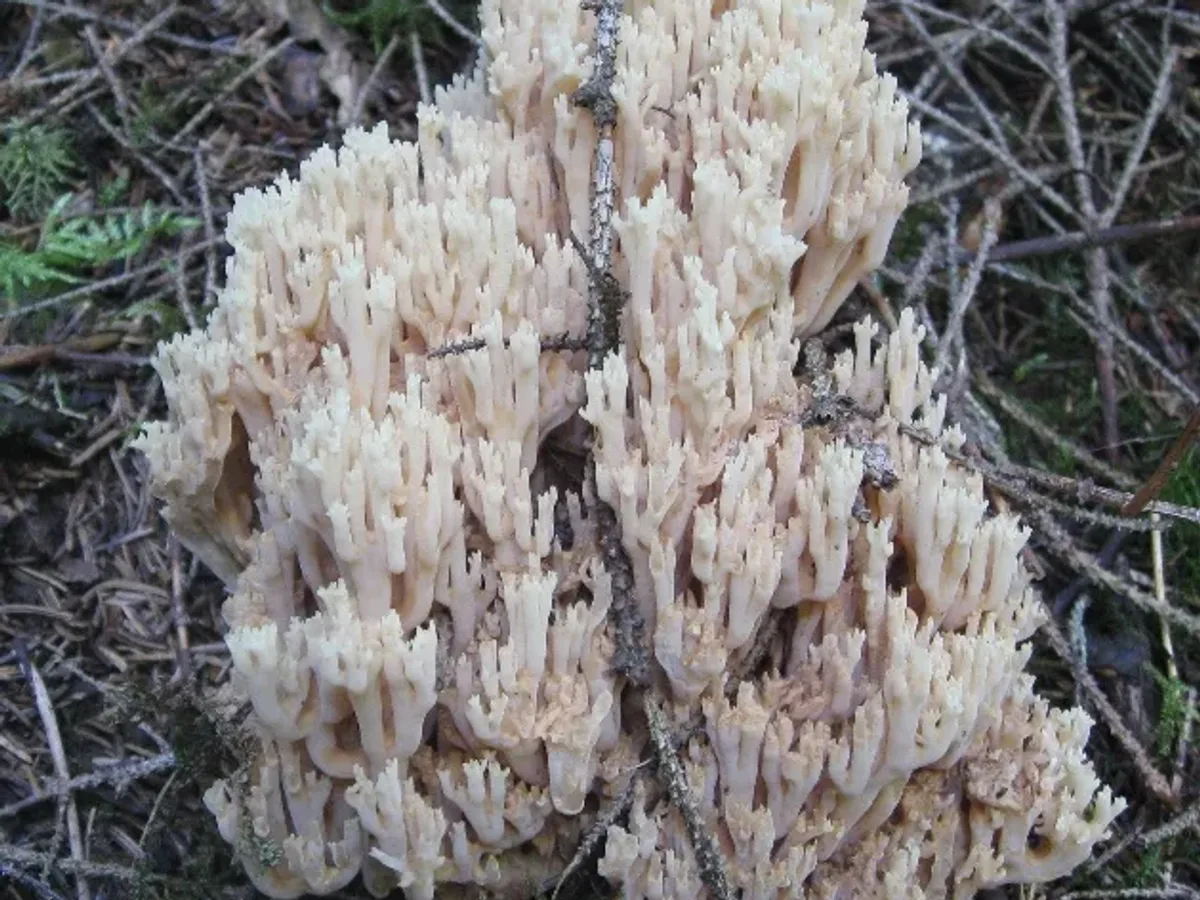 © Siv Moen (CC BY)
 © Siv Moen (CC BY)Cornell University Plant Pathology Herbarium (CUP-) (CC0)© Björn Sothmann (CC BY-SA)
Edible only with the right preparation - or safe for some people but not others. Learn the caveats first.
How to recognise it
Ramaria flava is one of the largest and most spectacular coral fungi of European forests - a creature that looks less like a mushroom than a piece of tropical reef transplanted into the beechwood.
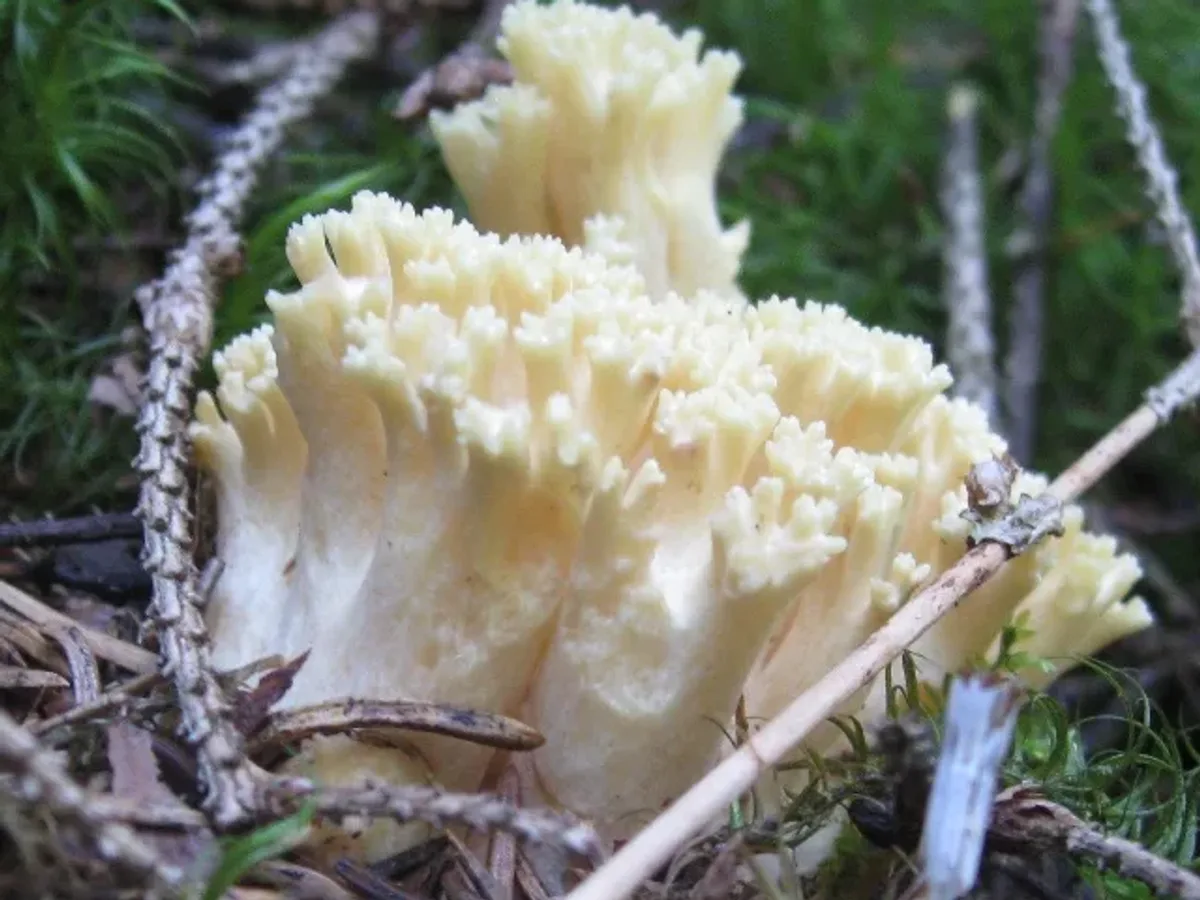
It forms dense, repeatedly branched tufts 8-25 cm tall and up to 20 cm across, erupting from a stout, fleshy, pale cream base that gives rise to a profusion of upright arms forking 2-4 times.
The overall color is a characteristic, uniform bright sulfur-yellow to golden-yellow throughout all branches, with the very base slightly paler or whitish and the blunt branch tips concolorous or very slightly paler lemon-yellow when fresh.
As it ages or dries, the vivid yellow fades toward ochre, pale tan, or buff - a useful sign that the specimen is past its prime.
The flesh is white to pale yellow, firm, brittle, and dense; it does not stain or discolor when cut.
Smell is mild, sometimes faintly fruity; taste is mild when young but older specimens can be slightly bitter or astringent.
Spore print is ochre-yellow to pale ochraceous. Under the microscope, spores are cylindrical to subfusiform, 9-15 × 3.5-5.5 µm, finely warted (ornamented), pale yellowish in mass.
Key identification markers:
- uniform sulfur-yellow coloration throughout (no pink or salmon anywhere)
- blunt non-pink tips
- white flesh
- pale base
- a preference for mature beech-dominated forest
Where & when it grows
Habitat
Ramaria flava is a mycorrhizal forest species most at home in mature, humid broadleaved or mixed forests on calcareous or mildly acidic soils with well-developed humus.
In central and western Europe it is most consistently associated with European beech (Fagus sylvatica), especially in old-growth or semi-natural beechwood; it also occurs under oak (Quercus spp.) and occasionally alongside silver fir (Abies alba) in mixed montane stands.
It favors undisturbed forest floor with deep leaf litter and is seldom found in young plantations, heavily managed woodland, or open landscapes.
Elevation range extends from lowland beechwoods to montane forests up to about 1400 m in the Alps and Apennines.
When
The main fruiting season runs from July through October across central Europe, with the best fruiting typically in August and September following warm, wet periods.
It is often one of the first large coral fungi to appear after summer rains, sometimes coexisting with early cep (Boletus edulis) flushes.
In drought years, fruiting may be severely reduced or absent. In the mountains, the season can extend into October.
How it grows
Fruiting bodies arise singly or in small loose groups from the forest floor, occasionally several basidiocarps emerging close together from the same mycelial network.
Growth is relatively rapid after suitable rainfall. Young buttons emerge as compact pale-yellow nubbins that expand and branch quickly over several days, and mature specimens can become very large and impressive.
The mycelium forms ectomycorrhizal associations with host tree roots and is perennial; the same site may produce fruiting bodies over many successive years.
Fruiting conditions
Typically requires sustained warm, moist conditions over at least 1-2 weeks; best fruiting follows late-summer rainfall events in August-September in beech forest with soil temperatures 12-18 °C.
Look-alikes
Several Ramaria species share the yellow coral growth form and can be confused with R. flava:
- Ramaria formosa (salmon coral): Main branches salmon-pink to coral-orange; branch TIPS distinctly lemon-yellow to pale straw-yellow - NOT pink or salmon. The yellow tips against pink branches are the critical danger signal. This color combination (pink body, yellow tips) is the opposite of R. flava (yellow body, yellow tips). TOXIC - causes severe gastrointestinal upset with a pronounced laxative effect.
- Ramaria aurea: Very similar bright yellow coloration; branching tips sometimes slightly deeper chrome-yellow; spores larger (12-17 µm); tends to be associated with conifers; edibility uncertain/suspect.
- Ramaria pallida: Pale cream to whitish-yellow; smell slightly unpleasant; TOXIC (causes gastrointestinal symptoms).
- Ramaria flavescens: Very similar, sometimes treated as synonymous; close examination of spore size, tip color, and habitat needed.
- Ramaria botrytis (cauliflower coral): Branch tips distinctly wine-red to reddish-purple when fresh - unmistakably different; R. botrytis is edible and choice.
- Clavariadelphus truncatus and Clavulina species: Club-shaped or less intricately branched, easily separated by gross morphology.
Any bright yellow coral found in the forest should be identified with great care. The key features of R. flava are:
- uniform sulfur-yellow coloration throughout all branches and tips (tips never pink or salmon)
- blunt non-pink tips
- white flesh
- pale base
- beech-forest habitat
Overall body cream to pale ochre; branch tips distinctly wine-red to reddish-purple when fresh - unmistakably different from R. flava's yellow tips. Edible and choice. No confusion once tips are observed.
Simple or sparingly forked club-shaped basidiocarps, not multi-branched coral form. Easily separated by growth habit.
Very similar bright chrome-yellow coloration; overlaps with R. flava morphologically. R. aurea tends toward conifer association; spores typically larger (12-17 µm vs 9-15 µm in R. flava). Edibility uncertain - treat as suspect.
Pale cream to whitish-yellow, lacking the vivid sulfur-yellow of R. flava. Often has an unpleasant or farinaceous smell. Toxic - causes gastrointestinal upset. Avoid any pale-cream coral in the same habitat.
Tips and upper branches salmon to pinkish-red; body more ochre-cream. Edibility doubtful. Tip color distinguishes it from R. flava.
The most dangerous confusion species. R. formosa has salmon-pink to coral-orange main branches with distinctly lemon-yellow to pale straw-yellow TIPS - not pink tips. The key danger signal is a coral with a pink or salmon body and yellow tips. R. flava is uniformly yellow throughout branches and tips with no pink or salmon pigment anywhere. R. formosa is toxic and causes severe laxative gastrointestinal symptoms - do not eat.
In the kitchen
Picking & cleaning
Select only young, firm specimens with a consistent bright yellow color and no signs of insect infestation (maggots are common in older individuals - break the base to check the interior).
Trim the base cleanly with a knife and brush away soil and debris in the field.
Because the species is encountered irregularly and habitats are ecologically sensitive, harvest conservatively: take no more than about a third of the basidiocarps at any one site and leave smaller or older individuals.
The species is placed on red lists or requires consideration in some European countries due to habitat loss. Never uproot - cutting at ground level preserves the mycelial base.
Cooking
When confidently identified, young firm specimens of R. flava can be cooked similarly to other edible coral fungi. The flavor is mild with a pleasant, slightly nutty or forest-floor quality.
Clean the branching arms by separating them and rinsing under cold water; check all interior surfaces for maggots. Always cook thoroughly - never consume raw.
Sautéing in butter with garlic and fresh parsley is the classic preparation; the firm texture holds well in stir-fries and pasta dishes. Because the flavor is mild, it pairs well with cream sauces and eggs.
Blanching briefly before the main cooking step helps mellow any mild bitterness. Dried R. flava loses much of its texture but retains flavor; rehydrate before use.
Good to know
Ramaria flava has a long tradition of use as an edible mushroom in parts of central Europe (Germany, Italy, Eastern Europe), but it must be treated with considerable caution for several reasons:
- 1The genus Ramaria is a notoriously difficult complex with many superficially similar species, including toxic ones (notably R. formosa and R. pallida) that cause significant gastrointestinal illness.
- 2R. flava itself can cause mild laxative or gastrointestinal effects in some individuals, especially if eaten raw, in large quantities, or poorly cooked.
- 3Correct identification to species is difficult even for experienced mycologists: many species intergrade, and the taxonomy of the group has been revised repeatedly.
General safety rules:
- Never eat Ramaria raw.
- Always cook thoroughly.
- Eat only small amounts on first trial.
- Do not collect unless you are confident in identification - if the branches are pink or salmon, or if the tips are lemon-yellow against a pink-colored body (indicating R. formosa), do not eat.
- Children and pregnant women should avoid all Ramaria species.
- When in doubt, discard.
A reference guide - never an edibility guarantee. When in doubt, leave it out.