Golden coral
Ramaria aureasyn. Clavaria aurea Schaeff., Corallium aureum (Schaeff.) Henn., Ramaria aurea var. aurea
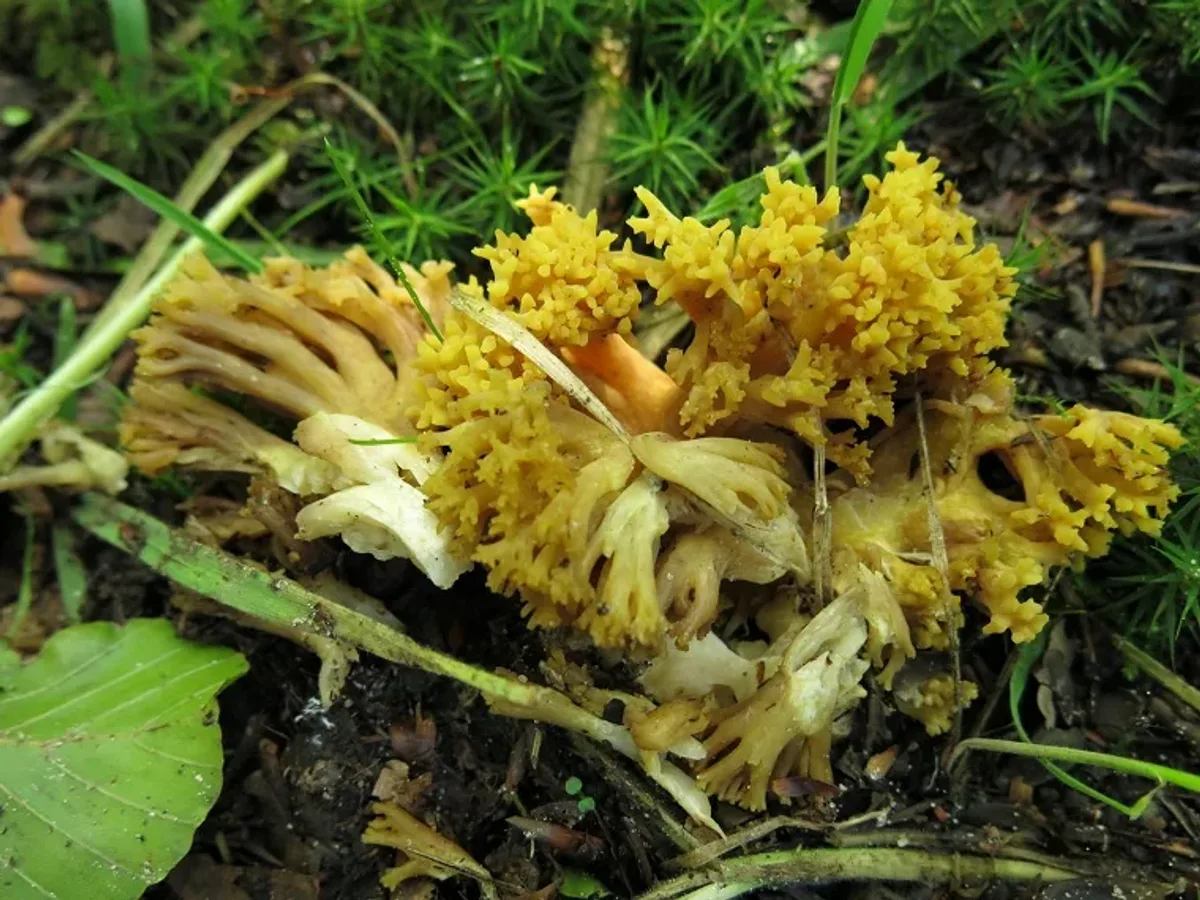 Riet van Oosten (CC0)
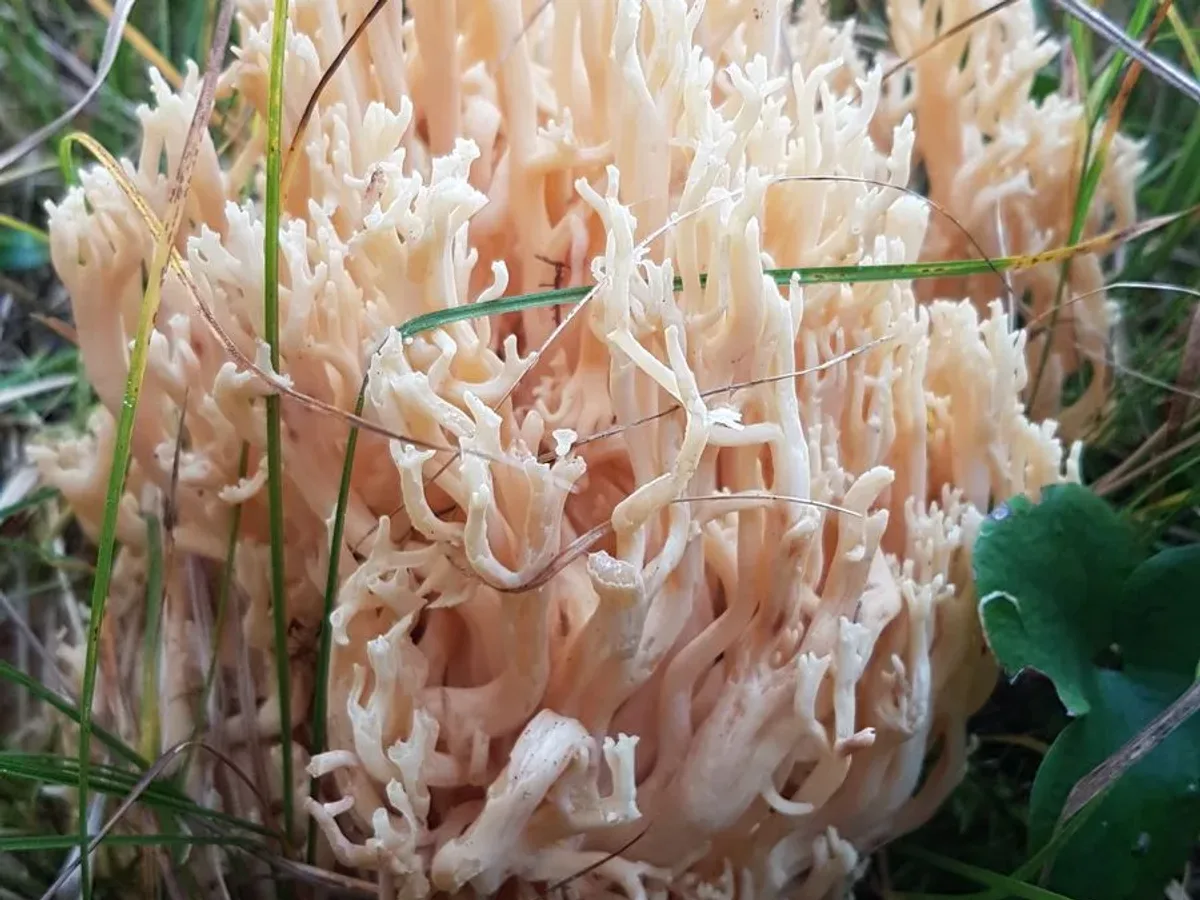 © Lennart Lennuk (CC BY-SA)
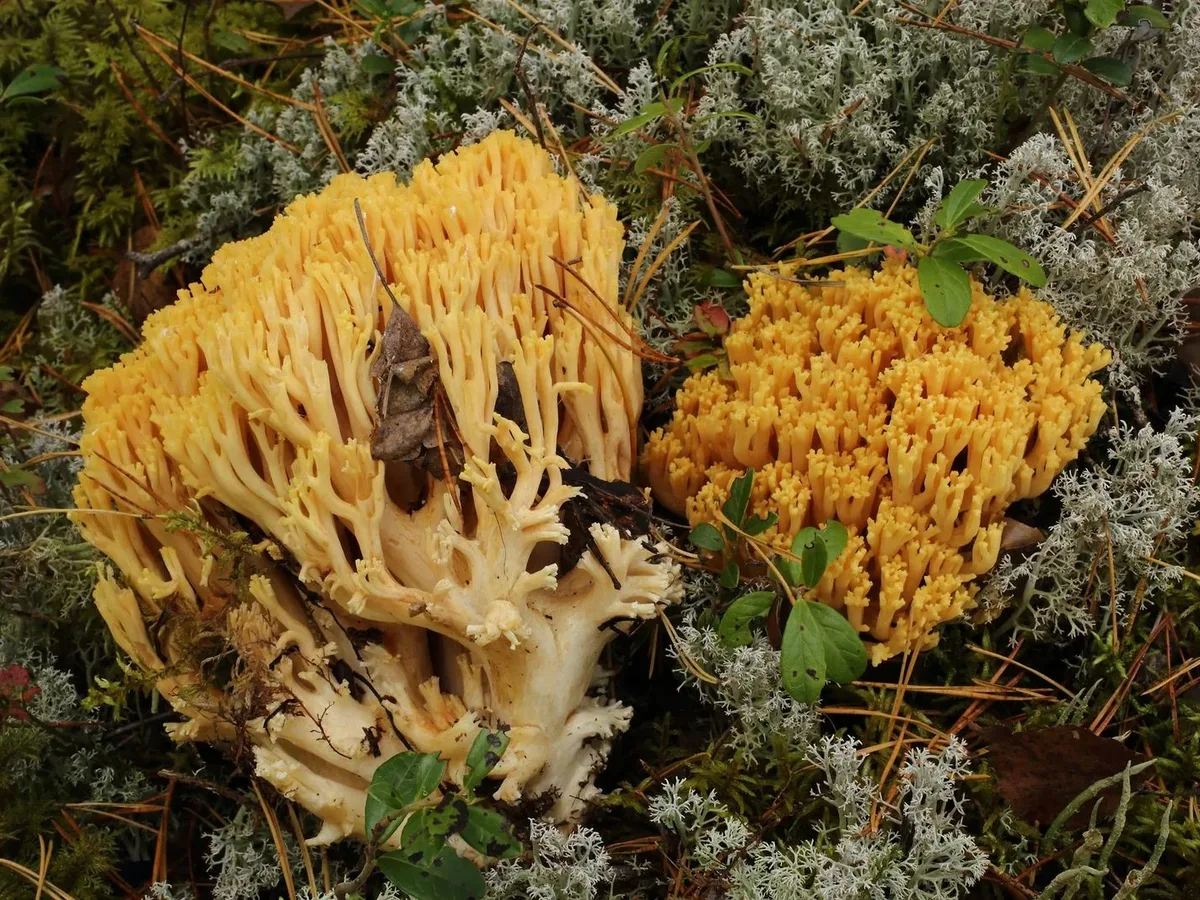 © Veiko Kastanje (CC BY-SA)
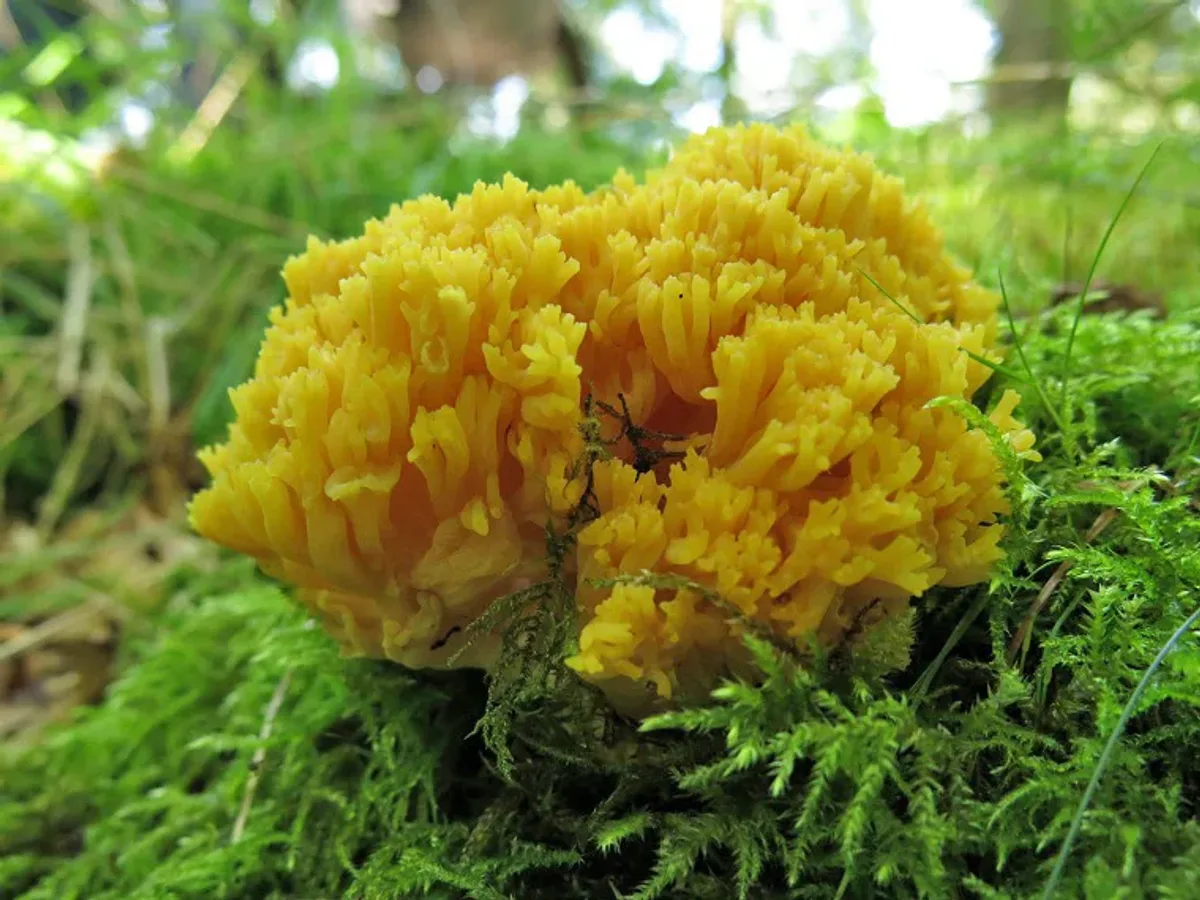 Riet van Oosten (CC0)
 Riet van Oosten (CC0)Riet van Oosten (CC0)© Lennart Lennuk (CC BY-SA)
Edible only with the right preparation - or safe for some people but not others. Learn the caveats first.
How to recognise it
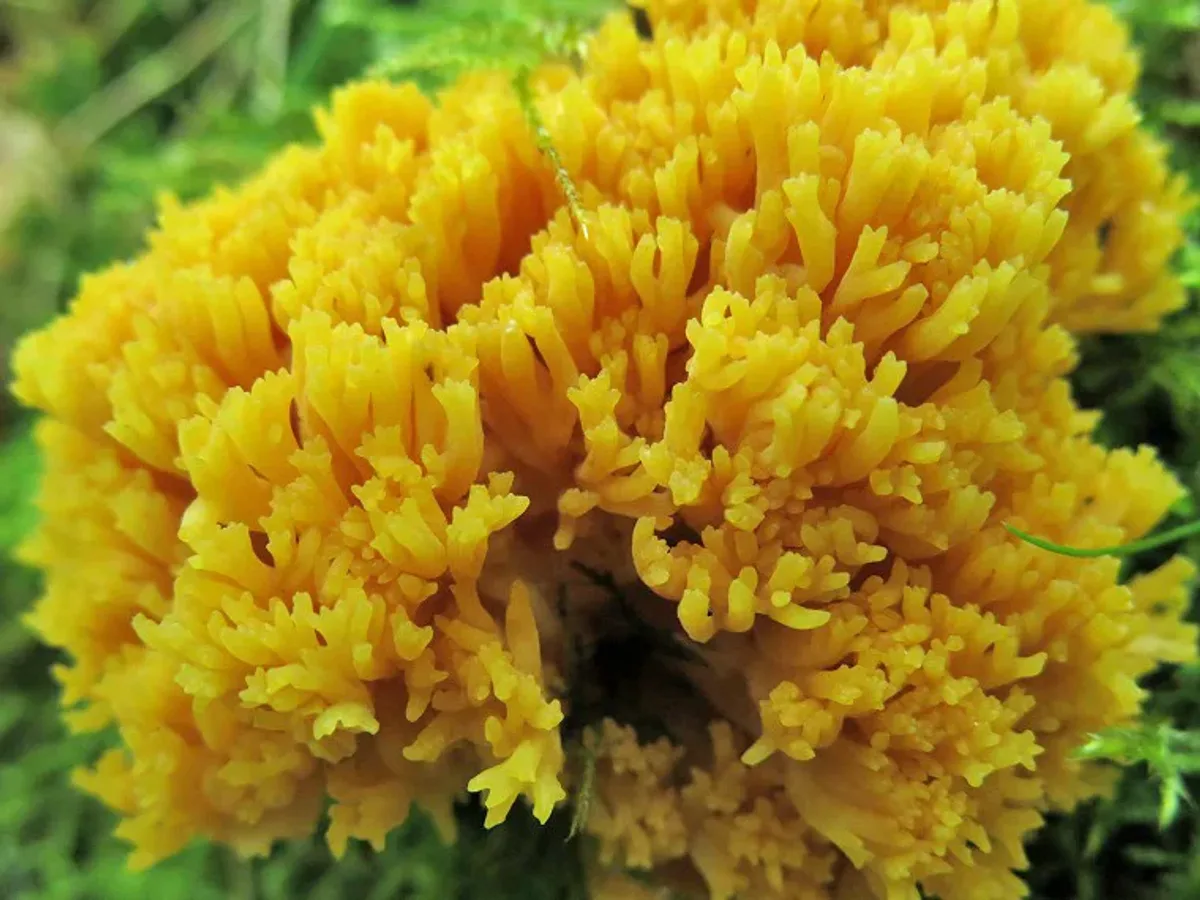
Ramaria aurea is one of the most visually arresting coral fungi of European temperate woodland, immediately recognisable by its uniformly saturated golden-yellow to egg-yolk-yellow coloration.
The entire fruitbody - base, branches, and tips alike - shares this rich, even colour, without the contrasting tip colours that characterise related species such as Ramaria formosa (yellow tips on salmon branches) or Ramaria botrytis (wine-red tips on cream branches).
The body reaches 8-25 cm in height and may be nearly as wide, forming a dense, upright coral or miniature tree-like mass.
The basal trunk is stout and whitish to pale cream at the point of emergence from the soil, quickly transitioning to yellow as it divides into the main branch system. Branches fork repeatedly in a dichotomous (Y-shaped) pattern, becoming progressively finer toward the tips.
In prime, young specimens the yellow is vivid and almost glowing; older specimens fade toward ochre or dull straw-yellow and deteriorate in quality.
Flesh throughout is white, firm, and distinctly brittle - branches snap cleanly rather than bending or tearing. The flesh does not discolour on cutting or bruising.
The odour is faint and pleasant or virtually indistinct; the taste is mild at first, though some individuals detect a slight bitterness or astringency, especially in older specimens.
The spore print is pale ochre to yellowish-ochre. Microscopically, spores are 8-15 × 3.5-5 µm, cylindric-ellipsoid, and show fine longitudinal striations (ornamentation) under high magnification.
Why it's dangerous
Low to moderate. Not a deadly species; no fatalities are documented from Ramaria aurea alone.
The principal risks are:
- 1Unpleasant gastrointestinal illness from consuming without proper preparation, affecting a significant minority of individuals.
- 2Misidentification of the poisonous Ramaria formosa as R. aurea, which carries a higher risk of GI illness.
The species is best avoided by non-expert foragers.
Experienced collectors in traditional regions who insist on eating it should use obligatory parboiling (3-5 minutes in boiling water, water discarded), cook thoroughly, and try only a small portion initially.
Toxin
The specific toxic compounds in Ramaria aurea have not been fully characterised in modern analytical literature.
The gastrointestinal syndrome is consistent with heat-labile or partially heat-stable irritant compounds - possibly sesquiterpenes or related terpenoid metabolites similar to those implicated in other toxic Ramaria species.
Some sources suggest the irritants are more concentrated in older or fully mature fruitbodies, which would explain why young specimens are better tolerated.
The mechanism appears to be direct mucosal irritation of the gastrointestinal tract rather than systemic toxicity. No amatoxins, orellanin, gyromitrin, or other severely dangerous toxins have been identified.
Symptoms
Gastrointestinal syndrome beginning 1-4 hours after ingestion: nausea, abdominal cramps, and diarrhea, sometimes accompanied by vomiting.
Symptoms are typically self-limiting and resolve within 24 hours in healthy adults.
Severity varies considerably between individuals - some people consume this species without any ill effects, while others experience pronounced illness.
In children, the elderly, or immunocompromised individuals, significant fluid and electrolyte loss from vomiting and diarrhea can become serious.
No hepatotoxic, nephrotoxic, or neurological effects have been documented.
Staying safe
Ramaria aurea occupies an ambiguous position in the edibility literature.
It has been consumed traditionally in parts of Italy (particularly the Trentino-Alto Adige and Friuli regions) and southern France, and older mycological guides from these regions sometimes list it as edible.
However, contemporary European mycological literature and poison control guidance consistently classifies it as requiring caution or as conditionally edible at best. The reasons are:
- 1It contains gastrointestinal irritants that cause nausea, vomiting, and diarrhea in a significant proportion of consumers, even after cooking.
- 2These irritants are at least partially heat-stable, meaning standard cooking does not fully neutralise them.
- 3The traditional preparation method (obligatory parboiling with water changes before cooking) reduces but does not eliminate risk.
- 4The identification complexity within the Ramaria genus means there is a real risk of mistaking the poisonous Ramaria formosa or other toxic species for R. aurea, particularly in faded or mixed-age specimens.
Modern German, Swiss, and Austrian mushroom guides advise against collecting or eating any yellow Ramaria for these reasons.
The correct conservative approach for this app is to treat Ramaria aurea as a caution-tier species.
- Never eat raw.
- Never skip the preparatory parboiling if consuming at all.
- Begin with a small portion.
- Seek medical advice if symptoms of nausea, vomiting, or diarrhea occur within 1-4 hours of consumption.
Where & when it grows
Habitat
Ramaria aurea is a mycorrhizal species most characteristic of mature montane mixed forests in central and southern Europe.
Its primary association is with silver fir (Abies alba), and it reaches its greatest abundance and consistency in the beech-fir mixed forests (Fagetum with Abies alba understorey) that clothe the limestone and flysch mountains of central Europe - the Jura, pre-Alps, Carpathians, and Apennines.
It also forms mycorrhizal partnerships with beech (Fagus sylvatica), oak (Quercus spp.), and spruce (Picea abies).
Characteristic sites are well-shaded slopes and valley floors with deep, humus-rich soils and reliable summer-autumn moisture.
The fungus prefers slightly calcareous to neutral soil conditions and is rarely found on strongly acidic, sandy, or waterlogged substrates.
It grows singly or in small scattered groups and is not known to form conspicuous gregarious clusters as regularly as Ramaria formosa. It is considered an indicator of old, ecologically undisturbed mixed woodland.
When
The main fruiting season runs from late July through October, with the peak in August and September in central and western Europe.
In warmer, lower-elevation broadleaved woodland the first fruitings can appear in July after a good summer rain. At montane elevations (600-1400 m), the peak tends to shift into September and early October as the mountains cool.
Fruiting is closely tied to adequate late-summer rainfall and moderately warm soils; a dry summer can suppress flushes almost entirely.
Under good conditions a fruitbody persists for one to two weeks before softening and fading as it ages.
The first hard frosts end the season quickly - fruitbodies that survive ground frost deteriorate within days.
How it grows
Emerging from the humus and leaf-litter as a small, compact, rounded yellowish mass, the fruitbody expands rapidly when triggered by rainfall and warm temperatures, developing its coral branching structure over several days.
Growth is fastest under warm (15-22 °C), humid conditions with adequate soil moisture from recent rainfall.
The mycelium is perennial underground, and fruitbodies may recur at the same spot year after year when conditions are favourable.
Individual fruitbodies are a single unit with a common base; the entire aerial structure develops together rather than as separate caps.
Fruiting conditions
Fruiting is triggered by late-summer rainfall (20+ mm over 14 days) combined with moderately warm soil temperatures (10-22 °C). The typical flush emerges 7-14 days after adequate precipitation. Extended summer drought strongly suppresses fruiting. In montane beech-fir forest, the combination of late-August rains and cooling September temperatures reliably produces the best flushes. Fruitbodies are frost-sensitive and deteriorate rapidly once ground temperatures fall below 0 °C.
Look-alikes
The uniform golden-yellow coloration of Ramaria aurea distinguishes it from most other European coral fungi. The most important confusion species to understand are:
- Ramaria formosa (salmon coral, poisonous) - has salmon-pink to coral-orange branches with distinctly paler, yellowish tips; never uniformly golden-yellow throughout. In good light the salmon-orange tone of R. formosa branches is readily apparent, but in low-light woodland conditions or where specimens have begun to fade, the distinction requires attention. R. formosa is a confirmed gastrointestinal irritant and should never be eaten.
- Ramaria flava (yellow coral) - closely resembles R. aurea and is treated as a sister species by some authorities; generally more pallid (pale lemon-yellow to sulphur-yellow) than the deep egg-yolk yellow of R. aurea, though the boundary is not sharp, and some sources consider them conspecific or overlapping. Ramaria flava is also considered edible with caution.
- Ramaria botrytis (cauliflower coral) - cream to ivory branches with vivid wine-red to carmine-pink tips; the wine-red tips make identification straightforward in fresh specimens and it is edible.
- Ramaria stricta - grows on buried wood or woody debris, has bitter taste, parallel ascending branches (less densely branched), and ochre-buff to pale brownish-yellow coloration; considered mildly toxic.
- Ramaria pallida - whitish to pale lilac or buff throughout, in broadleaved woodland; considered mildly toxic.
None of the realistic lookalikes are deadly, but Ramaria formosa is the most important to distinguish because it causes significant gastrointestinal illness.
Ramaria botrytis has cream to ivory branches with vivid wine-red to carmine-pink tips when fresh - an immediately distinctive combination quite unlike the uniform golden coloration of R. aurea. R. botrytis is edible and choice.
Ramaria pallida is uniformly whitish to pale lilac-grey or buff - lacking any yellow pigment - and grows in broadleaved woodland. Considered mildly toxic. Easily distinguished from R. aurea by its pale, non-yellow coloration.
Ramaria formosa has salmon-pink to coral-orange branches with distinctly paler, lemon-yellow tips - the colour is never uniformly golden throughout. In good light the salmon-orange tone of the branches is readily visible. R. aurea is uniformly deep golden-yellow without any pink or salmon pigment anywhere. R. formosa causes significant gastrointestinal poisoning; it must not be eaten.
Ramaria stricta grows on buried woody debris or at the base of dead wood, has parallel, more densely clustered and less spreading branches, a distinctly bitter taste, and ochre-buff to yellowish-brown coloration (not deep golden-yellow). Considered mildly toxic; avoid.
Very similar to R. aurea, both uniformly yellow throughout. Ramaria flava tends to be paler - sulphur-yellow or lemon-yellow - compared to the deeper egg-yolk or golden-yellow of R. aurea. Some authorities regard them as very closely related or overlapping. Both are in the caution category; the distinction is not safety-critical but worth noting for accurate recording.
A reference guide - never an edibility guarantee. When in doubt, leave it out.