Powdery sulfur bolete
Pulveroboletus raveneliisyn. Boletus ravenelii Berk. & M.A.Curtis, Boletus pulverulentus var. ravenelii (Berk. & M.A.Curtis) Peck, Suillus ravenelii (Berk. & M.A.Curtis) Kuntze
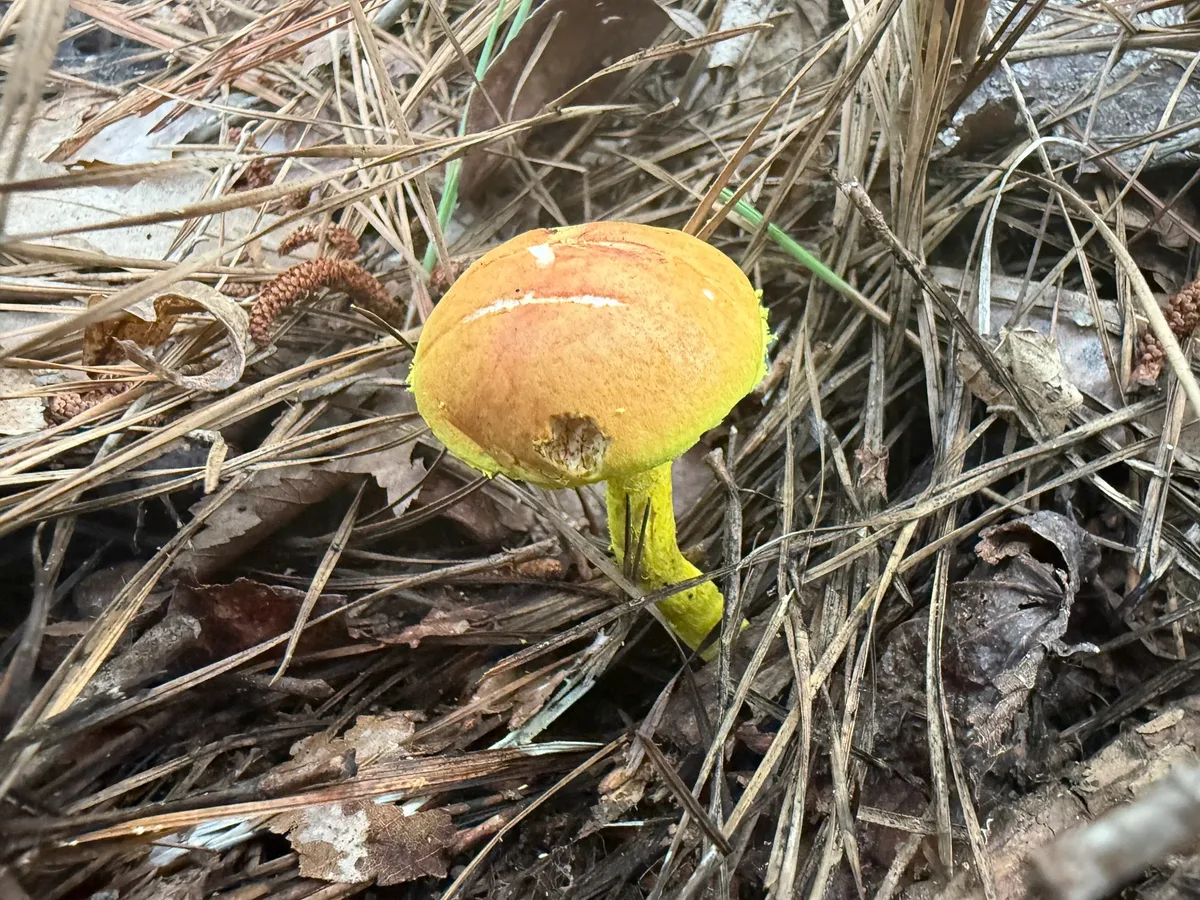 © Brandon Johnson (CC BY)
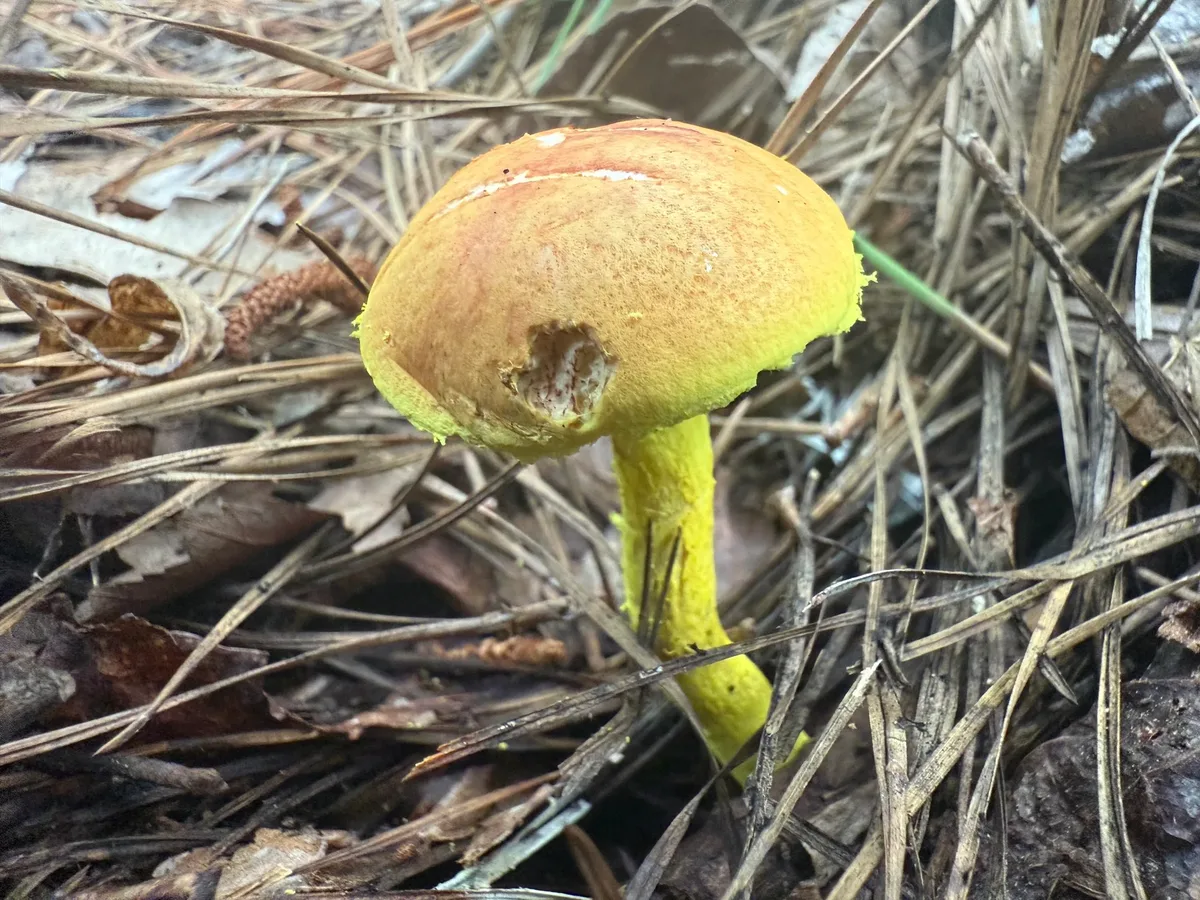 © Brandon Johnson (CC BY)
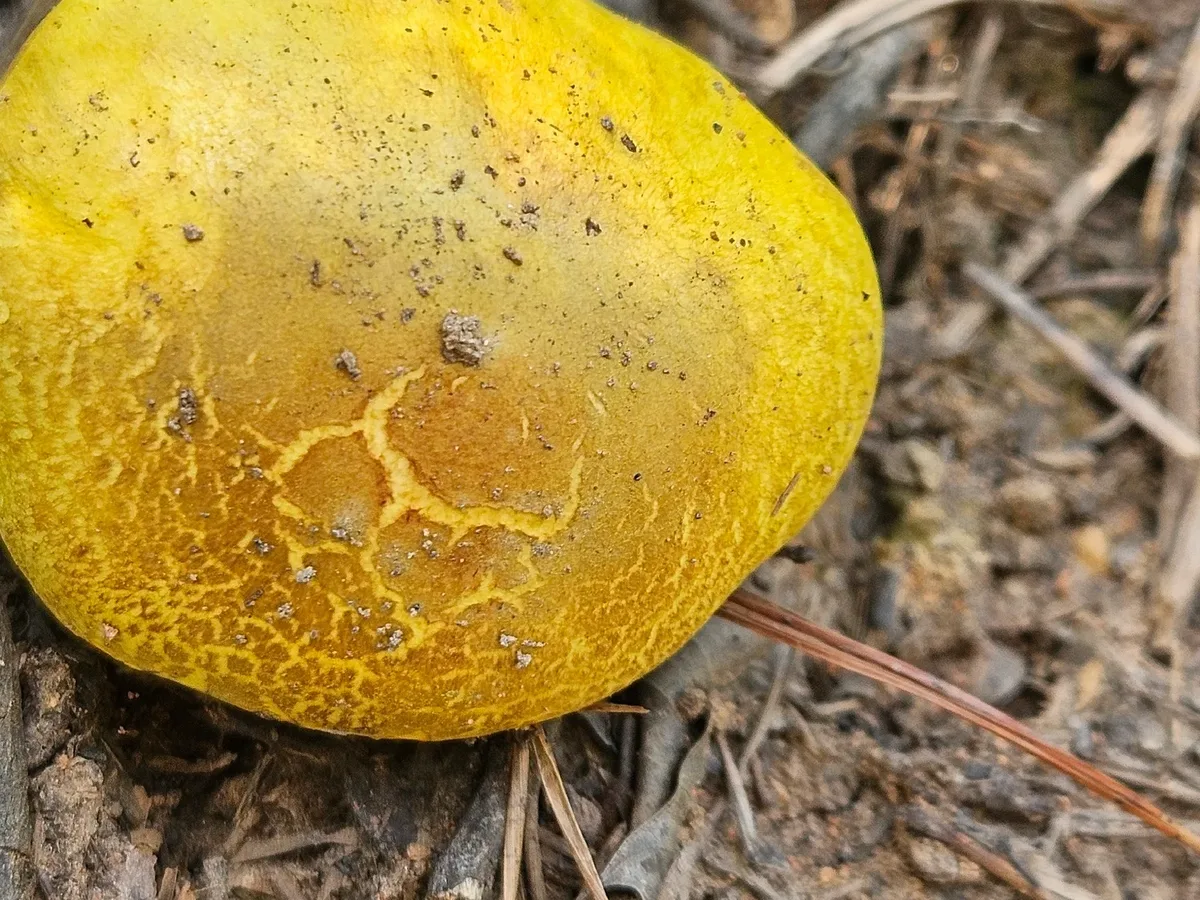 © willingarden (CC BY)
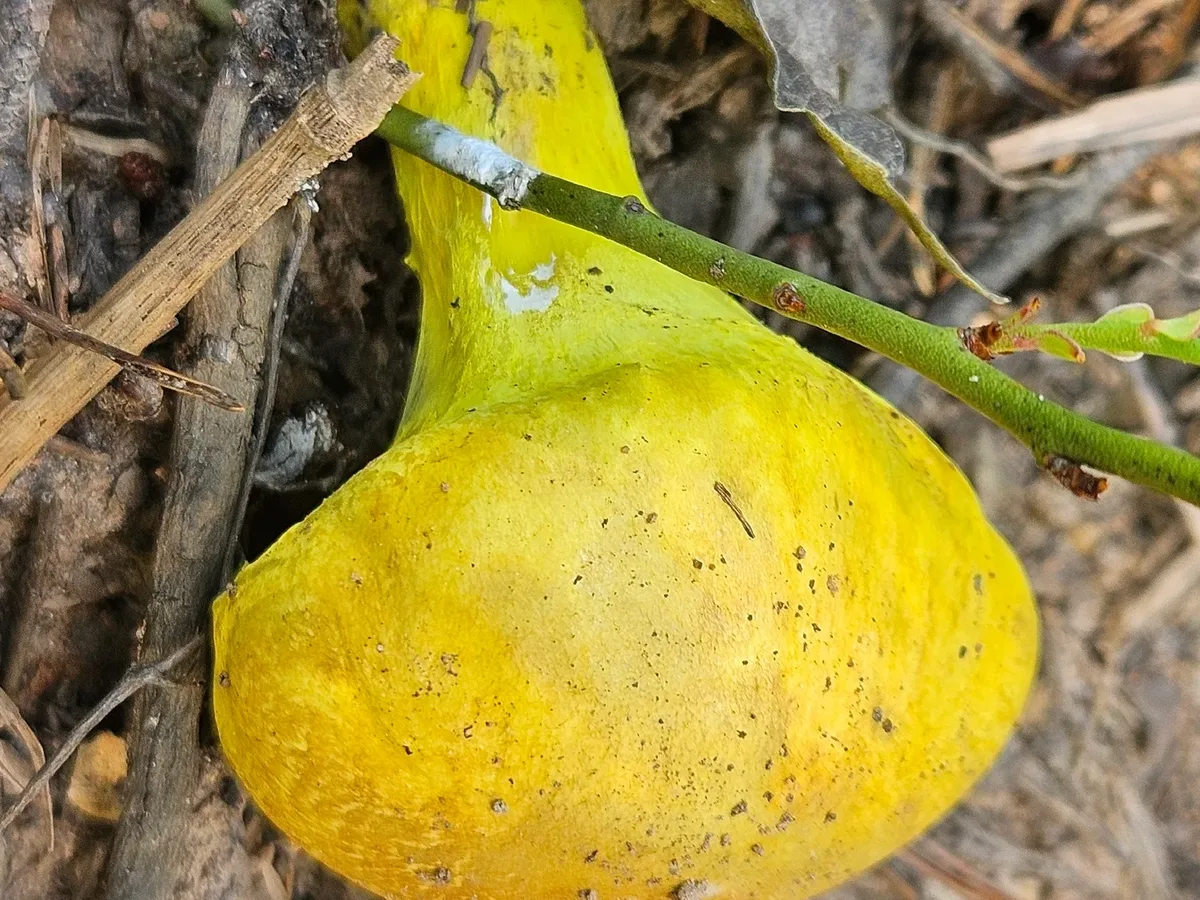 © willingarden (CC BY)
 © Elizabeth Altman (CC BY)
 © Elizabeth Altman (CC BY)
 © Atsushi Nakajima (CC BY)
 © Atsushi Nakajima (CC BY)© Brandon Johnson (CC BY)© Brandon Johnson (CC BY)
Edible only with the right preparation - or safe for some people but not others. Learn the caveats first.
How to recognise it
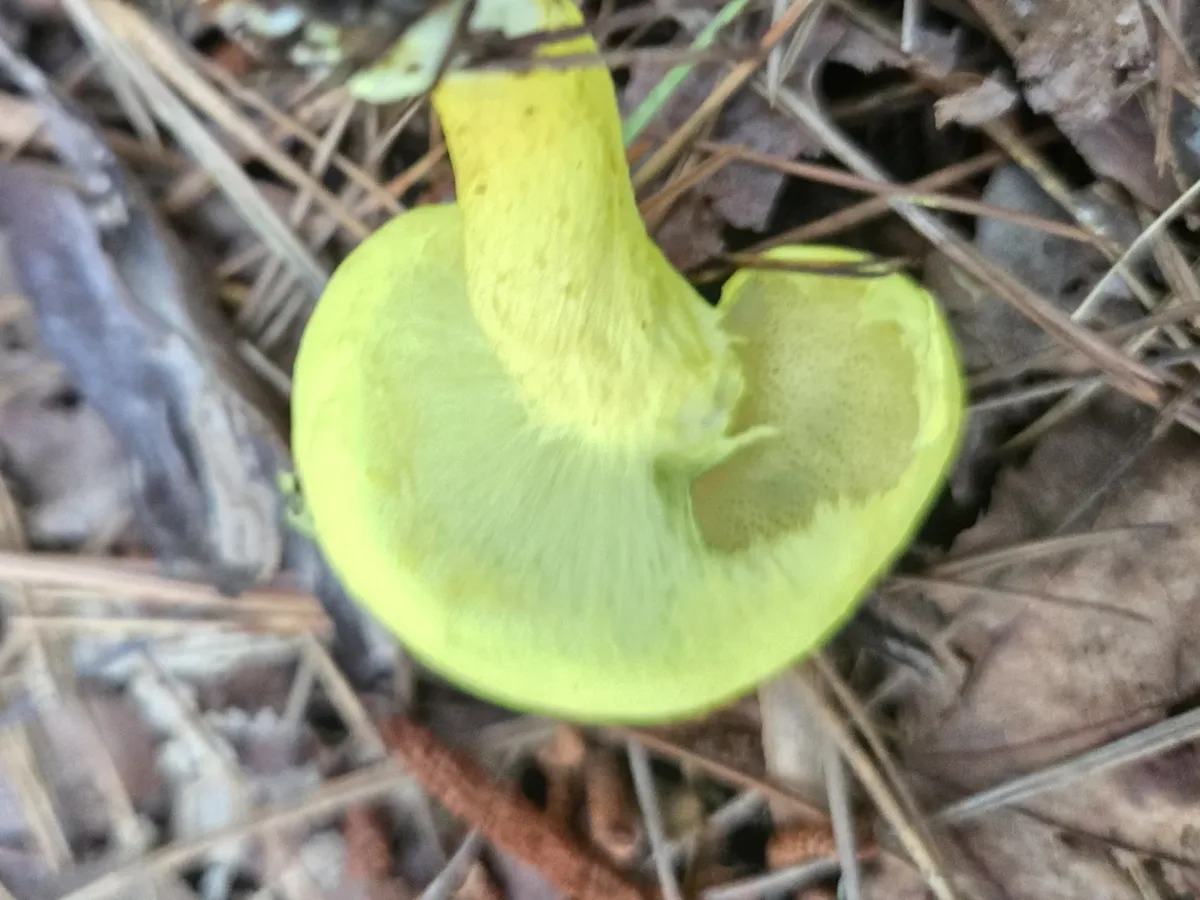
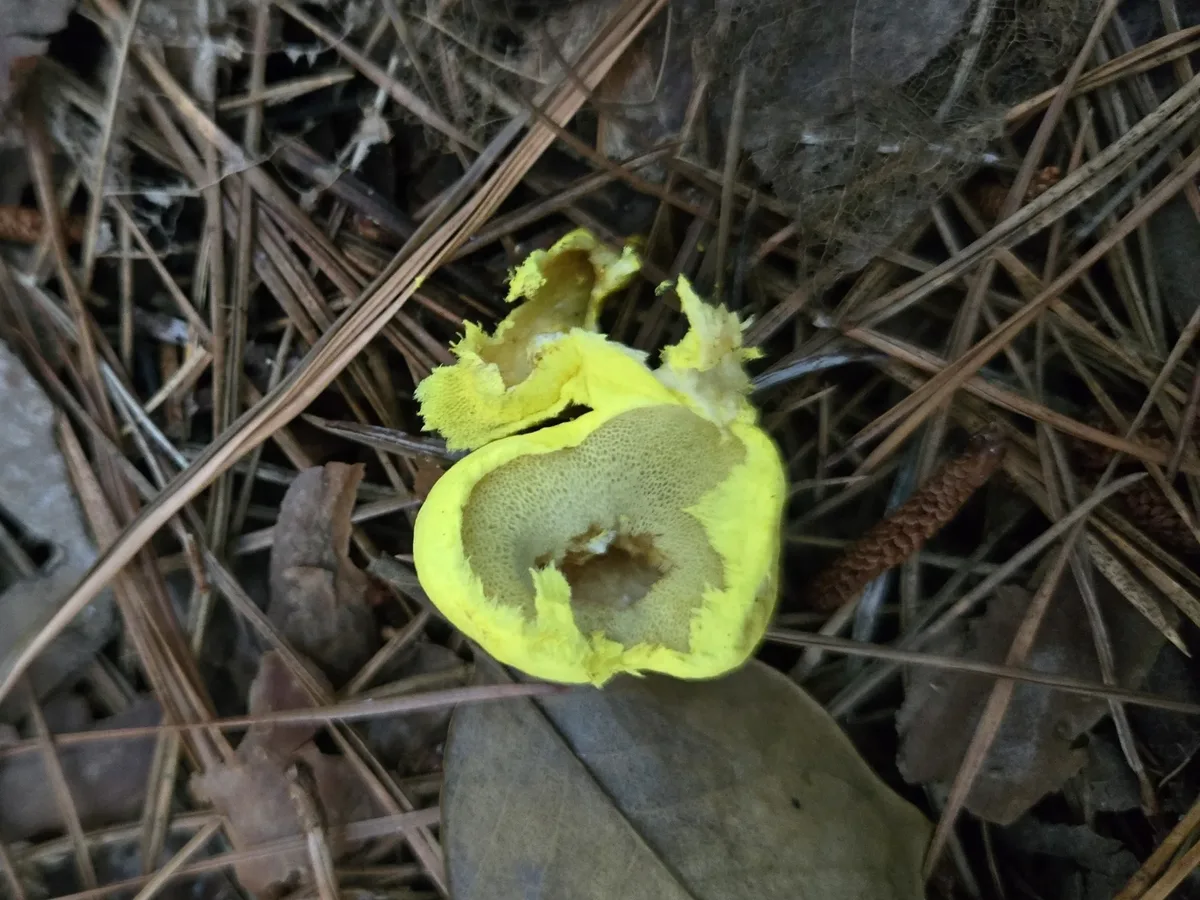
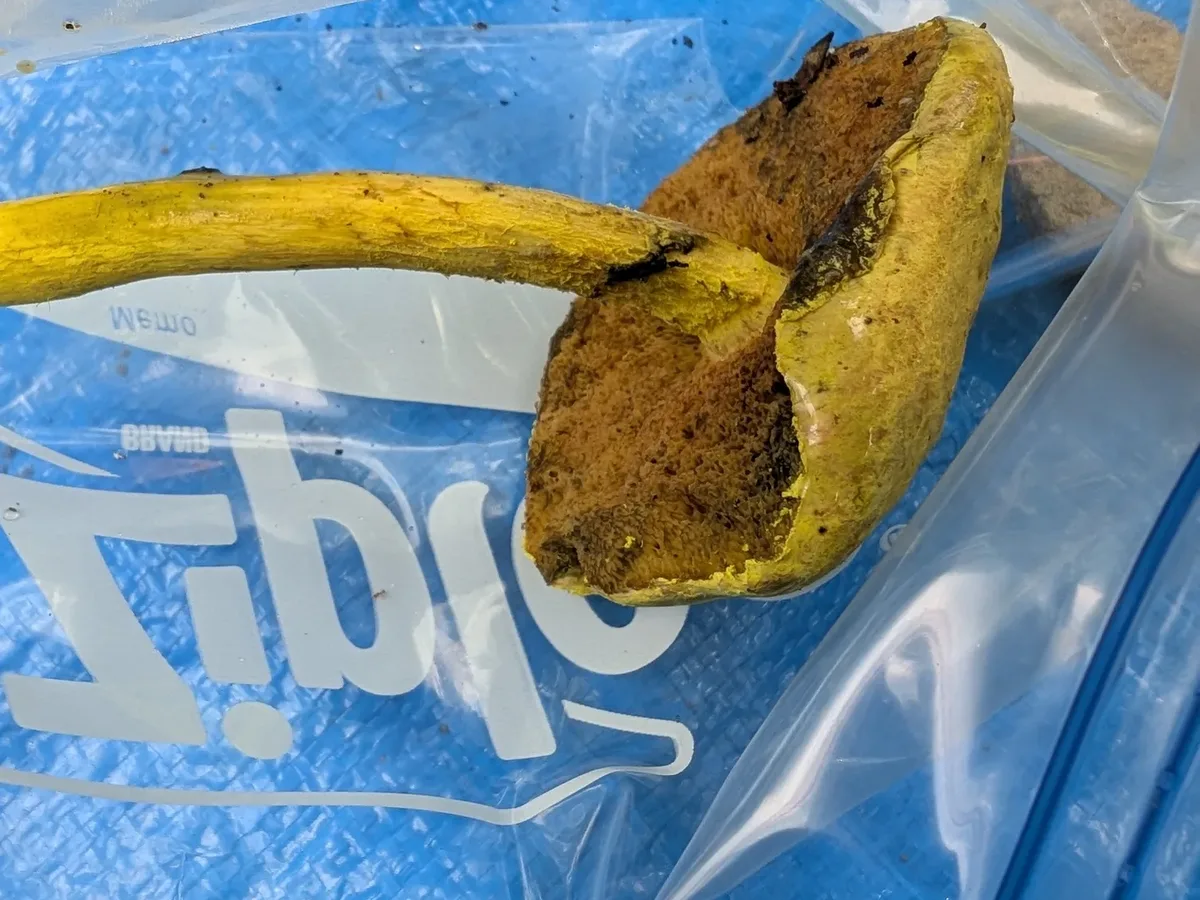
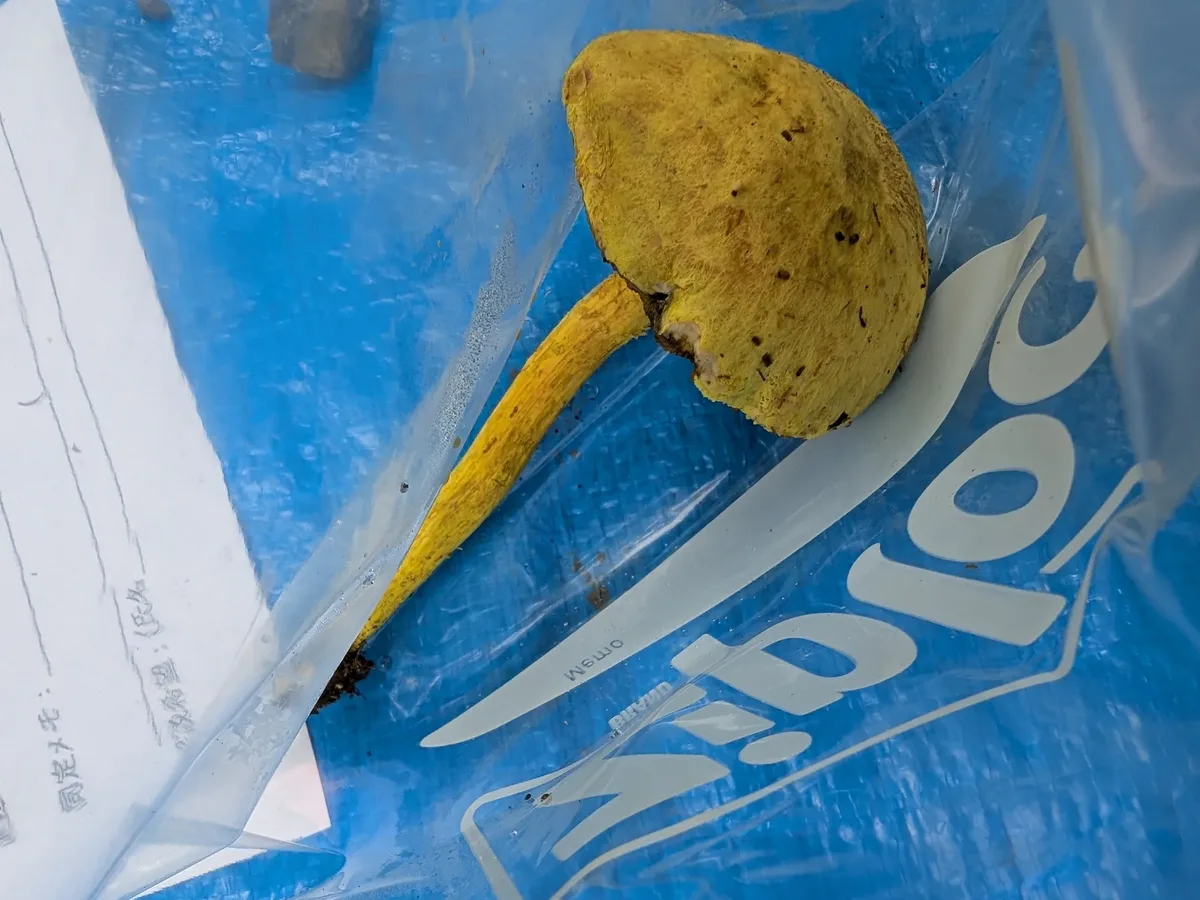
Pulveroboletus ravenelii is one of the most visually arresting boletes in the world, and once seen it is almost impossible to forget. The entire fruit body - cap, stipe, and even the young pore surface - is coated in a dense, dry, powdery bloom of vivid sulfur-yellow to chrome-yellow pigment, as though someone has dusted the mushroom with powdered sulfur or fine yellow chalk.
This powdery coating is present on fresh, young specimens at their most spectacular and diminishes in old or weathered material as the granules fall away, leaving a paler ochre or buff surface beneath. In wet weather the yellow bloom can partially dissolve into the surface, making old specimens look dull and ochre; always handle fresh material to appreciate the full character.
Cap
The cap starts as a firm hemisphere and flattens out to broadly convex or nearly plane, 3-10 cm across.
Gills / Pores
The pore surface is bright yellow and does not blue when pressed or cut - this is an important and reliable field mark, because many superficially similar yellow boletes do bruise blue or greenish-blue. The spore print is olive-brown, consistent with the bolete family.
Stem
The stipe is stout, solid, and equally powdery-yellow, lacking a ring.
Flesh
The flesh inside the cap and stipe is pale yellow to cream, mild-tasting, and also fails to blue on exposure.
Where & when it grows
Habitat
In eastern North America - where Pulveroboletus ravenelii was first formally described and is most thoroughly documented - it lives in warm deciduous and mixed forest, most often under oaks and pines on acidic sandy or loamy soils.
It has an affinity for disturbed or edge habitats: trail margins, forest roadsides, second-growth woodland, and the open fringes of mixed oak-pine stands where light reaches the ground and soils warm readily in summer.
In East and Southeast Asia it appears in broadly analogous situations under Fagaceae hosts including Quercus, Castanopsis, and Lithocarpus - the hardwood complexes that dominate warm-temperate and subtropical broadleaf forest across China, Japan, and mainland Southeast Asia.
The consistent habitat thread across its entire range is warm soil, adequate summer moisture, and a living hardwood (or hardwood-pine) mycorrhizal partner. Its ecological flexibility makes it a species of scattered discovery across a wide landscape rather than a concentrated patch-fruiting species like some of the more strictly host-specific boletes.
When
Pulveroboletus ravenelii is primarily a summer bolete, entering its peak fruiting window from late June and peaking through July, August, and early September across most of its Northern Hemisphere range.
In the southeastern United States and the warmer lowland parts of its Asian range, fruiting may begin as early as June and persist into October with late-season rains.
The trigger is warmth combined with rainfall: soil temperatures above about 16°C and a rainfall event of 15 mm or more over a 7-14 day window reliably precede flushes by approximately one to two weeks. This pattern - warm soil, a soaking rain, then a short wait - is the standard formula for most ectomycorrhizal summer boletes.
Individual fruit bodies are relatively short-lived, deteriorating quickly in summer heat, so visiting known sites within a few days of a rain event gives the best chance of finding them in prime condition.
How it grows
Grows singly or in small scattered groups of two to five, emerging directly from the soil under host trees.
Like all ectomycorrhizal boletes, the mycelium forms an intimate partnership with the root system of living trees, exchanging mineral nutrients and water for photosynthetically fixed carbon from the tree - an underground economy that has been running quietly for millions of years before a fruit body ever pushes into view.
Productive spots can recur year after year under the same trees if conditions align, making the mapping of known sites a worthwhile practice.
The fruit bodies expand quickly in warm summer conditions - a small button can reach full size in two to three days - and deteriorate almost as fast. Insect larvae (bolete maggots) colonise them rapidly in warm weather, so early inspection of found specimens is important.
Fruiting conditions
A warm-season ectomycorrhizal bolete; fruiting is triggered when soil temperatures reach 16°C or above, following rainfall of at least 15 mm over a 14-day period, with a typical lag of 7-14 days between soaking rain and emergence of fruit bodies. Peak fruiting is in the height of summer (July-September in temperate latitudes), earlier than most autumn boletes but later than spring species. Deteriorates rapidly in summer heat; prime specimens have a brief window of a few days before insect colonisation and softening make them unsuitable.
Look-alikes
The vivid sulfur-yellow powdery bloom covering the entire fruit body is so distinctive that Pulveroboletus ravenelii is not easily confused with most boletes once its character is understood. The realistic risks are:
- 1Other sulfur-yellow or bright-yellow boletes without a powdery coating - such as Suillus americanus (chicken fat suillus), which has a similarly vivid yellow but slimy, not powdery cap, and is restricted to white pine.
- 2Gyroporus sulphurinus (sulfur gyroporus), a North American yellow bolete with a dry, non-powdery cap and a hollow stem - the hollow stem is immediately diagnostic.
- 3Some yellow-capped Suillus species in Asia, which are slimy, not powdery, and typically grow under two- or three-needle pines with a distinct ring or ring-zone.
- 4Boletus speciosus in Asia, which can be bright yellow, but typically has a smooth non-powdery cap and different host associations.
The key differentiators for P. ravenelii are:
- The powdery (not slimy, not smooth) texture on all surfaces
- No blue reaction when the flesh or pores are cut or pressed
- No ring
- Uniform sulfur-yellow colouration across cap, stem, and pores simultaneously
No genuinely deadly species is known to be routinely confused with Pulveroboletus ravenelii because the powdery bloom is so unusual among the boletes.
Suillus americanus has a similarly vivid chrome-yellow cap but its surface is glutinous and slimy - not dry and powdery - and it bears reddish-brown fibril streaks under the slime. It grows strictly under eastern white pine (Pinus strobus) and has glandular dots on the stipe rather than a powdery coating. The sticky, wet cap feel versus the dry, dusty feel of P. ravenelii distinguishes them instantly in the field.
Rubroboletus satanas is a large, dangerous bolete with a pale whitish cap and vivid blood-red to carmine pore surface - the red pores are unmistakable and nothing in P. ravenelii's appearance resembles them. The cap is never powdery-yellow. Confusion requires ignoring both the red pores and the pale whitish cap, which makes it extremely unlikely in practice. Included here because any confusion between a yellow bolete and a toxic red-pored bolete in the same landscape would be serious.
Suillus luteus has a slimy brown to ochre-brown cap (not vivid yellow and not powdery), grows under two-needle pines such as Pinus sylvestris, and bears a distinct membranous ring on the stipe. None of these features match Pulveroboletus ravenelii. Confusion is only plausible in very young specimens before the full character of each species is expressed.
A bright yellow-capped bolete of eastern North America that can look superficially similar. The decisive character is the stipe, which becomes hollow or chambered with age in Gyroporus - Pulveroboletus ravenelii has a consistently solid stipe. The cap of G. sulphurinus is also dry but not distinctly powdery. Slice the stipe: if it is hollow or contains air chambers, it is Gyroporus, not Pulveroboletus.
In the kitchen
Picking & cleaning
Harvest young to mid-aged specimens with firm caps and intact powdery coating. The yellow bloom is the most reliable identity confirmation you have, and its presence on a freshly cut stem confirms you have the right species.
Always slice the stem vertically and examine for insect galleries before collecting - bolete maggots are common and can honeycomb the flesh of warm-weather specimens within a day of emergence. Cut the stem at soil level with a knife rather than pulling, to minimise disturbance to the mycelium.
The powdery bloom transfers readily to hands and baskets; transport in a paper bag or open basket rather than plastic to allow air circulation and prevent the collected specimens from becoming damp and soft.
Use within a day or two of collection, as Pulveroboletus ravenelii does not keep well. If in any doubt about identification - for example, if pores bruise blue, or if the powdery coating is absent - do not collect.
Cooking
The culinary reputation of Pulveroboletus ravenelii is modest - it is an acceptable edible rather than a prize table mushroom, and is not regarded as a choice species in any regional foraging tradition.
The flavour is mild, slightly earthy and nutty, without the depth of Boletus edulis or the aromatic quality of Cantharellus cibarius. The powdery surface coating dissolves during cooking and does not affect the dish.
Always cook thoroughly; raw consumption of boletes is inadvisable regardless of species. The pore surface can become soft and spongy when cooked and some cooks remove it, using only the cap flesh for firmer texture.
Best uses:
- Sautéed in butter or olive oil with garlic, shallots, or herbs as part of a mixed mushroom dish
- Added to soups and pasta sauces
- Combined with more strongly flavoured fungi to add bulk and earthy body
Drying is possible at 40-50°C and concentrates the flavour modestly. The firmness and quality of young, freshly collected specimens are significantly better than older, weathered ones - collect early and cook promptly.
Good to know
Pulveroboletus ravenelii is considered edible and is consumed in parts of its range, particularly in Japan and China where it is treated as an acceptable wild edible. No documented cases of serious human toxicity attributable to this species are recorded in the mycological literature.
A general precaution applies that governs all wild boletes: always cook thoroughly before eating. Raw boletes as a class contain heat-labile compounds that can cause gastrointestinal upset in many people, and thorough cooking is not optional.
Identification should always be confirmed before collecting. Confirm all of the following on every specimen:
- The powdery yellow bloom on all surfaces
- The absence of any blue reaction when the pores or flesh are cut or pressed
- The absence of a ring
Any bolete that bruises blue or has red pores should be treated with serious suspicion in the region and not assumed to be Pulveroboletus ravenelii.
As with any wild mushroom eaten for the first time, taste only a small, well-cooked portion on the first occasion and monitor for any gastrointestinal reaction over 24 hours before consuming larger amounts.
A reference guide - never an edibility guarantee. When in doubt, leave it out.