Umbrella Polypore
Polyporus umbellatussyn. Boletus umbellatus Pers., Grifola umbellata (Pers.) Pilát, Dendropolyporus umbellatus (Pers.) Jülich, Polyporus ramosissimus Schaeff., Scutiger umbellatus (Pers.) Murrill
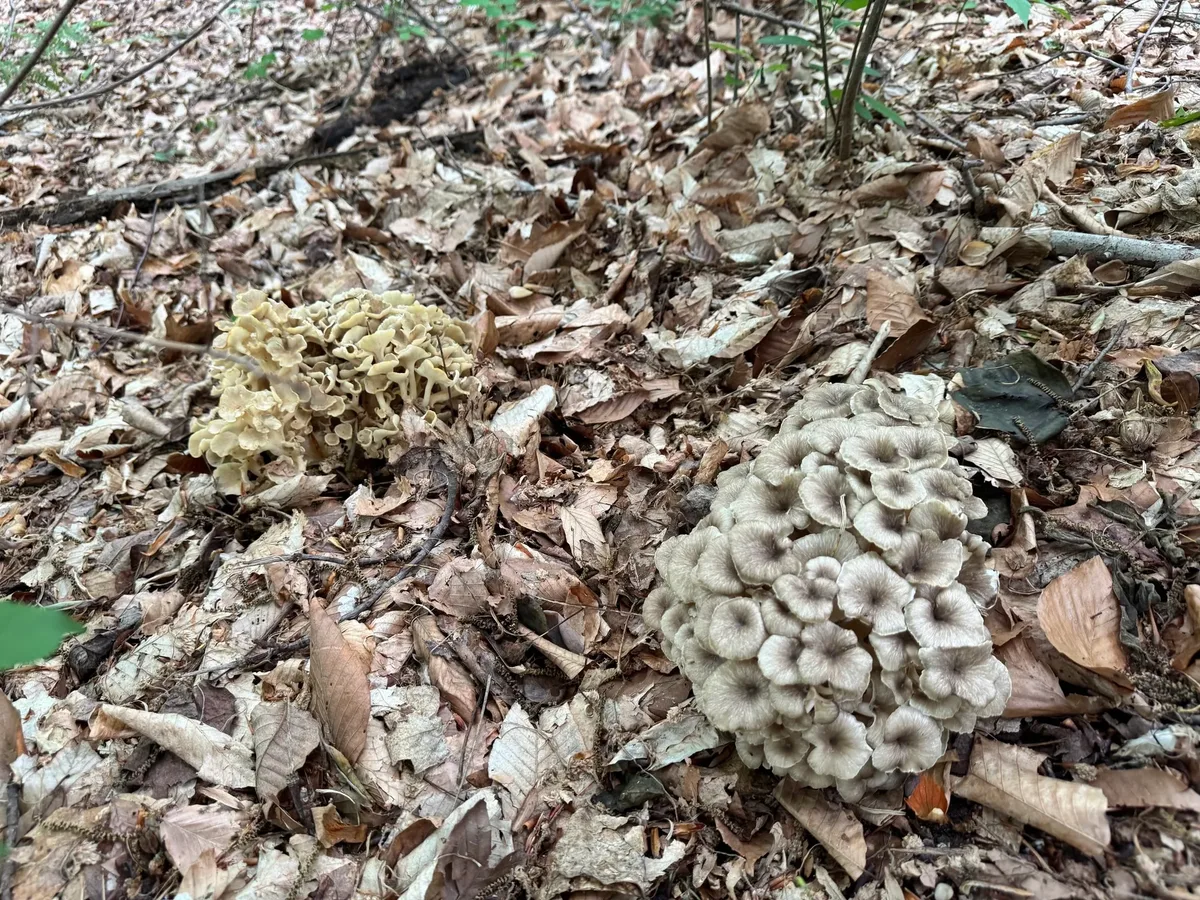 © Annie Weissman (CC BY)
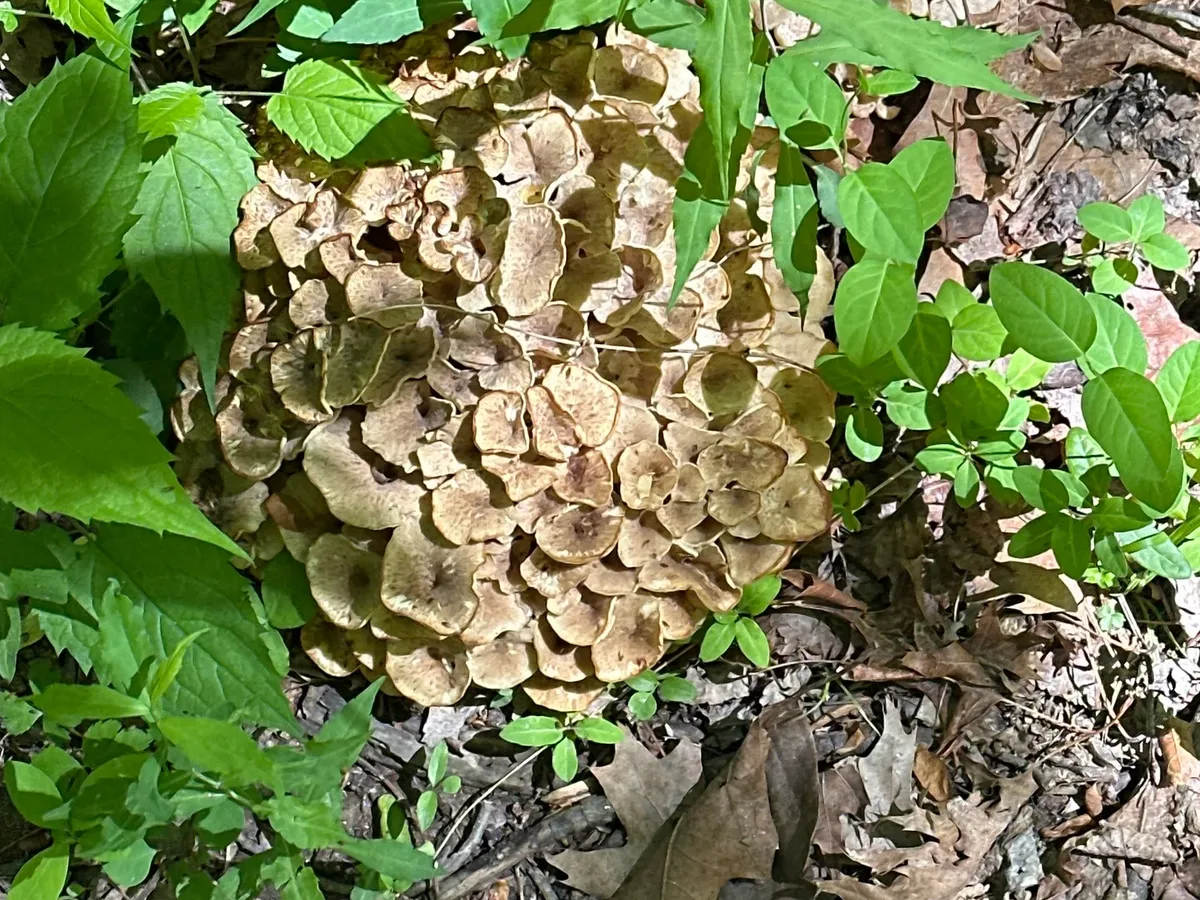 © Jessica Precht (CC BY)
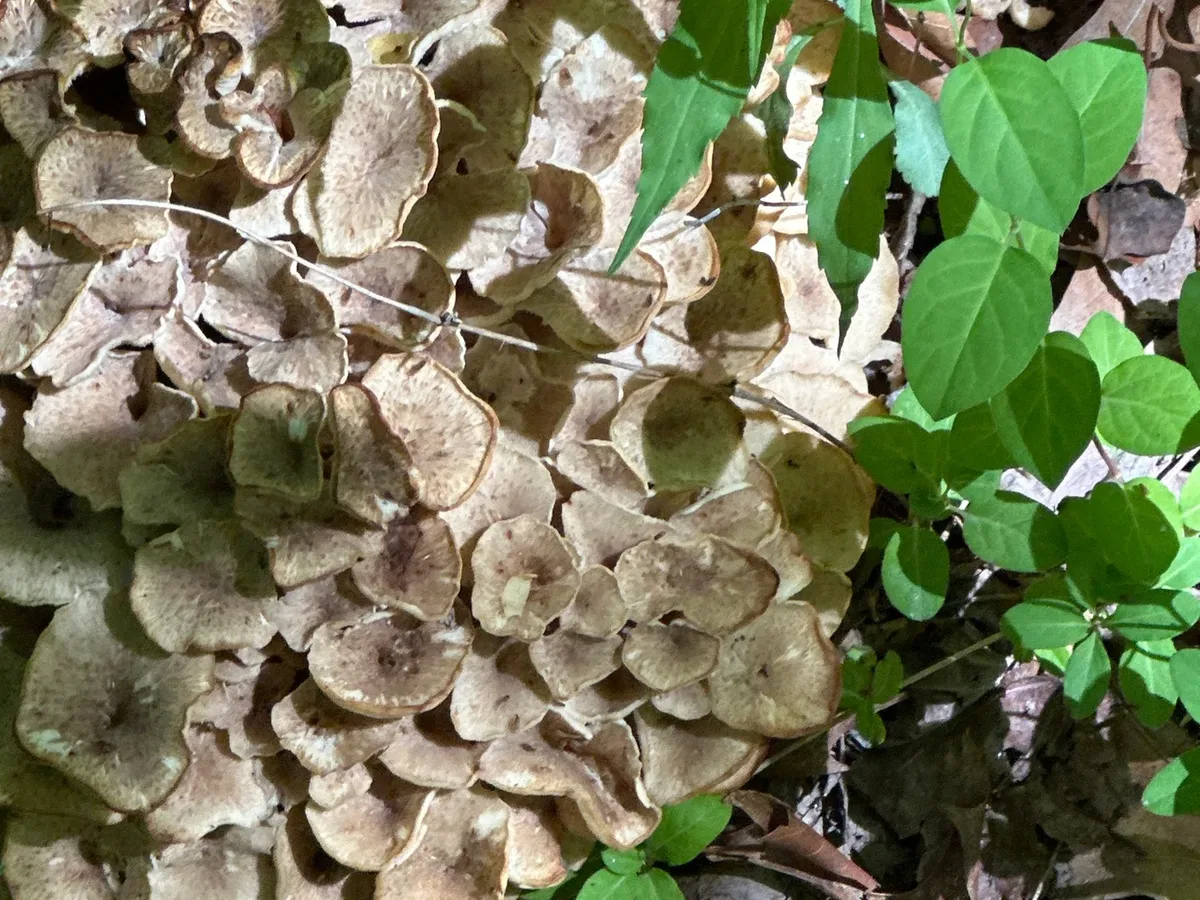 © Jessica Precht (CC BY)
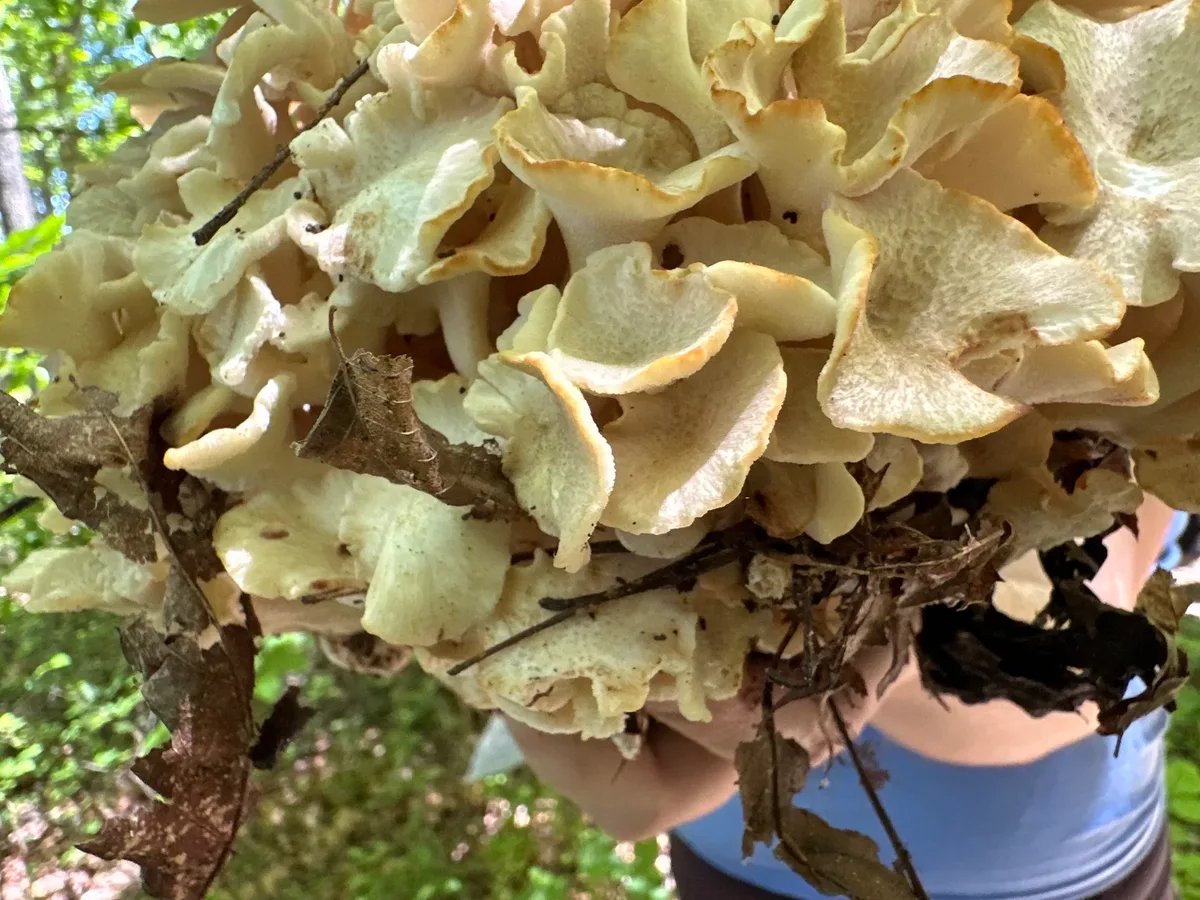 © Jessica Precht (CC BY)
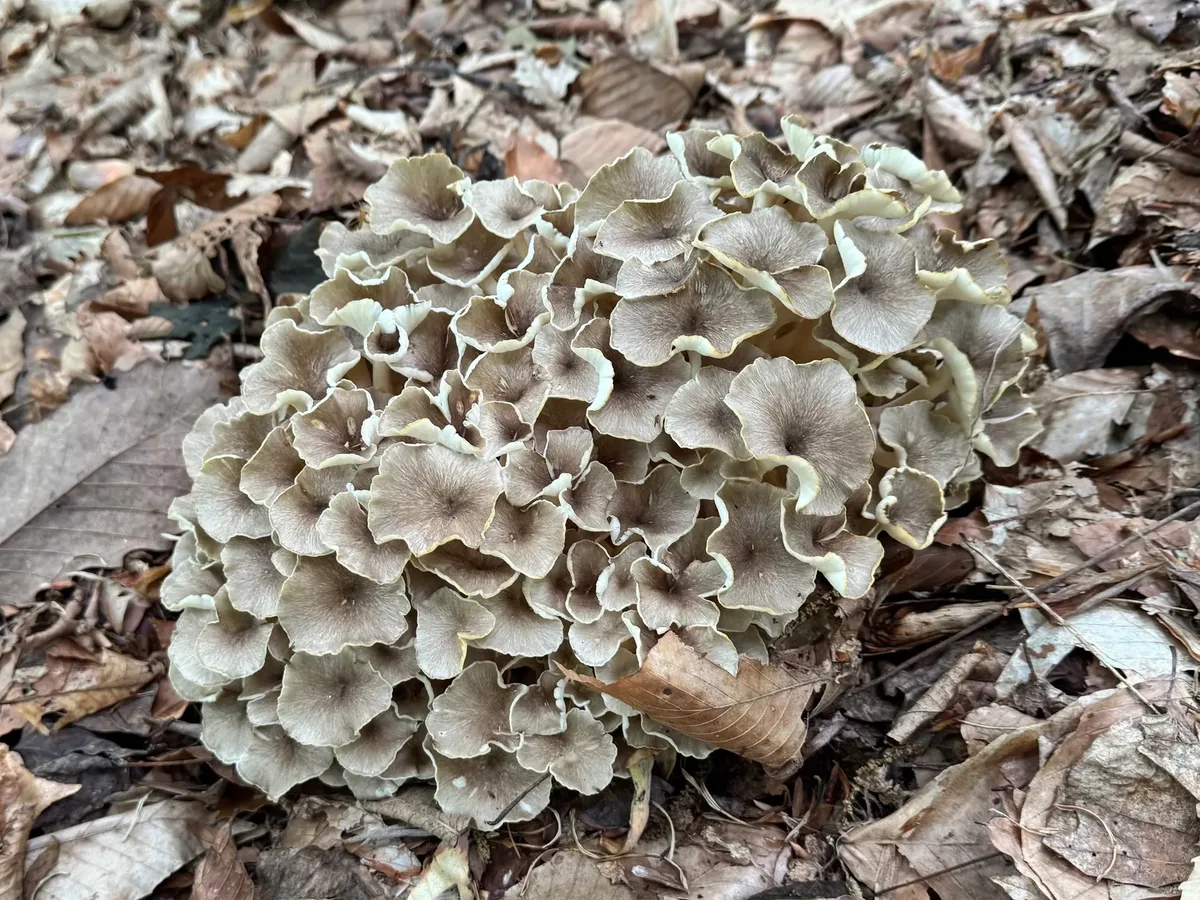 © Annie Weissman (CC BY)
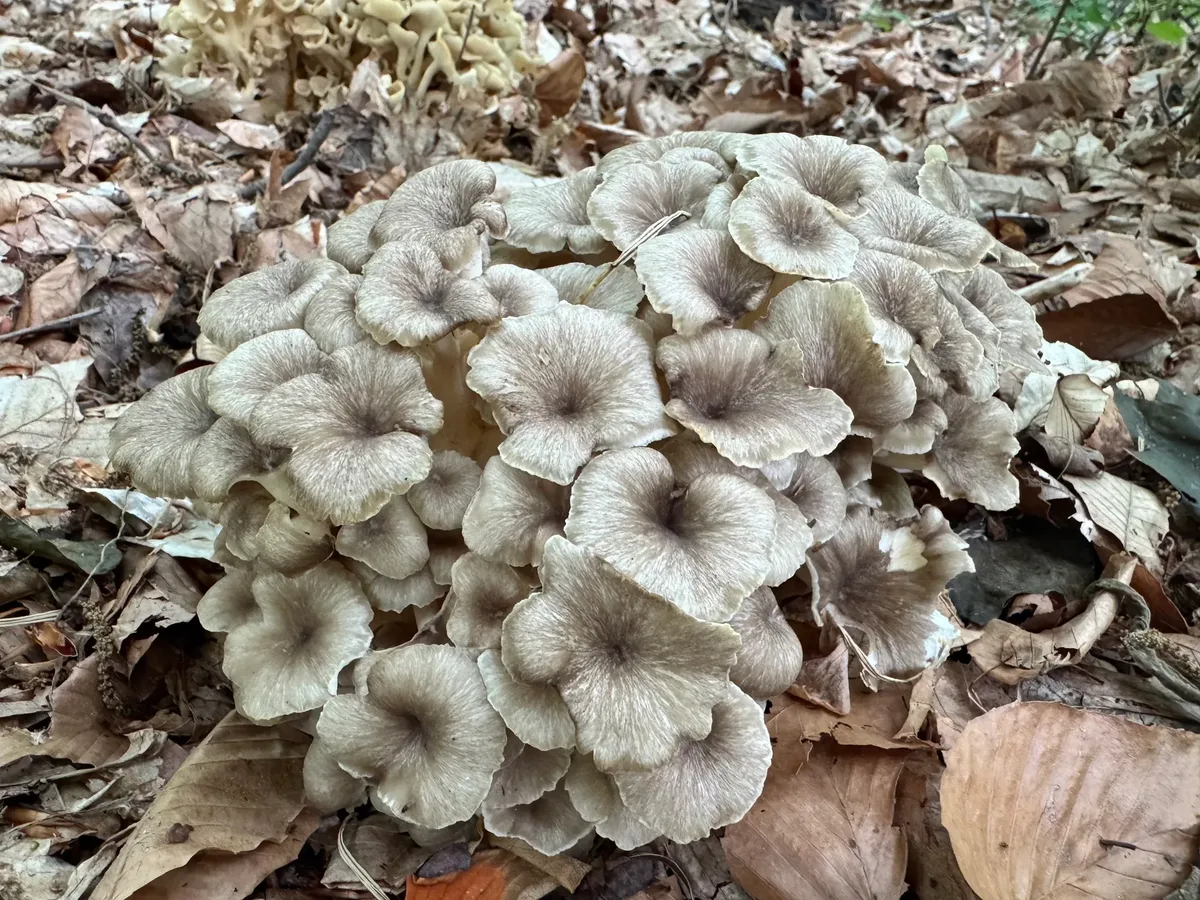 © Annie Weissman (CC BY)
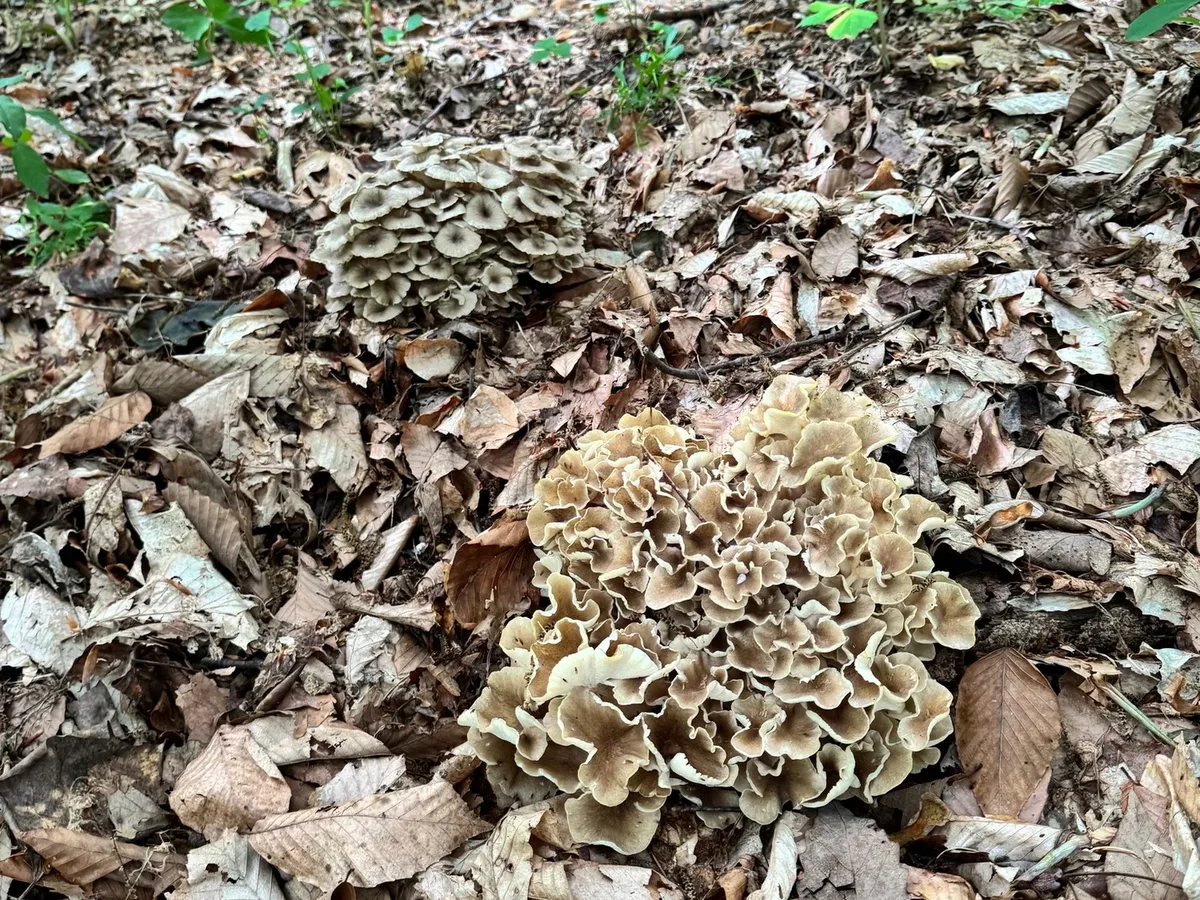 © Annie Weissman (CC BY)
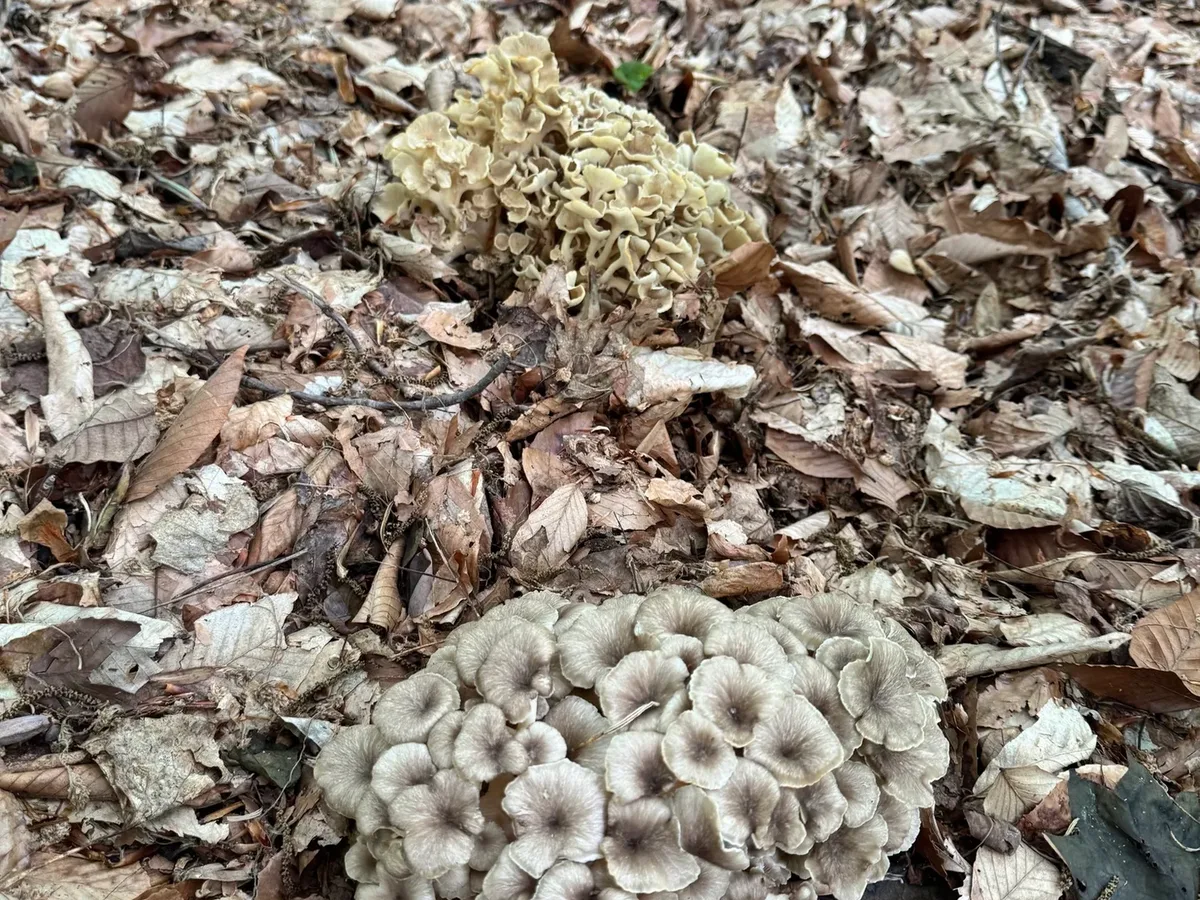 © Annie Weissman (CC BY)© Annie Weissman (CC BY)© Jessica Precht (CC BY)
Good to eat, once you have identified it with certainty and cooked it through.
How to recognise it
Polyporus umbellatus is one of those fungi that stops you in your tracks - a large, pale, many-branched bouquet of miniature caps erupting from a single base, the whole structure suggesting a colony of small umbrellas arranged in tiers.
The full fruiting body can reach 15-40 cm across, and outstanding specimens tip the scales at several kilograms - a useful discovery for the forager.
Stem
The central stem-base is thick, fleshy and white. Within a few centimetres it subdivides again and again into dozens of ascending branches, each ending in a small, individual cap.
Cap
Each cap is circular or fan-shaped and 1-4 cm across. The caps are thin but pliable rather than brittle, pale grey to greyish-buff or pale ochre-brown, smooth and dry, with a finely radial texture and a slightly wavy, incurved margin.
Pores
The underside of every cap is white and covered with a neat layer of fine, rounded to angular pores (2-4 per mm), the signature of a polypore.
Flesh
Slice through the flesh and it is uniformly white, firm yet tender, and does not change colour. In mature specimens the central base may become tough and woody, but the peripheral caps and their attached stems retain a pleasant texture up to quite a late stage.
Smell
The smell is mild and pleasant, faintly earthy or herbaceous.
Where & when it grows
Habitat
The key to understanding where to look for umbrella polypore is to know it grows from a sclerotium - a hard, compact, potato-like resting body buried in the soil beneath old deciduous trees.
The sclerotium can be the size of a fist or considerably larger, and it anchors the mycelium to a long-standing food source: decaying heartwood or old root systems of broadleaved trees, particularly oak, beech and birch.
The fruiting body emerges from the soil directly above or close to the sclerotium, often looking as though it has no substrate because all the visible wood has already been consumed underground.
Once a sclerotium is established it may fruit from the same spot for many consecutive years, so a known site is genuinely worth returning to every summer.
Look in old-growth deciduous woodland, parkland with veteran trees, wood pasture and along old hedgerows; avoid very young plantations. In East Asia it is also cultivated commercially, both for the edible fruiting body and for the medicinally prized dried sclerotium (Zhu Ling).
When
This is predominantly a summer fungus, which distinguishes it from many polypores that peak in autumn.
In temperate East Asia and across Europe, fruiting runs from June through September, with the heart of the season in July and August when soil temperatures are warmest - this early-summer preference is one of the features that make it distinctive. In the warmer parts of its range (subtropical China, Korea) fruiting can start in May.
Individual fruiting bodies develop relatively quickly once triggered, producing their full structure within a few days of warm, humid weather following rain, and they are best collected while the individual caps are still pale, firm and pliable.
Once the caps begin to darken, become tough or dry out, the eating quality declines sharply.
How it grows
The entire compound fruiting body grows as a single organism from the buried sclerotium, expanding outward from the central base in a burst of branching. Growth can be rapid in warm, humid conditions - a small nub visible on Monday may be a full-sized specimen by Thursday.
The species does not grow in large gregarious troops the way some polypores do; instead single large specimens (occasionally two or three close together from adjacent sclerotia) appear in specific spots that tend to recur annually.
The mycelium causes a white rot of the buried host wood, breaking down lignin and leaving the wood pale, fibrous and soft.
Unlike the brown rot of many conifer-associated species, white rot is less obviously visible from the surface, so the tree may appear healthy while the root system is colonised below.
Fruiting conditions
Triggered by warm summer soil temperatures and sustained rainfall or high humidity. Growth from the established sclerotium is rapid once conditions are met - fruiting bodies can develop to full size within 3-7 days in ideal warm-humid weather. Peaks at higher soil temperatures than most autumn polypores (optimum around 18-25 °C), which explains its summer-dominance timing.
Look-alikes
Polyporus umbellatus has no deadly lookalikes, and its closest visual relatives are all edible, making this a reassuringly safe species for experienced foragers who confirm the key features.
The most commonly confused species is Hen of the Woods (Grifola frondosa), which also produces a large compound polypore at the base of oaks and other hardwoods. It differs in forming overlapping, shelf-like fans arranged in layers rather than individual small caps on distinct branching stems, and its individual fans are larger (4-12 cm), grey-brown to brown with a white pore surface below. Both are excellent edibles, so confusion between them is harmless.
Black-staining polypore (Meripilus giganteus, also called Meripilus sumstinei in North America) produces a large cluster of overlapping fan-shaped brackets, also at the base of oaks and beeches. The brackets are much larger (each 10-30 cm), tough, and, crucially, they stain black or dark brown within minutes of cutting or bruising - Polyporus umbellatus does not stain at all. Meripilus is listed as edible but can cause GI distress in some people, particularly in quantity.
The Chicken of the Woods (Laetiporus sulphureus and related species) is also a compound bracket polypore on hardwoods, but it is immediately distinct: vivid sulphur-yellow and orange caps in overlapping shelves, no branching stem structure, much tougher flesh.
No species likely to be confused with umbrella polypore is deadly.
Produces large overlapping fan-shaped brackets (each 10-30 cm) in dense clusters at the base of oaks and beeches; the flesh and pore surface stain black to dark brown within minutes of cutting or bruising - Polyporus umbellatus does not stain. Meripilus is considered edible but can cause GI distress in some people, especially in large quantities or when not fully cooked.
Brilliant sulphur-yellow and orange overlapping brackets, much tougher, no branching central stalk and no individual small caps - unmistakable on colour and texture alone. Edible when young and cooked, though it can cause GI reactions in some people.
Also a large compound polypore at the base of oaks and beeches, but forms overlapping, shelf-like fans (each 4-12 cm, grey-brown above, white-pored below) arranged in layers, not small individual caps on a branching stem. Both species are excellent edibles, so confusion is harmless. Grifola typically appears in autumn; Polyporus umbellatus peaks in summer.
A stalked polypore with a single, smooth, chestnut-brown to blackish-stemmed cap; lacks the compound, many-branched umbrella form of P. umbellatus. Considered inedible (too tough and bitter) but not toxic.
In the kitchen
Picking & cleaning
Harvest the entire fruiting body by cutting cleanly through the central stem-base at ground level, leaving the buried sclerotium intact - this is essential if you want the spot to fruit again next year.
The best specimens are those with pale, firm caps whose pore surfaces are still pristine white; avoid any that are yellowed, dried, soggy or heavily insect-ridden, as quality falls quickly.
The branched structure traps leaf-litter, soil and small insects among the caps, so expect to spend some time cleaning in the field:
- Shake gently.
- Brush with a soft brush.
- Separate the branches for a thorough inspection.
The tough central stem-base (especially on large mature specimens) is often too fibrous to enjoy eating and is best discarded or used for stock. Young to middle-aged specimens are the culinary prize.
Cooking
The individual caps and the thinner branch-tips of umbrella polypore are tender, mild and pleasant, with a slightly firm texture that holds together well in the pan and does not become slimy. The flavour is delicate and mildly earthy - more subtle than hen of the woods or chicken of the woods.
Young specimens are best. Clean carefully, discard any tough central stem-base, and separate the cluster into smaller sections.
- Stir-frying in a hot pan with oil, garlic and a little salt is the classic preparation in China and Japan, where the mild flavour is appreciated alongside bolder seasonings.
- It also suits soups, broths and hot pot dishes, where its firm texture prevents it from falling apart during long simmering.
- In Japanese cuisine it is valued in nabemono and braised dishes.
- It can be dried at low temperature for storage and rehydrated well.
Avoid overcooking the tender caps, which can become chewy; brief high-heat cooking or gentle simmering are both effective.
Good to know
Polyporus umbellatus is a straightforward edible with an excellent safety record and no deadly lookalikes. The standard precautions that apply to all wild polypores are nonetheless worth stating.
- Always cook it properly: the tough, fibrous central stem-base and the stems of mature specimens can be hard to digest raw.
- Harvest only fresh, firm material: old, discoloured or soggy specimens can cause mild GI upset from spoilage organisms, not from any intrinsic toxin.
- A small number of people find polypores in general harder to digest than gill mushrooms, so try a modest portion the first time.
- As with any woodland mushroom, do not harvest from clearly polluted sites - polypores can accumulate heavy metals from their substrate.
Medicinally, the dried sclerotium (Zhu Ling) contains polysaccharides with documented diuretic and immunomodulatory effects and is a separate, well-studied traditional medicine product, but that is distinct from eating the fruiting body, which is simply a pleasant food.
A reference guide - never an edibility guarantee. When in doubt, leave it out.