Blue chanterelle
Polyozellus multiplexsyn. Cantharellus multiplex Underw., Craterellus multiplex (Underw.) Shope, Thelephora multiplex (Underw.) Kawam., Phyllocarbon yasudai Lloyd
 © Andrus Voitk (CC BY-SA)
 © Annie Weissman (CC BY)
 © Annie Weissman (CC BY)
 © Annie Weissman (CC BY)© Andrus Voitk (CC BY-SA)© Annie Weissman (CC BY)
Good to eat, once you have identified it with certainty and cooked it through.
How to recognise it
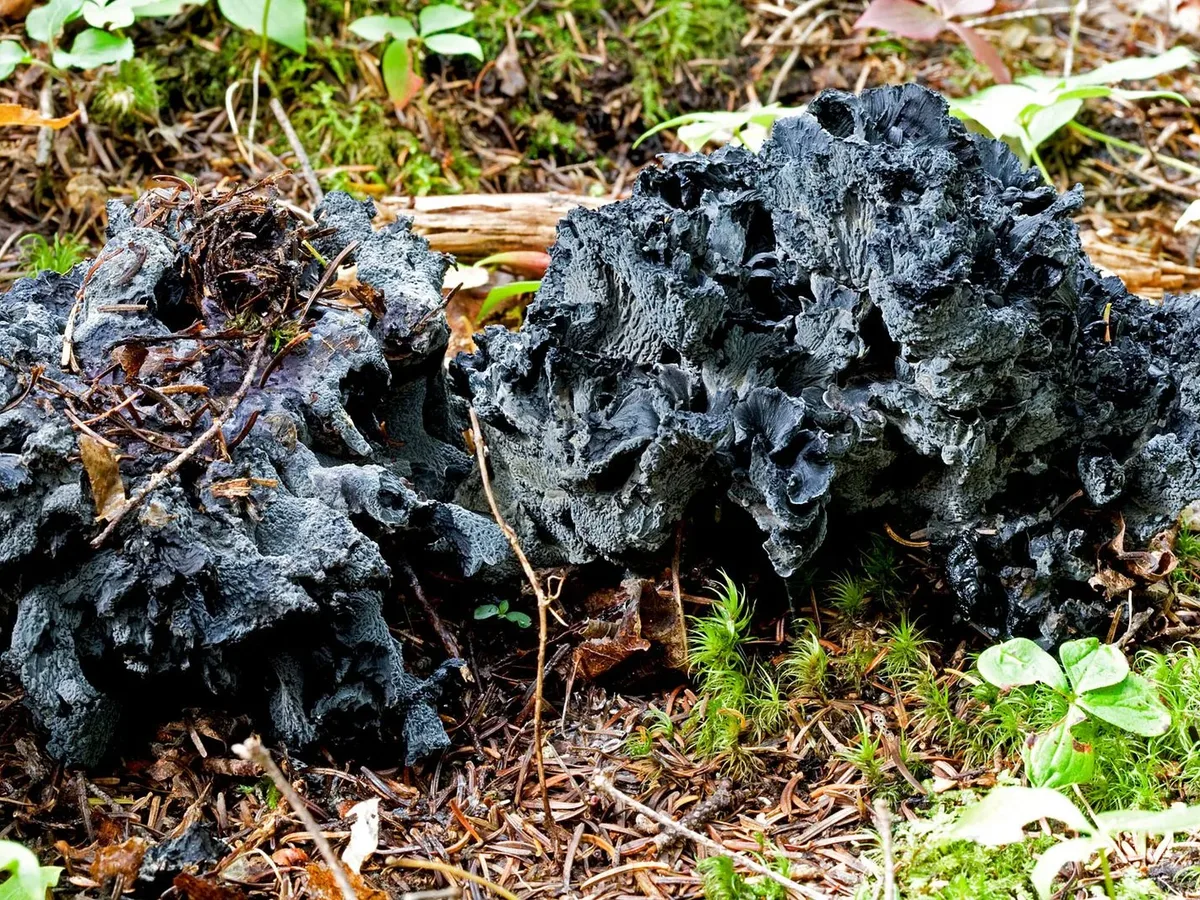
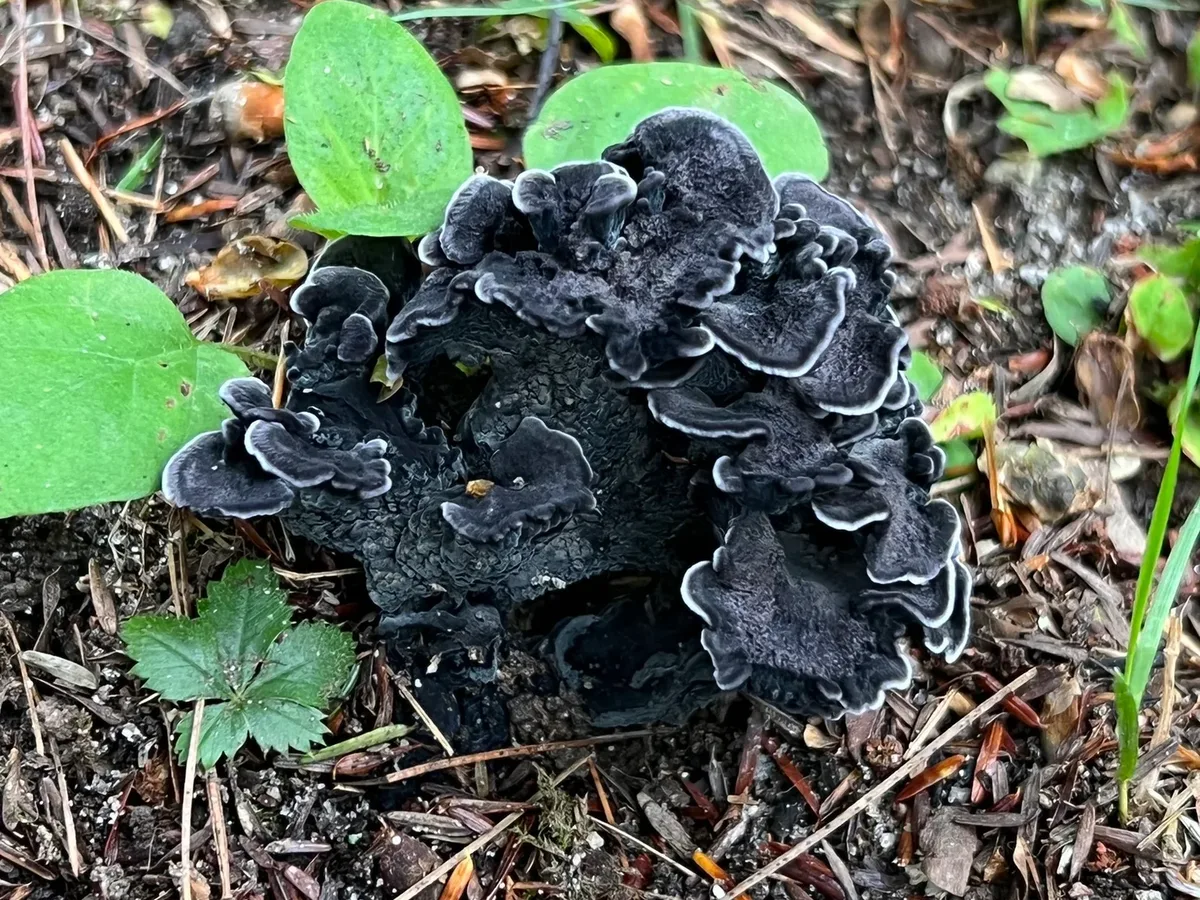
Among the fungi of the Pacific Northwest, Polyozellus multiplex stands apart: it is one of the very few genuinely blue-black mushrooms in the temperate world. Finding one - a dark, layered rosette of deep-blue fans pressed against the moss - stops you in your tracks.
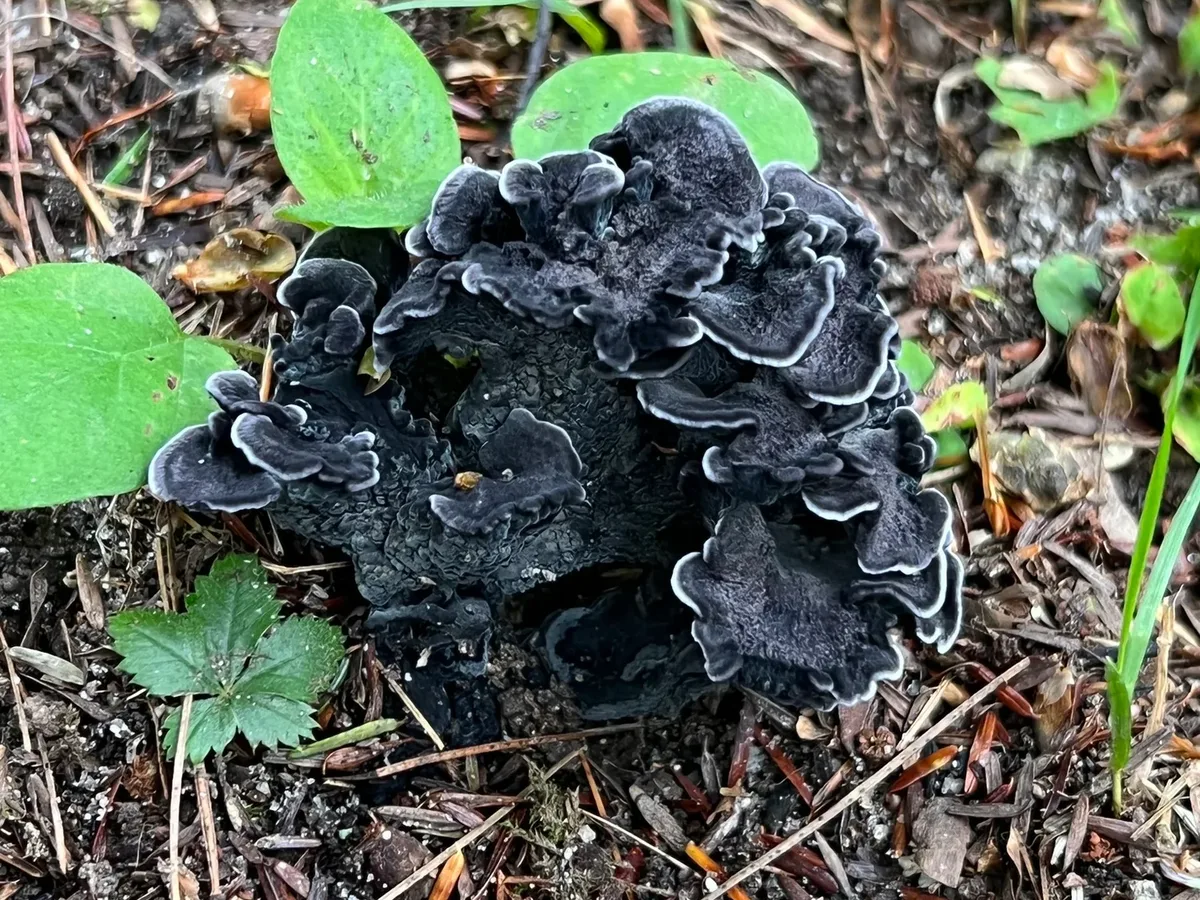
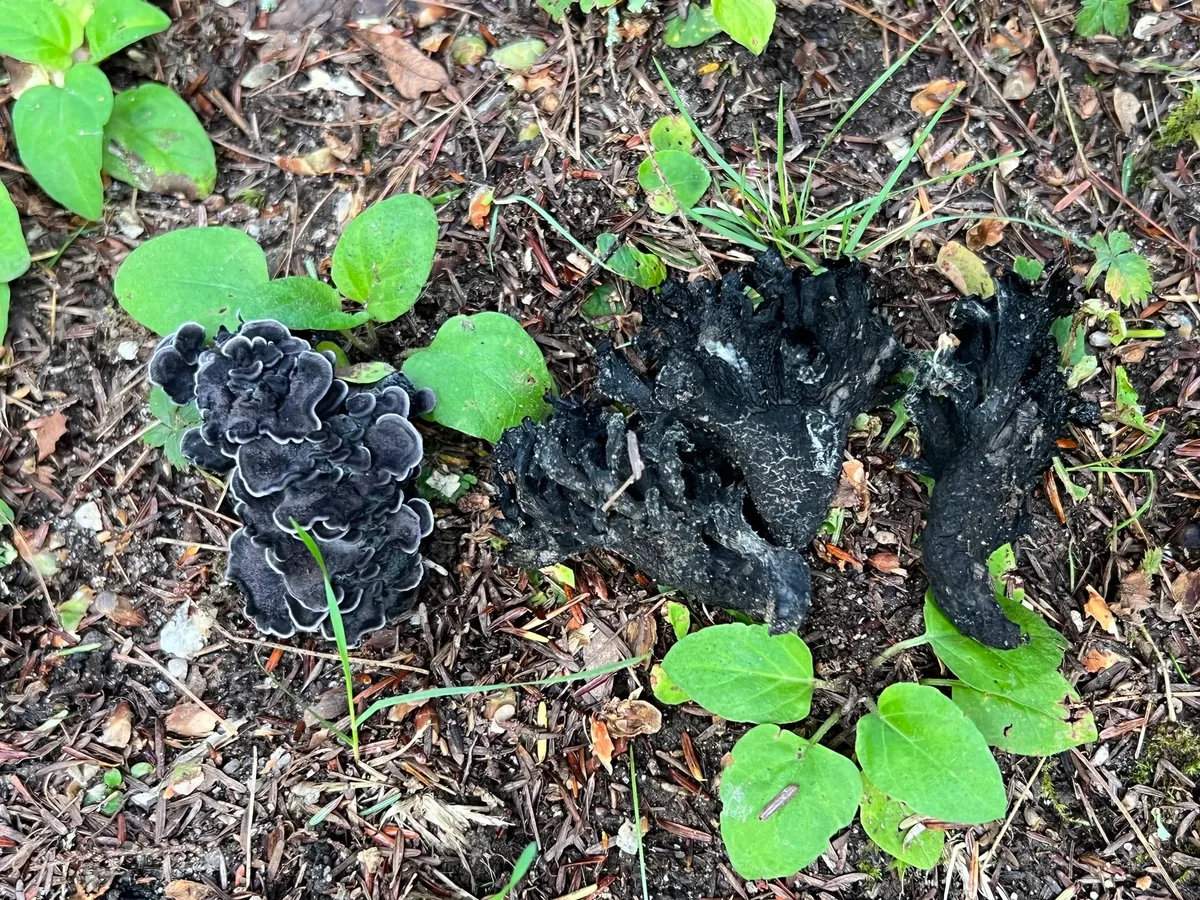
The fruiting body always arises as a compound cluster - multiple fan- or spatula-shaped caps fused at their bases into a single mass that may span 20-25 cm and weigh 500 g to over 1 kg.
Cap
Individual caps are 3-10 cm across. Young caps are fan-shaped or spatulate with an inrolled margin; as they mature the centre sinks, sometimes approaching a shallow funnel.
The upper surface is dry and finely fibrous, like suede, and coloured uniformly deep blue-black to purplish-black or blue-grey - fading to dull grey-brown only on drying or in aged specimens.
Gills / Pores
The most important thing to check is the underside. Instead of true gills, the hymenium bears blunt, shallow, forking, vein-like ridges (pseudogills) coloured bluish-grey to slate-blue, running smoothly down the stem - the classic chanterelle-type ornamentation that immediately separates Polyozellus from any gilled mushroom.
Stem
The stems are stout, solid, tapering downward, and fused together into a thick compound base the same deep blue-grey as the caps.
Flesh
Slice through the flesh: it is uniformly blue-grey to bluish-black all the way through - not white beneath a dark skin - and firm and dense. There is no colour change on cutting, bruising, or with KOH.
Smell & taste
The odour is mild, faintly fruity to slightly smoky. Spore print is white.
The full picture - compound clustered habit, blue-black colour through cap, flesh, and ridges, chanterelle-type ridges underneath, old-growth conifer habitat - makes this fungus essentially unmistakable in its range.
Where & when it grows
Habitat
Polyozellus is an old-growth specialist in the truest sense: its mycorrhizal partnership with mature spruce and fir is so close that finding it means you are standing in genuinely old, undisturbed forest.
It grows almost exclusively where large conifers have had decades to build a deep duff layer and a carpet of thick green moss - the kind of forest floor that retains moisture long after the last rain.
- Coastal regions (Alaska south through British Columbia to Washington and Oregon): most frequent under Sitka spruce and western hemlock in old rainforest conditions.
- Rocky Mountains and Cascades: favours Engelmann spruce and subalpine fir at elevations typically above 900 m, often tucked into moist ravines or valley bottoms.
- East Asia: the same pattern - montane spruce-fir forest, deep moss, old trees.
The species has not been reliably recorded from pine- or larch-dominated stands.
Look for it on north-facing or stream-side slopes where moisture lingers, pushing up through the moss at the base of living conifers - and if you find it, take a moment to look around: you are in some of the best habitat a Pacific Northwest forest has to offer.
It is uncommon to rare throughout its range and is considered a species of conservation concern in several Pacific Northwest jurisdictions.
When
The blue chanterelle is a late-summer to autumn species, and its timing is tied closely to rain.
- Pacific Northwest lowlands and coastal ranges: from late July onward, with fruiting peaking in August and September.
- Cascades and Rockies (higher elevations): August and September are the main months.
- Alaska: the season runs from July into September.
The species tends to appear 10-20 days after significant late-summer rainfall that follows a warm, dry period - the flush arrives as soil temperatures begin to ease downward in September. In drought years, entire populations may not produce a single fruiting body.
By late October most specimens have aged and collapsed, though in mild coastal years fresh finds can persist into early November.
How it grows
Fruiting bodies are always compound - multiple individual caps arise from a shared mycelial base and fuse their stems into one thick stipe, forming the characteristic rosette. This habit is consistent across all ages and sizes.
The mycelium lives in intimate partnership with the fine root tips of mature spruce and fir, exchanging minerals for sugars in an ectomycorrhizal relationship that may persist for many years under the same trees. The fungus depends entirely on living hosts and has no saprophytic capacity.
Fruiting bodies push up through the deep duff and moss, enlarging over several days and persisting for 1-3 weeks before deteriorating.
The species does not form fairy rings but tends to fruit in the same spot year after year - a quiet testimony to the underground network that endures long after the above-ground cluster has gone.
Fruiting conditions
Fruiting is strongly triggered by significant late-summer rainfall after a warm dry period, with a lag of 10-20 days. Cool soil temperatures (5-15 °C) are a prerequisite; fruiting typically ceases once soils warm above ~16 °C or drop below ~4 °C. Deep, moisture-retaining duff under old-growth conifers buffers soil temperature and extends the window. Drought years may suppress fruiting entirely.
Look-alikes
Polyozellus has very few dangerous or even confusing lookalikes, primarily because of its unique blue-black to purplish-black colour and chanterelle-type ridged underside.
- Gomphus and Turbinellus species: Turbinellus floccosus (shaggy-stalked vase chanterelle) and Gomphus clavatus (pig's ears) share the compound, funnelled, ridged-undersurface body plan, but are yellowish-ochre to violet-lilac in colour, never blue-black, and both are considered mildly gastrointestinally toxic - colour alone separates them from Polyozellus.
- Dark Craterellus species (Craterellus calicornucopioides, C. cornucopioides - black trumpet): also have a dark fruiting body and forking ridges, but the black trumpets are thin-fleshed, hollow or tubular, with the spore-bearing surface on the outside of the funnel, and are consistently brown-black or grey-black rather than blue-black.
- Cortinarius species: can be very dark purple-blue ('webcap' group), but they always have true gills, a cortina (cobweb-like veil), and a rusty-brown spore print.
- Helvella lacunosa (elfin saddle): occasionally mentioned as a superficial lookalike due to its dark grey-black colour, but it has a completely different form - a saddle- or brain-shaped cap on a hollow, ribbed stem - and no chanterelle-type ridges; it is also thin-fleshed and must be thoroughly cooked.
There are no deadly lookalikes for Polyozellus in its natural range.
The combination of blue-black flesh throughout, chanterelle ridges, and clustered compound habit is unique.
Black trumpets are hollow or tubular, very thin-fleshed, shaped like a true trumpet or funnel, and bear their spore-bearing surface on the outside of the tube. They lack the fleshy, compound, clustered structure of Polyozellus. Colour is grey-brown to sooty black, not the deep blue-black of Polyozellus flesh. Black trumpets are excellent edibles.
Helvella lacunosa is dark grey-black but has a completely different form: a saddle-shaped or irregularly lobed cap on a hollow, deeply ribbed and furrowed stem. It is thin-fleshed and lacks the compound clustered rosette habit and chanterelle-type ridged underside of Polyozellus. Helvella species contain gyromitrin-related compounds and must be thoroughly cooked; raw or undercooked consumption can cause gastrointestinal distress.
Gomphus clavatus has a pale lilac to violet-buff cap and pale amethyst-lilac to ochre-brown ridges; flesh is whitish. It has a similar vein-ridged hymenium and occasionally clusters but lacks any blue-black colouration. Gomphus clavatus can cause gastrointestinal upset in some people.
Turbinellus floccosus is yellowish-ochre to orange with a shaggy, scaly cap surface and a deep funnel form; its flesh is pale whitish to yellowish, never blue-black. Colour alone immediately separates it: no orange-ochre Turbinellus could be mistaken for the uniformly blue-black Polyozellus. Additionally, T. floccosus often fruits singly or in small groups rather than the dense rosette clusters typical of Polyozellus. T. floccosus can cause gastrointestinal illness.
Cortinarius violaceus and related dark-violet webcaps have true blade-like gills (not forking chanterelle-type ridges), a cobweb-like cortina (partial veil remnants on the stem), and produce a rusty-brown spore print. They grow singly or scattered, never in dense rosette clusters. Some Cortinarius species are deadly - always confirm the ridged (not gilled) underside of Polyozellus before collecting.
In the kitchen
Picking & cleaning
Because the blue chanterelle is uncommon to rare throughout its range and is a conservation concern in several jurisdictions, restraint matters: take only what you will use, and leave at least half of any cluster to complete spore dispersal.
Harvest young, firm specimens by cutting at the base with a clean knife, or gently twist and lift the whole cluster. Avoid disturbing the adjacent moss and duff, which the mycelium needs.
The flesh is firm but brittle - it breaks easily, so carry specimens in a rigid container rather than a bag.
As a field check, slice a piece of flesh: it should be uniformly blue-grey all the way through; reject any specimen with white or discoloured interior.
Specimens keep well for 3-5 days refrigerated, loosely wrapped in paper. On drying the colour fades to drab grey-brown, though flavour is retained.
Before collecting, check whether you are on protected land: in parts of British Columbia and Washington, commercial or recreational harvest of old-growth fungi may be regulated.
Cooking
The blue chanterelle has a mild, pleasant flavour - earthy, faintly fruity, agreeable - and a firm, dense flesh that holds its shape through heat.
One thing to expect: the dramatic blue-black colour fades on cooking, shifting to grey-brown to nearly black. This can actually be striking in the right dish; if appearance matters, cook the mushrooms separately and add them at the end.
The classic approach works well here - sauté in butter or oil over moderately high heat until the moisture cooks off and the edges begin to caramelise, then season with salt, pepper, and thyme. It pairs naturally with cream sauces, egg dishes, polenta, and rice.
The flesh is slightly firmer and meatier than golden chanterelles (Cantharellus cibarius), which makes it well suited to soups and braised dishes where it contributes both body and depth of colour. In Japanese cuisine it appears in nabemono (hot pot) and sautéed preparations.
It dries reasonably well, though flavour diminishes somewhat; slice individual caps before drying, as the compound clusters dry unevenly.
Always cook thoroughly - raw consumption is not recommended.
Good to know
Polyozellus multiplex sensu lato is considered edible and is consumed in the Pacific Northwest and East Asia (Japan, Korea), where it has an established culinary tradition. There are no confirmed toxins.
Gastrointestinal upset from large quantities or raw consumption is possible, as with many wild fungi, but is not well documented.
The species is not to be confused with Gomphus or Turbinellus species (which can cause gastrointestinal distress) - colour alone should prevent any mix-up. There are no deadly lookalikes in its range.
As always, eat a small amount on first trial and cook thoroughly.
Polyozellus multiplex contains polyozellin and related bioactive compounds that have attracted pharmaceutical research interest (anti-carcinogenic, anti-inflammatory, neuroprotective properties in vitro), but this has no practical safety implication for foragers.
Taxonomy note: a 2018 molecular study (Crous et al., Persoonia 2018) split the Polyozellus multiplex complex into five species. Pacific Northwest material is now often referred to P. atrolazulinus or P. marymargaretae, while P. multiplex sensu stricto is more characteristic of eastern Asia and eastern North America. All are treated as edible; the split does not affect safety or identification in the field.
A reference guide - never an edibility guarantee. When in doubt, leave it out.