Aspen oyster mushroom
Pleurotus populinus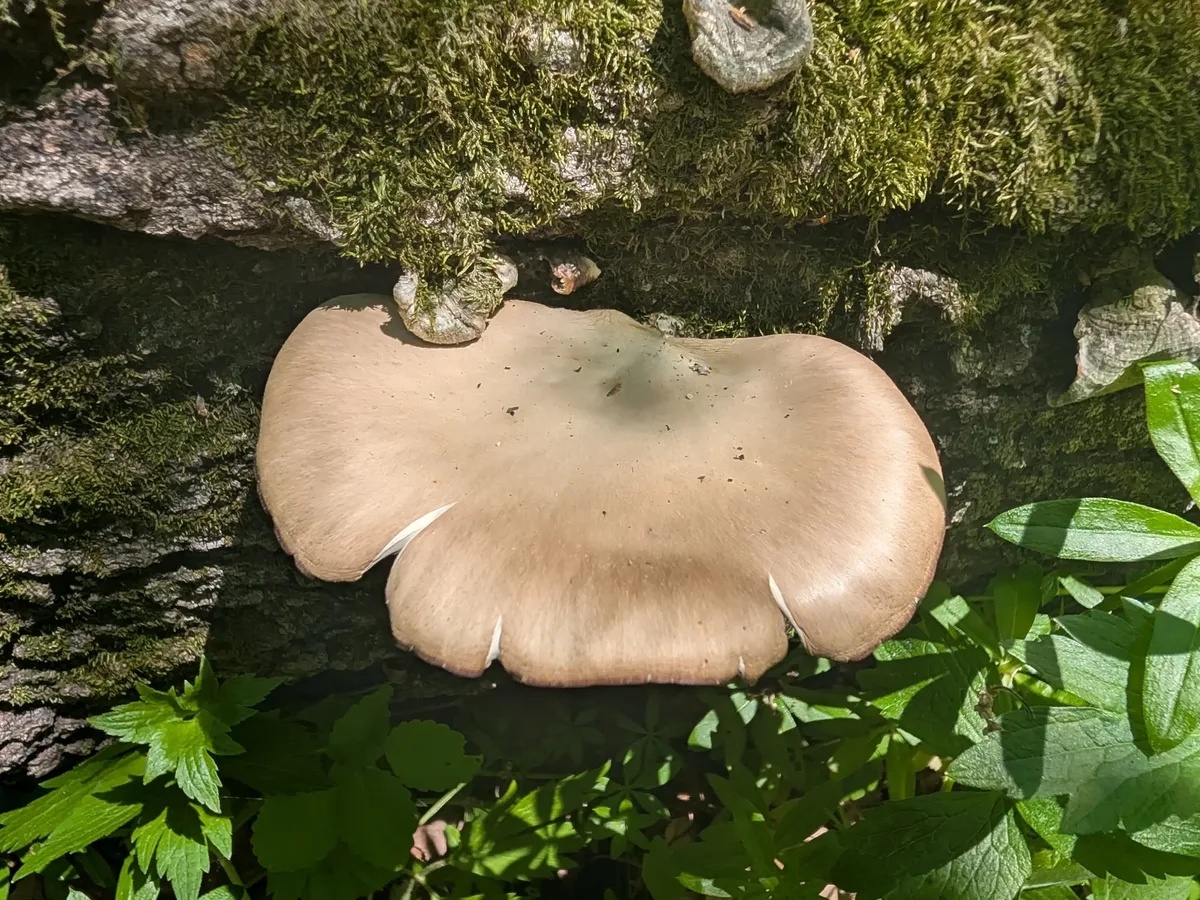 Jason Webb (CC0)
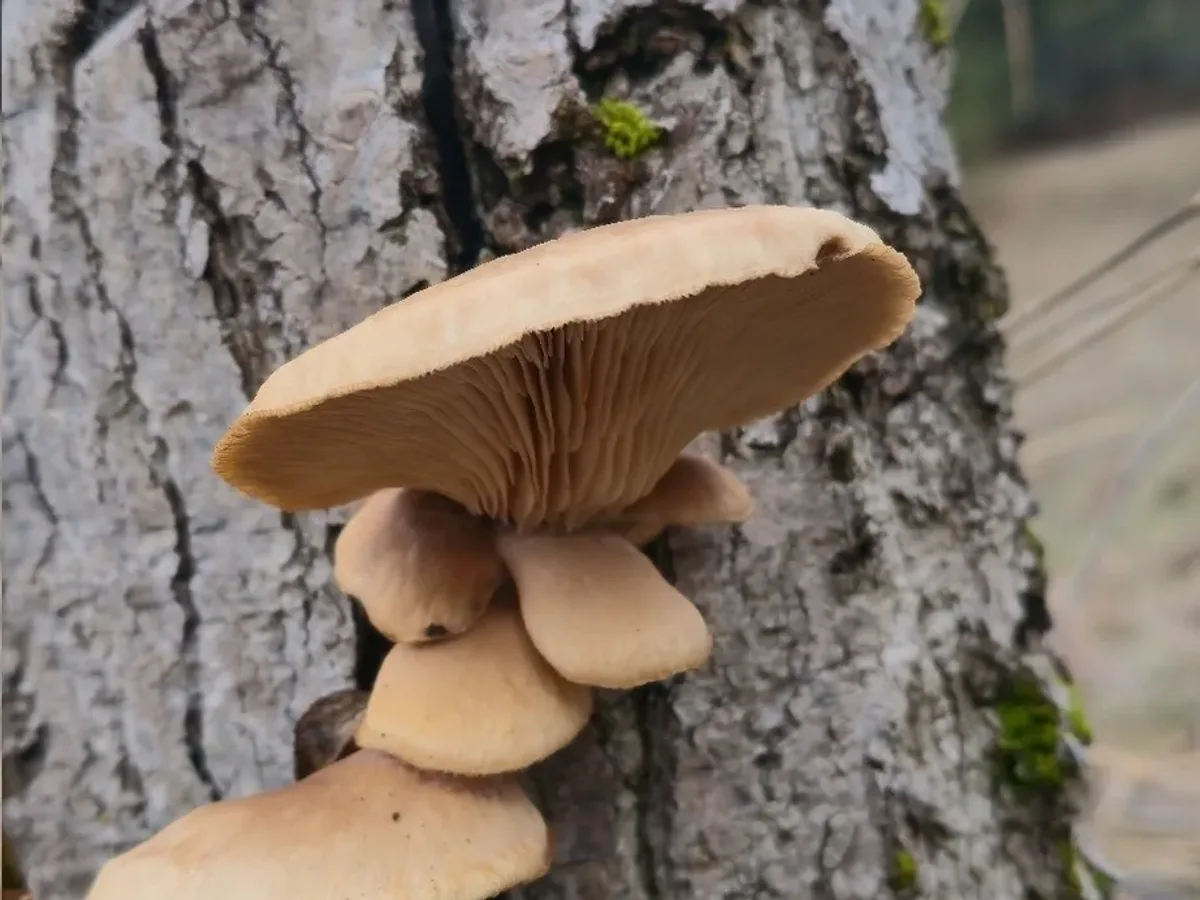 Leanne Stacy Reitan (CC0)
 Leanne Stacy Reitan (CC0)
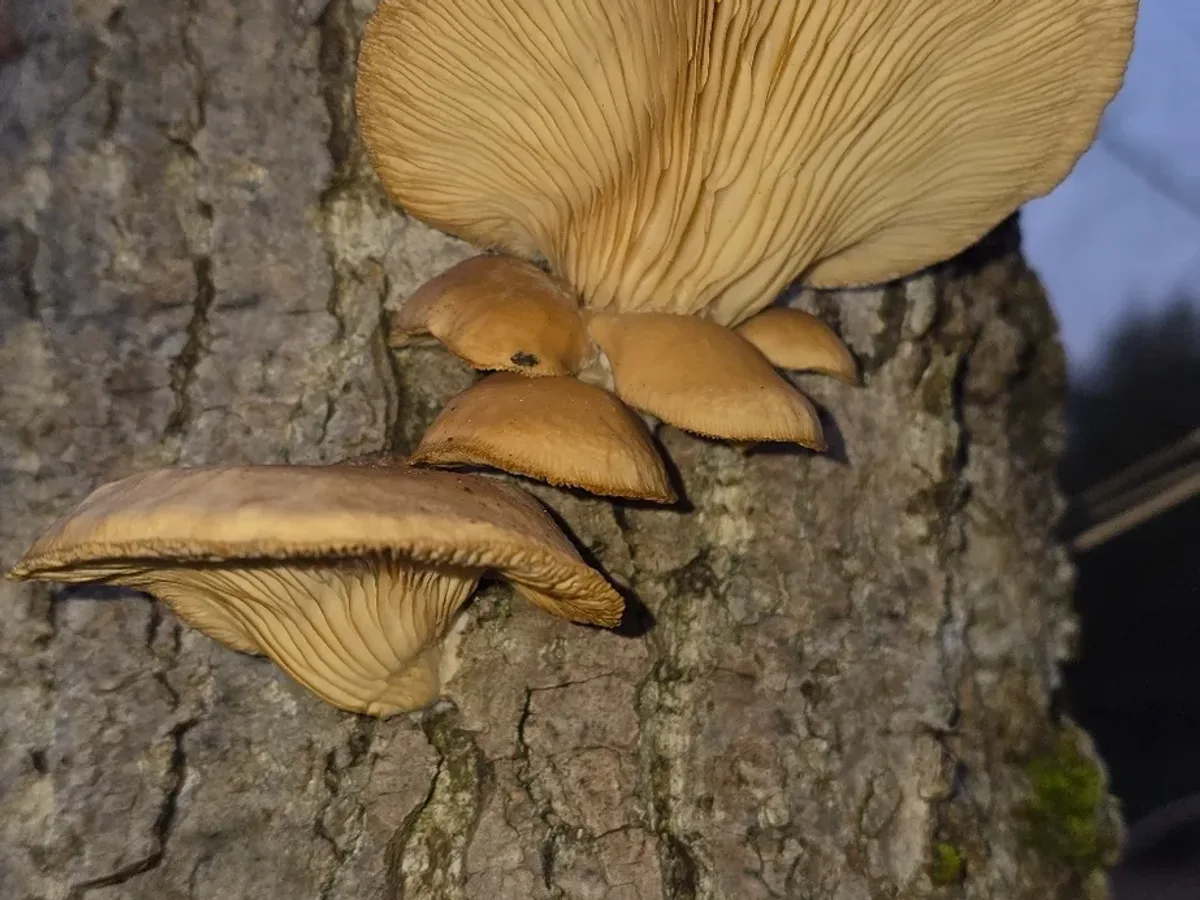 Leanne Stacy Reitan (CC0)
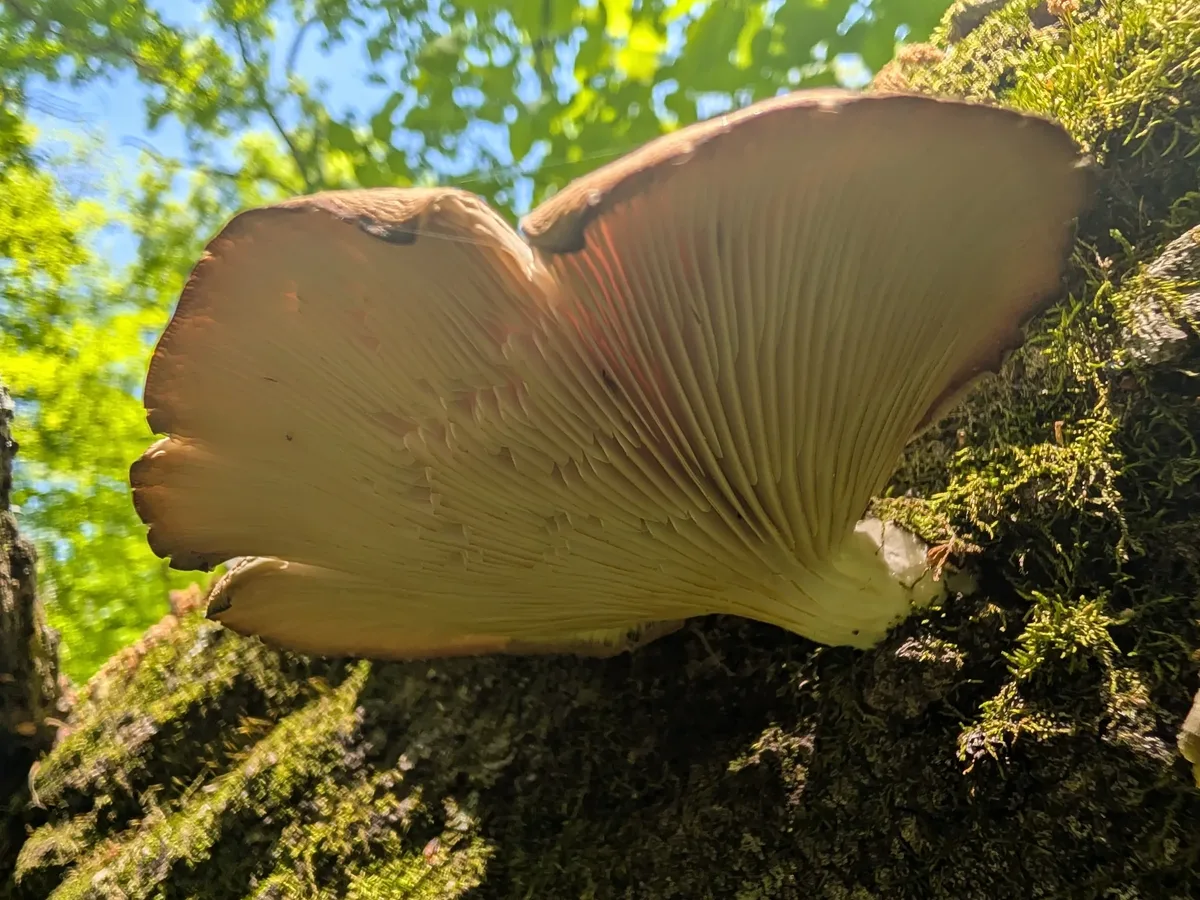 Jason Webb (CC0)
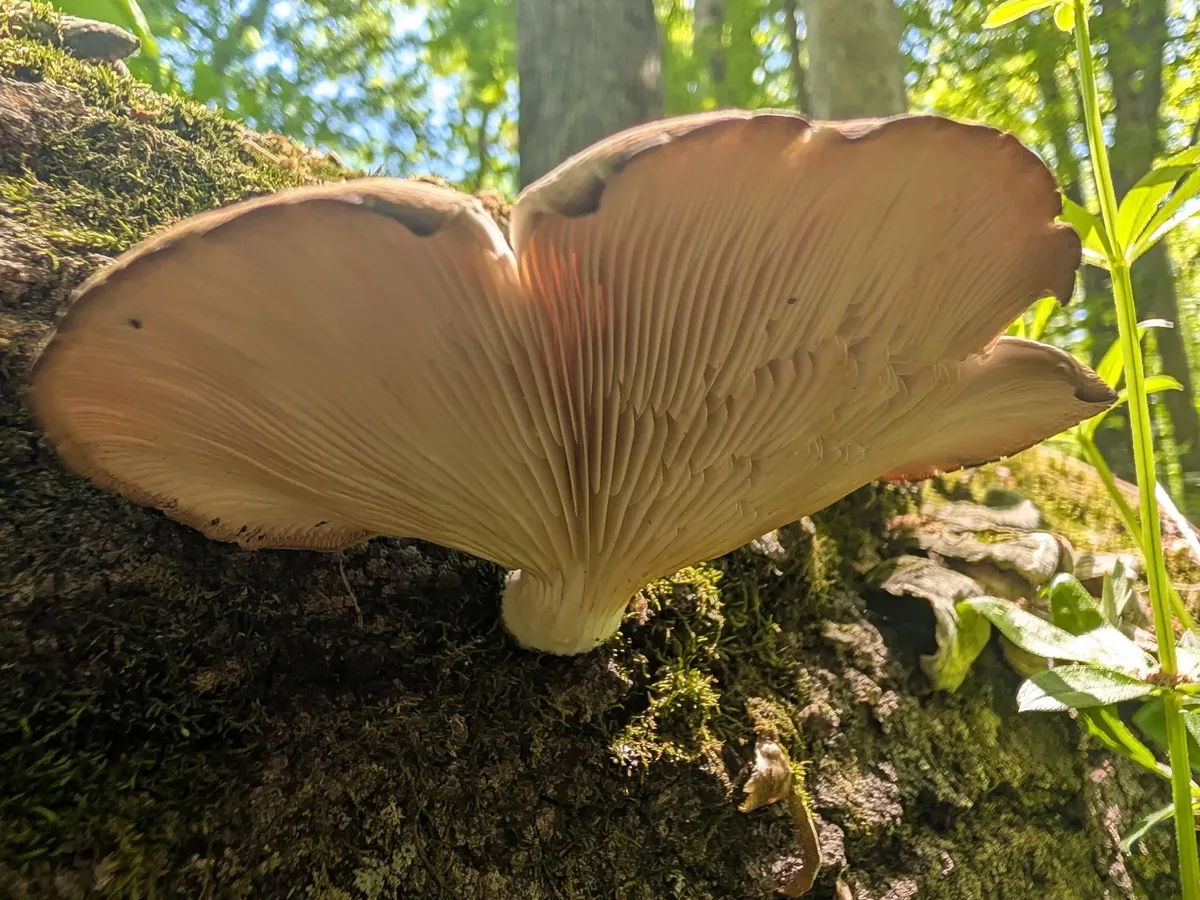 Jason Webb (CC0)
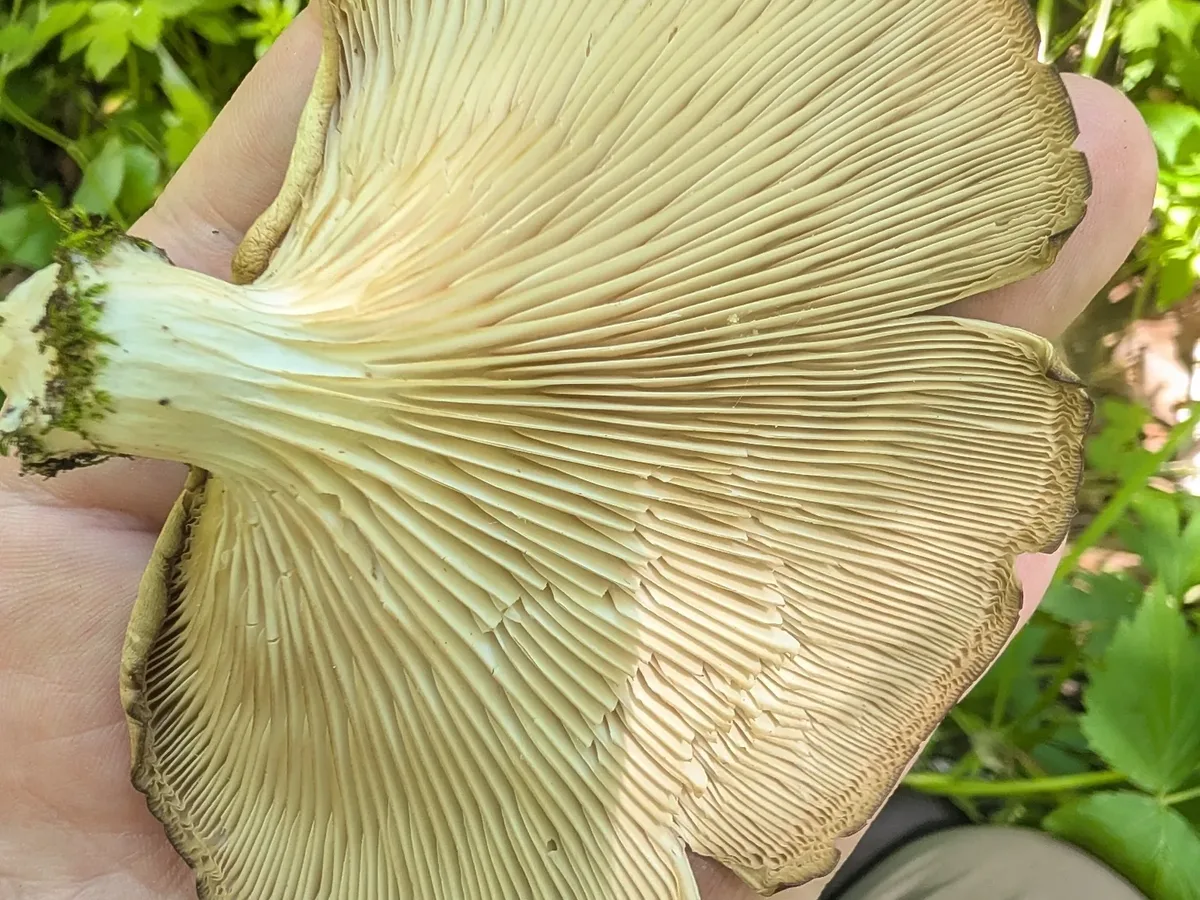 Jason Webb (CC0)Jason Webb (CC0)Leanne Stacy Reitan (CC0)
Good to eat, once you have identified it with certainty and cooked it through.
Never eat a mushroom you are not 100% sure of - check the look-alikes below, and always cook wild mushrooms.
How to recognise it
Fruiting bodies appear in dense overlapping clusters that can be spectacular in size. Fresh young caps have a clean appearance very similar to the common oyster mushroom (P. ostreatus), from which P. populinus was formally separated only in 2002.
Cap
Fan- to shell-shaped, 5-20 cm across. The upper surface is white to pale grey or cream, sometimes with a subtle yellowish tint in young buttons, ageing to pale buff. Smooth and slightly moist but not slimy.
Gills
White, crowded, and decurrent: they run clearly down the short off-centre or lateral stem rather than ending abruptly at it - a key structural feature shared across the oyster group.
Stem
1-4 cm long, white, firm, and often so short or laterally placed that the cap seems to project directly from the wood.
Flesh
White throughout, firm, and smells mildly pleasant with a faint mealy note. The spore print is pale lilac-grey to white.
Where & when it grows
Habitat
This species is a strict specialist of aspen and poplar. In eastern and central North America it is most often found on trembling aspen (Populus tremuloides), balsam poplar (P. balsamifera), and bigtooth aspen (P. grandidentata).
It grows on fallen trunks, large downed limbs, weathered stumps, and the base of standing snags, especially fire-killed or storm-damaged trees.
Because aspen regenerates abundantly after disturbance, post-fire and post-harvest forest edges are productive hunting grounds.
The fungus fruits from the wood itself (not from soil), so look for clusters emerging from bark cracks or exposed wood surfaces.
Unlike P. ostreatus, it almost never colonises other broadleaved genera in the wild.
When
The fruiting season runs from late spring through late autumn - roughly May to November across eastern North America.
The main flush peaks in late August through October, when cooling temperatures and autumn rains coax the largest and most reliable crops.
A secondary, smaller spring flush is possible in May-June as nights drop back toward 5-10 degrees C after warmer days.
Flushes are triggered by rain (ideally 20-40 mm over two weeks) following drier spells, combined with daytime air temperatures of 8-18 degrees C.
Because P. populinus handles near-freezing nights without complaint, it lingers in the forest long after most mushrooms have finished - a welcome find on a cold November walk through aspen stands.
How it grows
Pleurotus populinus is a saprotrophic white-rot fungus. Its mycelium colonises and breaks down lignin and cellulose in aspen and poplar wood, recycling nutrients back to the forest floor.
The same mycelial mat can produce multiple successive flushes from the same log over several years as the wood decays.
Like other Pleurotus species, the mycelium can also trap and consume nematodes as a supplementary nitrogen source, a remarkable predatory adaptation in an otherwise wood-decaying organism.
Fruiting begins once mycelial colonisation of the wood is well advanced. Established logs colonised for a season or two often yield the largest and most reliable harvests.
Fruiting conditions
Cool-weather oyster; flushes triggered by 20+ mm rain over 14 days when air temperatures are 8-18 degrees C. Main flush late August to October. Secondary spring flush possible May-June. Tolerates near-freezing nights and can persist into November.
Look-alikes
Pleurotus populinus is most likely confused with the common oyster mushroom (Pleurotus ostreatus), with which it was lumped until 2002. The two are essentially identical in appearance; reliable separation requires microscopy or host-tree context.
P. populinus grows almost exclusively on aspen and poplar, while P. ostreatus favours beech, oak, elm, and other broadleaves. Both are choice edibles, so the practical risk of mixing them is zero.
The elm oyster (Hypsizygus ulmarius) also grows on hardwood snags and can resemble Pleurotus, but has a more central stem, tighter gills that do not fully decurrent, and typically a spotted or watermarked cap.
The jack-o-lantern (Omphalotus illudens) is poisonous and superficially resembles oyster mushrooms to beginners. However it is vivid orange throughout, grows in clusters from oak or elm roots at ground level (not on aspen snags above the ground), and gills glow faintly in complete darkness.
Angel wings (Pleurocybella porrigens) are small (1-6 cm), thin-fleshed, and wafer-like, and grow exclusively on conifer wood (fir, spruce, pine) - a completely different substrate and size class from P. populinus.
Field confusion is implausible given the non-overlapping hosts. As a structural check, Pleurocybella fruitbodies lack a stem and have a distinctly thin, translucent cap margin unlike the firm flesh of Pleurotus.
Field confusion with P. populinus is implausible: P. porrigens grows exclusively on conifer wood (fir, spruce, pine) and is tiny (1-6 cm), thin-fleshed, and wafer-like, while P. populinus grows only on aspen and poplar and produces large, fleshy, shelf-like clusters (5-20 cm). The substrates and size classes do not overlap. As a genus-level structural check, Pleurocybella fruitbodies lack any stem and have a distinctly thin, translucent cap margin, unlike the firm flesh of Pleurotus. Toxic incidents with P. porrigens have occurred only in patients with severe pre-existing renal impairment consuming large quantities - not representative of normal foraging exposure.
Virtually identical in appearance; best distinguished by host tree. P. ostreatus favours beech, oak, and elm, not aspen or poplar. Reliable separation requires microscopy. Both are edible, so confusion carries no safety risk.
Also edible. Grows on elm and maple, not aspen. Cap more rounded and may have a watermarked appearance, stem more central, gills do not fully decurrent. Typically solitary or in small groups rather than dense overlapping shelves.
Poisonous, causes severe gastrointestinal illness. Vivid orange throughout: cap, gills, and stem all orange. Grows in clusters at the base of oaks or from buried oak roots at ground level, not on aspen snags. Gills glow faintly in complete darkness.
Edible. Paler and typically smaller-capped than P. ostreatus with a slightly more central stem; prefers warmer summer temperatures and grows on a wider range of hardwoods. Easily confused with P. populinus; both are safe to eat.
In the kitchen
Picking & cleaning
- Harvest young to medium-aged clusters before the cap margins begin to wave and split, which signals over-maturity and spore release.
- Cut the cluster cleanly at the base with a knife rather than tearing, to leave the remaining mycelium intact for future flushes.
- Shake or gently brush the cluster to dislodge insects, as the gill cavities of older specimens often harbour beetles and fly larvae.
- Very large clusters can be separated into individual caps for easier transport.
Firm, small-to-medium caps (5-12 cm) are best for eating; very large old caps become tough and fibrous.
Cooking
The flavour is mild and pleasant, similar to common oyster mushroom - slightly earthy with a delicate sweetness. Texture is firm when young, becoming silky-soft on cooking.
Best methods:
- Saute in butter or oil over medium-high heat until golden, then add garlic, thyme, and a splash of white wine.
- Also excellent in risottos, pasta, Asian stir-fries, and soups.
- Large firm caps can be grilled or pan-seared whole.
- Pairs well with leeks, cream, parmesan, and bacon.
- Dries reasonably well and can be reconstituted in warm stock.
Good to know
Pleurotus populinus is a safe, reliable edible with no known toxic compounds.
Like all Pleurotus species it should be cooked before eating, as raw oyster mushrooms contain lectins that can cause mild digestive discomfort in some individuals.
The species is not commercially cultivated at the scale of P. ostreatus but is an excellent wild food.
Always confirm identification on multiple characters:
- shelf habit on aspen or poplar wood
- white decurrent gills
- pale lilac-grey spore print
- white firm flesh with no colour change when cut
Never eat on the basis of a single character.
A reference guide - never an edibility guarantee. When in doubt, leave it out.