Abalone Oyster Mushroom
Pleurotus cystidiosussyn. Pleurotus abalonus, Pleurotus cystidiosus var. formosensis, Hohenbuehelia cystidiosa
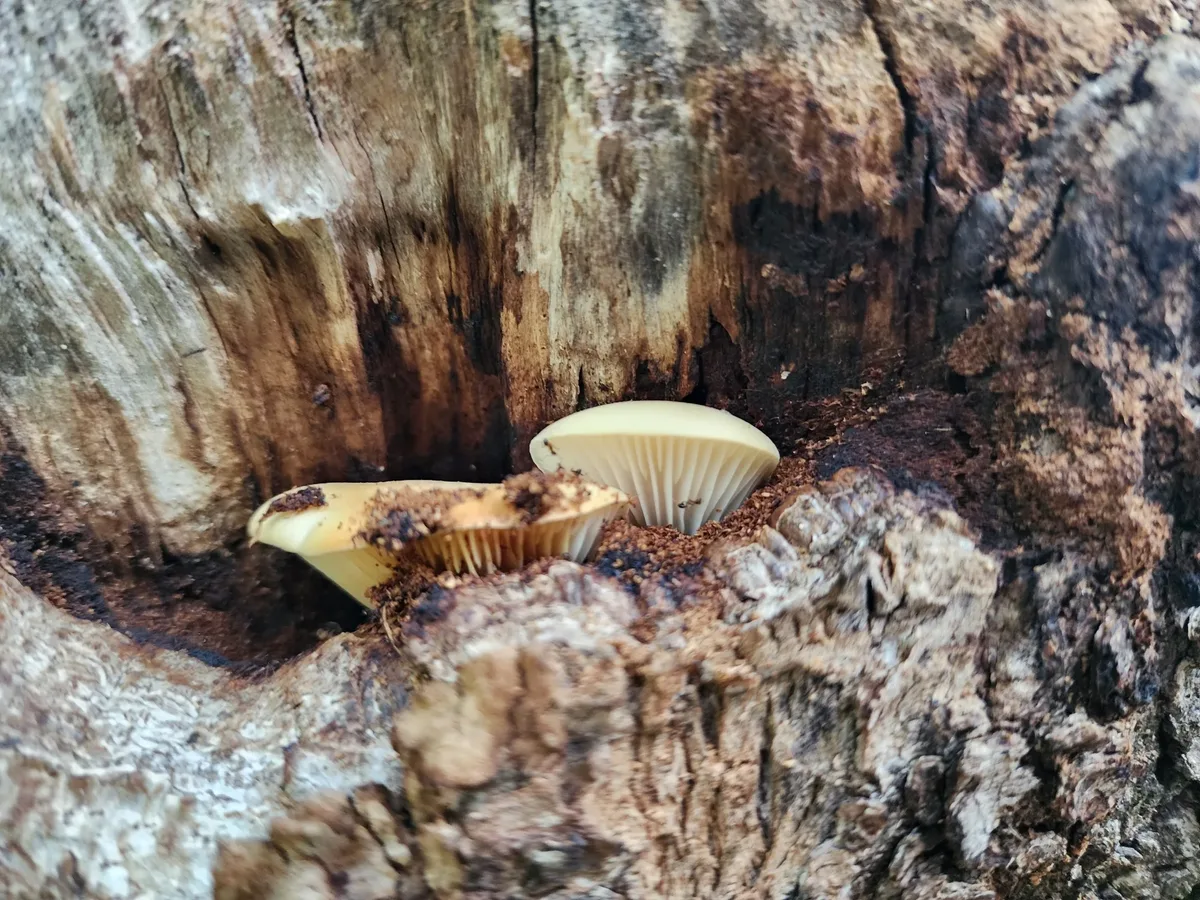 © Benjamin Tomerlin (CC BY)
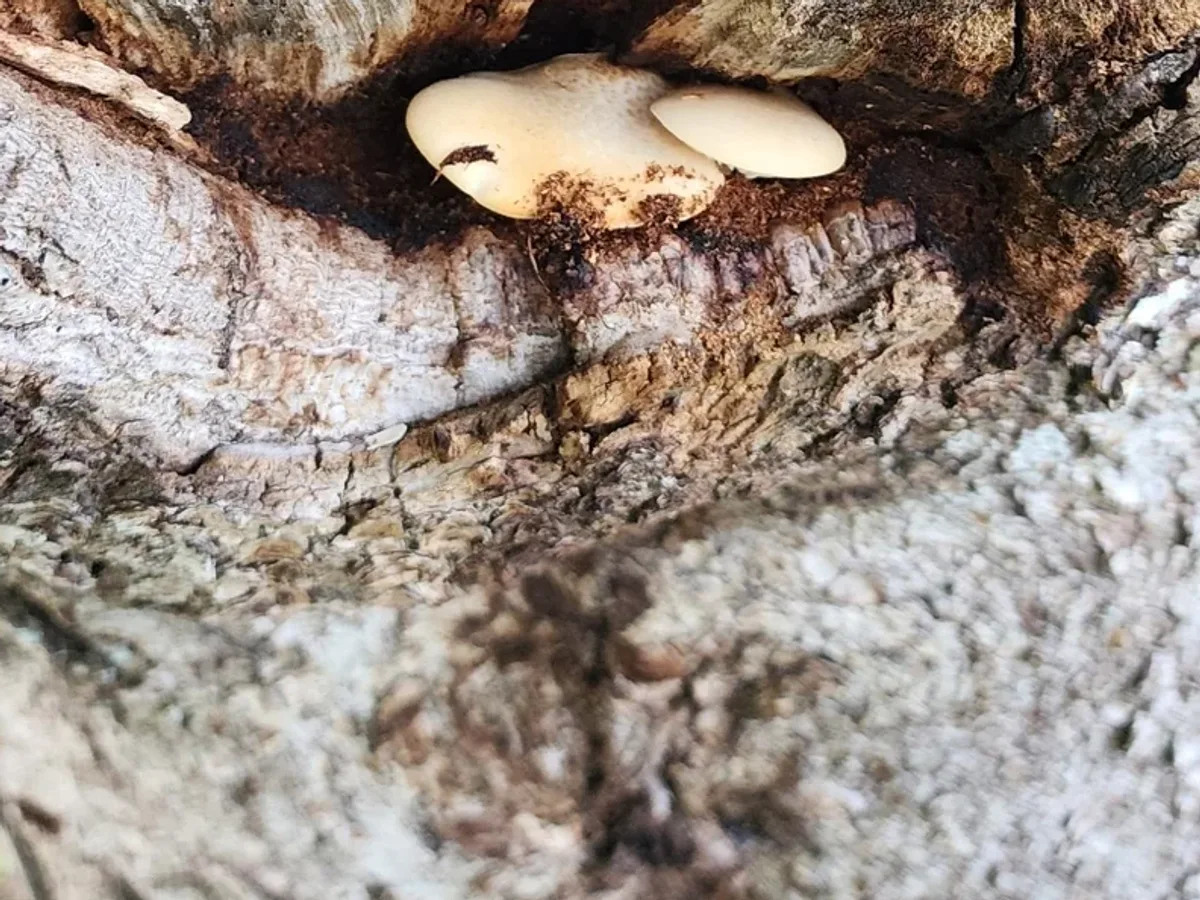 © Benjamin Tomerlin (CC BY)
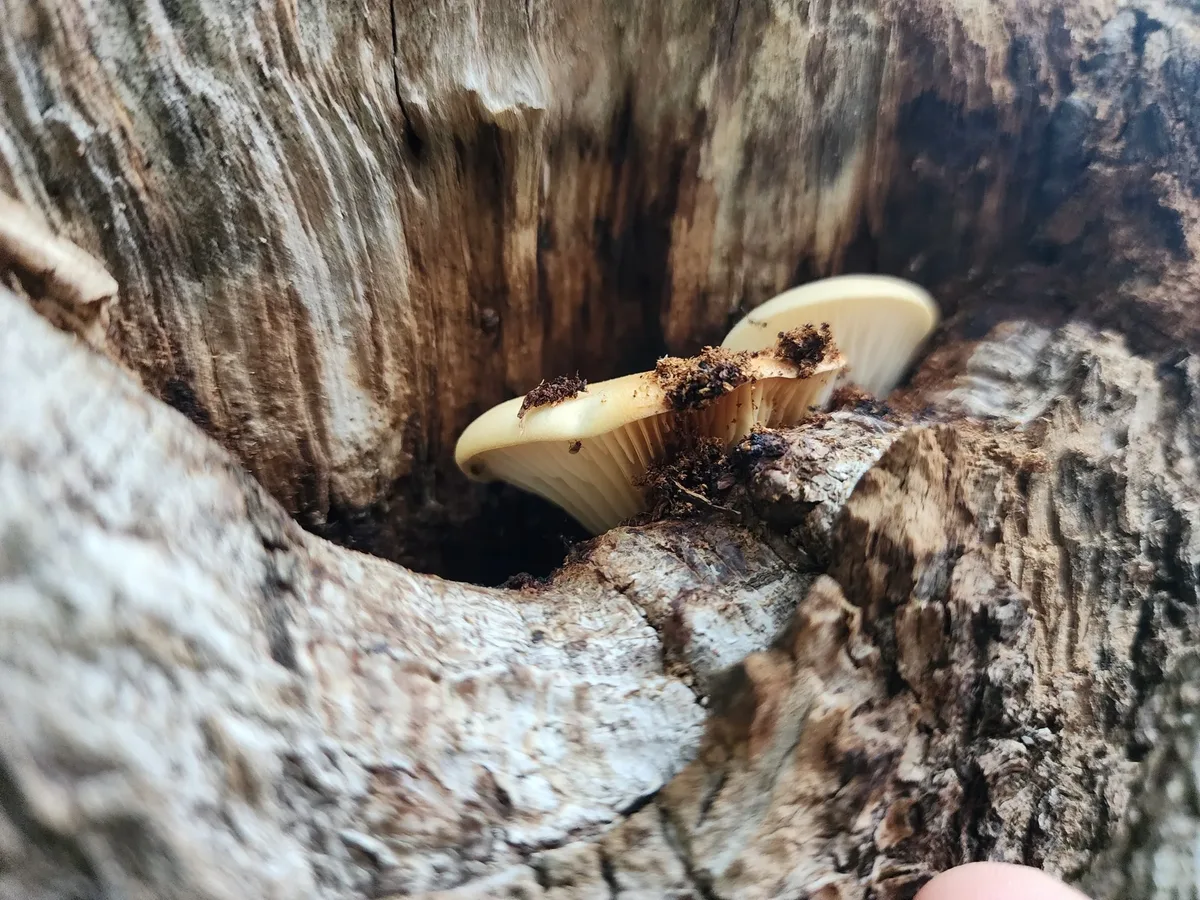 © Benjamin Tomerlin (CC BY)© Benjamin Tomerlin (CC BY)© Benjamin Tomerlin (CC BY)
One of the best mushrooms you can bring home - once you are certain of the identification.
How to recognise it
Pleurotus cystidiosus is the firmest and meatiest of the commonly encountered oyster mushrooms, and this physical character translates directly to a useful field marker: the caps feel substantially thicker and more substantial in the hand than P. ostreatus or P. djamor of similar diameter.
Cap
The fan-shaped caps, 5-20 cm across, are grey-brown to sepia with an almost suede-like matte surface texture - a consequence of the abundant thick-walled cystidia that stud the cap surface and gill edges.
This velvety matt surface, combined with brownish-grey rather than pale grey or white colouration, separates it readily from the commoner Grey Oyster (P. ostreatus) in the field.
Gills
The gills are white to cream, crowded, and run well down the short stubby stem.
Flesh
Cut through the cap and the flesh is white, springy, and dense - much more so than other oyster mushrooms - earning the cultivated form the market name 'abalone mushroom' for its resemblance in texture and visual profile to the shellfish.
The spore print is white to faintly lilac-white. There is no ring, no volva, and no partial veil of any kind.
Where & when it grows
Habitat
Pleurotus cystidiosus is a white-rot wood decomposer of tropical and subtropical hardwood forests.
In Australia it is primarily a species of tropical Queensland and the Northern Territory, found on dead or dying logs and large stumps of a broad range of native hardwoods - particularly in moister monsoon vine forest, riparian vegetation, and coastal scrub. It also appears on introduced hardwoods in parks and gardens.
In New Zealand it is recorded from Raoul Island in the Kermadec chain - a sub-tropical volcanic island - rather than the main islands of NZ.
The ecological role is straightforward: the mycelium colonises dead woody tissue, secretes ligninases and cellulases, and converts the wood to a white, bleached, fibrous rot (white rot). A log that has been colonised may produce multiple flushes over one or more seasons as the mycelium continues to work through available substrate.
When
In its natural tropical range, fruiting is linked to rain and warmth rather than cool-temperate seasonality.
In northern Australia the primary flush follows the onset of the monsoon wet season (November-April), with secondary flushes possible after significant autumn rainfall.
In subtropical Queensland fruiting peaks from late summer through autumn, broadly February through May, and again after any period of sustained autumn rain that follows summer heat.
The species needs substrate and air temperatures above about 18 °C and sustained high humidity; it will not fruit in Melbourne-style cool winters or in southern New Zealand. In cultivation the optimum fruiting temperature is 20-28 °C with humidity above 80 % RH.
How it grows
As a saprotrophic white-rot fungus, P. cystidiosus does not require a living tree host - it colonises dead or partially dead woody substrate, breaking down the lignocellulose matrix to access carbon.
The mycelium grows through wood actively, digesting cellulose and hemicellulose while partially preserving lignin (white rot), leaving the wood pale and fibrous.
Fruiting bodies emerge in response to high humidity, following a period of mycelial growth and substrate conditioning. Unlike some Pleurotus species that produce enormous tiered clusters, P. cystidiosus tends to produce smaller groups of 1-6 caps from a shared base, or occasionally solitary caps.
Under cultivation the species is slightly slower to colonise substrate than P. ostreatus but produces a superior commercial product - the thick firm flesh holds up well in transit, extending shelf life. Multiple flushes are produced from a colonised block over four to six weeks.
Fruiting conditions
Fruiting is triggered by sustained warm temperatures (above 18 °C, optimum 22-28 °C) combined with high humidity or rainfall events that keep the woody substrate and surrounding air moist. A rain event of 25+ mm over 14 days, followed by continued warm humid conditions, typically produces visible fruiting bodies within 5-14 days. Unlike temperate oyster mushrooms, this species does not require a cold-shock trigger; a drop in temperature below ~15 °C inhibits rather than stimulates fruiting. In tropical northern Australia the wet-season monsoon onset provides ideal continuous fruiting conditions; in subtropical areas fruiting is episodic and follows significant rain events during the warmer months.
Look-alikes
The realistic confusions for P. cystidiosus are all with other wood-rotting shelf-forming fungi rather than with deadly species, which considerably lowers the safety risk relative to many foraged mushrooms.
The closest lookalikes are:
- Pleurotus ostreatus (Grey Oyster) - the most likely confusion; grows in similar habit on hardwood in overlapping subtropical zones and in cultivation. Cap typically paler (grey, slate, or white to buff) and smoother (less matte/velvety), flesh thinner, overall more delicate. Edible and choice; confusion results in eating another excellent mushroom.
- Pleurotus pulmonarius (Indian Oyster / Phoenix Oyster) - very similar in appearance and habitat; cap pale grey to whitish, generally thinner-fleshed. Edible. The two species are frequently confused even in commercial cultivation. The distinction is largely academic from a safety standpoint as both are fine edible species.
- Pleurotus djamor (Pink Oyster) - in tropical zones; distinguished by vivid pink colouration when fresh (fading to buff with age). Edible.
- Ganoderma species (Bracket fungi) - persistent, hard, woody brackets that lack gills entirely (pore surface beneath) and have a varnished-looking ochre-red to dark brown upper surface. Not edible. The absence of gills and the hard corky texture immediately distinguish them.
- Lentinus sajor-caju (Sajor-caju mushroom) and related tropical Lentinus species - fan-shaped or funnel-shaped caps on wood in tropical forests; distinguished from P. cystidiosus by serrated or toothed gill edges, tougher leathery flesh, and typically a central or nearly central stem. Not deadly.
- Omphalotus nidiformis (Ghost Fungus, Australia) - the only genuinely dangerous Australian confusion risk. Ghost fungus is a bioluminescent oyster-like species on wood in southern Australia, most common in southeastern states. It is whitish to cream, fan-shaped, grows in clusters on dead wood, and has decurrent gills - superficially pleurotoid in form. It causes severe gastrointestinal poisoning (vomiting, cramping, diarrhoea) but is not lethal. Importantly, ghost fungus is not recorded in tropical northern Australia where P. cystidiosus is primarily found, and the two species have only limited geographic overlap.
Key distinctions for ghost fungus:
- it glows blue-green in the dark (requires darkness and 5-10 minutes for eye adaptation)
- the gills have a distinctly orange-yellow tinge in fresh specimens
- it grows primarily on Eucalyptus and Casuarina
- it is found in cooler southern Australia
However, because ghost fungus is the one genuinely toxic oyster-like species in the region, it warrants explicit mention: never consume any oyster-like mushroom on Australian wood without first checking in darkness for bioluminescence.
The only genuinely toxic oyster-like species in Australia. White to cream fan-shaped clusters on dead wood, decurrent gills often with an orange-yellow tinge, most common on Eucalyptus and Casuarina in southeastern Australia. The diagnostic test: place a fresh specimen in complete darkness for 5-10 minutes - ghost fungus gills glow blue-green (bioluminescent); Pleurotus species do not glow at all. Geographic separation also helps: ghost fungus is primarily a southern and southeastern Australian species, while P. cystidiosus in the wild occurs in tropical north Queensland and NT. Causes severe gastrointestinal poisoning (vomiting, cramps, diarrhoea lasting 1-3 days) but is not lethal. Never eat any oyster-like mushroom from Australian wood without the darkness bioluminescence test.
Very similar in overall form; distinguished by paler cap (slate-grey, ashy, or whitish rather than grey-brown to sepia), smoother and slightly glossier cap surface (less velvety matte), thinner flesh, and a tendency to grow in larger dense overlapping tiers. Widely grown and fully edible; confusion with P. ostreatus merely results in collecting another excellent edible mushroom.
Very closely related and frequently confused even by commercial growers. Generally paler (whitish to light grey or buff), thinner-fleshed, with a smoother cap. In cultivation the two are largely interchangeable. Both fully edible; distinction from P. cystidiosus is academic from a safety standpoint.
Fan-shaped or funnel-shaped caps on tropical hardwood; distinguished by serrated or finely toothed gill edges (never entire/smooth as in Pleurotus), tougher leathery flesh that becomes fibrous and inedible with age, and a more central to eccentric stem. Not toxic but unpleasant to eat. The toothed gill edges are the key separating character.
Large woody or corky bracket on hardwood stumps and trunks; distinguished instantly by the complete absence of gills - the underside has a cream to tan fine pore surface, not gills. The upper surface is hard, dull brown to dark ochre, sometimes with a pale growing margin. Not edible (indigestibly tough). The pore surface rather than gills makes confusion with any Pleurotus highly unlikely.
In the kitchen
Picking & cleaning
Harvest when the caps are still upturned or only just beginning to flatten, and before the margins start to split or the gill surface shows any yellowing or bruising. At this stage the flesh is at its densest and most flavourful.
The firm, abalone-like texture of P. cystidiosus means that - unlike the more delicate P. ostreatus - even caps that have expanded to full size retain good structural integrity and are worth harvesting.
Twist and detach cleanly from the substrate, or cut near the base of the stem cluster. The thick flesh means the caps keep well in a paper bag in the refrigerator for 3-5 days, longer than most oyster mushrooms.
Always confirm identification before consuming any wild specimen. Ensure all of these are present:
- white gills
- lateral short stem
- white flesh
- absence of ring or volva
- wood substrate
- matt grey-brown cap
Cooking
The defining culinary virtue of Pleurotus cystidiosus is its exceptionally firm, springy flesh - the characteristic that earned it the market name 'abalone mushroom.'
Where other oyster mushrooms can collapse to a silky softness with prolonged heat, P. cystidiosus retains pleasing structural integrity even after extended cooking. This makes it ideal for applications where textural presence matters:
- stir-fries at high heat
- braised dishes
- hot pot
- soups with long simmering times
- a meat substitute in Vietnamese, Chinese, and Japanese preparations
Slice the caps thickly (8-12 mm) to showcase the flesh. Sauté in a very hot dry pan first to drive off moisture and develop colour, then add oil or butter; the Maillard browning produces a rich, almost meaty savouriness.
The flavour is mild, subtly umami, and slightly nutty - less briny than abalone but textually evocative of it. It pairs well with oyster sauce, soy sauce, garlic, ginger, sesame, and any broth-based preparations.
In Taiwanese cuisine it appears in three-cup preparations (sanbei) and braised dishes. It requires more heat and time than thin oyster mushrooms - treat it as you would a meaty portobello rather than a delicate chanterelle.
Good to know
Pleurotus cystidiosus has an excellent safety record as a widely cultivated and consumed commercial mushroom across Asia. There is no documented toxicity in healthy adults when cooked.
As with all Pleurotus species, avoid raw consumption - the raw flesh can cause mild gastrointestinal irritation in some individuals, and thorough cooking eliminates this risk.
The key safety consideration in the Australian wild context is to distinguish P. cystidiosus from Omphalotus nidiformis (Ghost Fungus). If you are collecting oyster-like mushrooms from wood in southern or southeastern Australia, place the fresh specimen in darkness for 5-10 minutes and check for blue-green bioluminescence (ghost fungus glows; oyster mushrooms do not).
Also confirm:
- the absence of a ring or volva
- the white spore print
- the wood substrate
In tropical Queensland and the NT, ghost fungus is not a realistic concern, but collector discipline is always warranted. Never eat any mushroom if any element of the identification is uncertain.
A reference guide - never an edibility guarantee. When in doubt, leave it out.