Golden oyster mushroom
Pleurotus citrinopileatussyn. Dendrosarcus citrinopileatus, Pleurotus cornucopiae var. citrinopileatus
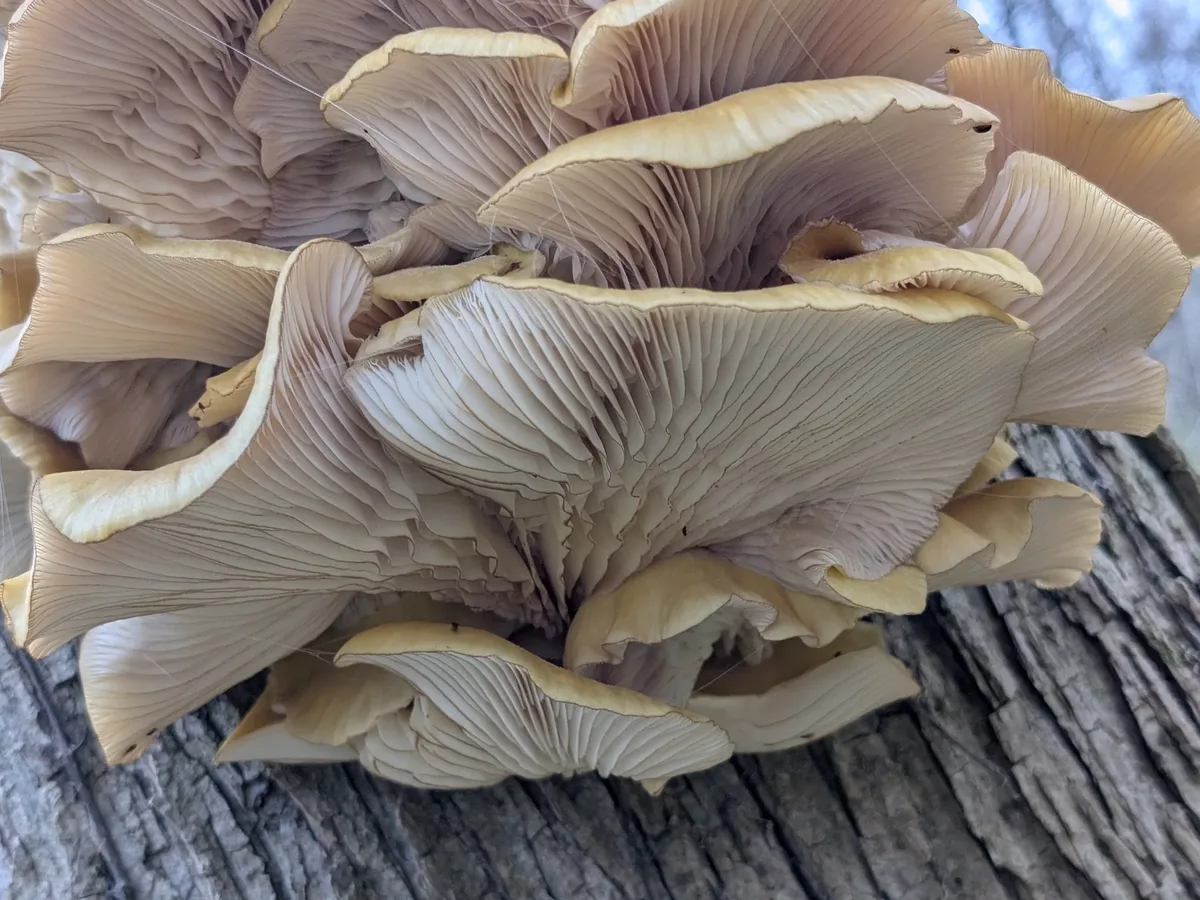 Norveig (CC0)
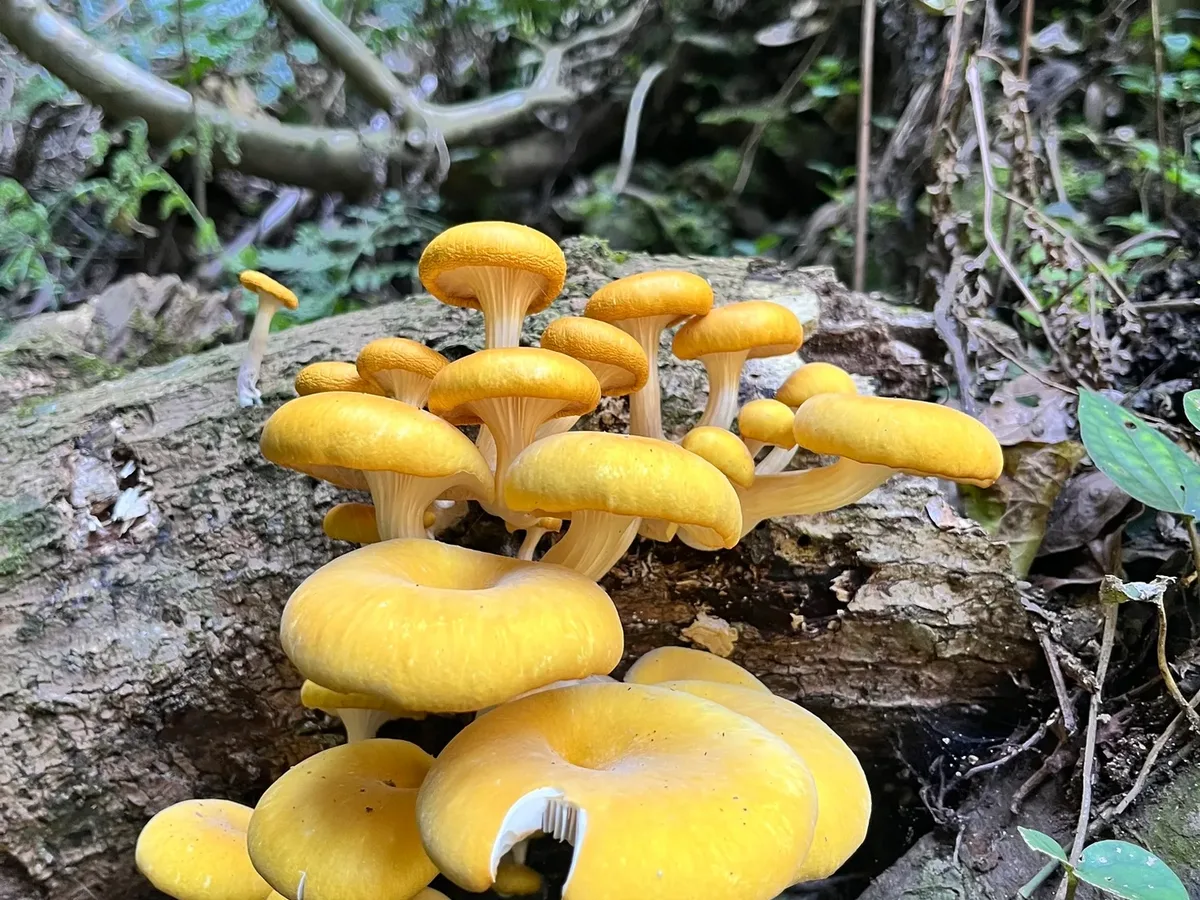 © Hazel Chang (CC BY)
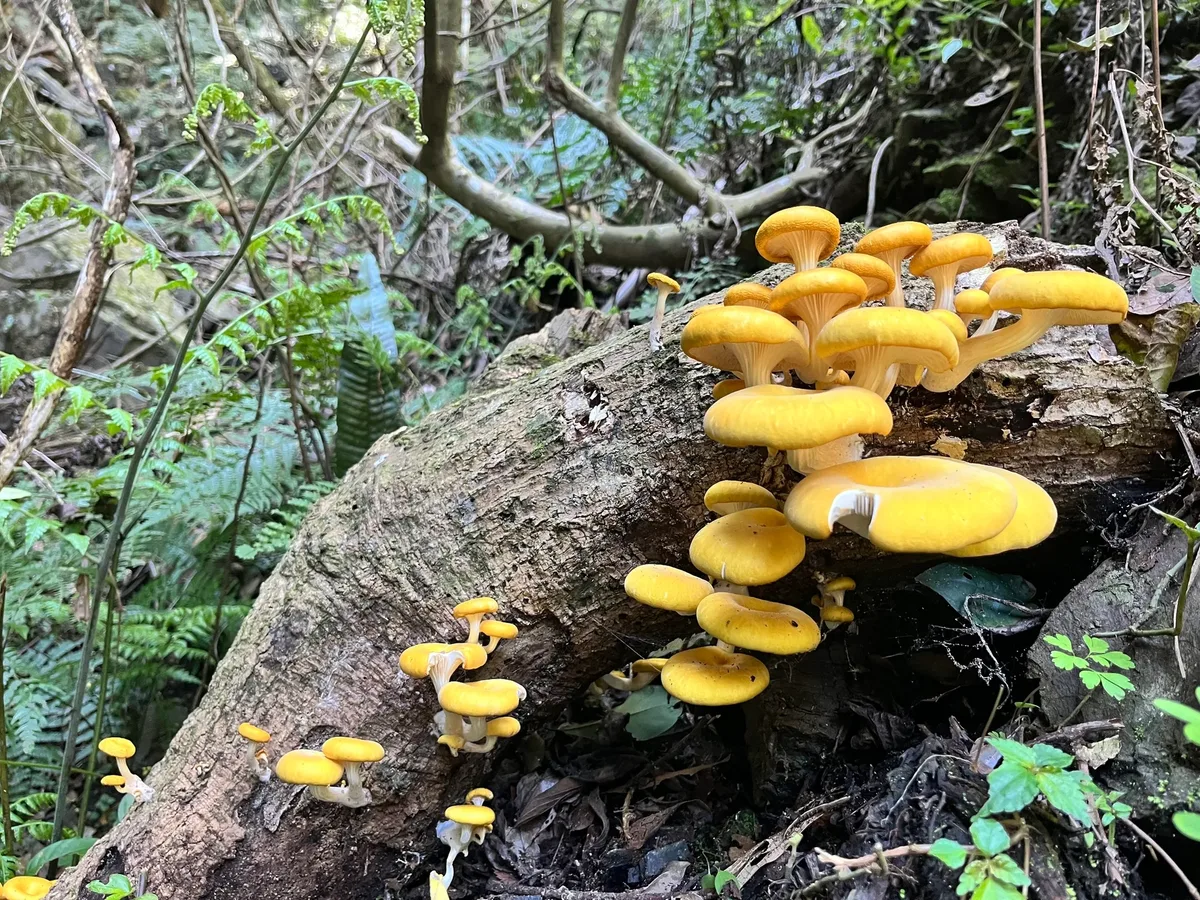 © Hazel Chang (CC BY)
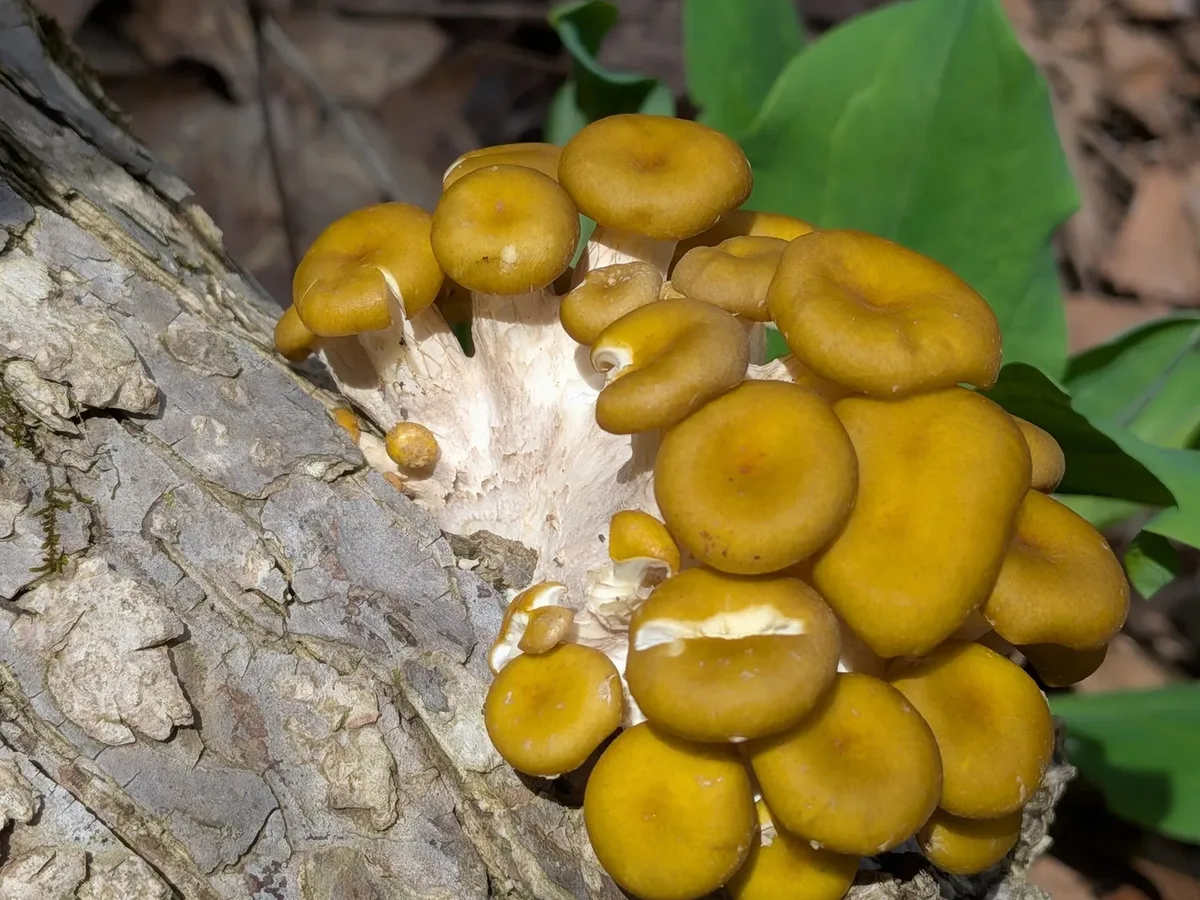 © Michael and Antoni Hinczewski (CC BY)
 © Michael and Antoni Hinczewski (CC BY)
 © Michael and Antoni Hinczewski (CC BY)
 © Kevin (CC BY)
 © Kevin (CC BY)
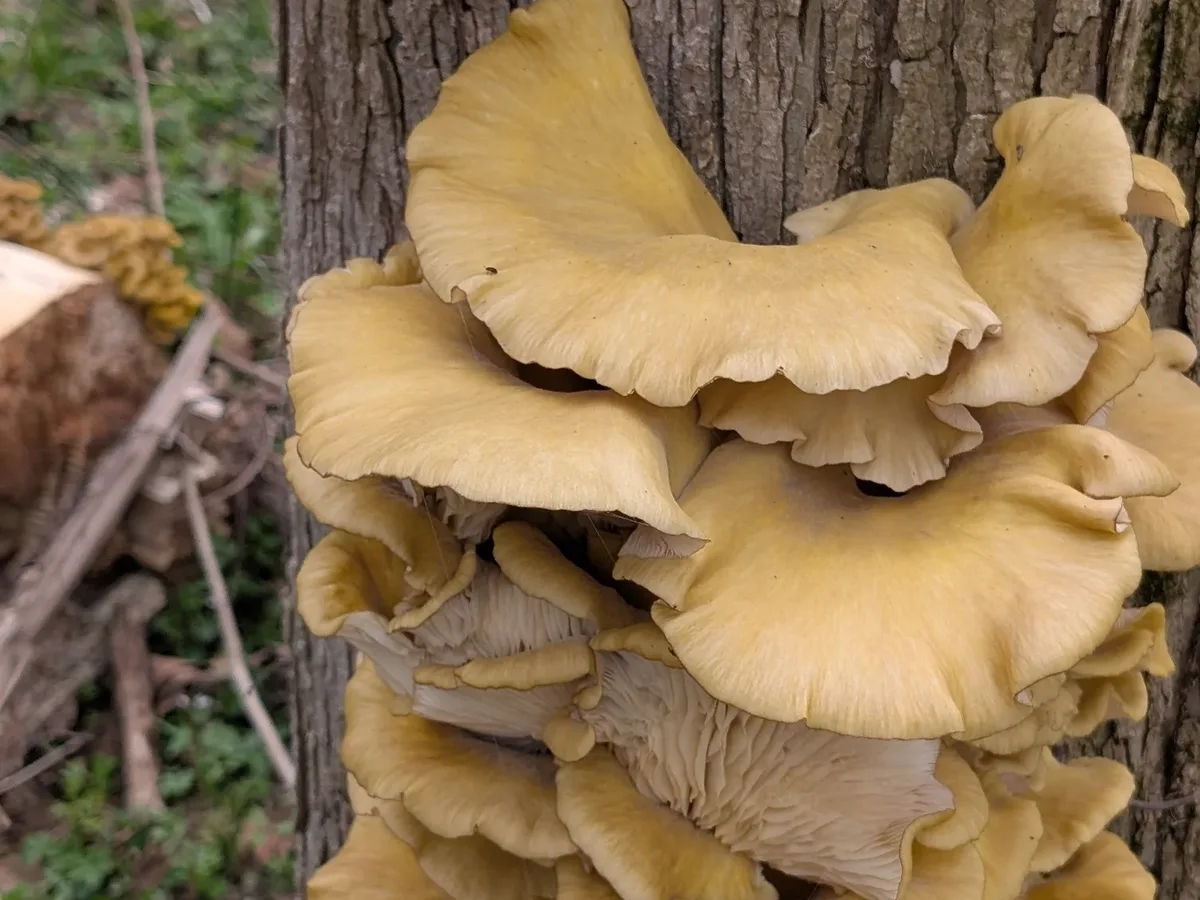 Norveig (CC0)Norveig (CC0)© Hazel Chang (CC BY)
Good to eat, once you have identified it with certainty and cooked it through.
How to recognise it
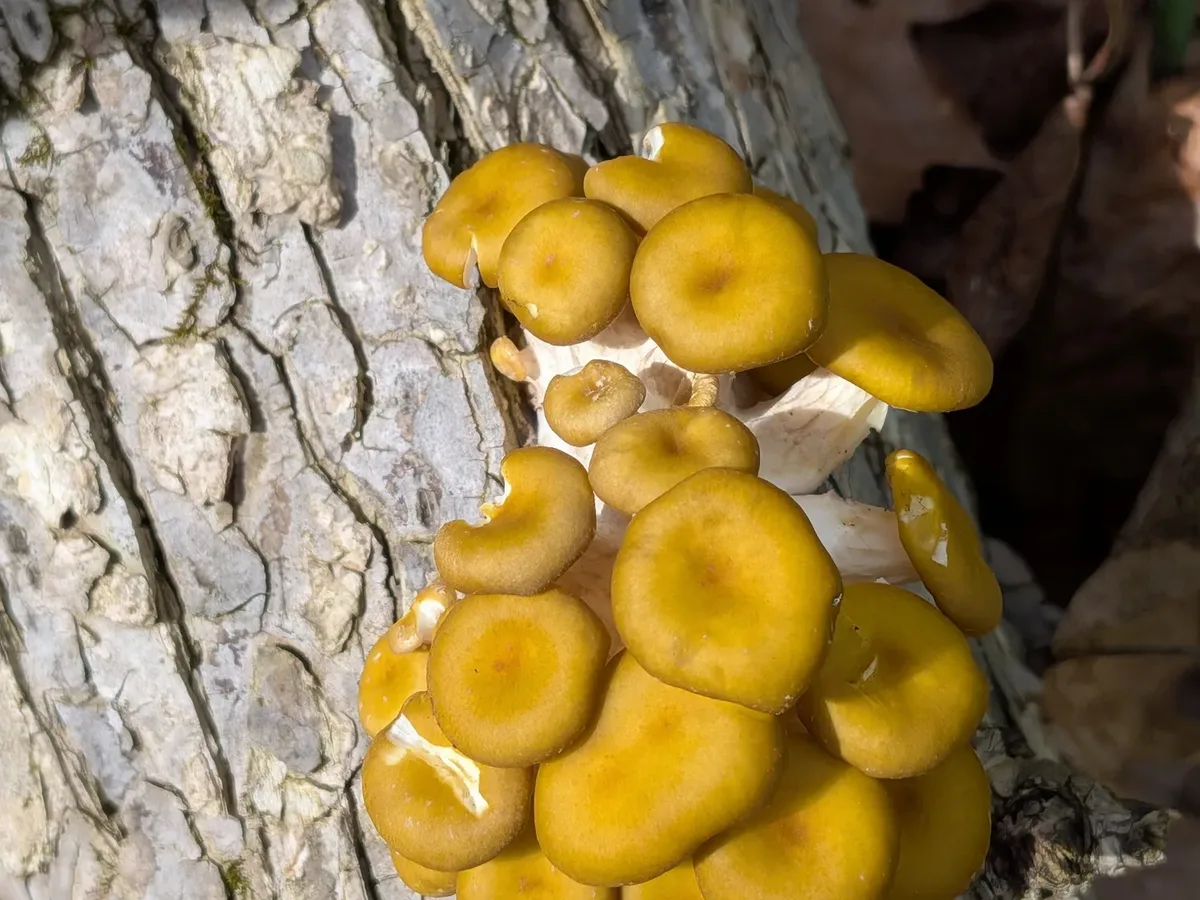
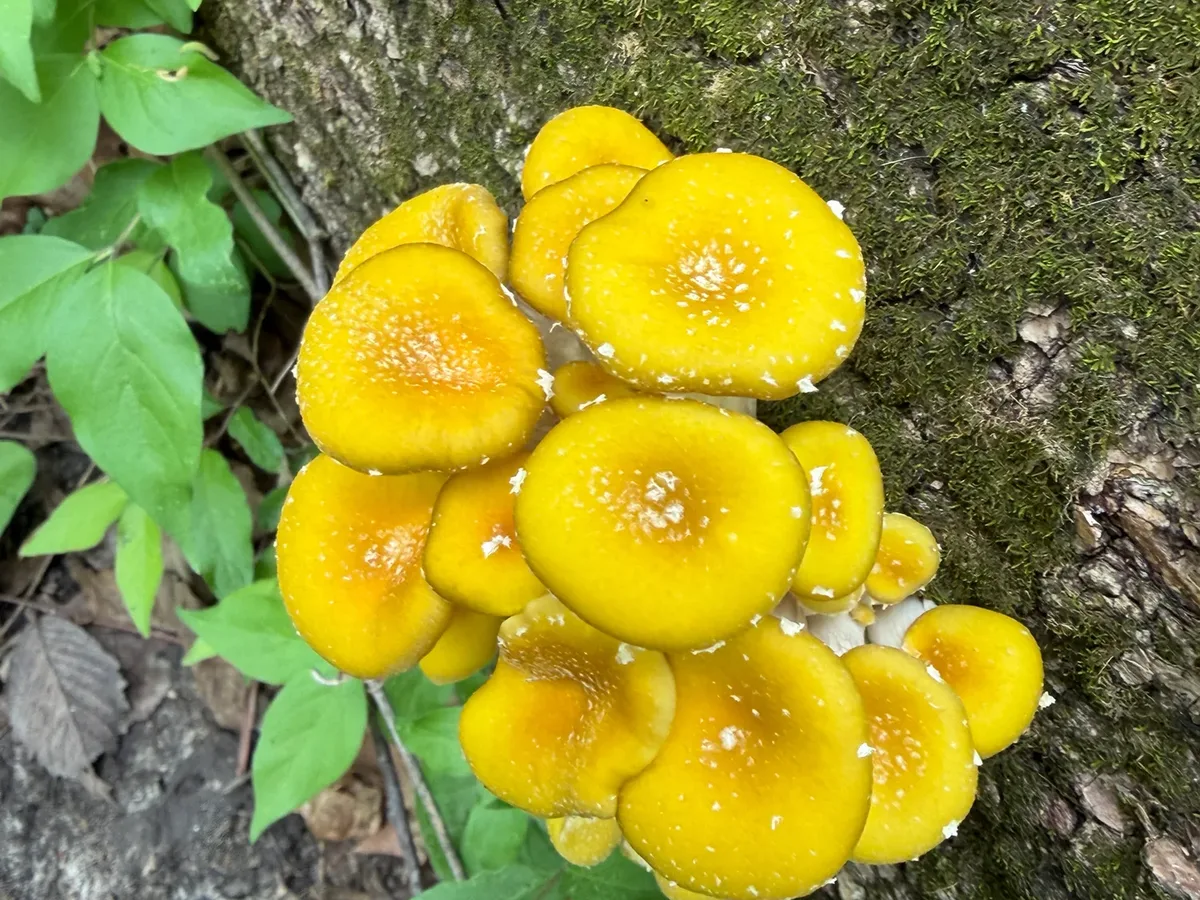
Among edible oyster mushrooms, the golden oyster is the one you won't second-guess on colour: it arrives in egg-yolk to golden-lemon yellow, vivid and consistent across every cap in a cluster.
Cap
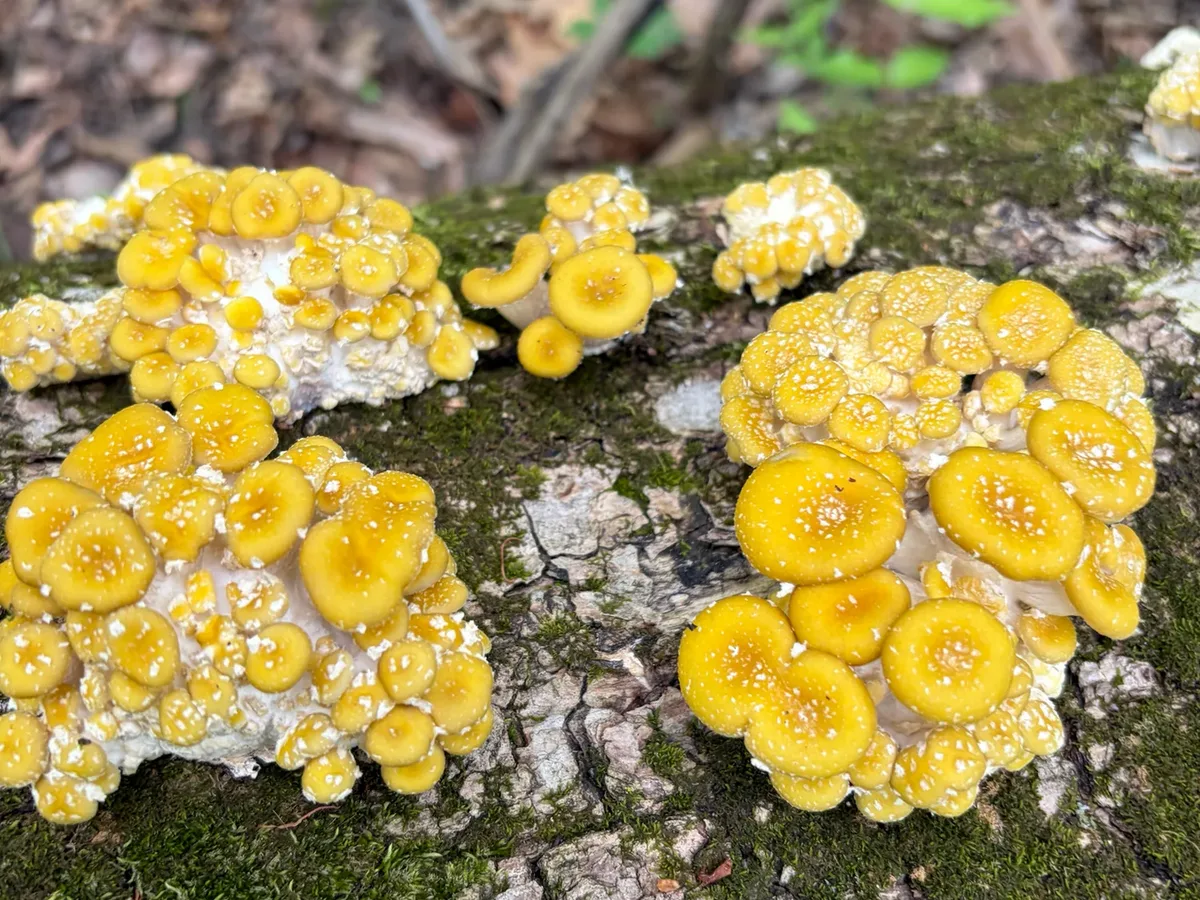
Caps run 3-10 cm across, emerging tightly packed in imbricate rosettes: fan- or bouquet-shaped arrangements of 5-30 or more caps sharing a common base.
Young caps are convex with inrolled margins; as they mature they flatten, wave, and curl at the edges, sometimes splitting or lobing with age.
The surface is smooth and has a subtly satiny sheen even in dry conditions.
Colour stays saturated across the cap, fading only slightly toward the margin in fresh specimens; old or sun-bleached caps retreat to straw-yellow or pale cream, which can muddy identification.
Gills
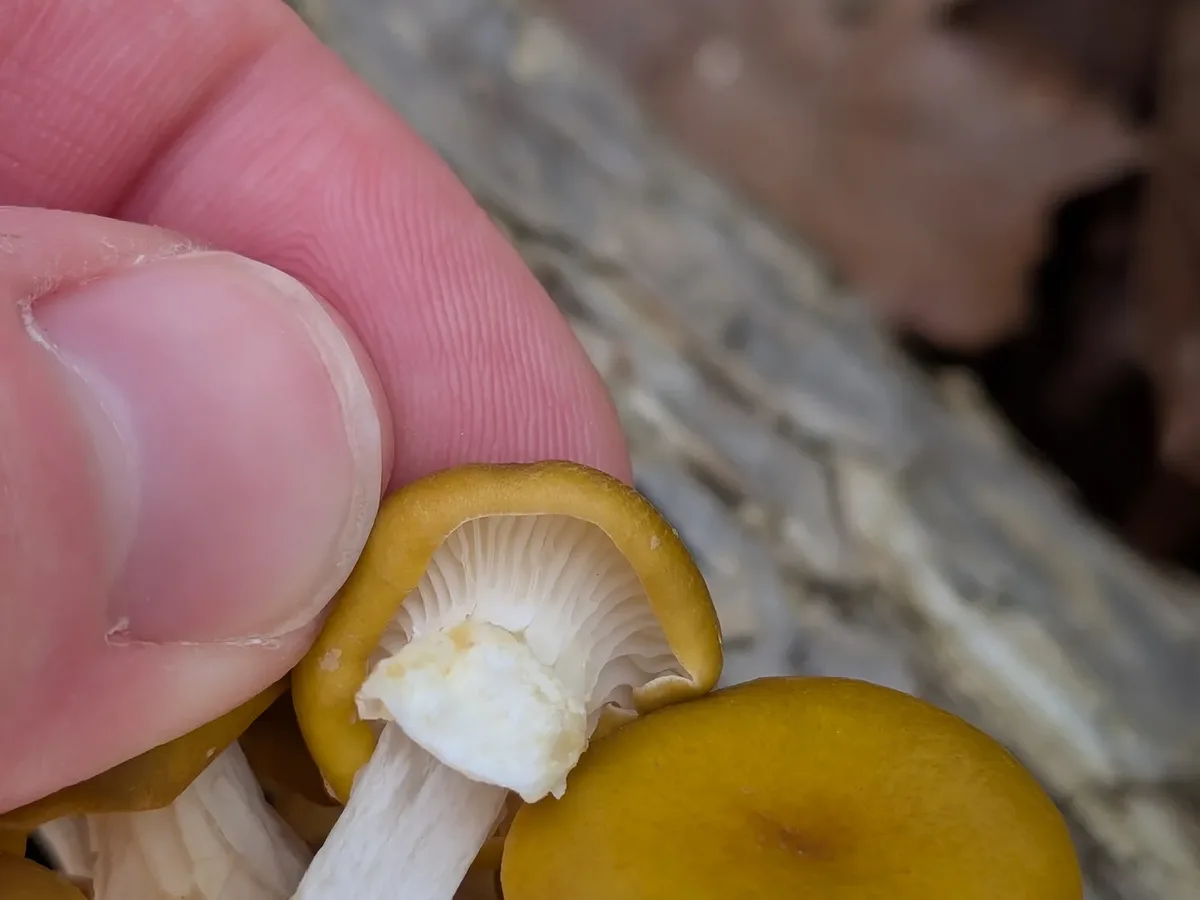
The gills underneath are white to ivory, closely spaced, clearly decurrent (running well down the stem), and moderately broad.
Stem
Stems are short (1-4 cm), firm and solid, white to pale yellow, and almost always fused at the base where the cluster originates.
Flesh
Flesh is white throughout, firm when young and softening with age, with a mild, pleasant aroma, somewhere between fungal and faintly floury.
Spore print: white to faintly lilac.
Microscopy: smooth cylindrical to sausage-shaped (allantoid) hyaline spores, 7-11 × 3-4 µm.
Where & when it grows
Habitat
The golden oyster is a white-rot wood decomposer: it lives by breaking down the cellulose and lignin of dead hardwood. The mycelium can persist in a log or stump for years, quietly working until conditions are right to fruit.
Elms (Ulmus) are its closest ally in the wild, but it also takes up residence in dead or dying poplar, aspen, willow, and a variety of other broadleaf trees.
Look for it in shaded, humid spots: riparian forests, stream banks, woodland ravines, anywhere dead standing or fallen wood stays moist. It does not occur on living healthy trees or on conifers.
Fruiting bodies push out from cracks, wounds, and cut surfaces of logs and stumps, often returning flush after flush from the same hidden mycelium.
The native range runs from the Russian Far East and Japan through northeastern China and Korea; elsewhere it turns up as a cultivation escapee, occasionally naturalising on fallen logs in North America and Europe.
When
Warm and humid is what this mushroom waits for.
In temperate regions the main fruiting window runs June through October, peaking in July-September when temperatures sit between 18 and 28 °C and summer rains keep the wood moist.
- In the Russian Far East and northern Japan that window tightens to July-September, tracking the summer monsoon moisture.
- In northeastern China the season stretches the full June-October span.
- Further south, in subtropical southeastern China and Taiwan, significant rainfall can trigger fruiting at almost any time of year.
- In North America golden oysters are not native, but cultivated populations occasionally escape onto elm logs in the upper Midwest and northeast, where they follow the same summer fruiting pattern.
How it grows
Saprotrophic on dead hardwood, the golden oyster breaks down cellulose and lignin via a highly efficient ligninolytic enzyme system. It is one of the faster white-rot species: given the right conditions, the transformation from pinhead to full cap can happen in as little as 5-8 days.
Fruiting bodies emerge in the characteristic overlapping rosettes of 5-30 or more caps from a shared base. The same substrate often yields multiple flushes over several weeks, the hidden mycelium regrouping between crops.
This speed and vigour make it one of the easiest oyster mushrooms to cultivate; it is widely grown commercially on supplemented sawdust, straw, and cottonseed hull blocks.
In cultivation it needs a humidity trigger (misting or fresh air exchange) and some light. Pins typically initiate within 7-14 days at 18-24 °C.
Fruiting conditions
Fruiting is triggered by warm, humid conditions - optimal substrate or air temperatures 18-24 °C with relative humidity above 85%. Significant rainfall (>20 mm in 14 days) promotes natural fruiting flushes. In hot weather above 30 °C fruiting stalls; below 12 °C growth slows markedly. In cultivation, pins initiate within 7-14 days of humidity induction and fresh air exchange.
Look-alikes
The intense, uniform yellow colour is quite diagnostic and greatly limits confusion with other species. The main potential confusions are with other oyster mushrooms of pale or yellowish hue, and with certain wood-growing species in East Asia.
- Pleurotus cornucopiae (branching oyster) has tan to buff-brown caps, never true yellow; it grows in tighter funnel shapes with more clearly branching central stems.
- Pleurotus ostreatus (pearl oyster) and P. pulmonarius (summer oyster) are grey, grey-brown, or whitish.
- Gymnopilus junonius (spectacular rustgill) has large, scaly golden-yellow caps on wood but bears a distinct membranous ring (annulus) on the stem, produces a rusty-orange spore print, tastes intensely bitter, and has adnate to adnexed (non-decurrent) gills.
- Hypholoma fasciculare (sulphur tuft) has sulphur-yellow caps that are much smaller (2-7 cm), domed with a dark olive-brown centre, and sulphur-yellow gills that turn green then purple-brown with age; its spore print is purple-brown and its taste is intensely bitter - spore print and bitterness immediately eliminate confusion.
- In East Asia, Omphalotus japonicus (moonlight mushroom / tsukiyotake) grows in clusters on hardwood and has orange-buff to orange-brown colouration that overlaps marginally with aged or washed-out golden oyster; it is toxic, but its stronger orange-brown tones, sharp (non-decurrent) gills, and faint bioluminescence in the dark readily separate it from the vivid-yellow, white-gilled, decurrent-gilled P. citrinopileatus.
No deadly lookalikes are known when the full suite of features is confirmed: vivid uniform yellow cap, white decurrent gills, white spore print, clustered growth strictly on dead hardwood, mild taste.
Large yellow-orange to rusty-brown capped species with a ring (annulus) on the stem; produces a rusty-orange spore print; tastes very bitter; gills are adnate to adnexed, not decurrent
P. cornucopiae has tan to buff-brown caps, never vivid yellow; caps form tighter, deeper funnels with a more distinctly branched central stem; gills fork and anastomose extensively near the stem
Toxic - causes severe gastrointestinal poisoning (nausea, vomiting, cramps). Grows in clusters on hardwood in East Asia; caps orange-buff to orange-brown (never vivid lemon-yellow); gills sharp, non-decurrent; may faintly bioluminesce green in complete darkness; spore print cream to pale yellow. Distinguished from golden oyster by orange-brown (not yellow) colour, non-decurrent gills, and bioluminescence. Any hardwood cluster that glows faintly in the dark should not be eaten.
P. ostreatus has grey to grey-brown to bluish-grey caps, never yellow; grows in autumn to winter at cooler temperatures; gills white, decurrent, similar in form but cap colour is completely different
Large, scaly golden-yellow caps with a distinct membranous ring (annulus) on the stem; produces a rusty-orange spore print; tastes intensely bitter; gills are adnate to adnexed, not decurrent - all clearly distinguish this from P. citrinopileatus whose spore print is white and gills are decurrent
Sulphur tuft has sulphur-yellow caps but they are much smaller (2-7 cm), domed with a dark olive-brown centre; gills are sulphur-yellow turning green then purple-brown with age; spore print is purple-brown; taste intensely bitter - gill colour, purple-brown spore print, and bitter taste immediately distinguish it from the white-gilled, white-spore-printed, mild-tasting golden oyster
P. pulmonarius caps are whitish to pale grey-brown, not yellow; grows at higher temperatures but lacks any yellow pigmentation
In the kitchen
Picking & cleaning
Harvest when caps are fully expanded but before margins begin to curl strongly upward and before the cap colour starts to pale or bleach, which signals age and deterioration in flavour. At peak, caps should be dry, vivid yellow, and firm.
Use a sharp knife to cut the entire cluster at the base rather than pulling individual caps, which damages the mycelium and substrate.
Golden oysters are fragile and bruise easily; handle gently and place in rigid containers rather than plastic bags. They deteriorate rapidly: use within 1-2 days of harvest.
The yellow pigment is heat-labile and fades to white or buff during cooking, so expect colour change in the pan. The distinctive vivid colour is not retained on the plate.
Cooking
Golden oyster mushrooms have a delicate, mild flavour with a slightly seafood-like or savoury umami quality, tender texture, and appealing aroma when freshly harvested.
Note that the vivid yellow colour fades completely to white or buff upon heating; this is normal and does not indicate spoilage.
They cook quickly and should not be overcooked, which makes them watery and slightly slimy.
Best methods:
- Sauté in butter or neutral oil over medium-high heat until edges crisp lightly (3-4 minutes).
- Use in stir-fries, hot pots, soups, ramen, and rice dishes.
- Tempura-fry individual caps for a visually striking presentation before colour loss occurs.
Avoid prolonged braising. Pairs well with garlic, ginger, soy sauce, sesame oil, rice vinegar, and fresh herbs.
Drying concentrates flavour but further destroys colour; dried and powdered golden oysters are used as a flavour ingredient in East Asian cooking.
Good to know
No toxins are known from Pleurotus citrinopileatus. It has a long history of safe consumption across East Asia.
A small number of individuals may experience mild gastrointestinal sensitivity if consumed raw or in very large quantities; normal thorough cooking eliminates this risk.
Respiratory allergic reactions to the spores during cultivation are documented in workers who inhale large quantities of spores in poorly ventilated grow rooms. Foragers are unlikely to be exposed at comparable levels.
The yellow pigment (a mixture of polyene compounds) is not toxic. As with all foraged mushrooms, positive identification is essential before consumption.
Key ID features:
- vivid yellow cap
- white decurrent gills
- white spore print
- clustered growth strictly on dead hardwood
- mild non-bitter taste
In East Asia, be aware of Omphalotus japonicus (toxic, orange-brown, bioluminescent in dark, non-decurrent gills) as a regional species on hardwood, though its colour and gill form are clearly different from golden oyster.
A reference guide - never an edibility guarantee. When in doubt, leave it out.