Dead man's foot
Pisolithus arhizussyn. Pisolithus tinctorius, Pisolithus arenarius, Lycoperdon arrizon, Scleroderma arrizon, Polysaccum pisocarpium
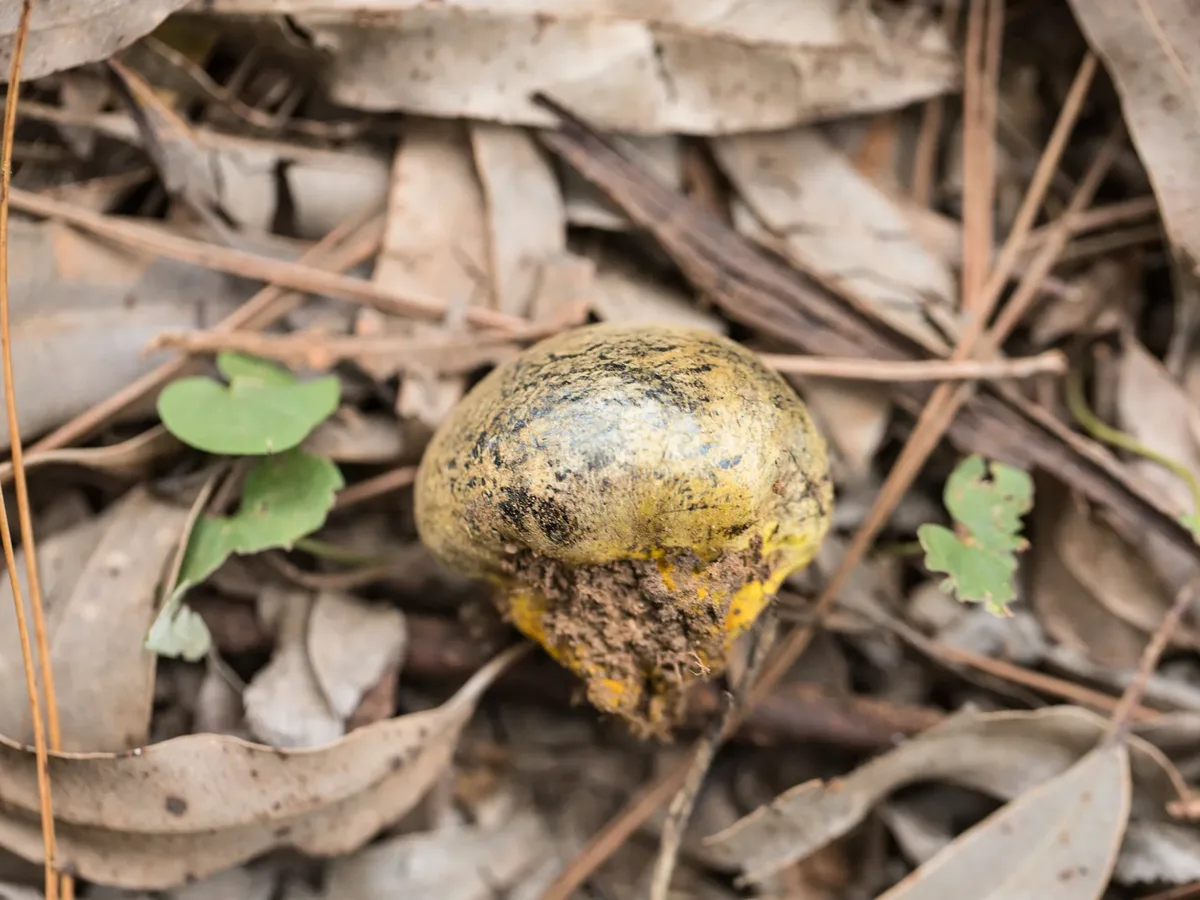 Frank Thomas Sautter (CC0)
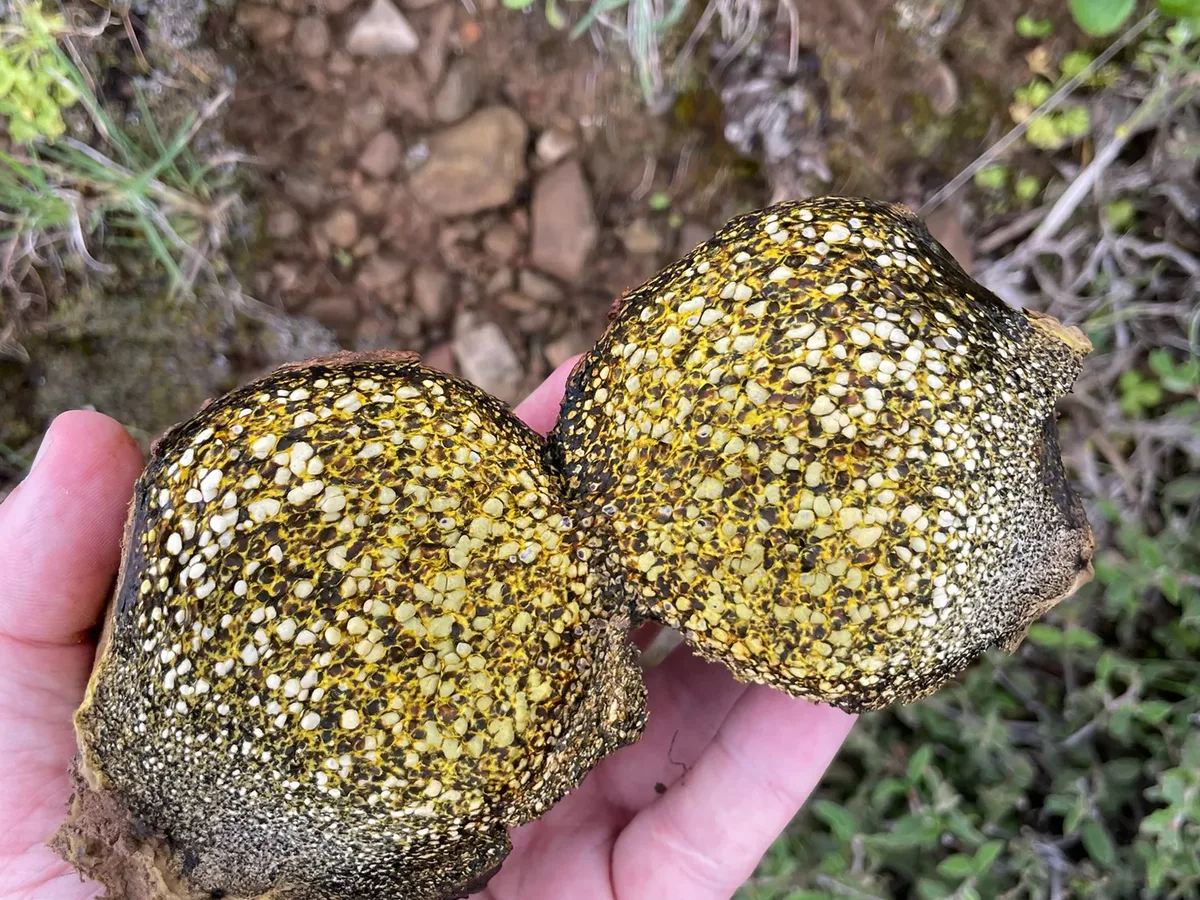 © Chase Mathey (CC BY)
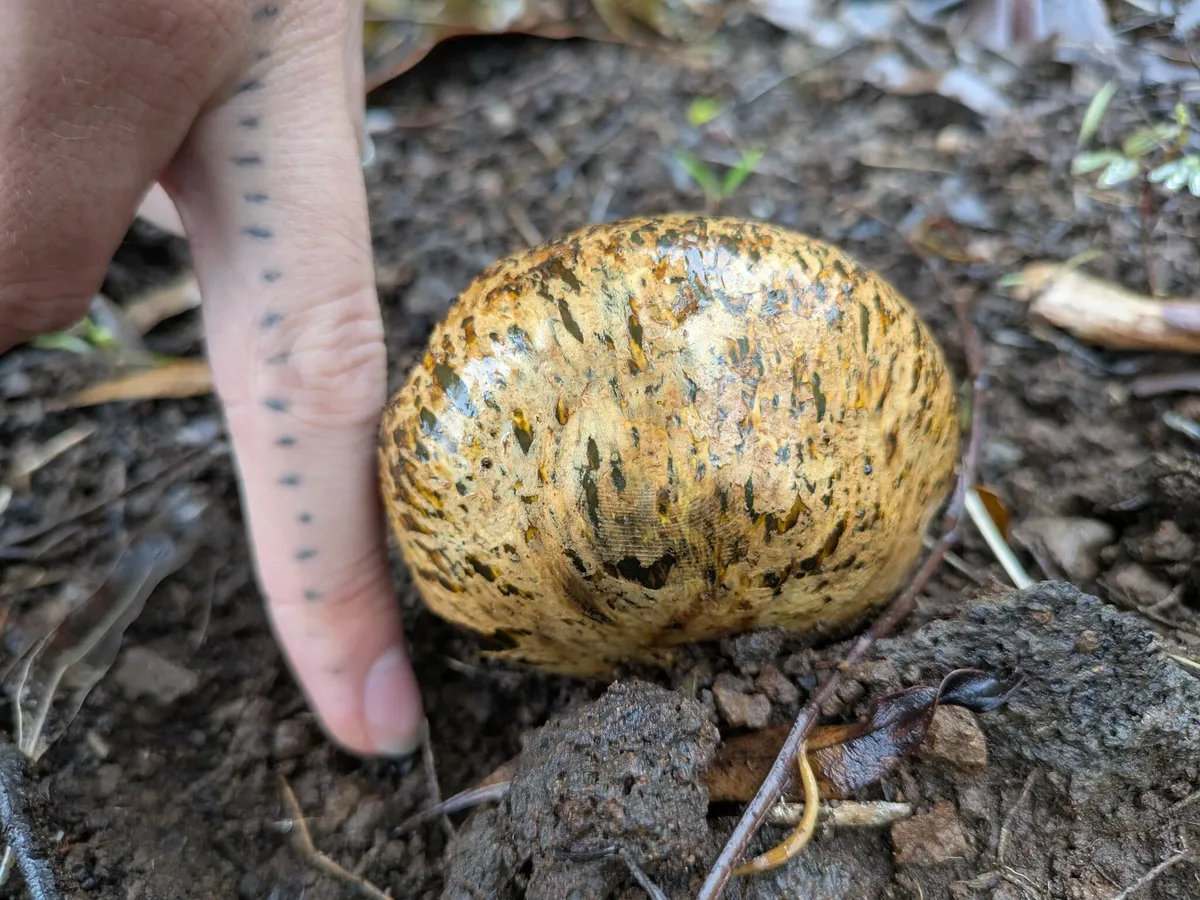 © Kevin Faccenda (CC BY)
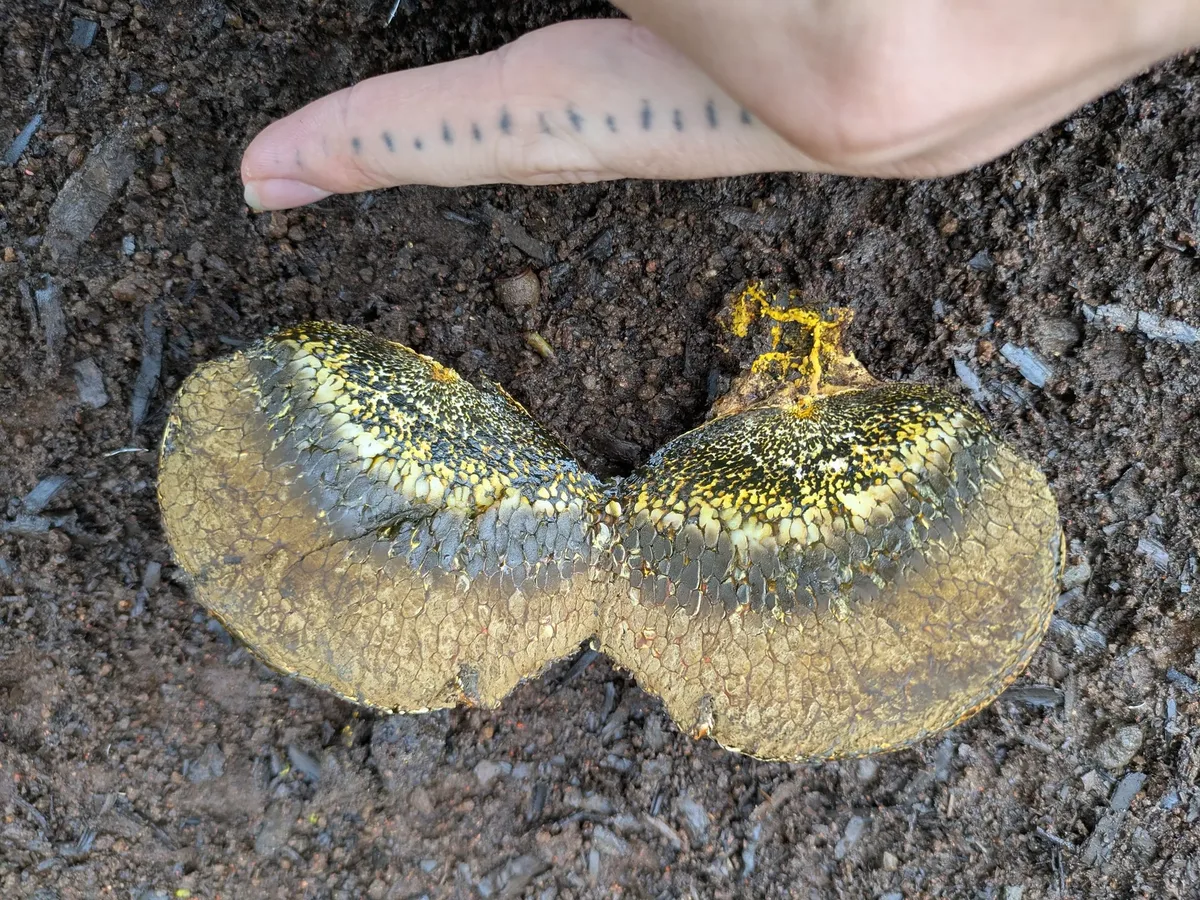 © Kevin Faccenda (CC BY)
 © Kevin Faccenda (CC BY)
 © Chase Mathey (CC BY)
 © Chase Mathey (CC BY)
 © Luis Carlos12 (CC BY)Frank Thomas Sautter (CC0)© Chase Mathey (CC BY)
Not poisonous, but not worth eating - too tough, bitter, or bland for the pot.
How to recognise it
Pisolithus arhizus is one of the most immediately recognisable and - once known - unmistakable fungi in the Australian and global mycosphere, though it tends to be overlooked by foragers precisely because it is neither edible nor conventionally beautiful.
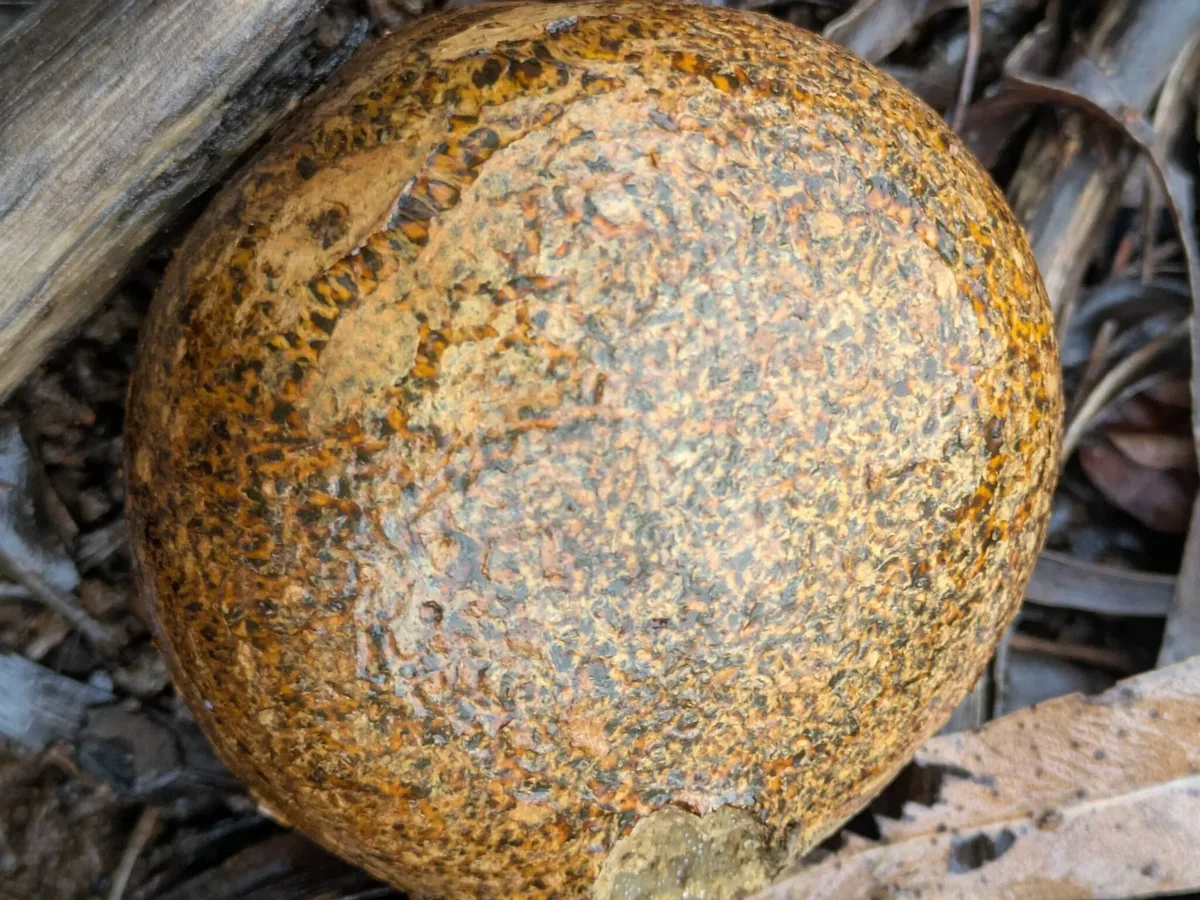
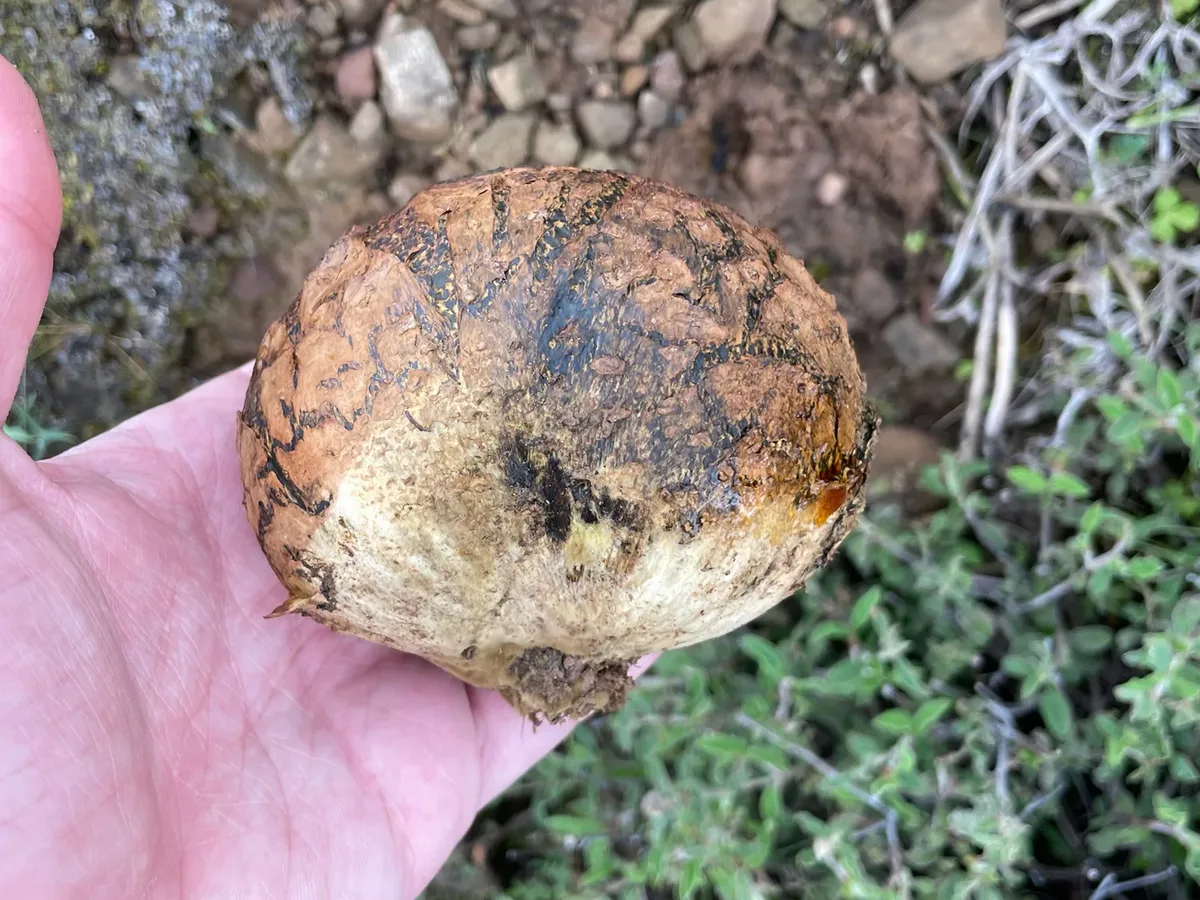
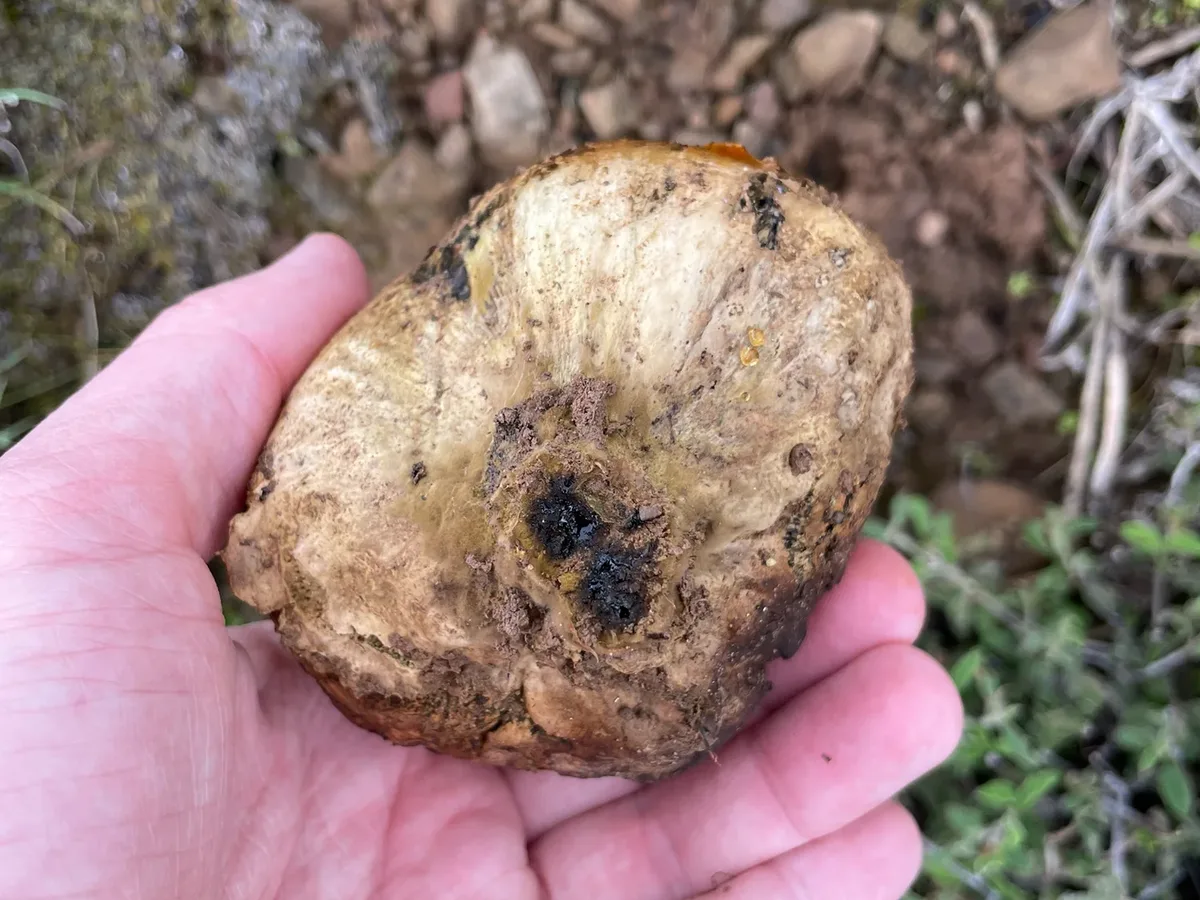
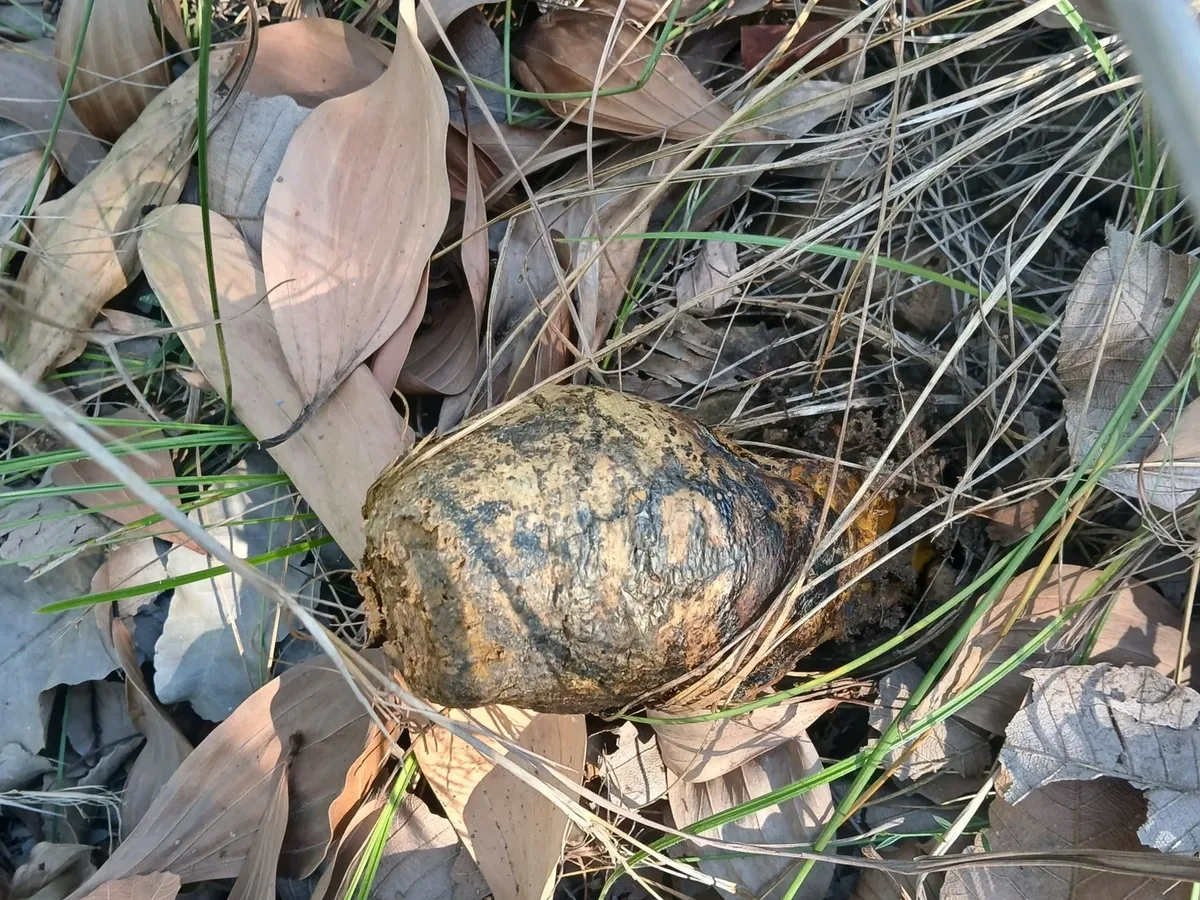
It grows as a club-shaped, pear-shaped, or simply lumpy mass arising from the soil without a clearly defined cap, gills, or stem in the conventional sense.
The outer skin (peridium) is thin and papery to slightly leathery, coloured a warm tawny-brown to rusty-ochre when young and drying through olive-brown to sooty blackish-brown at maturity. It often develops fine surface cracks in dry conditions and accumulates a dusty bloom of released spores that colours the surrounding soil chocolate-brown.
Stem
The base is a pale, spongy, mycelial column - sometimes called the pseudostipe - that tethers the fruiting body to the sandy soil and can extend several centimetres below ground level. The base lacks the dense, cordlike attachment of a true stipe.
Flesh
The interior is the definitive feature for anyone who picks one up: a cross-section reveals a tight mosaic of individual, enclosed chambers or peridioles, each a distinct pocket 1-5 mm across containing its own spore mass.
Young peridioles are pale yellow, ageing through olive to deep brown and finally black. In a specimen of any age, chambers in different stages of maturity may be visible simultaneously, creating a striking pattern of light and dark within the same cross-section.
This chambered interior is wholly unlike the structureless white gleba of a true puffball and utterly unlike the marbled dark interior of an earthball (Scleroderma), making cross-sectioning a decisive identification tool.
The spore mass itself is dark chocolate-brown to blackish, eventually released as a fine dusty cloud.
Smell & taste
The whole fungus smells distinctly of decaying, slightly sulphurous organic matter - often described as reminiscent of coal gas or damp cellar. This, combined with its often malformed appearance and dark colouring, accounts for the common name 'dead man's foot'.
Where & when it grows
Habitat
Pisolithus arhizus occupies an ecological niche that few fungi claim: bare, compacted, nutrient-poor, often highly disturbed soils in hot, dry, exposed positions.
In Australia and New Zealand it is found in coastal heathland, dry banksia scrub, sandy road banks, footpath margins, eroded slopes, mine waste, and the open margins of dry sclerophyll woodland.
It appears most commonly where the soil has been disturbed - bulldozed ground, construction sites, quarry edges, gravel tracks - and where tree roots are accessible within a metre or two.
Unlike the great majority of ectomycorrhizal fungi, which require the moist, organic-rich soils of intact forest interiors, Pisolithus arhizus can colonise raw mineral substrates and assist in the establishment of tree seedlings in hostile conditions.
Its host range is extraordinarily broad: it forms functional mycorrhizal partnerships with eucalypts, banksias, acacias, pines (including the widely planted Pinus radiata), and many other gymnosperms and angiosperms across different families.
This ecological breadth underlies its use in commercial reforestation inoculation programmes worldwide.
In Australia it is a native species; in New Zealand and other parts of the world it has spread, at least partly, with introduced trees and forestry operations.
When
In southeastern Australia and New Zealand, Pisolithus arhizus can be encountered in any month of the year when soil moisture is adequate, but fruiting concentrates in two periods:
- late summer to mid-autumn (February-May), after the first significant rains break the summer drought
- spring (September-November) as soils warm and spring rains arrive
The fruiting bodies are durable and persist long past initial spore maturation - desiccated, blackened husks may remain attached to the soil and visible on the surface for many months after fruiting.
This persistence means that fresh versus old specimens can be present simultaneously.
Fruiting is most predictable after a period of at least 15-25 mm of rain following dry or drought conditions. But the species is less seasonally constrained than most forest-floor fungi, because its preferred habitat on exposed soils experiences wide temperature and moisture swings that it is physiologically equipped to handle.
How it grows
Pisolithus arhizus is an obligate ectomycorrhizal fungus: it requires a living host tree and forms a perennial underground mycelial network with host roots.
The mycelium is notably stress-tolerant compared to other ectomycorrhizal fungi, persisting in soils with:
- low pH
- elevated heavy-metal concentrations
- low organic matter
This quality has made it one of the most studied fungi for land rehabilitation, mine-site revegetation, and drought-resilient tree-planting programmes.
The fruiting bodies develop as a single upward-growing mass rather than in clusters, though multiple specimens may emerge near the same root system.
Growth from initiation to full maturity can take several weeks. Because the peridioles ripen sequentially from the top of the fruiting body downward, a single specimen may simultaneously display ripe, dehiscing peridioles at the crown and immature yellow peridioles near the base.
Dried spent fruiting bodies often remain standing on the soil surface as hollow shells.
Fruiting conditions
Broadly tolerant of temperature and moisture fluctuations compared to most ectomycorrhizal fungi. Fruiting is triggered by rainfall (15+ mm over 14 days) following dry conditions on exposed, sandy soils. Soil temperatures from about 10-30 °C are tolerated; the wide range reflects adaptation to hot, exposed habitats. Flush lag from triggering rain to emergent fruiting bodies is 7-21 days. Fruiting bodies persist as dry husks long after spore dispersal, so fresh and spent specimens may be found simultaneously. No true dormant season in warm climates; fruiting most concentrated in autumn (March-May) and spring (September-November) in the Southern Hemisphere.
Look-alikes
Because of its unusual shape and distinctly unappetising appearance, Pisolithus arhizus is rarely confused with edible species.
The most realistic confusion is with Scleroderma species (earthballs), which occupy some of the same open, sandy-soil habitats. Scleroderma citrinum and related earthballs differ in having:
- a rounder shape
- a much thicker and tougher skin
- a firm interior that, when young, shows a uniformly dark, marbled purple-black or violet-black gleba rather than the distinct individual peridiole chambers of Pisolithus
Earthballs are also typically much smaller (3-12 cm) and more regularly globose.
Scleroderma species are toxic (causing gastrointestinal poisoning), so distinguishing them from Pisolithus is practically relevant even though neither is edible.
The immature fruiting body of a young puffball (Calvatia or Lycoperdon species) might superficially resemble a very young Pisolithus, but puffballs have:
- a pure white, homogeneous interior when young
- no chambered structure
- a smooth or spiny outer surface
In the Southern Hemisphere, the large puffball Calvatia species occur in moister grassland and forest habitats and would not typically be found on dry, bare soil alongside Pisolithus.
The 'horse dung' comparison sometimes leads to accidental encounters in urban environments, but no serious confusion with edible species has been documented.
More uniformly round or onion-shaped, typically 3-12 cm across, with a distinctly thicker and tougher rind (2-5 mm) that is yellowish-brown with coarse, flattened scales. Interior is uniformly dark purplish-black to violet-black with white marbling even in young specimens - never showing individual chambered peridioles as in Pisolithus. Scleroderma is toxic, causing gastrointestinal poisoning. Cross-section is decisive: Pisolithus shows discrete chambers; Scleroderma shows a single marbled dark mass.
Young puffballs are white and spherical with a pure, structureless white interior - no chambers or dark peridioles. Puffballs occur in moister grassland and open woodland, not typically on the bare sandy or compacted soils favoured by Pisolithus. Edible when interior is pure white; the bisection test immediately separates them from Pisolithus.
Smaller (2-7 cm), round, with a thin but tough rind covered in small flat scales or areolae. Interior is dark purplish-grey at all stages, with no discrete peridiole chambers. Occurs in similar open sandy habitats. Toxic - causes GI poisoning. Distinguished from Pisolithus by its round shape, tough uniform rind, and uniformly dark (not chambered) interior.
In the kitchen
Picking & cleaning
Pisolithus arhizus is not a species to collect for the table - it is inedible due to its deeply unpleasant taste and texture (hard, fibrous, and bitter), not merely unfamiliar.
Handling is safe: no toxins are absorbed through skin contact.
If you pick one up out of curiosity - and it is worth examining - hold it over bare ground or away from clothing, as the dark spore mass releases easily and will stain fabric and hands a persistent chocolate-brown.
The spore dust was historically used as a yellow-brown dye for wool, giving rise to the name 'dyeball'; the stain is water-soluble when fresh but sets with time.
Gloves are not essential but are sensible if you plan to handle multiple specimens.
When documenting or photographing, a cross-section with a knife reveals the distinctive chambered interior that confirms identification.
Wash hands with soap and water after handling.
Good to know
Pisolithus arhizus is not poisonous but is firmly inedible - avoid eating it. It has an intensely bitter, unpleasant taste and a fibrous, woody texture that make consumption practically impossible in any meaningful quantity.
No specific toxins have been identified in the species, and no confirmed cases of serious poisoning from accidental ingestion are documented in the mycological literature.
Mild gastrointestinal discomfort (nausea, stomach upset) may follow ingestion of raw material, consistent with the physical irritation of fibrous, indigestible matter - but this is not a toxicological risk in the sense of a confirmed toxin.
The main practical safety point is correct identification: confirm the chambered peridiole interior in cross-section, which unambiguously distinguishes Pisolithus arhizus from Scleroderma earthballs, which are genuinely toxic (GI poisoning).
The dark brown spore powder will stain skin and clothing but causes no harm.
A reference guide - never an edibility guarantee. When in doubt, leave it out.