Cleland's gilled bolete
Phylloporus clelandii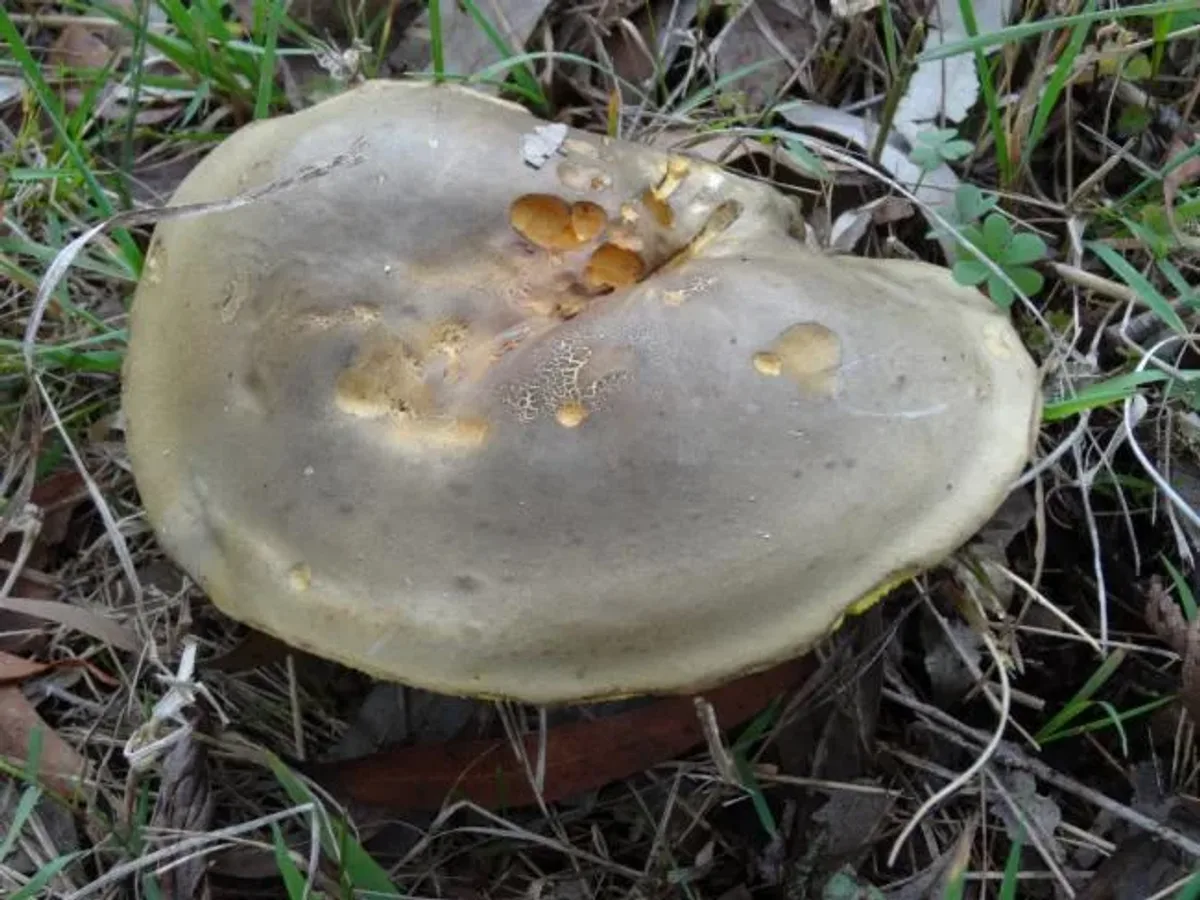 © Mark Ridgway (CC BY)
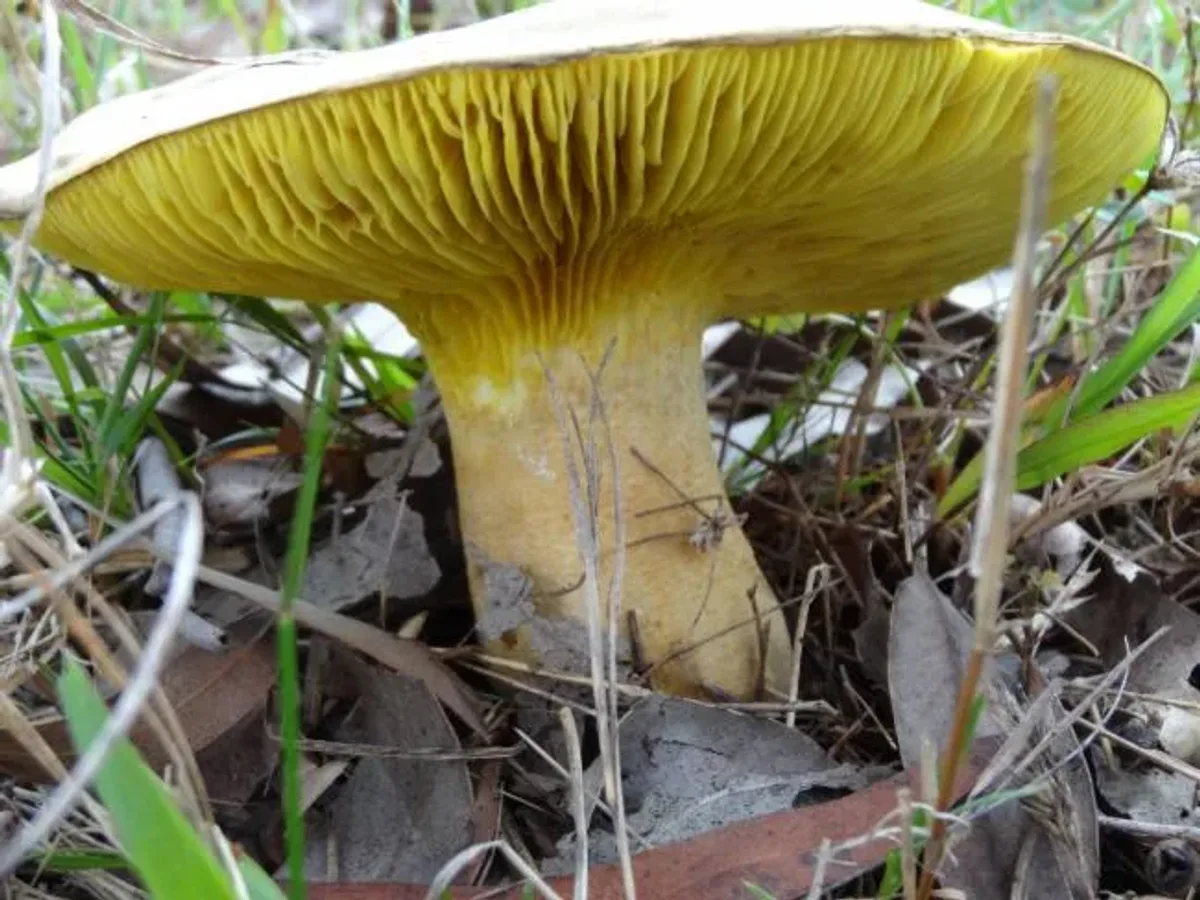 © Mark Ridgway (CC BY)
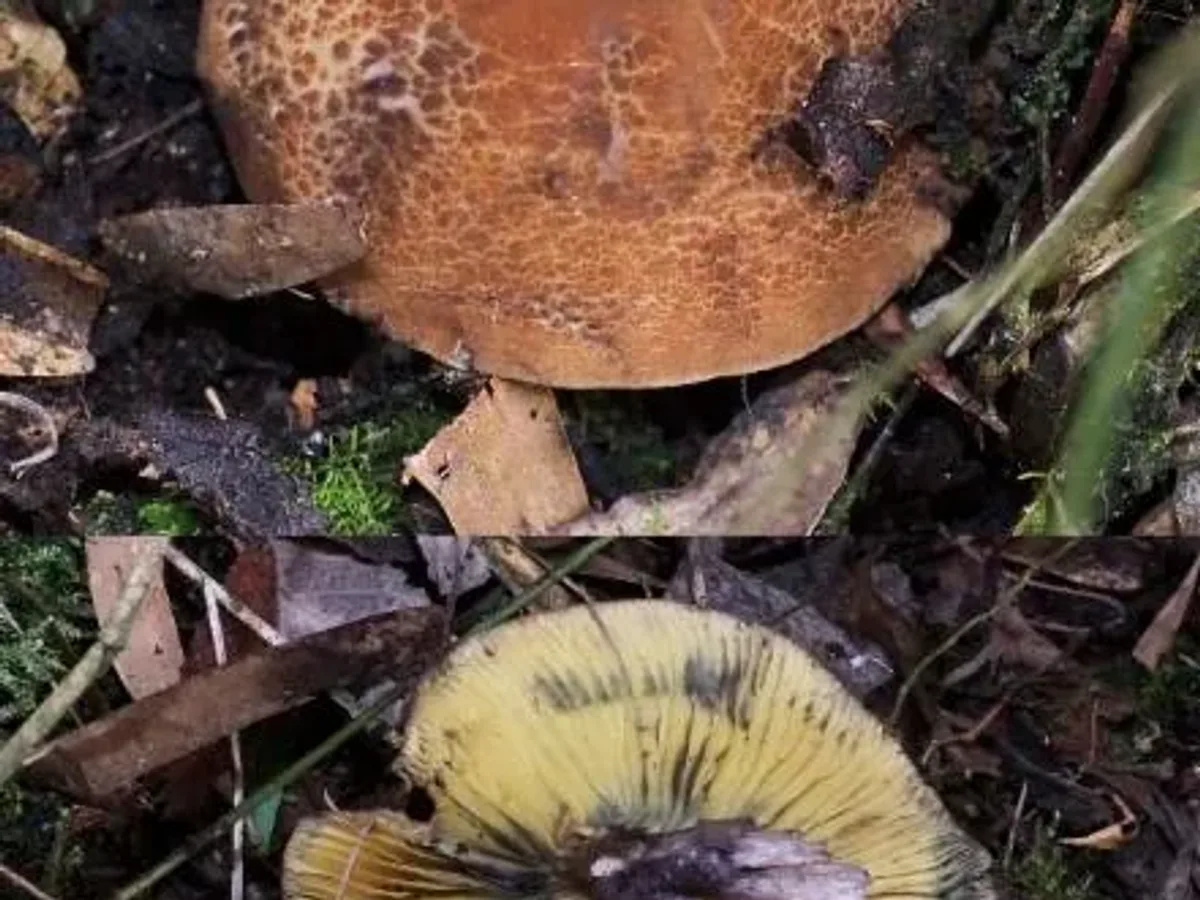 © Richard Hartland (CC BY)
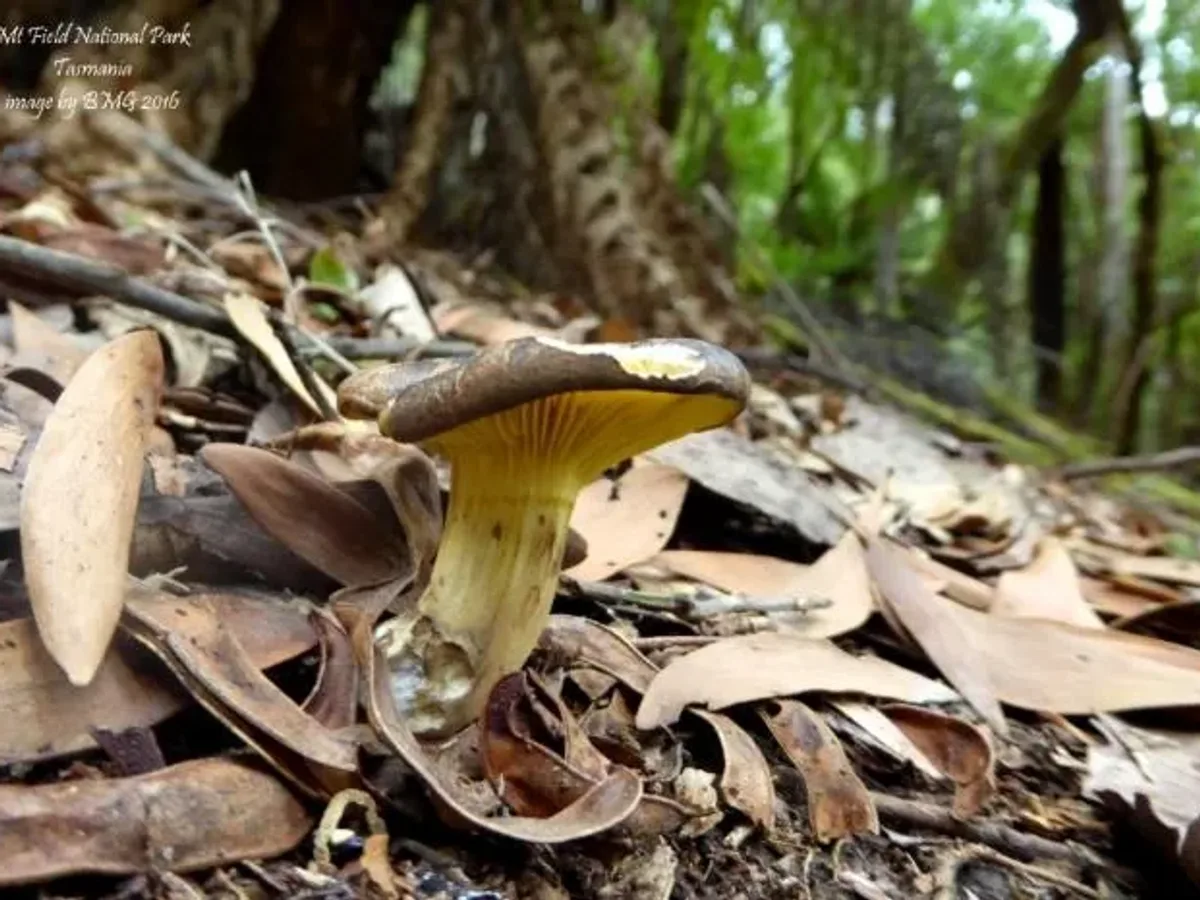 © B G (CC BY)© Mark Ridgway (CC BY)© Mark Ridgway (CC BY)
Good to eat, once you have identified it with certainty and cooked it through.
Never eat a mushroom you are not 100% sure of - check the look-alikes below, and always cook wild mushrooms.
How to recognise it
Phylloporus clelandii is one of Australia's most distinctive native boletes precisely because it does not look like a bolete at first glance below the cap - instead of a layer of tubes and pores, its underside bears true gills.
Cap
The cap is 3-8 cm in diameter, starting convex and becoming broadly umbonate to nearly flat, sometimes with a slight central depression in age.
The surface is characteristically dry and velvety, not slimy, coloured olive-brown to reddish tawny-brown; in dry conditions it may crack into small flat patches, similar to a dry Xerocomus.
Gills
The gills are the key character: chrome-yellow to golden-yellow, running a short way down the stem (decurrent), relatively broad, forking once or twice, with shorter gill-lets between the full-length gills.
Bruising the gills with a fingernail may produce a faint brownish or pinkish discolouration over several minutes.
Stem
The stem is solid, 3-7 cm tall, olive-brown to yellowish, often redder at the base, and longitudinally fibrous.
Flesh
Flesh is pale yellow, not staining blue (an important safety point - no blueing reaction).
Spore print is olive-brown to yellowish-brown.
There are no ring, volva, or cobweb-like veil remnants of any kind.
Where & when it grows
Habitat
A mycorrhizal species tightly coupled to native eucalyptus trees in dry and wet sclerophyll forests across southeastern and southwestern Australia. It occurs on the ground beneath Eucalyptus canopies, growing in the leaf litter layer on well-drained, slightly to moderately acidic soils.
In Victoria and New South Wales it is most commonly encountered in foothill and montane eucalypt forest dominated by species such as E. obliqua, E. radiata, and E. regnans (mountain ash). In South Australia and southwestern Western Australia it occurs in drier woodland contexts.
It does not grow on wood or from stumps - it is a soil fungus dependent on living tree roots. This habitat restriction is a useful safety indicator: if the fungus is growing on wood, it is not P. clelandii.
When
Fruiting occurs in the Southern Hemisphere autumn and early winter, from approximately March through July, peaking in April and May.
The ecological trigger mirrors that of European autumn boletes: once the summer heat finally breaks and the first substantial autumn rains begin soaking into still-warm soil, the mycelium threads woven through eucalyptus root mats sense the shift and push up fruiting bodies. Soil temperature dropping below about 20 °C after months of summer warmth is the key signal.
In drought years or after very dry summers, fruitings may be sparse or absent altogether. In good years with adequate March-April rainfall, scattered individuals or small groups appear quietly across the forest floor as if the forest itself were marking the season's turn.
How it grows
Solitary or scattered; does not form dense clusters or grow in rings.
The fruiting bodies emerge from soil where the mycelium runs in tight partnership with living eucalyptus roots - a relationship that may have been building underground for years before a cap ever appears.
Exact fruiting spots shift somewhat year to year, but experienced foragers know this species by its woodland type and return to the same foothill eucalypt forest reliably across many seasons.
Fruiting conditions
Southern Hemisphere autumn species; fruiting triggered by the first significant autumn rains (≥20 mm over 14 days) as soil temperatures drop below 20 °C after summer. Peak flush typically 7-14 days after the triggering rain event. Fruiting ceases when soils become waterlogged or soil temperature falls below about 8-10 °C in mid-winter.
Look-alikes
In Australia, the most dangerous confusable is Paxillus involutus, the roll-rim or poison pie, an introduced European species now established in pine and mixed plantations across Victoria, South Australia, New South Wales, and Western Australia.
Parxillus involutus has a similarly coloured olive-brown to date-brown cap with decurrent gills, and at first glance the two might be confused. However, Paxillus involutus has:
- a distinctly inrolled cap margin, especially when young
- gills that are olive-brown to buff (not chrome-yellow) and stain brown-black when bruised
- a more robust, often shorter and stouter stipe
- flesh that browns on exposure rather than staying pale yellow
- growth preferentially near introduced pine trees rather than native eucalypts
Parxillus involutus causes a potentially lethal immune-mediated haemolytic anaemia and must never be eaten.
Other non-deadly confusables:
- Various brown-capped Cortinarius species have a rusty-brown spore print (not olive-brown), a cobweb-like cortina veil when young, and typical gills (not decurrent yellow gills).
- Among boletes, Xerocomus or Suillus species with similar brown caps are distinguished by their tube layer (pores) beneath the cap rather than gills.
- The ghost fungus (Omphalotus nidiformis) differs dramatically: white to pale brown, growing on wood in overlapping clusters, and with bioluminescent gills that glow green in the dark.
Australian Cortinarius species (many undescribed) may share a similar brown cap but have a rusty cinnamon-brown spore print rather than olive-brown, gills that are typically not decurrent and not chrome-yellow, and a cobweb-like cortina veil when young (often leaving rusty fibres on the stem). Some Cortinarius species contain orellanin and are deadly; treat all brown Cortinarius with extreme caution.
Paxillus involutus has an inrolled cap margin when young (a critical field mark absent in Phylloporus clelandii), gills that are olive-brown to buff rather than chrome-yellow, gills that stain dark brown-black when bruised or pressed, flesh that turns brownish on exposure, and grows preferentially near introduced pine trees in Australia rather than native eucalypts. The spore print of Paxillus is warm rust-brown, whereas Phylloporus clelandii gives an olive-brown to yellowish-brown print. Paxillus involutus is deadly - it triggers immune-mediated haemolytic anaemia, a potentially fatal blood disorder that can develop after repeated ingestion. Never eat any decurrent-gilled brown-capped mushroom unless these differences are fully confirmed.
Cream-white to smoky-grey cap, grows in overlapping clusters on wood (not soil), and gills glow green bioluminescently in the dark. Very different ecology (saprotrophic wood-rotter vs soil mycorrhizal) and colour. Toxic - causes severe gastroenteritis.
The Northern Hemisphere counterpart, similar in all key characters (dry brown cap, yellow decurrent gills, olive-brown spore print, no blueing). Occurs in Europe and eastern North America, not in Australia. Both are edible; the distinction matters mainly for documentation and ecological records rather than safety.
In the kitchen
Picking & cleaning
Select young to mid-maturity specimens with firm flesh and caps free of worm damage.
Before collecting, confirm all key characters:
- dry felty brown cap
- bright chrome-yellow decurrent gills (not pores, not orange-yellow ridges)
- solid flesh that does not blue when cut
- growth from soil under eucalypts
Trim the stem base cleanly and brush off adhering soil. Carry in an open basket or paper bag to let spores disperse and keep the cap from sweating.
Specimens are best used within a day or two - refrigerate promptly. Because this is a relatively uncommon native species with limited population data, harvest conservatively and take only what you will use soon.
Cooking
The flavour is mild and pleasantly nutty, in the same general family as other boletes though more restrained than the prized Boletus edulis. Young specimens with firm flesh are best.
Clean by wiping with a damp cloth rather than soaking, which makes the cap waterlogged and affects texture.
Worth knowing: the yellow gills can turn slightly soft when cooked, and some cooks prefer to scrape them off and use only the cap flesh - either approach works.
It suits sautéing in butter or oil, folding into mixed mushroom dishes, risottos, or egg dishes. Drying concentrates the flavour noticeably. Always cook thoroughly before eating.
Good to know
Phylloporus clelandii is considered edible with no documented toxicity in Australian literature. However, several important cautions apply.
- 1As a less commonly studied Australian endemic, systematic toxicological assessment is limited compared to well-studied European edibles - eat in modest quantities on first encounter and observe any reaction.
- 2Critically, do not eat this species unless you are completely certain of your identification: the decurrent-gilled brown-cap gestalt overlaps with Paxillus involutus, which is deadly.
Confirm all of:
- dry felty cap
- chrome-yellow (not olive-brown) decurrent gills
- non-blueing flesh
- absence of cap margin inrolling
- growth under native eucalypts (not pine)
- olive-brown (not rusty-brown) spore print
If any of these characters does not match, do not eat. If in any doubt, discard and consult an experienced Australian mycologist or the local AMSA (Australian Mycological Society of Australia) chapter.
A reference guide - never an edibility guarantee. When in doubt, leave it out.