Golden scalycap
Pholiota aurivellasyn. Agaricus aurivellus Batsch, Flammula aurivella (Batsch) P.Kumm., Pholiota cerifera (P.Karst.) P.Karst., Pholiota limonella (Peck) Sacc.
 Harry Russell (CC0)
 © Stella Fish (CC BY)
 © Stella Fish (CC BY)
 © Kevin (CC BY)
 © Kevin (CC BY)
 Harry Russell (CC0)
 Harry Russell (CC0)Harry Russell (CC0)© Stella Fish (CC BY)
Not poisonous, but not worth eating - too tough, bitter, or bland for the pot.
Never eat a mushroom you are not 100% sure of - check the look-alikes below, and always cook wild mushrooms.
How to recognise it
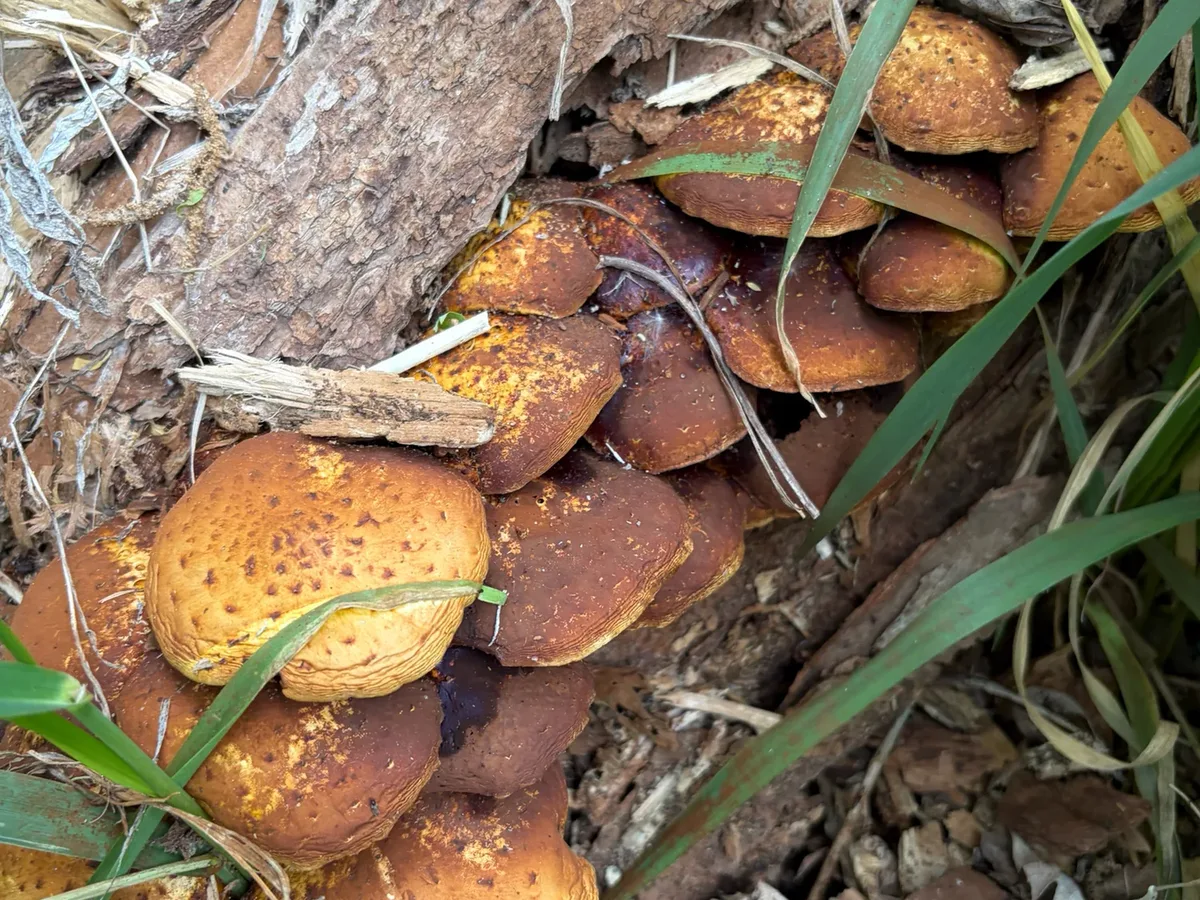
Pholiota aurivella is one of the most visually striking of the scalycaps.
Cap
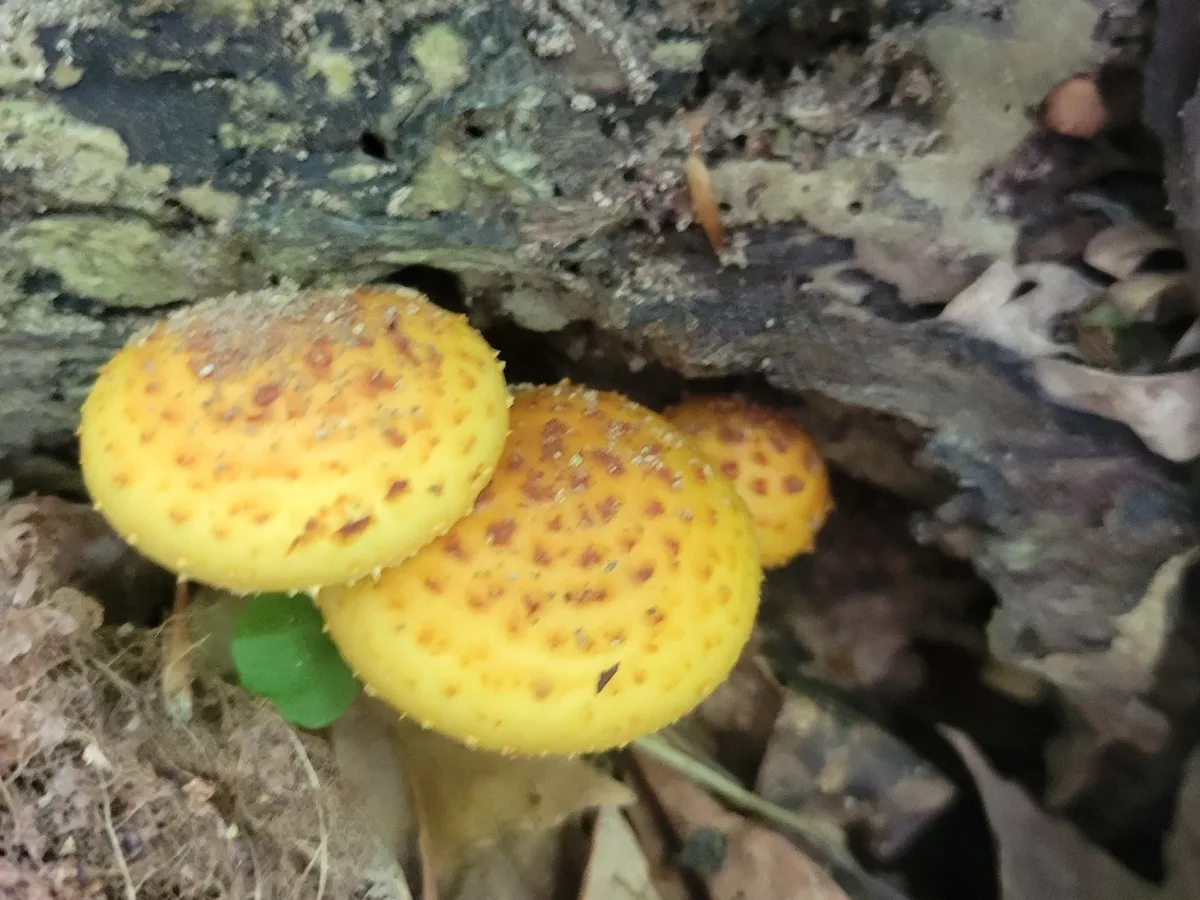
The cap begins convex and tightly inrolled, expanding to broadly umbonate or nearly flat, measuring 5-15 cm (exceptionally 20 cm) across.
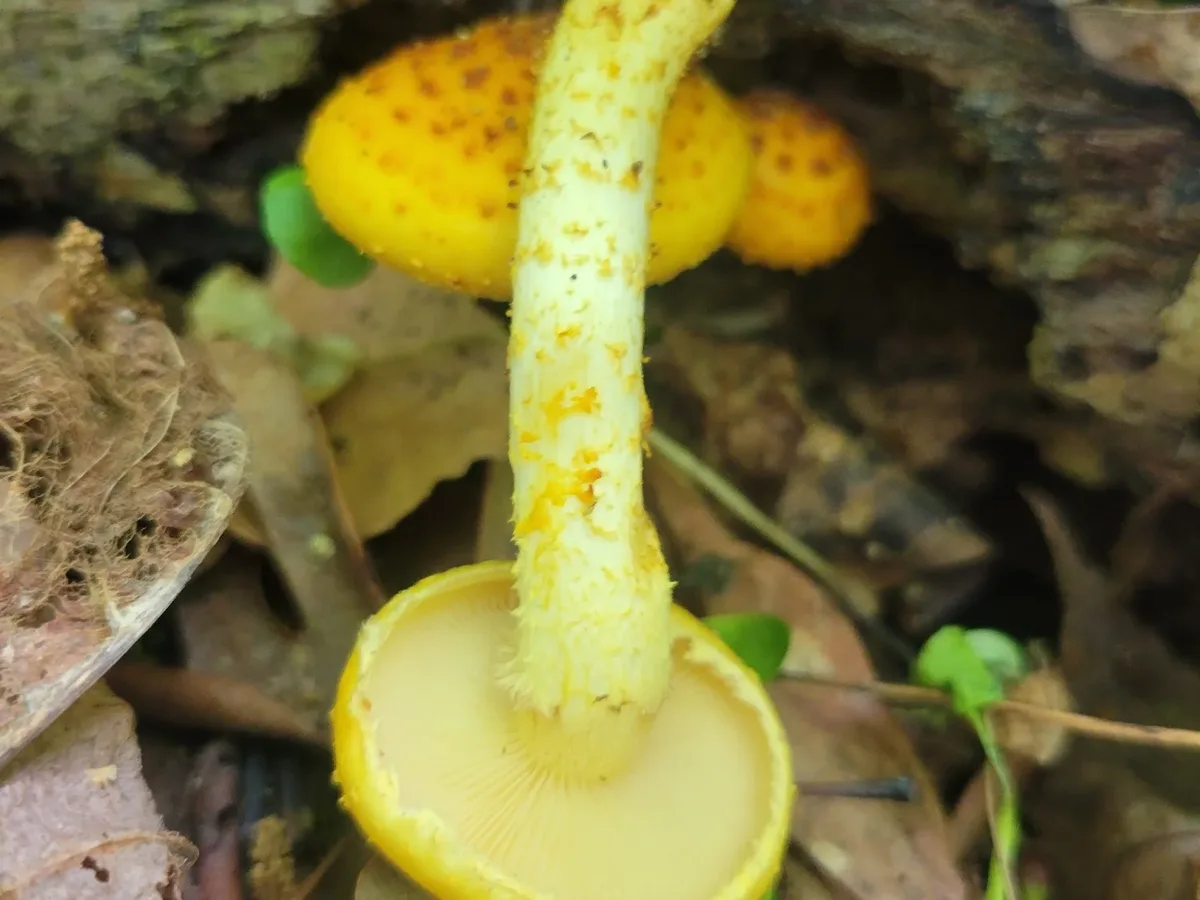
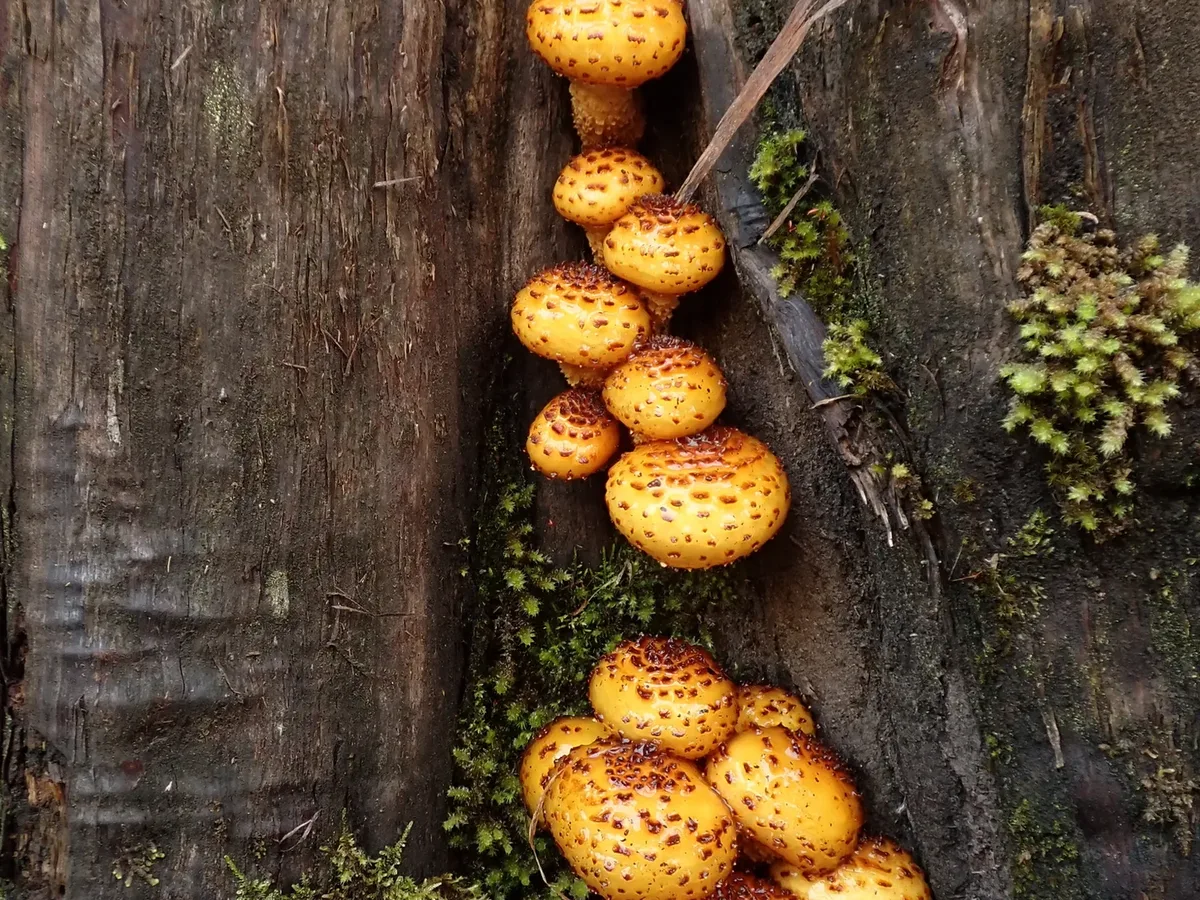
The surface is conspicuously viscid in wet conditions, gleaming bright golden-yellow to tawny-orange or warm amber, reminiscent of polished honey.
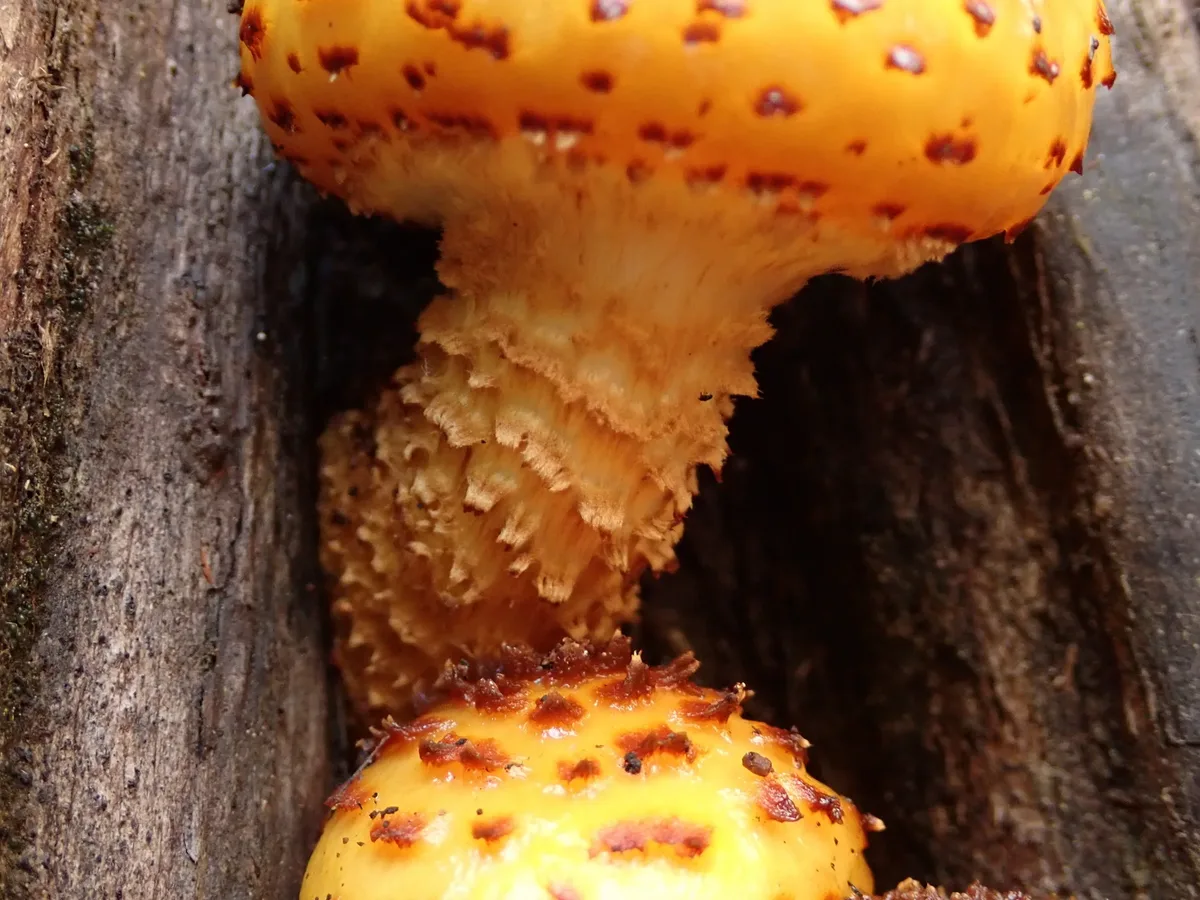
Superimposed on this shiny ground colour are numerous recurved, fibrillous scales of deeper rust-brown to date-brown hue, clustered especially thickly toward the centre and sparser near the margin.
As fruitbodies age the gluten may dry, the scales can wash or peel off on rain-exposed specimens, and the cap colour darkens to ochre-brown.
Gills
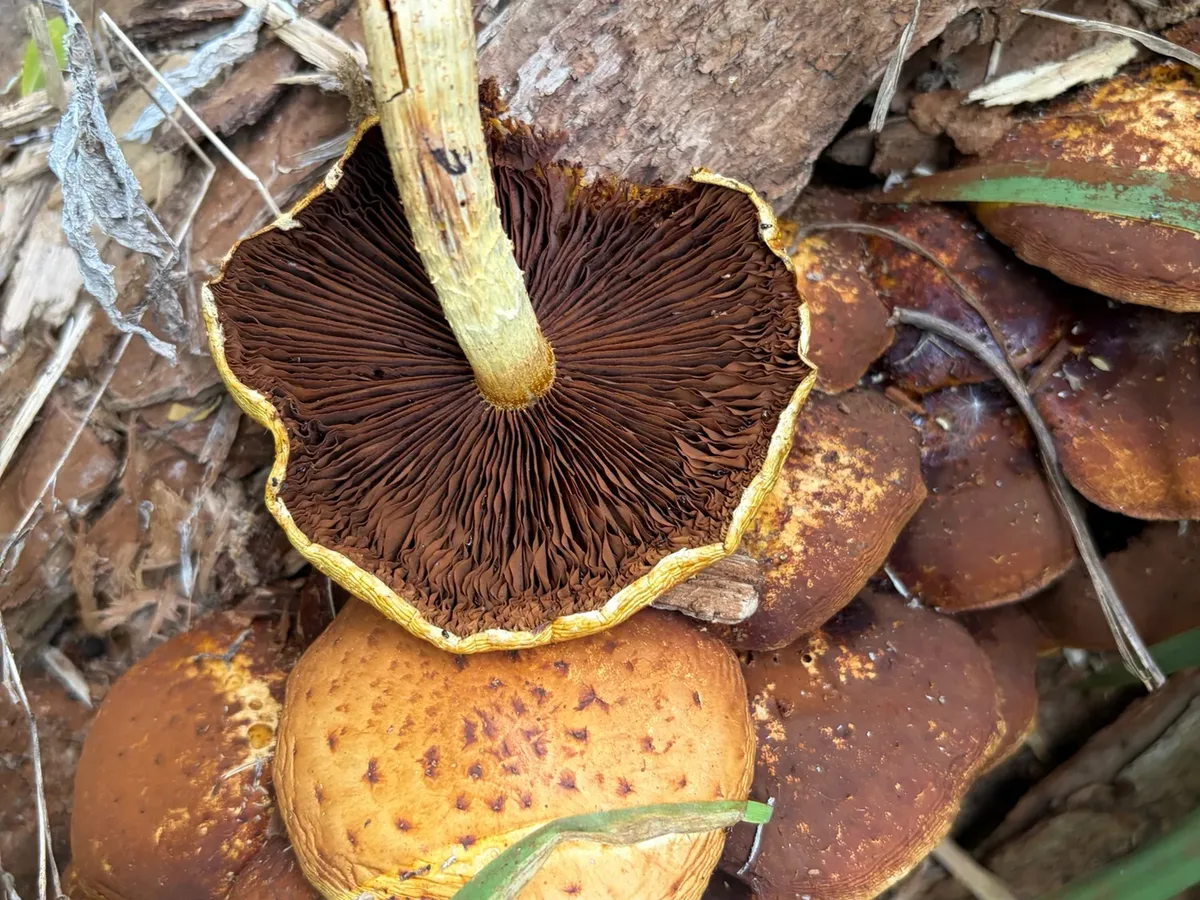
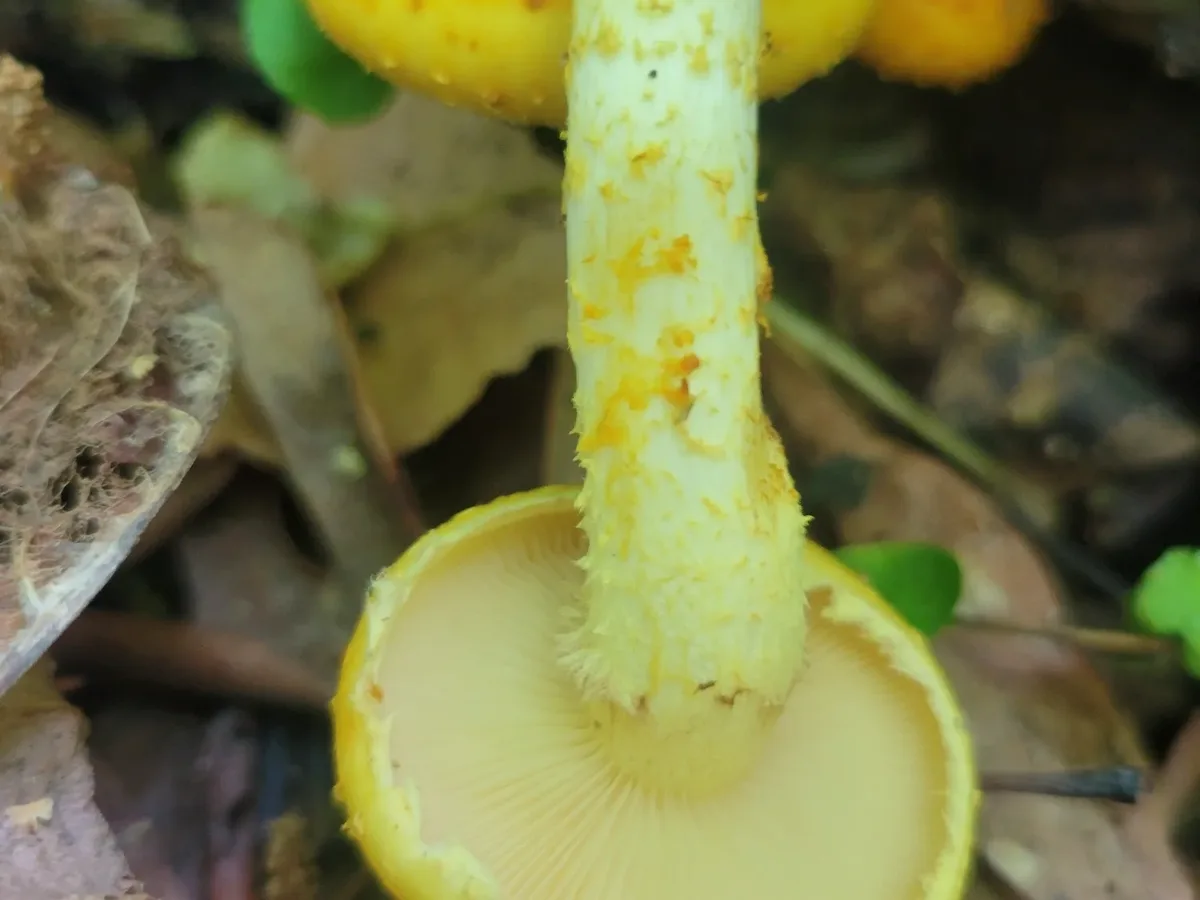
The gills are closely spaced, adnate to the stem, pale sulphur-yellow when young, aging progressively through cinnamon to rusty-brown as the voluminous spore deposit matures.
Stem
The stem is firm, 5-12 cm tall and 1-2 cm across, roughly cylindrical or slightly club-shaped, solid when fresh.
Above the ring zone it is whitish to pale yellow and smooth or finely fibrillose; below the ring it bears coarse recurved scales of the same tawny hue as those on the cap, giving the whole fruiting body a coherent, heavily armoured appearance.
The ring is membranous, initially white, soon heavily dusted rust-brown by falling spores; it may persist as a well-defined skirt or, in old specimens, become torn and ragged or collar-like.
Flesh
Flesh is firm, pale yellow, unchanging on cutting, and distinctly bitter - a useful confirmatory test.
Smell & taste
Smell is mild to faintly earthy or faintly of radish.
The spore print is cinnamon-brown to rust-brown.
Under the microscope: spores 7-10 × 4-5.5 µm, ellipsoid, smooth, with a discrete germ pore, thick-walled; chrysocystidia on gill faces are thick-walled and appear golden-refractive in KOH, a characteristic feature of the genus.
Why it's dangerous
Pholiota aurivella is not considered a life-threatening species in otherwise healthy adults under ordinary circumstances. Fatalities attributable solely to this species are not recorded in the toxicological literature, and the syndrome it causes belongs to the category of moderate-severity gastrointestinal poisoning rather than organ-damaging or neurologically disruptive toxicoses.
That said, the illness can be genuinely incapacitating, and certain populations face elevated risk of serious complications.
Children, elderly individuals, and those with pre-existing gastrointestinal disorders, kidney insufficiency, or compromised immune function may suffer disproportionate fluid and electrolyte loss from vomiting and diarrhoea, potentially requiring intravenous rehydration.
Seek emergency medical care without delay if the person:
- becomes unable to keep fluids down
- shows signs of dehydration (extreme thirst, reduced urination, dizziness, rapid pulse)
- has symptoms that do not begin to resolve within 12-24 hours
If there is any possibility that Galerina marginata or another amatoxin-bearing species was co-ingested - including any small, smooth, ring-bearing mushroom from the same wood substrate - treat the situation as a potential life-threatening emergency and go to an emergency department immediately, as amatoxin poisoning has a deceptively delayed clinical course.
For typical isolated P. aurivella ingestion, supportive care (rest, oral rehydration) is usually sufficient, but medical assessment is always prudent when the exact identity of ingested material cannot be absolutely confirmed.
Toxin
The toxic compounds in Pholiota aurivella have not been fully characterised by modern analytical chemistry, so no single named substance can be confidently attributed as the causative agent.
The working hypothesis in mycological toxicology is that the species contains bitter sesquiterpenes or related terpenoid compounds similar to those identified in other toxic Pholiota and Hypholoma species - compounds of this class are known to act as gastrointestinal irritants.
The intensely bitter taste of the raw and cooked flesh (a taste that cooking does not reliably abolish) is consistent with the presence of heat-stable terpenoid metabolites.
Until formal analytical studies isolate and characterise the responsible molecules, the toxin should be described honestly as uncharacterised; claims citing a specific compound name for this species would be speculative.
What is empirically established is that the species reliably causes gastrointestinal upset in the majority of people who consume it, regardless of preparation method - sufficient grounds to classify it as poisonous.
Symptoms
Poisoning by Pholiota aurivella presents as an acute gastrointestinal syndrome with a short onset window. Symptoms typically begin within 30 minutes to 3 hours of ingestion, though onset as late as 4-6 hours has been reported in some cases, possibly reflecting individual variation in gastric emptying and gut sensitivity.
The primary presentation includes:
- nausea, often intense, followed by vomiting and watery diarrhoea
- abdominal cramping and a burning or churning sensation in the stomach and upper intestine are common
- excessive salivation may occur
In most reported cases symptoms are self-limiting, resolving within 6-24 hours once the irritant material has been cleared from the gastrointestinal tract.
Systemic effects beyond the gut - liver dysfunction, neurological signs, renal impairment - are not characteristic of this toxin group and should not be expected. If such symptoms appear, consider whether another species (including Galerina marginata, which can grow on the same wood substrate) has been co-ingested.
The severity of symptoms is broadly dose-dependent: larger quantities cause more intense and prolonged illness. Eating the species raw is likely to cause more severe symptoms than cooked preparations, though cooking is not a reliable means of detoxification given the suspected heat-stability of the irritants.
Staying safe
Pholiota aurivella causes gastrointestinal poisoning in most people who eat it, manifesting as nausea, vomiting, and diarrhoea within 1-3 hours of consumption. The toxins are not fully characterised but are likely bitter sesquiterpenes or related terpenoids stable to cooking. The species should be considered inedible.
The genus Pholiota as a whole contains numerous mildly toxic species; only a handful (such as P. nameko) are regularly consumed after thorough cooking, and these have well-established culinary traditions in East Asia. In a foraging context, P. aurivella should never be eaten.
The key safety check is the strong bitter taste of the raw flesh: truly choice edible wood-rotters (such as Flammulina) taste mild or pleasant. Any bitter clustered wood-dwelling mushroom with rust-coloured scales should be left in place.
Note that Galerina marginata, a lethally poisonous amatoxin-containing species, can grow on the same dead wood; always verify any small smooth brown gilled mushrooms nearby are not Galerina before touching a wood substrate.
Where & when it grows
Habitat
Pholiota aurivella lives inside wood, spending most of its existence as mycelium quietly digesting the heartwood of broadleaf trees - causing white rot that breaks down both lignin and cellulose.
It can act as a weak parasite, slipping into a living tree through bark wounds, lightning scars, or old pruning cuts, and then persisting there for years before it finally throws up a crop of fruitbodies.
When it does fruit, it goes big: tight clusters erupt from the bole, sometimes cascading down several metres of trunk on a single veteran beech.
Look for beech, alder, willow, sycamore, ash, lime, and poplar in humid deciduous forest, riverine woodland, old parkland, and avenue plantings. In Central Europe it is one of the most frequently encountered large Pholiota species on beech. Occasionally found on large-diameter conifer stumps.
Clusters commonly appear 3-10 m above the ground, so they are often spotted from a distance - binoculars can be useful - rather than stumbled upon at eye level.
When
The golden scalycap is an autumn species. In temperate Europe it fruits from late August or early September through November, peaking in October (weeks 40-45), when cool nights and persistent rain give the mycelium inside the wood the signal it has been waiting for.
A prolonged dry September can delay the first flushes, then a week of steady rain brings them on quickly.
In mild Atlantic climates - Ireland, Britain, western France - fruitbodies sometimes linger into December; in Scandinavia and Central Europe the season closes earlier as hard frosts arrive.
In North America, populations treated as P. limonella or P. aurivella s.l. follow a similar autumn arc, broadly September to November.
How it grows
Fruitbodies emerge in overlapping clusters ('shingles') from crevices or wounds in bark, the bases pressed together but individual caps distinct. A single trunk may bear dozens of specimens arranged in tiered masses.
The caps expand rapidly during wet weather; the species has a noticeably high water content.
Fruiting bodies can persist and remain recognisable for 2-4 weeks, darkening and eventually collapsing into a slimy, rust-brown mass after heavy rain.
Fruiting conditions
Fruiting is triggered by cool, moist autumn conditions. A drop in night temperatures combined with sustained rainfall over 1-2 weeks is the typical trigger. Because the mycelium is established in the heartwood of large trees, soil temperature is less directly relevant than ambient air temperature and bark moisture; fruiting tends to follow extended rainfall by 1-2.5 weeks.
Look-alikes
Several scalycap (Pholiota) species share the combination of golden-yellow viscid cap, rusty scales, and clustered growth on wood.
- Pholiota squarrosa (shaggy scalycap) - the most common confusion species: dry, non-viscid cap and stem covered in erect, pale straw-to-ochre scales, a strong garlic-like smell, and grows primarily at the base of living trunks. It is also mildly toxic (gastrointestinal) and should be avoided.
- Pholiota adiposa (fat scalycap) - very similar to P. aurivella and may even represent the same species complex; differs in having a stickier, more orange cap with more closely appressed scales, tends to grow on conifers, and has slightly smaller spores (7-9 × 4-5 µm). Distinction is unreliable in the field.
- Pholiota flammans (flaming scalycap) - bright sulphur-yellow overall with dry, flame-coloured scales, and grows on conifer wood.
- Honey fungus (Armillaria mellea) - grows in large clusters at or near tree bases, has white gills that turn cream, a white spore print, and white-streaked ring; very different.
- Kuehneromyces mutabilis (sheathed woodtuft, an edible species) - smaller, lacks heavy scales and viscidity, and has a notably two-toned hygrophanous cap.
- Galerina marginata (funeral bell) - though much smaller and lacking scales, can share the same wood substrate; any small brown, smooth ring-bearing mushroom on the same fallen wood should be identified carefully before handling - it is lethally poisonous.
None of the scaly Pholiota lookalikes are deadly, but gastrointestinal toxicity is widespread in this group.
DEADLY POISONOUS - contains lethal amatoxins (same as death cap). Much smaller (cap 1-5 cm), honey-brown, smooth or faintly striate, not viscid and not scaly. Stem slender, ring fragile, grows on well-decayed conifer or hardwood logs often singly or in small groups. Not easily confused with large, scaly P. aurivella directly, but Galerina can colonise the same fallen logs and stumps in the vicinity. Always verify any small smooth brown gilled mushroom sharing the same wood substrate is not Galerina before handling or consuming anything from that site.
Extremely similar and possibly the same species complex. P. adiposa tends to be more orange, slightly stickier, with more appressed scales, and often grows on conifer wood (spruce, fir). Spores average slightly smaller. Field separation is unreliable; both are inedible.
Bright sulphur-yellow overall with a dry (not viscid) cap covered in sulphur-yellow to flame-orange dry scales. Grows predominantly on conifer stumps and logs, not on living broadleaves. Much smaller fruiting bodies on average.
Grows in large clusters at or near the base of trees from buried wood or roots, not high on trunks. Cap honey-brown with small dark central scales, not viscid golden-yellow with heavy rusty scales. Gills white to cream; spore print white. Ring has a diagnostic cottony white underside with yellowish edge.
P. squarrosa has a dry (not viscid) cap surface, erect pale straw-to-ochre scales on both cap and stem, and a distinctive strong garlic or garlicky-radish smell. P. aurivella has a viscid, shiny golden cap, darker rust-brown recurved scales, and lacks the garlic odour.
Much smaller (cap 3-7 cm), strongly hygrophanous (two-toned buff and ochre), lacks heavy recurved scales and viscidity. Stem has a persistent fibrous ring and is distinctly scurfy below. Edible but easily confused with the deadly Galerina marginata - always check Galerina before eating any woodtuft.
Clusters densely on stumps and dead wood like P. aurivella but is bright sulphur-yellow to greenish-yellow with greenish to purplish-grey gills, a very bitter taste, and a purple-brown (not cinnamon) spore print. Lacks viscidity and rusty scales. Poisonous (gastrointestinal), not deadly.
A reference guide - never an edibility guarantee. When in doubt, leave it out.