Medbury Webcap
Phlegmacium medburyensissyn. Cortinarius medburyensis (T.W.May & A.E.Wood) Niskanen & Liimat.
 © Atlas of Living Australia (CC BY)
 Atlas of Living Australia (CC0)
 Atlas of Living Australia (CC0)
 Atlas of Living Australia (CC0)© Atlas of Living Australia (CC BY)Atlas of Living Australia (CC0)
Toxic - and the most serious cases can be fatal. Never eat it, and wash your hands after handling.
Never eat a mushroom you are not 100% sure of - check the look-alikes below, and always cook wild mushrooms.
How to recognise it
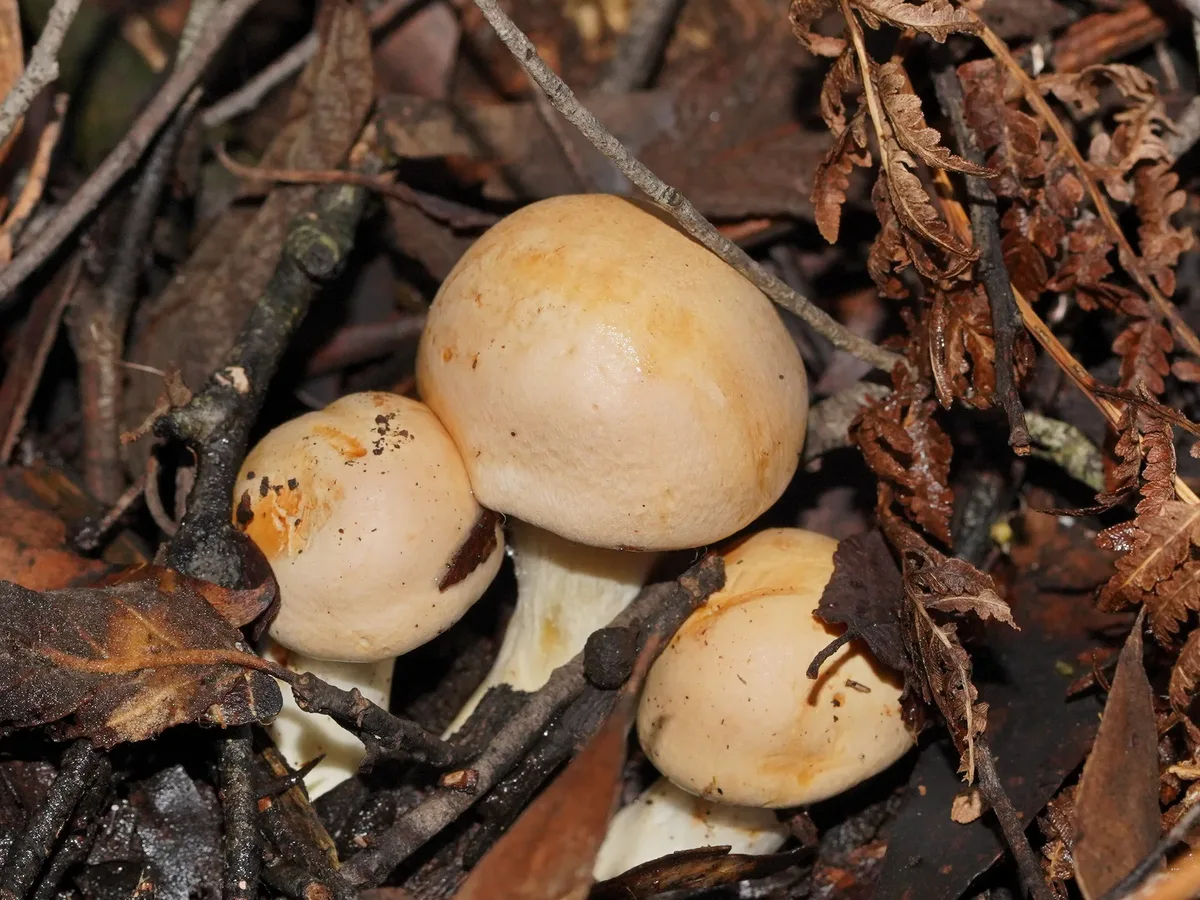
Phlegmacium medburyensis is a medium to large webcap with the quintessential Phlegmacium signature: a distinctly glutinous, sticky cap when moist, a rusty-brown spore print, and the characteristic cobwebby cortina of the genus Cortinarius in its broad sense.
Cap
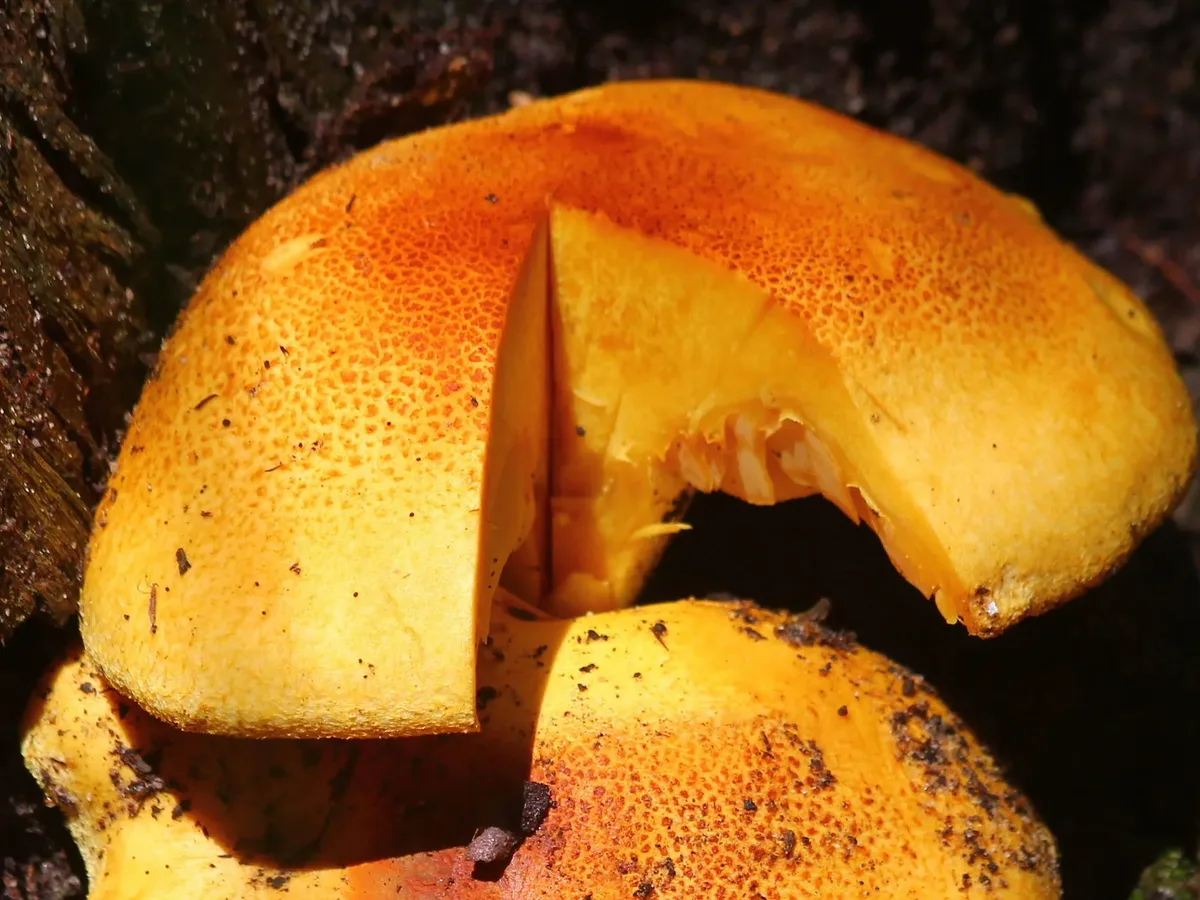
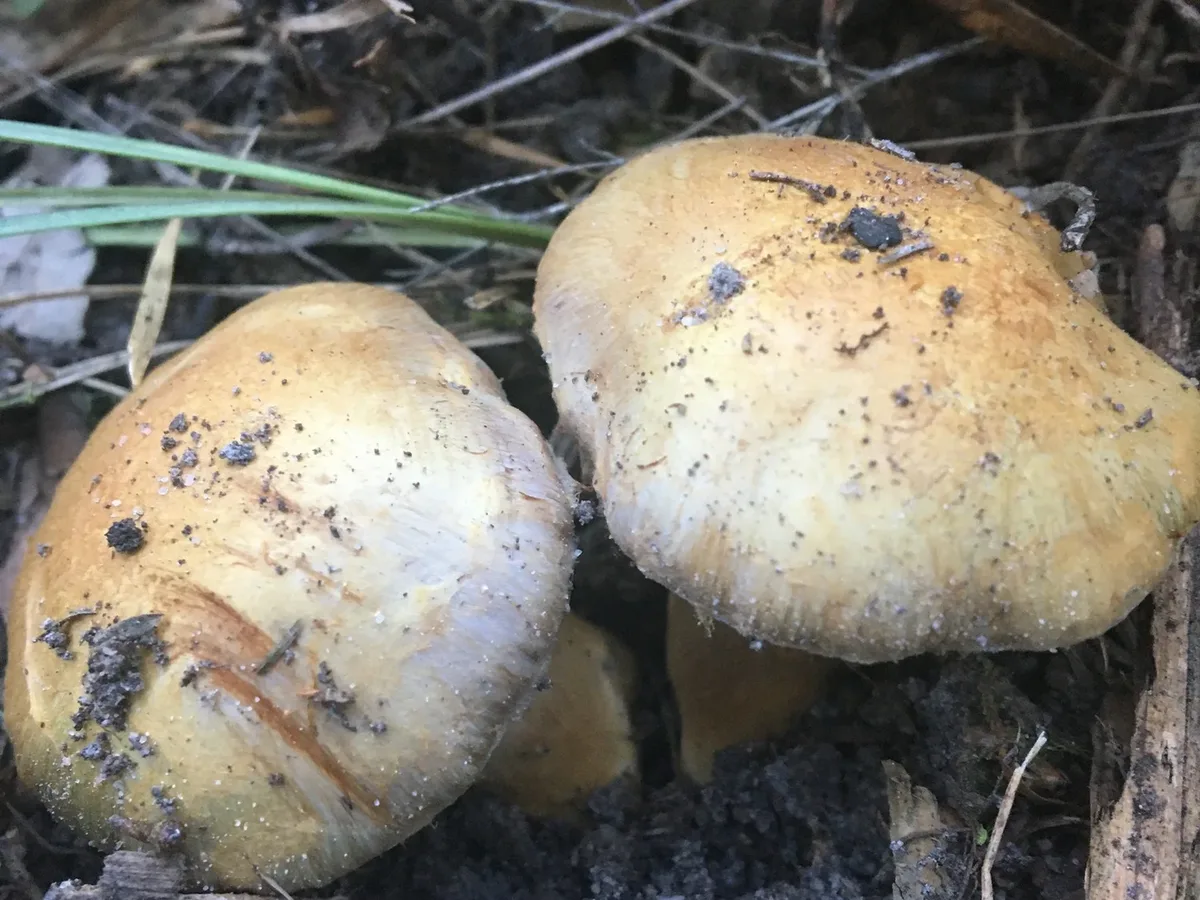
The cap - 4-10 cm across - progresses from a tight convex button to broadly convex or nearly flat, and the viscid surface in young, moist specimens is immediately tactile: the cap will cling slightly to your finger and gather debris.
The colour is warm ochre to tawny-brown or rusty-orange, richest at the centre and shading toward paler ochre or buff at the margin. When the weather is dry or the specimen ages, the glutinous layer dries out and the cap becomes dull ochre to pale tan, losing its most immediately recognisable feature.
Gills / Pores
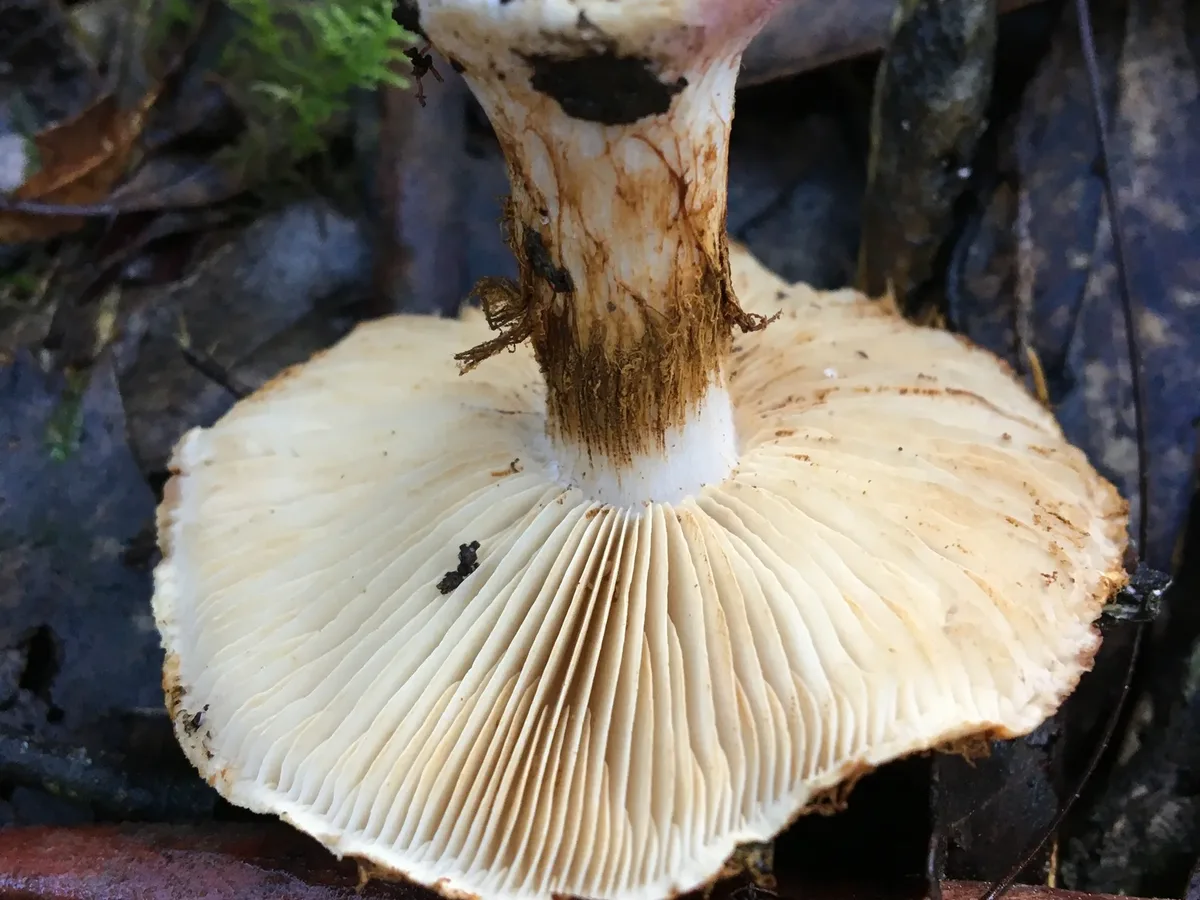
The gills start pale clay-buff and reliably darken to rusty cinnamon-brown as the spore crop matures - a hallmark of the entire Cortinarius/Phlegmacium clade: any gill-bearing mushroom with a rusty-brown spore print and a silky stem belongs to this group.
Stem
The cobwebby cortina is most conspicuous in young specimens, visible as white to buff strands spanning the gap between the cap margin and the upper stem; as the cap expands, these threads snap and leave a fibrous, rust-stained ring-zone on the stem.
The stem itself is whitish to pale buff, firm, and slightly fibrillose-silky.
Flesh
Flesh is white throughout and does not change on cutting.
The verrucose (warted) spores, 8-11 µm long, are a microscopic confirmation character but not a field feature.
Why it's dangerous
FATAL. Phlegmacium medburyensis must be treated as a deadly poisonous species carrying orellanine-class nephrotoxin.
The Australasian Cortinarius/Phlegmacium complex is firmly documented to contain orellanine, and there is no reliable field test - and no macroscopic or olfactory feature - that can distinguish a toxic from a non-toxic webcap without chemical analysis.
The extremely long latency of orellanine poisoning (up to several weeks between ingestion and the first symptoms) means that serious, potentially irreversible kidney damage accumulates silently before any alarm is raised.
There is no antidote. Treatment is supportive care, renal dialysis, and in severe cases kidney transplantation. A single meal containing this species can cause permanent renal failure or death.
If consumption of any Australasian Phlegmacium or Cortinarius species is suspected - even weeks previously, even in small amounts - emergency medical care must be sought immediately without waiting for symptoms to develop.
Advise emergency staff of the suspected exposure and the potential for orellanine so that renal function can be monitored over weeks.
Toxin
Phlegmacium medburyensis belongs to the orellanine-bearing Australasian webcap complex. Orellanine - a bicyclic dipyridine N-oxide - has been confirmed in multiple Australasian Cortinarius and Phlegmacium species, including confirmed-deadly species sharing the same habitat and season.
Orellanine is heat-stable and is not destroyed by any standard cooking, drying, freezing, or pickling method.
In the body it undergoes bioactivation to nordihydroorellanine and related compounds that selectively destroy the proximal tubule cells of the kidney, producing progressive and potentially irreversible renal failure.
The compound has a uniquely long latency before symptoms appear: typically 2-3 weeks, with a documented range extending to a month or more.
Toxicological confirmation for P. medburyensis as a recently described species is limited by the small body of literature. But Australian mycological consensus treats all Australasian Phlegmacium and Cortinarius species as carrying full orellanine-class risk unless specifically cleared by chemical analysis - which has not been performed for this species.
Symptoms
Orellanine nephrotoxicity has a severely delayed onset that is the defining characteristic - and the defining hazard - of this poisoning.
After ingestion, the victim typically remains entirely well for 2 to 3 weeks (occasionally up to 4-6 weeks), during which time orellanine is causing progressive, cumulative destruction of the kidney's proximal tubule cells with no warning symptoms.
When the damage threshold is eventually crossed, symptoms appear:
- Intense thirst (polydipsia)
- Increased or decreased urinary output
- Persistent fatigue
- Headache
- Nausea and vomiting
- Anorexia
- Severe flank or lower back pain
These signs reflect advancing acute kidney injury and, if untreated, progress to oliguria (severely reduced urine output), uraemia, and end-stage renal failure.
The extreme delay between ingestion and symptoms is clinically catastrophic: patients rarely connect a mushroom meal from three weeks prior to their emerging renal failure, and physicians may not consider the diagnosis until renal function has declined severely.
Staying safe
Do not eat Phlegmacium medburyensis or any unknown webcap in Australasian native forest. The orellanine toxin is heat-stable and not inactivated by cooking, drying, freezing, pickling, or any other food preparation technique.
The catastrophically long delay before symptoms appear - up to several weeks - means a forager can consume this species, feel entirely well, and not connect their subsequent kidney failure to the mushroom. By the time the renal damage becomes symptomatic, significant and potentially irreversible destruction of kidney tissue has typically already occurred.
If there is any possibility that a Phlegmacium or Cortinarius species has been consumed - even in small quantities, even well-cooked, even as a small bite taken 'just to try' - seek emergency medical care immediately without waiting for symptoms:
- In Australia, call the Poisons Information Centre (13 11 26).
- In New Zealand, call the National Poisons Centre (0800 764 766).
Never allow any webcap in native Australian or New Zealand forest to enter a food basket alongside edible species: cross-contamination of toxin residue is a real and documented risk. Leave this species undisturbed in the field.
Where & when it grows
Habitat
Phlegmacium medburyensis is an obligate partner of native eucalypts in southeastern Australia's tall and medium sclerophyll forests. The ectomycorrhizal relationship with Eucalyptus species is the ecological core of this species' existence, particularly with:
- Mountain ash (E. regnans)
- Messmate (E. obliqua)
- Snow gum relatives
- Ribbon gum (E. viminalis)
It cannot fruit in the absence of its tree host, which means it is strictly tied to mature native forest with established root networks.
The forest floor setting is shaded or semi-shaded, with a well-developed accumulation of eucalypt leaf litter and often a layer of woody debris. Soil chemistry is typically acidic (consistent with eucalyptus-dominated forest), and fruiting sites are generally moist in autumn without being waterlogged.
Seeing a viscid, ochre-brown mushroom with rusty gills and a cobwebby veil beneath mature eucalypts in April-May in southeastern Australia is a reliable indicator of the Phlegmacium complex - the specific species determination requires expert assessment but the danger level is consistent across the group.
When
Fruiting is a Southern Hemisphere autumn phenomenon, beginning as early as March in wetter years and running through to June or July at higher elevations or in more rainfall-reliable sites.
The core season is April-May, when two converging autumn cues - soil cooling and rainfall rehydration - activate the established mycorrhizal mycelium to initiate fruiting.
Summer in southeastern Australia is typically hot and dry, suppressing mushroom activity. The first meaningful autumn rains (a useful threshold is 20-30 mm over 14 days), combined with soil temperatures falling through the 8-16 °C range, reliably precede fruiting - with a lag of approximately 10-21 days between the rain event and the emergence of visible fruiting bodies.
In drought years the season may be negligible; in well-watered autumns a flush can persist across multiple weeks. The species does not fruit in spring or summer.
How it grows
As a strictly ectomycorrhizal species, Phlegmacium medburyensis forms a long-lived, perennial underground partnership with its eucalyptus host. The true body of the organism - the mycelial network enveloping fine root tips and threading through the soil matrix - is invisible most of the year.
When autumn conditions align, the mycelium invests resources into producing the macroscopic fruiting body that we recognise as the mushroom.
Fruiting bodies emerge singly or in small, loosely scattered groups of two to five at any given site; dense clusters are not characteristic.
Because the underground network is perennial, productive forested patches tend to fruit repeatedly across successive autumns when conditions permit, and experienced observers often return to known sites.
The mushroom itself is only the spore-bearing reproductive organ; the ecological significance of the organism lies in its soil-building, nutrient-cycling partnership with the eucalyptus canopy.
Fruiting conditions
Southern Hemisphere autumn species. Fruiting triggered by post-summer soil cooling (temperatures falling below approximately 16 °C) combined with meaningful autumn rainfall (approximately 20+ mm over 14 days). Flush lag from triggering rain event to visible fruiting bodies is 10-21 days. Peak fruiting April-May across southeastern Australia; may extend to June-July at higher-altitude or wetter sites in Victoria and Tasmania.
Look-alikes
The most dangerous lookalikes are other Australasian Phlegmacium and Cortinarius species sharing the same viscid-capped, ochre-to-tawny appearance in native eucalyptus forest.
- Cortinarius australiensis and related species (collectively the 'ochre webcap complex') share the warm brown, glutinous cap and rusty spore print in the same habitat and season. The distinction between species is not reliably achievable in the field without expert microscopy. All carry equivalent orellanine risk and should be treated identically.
- The violet-blue webcaps - C. rotundisporus, C. archeri - differ in colour (blue-violet rather than ochre-brown) but share habitat, season, and deadly risk. A forager encountering multiple webcap species in the same forest patch must treat all as equally dangerous.
- Some Suillus species (boletes) are superficially similarly coloured and glutinous-capped but have pores (sponge-like undersurface) rather than gills, and bear no structural resemblance to a webcap once the underside is examined.
- Hebeloma crustuliniforme (poison pie) has a similarly pale buff to ochre-brown cap and earthy smell but is smaller, lacks the glutinous texture of a Phlegmacium cap, produces brown (not rusty-orange) spore prints, and grows in different habitat associations. It is also toxic but not through orellanine.
- Rozites caperatus (gypsy mushroom, also reclassified to Cortinarius) is edible in Europe but does not reliably occur in Australian native eucalyptus forest, and any confusion in that setting would be extremely unusual.
In Australian eucalyptus forest, any brown, viscid-capped, gilled mushroom with a rusty-brown spore print and silky-fibrillose stem must be treated as a potentially deadly webcap.
C. archeri is typically violet to purple but can fade or present in paler variants; it is confirmed to contain orellanine and occurs in the same native Australasian forest habitat. As with all Australasian Cortinarius/Phlegmacium species, field separation of individual species from P. medburyensis is unreliable and carries no practical safety benefit - all must be treated as equally deadly.
Multiple Phlegmacium and Cortinarius species occur in Australian native eucalyptus and Nothofagus forest, sharing the viscid cap, rusty spore print, cobwebby cortina, and ectomycorrhizal ecology. Orellanine has been confirmed across the complex. Species-level identification requires microscopy, chemical analysis, and expert review. In the field, all species in this complex must be treated as potentially carrying orellanine-class deadly risk - the 'leave all webcaps in native Australasian forest untouched' rule applies universally.
C. australiensis and closely related Australasian Cortinarius species share the viscid ochre-brown cap, rusty-brown spore print, and eucalyptus forest habitat. Field separation between P. medburyensis and C. australiensis and related ochre webcaps requires microscopy and, ideally, chemical analysis. Both carry equivalent orellanine-class deadly risk; the practical safety conclusion is identical for all species in the complex - avoid.
C. rotundisporus shares the same native eucalyptus forest habitat and season and is a confirmed deadly orellanine species. It is distinguished by its striking blue-violet to violet-blue coloration (versus the warm ochre-brown of P. medburyensis), but both species may co-occur in the same forest patch. The colour difference is reliable in fresh specimens but fades in old or dry specimens; confusion is most likely between aged, faded blue webcaps and fresh ochre ones. All Cortinarius/Phlegmacium in this habitat must be avoided.
Rozites/Cortinarius caperatus has a similarly coloured dry to slightly wrinkled cap (not glutinous), occurring in European conifer and beech forests. It does not naturally occur in Australasian native eucalyptus forest, so confusion is only a risk for European foragers transplanted to Australia who mistake a viscid Phlegmacium for a familiar European species. In its European range, C. caperatus is edible, but in an Australian eucalyptus forest any species resembling it must be treated as part of the local orellanine-bearing Cortinarius complex. The glutinous cap surface of P. medburyensis (versus the dry or only slightly moist cap of C. caperatus) is a key separating feature.
A reference guide - never an edibility guarantee. When in doubt, leave it out.