Tropical brown bolete
Phlebopus tropicussyn. Boletus tropicus, Gyroporus tropicus
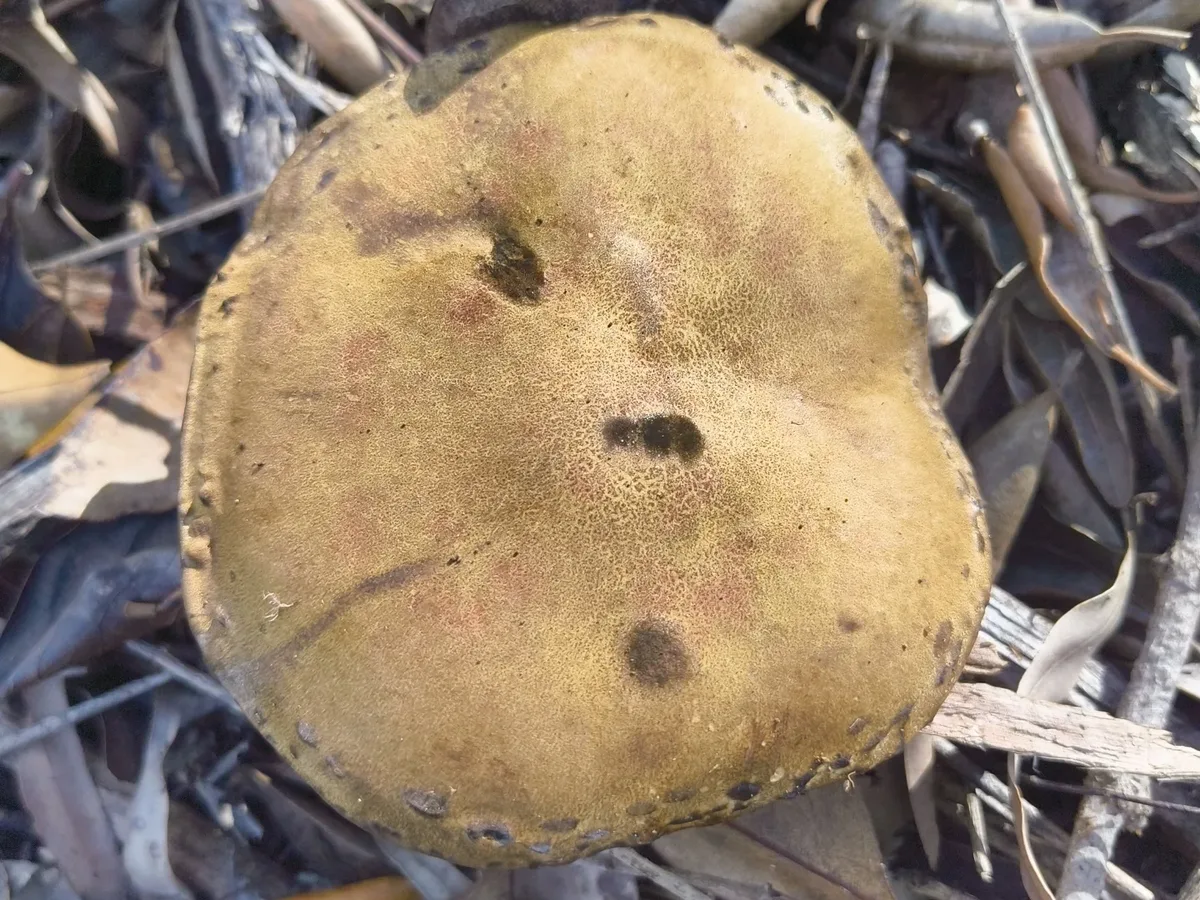 Atlas of Living Australia (CC0)
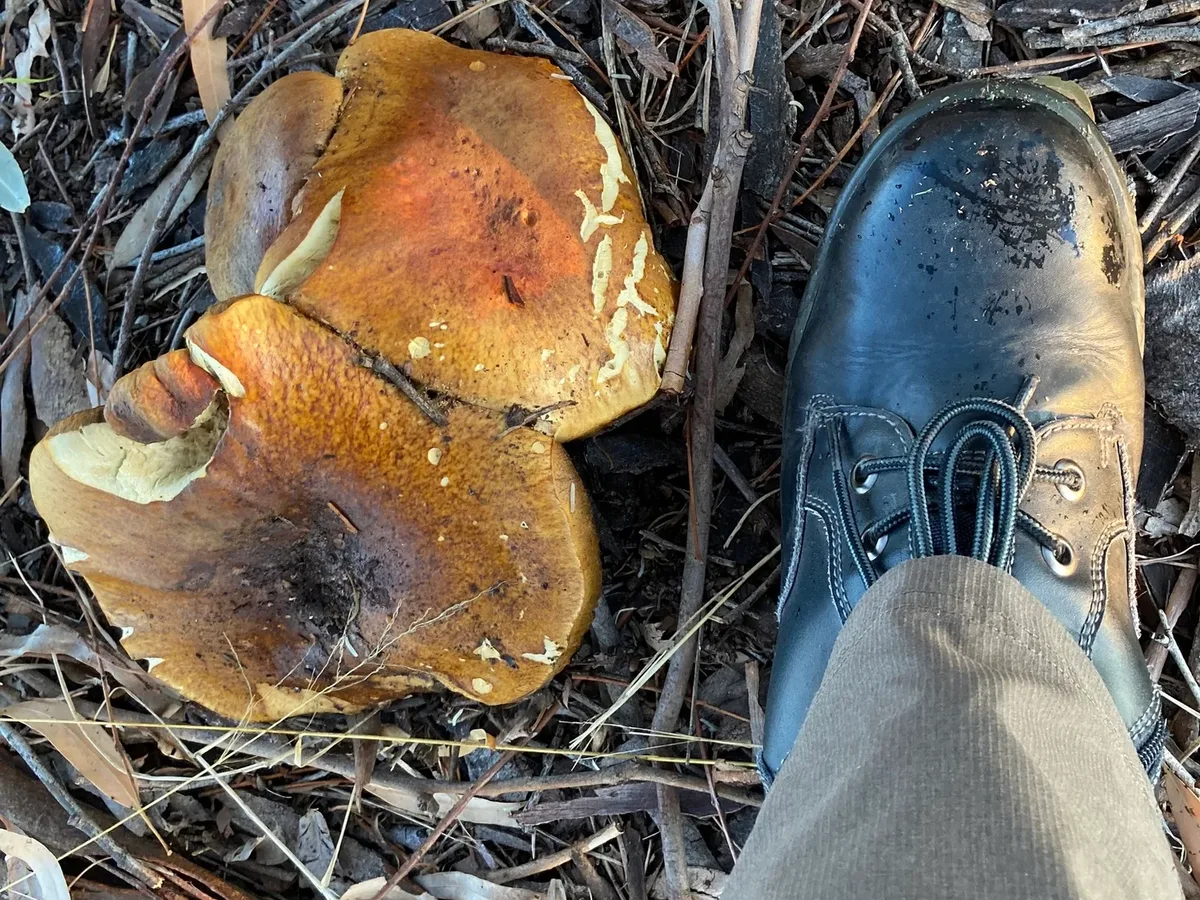 Atlas of Living Australia (CC0)Atlas of Living Australia (CC0)Atlas of Living Australia (CC0)
Good to eat, once you have identified it with certainty and cooked it through.
How to recognise it
Phlebopus tropicus is a genuinely large bolete - cap 8-25 cm across, stout-stemmed, built for the abundance of the tropical wet season.
Cap
Young caps are firmly convex and smooth, the surface a warm mid-brown to dark chocolate-brown that can crack faintly in dry spells. With age the cap flattens and may develop a shallow central dip.
Gills / Pores
Turn the cap over and the pore surface is a consistent pale sulphur-yellow, fine and angular. Here is an important character: any blueing when you press or nick it is slow and faint at most, nothing like the swift indigo flood of the dangerous blueing boletes.
Stem
The stem is stout and clearly reticulate on its upper half - a raised, net-like pattern of ridges that is one of the hallmarks of the genus.
Flesh
The flesh inside is pale cream to pale yellow, dense and firm in fresh specimens, and holds its colour well when cut.
Spore print is olive-brown.
Where & when it grows
Habitat
A South American species at home across Brazil, Argentina, Paraguay, and Uruguay - from the Atlantic Forest coast to the cerrado-edge woodlands of the interior.
Where it differs from the classic porcini group is in its tolerance of disruption. This is a mushroom that thrives at plantation edges, roadsides, and in secondary regrowth, fruiting from humus-rich soil or near tree bases under introduced eucalypts and conifers as readily as under native canopy.
That flexibility comes from its ecology - Phlebopus tropicus is saprotrophic (breaking down organic matter rather than trading nutrients with a host tree root), which means it can persist and prosper in landscapes that would exclude strictly mycorrhizal species.
After warm summer rains, fruiting bodies push up from the damp soil - sometimes in places you would not expect a large handsome bolete to appear.
When
The fruiting season mirrors the Southern Hemisphere summer rains. From October onward, as the austral wet season builds, fruiting bodies begin to appear.
November through February is the productive heart of the season - warm soil (above roughly 20-22 °C) combined with cumulative rainfall is what unlocks a flush. Individual mushrooms develop quickly once conditions are right, reaching full size in just a few days.
By March-April, as the rains taper and temperatures ease, fruiting fades out. Through the dry austral winter, May to September, the mycelium waits quietly in the soil - invisible, but ready for the next rainy season.
How it grows
Like other Phlebopus species, P. tropicus appears to fruit saprotrophically from rich organic matter rather than depending on a strict ectomycorrhizal tree partner - though loose root associations cannot be fully excluded.
Fruiting bodies appear singly or in small groups, emerging quickly after significant rainfall and reaching full size within 2-4 days. They deteriorate rapidly in tropical heat, so freshness assessment is critical.
The mushroom can reappear in the same site across successive seasons, suggesting persistent mycelial networks in stable soil conditions.
Fruiting conditions
Fruiting is triggered by summer monsoon-season rains in the Southern Hemisphere. Cumulative rainfall of at least 35 mm over the preceding 14 days combined with warm soil temperatures (20-32 °C) drives flush initiation. Fruiting bodies emerge 3-7 days after significant rainfall and develop to full size within 2-4 days. The dry austral winter prevents fruiting from May to September.
Look-alikes
Within South America, several boletes could cause confusion.
- Blueing boletes (Neoboletus, Rubroboletus) - the most important look-alike group; they blue rapidly and dramatically within seconds of cutting, and can cause gastrointestinal illness if not thoroughly cooked (Rubroboletus can be more severely toxic). Phlebopus tropicus does not blue rapidly or dramatically.
- Porphyrellus species - darker, purplish-grey pores rather than yellow pores.
- Suillellus luridus-group species - if imported in mycelium or locally recorded, show red pore surfaces and dramatic blueing.
No deadly species is known to be a close mimic of P. tropicus in South American markets, but the general rule applies: any large bolete with red pores or rapid dramatic blueing should not be consumed without expert verification.
Blueing boletes (Neoboletus, Lanmaoa) produce a rapid, dramatic indigo colour change in the cut flesh within seconds - Phlebopus tropicus shows only faint, slow or absent blueing. Blueing boletes may also have reddish or orange tones in the pore surface. The speed and intensity of the blueing reaction is the key diagnostic: cut a small sliver of flesh and observe for 30 seconds. Rapid deep-blue = blueing bolete; slow pale tinge or none = consistent with Phlebopus.
Porphyrellus has characteristically dark purplish-grey to dark brown pores (not yellow), a darker overall colouration, and is typically smaller. It is generally considered inedible or of unknown edibility. The yellow pore surface of Phlebopus tropicus readily distinguishes it.
Any bolete with orange-red to blood-red pores is a completely different and potentially dangerous species. Phlebopus tropicus has pale sulphur-yellow pores. Never collect a large brown-capped bolete with red or orange-red pores without expert identification - several such species cause severe gastrointestinal poisoning.
In the kitchen
Picking & cleaning
Pick when the cap is still convex to flat-convex and the pores are firm and a clean sulphur-yellow - at this stage the flesh is dense and at its best.
Cut cleanly at the base or twist carefully, then check the stem base for larval tunnelling. Large tropical boletes in warm weather are popular with insects, and an apparently fresh cap can have a hollowed stem.
Before you bag it, run two quick checks in good light:
- 1Are the pores yellow (not red, orange, or purplish)?
- 2Does a small nick in the flesh stay pale rather than turning deep indigo within 30 seconds?
If both checks pass, you have a good candidate. Trim any soft or damaged tissue in the field, and get the mushrooms into a cool, ventilated container as soon as possible - tropical boletes deteriorate quickly once picked and do not forgive delay.
Cooking
Phlebopus tropicus has firm, pale flesh with a mild, pleasant flavour suited to most cooking methods appropriate for large boletes. The texture holds up well to heat.
It can be:
- Sliced and sautéed in oil or butter with garlic and herbs
- Added to rice dishes, stews, and soups
- Grilled
In Brazil it may be prepared in the tradition of locally foraged large boletes: simply fried with olive oil, garlic, and parsley, or incorporated into risotto-style rice dishes.
Drying is an effective preservation method - sliced thin and dried in the sun or a dehydrator, it reconstitutes well and concentrates the earthy flavour.
Always cook thoroughly; do not eat raw.
Good to know
Phlebopus tropicus is consumed locally in parts of Brazil and is considered edible, with no confirmed poisoning reports attributed to correctly identified specimens. However, documentation of this species in scientific safety literature is limited compared to its Asian congener P. portentosus.
As a species known primarily from field reports and regional mycological literature rather than systematic toxicological testing, a cautious approach is warranted:
- Always cook thoroughly before eating (raw boletes of any species can cause gastrointestinal irritation).
- Avoid over-mature or larva-damaged specimens.
- Verify identification with a local expert before consuming.
The absence of red pores and of rapid dramatic blueing provides reasonable reassurance against the most dangerous bolete look-alikes, but does not replace careful identification.
A reference guide - never an edibility guarantee. When in doubt, leave it out.