Salmon gum mushroom
Phlebopus marginatussyn. Boletus marginatus, Phaeogyroporus marginatus, Gyroporus marginatus
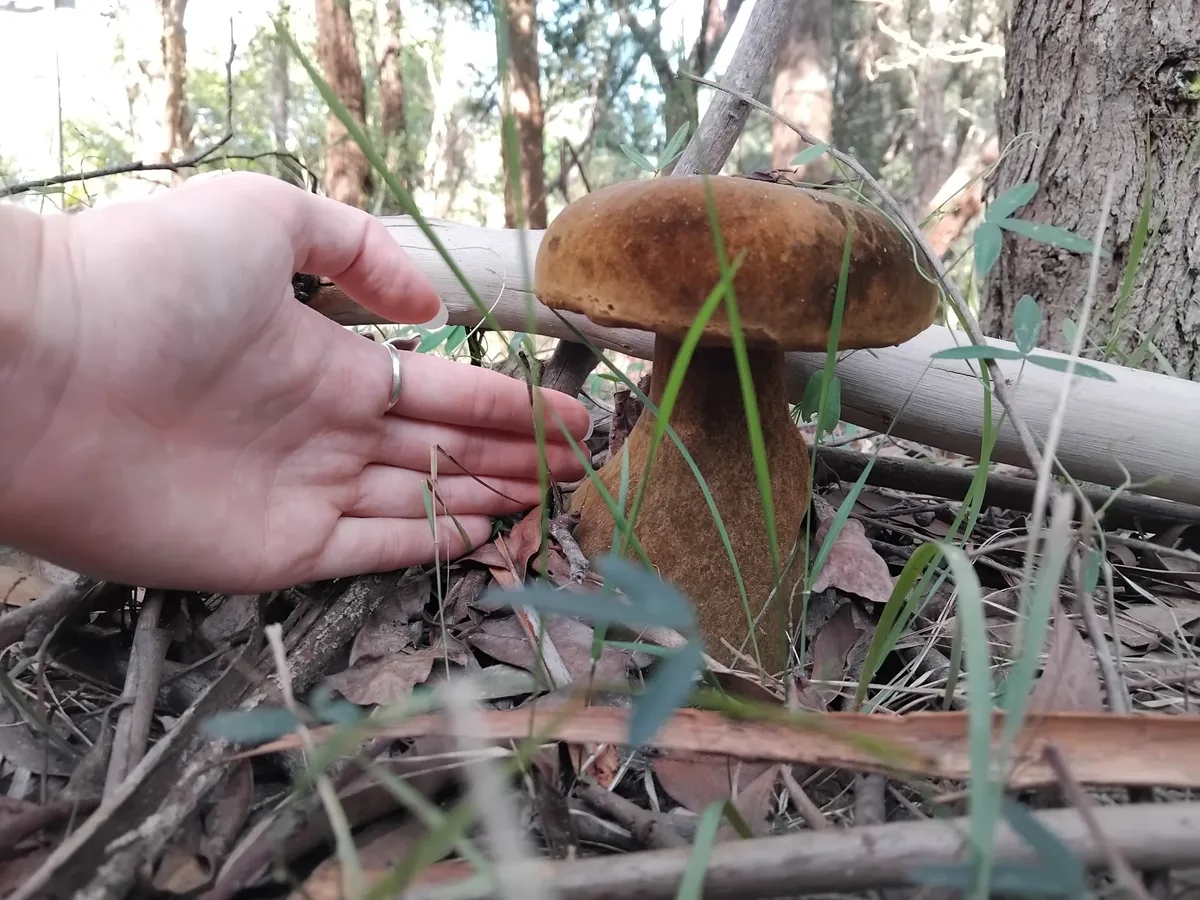 © Sofia Zvolanek (CC BY)
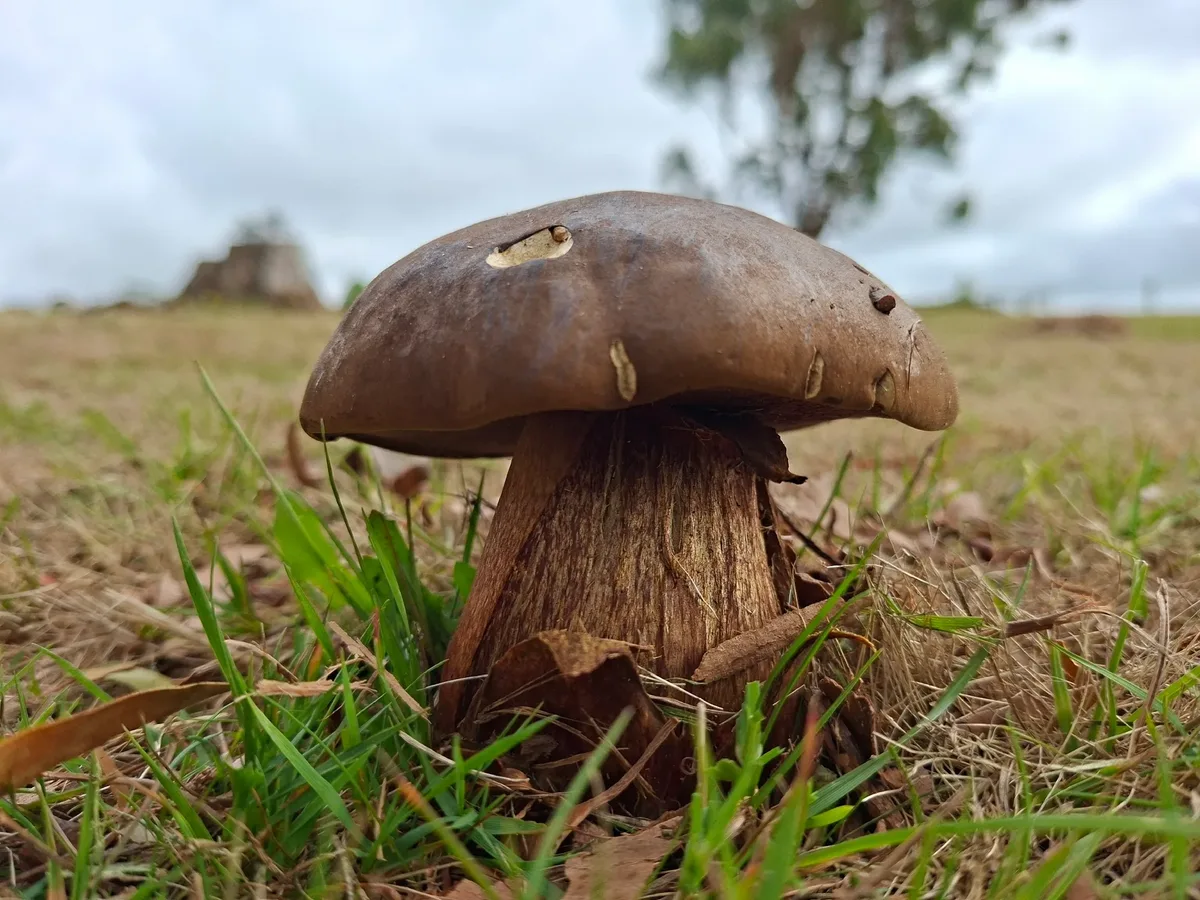 © Brendan Costello (CC BY)
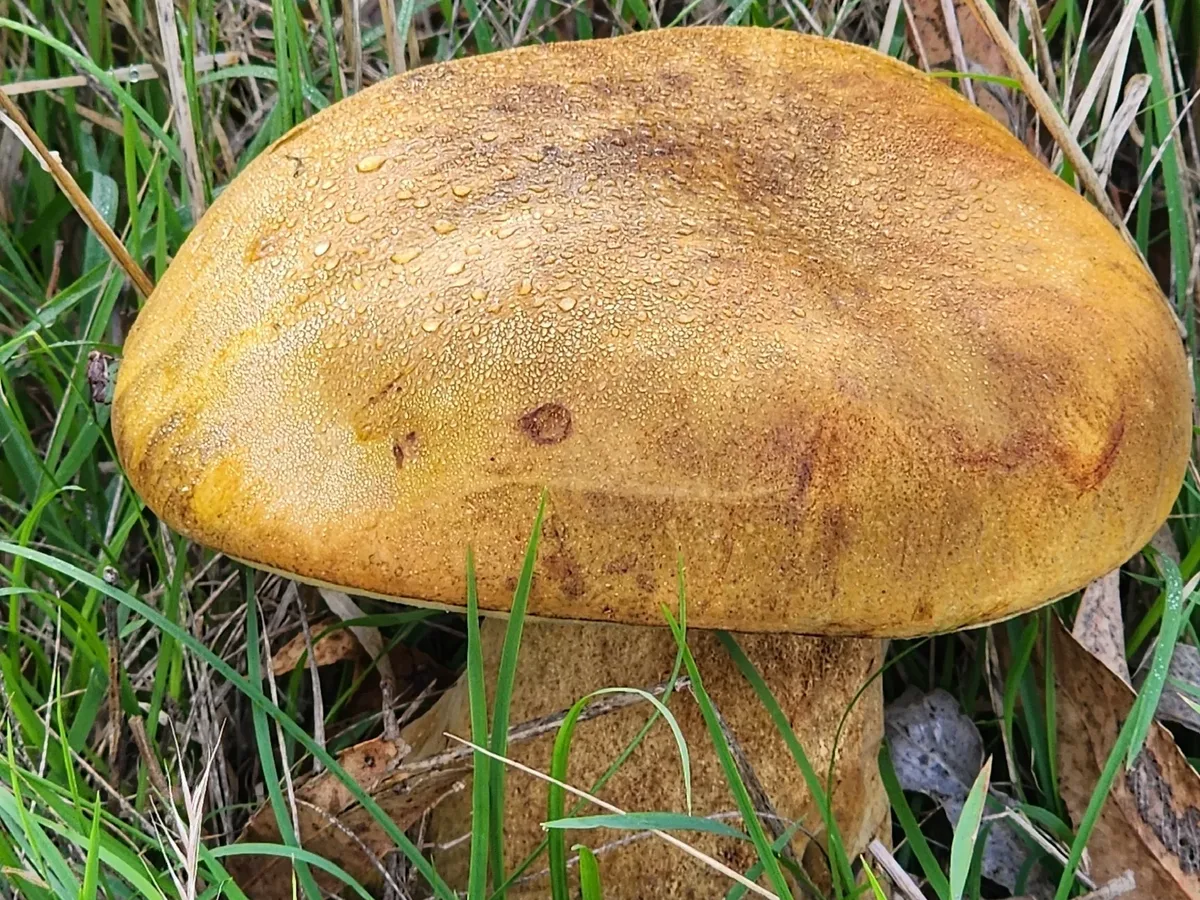 © Wendy F (CC BY)
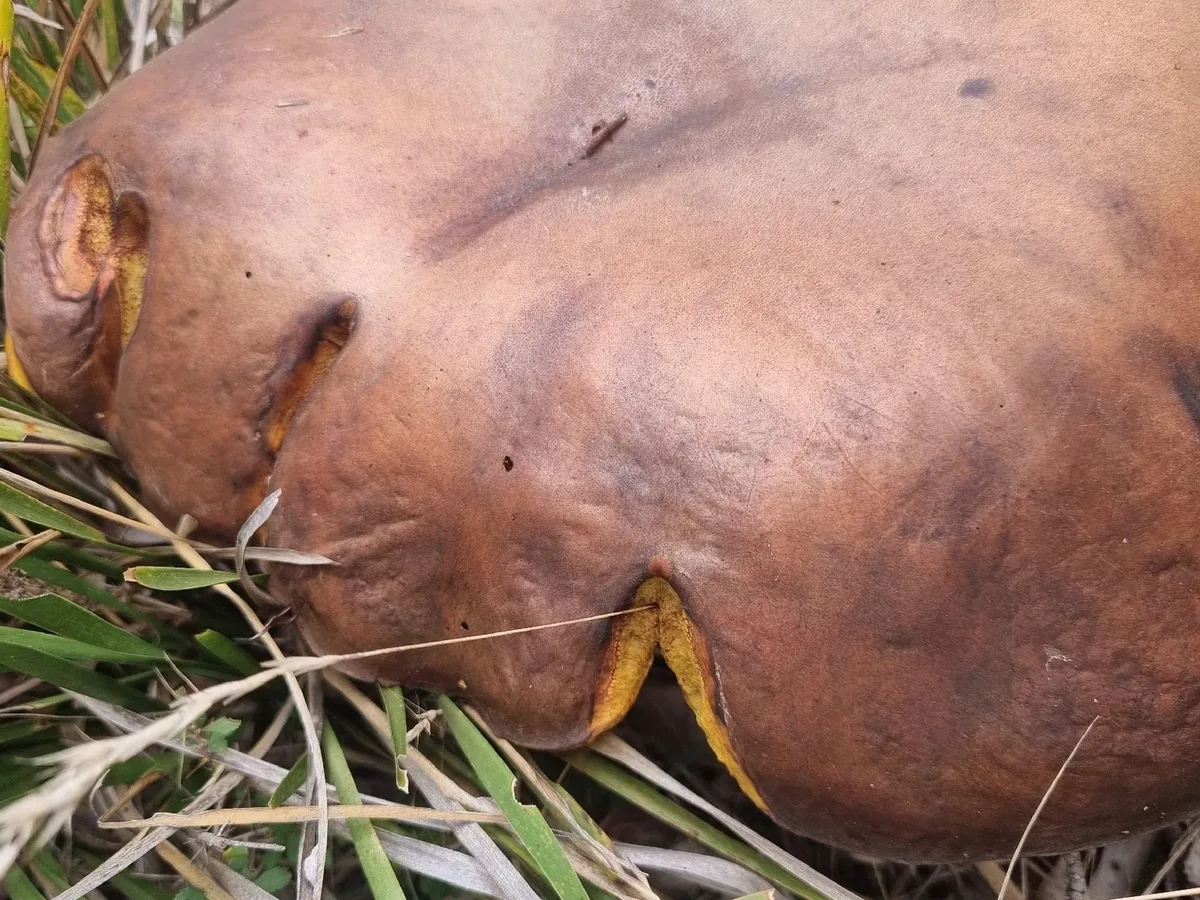 © Peter Crowcroft (CC BY)
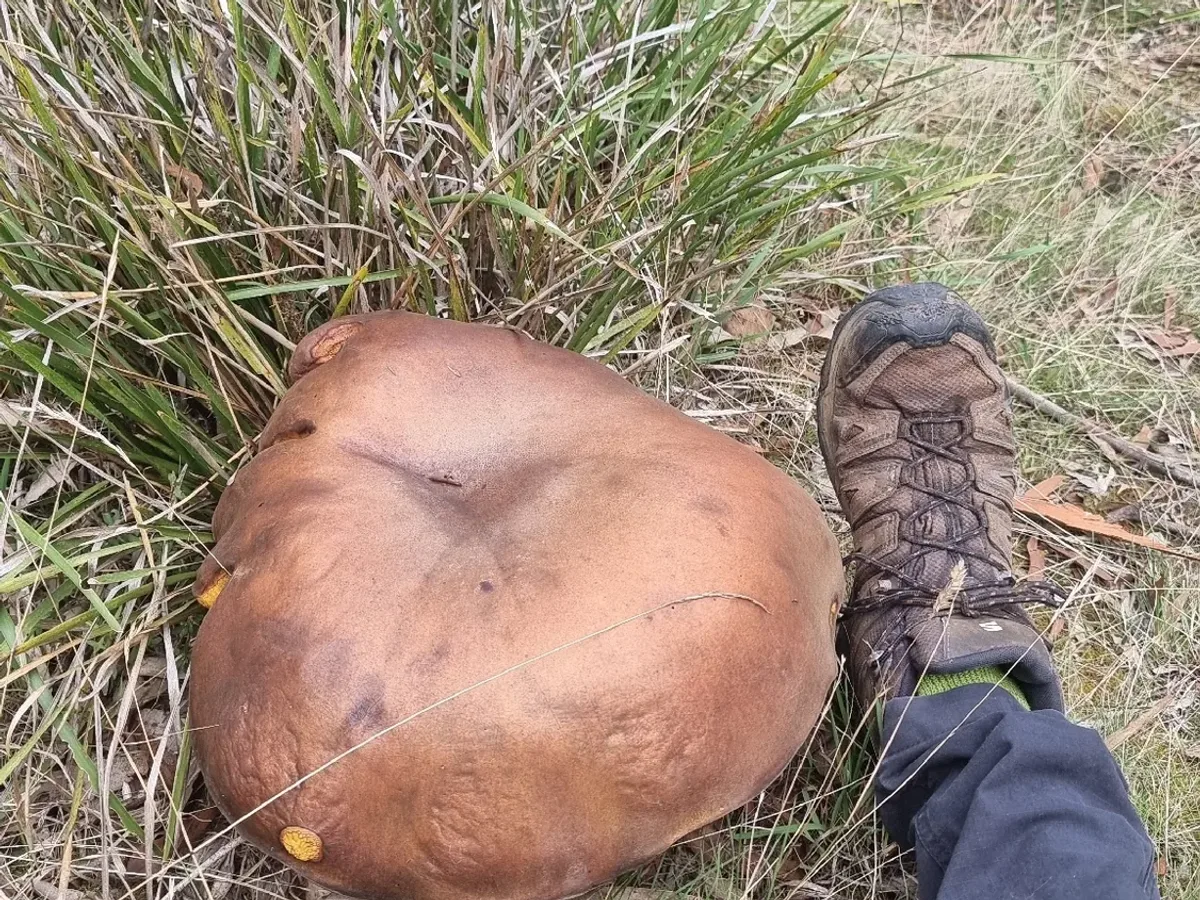 © Peter Crowcroft (CC BY)
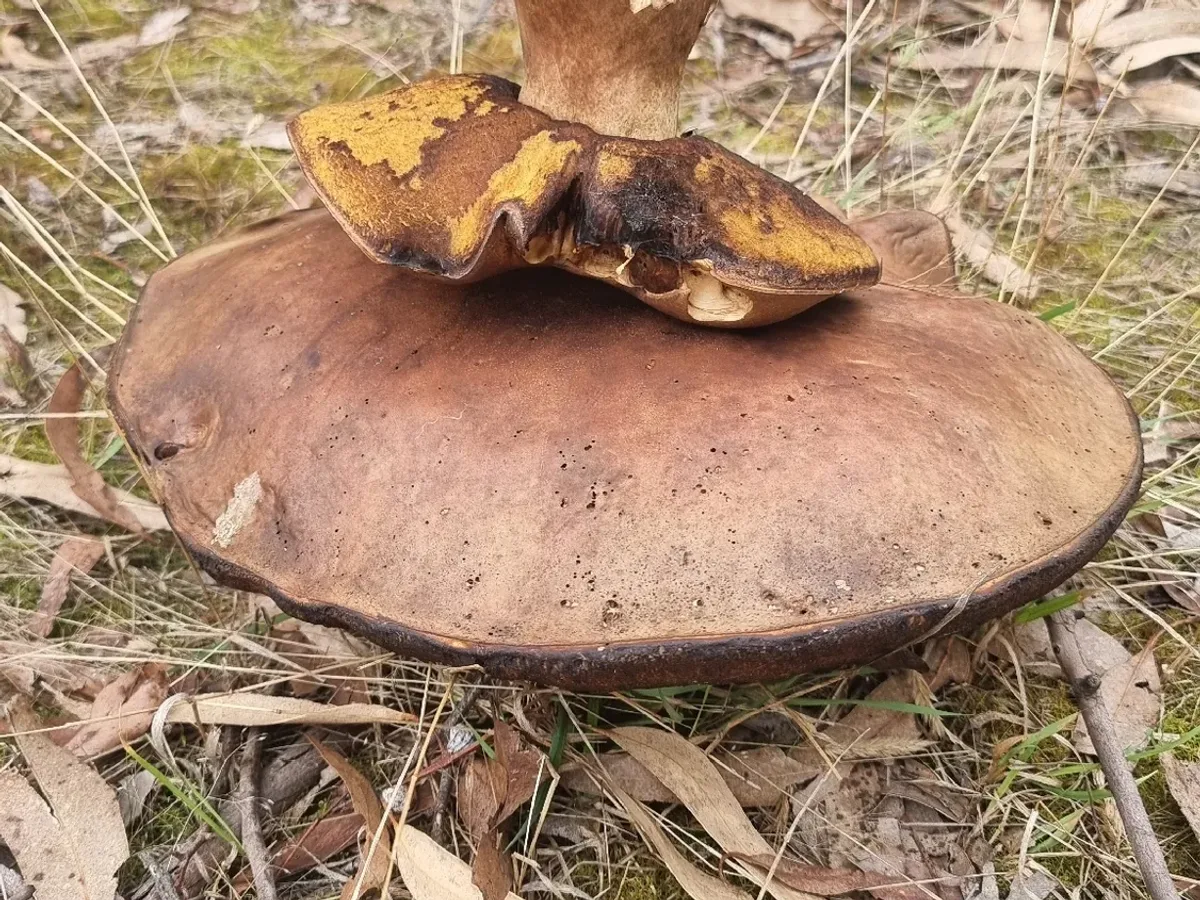 © Peter Crowcroft (CC BY)
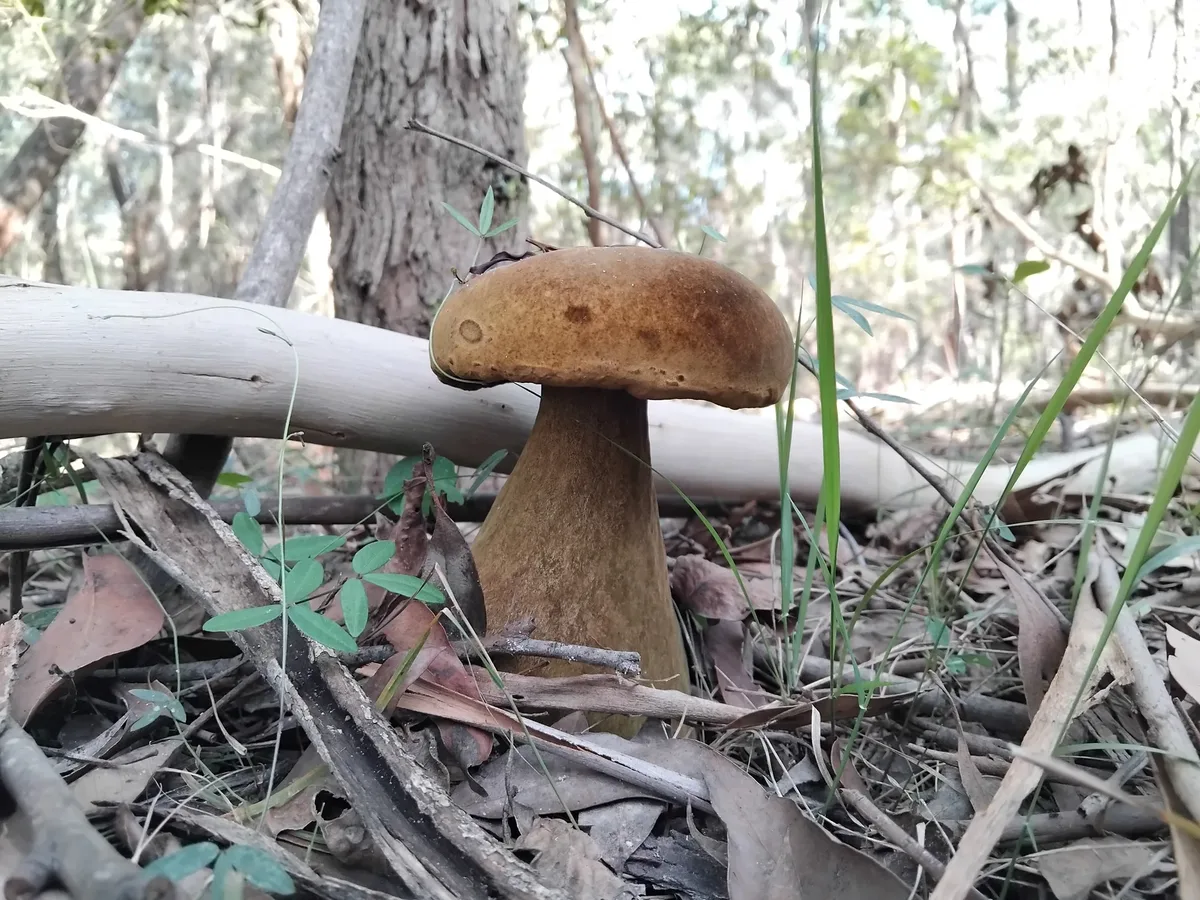 © Sofia Zvolanek (CC BY)© Sofia Zvolanek (CC BY)© Brendan Costello (CC BY)
Edible only with the right preparation - or safe for some people but not others. Learn the caveats first.
Never eat a mushroom you are not 100% sure of - check the look-alikes below, and always cook wild mushrooms.
How to recognise it
Phlebopus marginatus is one of the largest boletes in the Southern Hemisphere, sometimes described as the 'Australian porcini' on account of its imposing size and appealing colour.
Cap
The cap opens broadly convex, ranging from 8 cm in young buttons to 30 cm or more at full maturity. The surface is dry to very slightly greasy in wet weather, coloured a handsome dark chocolate-brown to warm tawny-brown, sometimes taking on a greenish-olive cast near the thin, slightly overhanging margin.
Gills / Pores
The underside is covered in fine, tightly packed pores rather than gills. These start a vivid chrome-yellow in buttons, turning yellowish-olive with age, and bruise distinctly blue-green when pressed or cut - a reaction familiar to bolete hunters but important to note as a diagnostic feature. The tubes beneath are up to 2 cm deep.
Stem
The stem is very robust, often club-shaped or bulbous at the base, 5-15 cm tall and 2-7 cm thick, solid throughout. Its surface is pale to mid yellowish-brown, covered in longitudinal fibres and a subtle reticulation near the apex; the base frequently darkens to deep brown or blackish.
Flesh
Flesh is pale cream-yellow, thick and firm in youth. On cutting it slowly turns blue-green, most noticeably near the tube layer, then fades to pale grey or off-white within a few minutes.
Smell & taste
The smell is mild and pleasant, faintly earthy, occasionally with a faint farinaceous note.
Spore print: olive-brown to dark brown.
Microscopically the spores are ellipsoid-subfusiform, 8-13 × 4-6 µm, smooth, pale ochre-brown in KOH.
Where & when it grows
Habitat
This species is associated with eucalypts and closely related trees. The exact nutritional relationship (ectomycorrhizal or saprotrophic) remains debated in the literature, though it is most reliably found close to root zones.
It is most frequently encountered beneath Eucalyptus and Corymbia species - particularly the salmon gum (Eucalyptus salmonophloia), from which one of its common names derives - as well as flooded gum, red gum, spotted gum, and other woodland eucalypts.
It also forms associations with Casuarina and has been found in pine plantations, suggesting some flexibility in host range.
Phlebopus marginatus is notably at home in disturbed and semi-urban settings: it appears regularly in parks, street tree pits, golf courses, and suburban gardens wherever host trees are present, and large fruitbodies emerging from lawns are frequently reported.
Soils are typically sandy to sandy-loam, well-drained but moistened by autumn rain.
When
Phlebopus marginatus is an autumn mushroom, and its timing follows autumn rain as faithfully as any fungus in the Southern Hemisphere.
Across temperate and cool-temperate Australia the main flush runs from March through June, with the peak concentrated in April and May as soil temperatures drop and the first significant rains soak in beneath the eucalypts.
In subtropical Queensland and along the warmer coastal strip the season is more elastic - prolonged dry spells can hold the fungus in check for months, then a good rain event will trigger a flush almost regardless of the calendar.
In New Zealand the pattern mirrors south-eastern Australia: North and South Islands both produce fruitbodies in the same April-June window, occasionally extending into July in mild, wet years.
How it grows
Fruitbodies appear singly or in small scattered groups, sometimes in loose arcs or rings reflecting the extent of the underground mycelial network around a host tree.
Young specimens emerge as firm, rounded buttons with strongly incurved caps. Growth is rapid after rain and large caps can open within 48-72 hours.
Old specimens become broad and flat, edges sometimes split or upturned, pores browning and often infested by fly larvae.
The mycelium is perennial and large; old eucalypts may fruit reliably year after year at the same spots.
Fruiting conditions
Fruiting is triggered by significant autumn rainfall of 25 mm or more over 1-2 weeks combined with cooling soil temperatures. The flush typically appears 5-14 days after rain soaks the soil around host eucalypts. In hot dry summers fruiting is suppressed entirely.
Look-alikes
The most important lookalike concern in Australia is red-pored boletes. True Rubroboletus satanas (Satan's Bolete) is a Northern Hemisphere species not established in Australia, but related red-pored genera including Neoboletus and Imperator can occur in Australia.
Any bolete with red or orange pores must be rejected immediately and unconditionally - red-pored boletes can cause severe poisoning and have been linked to fatalities.
Phlebopus marginatus has uniformly yellow pores that age to olive-brown, never showing any red or orange colouration - this is the single most important distinguishing feature.
Other species to separate:
- The Slippery Jack (Suillus luteus) is much smaller, has a sticky cap, and grows only under pines.
- Gyroporus castaneus is much smaller with white pores and a hollow stem.
- Caloboletus calopus could theoretically appear in planted European tree areas in cooler southern Australia; it has pale pores that blush blue strongly and then also redden, a vivid red stem base, and an intensely bitter taste - a taste test resolves confusion immediately.
- Within Phlebopus itself, the related Phlebopus sudanicus occurs only in sub-Saharan Africa.
Overall, P. marginatus is a relatively distinctive fungus in Australia due to its large size, association with eucalypts, yellow pores, and moderate blue staining - but the red-pored bolete risk is real and must be checked every time.
DEADLY - reject immediately. Any bolete with red or orange pores must never be eaten. True Rubroboletus satanas is a Northern Hemisphere species not established in Australia, but related red-pored genera (Neoboletus, Imperator) can occur in Australia and have caused severe poisoning. Phlebopus marginatus has uniformly yellow pores that age to olive-brown - never any red or orange. Check pore colour on every specimen before picking.
Possible in southern Australia near planted European trees. Has pale yellowish pores that flush blue strongly but also redden; stem has a vivid red base and reticulate orange-red pattern; flesh is intensely bitter - a single taste test (spit out immediately) resolves confusion. Not deadly but causes gastrointestinal poisoning.
Much smaller, chestnut-brown cap, white pores that do not stain blue, stem hollow or chambered - easy to separate from the large robust Phlebopus marginatus.
An African species not found in Australia. Distinguished by distribution alone; morphologically very similar but associated with African woodland trees. Notably, P. sudanicus is toxic when eaten raw, reinforcing the need for thorough cooking of all Phlebopus species.
Much smaller (cap 5-12 cm), sticky slimy cap, ring on stem, white to pale yellow pores. Found only under pines, not eucalypts. Easy to separate on size, habitat, and the distinctive slimy cap.
In the kitchen
Picking & cleaning
Choose young to medium-sized fruitbodies with firm, pale yellow pores. Avoid any with brown or slimy pores, or with maggot tunnels evident on cutting.
Cut the stem cleanly at ground level; there is no need to dig up the base. Trim away the tube layer if pores are soft or have browned in mature specimens.
Field-cleaned caps transport well in a shallow basket. Because individual caps can be very large, a single find may yield a kilo or more of usable flesh.
Use within 24-48 hours of picking; refrigerate on paper towels to absorb moisture.
Cooking
The flesh is firm, mild, and pleasantly savoury with a texture reminiscent of porcini, making it an excellent substitute in any recipe calling for Boletus edulis.
The blue staining disappears on cooking and the flesh turns pale grey-white, becoming firmer. Always cook thoroughly - never eat raw.
Slice thickly and dry-fry in butter over high heat until golden, seasoning generously; this caramelises the surface and concentrates the flavour. It performs well in risottos, pasta sauces, cream-based soups, and stir-fries.
The cap skin may be peeled from large specimens if very tough. The tube layer should be removed from older specimens as it becomes slimy and bitter with age.
For long storage, slice and dry at 50-60 °C until brittle; dried caps can be ground into a powder to use as a flavour base.
Good to know
Phlebopus marginatus is widely eaten in Australia and New Zealand, but must be considered a species requiring caution and thorough cooking.
Gastrointestinal upset has been reported from consuming large quantities or insufficiently cooked specimens. The closely related Phlebopus sudanicus is explicitly considered toxic when eaten raw.
Thorough cooking is mandatory - do not eat this species raw or undercooked.
The blue staining of the flesh, which may look alarming to new foragers, is caused by the oxidation of variegatic acid - the same reaction seen in many edible boletes - and is not a sign of toxicity.
As with all boletes, positively identify by confirming all of the following:
- 1yellow to olive pores, never red or orange;
- 2absence of a skirt (ring) or volva (cup at base);
- 3eucalypt or related host tree nearby;
- 4the moderate blue staining pattern on cut flesh;
- 5large, robust stature with dark brown cap.
Never eat any bolete with red or orange pores - this is the most critical safety rule for bolete hunting.
A reference guide - never an edibility guarantee. When in doubt, leave it out.