Phlebopus bruchii
Phlebopus bruchiisyn. Phaeogyroporus bruchii
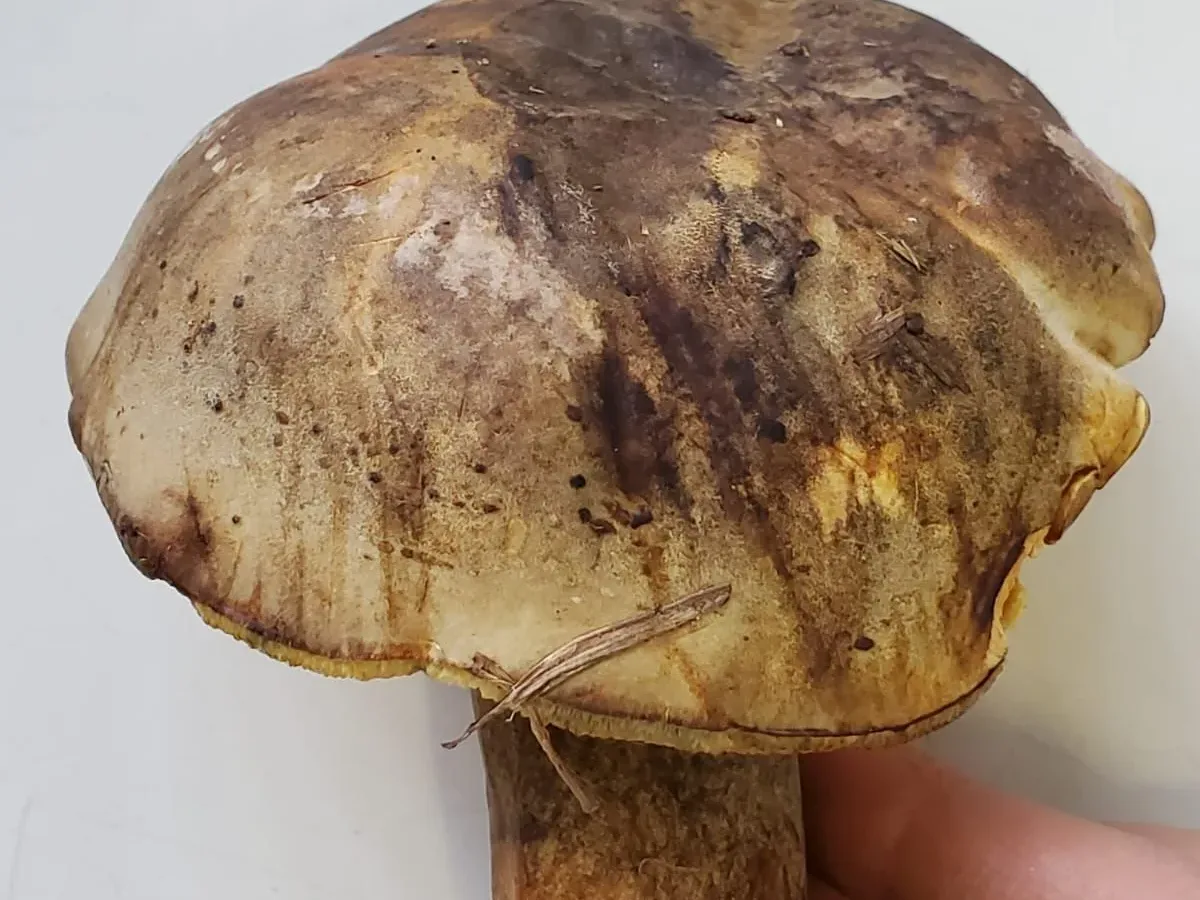 © Tatiana Rubiano Goubert (CC BY-SA)
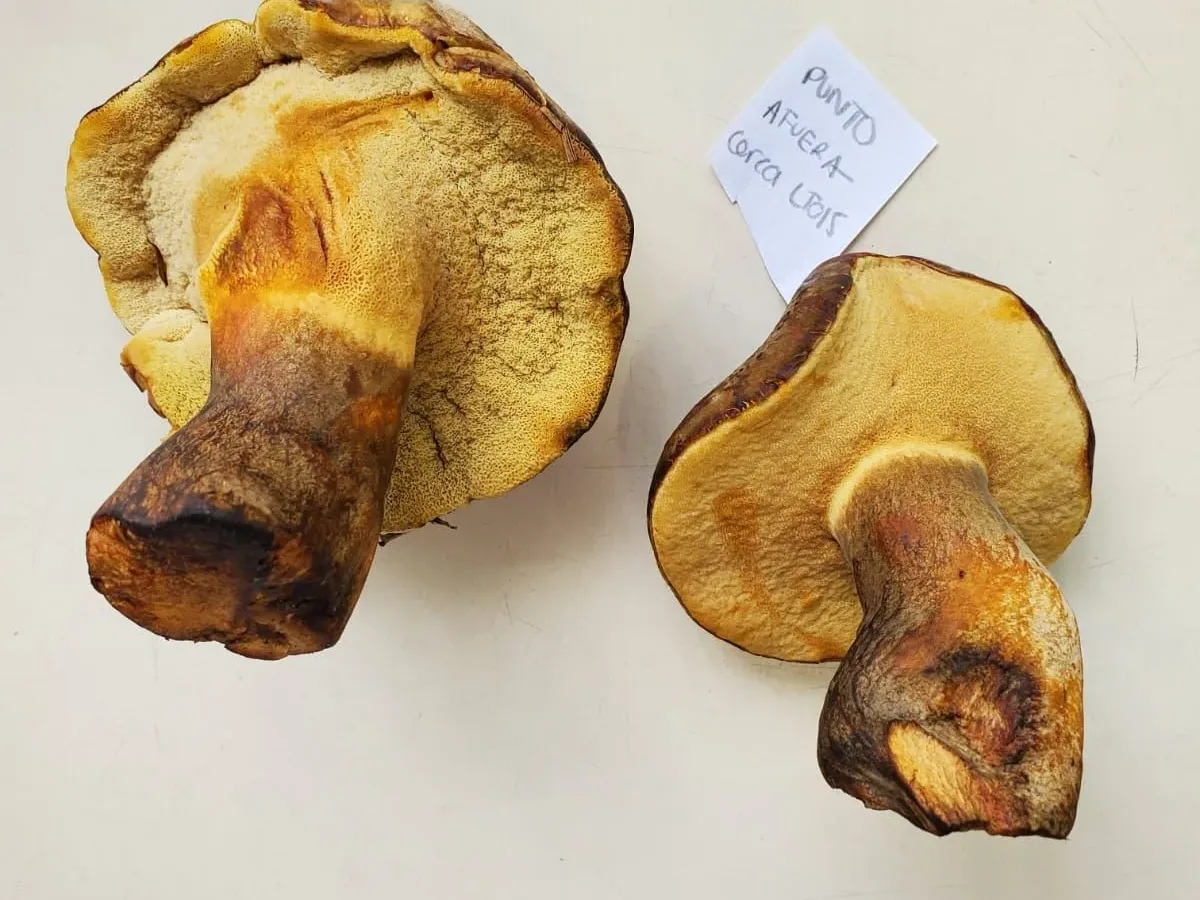 © Tatiana Rubiano Goubert (CC BY-SA)© Tatiana Rubiano Goubert (CC BY-SA)© Tatiana Rubiano Goubert (CC BY-SA)
Edible only with the right preparation - or safe for some people but not others. Learn the caveats first.
Never eat a mushroom you are not 100% sure of - check the look-alikes below, and always cook wild mushrooms.
How to recognise it
Phlebopus bruchii is one of the largest boletes native to South America, an imposing mushroom that can stop a forest walker in their tracks.
Cap
The cap begins as a broad, firm dome - sometimes 10 cm or more across even in the button stage - and expands steadily to a generous flat disc that can reach 35 cm at maturity, though 15-25 cm is the more typical range for an adult specimen.
The surface is dry to very slightly tacky in wet conditions, starting finely velvety and becoming smoother with age, and coloured a rich warm chestnut to tawny-brown, darkest toward the centre and sometimes shading to a slightly olivaceous tone at the thin margin.
Seen from the side, the cap often has a subtle lip or overhang beyond the tube layer.
Pores
Flip the cap and the pore surface is immediately attractive: densely packed small round pores, bright chrome-yellow in young specimens, dulling to ochre and eventually brownish-olive-yellow as the mushroom matures.
Pressing or cutting the pores does not cause strong blue staining - or at most provokes only a faint, transient bluish discolouration - which is a useful feature distinguishing Phlebopus from some related genera where bluing is intense.
The tubes below the pores are 1-2.5 cm deep.
A spore print made on white paper shows an olive-brown to dull brown deposit.
Stem
The stem is the most imposing part: solidly built, 6-15 cm tall and up to 7 cm thick at its widest, often club-shaped with the base the widest point, and entirely solid when cut across.
Its surface is pale yellowish-buff to light brown, streaked longitudinally with fibres and sometimes very faintly reticulate near the apex, with the base often darkening to a deeper brown.
There is no ring or volva at any stage.
Flesh
The flesh throughout is thick, cream to pale yellow, very firm and dense when the mushroom is young, softening somewhat as it ages, and it does not change colour significantly on cutting.
Smell
The overall smell is mild and pleasant - faintly earthy, occasionally with a farinaceous undertone.
Where & when it grows
Habitat
Phlebopus bruchii is a species of subtropical and warm-temperate South America, centred on the subtropical Atlantic Forest zone of northeastern Argentina (above all the province of Misiones, which holds one of the continent's most biodiverse remnants of Atlantic Forest) and spreading into adjacent Corrientes, Chaco, Tucumán, and Jujuy.
Records also come from southern Brazil - particularly Rio Grande do Sul and Paraná, where the Atlantic Forest continues across the border - and from Uruguay.
The species favours:
- gallery forest lining rivers and streams
- the mossy interior of subtropical rainforest
- the moister patches of mixed dry-forest
It has also been found in wooded parks, arboretum grounds, and gardens near old trees in the Buenos Aires metropolitan region, suggesting tolerance of disturbed and semi-urban habitats where host trees persist.
The underground nutritional relationship - whether strictly ectomycorrhizal with tree roots or with a saprotrophic component - has not been precisely resolved for this species, as is the case with several Phlebopus species outside Southeast Asia. The consistent association with large trees, however, points to an ectomycorrhizal lifestyle.
Soils are typically moist, humus-rich, and well-structured.
Individual fruiting bodies often appear singly or in small groups of two or three; fairy rings or large troops are not characteristic.
When
The season for Phlebopus bruchii follows the austral summer rains.
In its core range in Misiones and Corrientes, the hottest and wettest months run from November through March, and this is when the fungus is most active. The first large fruitbodies push up after the early summer rains in November, the season builds through December and January, and fruiting continues into February and March before tapering as the rains ease.
In the more temperate climate of the Buenos Aires region and Uruguay, the season shifts slightly later - fruitbodies appear from December through April, with good autumn rains sometimes extending fruiting to the point of the first real cold.
In the upland subtropical forests of Tucumán and Jujuy, where rainfall is more seasonal, fruiting is most concentrated in the rainy summer months.
A reliable fruiting pattern is:
- 1Wait for a period of significant rainfall (30 mm or more over a few days) during warm months.
- 2Then visit the site 5-12 days later.
How it grows
Fruitbodies emerge from the forest soil singly or in loose, small groups of two or three, occasionally more.
Young specimens push up as firm rounded buttons with strongly inrolled margins. The cap unfurls rapidly after the initial flush, expanding to full size within a few days of humid weather.
Old specimens deteriorate quickly in the subtropical heat and humidity:
- caps become soft
- the pores brown and slimy
- fly larvae colonise the flesh
So timing the harvest to the young-to-medium stage is important.
In suitable habitats the same spots tend to produce fruitbodies in successive seasons, reflecting the perennial underground mycelial network.
Fruiting conditions
Fruiting is triggered by substantial summer rainfall of 30 mm or more over 1-2 weeks combined with warm soil temperatures. Flush typically appears 5-12 days after significant rainfall during the warm season (November-April in the Southern Hemisphere). Fruiting is suppressed during the dry season and ceases when temperatures drop below roughly 15 °C in the cooler southern parts of the range.
Look-alikes
The most critical lookalike concern for Phlebopus bruchii - and for any bolete encountered in South America - is the group of red-pored or orange-pored boletes.
In South America, species of the genera Neoboletus and related groups can produce large, brown-capped fruitbodies that may superficially resemble Phlebopus from above, and these boletes are capable of causing severe poisoning.
The single most important distinguishing feature is pore colour: Phlebopus bruchii has yellow to ochre-yellow pores that age to olive-brown - they are NEVER red, orange, or pink. This check must be performed on every specimen without exception.
- Within the genus, Phlebopus sudanicus (an African species) is structurally very similar and is explicitly toxic when eaten raw; it does not occur in South America, but its existence reminds us that Phlebopus edibility varies by species and thorough cooking is non-negotiable.
- Suillus species (Slippery Jacks) may occur in plantations of introduced pines; they are much smaller, have sticky-slimy caps, a ring on the stem, and grow only under conifers.
- Gyroporus castaneus is much smaller, has white pores, and a hollow stem.
- Caloboletus calopus can occur near planted European trees in parks and estates; it has pale pores that blue strongly and also redden, a vivid red-orange stem pattern, and intensely bitter flesh - a cautious taste test resolves this immediately.
- Poisonous Amanita species (including the Death Cap, Amanita phalloides, which has been introduced to South America with European trees) could in theory be confused with a button-stage bolete by a very inexperienced forager, but they have gills rather than pores and a volva at the base - both features absent in Phlebopus bruchii.
DEADLY. Introduced to South America with imported European trees; now established in central Chile, Argentina (Córdoba, Jujuy, Buenos Aires), and Uruguay. Could be confused with a button-stage bolete only by a very inexperienced forager - it has gills (not pores) under the cap and a membranous sac (volva) cupping the base, features Phlebopus bruchii never shows. Pore vs. gill structure and absence of volva are absolute separators.
DEADLY - reject immediately. Any bolete in South America with red, orange, or pink pores must never be consumed. These boletes can produce large, brown-capped fruitbodies superficially resembling Phlebopus from above, but differ critically in pore colour. Phlebopus bruchii has uniformly yellow to ochre-yellow pores aging to olive-brown - never any red or orange colouration. Check pore colour on the underside of every specimen before picking. This is the single non-negotiable safety check.
Possible near planted European beech, oak, or chestnut in parks and estates. Has pale pores that blue strongly and also flush reddish; stem has a vivid red-orange reticulate pattern; flesh is intensely bitter - a cautious taste test (small amount, spit out) resolves confusion. Causes gastrointestinal poisoning but is not lethal.
An African species not occurring in South America, but mycologically relevant because it is morphologically very similar and is explicitly toxic when eaten raw - a reminder that Phlebopus edibility is not universal within the genus. Distinguished from P. bruchii by distribution alone.
Much smaller (cap 5-12 cm), sticky-slimy cap, ring on stem, white to pale yellow pores. Found only under introduced conifers (pines), not in native subtropical Atlantic Forest. Easy to separate on size, habitat, slimy cap surface, and ring.
In the kitchen
Picking & cleaning
Seek out young to mid-aged specimens with firm, bright yellow pores and dense, firm flesh.
Avoid any specimen with brown or slimy pores, or in which the flesh feels soft and wet throughout - these are signs of over-age or insect infestation.
- Cut the stem cleanly at ground level; there is no need to dig up the entire base, as Phlebopus does not form a volva.
- Trim away the tube layer if pores are soft or heavily browned.
Large caps can yield an impressive weight of clean flesh from a single find.
- Field-clean the cap and transport in a shallow open basket, not a sealed bag.
- Use within 24-48 hours of picking; do not leave unrefrigerated in the summer heat.
Always cook thoroughly - see Safety.
Cooking
Local foragers in Misiones and the broader Mesopotamia region of Argentina regard Phlebopus bruchii as one of the best wild boletes available in their area - a reasonable designation given the limited variety of choice boletes in subtropical South America.
The flesh is firm, mild, and pleasantly earthy, with a texture that holds up well to cooking.
The classic preparation is to slice the cap thickly and dry-fry in a little oil or butter over high heat until the surface is golden and lightly caramelised, seasoning with salt and garlic. This concentrates the mild flavour and gives a satisfying, porcini-like result.
It performs well in:
- rice dishes (arroz con hongos)
- stews
- meat accompaniments
- empanadas
The spongy tube layer may become soft and slightly slimy in older specimens; peeling it away before cooking is recommended for those specimens.
Always cook thoroughly - never eat raw.
Drying sliced caps in a low oven or food dehydrator is an effective preservation method; dried caps reconstitute well and can be ground to a powder for adding depth to sauces and soups.
Good to know
Phlebopus bruchii is eaten as a wild food in Argentina and Brazil, and its edibility is supported by a tradition of local use, but several safety rules are essential and must not be relaxed.
- 1Most critical: pore colour. Every time, before any other consideration, check the pore surface. The pores of P. bruchii are yellow to ochre-yellow, aging to olive-brown - NEVER red, orange, or pink. If you find a large, brown-capped bolete with red or orange pores anywhere in South America, discard it immediately; red-pored boletes in this region can cause severe, potentially fatal poisoning.
- 2Always cook thoroughly. Do not eat raw or undercooked. Boil, sauté, grill, or otherwise cook at high heat for a minimum of 15-20 minutes; this is standard practice for all large wild boletes and is especially important for Phlebopus species given that the raw-toxic P. sudanicus belongs to the same genus.
- 3Confirm the full combination of features - large dark-brown cap, yellow-to-olive pores (not red), no ring, no volva, solid club-shaped stem, mild flesh that does not blue strongly. Any departure from this profile warrants rejection.
- 4Obtain expert confirmation on your first encounters with this species in a new location; identifying any large bolete from photographs alone is unreliable.
A reference guide - never an edibility guarantee. When in doubt, leave it out.