Phlebopus braunii
Phlebopus brauniisyn. Phaeogyroporus braunii
 Atlas of Living Australia (CC0)
 Atlas of Living Australia (CC0)Atlas of Living Australia (CC0)Atlas of Living Australia (CC0)
Edible only with the right preparation - or safe for some people but not others. Learn the caveats first.
Never eat a mushroom you are not 100% sure of - check the look-alikes below, and always cook wild mushrooms.
How to recognise it
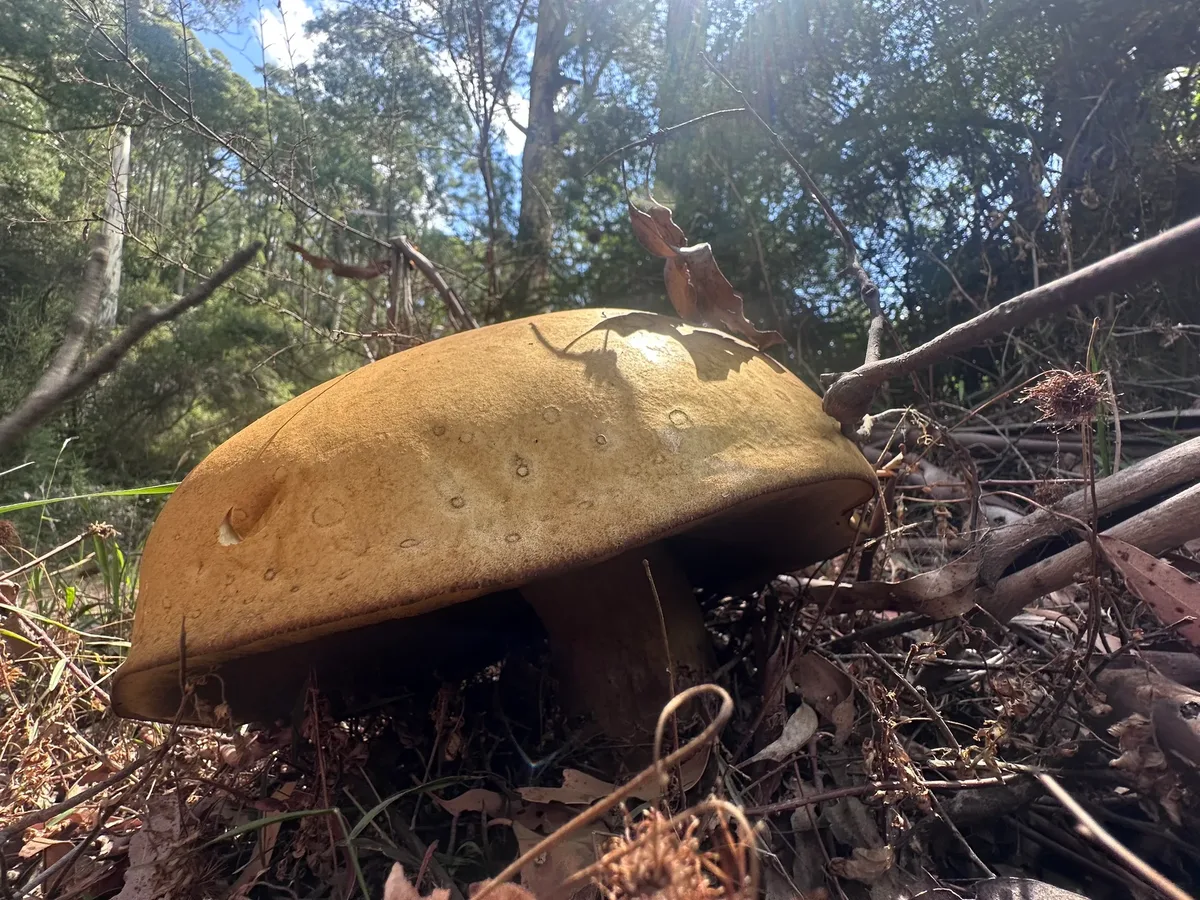
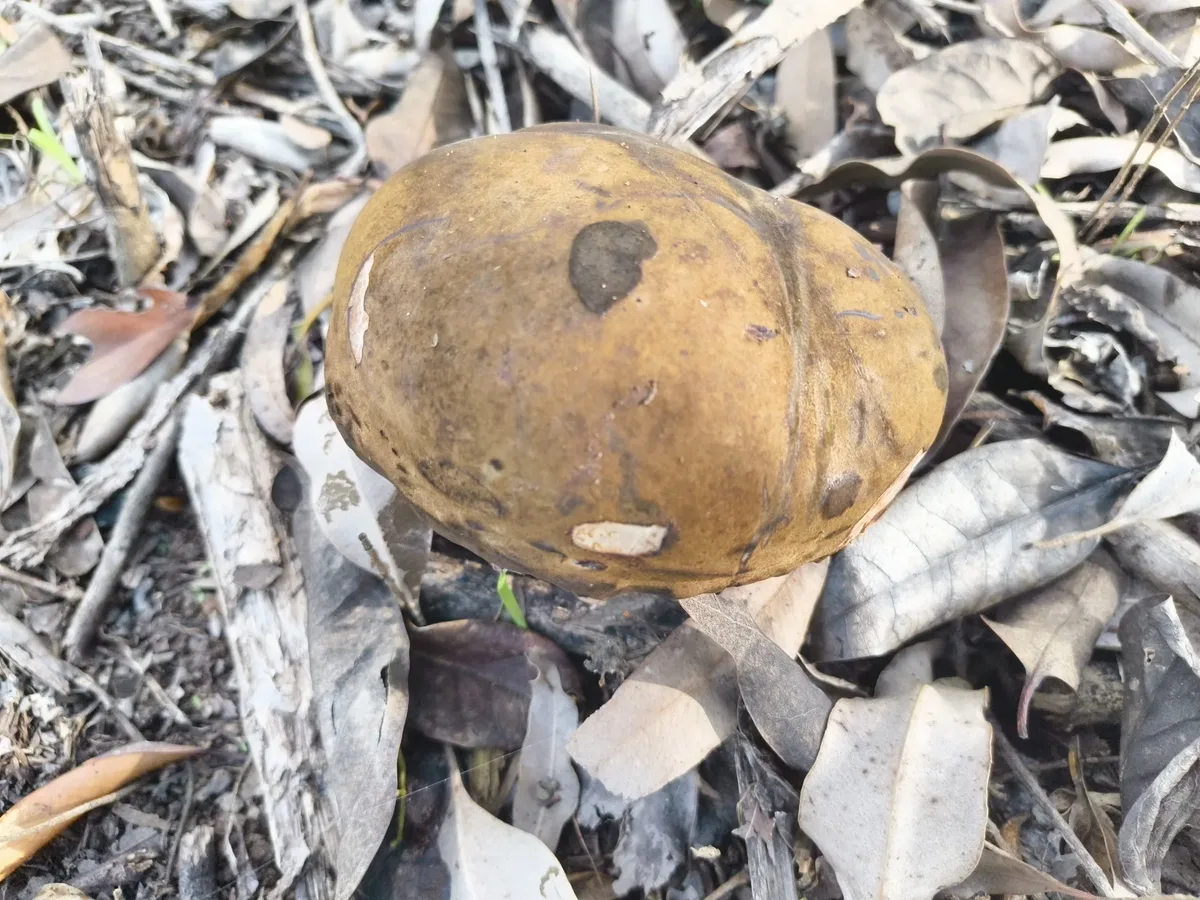
Phlebopus braunii is a substantial bolete built on the familiar Phlebopus template: a broad cap in shades of warm chestnut-brown, a stout solid stem, and a yellow pore surface that is the centrepiece of the species' field identification.
Cap
Young caps arrive firmly convex and smooth, the surface a medium to dark chocolate-brown that can develop faint fibrous texturing with age. With maturity the cap flattens and may sink into a very shallow central depression.
Gills / Pores
The pore surface is a consistent pale yellow to ochre-yellow, fine and angular, and here lies one of the most important safety checks with this species: the blueing reaction - pressed pores or cut flesh turning blue - is slow, faint, or absent, nothing like the swift indigo flood produced by the dangerous blueing boletes of the Southern Hemisphere.
Stem
The stem is stout and solid throughout, pale yellowish-brown, fibrous lengthwise, sometimes faintly reticulate near the cap.
Flesh
The flesh inside is cream to pale yellow, firm when fresh, and changes colour little on cutting. Spore print olive-brown.
Where & when it grows
Habitat
A species of the subtropical forests and plantation edges of southern Brazil, at home particularly in the landscape where Araucaria pine forest meets modified land - plantation margins, secondary regrowth, roadsides, and parks.
This ecological tolerance of disruption is characteristic of the genus: Phlebopus species are saprotrophic or weakly root-associated rather than strict mycorrhizal partners, freeing them from dependence on undisturbed forest and allowing them to thrive in the plantation-edge environments that now dominate much of southern Brazil's rural landscape.
The core documented range is Paraná state, but the species almost certainly extends into Santa Catarina, Rio Grande do Sul, and adjacent parts of Argentina and Paraguay wherever the same combination of warm summer rainfall and suitable organic substrate occurs.
Soils are typically well-drained and humus-rich.
When
The season mirrors the Southern Hemisphere summer rains. From October, as the austral wet season establishes itself, fruiting bodies begin pushing up through the soil.
The productive heart of the season runs November through February - the months when summer rainfall accumulates and soil temperatures climb well above 20 °C. Individual fruiting bodies develop quickly once conditions are right, reaching full size in a few days.
By March and April, as the rains taper and soil temperatures ease, fruiting becomes sporadic.
Through the dry austral winter from May to September, the mycelium persists invisibly in the soil, waiting for the next warm wet season.
How it grows
Fruitbodies appear singly or in small scattered groups from humus-rich soil, often near the base of plantation trees or along forest margins.
Growth after significant rainfall is rapid - substantial caps can open within 2-4 days of a flush-triggering rain event.
In tropical warmth, mature specimens deteriorate quickly, developing soft flesh and insect damage, so freshness is important to assess in the field.
The mycelium is perennial, and productive spots near the same trees can yield fruitbodies in successive rainy seasons.
Fruiting conditions
Fruiting is triggered by warm-season rainfall in the Southern Hemisphere. Cumulative rainfall of approximately 35 mm or more over the preceding 14 days combined with warm soil temperatures (18-30 °C) drives flush initiation. Fruiting bodies emerge 3-8 days after significant rainfall and develop to full size within 2-4 days. The dry austral winter suppresses fruiting from May to September.
Look-alikes
The most critical lookalike concern is the group of red-pored or rapidly-blueing boletes found in South American forests and plantations.
These include species in the genera Neoboletus, Lanmaoa, and related groups. They can share the broad brown-capped, stout-stemmed bolete silhouette but differ critically in having orange-red to blood-red pores and in producing a rapid, intense indigo blueing of the cut flesh within seconds.
Phlebopus braunii has uniformly yellow to ochre-yellow pores and shows only slow, faint, or absent blueing - these two features together are the primary field safety test.
Porphyrellus species have distinctly dark purplish-grey to dark brown pores rather than yellow ones.
Other South American Phlebopus species including Phlebopus tropicus are closely related, similar in appearance, and share the same edible status; distinguishing between them has no toxicological significance.
The general rule for bolete hunting in South America applies absolutely: any bolete with red or orange pores must be left completely alone.
DEADLY - reject immediately if pores are red or orange. Red-pored boletes in South America can share the broad brown-capped bolete silhouette of Phlebopus braunii but differ critically in pore colour (orange-red to blood-red) and in producing rapid, intense indigo blueing of the cut flesh within seconds of cutting. Phlebopus braunii has yellow to ochre-yellow pores and shows only slow, faint, or absent blueing. Check pore colour on every specimen before picking; this single check is the primary safety filter for bolete hunting in South America.
Much smaller (cap 3-10 cm), chestnut-brown cap with white to pale cream pores that do not stain blue. The stem is hollow or chambered - cut it lengthwise to confirm. Overall much less robust than Phlebopus braunii. Considered inedible or of poor edibility.
Porphyrellus species have characteristically dark purplish-grey to dark brown pores - never the yellow pores of Phlebopus braunii - and a generally darker, more uniformly sooty-brown colouration. Typically smaller in stature. Considered inedible or of unknown edibility. The yellow pore surface of P. braunii distinguishes it readily.
A closely related South American Phlebopus species with similar colouration, cap shape, and yellow pores. Also edible and similarly regarded as safe when cooked. The two species overlap in range and can be difficult to separate without careful examination of spore measurements and microscopic characters. Confusing the two has no safety consequence as both are edible, but it highlights why colour and pore reaction - not species-level Phlebopus ID alone - are the key safety filters when hunting South American boletes.
In the kitchen
Picking & cleaning
Pick when the cap is still broadly convex to flat-convex and the pores are firm and a clean pale yellow - at this stage the flesh is at its densest and best.
Cut cleanly at the base or twist carefully to free the stem, then inspect the cut stem for larval tunnelling; large tropical boletes in warm weather attract insects quickly, and an apparently fresh cap can conceal a hollowed stem.
Before collecting, perform two essential field checks in good light:
- 1Are the pores yellow to ochre-yellow with no trace of red, orange, or purplish colouration?
- 2Does a small nick in the flesh stay pale rather than turning deep indigo within 30 seconds?
Both checks must pass.
Trim damaged tissue in the field and transport mushrooms in a ventilated basket; they deteriorate rapidly in warm conditions.
Cooking
The flesh of Phlebopus braunii is firm, mild, and pleasantly earthy - qualities that suit it to the same preparations appropriate for other large edible boletes.
Slice and sauté in butter or good olive oil over high heat until golden, adding garlic and fresh herbs, for a simple preparation that showcases the flavour.
It works well in rice dishes, pasta sauces, cream-based soups, and stews, and the firm texture holds up to extended cooking without disintegrating.
Always cook thoroughly - sustained heat for at least 10-15 minutes - and never eat raw; this is the standard precaution for the genus.
In southern Brazil, foragers who know this species prepare it much as they would Phlebopus tropicus or similar regional boletes: simply cooked with local aromatics or incorporated into traditional rice and bean dishes.
For preservation, slice thinly and dry in the sun or a dehydrator at 50-60 °C until brittle; dried pieces reconstitute well in warm water and concentrate the earthy flavour effectively.
Good to know
Phlebopus braunii is regarded as edible and has been consumed in southern Brazil without documented poisoning reports.
However, the overall edibility documentation for this species in scientific literature is limited - it has not been subjected to formal toxicological analysis - and the genus Phlebopus contains members (most notably Phlebopus sudanicus in Africa) that cause gastrointestinal illness when eaten raw.
On that basis, thorough cooking is mandatory for this species; never eat it raw or only lightly heated.
Beyond the cooking precaution, the most serious danger associated with Phlebopus braunii is misidentification: this species occurs in the same habitats as potentially dangerous boletes with red or orange pores, and a failure to check pore colour carefully is the primary risk pathway.
Confirm positive identification by checking all of:
- Yellow to ochre pores (never red or orange)
- Absent or very faint slow blueing
- Stout solid stem with no ring or volva
- The appropriate habitat and season for southern Brazil
When in doubt, leave it out.
A reference guide - never an edibility guarantee. When in doubt, leave it out.