Veiled Lady Stinkhorn
Phallus indusiatussyn. Dictyophora indusiata, Dictyophora phalloidea, Clathrus indusiatus, Phallus duplicatus var. indusiatus, Simblum indusiatum
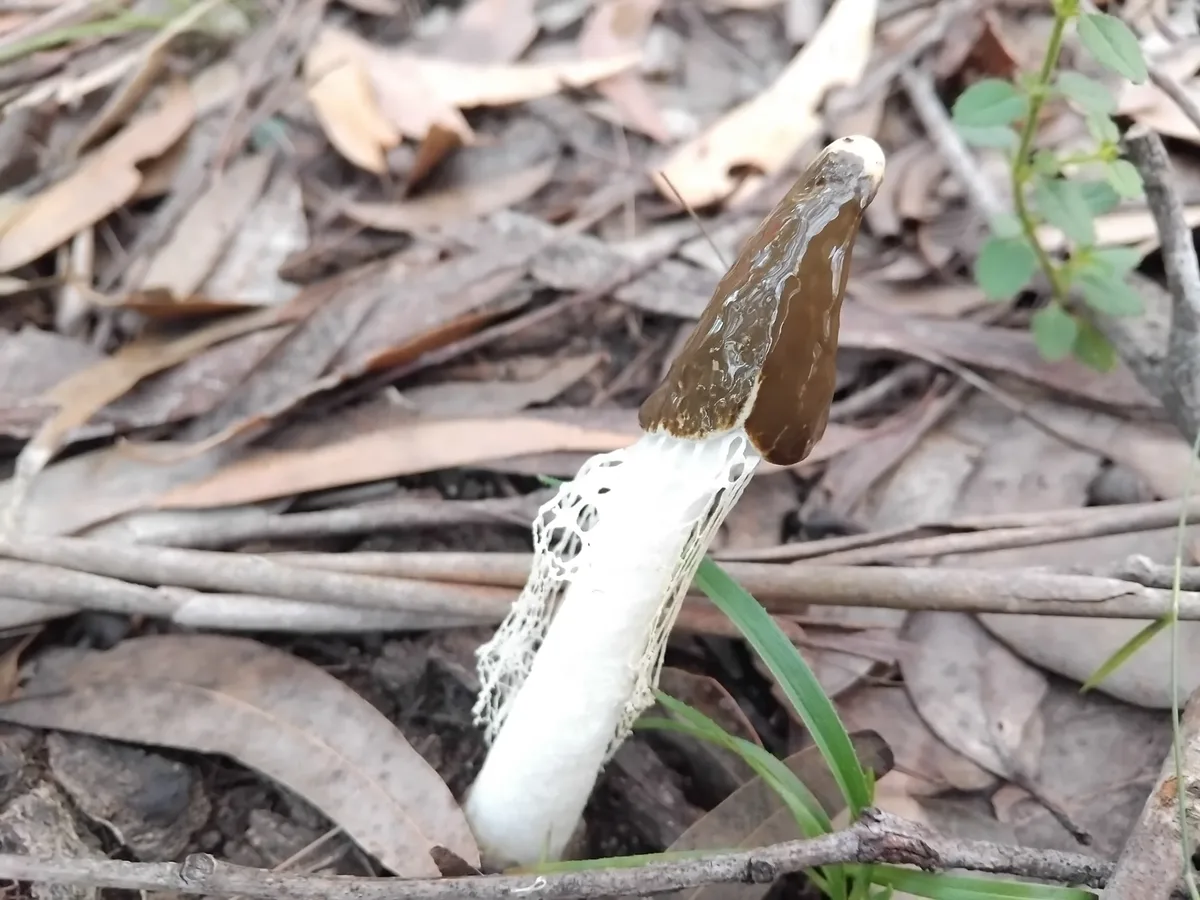 © Sofia Zvolanek (CC BY)
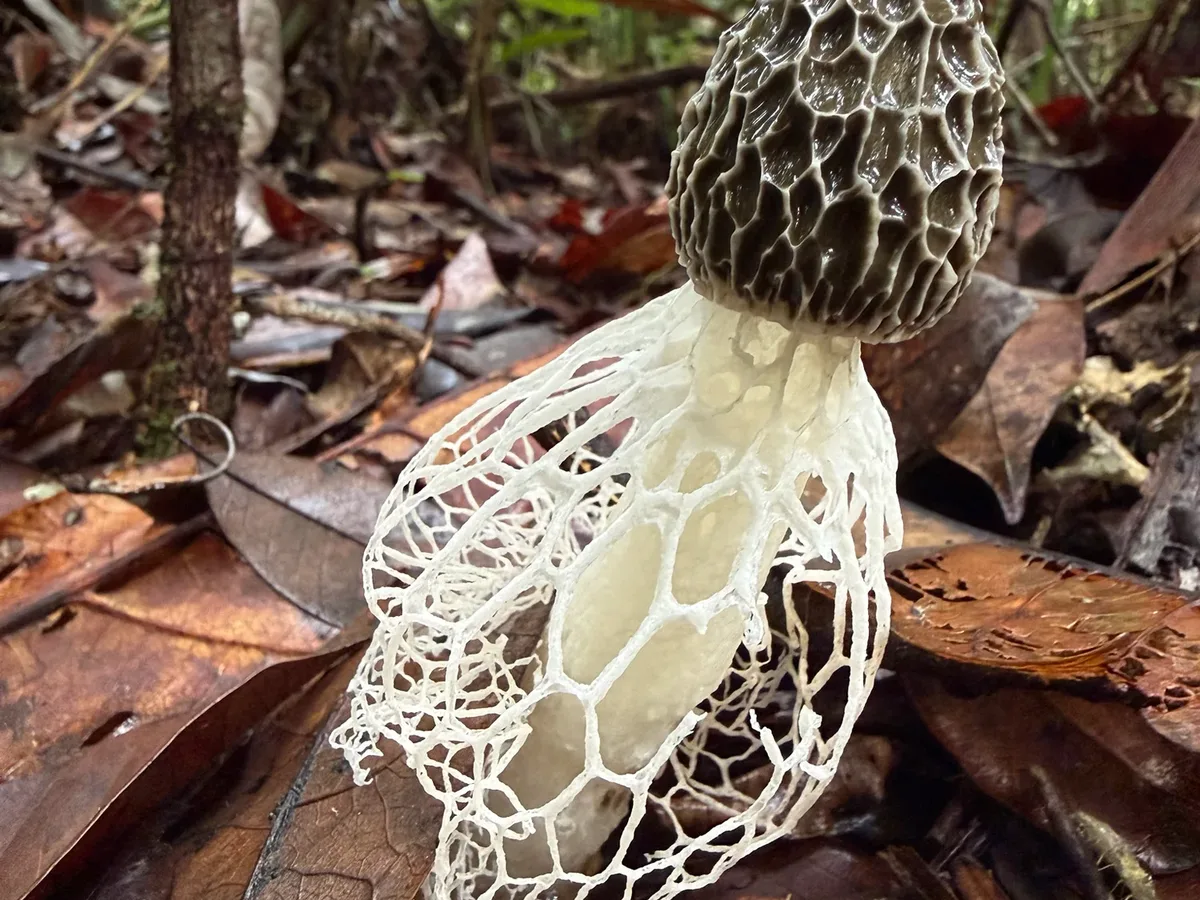 © Rob Felix (CC BY)
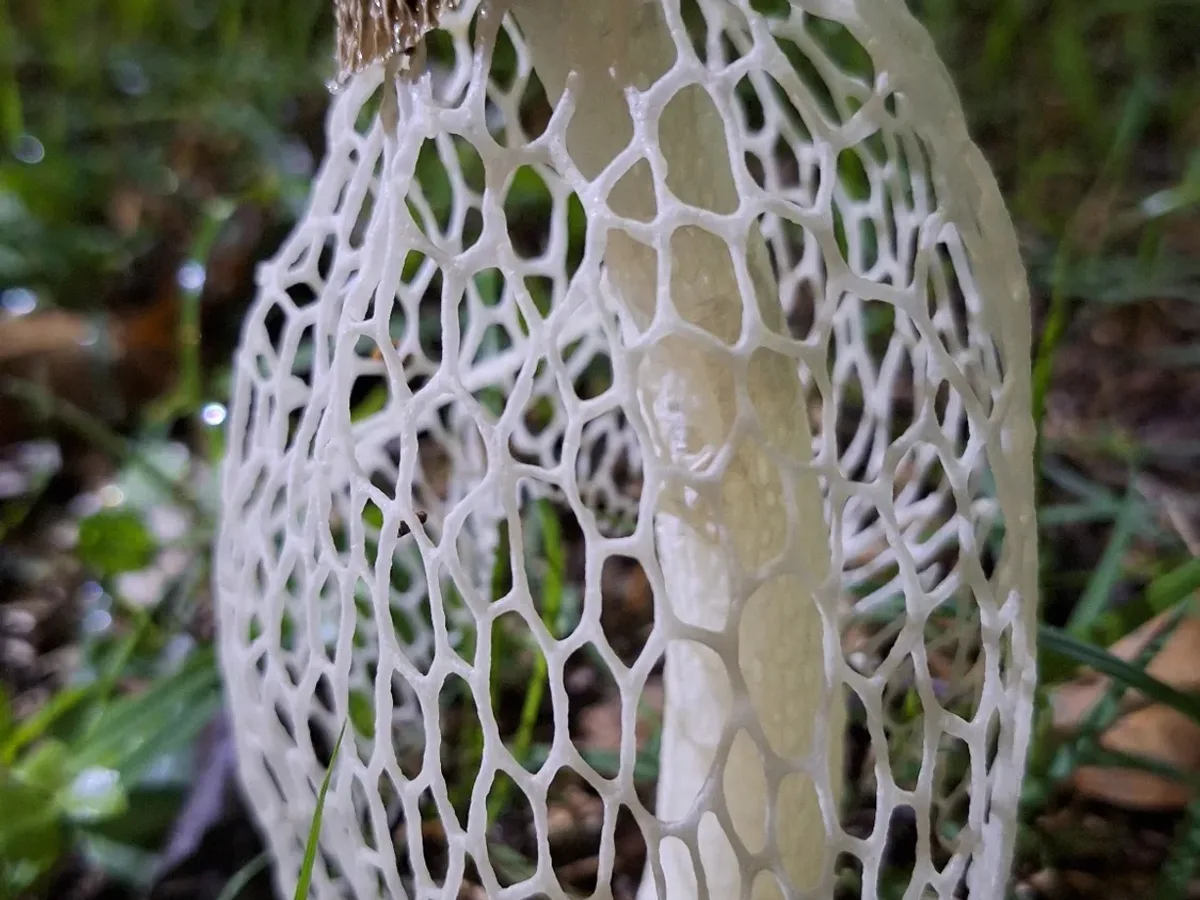 © Denis Zabin (CC BY)
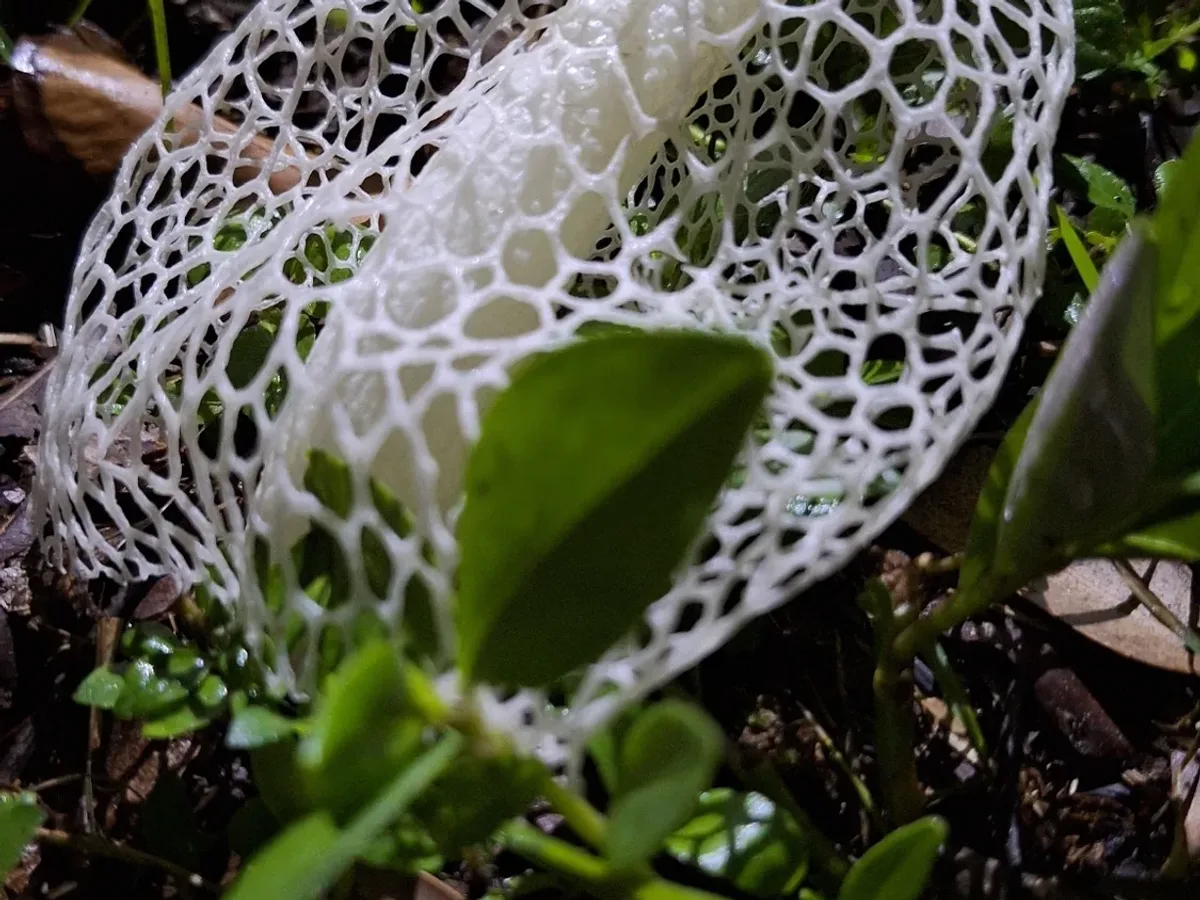 © Denis Zabin (CC BY)
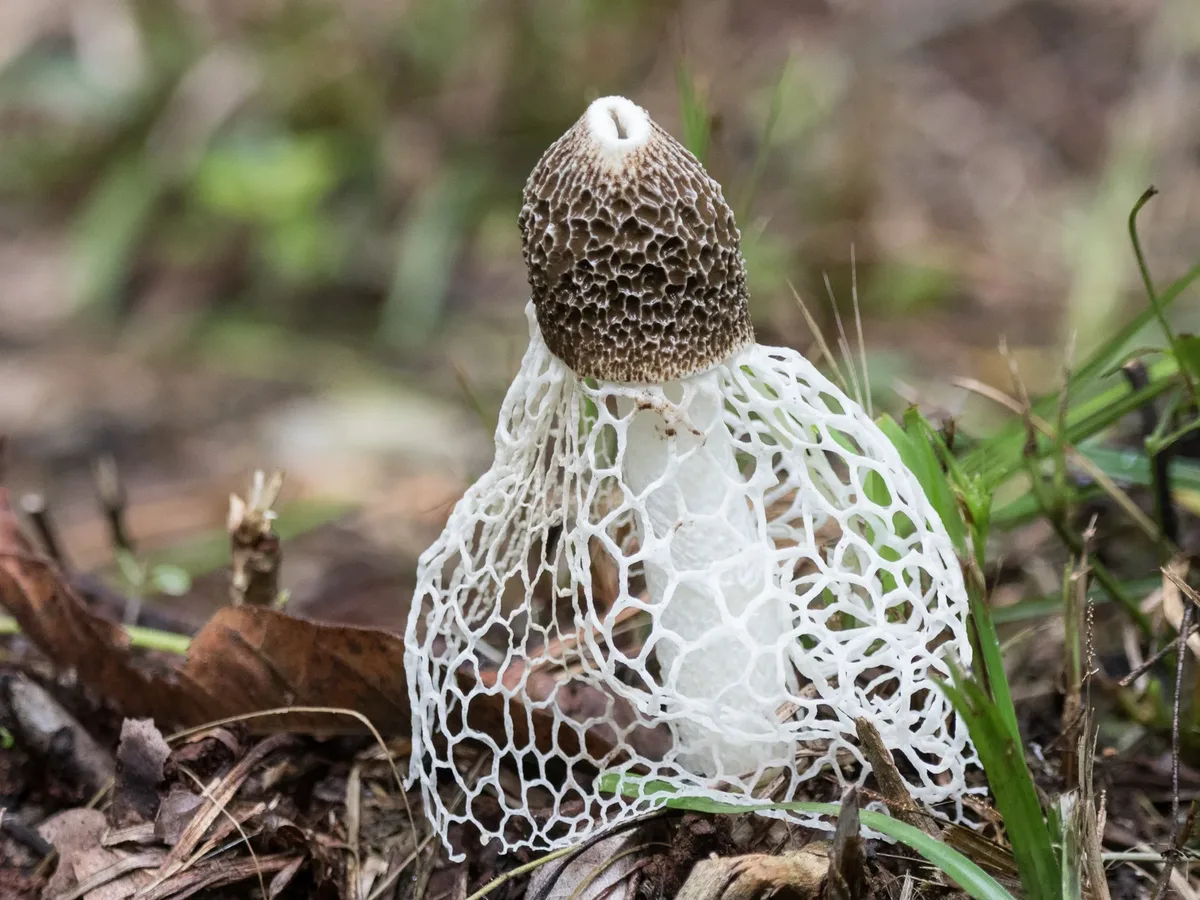 Frank Thomas Sautter (CC0)
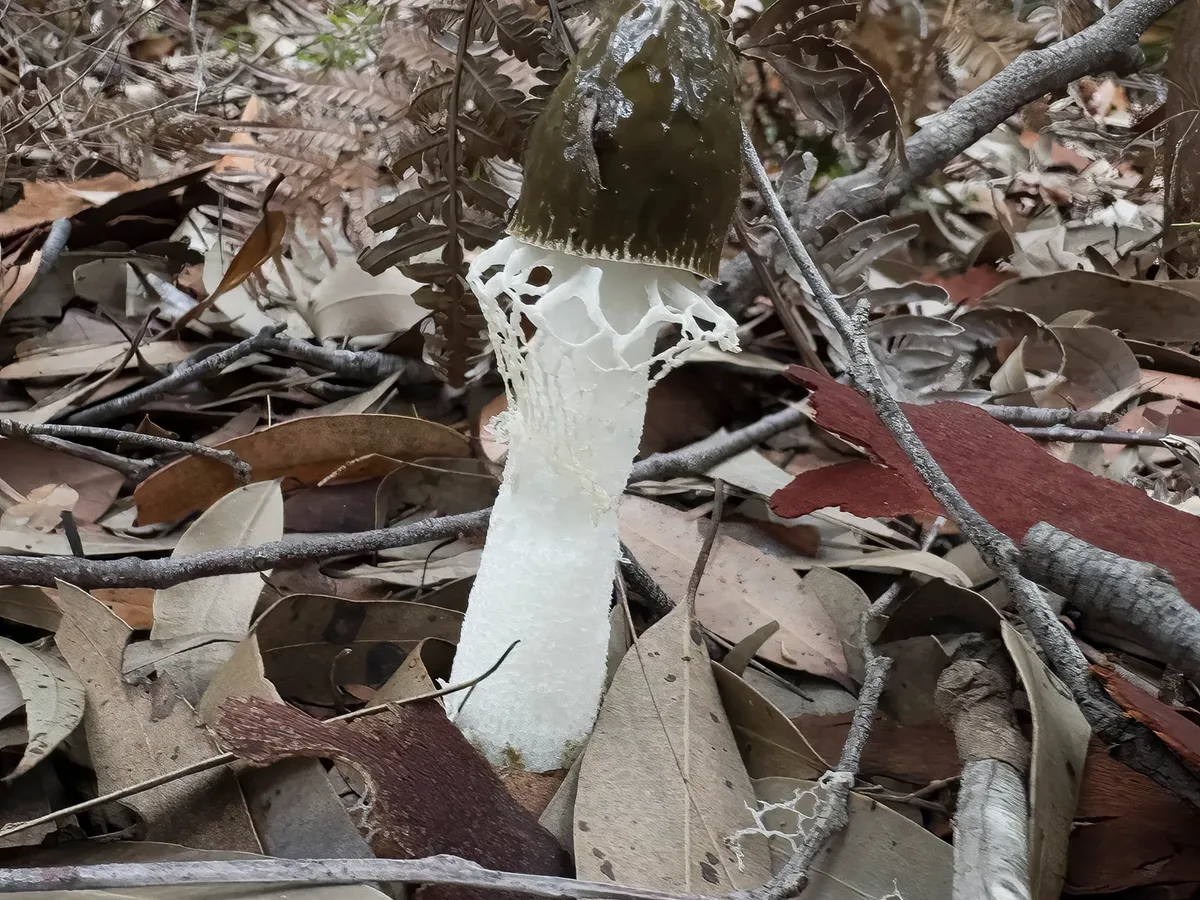 © Lawrence Hylton (CC BY)
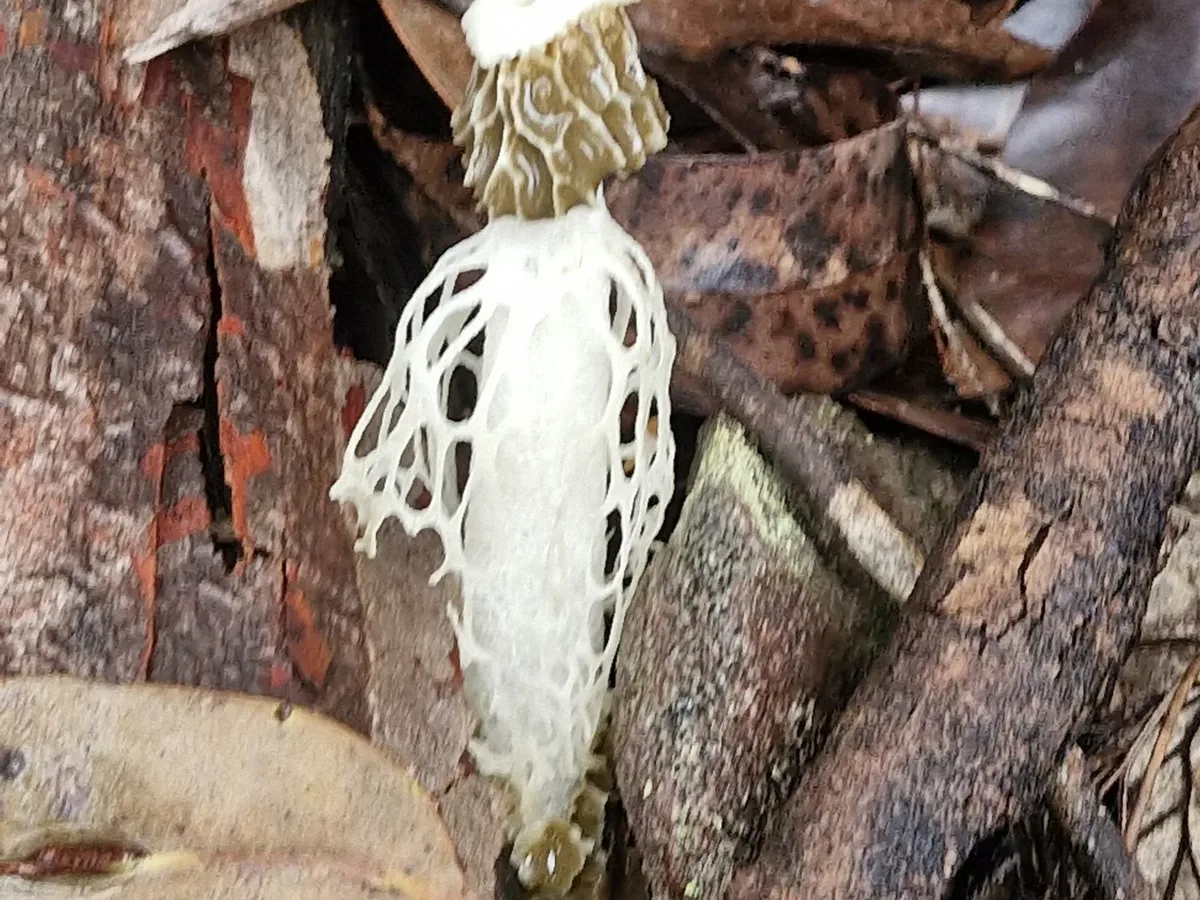 © ronavery (CC BY)
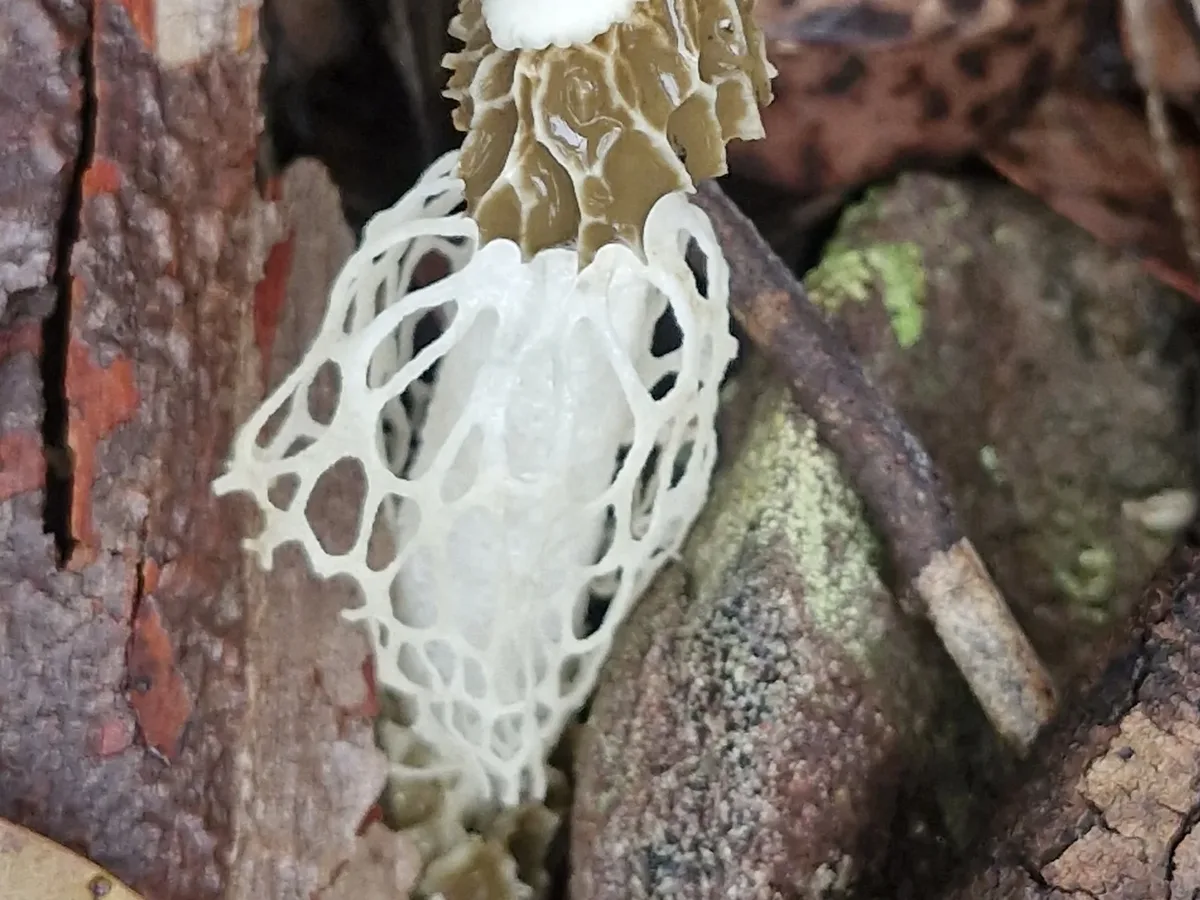 © ronavery (CC BY)
 © ronavery (CC BY)© Sofia Zvolanek (CC BY)© Rob Felix (CC BY)
Good to eat, once you have identified it with certainty and cooked it through.
Never eat a mushroom you are not 100% sure of - check the look-alikes below, and always cook wild mushrooms.
How to recognise it
Phallus indusiatus is one of the most visually arresting organisms in the fungal kingdom, and once encountered in the field it is essentially unmistakable. The key is to encounter it at the right moment.
Everything begins as an inconspicuous white to cream egg, 30-60 mm across, half-buried at the base of bamboo or woody debris - easy to overlook. Then, typically overnight or in the early hours of a warm, moist morning, the stipe erupts.
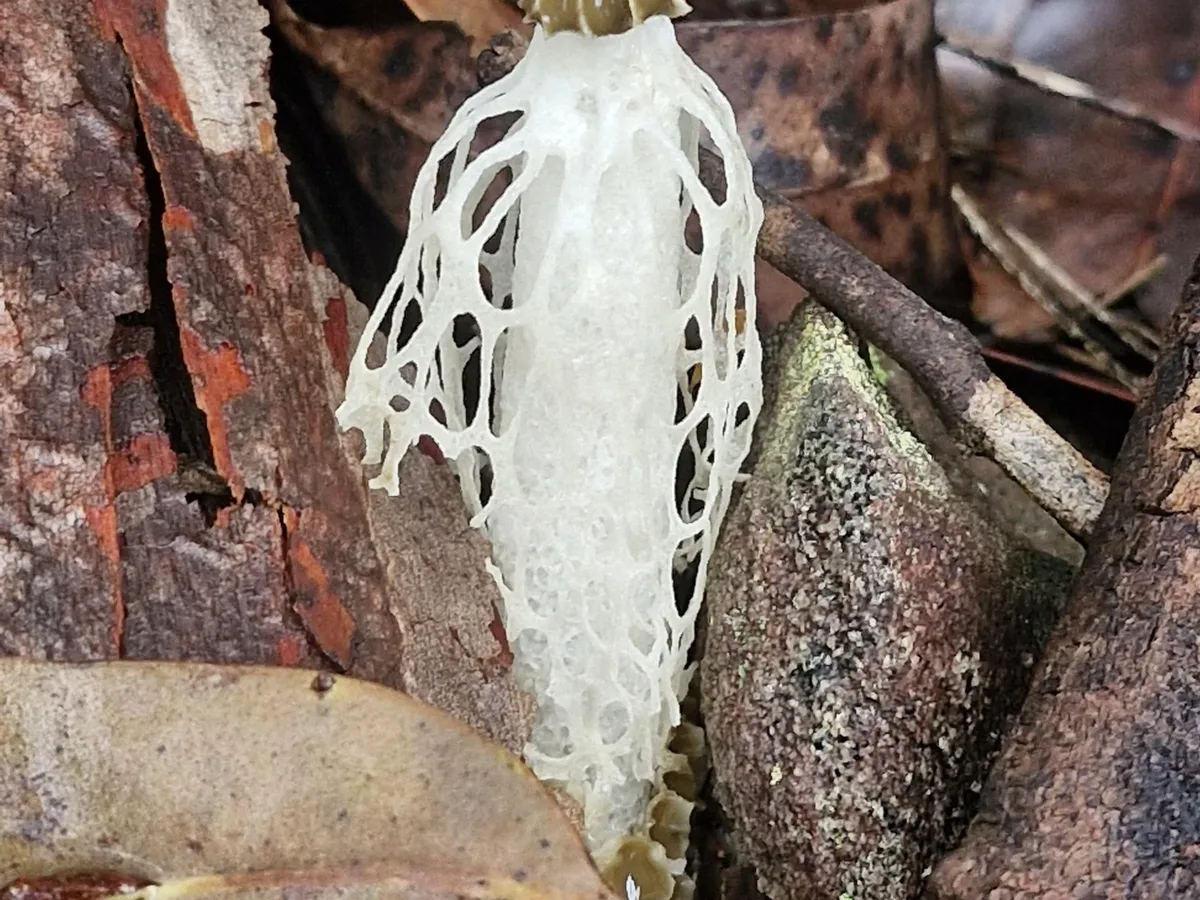
Within a few hours a spongy white column 10-25 cm tall extends upward, capped by a dark olive-brown conical pileus draped in the remarkable indusium: a white, finely netted lace-like skirt descending 8-20 cm down the stipe, its meshwork of irregular hexagonal holes making it look like an elaborate veil or crinoline.
The stipe itself is hollow, spongy, and reticulate (finely pitted), pure white. At the apex, the dark gleba is sticky, fetid, and fly-attracting - this is the spore dispersal mechanism, and once flies have removed it the exposed cap is pale.
The smell of the gleba is emphatically foul - carrion or rotting faeces - detectable from metres away when the cap is fresh. The white indusium itself, however, does not share this smell, and the washed or dried stipe material is odour-neutral to mildly pleasant.
By afternoon of its first day, the fruiting body begins to collapse and discolour. Collecting for the table should be done at the egg stage or within the first few hours of expansion while the stipe is still firm and white.
Where & when it grows
Habitat
A saprobic species, growing from decaying wood, bamboo root systems, and buried woody debris rather than living trees.
It is quintessentially a bamboo-grove fungus in China, Japan, and Southeast Asia - hence the most widely used Chinese name, 竹荪 (zhú sūn), literally 'bamboo soul'.
The species also appears in mixed broadleaf forest, tea gardens, plantations, and even urban parks wherever a pulse of warm, humid weather arrives and sufficient buried organic matter is present. Because the mycelium feeds on buried wood and humus, fruiting bodies can appear in lawns or garden beds far from any obvious woody substrate.
Spot-finding logic in bamboo groves follows the rhizomorph network: once you find one egg or fruiting body, others are usually within a metre or two.
When
In subtropical China, Japan, and Korea the season runs roughly May through October, peaking in July and August when night temperatures stay above 20 °C and monsoon rains keep the soil moist.
In true tropical Southeast Asia the window widens: fruiting can occur in any month of the wet season.
The actual event - stipe elongation and veil deployment - happens at remarkable speed, typically in a 4-6 hour window in the early morning following a warm humid night.
Foragers who know productive bamboo groves often check them at dawn to catch the indusium fully deployed and the stipe still firm. By mid-afternoon the first flush collapses. The egg stage can be collected for 1-3 days before the expansion trigger.
How it grows
A wood-rotter and humus decomposer, its mycelium forms a diffuse network of white cord-like rhizomorphs through the substrate. Fruiting bodies arise singly or in small groups of 2-5, rarely more.
The egg develops over several days below or at the soil surface. Stipe elongation is driven by turgor pressure in the spongy, water-filled stipe tissue - one of the fastest known growth events among macrofungi, with extension rates documented at several centimetres per hour.
The function of the indusium is still debated. The leading hypothesis is that it increases the surface area presenting the spore-bearing gleba to flies, while also funnelling air currents that disperse the odour signal.
The gleba is produced on the cap surface and spread by flies, which carry spores to new substrates.
The species is now cultivated at significant commercial scale in southern China, where growers inoculate beds of bamboo chips, straw, or woodchip substrate in humid enclosures.
Fruiting conditions
Fruiting requires warm, moist conditions: soil temperatures above 20 °C and sustained high humidity (>75 % RH) following rain events. The egg develops over 3-7 days before the rapid stipe elongation event, which is itself triggered by a combination of high moisture availability and overnight warmth. Full stipe expansion from egg rupture to complete indusium deployment takes approximately 4-6 hours. Multiple eggs in a cluster may expand on the same morning. Under commercial cultivation in southern China, growers manage temperature (22-28 °C) and high relative humidity to produce consistent harvests.
Look-alikes
At full expansion Phallus indusiatus is effectively unmistakable - no dangerous species shares its combination of white netted veil, spongy white stipe, and olive-brown fetid cap.
The egg stage presents the only realistic identification challenge, because all stinkhorn eggs are superficially similar white to pale ovals. The most important comparison is with other Phallus and Mutinus species, all of which are similarly saprobic and all emerging from white eggs.
- Phallus impudicus (common stinkhorn): produces a similar egg and fetid cap but lacks any indusium; it is not dangerous (also edible at the egg stage, though less palatable).
- Phallus ravenelii: has a similar veil but is restricted to North America.
- Mutinus caninus (dog stinkhorn): produces a slender, much smaller fruiting body with orange tip and no veil; edible at egg stage but poor-tasting.
- Dictyophora duplicata: the closest relative and very similar, differing primarily in the indusium being shorter (not reaching the base of the cap) and slightly coarser meshwork; it shares the same range, is also edible, and is often traded under the same common names - many records in the literature conflate the two.
None of the realistic lookalikes are toxic or deadly.
White Amanita eggs - including those of deadly species like Amanita phalloides, Amanita exitialis, and Amanita virosa - can resemble stinkhorn eggs in the ground. Cut the egg in half: a stinkhorn egg contains a clearly preformed, structured interior (stipe, gelatinous layer, and visible dark cap primordium); an Amanita egg contains a solid white to cream undifferentiated mass with the embryonic cap visible as a white form, but no hollow stipe and no dark olive gleba tissue. Stinkhorn eggs are typically connected to the substrate by visible white rhizomorphs. Amanita eggs grow from soil under trees, not from buried wood or bamboo. The context matters enormously: bamboo grove versus forest under oak or beech are different environments. If any doubt exists, do not consume the egg.
The egg stage is superficially identical to P. indusiatus eggs; cut it open to find the same structured interior confirming a Phallus species. At maturity, P. impudicus is immediately distinguishable: it has NO indusium (veil) whatsoever - just a bare white spongy stipe and a dark olive fetid cap. It is also edible at the egg stage and considered acceptable cooked, though less prestigious. Range: primarily Europe and North America, but occurs in overlapping subtropical zones.
Also emerges from a white egg, but the fruiting body is far smaller (5-10 cm tall), slender, and lacks any indusium. The tip is orange to red-orange and carries a small amount of olive gleba rather than an elaborate cap. Not toxic; unpalatable but edible at the egg stage according to some sources. The absence of a veil and the much smaller size distinguish it clearly at any stage after expansion.
Confusion is only possible at the pre-expansion egg stage, if a forager mistakes a Phallus egg for a puffball. Scleroderma citrinum has a very hard, thick, yellowish-brown rind (not smooth white like a stinkhorn egg), and when sliced open reveals dark purple-black spore mass throughout - not the structured preformed stipe of a stinkhorn. Scleroderma is mildly toxic (GI irritant) and should not be eaten. Always slice white eggs open before consuming.
The closest relative and most likely confusion. Also has a white netted indusium, but the veil is substantially shorter - typically 4-10 cm, not reaching the base of the stipe - and the mesh is somewhat coarser and less regular. The indusium of P. indusiatus is the longer, more elegantly draped of the two. Both are edible and often traded interchangeably; confusing them has no adverse culinary consequence.
In the kitchen
Picking & cleaning
For culinary use, collect at the egg stage (before veil deployment) or in the first hours after expansion, while the stipe is still firm, white, and fully expanded with the indusium intact.
Eggs are the preferred commercial product: they store better, lack the foul gleba odour, and can be transported without damage. To confirm you have the right egg, cut one in half - you will find a structured interior with a central pre-formed white stipe, gelatinous layer, and (in more developed eggs) a visible dark olive primordium at the apex corresponding to the future gleba.
After expansion, remove the dark gleba cap (which smells offensive and is not consumed) by rinsing the cap under running water or simply detaching it. The remaining white stipe and the indusium are what go to the kitchen. The stipe is hollow; rinse the interior as well to remove soil or debris. Handle the expanded indusium gently - it is delicate.
For drying, slice the cleaned stipe rings or lay the indusium flat and dry at low temperature; the dried product stores well and is the form most commonly found in Asian markets.
Cooking
竹荪 (zhú sūn) is a prestigious ingredient in Chinese cooking, considered a luxury product and given as gifts; it commands a high price relative to other dried fungi.
The texture is unique: the stipe is hollow, spongy, and slightly crunchy-gelatinous when cooked, absorbing broth beautifully, while the indusium is more delicate and silky. The flavour is mild, earthy, and faintly umami - the mushroom is valued as much for its texture and visual elegance as its taste.
In Chinese cuisine it is a cornerstone of high-end hot pots, delicate clear soups (particularly the classic dish 竹荪炖鸡, bamboo mushroom braised chicken soup), and Buddhist vegetarian cooking. In Japan it appears in refined dashi-based soups.
Preparation:
- From dried: soak in warm water 15-20 minutes until pliable, then squeeze out the soaking water (which has a slightly musty note), rinse, and cut into rings or leave whole depending on the dish.
- From fresh: rinse thoroughly after removing the gleba cap, then slice or use whole.
The hollow stipe can be stuffed (a popular preparation in Sichuan cooking). Cook gently rather than aggressively to preserve the delicate texture.
The visual appeal of intact indusium rings in clear soup is a significant part of its culinary prestige.
Good to know
Phallus indusiatus is a well-established and widely consumed edible species with a long culinary history in China, Japan, and Southeast Asia. There is no credible documented toxicity, and it is consumed in significant quantities as both a cultivated crop (竹荪 is sold dried in virtually every Chinese supermarket) and a wild-harvested delicacy.
The gleba (the dark, smelly mass on the cap) is unpleasant and not eaten, but it is not toxic - simply foul-smelling. Remove it before cooking.
The egg stage should be cut open and confirmed before eating: look for the structured interior with a formed stipe.
One theoretical safety note: individuals unfamiliar with stinkhorns could in principle mistake the egg stage of a stinkhorn for a puffball species - and some puffball lookalikes could themselves be toxic species such as Scleroderma or immature Amanita eggs.
The rule of thumb: always cut white eggs open and confirm the structured stinkhorn interior before consuming. If the interior is pure white and undifferentiated, do not eat it - this is either a puffball (needs separate identification) or potentially a deadly Amanita egg.
This species has no deadly lookalike in the expanded form.
A reference guide - never an edibility guarantee. When in doubt, leave it out.