Dyer's Polypore
Phaeolus schweinitziisyn. Boletus schweinitzii Fr., Polyporus schweinitzii Fr., Hydnum schweinitzii (Fr.) Berk., Phaeolus rutilans (Pers.) Pat., Cladomeris schweinitzii (Fr.) Quél.
 © ianrainbow (CC BY)
 © ianrainbow (CC BY)
 NENP_HPS (CC0)
 © ianrainbow (CC BY)
 © ianrainbow (CC BY)© ianrainbow (CC BY)© ianrainbow (CC BY)
Not poisonous, but not worth eating - too tough, bitter, or bland for the pot.
How to recognise it
Phaeolus schweinitzii is one of the most visually striking polypores of the conifer forest, and its distinctive colouration makes it among the more confidently identifiable bracket fungi.
Cap
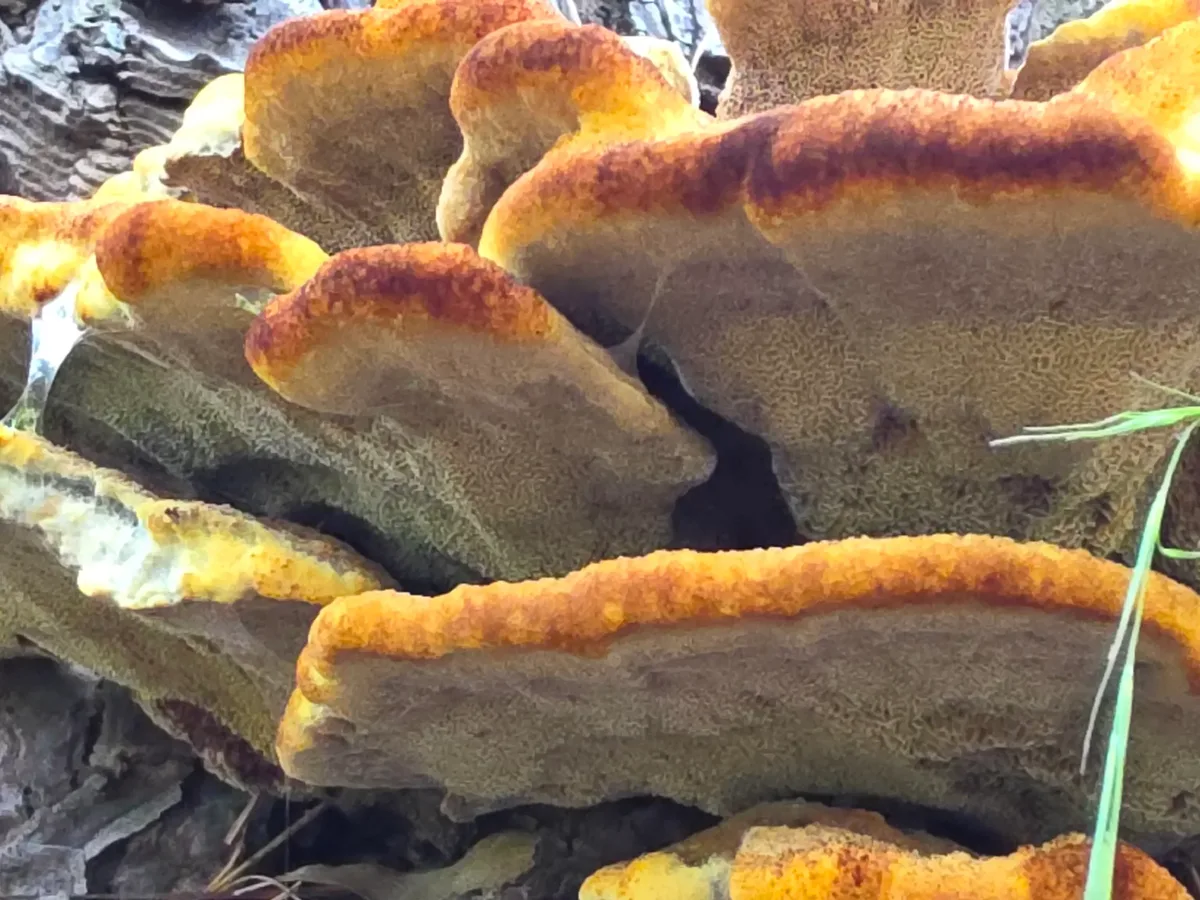
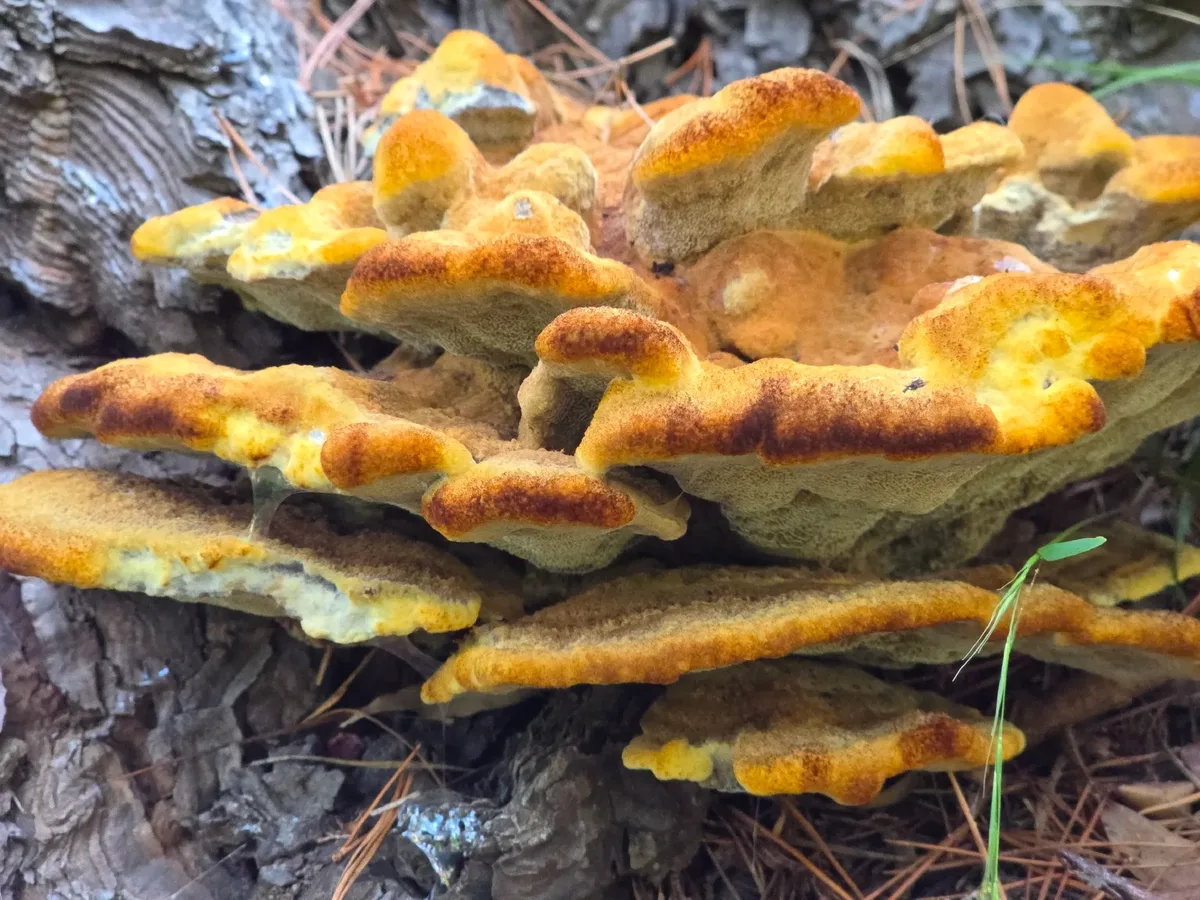
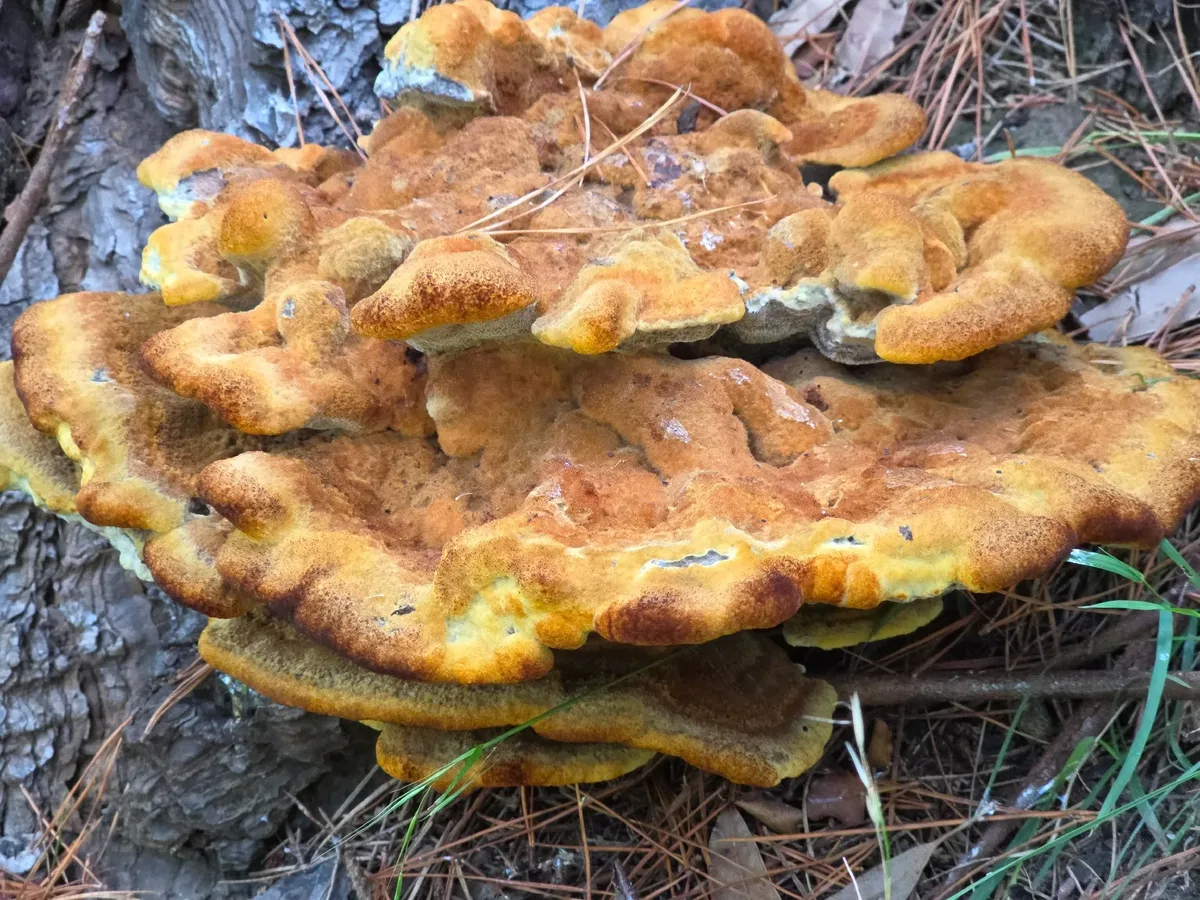
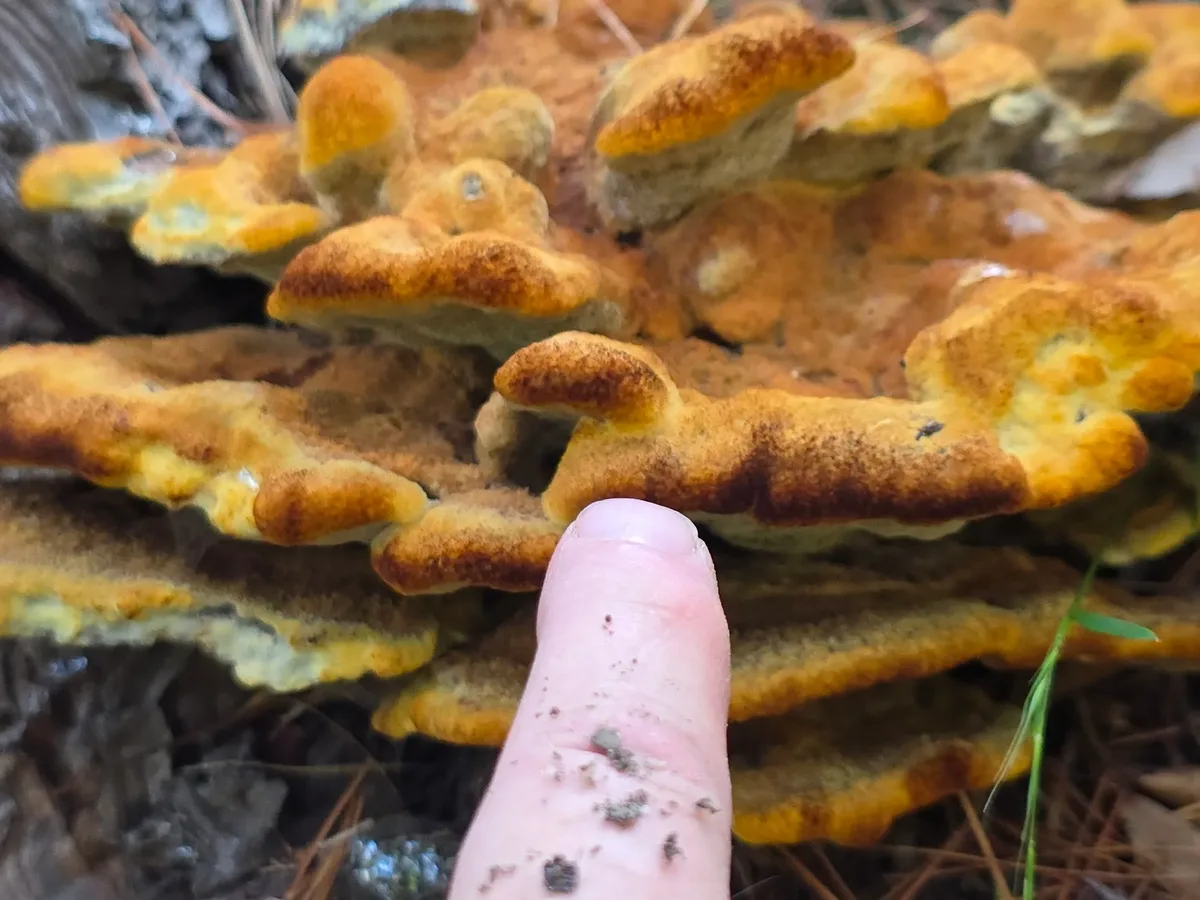
Young specimens are impossible to mistake for anything dull: the actively growing margin is a vivid sulphur-yellow to yellow-green or olive-yellow, while the older central portion of the same cap ranges from orange-brown and rust to deep chocolate-brown or almost black in the oldest parts.
This radial colour gradient - yellow-green at the edge, darkening to brown at the centre - is the single most reliable visual character, and it is visible from a considerable distance.
The surface is densely velvety or felty-hairy when young, soft to the touch in the way that earned it the name 'velvet top,' and this hairiness flattens and roughens in age.
The whole fruitbody can be enormous: a vigorous specimen readily reaches 30-40 cm across, and multiple lobes fusing around a stump base can cover an area of 60 cm or more.
Gills / Pores
The pore surface beneath is initially creamy-yellow-green, matching the cap margin, and stains and darkens to ochre-brown at maturity.
Flesh
The flesh is pale buff, watery-soft in young specimens but becoming distinctly fibrous and tough as the bracket ages - a quality that would make it unpleasant eating even if it were otherwise tempting.
The KOH reaction (yellow-green colouration of the flesh) is a useful confirmatory test in the field: it clearly separates this species from the cinnamon-brown Hapalopilus nidulans, which turns vivid violet with KOH and is toxic.
Where & when it grows
Habitat
This is a conifer specialist and one of the more economically significant wood-decay pathogens in the conifer forests of the Northern Hemisphere. It attacks living trees through the root system and lower trunk, causing a brown cubical butt rot that hollows the heartwood and compromises structural integrity, sometimes felling apparently healthy-looking trees in windstorms.
In the Pacific Northwest, Douglas-fir is its primary host, but Sitka spruce, true firs, hemlock, western red cedar, and various pines are all susceptible.
Fruitbodies erupt at the base of living trees, from stumps, or from the ground surface directly above infected buried roots - sometimes appearing metres away from the nearest visible trunk. The same infected stump or root system can fruit repeatedly for many years; large, old-established stumps in clearings or at the edge of plantations are productive sites to revisit.
The pathogen is common in mature and old-growth stands, managed timber plantations, roadside trees, and wherever large conifers grow. Its global distribution follows the conifer belt: Pacific Northwest, northern Rockies, boreal North America, northern and montane Europe, and the conifer zones of Asia.
When
The main fruiting season runs from mid-summer through late autumn, broadly July to November across the temperate range, with the clear peak in September and October when the Pacific Northwest's autumn rains arrive in earnest.
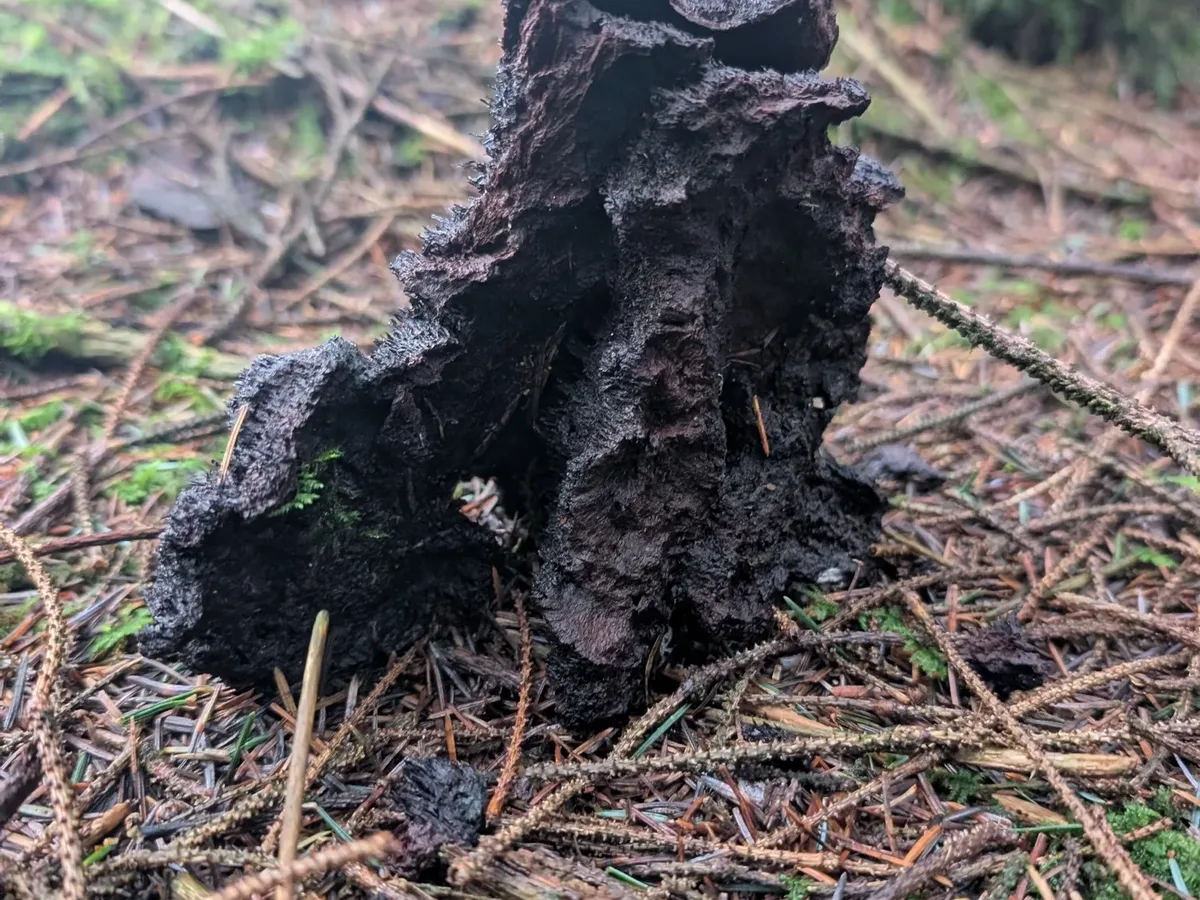
Individual fruitbodies develop over one to two weeks and can persist for several weeks if conditions remain cool and moist before collapsing into a brown, blackened crust.
Old, weathered, blackened remnants from the previous season are frequently found at the base of trees even into spring and summer, and they serve as a useful prospecting clue - if last year's stump carried a bracket, the mycelium is still there and will likely fruit again.
Young brackets with vivid yellow-green margins are the most visually obvious and are the easiest to identify confidently.
How it grows
As a parasitic and saprotrophic polypore, Phaeolus schweinitzii derives its energy by dismantling the cellulose of conifer heartwood and roots through a brown-rot mechanism - leaving the wood cracked into characteristic brown cubical blocks.
The mycelium threads through the root system and lower trunk of the host, often spreading extensively before the first visible fruitbody appears. This hidden network can persist for decades in a stump or dead root mass, producing annual fruiting bodies each autumn with no living host remaining.
The visible bracket is annual and does not build up woody growth rings, but the underground mycelium is perennial; the same site will fruit year after year as long as the root mass provides substrate.
A single large rosette-form fruitbody with multiple fused lobes may represent many years of mycelial growth expressed as one season's reproductive structure.
Fruiting conditions
Fruiting is triggered by late-summer to early-autumn rainfall following summer warmth, with the main flush in the Pacific Northwest aligning with September and October rains. Soil temperature drives host physiology more than direct mycelial activation; soil temperatures between 7-20 °C with at least 25 mm of rain over two weeks are typical fruiting conditions. The same infected stump or root zone refuits annually from the perennial mycelium, making previously productive sites reliable to revisit.
Look-alikes
The vivid yellow-green to sulphur margin combined with the rust-to-brown centre, the velvety texture, the conifer-base habitat, and the stout central stem are collectively so distinctive that Phaeolus schweinitzii is unlikely to be mistaken for anything dangerous by a careful observer.
The most practically useful comparisons involve other cinnamon- to rust-brown bracket fungi that might be encountered on or near conifers.
- Hapalopilus nidulans (cinnamon bracket) is much smaller (3-12 cm), uniformly cinnamon-brown without any yellow-green tones, grows on dead hardwood (especially hazel), and turns vivid violet with KOH - the opposite reaction to Phaeolus. Crucially, it is seriously toxic and has caused documented kidney failure in humans; the KOH test is therefore an important safety separator if any doubt exists.
- Inonotus tomentosus (wooly velvet polypore) grows in overlapping tiers on conifer stumps and roots but is smaller, more uniformly rust-brown to tan without the yellow-green margin, has much smaller pores, and lacks the stout central stem.
- Phlebia radiata and similar resupinate crusts are flat and lack a free margin or stem.
- Laetiporus gilbertsonii and related chicken-of-the-woods species in western North America are sometimes encountered on conifers and are broadly similar in forming large, overlapping, brightly coloured brackets - but Laetiporus is vivid orange-yellow with a smooth (not velvety) upper surface, sulphur-yellow pores, and white flesh, differing entirely from the brown-centred, velvety Phaeolus.
None of the species realistically confused with Phaeolus schweinitzii are deadly.
Ganoderma species have hard, corky to woody flesh that cannot be compressed, a dull grey-brown to chestnut upper surface that is not velvety, and a white pore surface that bruises brown. They are perennial, building up annual growth layers. Phaeolus schweinitzii is annual, distinctly soft and felty when young, and has the vivid yellow-green margin colour. Different entirely in feel and colouration.
Laetiporus gilbertsonii (and related western North American Laetiporus) forms large, overlapping shelf brackets that can occur on conifers, but they are vivid orange-yellow with a smooth (not velvety) upper surface, sulphur-yellow pores, and white firm flesh - entirely different in colour and texture from Phaeolus schweinitzii's rust-brown, velvety, central-stemmed form. Laetiporus is edible in young specimens.
Hapalopilus nidulans is much smaller (3-12 cm), uniformly cinnamon-brown or rust-orange without any yellow-green tones, grows on dead hardwood (especially hazel, beech, oak) rather than at conifer bases, and gives a vivid violet reaction with KOH - the opposite of Phaeolus schweinitzii's yellow-green reaction. Hapalopilus nidulans is seriously toxic and has caused acute kidney failure in humans, so the KOH test is a critical field safety separator when any uncertainty exists about a cinnamon-brown bracket on or near dead wood.
Inonotus hispidus is larger and has a coarser, more obviously shaggy-hispid (not velvety) upper surface, exudes dark rusty-brown juice when fresh, grows primarily on living hardwoods (apple, ash, walnut) rather than conifers, and lacks the yellow-green marginal colouration. Also inedible but not toxic.
Inonotus tomentosus grows in overlapping tiers and rosettes at the base of conifers and shares the velvety surface texture, but is smaller (5-20 cm per cap), more uniformly rust-brown to tan throughout without the yellow-green margin that defines Phaeolus schweinitzii, has smaller, finer pores, and lacks the stout central stem. Also inedible but not toxic.
In the kitchen
Picking & cleaning
Phaeolus schweinitzii is inedible and should not be gathered for food. The flesh is far too tough, bitter, and woody in texture to be palatable - even young specimens have a coarse, fibrous quality and a sharp bitter taste that makes eating them unappealing, and there is no traditional food use to consult.
The correct reason to pick it is for natural dyeing: the fruitbody contains a suite of terphenylquinone and styrylpyrone compounds that yield rich, lightfast dyes on protein fibres (wool, silk) mordanted with alum, chrome, iron, or copper.
Dye tones vary with age and mordant:
- Young, yellow-margined specimens produce warm golden-yellows and golds
- Older, rust-brown material yields khaki, olive, tan, and brown tones
- Iron mordanting gives greens
If harvesting for dyeing, cut young-to-mid-aged brackets close to the base, bag them loosely, and process promptly or dry for later use. Even for dyeing, wash hands after handling and do not use any utensils also used for food preparation.
Cooking
Phaeolus schweinitzii is not edible and cannot be made palatable by any culinary preparation. The flesh is coarse, fibrous, and bitter even in young specimens; in older material it becomes corky and woody.
There is no record of any traditional food use, and no preparation - boiling, frying, drying, or extended marinating - removes the bitterness or softens the texture adequately. If you have accidentally collected it believing it to be an edible species, discard it.
It is not toxic in the poisoning sense - consuming a small amount is unlikely to cause more than gastrointestinal discomfort from the unpleasant taste and indigestible fibre - but it is genuinely not food and should not be eaten.
Good to know
Phaeolus schweinitzii is not known to be toxic and has no history of causing poisoning. The flesh is simply too tough, fibrous, and bitter to eat, and the species carries no culinary tradition.
The most important safety message for this species is therefore one of recognition: its distinctive yellow-green margin and conifer-base habit make it an excellent marker species, and learning to identify it reliably helps cross-calibrate field skills for other, more dangerous cinnamon-brown bracket fungi (particularly Hapalopilus nidulans, which is seriously toxic).
If encountered in the field:
- Do not eat it
- Perform the KOH test if you carry a field kit (yellow-green reaction confirms Phaeolus; violet reaction would indicate the toxic Hapalopilus)
- Handle normally - there is no known hazard from casual contact
The natural dye compounds in the fruitbody (polyporic acid relatives, norbadione A, variegatic acid) are not known to cause harm through skin contact during normal handling.
A reference guide - never an edibility guarantee. When in doubt, leave it out.