Alder rollrim
Paxillus rubicundulussyn. Paxillus involutus var. rubicundulus (P.D. Orton) Bon, Paxillus obscurisporus P.D. Orton
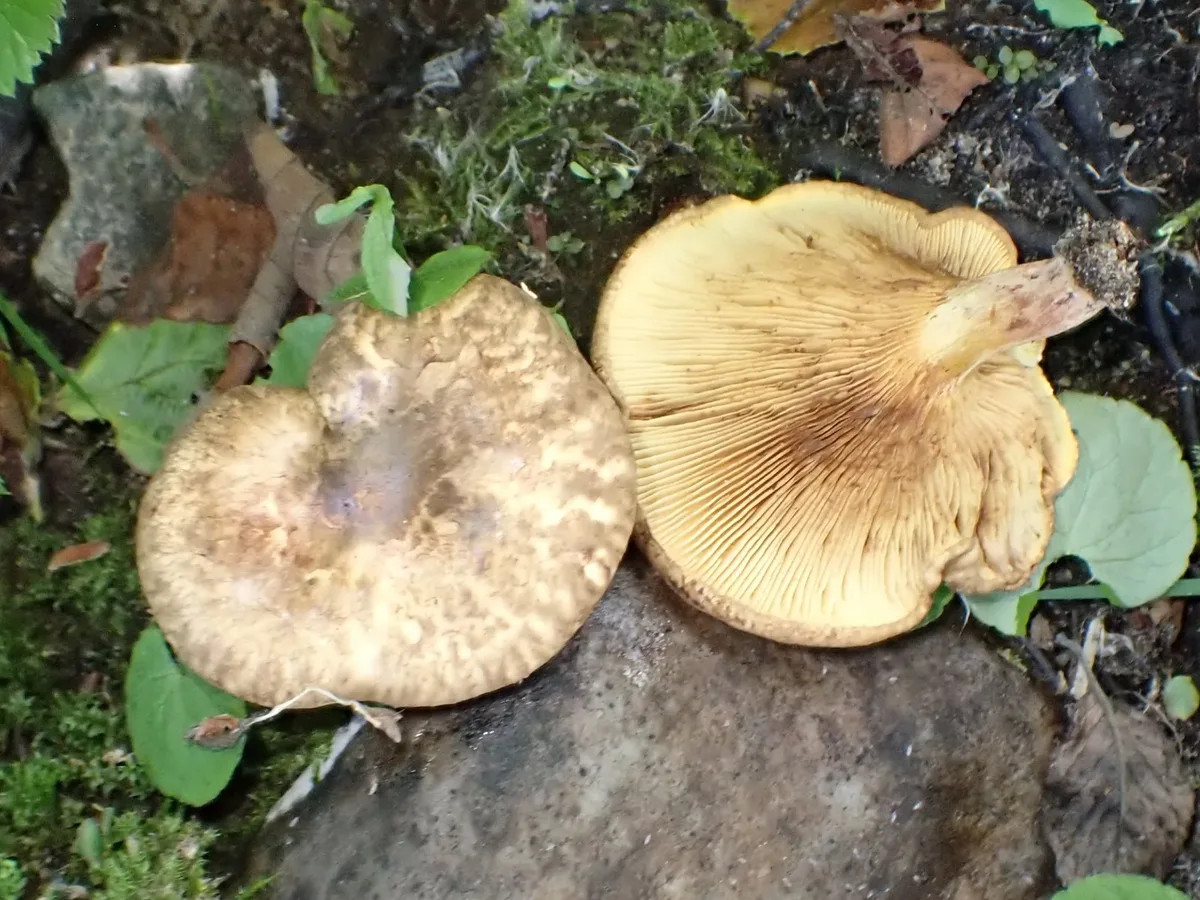 © Perry Gunnar Larsen (CC BY)
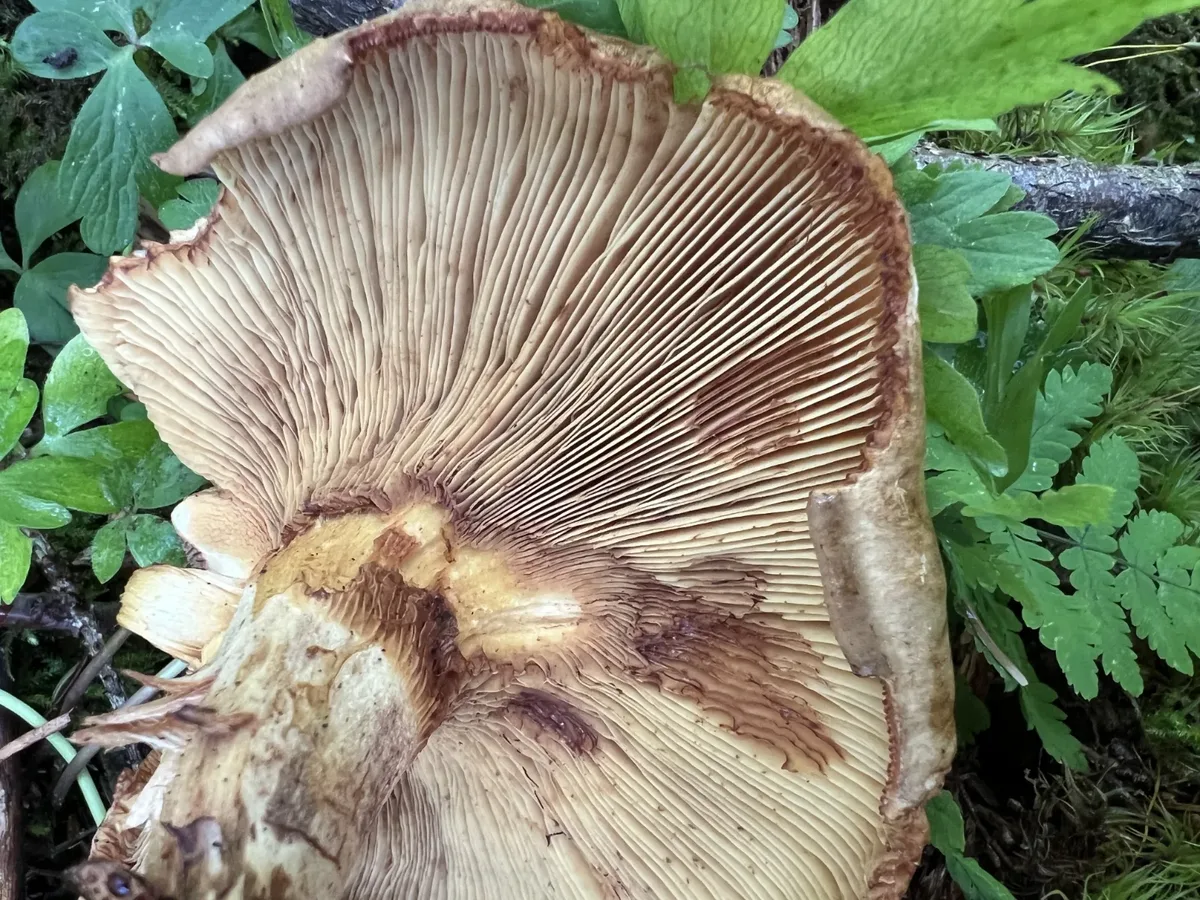 © Else Landsem (CC BY)
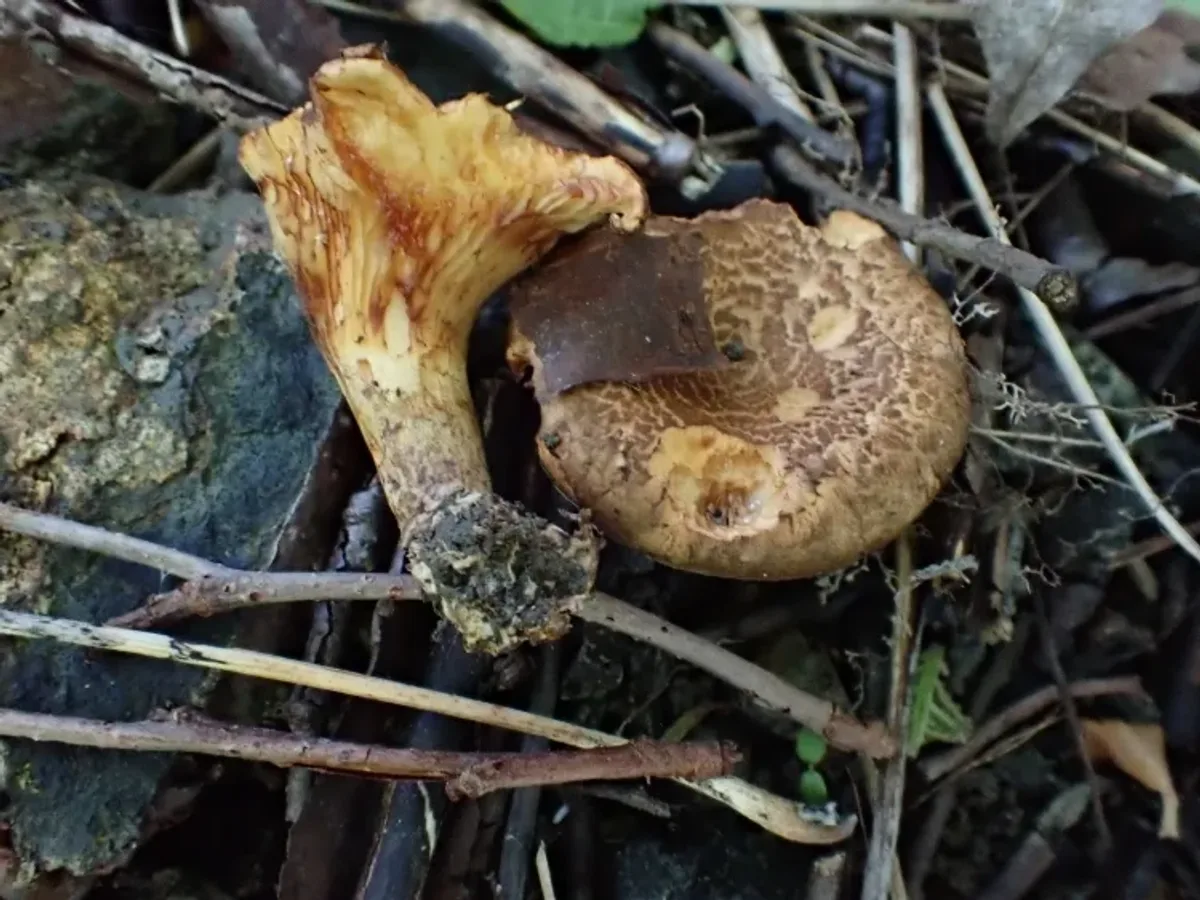 © Morten Pettersen (CC BY)
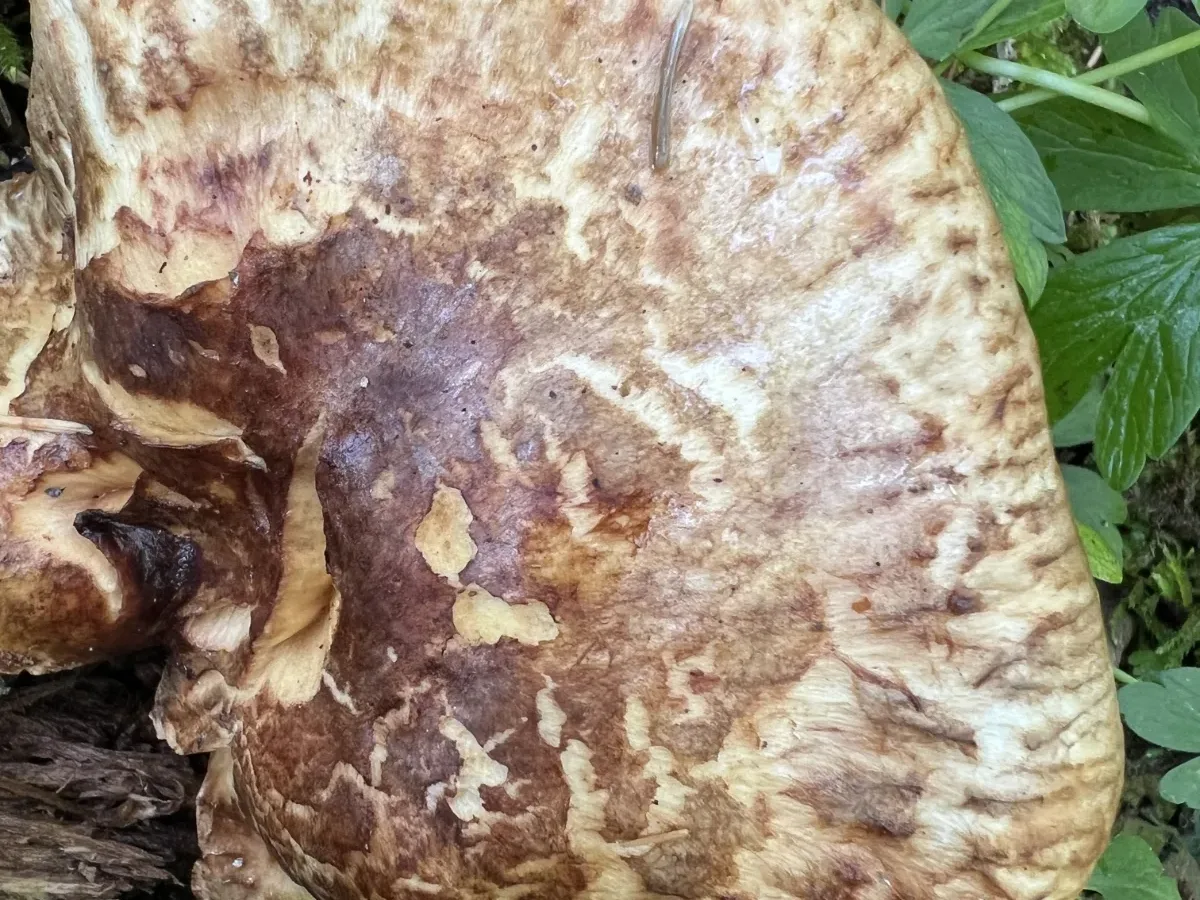 © Else Landsem (CC BY)
 © Else Landsem (CC BY)
 © Nils Edvard Stokke (CC BY)© Perry Gunnar Larsen (CC BY)© Else Landsem (CC BY)
Toxic - and the most serious cases can be fatal. Never eat it, and wash your hands after handling.
Never eat a mushroom you are not 100% sure of - check the look-alikes below, and always cook wild mushrooms.
How to recognise it
Paxillus rubicundulus is a medium-to-large rollrim (family Paxillaceae) that looks, at first glance, like a sturdy autumn fieldcap - but carries two giveaway traits that mark the genus instantly.
Cap
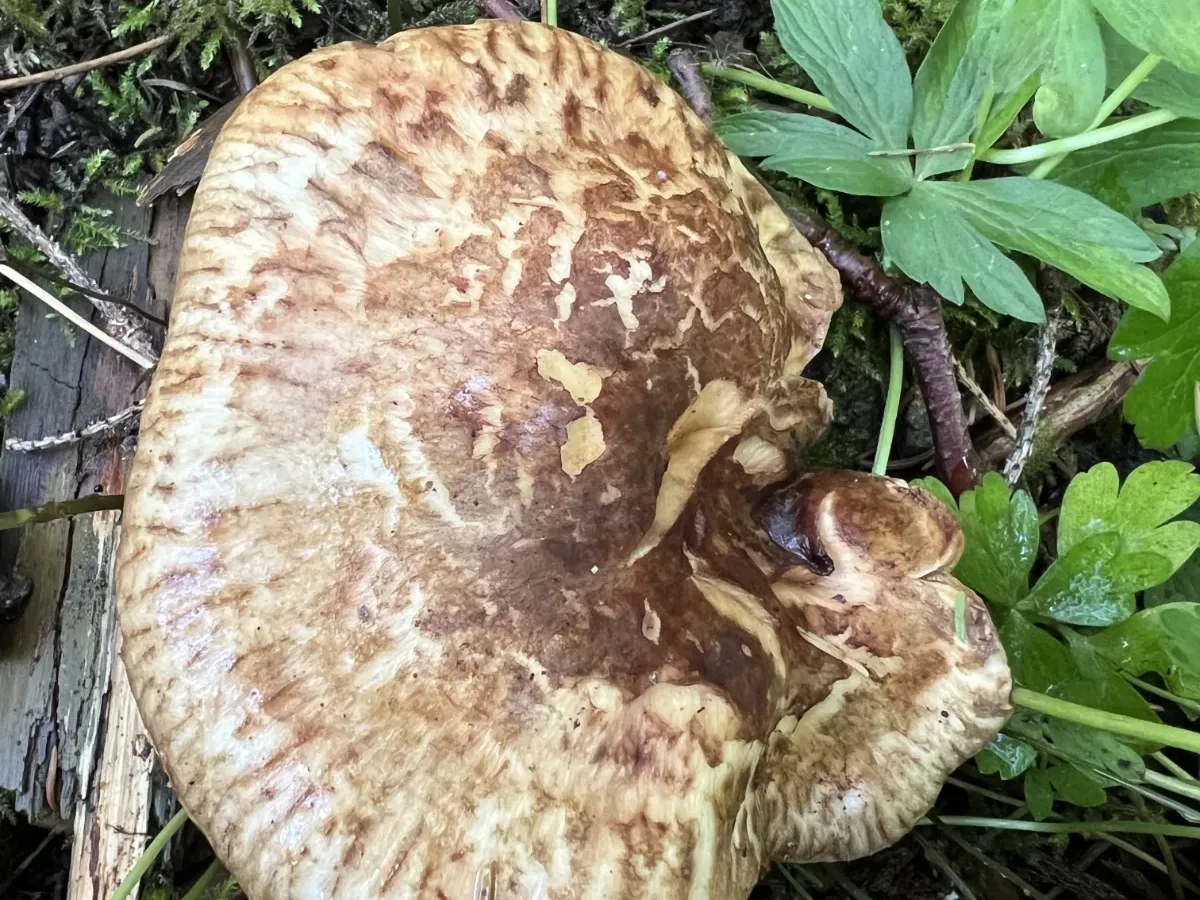
The cap runs 4-12 cm across: convex when young, gradually flattening, then hollowing at the centre into a shallow funnel at maturity.
Its colour is the first useful clue: reddish-brown to date-brown or chestnut-brown, often with a warm rusty suffusion, distinctly warmer and redder than the yellowish-olive or grey-brown you get on its close relative Paxillus involutus.
The second clue is the margin, which stays tightly inrolled for far longer than most gilled mushrooms - only flattening and occasionally upcurving in very old specimens, as if the cap never quite wants to open fully.
Gills
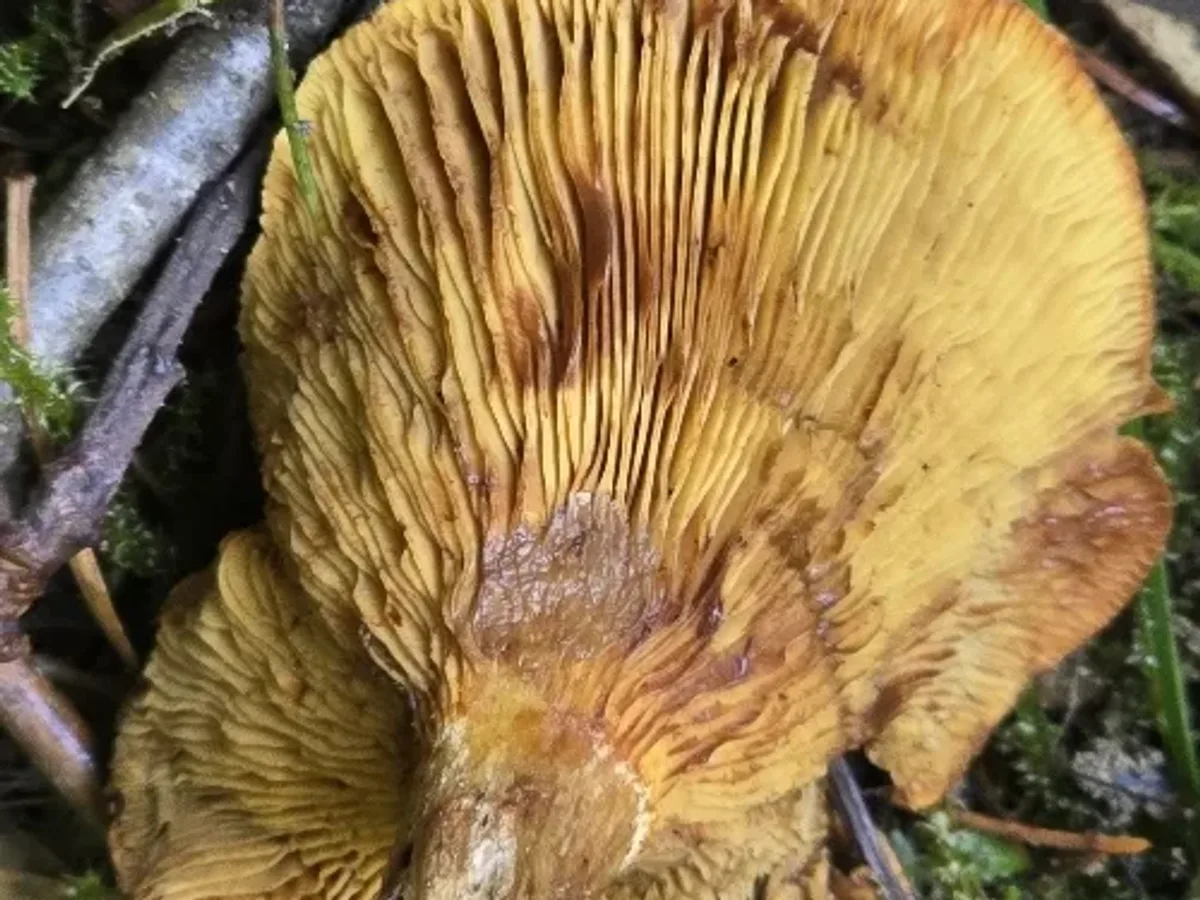
The gills are the most diagnostic feature of all: pale ochre-yellow when fresh, they bruise to reddish-brown and then dark rust-brown almost the moment they are touched.
Press a finger gently against the gills and the colour changes within seconds - a reaction that is dramatic, reliable, and unique to this group. The gills run decurrently down the stem.
Stem
The stem is firm, 3-7 cm tall, 1-2 cm wide, ochre to pale reddish-brown, often noticeably redder toward the base.
Flesh
Cut flesh is cream to pale yellow, turning slowly reddish-brown on exposure, especially in the lower stem.
Smell & taste
Smell faint, slightly acidic or floury; taste mild to weakly acidic.
Spore print rust-brown to ochre-brown.
Why it's dangerous
High - potentially lethal.
The insidious danger lies in the progressive sensitization mechanism: the first several exposures may produce only trivial gastrointestinal upsets that the consumer dismisses, while simultaneously building the immune sensitization that makes a later ingestion potentially fatal. This pattern has misled Eastern European foragers for generations, who considered the species "safe after proper preparation".
There is no safe preparation method, no reliable way to know whether you are sensitized, and no antidote once the hemolytic crisis begins.
Any inrolled-margin mushroom in alder riparian habitat with instantly-browning gills must be considered P. rubicundulus and must not be eaten under any circumstances.
Toxin
The toxic mechanism of Paxillus rubicundulus is identical to that of Paxillus involutus, and represents one of the most unusual poisoning syndromes in mycology. The causative agents are glycoproteins and heat-stable antigens present in the mushroom tissue.
The immune cascade - the so-called Paxillus syndrome - unfolds in stages:
- 1On repeated ingestion, these antigens stimulate the immune system to produce IgG antibodies.
- 2On subsequent exposure, antigen-antibody complexes form on the surface of erythrocytes (red blood cells), activating complement.
- 3This triggers an acute immune hemolytic crisis.
The toxins are heat-stable and are not destroyed by cooking, boiling, drying, or any other conventional preparation method.
Involutin, a phenanthrene pigment, has been identified in Paxillus species and contributes to gastrointestinal effects. But the primary lethal mechanism is the immunological cascade rather than a directly cytotoxic compound in the conventional sense.
Symptoms
Symptoms occur in two distinct phases depending on sensitization status.
In non-sensitized or first-time consumers: gastrointestinal symptoms beginning 1-3 hours after ingestion - nausea, abdominal cramps, vomiting, and diarrhea - that typically resolve within 24 hours.
In sensitized individuals (those who have eaten Paxillus species previously, sometimes over many years): acute hemolytic crisis beginning 30 minutes to 3 hours after ingestion, characterized by rapid onset of:
- pallor
- hemoglobinuria (dark reddish-brown urine from lysed red blood cell products)
- severe back and abdominal pain
- fever
- shaking chills
- acute kidney failure
- circulatory shock
The transition from the mild gastrointestinal phase to hemolytic crisis can be rapid and unexpected. Without immediate intensive medical treatment, the hemolytic crisis can be fatal.
Staying safe
Paxillus rubicundulus is a deadly toxic species. It causes the same syndrome as Paxillus involutus: Paxillus syndrome (also called Type VIII poisoning), a delayed immune-mediated hemolytic anemia.
On first or occasional exposures, the mushroom may produce only mild gastrointestinal symptoms (nausea, cramps, vomiting, diarrhea) that resolve within hours.
Repeated exposures - and sometimes a single large exposure - sensitize the immune system to glycoproteins in the mushroom. On subsequent ingestion, the immune system mounts an IgG-mediated attack on red blood cells coated with Paxillus antigen, causing acute intravascular hemolysis: rapid destruction of red blood cells in the bloodstream.
This manifests as sudden hemolytic crisis with acute kidney failure (from haemoglobin precipitation in the renal tubules), circulatory shock, and potentially death.
The mechanism does not require consuming large quantities - even modest amounts can trigger the crisis in sensitized individuals, and sensitization can develop silently over years of repeated consumption.
No antidote exists; treatment is intensive supportive care including dialysis and transfusion. Fatal cases have been well documented in the European medical literature.
Older guidance (particularly eastern European sources from before 1980) that described P. involutus-group mushrooms as edible after salting or long cooking is dangerously wrong and must be disregarded entirely.
Where & when it grows
Habitat
Of all the rollrims, this one has staked out a very particular corner of the world: wherever black alder grows with its feet in the water.
Paxillus rubicundulus is a specialist mycorrhizal partner of alder (Alnus spp.) - primarily black alder (Alnus glutinosa) - and it follows that tree faithfully into wet riparian ground: stream banks, river floodplains, alder carr woodland, lakeside fringes, and the edges of fens and marshy clearings. It tends to emerge at the very base of alder trunks, threading its mycelium through the surface roots in saturated soil.
If you are in a wet alder wood and encounter a rollrim, it is almost certainly this species rather than P. involutus, which favours drier birch and pine habitats.
In more upland riparian corridors it will also grow under grey alder (Alnus incana), and rarely under Italian alder (Alnus cordata) in southern European plantings.
The three-part check is a reliable identification suite:
- 1Inrolled margin.
- 2Instantly-browning gills.
- 3Wet alder setting.
When
Fruiting runs from July through November across central Europe, with the heart of the season falling in late August through October - broadly the same rhythm as Paxillus involutus.
Peak weeks are 35-42 (late August to mid-October), when temperatures begin their autumn slide and rainfall keeps the lowland floodplains damp.
Regional variation:
- In northern Scandinavia the window compresses into August-September.
- Toward the Mediterranean, fruiting can slip into November in mild, wet years.
One useful quirk of the riparian habitat: even when summer droughts leave upland woodland dry and quiet, the water table beneath alder carr stays elevated, and P. rubicundulus can fruit weeks ahead of woodland species that are still waiting for rain to arrive.
How it grows
Fruitbodies emerge singly or in small groups of 2-8 from the soil among alder roots, or from the humus layer pressed against the trunk base.
The mycelium is perennial - living invisibly in the root zone year-round, threading through the saturated soil in a silent partnership with its host tree - while the fruitbodies themselves are annual.
Cap and stem push up together from a rounded primordium, the margin staying tightly inrolled the whole time, and the fruitbody reaches maturity over 5-10 days when moisture holds.
The damp riparian setting works in its favour: high ambient humidity slows desiccation, so specimens often remain in good, recognisable condition for longer than upland mushrooms would.
Fruiting conditions
Fruiting is triggered by autumnal rainfall and declining soil temperatures, similar to P. involutus. The riparian habitat of P. rubicundulus means soil moisture is often sufficient even when upland sites are dry, so fruiting rain thresholds are somewhat lower than for woodland species. A moderate rainfall event (15+ mm over 14 days) combined with soil temperatures dropping below 18°C typically initiates fruiting. The flush lag of 5-12 days is slightly shorter than P. involutus owing to the reliably moist root zone under alder in carr habitats.
Look-alikes
The most important comparison species is Paxillus involutus (Brown rollrim), which is equally deadly. It differs in its preference for birch, pine, and oak in drier upland habitats, and its cap is typically more olive-brown to grey-brown rather than the reddish-brown to date-brown of P. rubicundulus. Habitat (alder-riparian versus general woodland/garden) is the most practical separation, though both are equally toxic and both must be avoided.
Tapinella atrotomentosa (Velvet rollrim) is another non-edible Paxillaceae relative. It is distinguishable by its distinctive dark velvety-brown to blackish stem (like black velvet), its dry, hazel-brown cap, and its preference for dead conifer wood (stumps and roots) rather than living alder. It causes gastrointestinal irritation and must not be eaten.
Lactarius species growing near alder, particularly Lactarius obscuratus and Lactarius cyathuliformis, could potentially be confused with young P. rubicundulus before the inrolled margin is obvious. But all Lactarius species exude coloured or white latex (milk) when broken - P. rubicundulus has no latex whatsoever. The absence of latex and the instantly-browning decurrent gills immediately resolve any Lactarius confusion.
Naucoria escharioides is a small, brown alder-associate, but it is a much smaller, thin-fleshed agaric with attached (not decurrent) gills and no inrolled margin.
Paxillus involutus is equally deadly and the primary confusion species within the genus. It grows in a much wider range of habitats (birch, pine, oak, garden lawns) rather than specifically under alder in riparian zones. Cap color is typically more olive-brown to grey-brown, lacking the reddish-brown to date-brown tones of P. rubicundulus. In practice, both species share identical toxicity and identifying one versus the other is mycologically interesting but does not affect the safety decision: neither must ever be eaten.
Lactarius obscuratus is a small, dull ochre-brown milkcap found specifically under alder. It could theoretically be confused with young P. rubicundulus before the inrolled margin is obvious, but it exudes watery, mild, colourless latex (milk) when gills or flesh are broken - Paxillus has no latex whatsoever. The gills of L. obscuratus do not bruise instantly dark brown when touched. It is considered inedible but not seriously toxic.
A small, ochre-brown agaric specifically associated with alder, much smaller than P. rubicundulus (cap 1-4 cm), with attached rather than decurrent gills, no inrolled margin, and a slender stem. It may share the same habitat but scale, gill attachment, and margin form separate it immediately. Not known to be seriously toxic but inedible.
Tapinella atrotomentosa shares the inrolled margin and decurrent-gills appearance but is immediately distinguished by its stem, which is covered in a distinctive dark chocolate-brown to blackish velvet (tomentose) texture unlike any other common mushroom. It grows on or near conifer wood (stumps, buried roots) rather than under living alder. The cap is dry, hazel to brown without reddish tones. It is inedible and causes gastrointestinal irritation. The velvety stem and conifer-wood habitat resolve the confusion.
A reference guide - never an edibility guarantee. When in doubt, leave it out.