Scarletina bolete
Neoboletus luridiformissyn. Boletus luridiformis, Boletus erythropus, Boletus erythropus var. erythropus, Tubiporus luridiformis
 © Eila Sieppi (CC BY-SA)
 © Unknown (CC BY-SA)
 © Unknown (CC BY-SA)
 © Unknown (CC BY-SA)
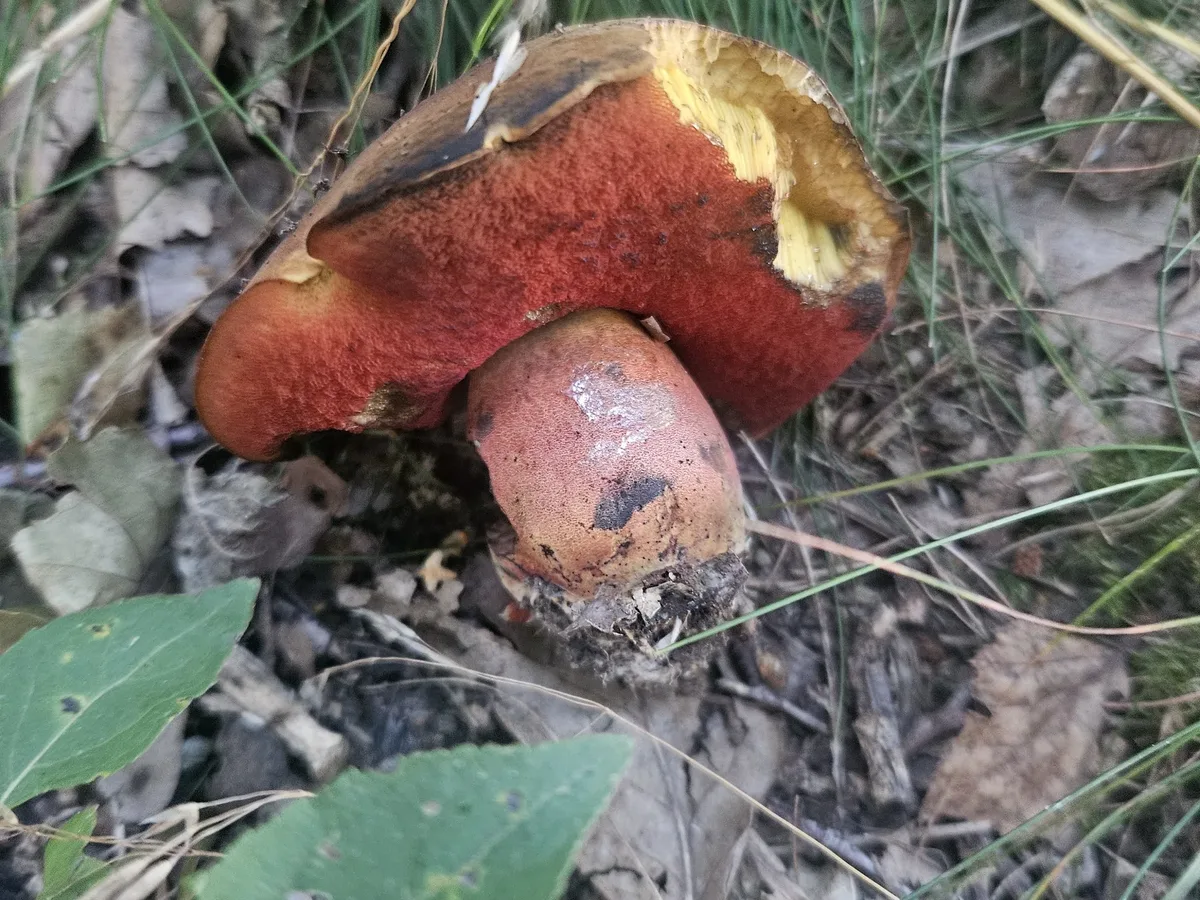 © Katja Simonen (CC BY-SA)© Eila Sieppi (CC BY-SA)© Unknown (CC BY-SA)
Edible only with the right preparation - or safe for some people but not others. Learn the caveats first.
Never eat a mushroom you are not 100% sure of - check the look-alikes below, and always cook wild mushrooms.
How to recognise it
The Scarletina bolete is a large, imposing fungus that announces itself with colour.
Cap
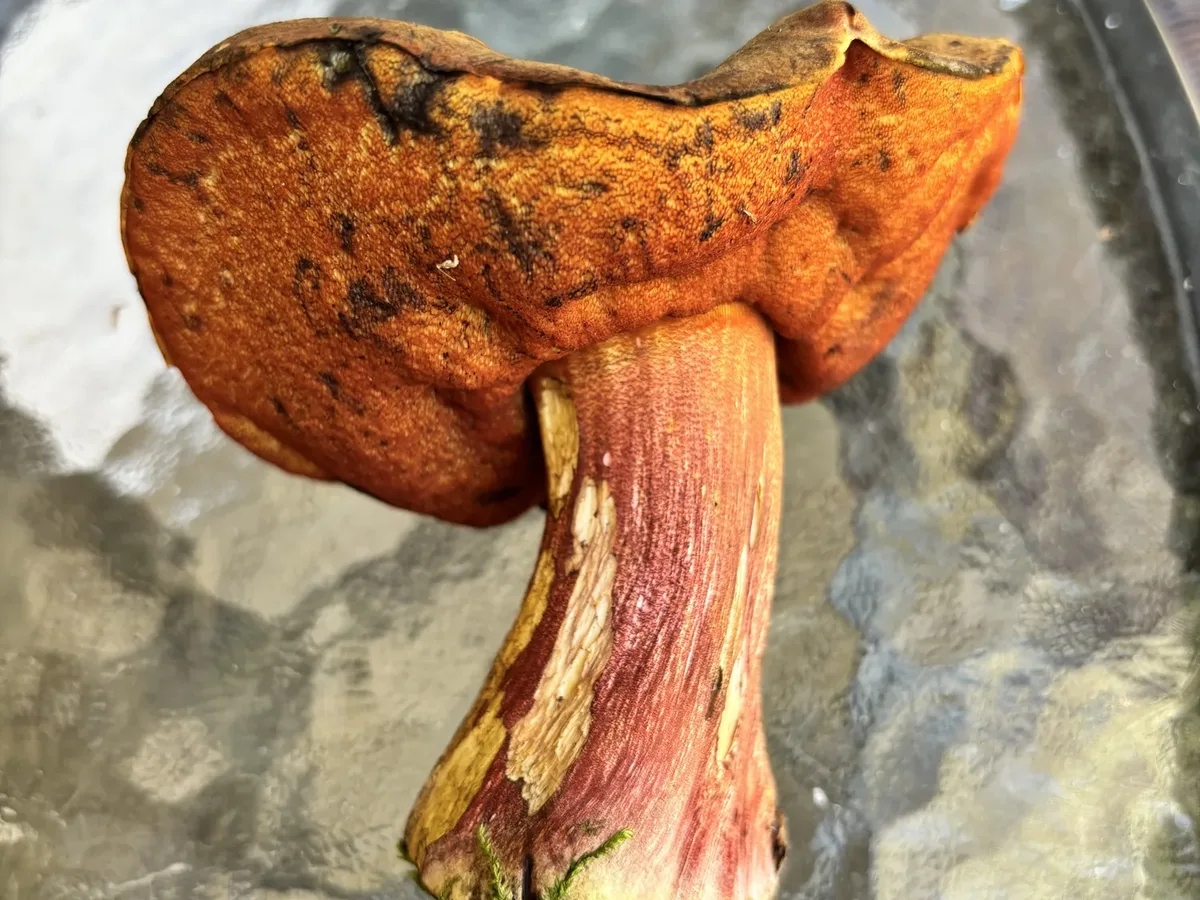
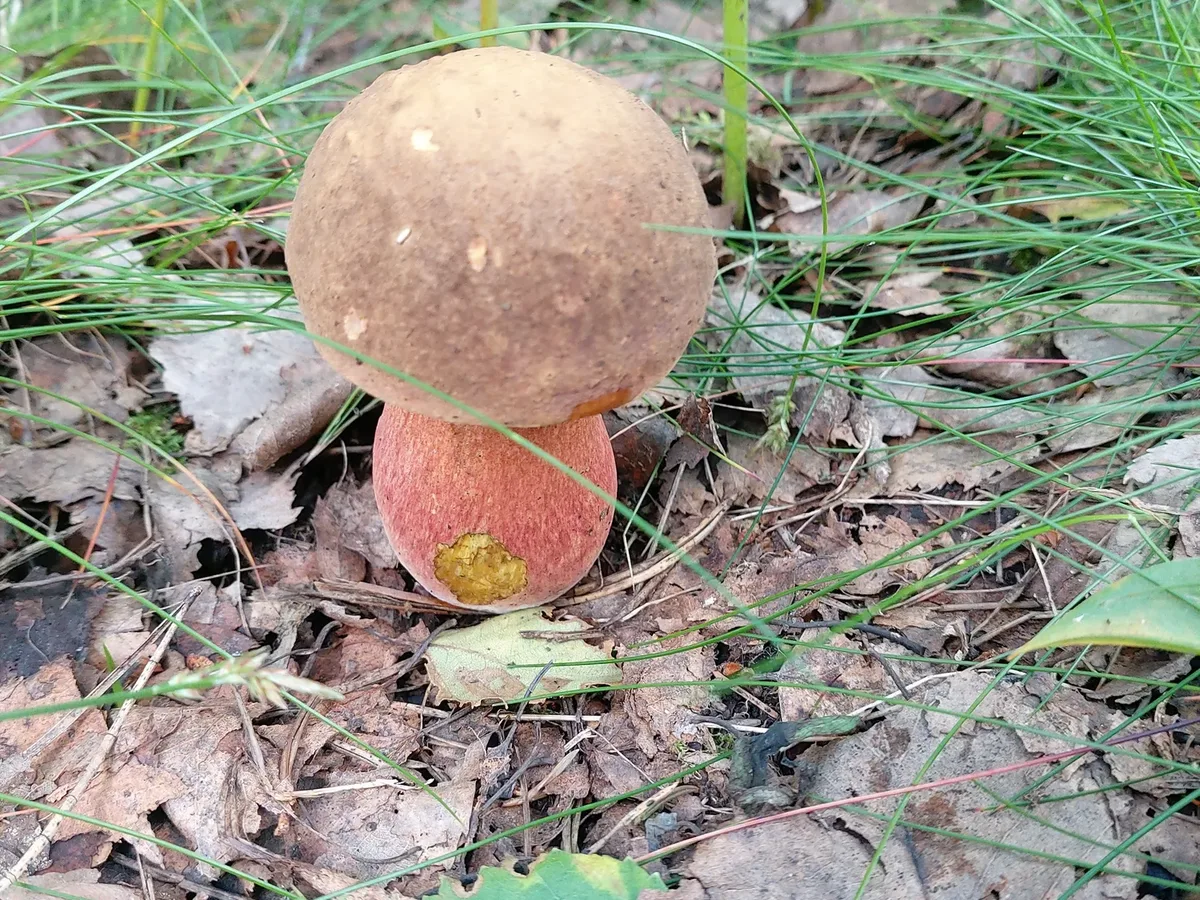
The cap begins tightly rounded and convex in youth, expanding with age into a broad, cushion-like pileus up to 20 cm across - substantial enough to fill a palm.
The surface is dry and finely velvety (tomentose) when young, becoming smoother with age but never viscid or sticky even in wet conditions.
Colour ranges from mid-brown to rich dark umber or chestnut-brown, occasionally with olive or reddish-brown tones; the cap margin may carry a slightly paler or more yellowish tinge.
Pores
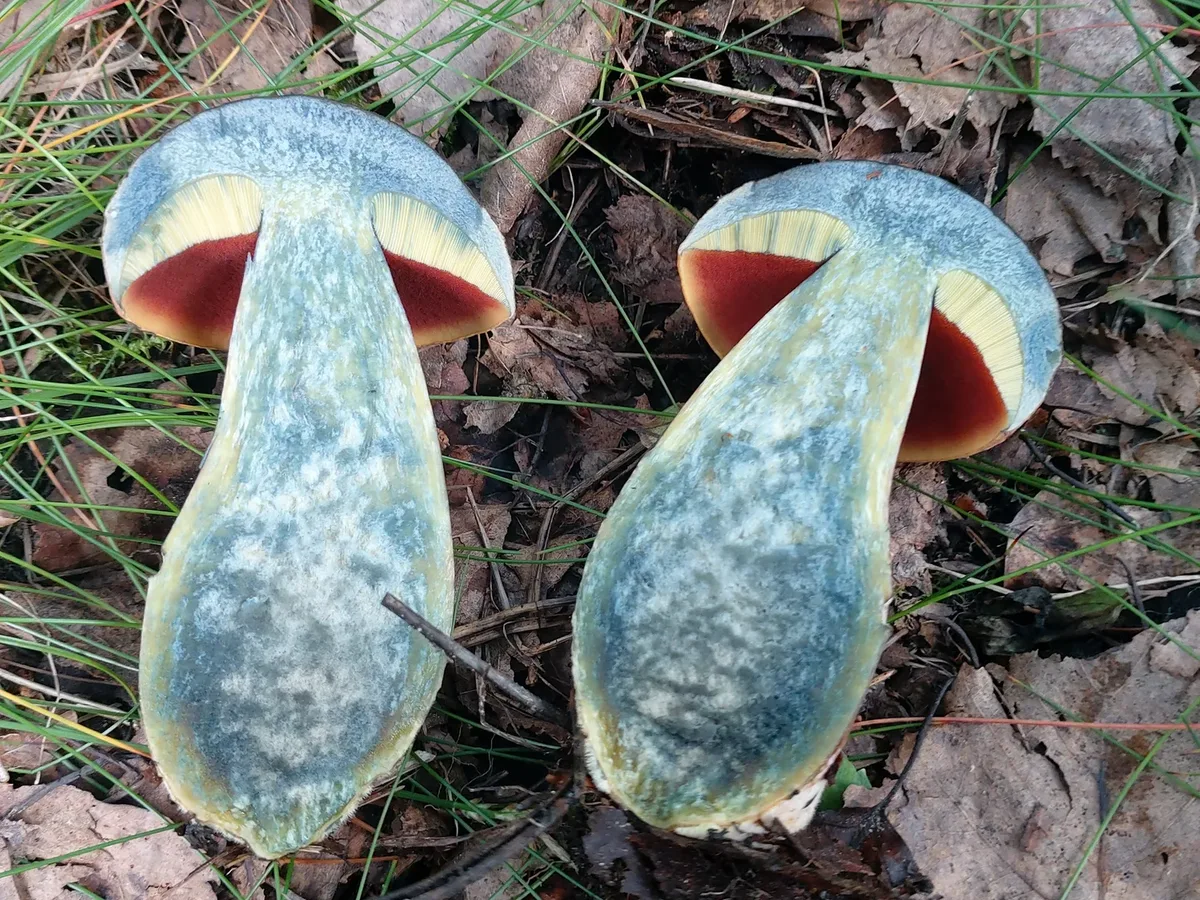
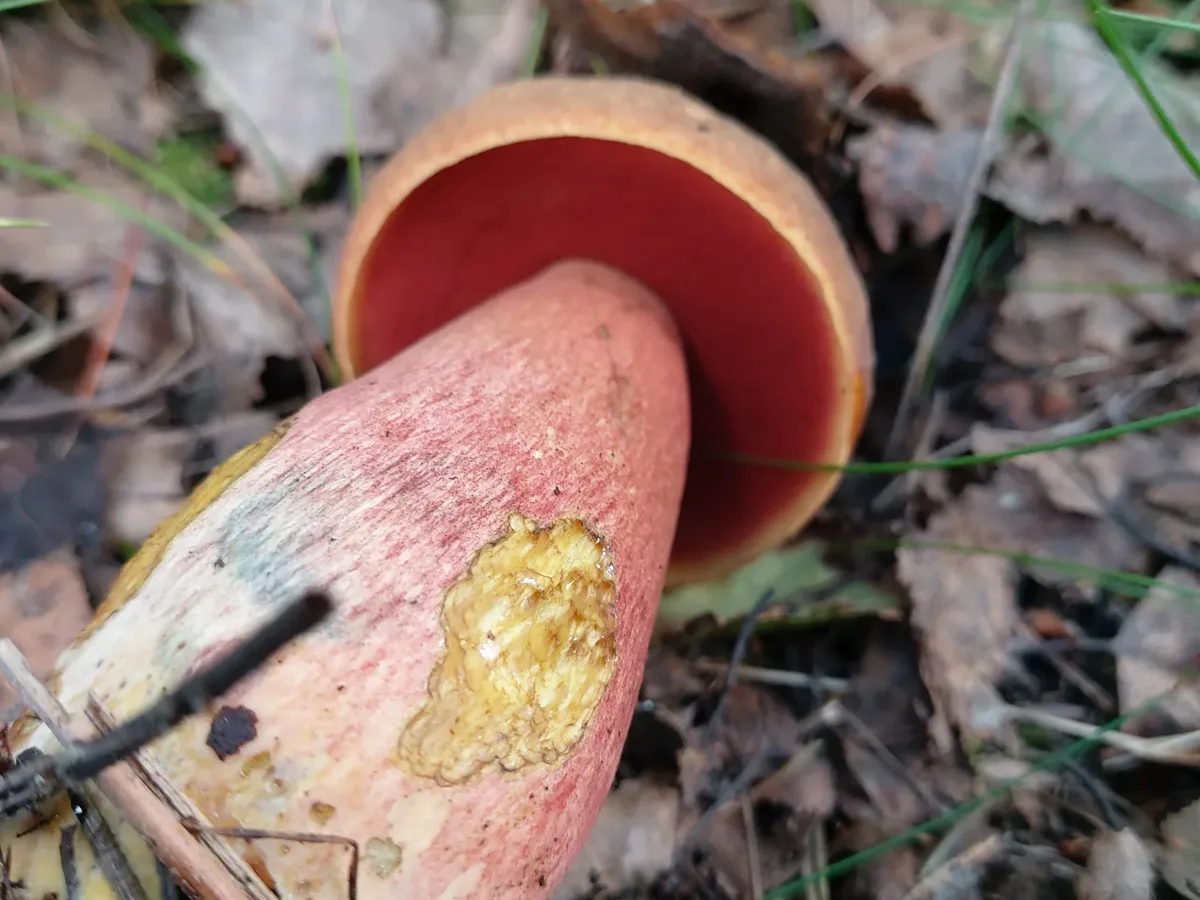
The undersurface is where this species earns its reputation. The pores are small, perfectly circular, and coloured a striking blood-red to scarlet - almost as if freshly painted - when the mushroom is young and fresh. With age they fade toward orange-red but rarely lose their intensity entirely.
Touch or cut them and something remarkable happens: the pore surface and tubes darken to deep indigo-blue or blue-black almost instantaneously, one of the fastest and most vivid blue reactions in the bolete world. The tubes themselves (10-20 mm deep) match the pores in colour and respond with equal speed.
Stem
The stem is robust and solid, 5-12 cm tall and 2-5 cm in diameter, often somewhat club-shaped or widest in the lower half.
Its most diagnostic feature is the surface: it is covered with dense, raised, fine red or orange-red granules (scabers or glandular dots) set against a yellow to pale yellow ground colour, giving it a vividly speckled, fire-like look.
Crucially, this granular pattern is NOT a net (reticulum) - there are no connecting ridges, which distinguishes it from Boletus edulis and its allies.
Flesh
The flesh throughout cap and stem is firm and pale lemon-yellow; slice into it and the cut surface turns a rapid deep indigo-blue within seconds, eventually settling to a slate-grey.
The stem base flesh does NOT flush red before turning blue (in contrast to Suillellus luridus).
Spore print olive-brown to olive-ochre.
Where & when it grows
Habitat
Neoboletus luridiformis is an ectomycorrhizal species - it lives in quiet partnership with the roots of trees, trading mineral nutrients for the sugars the tree produces.
It works with a wide range of hosts: Norway spruce, silver fir, beech, oak, and birch are all suitable partners, making it at home in mixed and montane forests across much of Europe.
It favours acidic to mildly acidic soils that are humus-rich and well-drained, and is particularly productive in upland forest zones from about 400 to 1500 m elevation, where it often emerges after summer thunderstorms.
It is not restricted to the mountains, though - it appears widely at lower elevations too:
- In Scandinavia it grows readily under birch and in boreal spruce forest.
- In the British Isles it favours oak and beech woodland on acid soils.
- Across central Europe it is especially abundant in the forests of the Alps, Carpathians, and Bohemian massif.
Fruiting bodies tend to emerge singly or scattered rather than in tight clusters.
When
The Scarletina bolete has one of the longer fruiting windows among large boletes, typically appearing from June (occasionally late May in warm years) through to October.
The core season spans July to September, closely tied to warm, humid spells following summer and early-autumn rain. Peaks in fruiting are strongly linked to rainfall of 20-40 mm over a 10-14 day period with soil temperatures between 12 and 20 °C.
At montane elevations in the Alps and Carpathians, the season may stretch into October. In lowland western Europe and southern Scandinavia, early July flushes are common after heavy summer rain.
How it grows
Fruiting bodies emerge singly or scattered through the forest floor litter and humus. They push up rapidly - a young button can expand to full size within 4-6 days under warm, moist conditions.
The velvety, brown cap buttons are sometimes initially obscured beneath fallen needles or leaf litter.
Young specimens are among the most prized for eating, with firm, vividly coloured flesh. Older, larger individuals often become soft, waterlogged, or host to insect larvae (maggots), and deteriorate rapidly in warm weather.
Fruiting conditions
Fruiting is strongly triggered by warm summer rain events; a period of 20+ mm over 14 days with soil temperatures between 10 and 22 °C typically produces flushes within 7-14 days. Best yields follow convective summer thunderstorms in July and August in montane zones.
Handle with care
Toxin
Contains thermolabile haemolysins and related glycoprotein compounds that are denatured by heat above approximately 70 °C.
The exact toxin profile of N. luridiformis has not been as thoroughly characterised as that of R. satanas (which contains bolesatin and traces of muscarine), but the heat-sensitive nature of the harmful compounds is well established empirically.
Symptoms
Raw or insufficiently cooked consumption causes gastrointestinal syndrome:
- onset 30 minutes to 3 hours after ingestion
- nausea, vomiting, abdominal cramps, and diarrhoea
Symptoms are generally self-limiting and resolve within 12-24 hours with supportive care (hydration).
In severe cases or with very large raw quantities, haemolytic effects are theoretically possible but rarely documented in clinical practice.
Thoroughly cooked mushrooms produce no toxic effects in the vast majority of consumers.
Look-alikes
Several boletes share the combination of red pores and blue-staining flesh, and correct identification is critical because at least two of the lookalikes are seriously toxic.
Rubroboletus satanas (Satan's bolete) - SEVERELY TOXIC / REQUIRES HOSPITALISATION. This is the most important lookalike to exclude. Satan's bolete has:
- a pale ivory to whitish, greyish-white, or pale grey cap (never the rich brown of N. luridiformis)
- vivid scarlet to blood-red pores
- a robust, bulbous stem with a red reticulum (net pattern) at least in the lower part
- flesh that also blues on cutting
Critically, R. satanas has an unpleasant, carrion-like or fetid odour, especially in older specimens. N. luridiformis has a brown cap and no reticulum on the stem. If the cap is pale/whitish, stop - do not eat.
Suillellus luridus (Lurid bolete) - edible only when thoroughly cooked, toxic raw (contains thermolabile haemolysins). This species has an olive-brown to tan cap, red pores, and a stem that shows a distinct red net (reticulum) in the lower portion over a yellow-orange ground. The stem base flesh turns red before turning blue.
S. luridus is edible but must be well cooked; raw consumption causes poisoning. N. luridiformis lacks the net on the stem and does not show red at the stem base. Inexperienced foragers should avoid S. luridus entirely due to the risk of confusion and the need for complete cooking.
Rubroboletus pulchrotinctus - a Mediterranean species with similar red pores; cap pinkish-orange to brick-red; causes gastrointestinal poisoning. Distinguished by cap colour and Mediterranean habitat.
Boletus edulis and allies - lack red pores (pores are white to yellow-green), have white to buff stem reticulum, and flesh does not blue (or blues only faintly at the cap-tube junction). No confusion possible if pore colour is checked.
Neoboletus xanthopus - closely related but has a brighter yellow stem and cap that tends toward olive-ochre; eastern European distribution; edible and similar treatment.
Why it matters
Moderate risk when raw; negligible when properly cooked.
The primary danger is misidentification - especially confusion with Rubroboletus satanas, which causes severe gastrointestinal poisoning:
- onset 30 minutes to 3 hours
- violent vomiting, profuse diarrhoea, cramps
- may require hospitalisation and IV rehydration
If in any doubt about identification, do not consume.
Cap is pale ivory-white to greyish-white (never brown); stem has a distinct red net (reticulum) in the lower portion; older specimens have a strong fetid or carrion-like odour. N. luridiformis has a brown cap, granular (not netted) stem surface, and a pleasant mild smell.
Very similar; tends to have a brighter yellow stem with more vivid yellow tones and a slightly more olivaceous cap. Edible with same treatment. Primarily central to eastern European distribution. Best separated by microscopy or molecular data.
Stem shows a clear red to orange net (reticulum) - N. luridiformis has dots/granules, not a net. Stem base flesh of S. luridus turns red before bluing; N. luridiformis flesh goes straight to blue. S. luridus is edible when thoroughly cooked but toxic raw - treat with the same cooking discipline.
Mediterranean species; cap coloured pinkish-orange to brick-red, not brown. Causes gastrointestinal poisoning. Range mostly does not overlap with N. luridiformis at low elevations.
In the kitchen
Picking & cleaning
Select only young to mid-aged specimens with firm caps free of obvious larval tunnelling.
Slice the base of the stem cleanly with a knife and check the cross-section: clean, firm yellow flesh that turns blue is expected. If the flesh is already soft, discoloured, or heavily insect-damaged, leave it.
Because the flesh turns blue immediately on cutting, do not be alarmed: this is normal and the colour does not indicate toxicity. The blue-stained flesh remains blue throughout cooking and may give sauces or risottos a grey tinge; this is purely aesthetic.
Carry in an open basket to allow spore dispersal and prevent rapid deterioration.
Do not confuse with the genuinely dangerous Rubroboletus satanas (Satan's bolete) or the caution-requiring Suillellus luridus (lurid bolete) - see Lookalikes.
Cooking
Once cooked, Neoboletus luridiformis offers firm, meaty flesh with a mild, pleasantly mushroomy flavour. The texture holds up well to high-heat cooking.
Sauté sliced caps and stem pieces in butter or olive oil over medium-high heat until fully cooked through and any excess moisture has evaporated - at least 10-15 minutes for thicker slices. The blue colour fades partially during cooking and the flesh takes on a grey-buff hue, which is purely aesthetic.
It excels in mushroom ragù, pasta sauces, risotto, mushroom soups, and alongside game meats. Pair with thyme, garlic, cream, or red wine sauces.
It can be dried effectively (colour darkens but flavour concentrates), and dried slices can be ground into mushroom powder for flavouring. Pickling in vinegar is traditional in eastern Europe.
Do not eat raw under any circumstances.
Good to know
Neoboletus luridiformis is considered edible and is widely eaten across central and eastern Europe, but it MUST be thoroughly cooked before consumption.
Raw or insufficiently cooked specimens contain thermolabile toxins (haemolysins and other compounds that are denatured by heat) that can cause gastrointestinal distress - nausea, vomiting, and diarrhoea - similar to eating the related Suillellus luridus raw.
Once properly cooked (sautéed, boiled, or roasted until the flesh is fully heated through), it is safe and palatable for most people.
Never eat raw. The dramatic blue staining is a reliable field mark but does NOT by itself confirm identity - always verify:
- cap colour (brown, not white/pale)
- stem surface (granular dots, not a net)
- lack of offensive smell
The greatest danger is confusion with Rubroboletus satanas, which shares red pores and blue staining but causes severe gastrointestinal poisoning requiring hospitalisation.
Alcohol does not appear to worsen N. luridiformis toxicity (unlike Coprinopsis atramentaria), but alcohol should never be used as a safety net for uncertain identification.
The blue colour persists through cooking and will tint sauces grey - this is harmless but can be visually unappealing.
A reference guide - never an edibility guarantee. When in doubt, leave it out.