East Asian black morel
Morchella eximioidessyn. Morchella elata auct. East Asia (misapplied)
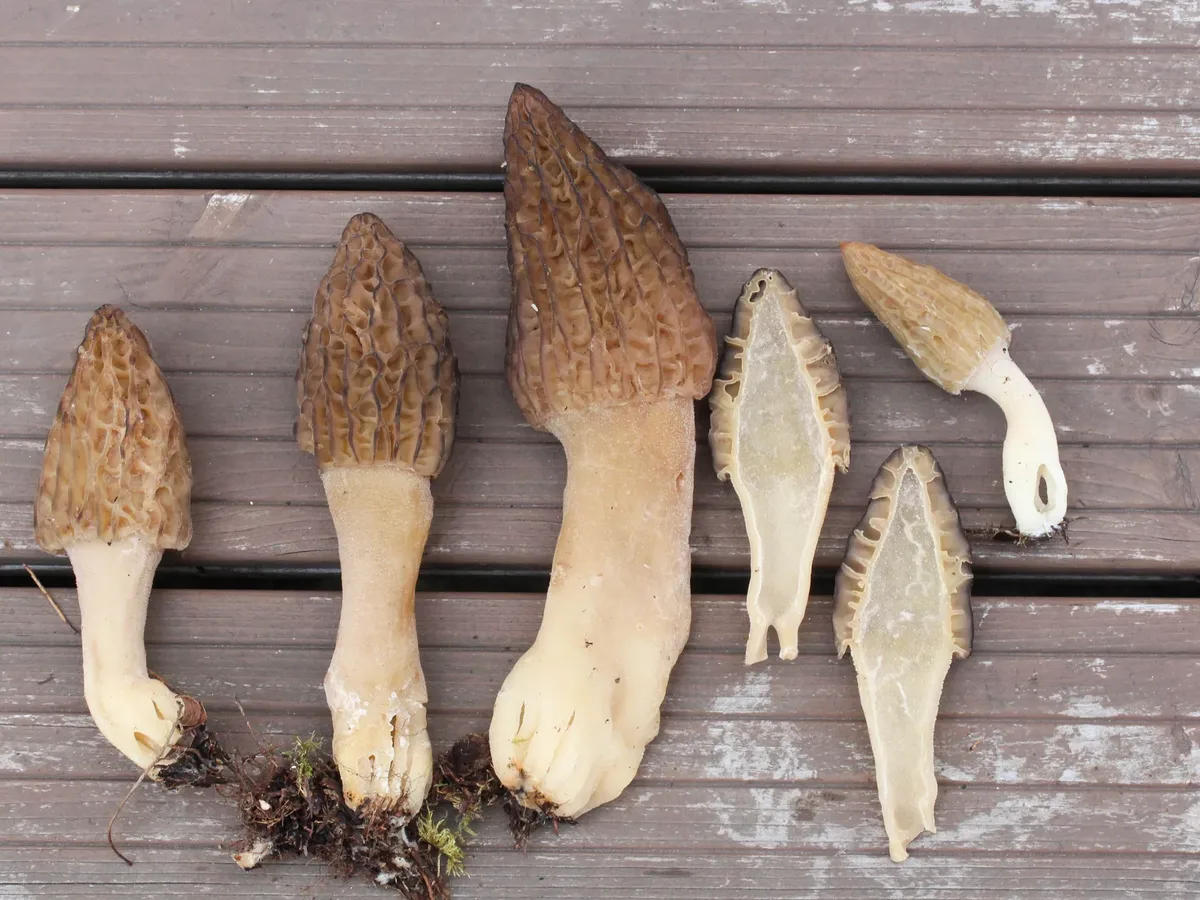 © Tapio Kekki (CC BY-SA)
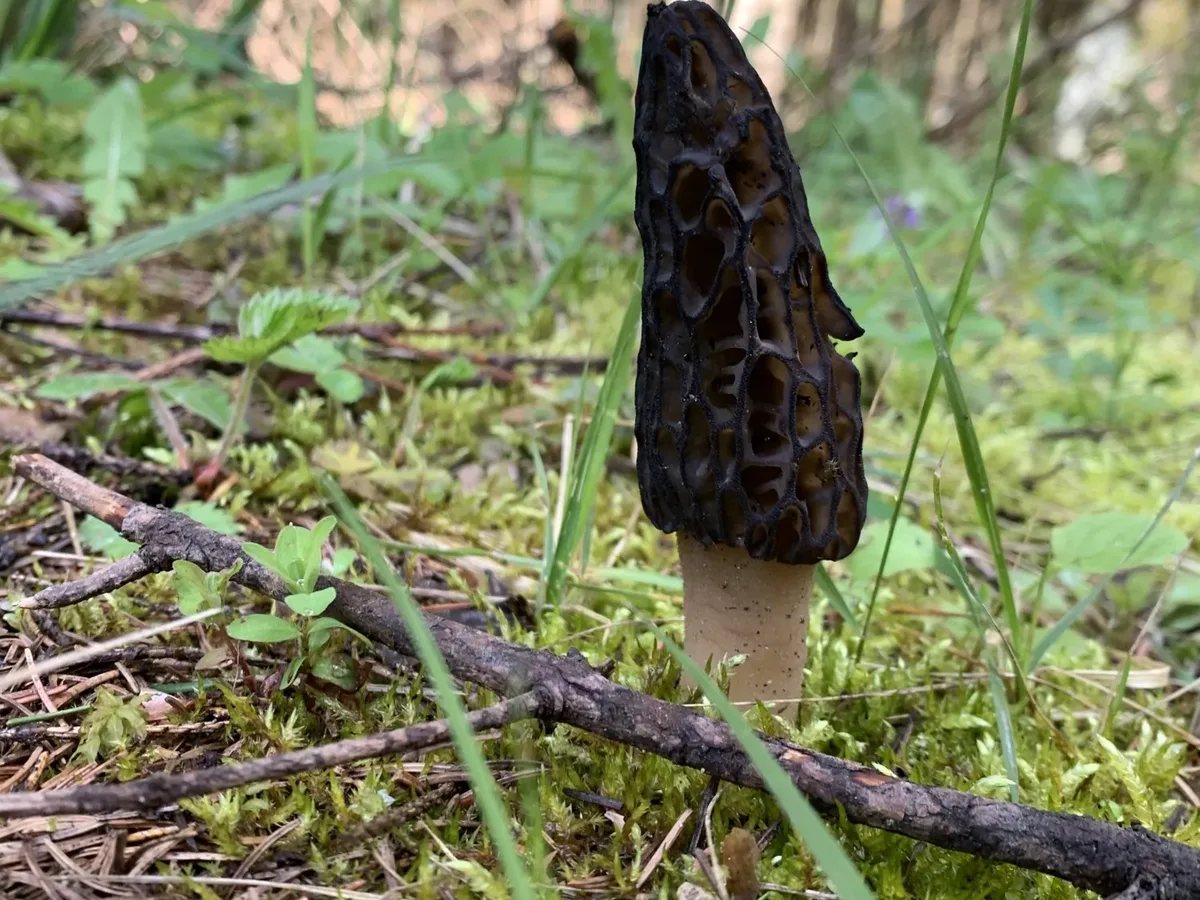 © vuikaan (CC BY)
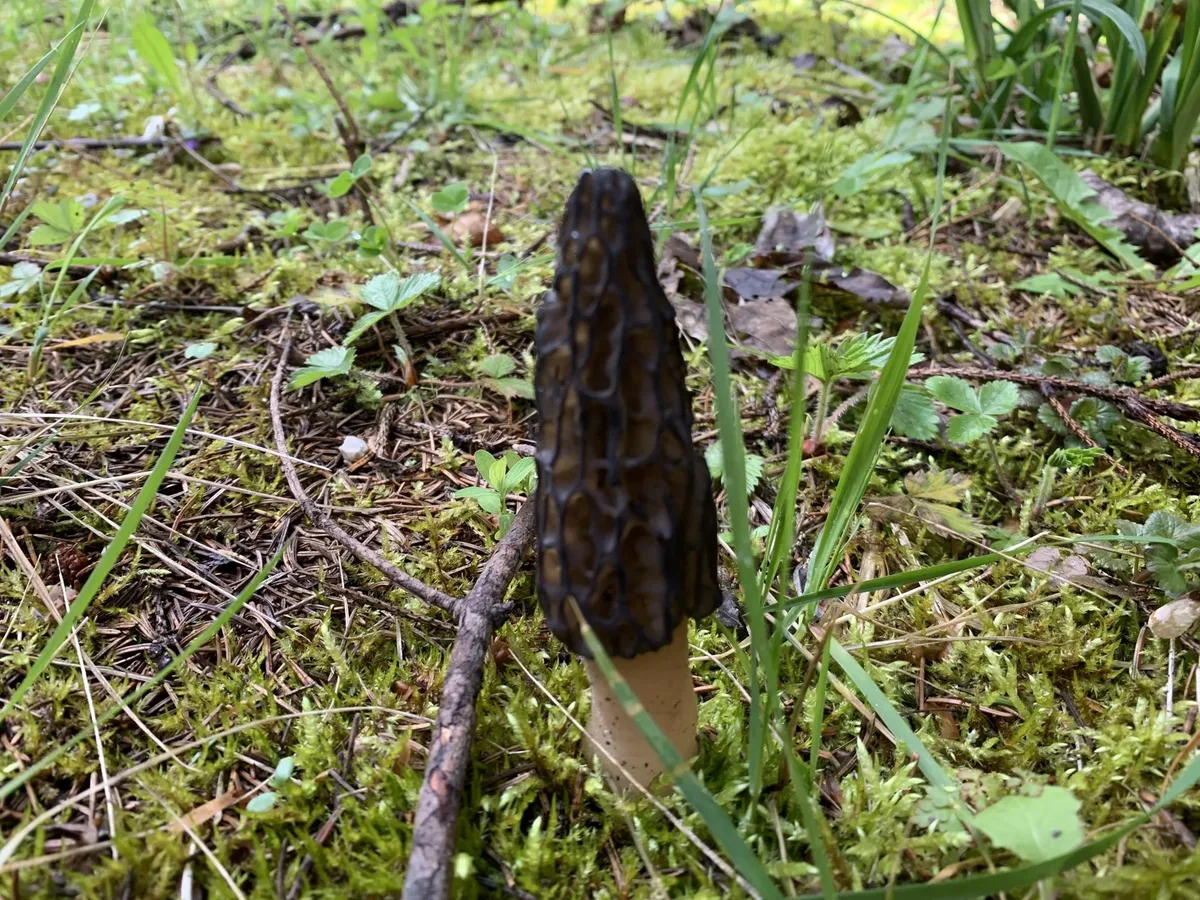 © vuikaan (CC BY)
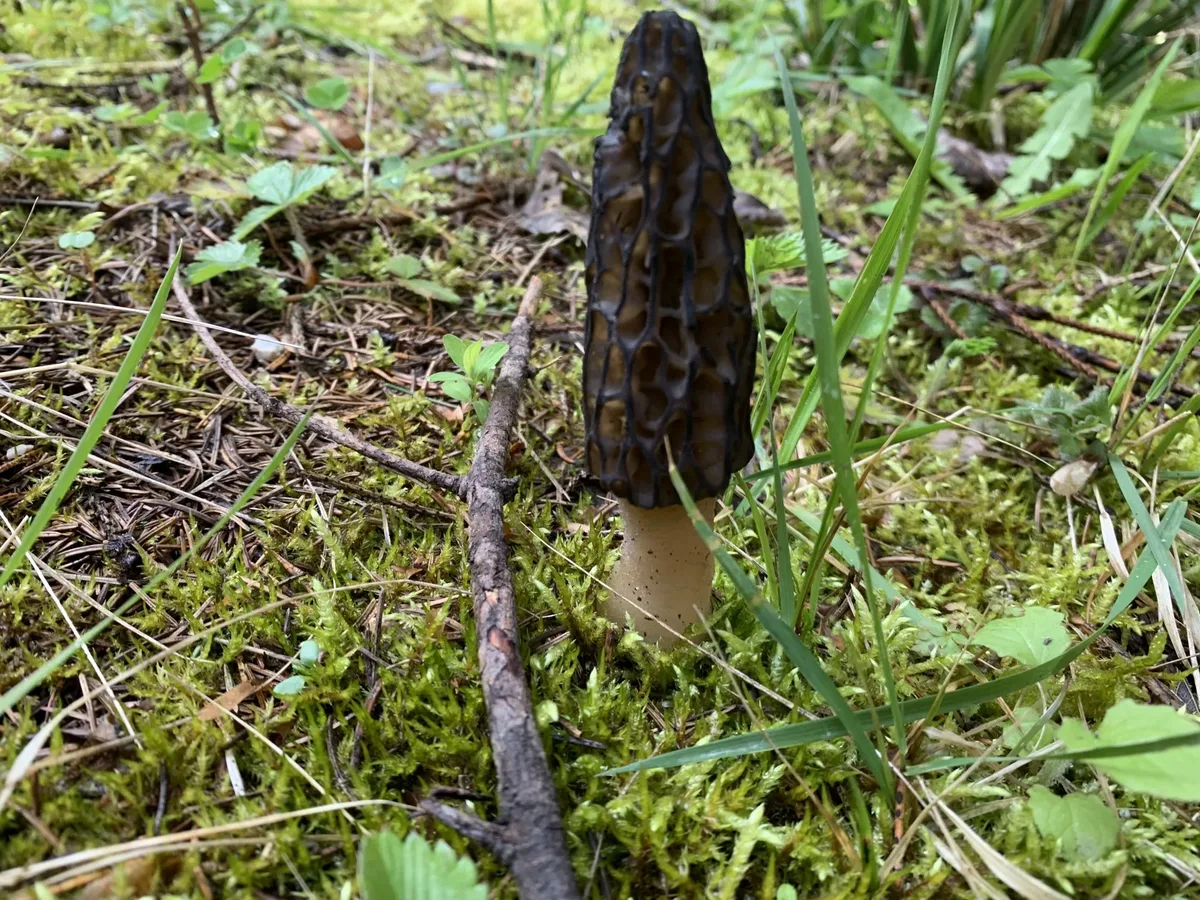 © vuikaan (CC BY)
 © Unknown (CC BY-SA)© Tapio Kekki (CC BY-SA)© vuikaan (CC BY)
One of the best mushrooms you can bring home - once you are certain of the identification.
Never eat a mushroom you are not 100% sure of - check the look-alikes below, and always cook wild mushrooms.
How to recognise it
Cap
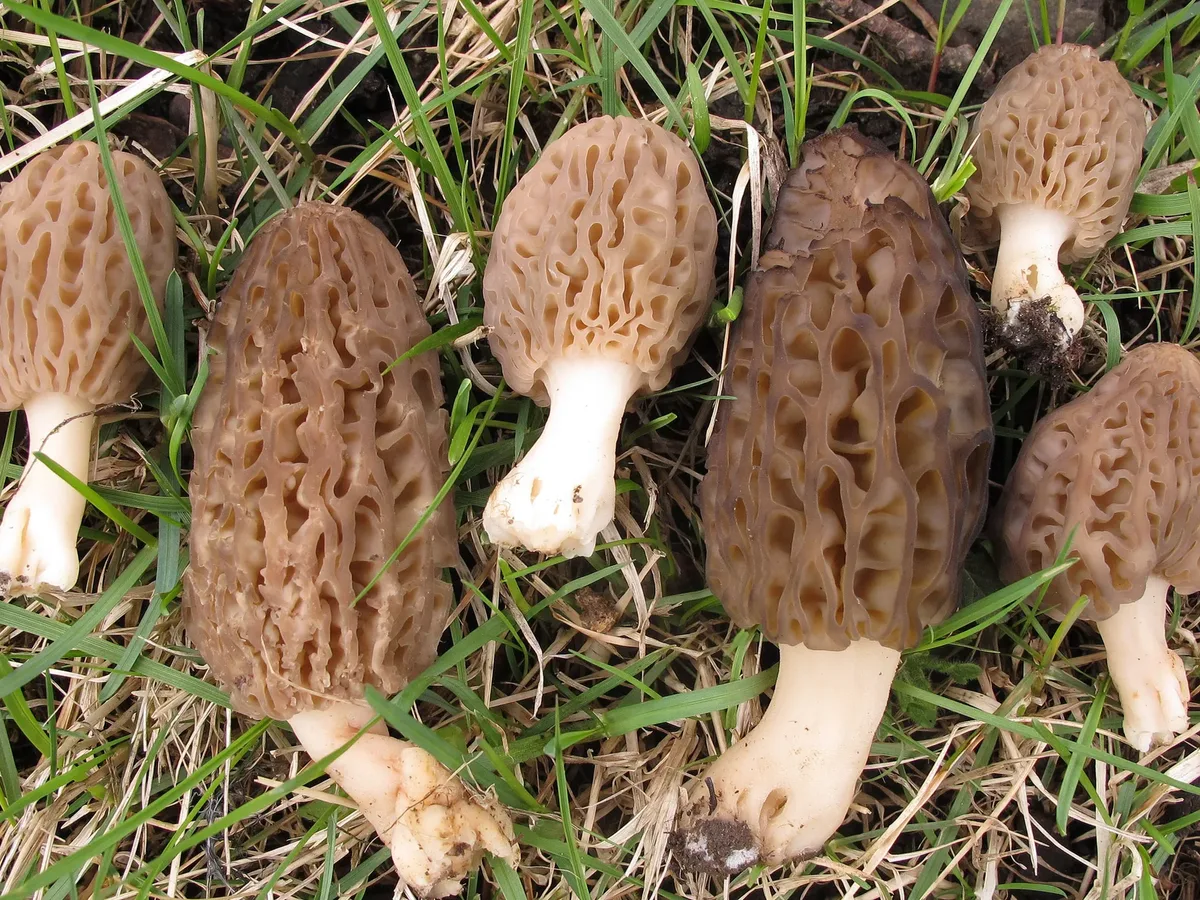
A true black morel: a slender, conical mushroom whose entire head is covered in a deep, regular honeycomb of pits and ridges - not wrinkled, not brain-like, not lobed, but a genuine geometric lattice of interconnected cells.
The head stands 3-8 cm tall and up to 5 cm wide, narrowing gradually from its widest point near the base toward a pointed or blunt tip.
The ridges are the easiest feature to read across the life of the fruiting body: when young they are pale gray-tan, almost mousy, but they steadily darken with age until a fully mature specimen shows charcoal-gray to near-black ridges contrasting vividly with the paler ochre or grayish-buff pits recessed between them.
This darkening of ridges while the pits remain lighter is characteristic of the Elata clade and distinguishes black morels as a group from the yellow/common morel group (Esculenta clade), whose ridges and pits tend toward a uniform golden-tan.
The cap base merges smoothly into the top of the stem with no free margin; this full attachment distinguishes true morels from the thimble-caps (Verpa), where the cap hangs loosely around the stem.
Stem
The stem is white to cream, mealy-textured, and relatively stout.
Flesh
Slicing the entire mushroom lengthwise is non-negotiable: the interior must be a single, uninterrupted hollow chamber from the tip of the cap to the base of the stem. Any sign of cottony pith, chambers, or partitions means it is not a true morel.
Where & when it grows
Habitat
In East Asia, Morchella eximioides occupies the same ecological niche as black morels do elsewhere - moist, well-drained soils in montane and submontane spring woodland.
Look for it along the banks of mountain streams, on mossy forest slopes, and at the edges of mixed conifer-broadleaved stands where sunlight penetrates just enough to warm the soil surface in April and May.
It appears most often in moderately disturbed sites: alongside forest tracks, near felled trees, or on gentle slopes where leaf litter and duff have been partly cleared.
It is not a fire specialist to the degree that some North American Elata-clade species are, but small populations on disturbed ground after low-intensity canopy opening are well documented.
In Yunnan and Sichuan provinces of China - where morel diversity is exceptionally high and morels are actively collected for sale in markets - this species occurs alongside several other Morchella species, making careful identification important.
When
Spring is the only window.
At lower elevations (below 1,000 m) in China and Japan fruiting begins in late March and April, following the period when soils warm past roughly 8-10 °C after winter. At montane sites (1,500-2,500 m) the season is compressed into May and early June, tracking the snowmelt line upslope.
Fruiting is sensitive to weather: a warm, dry spring can cut the season short; a cool, wet spring tends to extend it and produces larger crops.
The timing echoes that of M. elata and M. importuna in Europe and North America, but shifted by the East Asian spring climate.
Individual fruiting bodies are short-lived - from emergence to over-maturity in as little as five to ten days under warm, dry conditions - so repeated visits to productive sites across the season are more rewarding than a single trip.
How it grows
Morchella eximioides fruits singly or in scattered to loosely gregarious groups, emerging directly from woodland soil, often partly concealed by leaf litter or duff.
It does not appear to require a specific mycorrhizal host and is likely saprotrophic or weakly saprotrophic, breaking down woody debris and forest duff. Whether it forms transient facultative associations with roots (as some Morchella research suggests) remains uncertain.
The mycelium persists in the soil between fruiting seasons; productive sites often yield morels in multiple consecutive springs, though quantities vary with annual weather.
Growth from soil emergence to full maturity is rapid - two to five days is typical in warm spring conditions.
Fruiting conditions
Fruiting is triggered by warming spring soils (8-15 °C) following adequate moisture from snowmelt or spring rain. At lower elevations, the main flush follows the first sustained warm period after winter. At montane sites (1,500-2,500 m) fruiting tracks the retreating snowline. Marked year-to-year variability; cool, wet springs generally produce better crops than warm, dry ones.
Look-alikes
The most dangerous confusion is with false morels in the genus Gyromitra - particularly Gyromitra esculenta and G. infula, both of which occur in East Asia.
These species do NOT have a honeycomb-pitted cap: their cap surface is irregularly lobed, convoluted, and wrinkled, resembling a brain or a saddle rather than a lattice of pits and ridges. Sliced open, a Gyromitra is chambered and stuffed with cottony tissue, not hollow.
Gyromitra esculenta contains gyromitrin, a potent toxin metabolised in the body to monomethylhydrazine (MMH), a rocket-fuel component - poisonings have been fatal, even after cooking. There is no safe dose: discard any specimen that is not clearly, definitively a true morel.
Verpa species (thimble-caps, e.g. Verpa bohemica) look superficially similar but have caps attached only at the apex, hanging freely around the stem, and stems stuffed with cottony pith. They are considered poisonous to many people.
Other Morchella species in East Asia - including Morchella importuna and M. sextelata - are genuine morels and are equally edible when cooked; they are distinguishable by cap colour, habitat preference, and ultimately by molecular methods, but misidentifying one edible morel for another is not a safety risk.
The two non-negotiable checks for a true morel:
- 1cap fused to stem at its base with no free overhang
- 2interior a single clean, continuous hollow
Cap is irregularly lobed, wrinkled, and brain-like - never a regular honeycomb of pits and ridges. Interior is chambered and stuffed with cottony tissue, not a single clean hollow. Contains gyromitrin (metabolised to the hepatotoxin/neurotoxin MMH); potentially fatal even after cooking. Occurs in conifer woodland in East Asia, overlapping with morel habitat and season. Never eat any specimen that is not definitively a true morel with a honeycomb cap and hollow interior.
Cap is saddle-shaped to bilobed, wavy and irregularly wrinkled, reddish-brown - not conical or honeycomb-pitted. Interior chambered and stuffed, not hollow. Contains gyromitrin-type toxins. More frequent in late summer and autumn than spring, but temporal overlap at higher elevations is possible. Not a true morel by any visual check.
A genuine true morel (fully hollow, honeycomb cap, fused base), equally edible when cooked. Distinguishable from M. eximioides primarily by habitat preference (M. importuna strongly associates with wood-chip mulch and burn sites; M. eximioides favours undisturbed or lightly disturbed montane forest) and by molecular data. Both are safe when cooked; misidentifying one for the other carries no safety risk.
A true morel and equally choice edible when cooked. Cap is broader, more rounded, and tends toward yellow-tan to golden-brown with ridges and pits at similar tones - lacking the progressive darkening-to-black ridges of the Elata clade. Cap shape is more ovoid and less narrowly conical. Both are safe when cooked; the distinction is one of species and ecology, not safety.
Cap smooth to finely granular, bell-shaped, attached only at apex to stem, hanging freely at sides. No honeycomb pitting. Stem often stuffed. Edibility uncertain; avoid.
Cap has longitudinal wrinkled ridges but lacks the crossbar pitting that creates a true honeycomb; most importantly, the cap hangs freely around the stem, attached only at the apex (like a thimble on a peg), not fused along its base. Stem is often stuffed with cottony pith rather than cleanly hollow. Contains trace gyromitrin; considered toxic - causes GI upset and sometimes neurological symptoms in many people. Do not eat.
In the kitchen
Picking & cleaning
Cut cleanly at the base with a knife rather than pulling, to avoid disturbing developing primordia nearby. Use a mesh bag or open basket so spores can disperse as you walk.
Before placing any specimen in your bag, slice it lengthwise on the spot and confirm:
- a single, completely hollow interior
- the cap fused to the stem at the base
- a fresh, earthy (not sour, ammoniacal, or foul) smell
Hollow interiors sometimes harbour small insects and grit in the honeycomb pits - a lengthwise cut also lets you blow or brush these out.
Harvest only firm, fully formed, fresh specimens and leave old, waterlogged, or decomposing ones. Cook all specimens thoroughly before eating: raw or undercooked morels cause gastrointestinal illness.
Cooking
Morchella eximioides is considered a choice edible and is collected, sold, and prized in the markets of Yunnan and Sichuan, where wild morels fetch premium prices in spring.
The flavour is rich, nutty, and deeply savoury, with the characteristic earthy depth common to the morel genus. The honeycomb structure traps butter and cooking juices, producing an almost sponge-like absorption of flavour.
Cook thoroughly - a minimum of 10 minutes of active heat. Halve or quarter large specimens and rinse the pits gently under cold running water to remove grit and any insects. Sauté in generous unsalted butter over medium heat until golden, fragrant, and fully tender, 10-15 minutes.
In Chinese cooking, morels are commonly stir-fried with vegetables, braised in stocks, or stuffed and steamed. They work equally well in cream sauces, with eggs, or alongside spring vegetables such as asparagus and snow peas.
Dried morels - dehydrate at 55 °C until completely brittle - reconstitute well after 20-30 minutes in warm water and intensify in flavour; use the soaking liquid (strained carefully to remove sediment) as a flavourful stock addition.
Good to know
Never eat Morchella eximioides or any morel raw or undercooked. All true morels contain heat-labile hemolytic compounds that are destroyed by thorough cooking but cause nausea, vomiting, and abdominal cramps if the mushroom is eaten raw or insufficiently heated.
Cook for a minimum of 10-15 minutes at temperatures above 70 °C; boiling or sautéeing until fully tender is adequate.
Some individuals are sensitive to even well-cooked morels, particularly in large quantities or when combined with alcohol - introduce morels gradually and avoid alcohol on the first occasion.
The overriding safety concern is misidentification: the false morels (Gyromitra esculenta, G. infula) are potentially lethal and can share the same habitat and season. Slice every single specimen before cooking and confirm the clean hollow interior.
Beginners in East Asia should have their first morel identification verified by a knowledgeable local forager, since several Morchella species and potential dangerous lookalikes co-occur in the same montane forests.
A reference guide - never an edibility guarantee. When in doubt, leave it out.