White Parasol
Macrolepiota dolichaulasyn. Lepiota dolichaula (Berk. & Broome) Sacc., Lepiota gracilenta var. dolichaula Berk. & Broome, Mastocephalus dolichaulus (Berk. & Broome) Kuntze
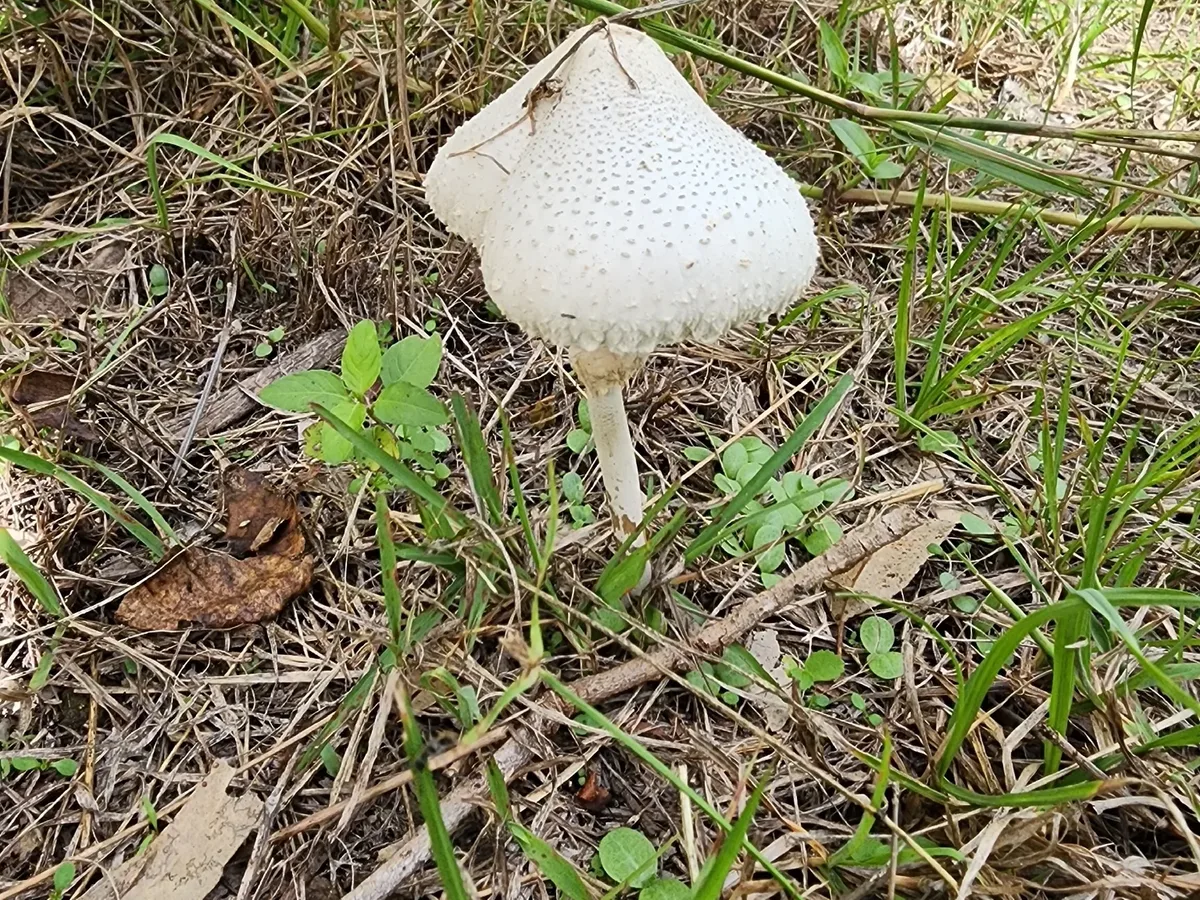 © Mark Clarke (CC BY)
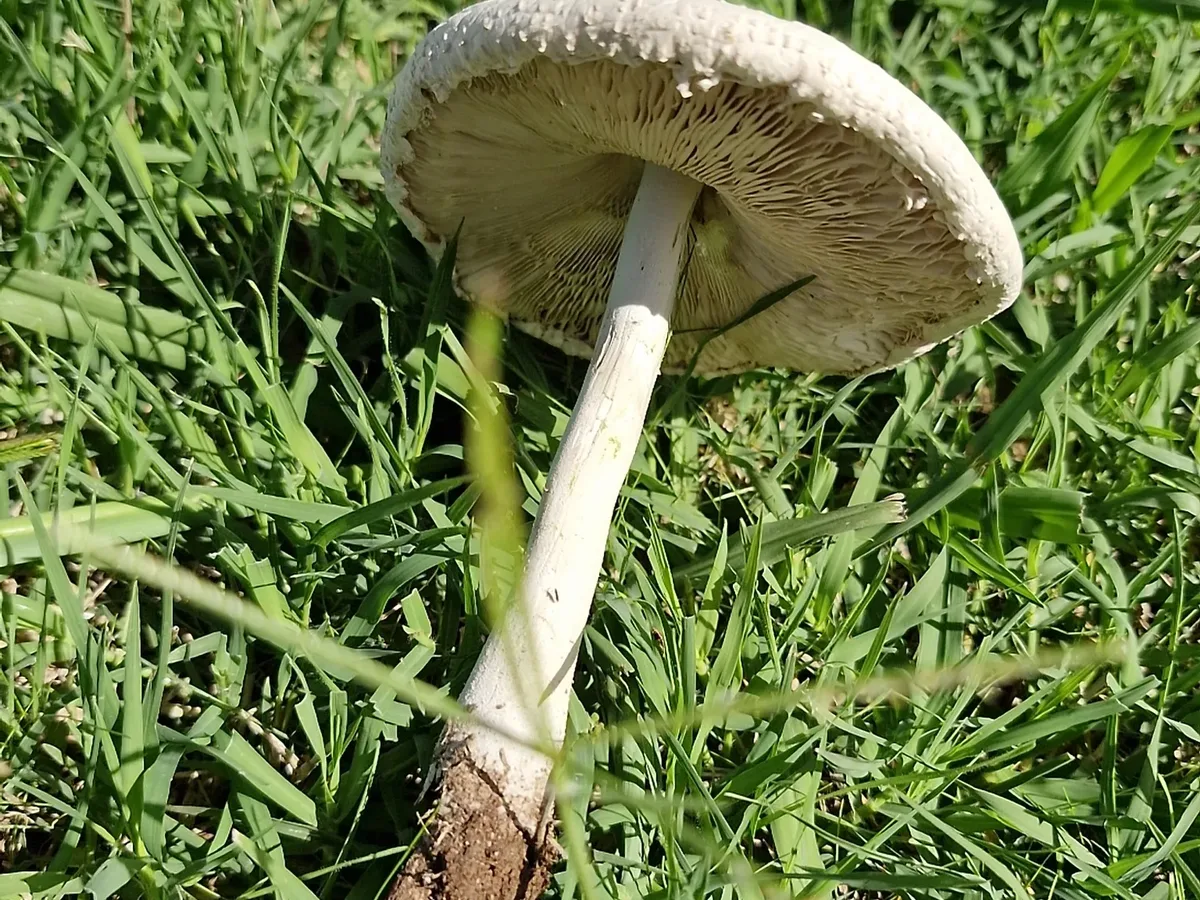 Claudia Schipp (CC0)
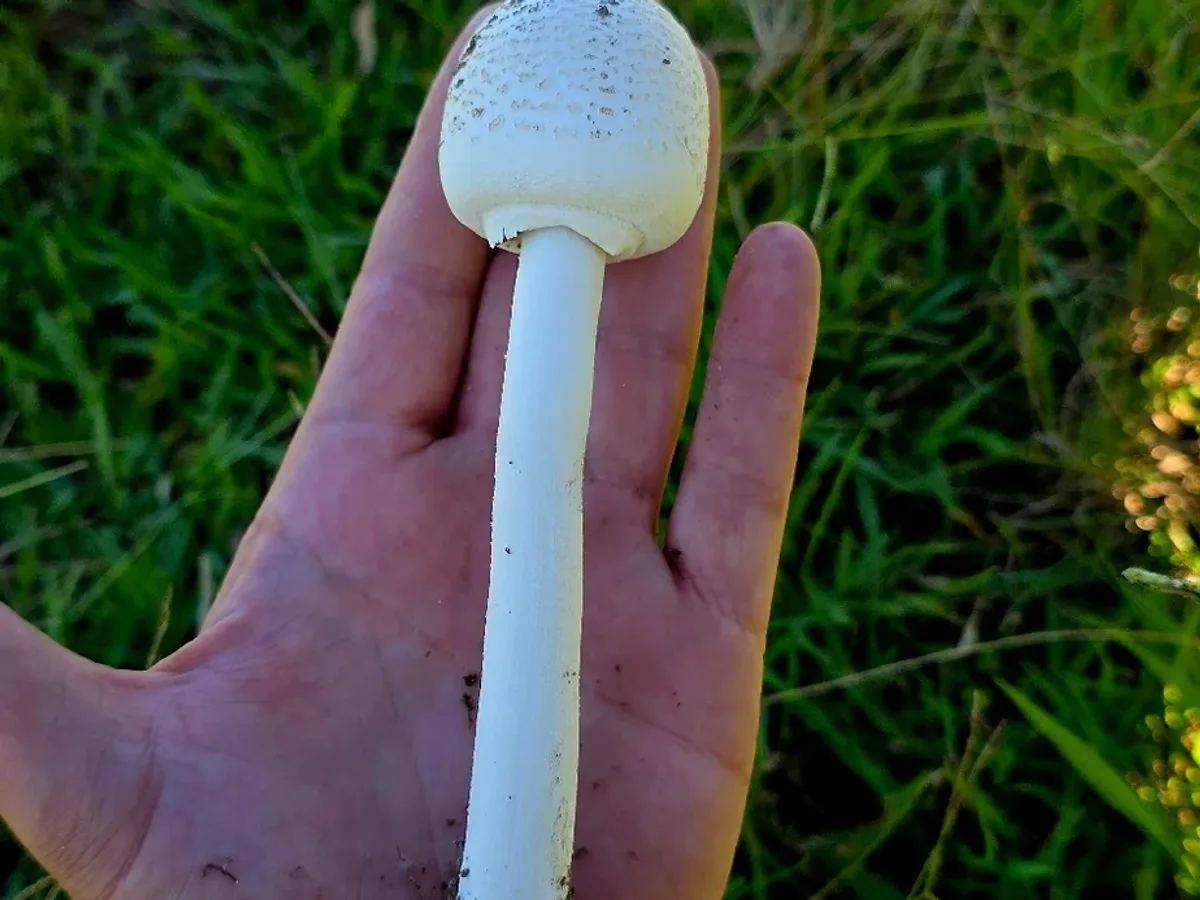 © Hector Hind (CC BY)
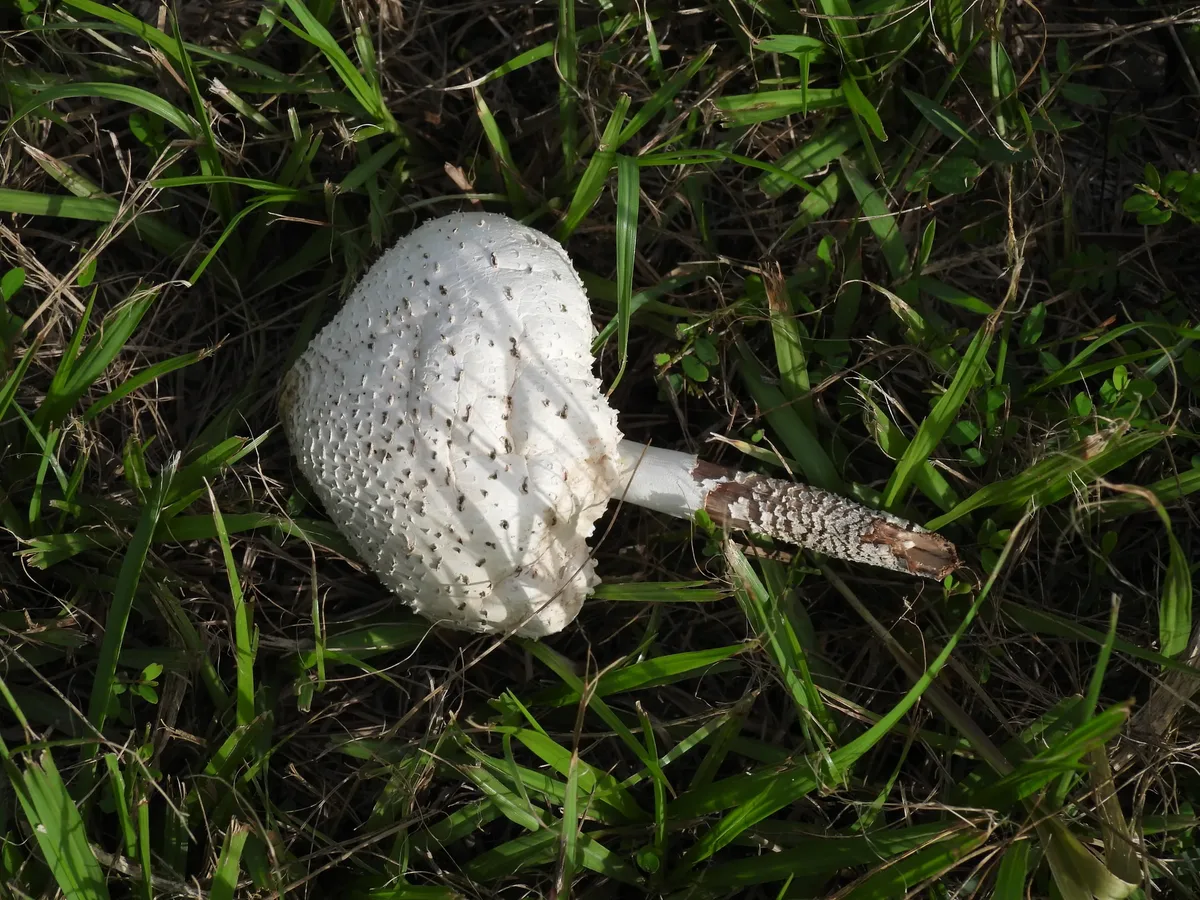 © Mark Clarke (CC BY)
 © Mark Clarke (CC BY)
 Max Tweddell (CC0)
 Max Tweddell (CC0)© Mark Clarke (CC BY)Claudia Schipp (CC0)
Good to eat, once you have identified it with certainty and cooked it through.
Never eat a mushroom you are not 100% sure of - check the look-alikes below, and always cook wild mushrooms.
How to recognise it
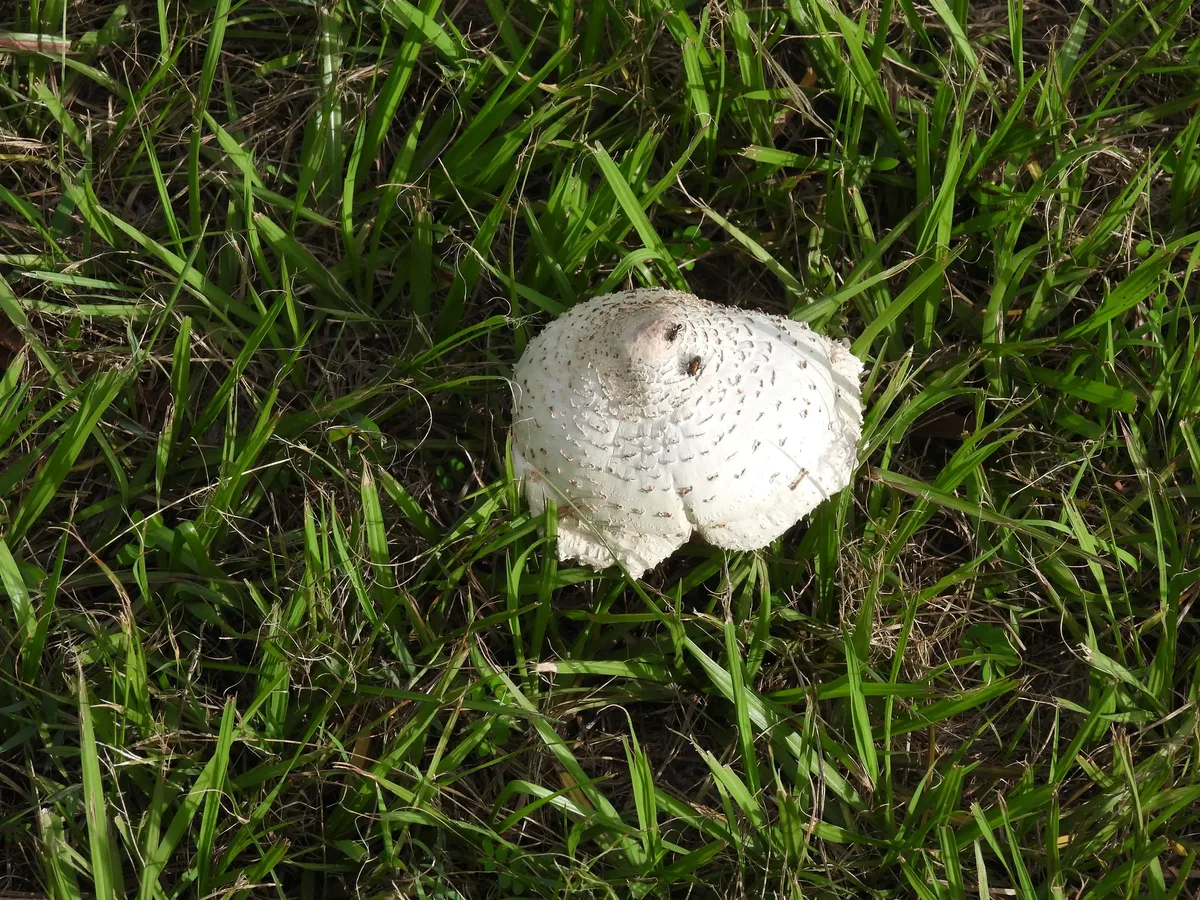
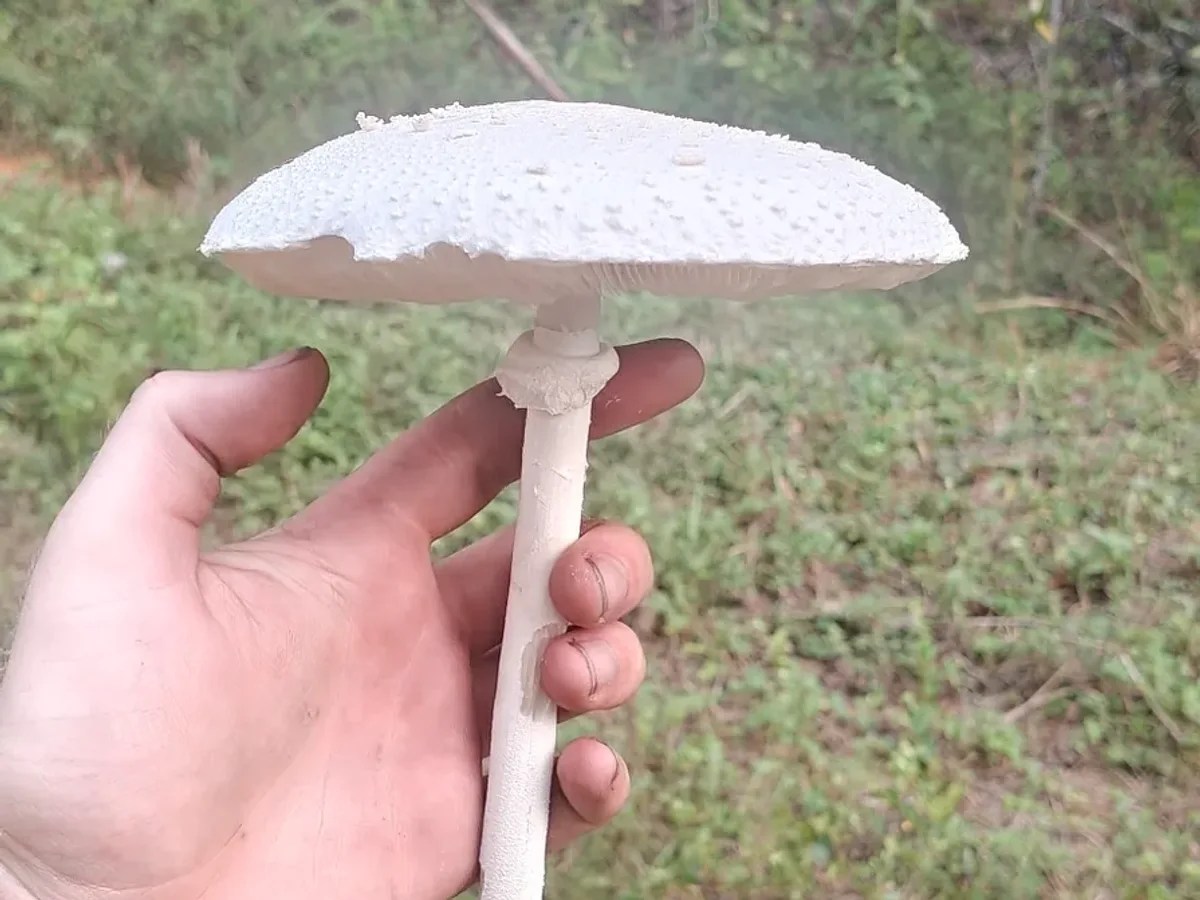
Macrolepiota dolichaula is the classic white parasol of Australia and New Zealand - an unmistakably elegant mushroom whose most arresting feature is its extraordinary height. The stem can reach 25-30 cm while the cap is still only 10-12 cm across; this gives the whole fruiting body a slender, slightly architectural quality, as though the cap has been raised on a pole.
Cap
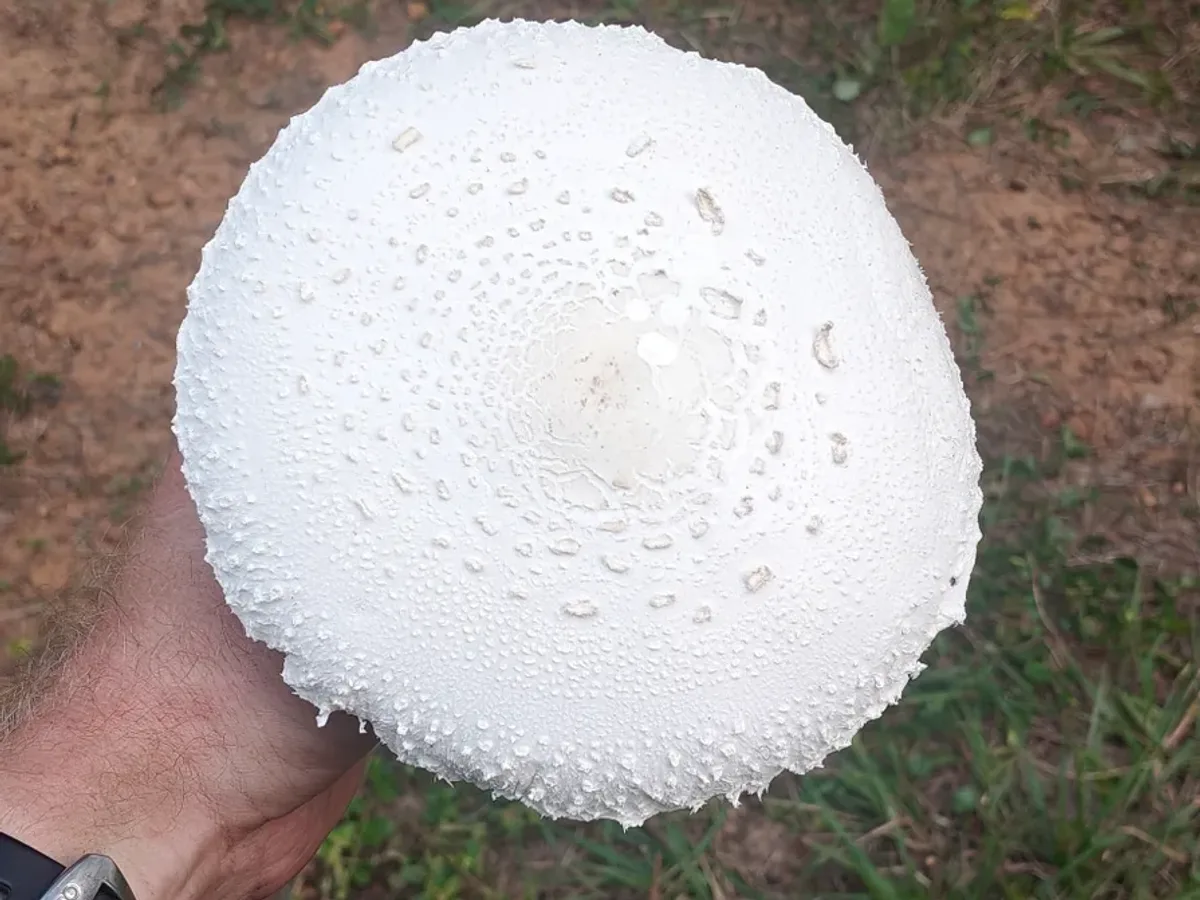
White to ivory, breaking up into fine, flat, pale scales on an equally pale background, with only a slightly darker buff disc at the centre. It is a predominantly white mushroom, which is both its appeal and the root of its main safety risk.
Gills
Free, crowded, and staying white throughout - never turning green or yellowing.
Stem
Run a finger along the lower face of the stem and you will feel faint, pale fibrous banding, something like the snakeskin pattern of a parasol mushroom but in muted tones. The double ring slides freely when you push it up or down - always confirm this, as a ring that is glued or fused in place is a reason to stop and reconsider.
Flesh
Most importantly, cut the flesh: it must be pure white and stay white. Any colour change - orange, red, or bright yellow - means this is not M. dolichaula.
Spore print white.
Where & when it grows
Habitat
This is a creature of open, grassy places. In the Australian and New Zealand landscape, look for it in suburban lawns, grassy paddocks, parkland turf, golf course roughs, and the grassy margins of eucalypt woodland - anywhere the soil is reasonably rich and moisture is retained after autumn rains.
It grows as a saprotroph, drawing energy from buried organic matter and decomposing root material rather than from tree roots, so it is not tied to a particular tree species.
Single specimens or small scattered groups are the norm; loose arcs may appear where mycelium has grown outward steadily over several years.
The habitat preference for open, grassy ground is an important clue: this is not primarily a deep-forest species.
When
Autumn to early winter in the Southern Hemisphere. The main fruiting window opens with the first persistent autumn rains, typically in April, and continues through May and June, tapering off in July as soils cool toward winter temperatures.
The trigger is the combination of meaningful rainfall and a drop in soil temperature to between roughly 10 and 18 °C - the "autumn break" that follows the summer drought across much of southeastern Australia and New Zealand.
In warmer subtropical zones (coastal Queensland, northern New South Wales) fruiting may begin earlier, from March, and in cooler highland areas of Victoria and New Zealand's South Island it may extend into August.
Fruiting bodies develop quickly and are short-lived, so productive sites warrant revisiting after rainfall events.
How it grows
Saprotrophic, decomposing buried humus, dead root material, and grass thatch in open turf. The mycelium extends through the soil over time, which is why arcs or loose rings of fruiting bodies sometimes appear at the same location in successive years.
Growth from initial button to fully expanded cap is rapid under warm, moist autumn conditions - 48 to 72 hours is typical - so picking windows are brief.
The long, hollow stem is one of the most energetically distinctive structures in the genus: the species invests disproportionately in height, which likely assists spore dispersal in open, low-vegetation environments.
Fruiting conditions
Fruiting is triggered by significant autumn rainfall after the summer dry period, once soil temperatures have dropped to the 10-18 °C range. The classic trigger is the first sustained autumn rains (the 'autumn break') in southeastern Australia and New Zealand, typically arriving in late March to May. A flush typically appears 5-12 days after significant rainfall (20 mm or more over 14 days). Consecutive wet periods can produce multiple flushes from established mycelium. Growth is rapid; fruiting bodies expand from button to full size in 2-3 days under warm moist conditions.
Look-alikes
Several species present genuine identification risks, two of which are deadly:
- 1Lepiota brunneoincarnata (Deadly dapperling) and related deadly small Lepiota species - these are DEADLY, containing alpha-amanitin identical to that in the death cap. They are uniformly small (cap 2-5 cm, very rarely 6 cm) and lack the large double moveable ring of Macrolepiota. They typically have concentric reddish-brown, pinkish, or buff-brown scales. The size threshold is the single most protective rule: NEVER collect any white parasol-type mushroom with a cap under 6-7 cm, and treat any uncertainty as a reason not to collect.
- 2Chlorophyllum molybdites (Green-spored parasol) - occurs in Australian and New Zealand lawns and parks and is the most common cause of mushroom poisoning in warm-region grassland globally. It closely resembles a large white parasol and has caused many poisonings in Australia, where it is sometimes mistaken for M. dolichaula or Macrolepiota procera. The gills of C. molybdites turn distinctly dull grey-green to olive-green as spores mature, and the spore print is olive-green to greenish-grey - never white. In young specimens the gills may still appear white, making a spore print essential. Taking a white spore print from a large white lawn parasol before consuming it is non-negotiable in Australia and New Zealand.
- 3Amanita phalloides (Death cap) - introduced to southeastern Australia and New Zealand with European trees and now established and spreading. Young buttons enclosed in their white universal veil can superficially resemble large white mushrooms. Distinguish by excavating the base completely: A. phalloides always has a membranous bag-like volva around the bulbous stem base, which M. dolichaula never has. The death cap also has permanently white gills and a white to greenish-yellow cap when expanded. Any large white grassy or woodland-edge mushroom with a volva should be left strictly alone.
- 4Macrolepiota procera (Parasol mushroom) - edible; a close relative found in European-style open grassland in Australia. Distinguished by its larger cap (typically 10-25 cm), more brownish-patterned cap scales with a darker central disc, more pronounced dark-brown snakeskin banding on the stem, and typically more robust build. M. procera is also edible and the confusion is not safety-critical, but M. dolichaula is notably whiter and more slender.
- 5Chlorophyllum rhacodes / C. brunneum (Shaggy parasols) - also present in Australian and NZ gardens. Distinguished by shaggy, coarser, upturned dark-brown cap scales, a markedly swollen basal bulb, and - critically - flesh that turns orange-red to brick-red immediately on cutting. M. dolichaula flesh never reddens.
Deadly (amatoxins). Much smaller than M. dolichaula - cap 2-5 cm, never approaching 7 cm. Has reddish-brown to flesh-pink concentric scales, a thin or absent ring that is never double or freely sliding, and a short stem. Never collect parasol-type mushrooms with caps under 6-7 cm; this single size rule is the most protective filter against all deadly Lepiota species.
Deadly. Introduced to southeastern Australia and New Zealand and now established and spreading. Young white-veil-enclosed buttons can superficially resemble a parasol egg. Distinguish at any age by excavating the base completely: A. phalloides always has a membranous bag-like volva enclosing the bulbous stem base - M. dolichaula has no volva. Mature A. phalloides cap is whitish to pale greenish-yellow with permanently white gills and a white spore print; the ring is thin and fragile, not a thick double moveable ring. Never pick grassy mushrooms without first digging to inspect the base.
The most dangerous practical confusion in Australian and New Zealand lawns. Very similar in size, shape, and initial white colouration. Distinction: gills turn distinctly dull grey-green to olive-green as spores mature; spore print is olive-green to greenish-grey, never white. In young specimens the gills may still appear pale - always take a spore print from any large white lawn parasol before consuming it. Flesh of C. molybdites may show mild reddening on cutting. Causes severe gastrointestinal poisoning. A white spore print conclusively excludes this species.
Edible; a close relative. Typically more robust, with more brownish cap scales arranged in a more obvious concentric pattern against a buff background, more vivid dark-brown snakeskin banding on the stem, a thicker leathery ring, and less strikingly elongated stem proportions. M. dolichaula is distinctly whiter and has a more slender and proportionally longer stem. The confusion is not safety-critical as both are edible, but apply the same flesh-colour and volva checks regardless.
Present in Australian gardens and park settings. Distinguished by coarser, shaggy, upturned dark-brown cap scales (not flat, pale, fine scales), a markedly swollen basal bulb, and - the decisive test - flesh that turns vivid orange-red to brick-red immediately on cutting. M. dolichaula flesh stays pure white. Causes gastrointestinal illness in a significant proportion of consumers.
Poisonous (gastrointestinal). Lacks the parasol shape and free gills - Agaricus has attached or nearly free gills that turn pink then chocolate-brown, and a very different cap morphology (smooth, no shaggy or flat parasol scales). However, in grassy habitats a quick check is warranted: cutting the base of a yellow stainer produces an immediate vivid chrome-yellow colour change and a strong phenol/ink smell. M. dolichaula shows none of these characters.
In the kitchen
Picking & cleaning
Confirm all identification features before collecting, and do so methodically rather than quickly.
The specimen must show all of these:
- Cap clearly exceeding 6 cm diameter (if smaller, stop - all toxic Lepiota species remain under 6 cm).
- White or ivory cap with fine flat pale scales.
- A free white gill.
- A double, freely sliding ring on an extraordinarily long pale stem.
Cut a small piece of the cap or stem and observe the flesh for 30 seconds: it must remain pure white with zero colour change. Do not collect any specimen with reddening or yellowing flesh.
Dig out the base completely and check that no membranous sac-like cup (volva) surrounds the base - such a cup would indicate an Amanita species and warrants discarding the entire collection immediately.
Take a white spore print from any specimen about which you are uncertain: this critically excludes Chlorophyllum molybdites, whose spore print is olive-green.
Collect only caps; the very long stem is fibrous, hollow, and poor eating. Place caps face-up in a basket with plenty of air.
In mixed grass habitats, check each specimen individually - never assume all large white mushrooms in the same area are the same species.
Cooking
The cap is the edible portion; the very long hollow stem is best discarded or used for stock. Clean caps by brushing off soil and removing the ring.
The white flesh is mild, pleasant, and slightly nutty in flavour, with a texture that remains pleasingly firm when cooked correctly.
Cooking methods:
- Pan-fry caps whole or in large sections over medium-high heat in butter or olive oil - 3-4 minutes per side until golden.
- Excellent breaded in egg and fine breadcrumbs and shallow-fried whole, producing a crisp, schnitzel-style result.
- Also good grilled briefly under high heat.
The thin flesh cooks quickly and overcooks to a rubbery or papery texture if left too long; high heat and brief cooking is preferable. Not well suited to drying due to the thin flesh.
Must be cooked before eating.
Good to know
Macrolepiota dolichaula is a genuine edible of reasonable quality and is eaten by experienced foragers across Australia and New Zealand.
However, the grassy habitats it favours in Australasia are also home to Chlorophyllum molybdites - the green-spored parasol, which causes severe gastrointestinal poisoning and is superficially very similar, particularly in young specimens before the gills colour - and to introduced Amanita phalloides (death cap), which is lethal.
Three non-negotiable safety rules apply:
- 1Only collect caps clearly larger than 6-7 cm, with a freely sliding double ring, and a long pale snakeskin-patterned stem.
- 2Cut the flesh immediately and reject any specimen that changes colour in any direction - reddening indicates a Chlorophyllum, yellowing indicates possible Agaricus xanthodermus or anomaly.
- 3Take a white spore print from any large white lawn mushroom before eating it the first time from a new site - a white print confirms Macrolepiota and conclusively excludes C. molybdites.
Additionally, dig out the base and confirm the absence of a volva. Cook all specimens thoroughly; raw consumption is inadvisable.
If in any doubt, leave the mushroom where it is and consult an experienced local mycologist or a state or national mycological society before collecting.
A reference guide - never an edibility guarantee. When in doubt, leave it out.