Asian parasol
Macrolepiota detersasyn. Lepiota detersa (F.H. Møller) Wasser
 (c) Garry Lydon, some rights reserved (CC BY)
 (c) りなべる, some rights reserved (CC BY)
 (c) Garry Lydon, some rights reserved (CC BY)(c) Garry Lydon, some rights reserved (CC BY)(c) りなべる, some rights reserved (CC BY)
Edible only with the right preparation - or safe for some people but not others. Learn the caveats first.
Never eat a mushroom you are not 100% sure of - check the look-alikes below, and always cook wild mushrooms.
How to recognise it
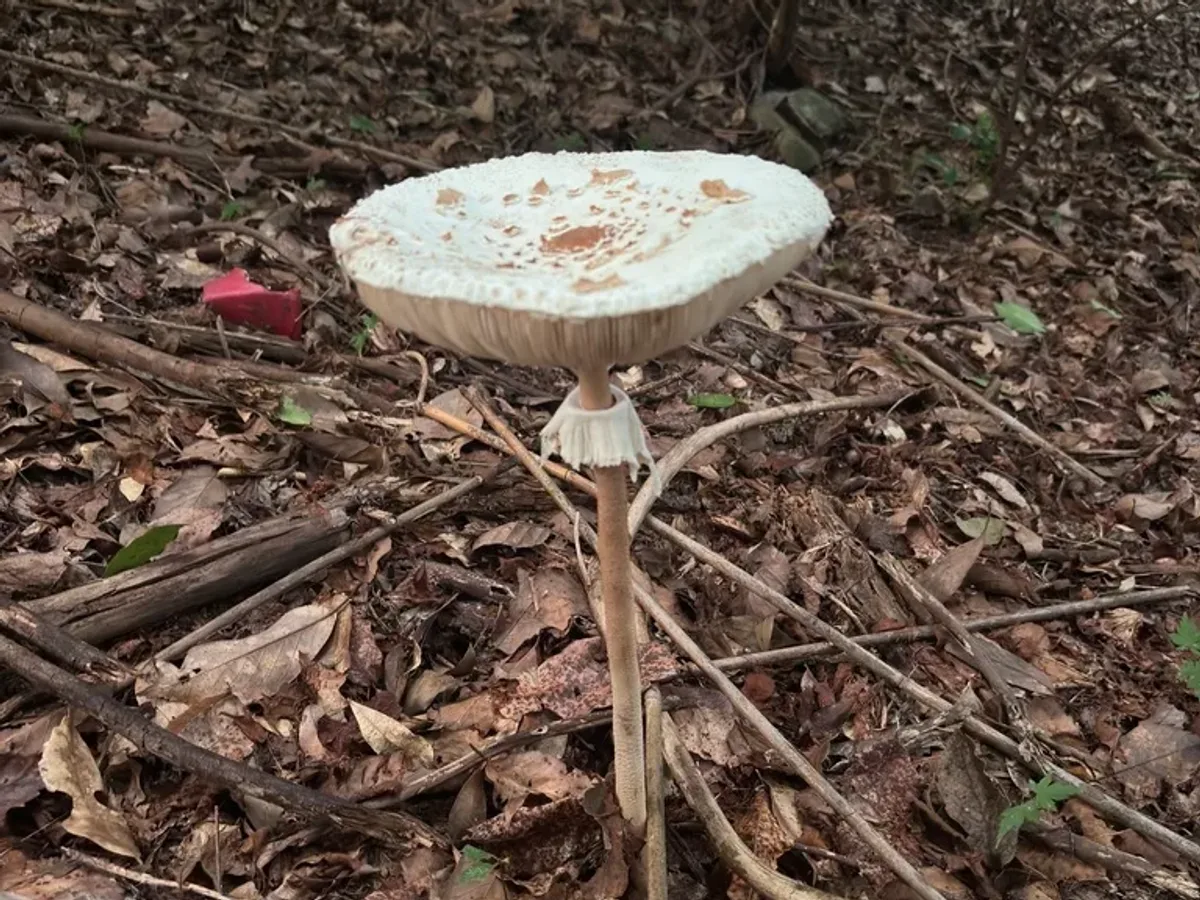
Macrolepiota detersa is a large, stately parasol mushroom with the classic proportions of its genus - a broad, flat cap on a tall, slender stem - but with a name that sets it apart: 'detersa' is Latin for wiped or scraped clean, referring to its unusually smooth cap surface in maturity.
Cap
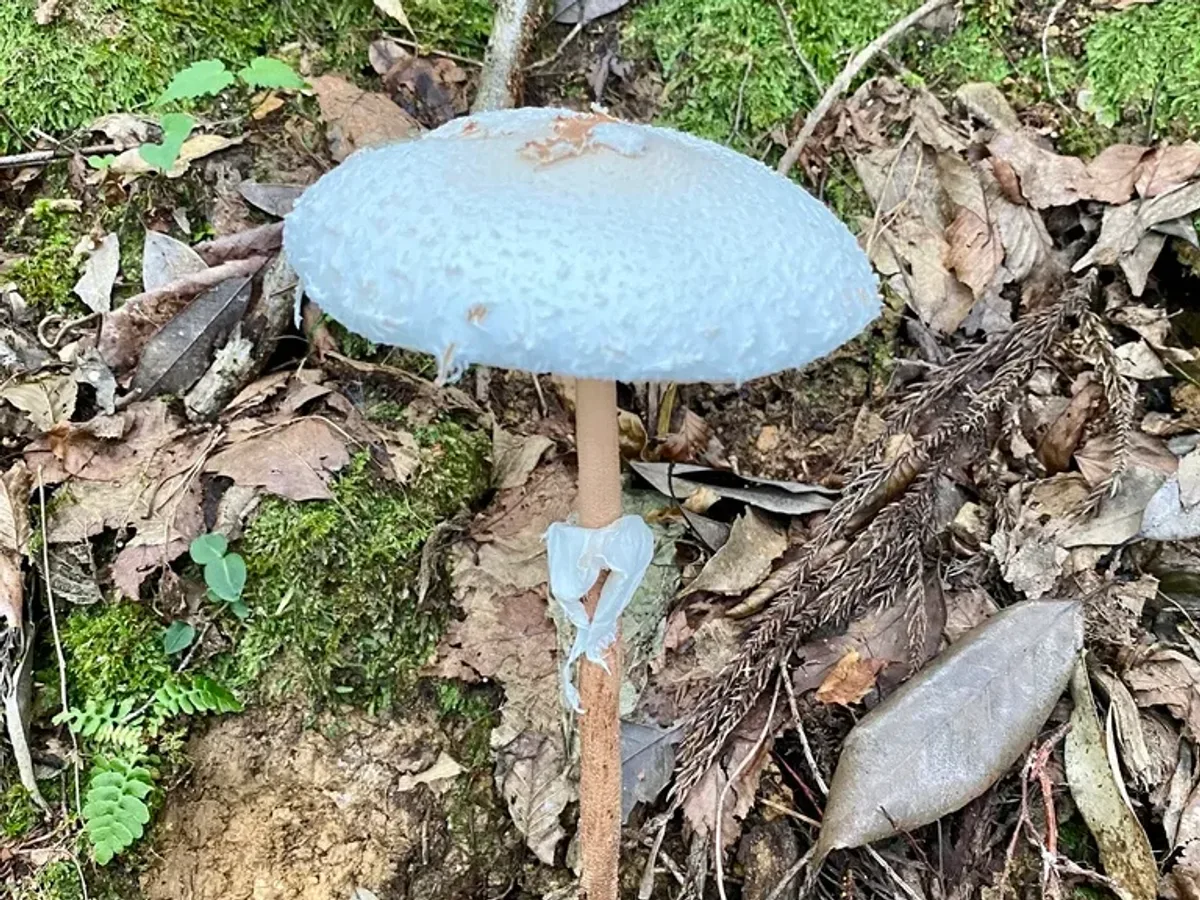
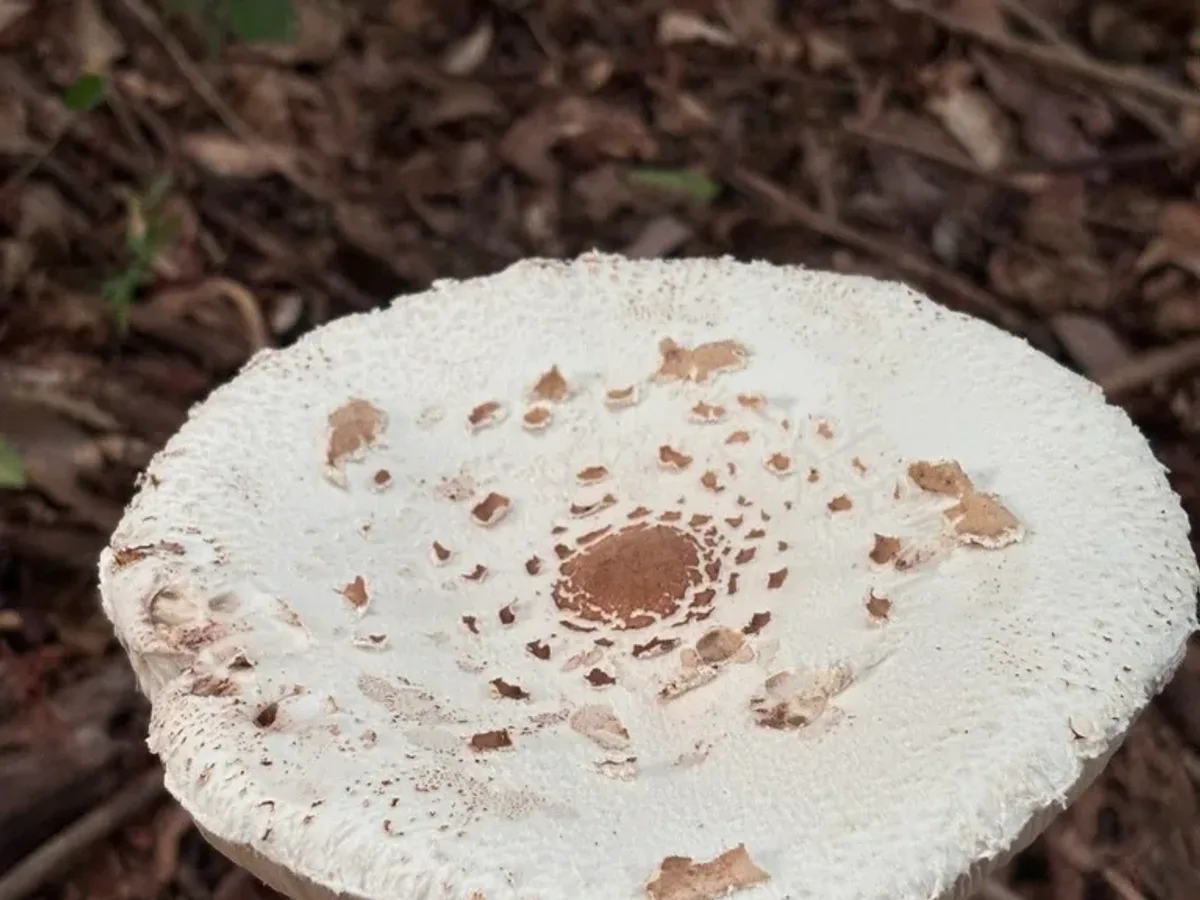
Young fruitbodies show the flat, plate-like brownish scales typical of the Macrolepiota group, but these scales are fewer and less contrasting than in the European M. procera, and in older or wet specimens the cap can look almost polished, save for the persistent dark-brown central umbo.
The cap reaches 8-20 cm across, expanding from a buff-brown egg to a broadly flat disc that keeps that raised dark knob at the centre throughout.
Gills
Gills are free, crowded, broad, and cream to white - they stay pale throughout maturity.
Stem
The stem is tall (12-25 cm), hollow, and pale buff to white, decorated below the ring with a handsome snakeskin or zebra-stripe pattern of brownish fibrous mottling.
The ring is large and double-layered, white on top and brownish below, and slides freely up and down the stem when gripped between two fingers - a key character that distinguishes all Macrolepiota from the small, deadly Lepiota dapperlings, whose rings are thin, fixed, or absent.
Flesh
Flesh is white throughout and stays white when cut cleanly through cap and stem. Spore print white.
Why it's dangerous
LOW for correctly identified, fully cooked specimens in non-sensitive individuals.
EXTREME if a deadly lookalike Lepiota (amatoxin-containing) or Amanita species has been collected instead - amatoxin poisoning has a delayed onset (6-24 hours) and causes fatal liver and kidney failure.
The danger profile for this species is dominated by misidentification risk, not intrinsic toxicity.
The practical risk hierarchy is:
- 1Collecting a small deadly Lepiota dapperling in error - fatal.
- 2Collecting Chlorophyllum molybdites in error - severely unwell but rarely fatal.
- 3Collecting a button-stage Amanita in error - potentially fatal.
- 4Eating a correctly identified specimen raw or undercooked - mildly unwell in susceptible individuals.
- 5Eating a correctly identified, thoroughly cooked specimen - generally safe, but residual individual sensitivity cannot be excluded.
Never make a decision to consume based on identification alone without completing all safety checks, including the spore print.
Toxin
The specific compound responsible for gastrointestinal sensitivity in some consumers of correctly identified M. detersa has not been characterised.
Unlike the deadly amatoxins (cyclopeptides such as alpha-amanitin) found in lethal Lepiota and Amanita species - which are thermostable and cause delayed, potentially fatal liver and kidney failure - the intrinsic irritant in M. detersa appears to be heat-labile, or at least reduced by thorough cooking. Traditional consumers across Thailand, southern China, and Japan consistently cook the mushroom before eating it.
Raw or undercooked specimens are more likely to provoke irritation; thorough cooking reduces but may not eliminate the risk in sensitive individuals.
Because the offending compound has not been isolated, it cannot be definitively excluded by any field test - it can only be mitigated by cooking.
The intrinsic GI risk is mild and inconsistent compared with the far greater danger posed by lookalike species, particularly amatoxin-containing Lepiota species and Chlorophyllum molybdites.
Symptoms
In correctly identified specimens: mild to moderate gastrointestinal irritation - nausea, abdominal cramping, or loose stools - primarily in sensitive individuals or when consumed raw or undercooked.
Onset typically within 1-3 hours of consumption. Self-limiting; symptoms generally resolve within 12-24 hours without medical treatment.
If symptoms are severe or onset is delayed (6-24 hours after eating), suspect amatoxin poisoning from a misidentified Lepiota or Amanita species and seek emergency medical care immediately.
Amatoxin poisoning characteristically produces an initial GI phase (6-24 hours post-ingestion), a deceptive apparent recovery period, followed by progressive liver and kidney failure beginning 2-4 days after consumption - delayed emergency presentation is a major cause of fatal outcomes.
Staying safe
Macrolepiota detersa is regarded as edible by experienced foragers and mycologists in its native range and is consumed locally in parts of Thailand, southern China, and Japan. However, the identification must be complete and unambiguous before any consumption.
The safety rules are:
- 1Cap must clearly exceed 7 cm in diameter - the hard threshold below which all deadly small Lepiota cannot be excluded.
- 2The ring must be genuinely double-layered and freely slide along the stem - a fixed, fragile, or thin ring means the mushroom must be discarded.
- 3Flesh must remain white throughout when cut cleanly through the cap and stem - any colour change disqualifies the specimen.
- 4An overnight spore print must be white - any olive, grey, or greenish tinge means the specimen is Chlorophyllum molybdites and must not be eaten.
- 5Dig up the base and check that there is no volva or sack-like structure, which would indicate Amanita.
This species is classified as caution because:
- Tropical Asian Lepiota species that contain lethal amatoxins share the same habitat and superficial appearance.
- Chlorophyllum molybdites is endemic across the entire range and is visually similar enough to cause routine poisonings.
- Mycological documentation of the M. detersa complex in Southeast Asia is less settled than for European Macrolepiota, leaving residual taxonomic uncertainty about the species boundary.
- Some individuals experience gastrointestinal sensitivity even from correctly identified specimens.
Cook thoroughly before eating; raw consumption is inadvisable.
Where & when it grows
Habitat
A saprotrophic species of subtropical and tropical East and Southeast Asia, growing in broadleaf forest interiors, forest margins, bamboo woodland, secondary growth clearings, and grassy areas associated with woodland. It occurs in Thailand, Malaysia, southern China (Yunnan, Guangdong, Fujian, Hainan), Japan (Kyushu, Shikoku, Okinawa), and adjacent regions.
Like all Macrolepiota species it decomposes buried organic matter and is not dependent on a specific mycorrhizal tree partner, so it can appear on disturbed ground, roadsides, garden borders, and trail edges near forest as readily as within intact forest.
Fruiting bodies appear singly or in scattered groups of two to five; large rings are uncommon.
When
This is a monsoon mushroom through and through - it appears when the rains arrive and retreats when they leave.
In the seasonal tropics of Thailand, Malaysia, and southern China the main flush opens with the southwest monsoon in May or June and runs through October, with the strongest pushes in June-July and again in September-October as storm events alternate with dry spells.
In Japan (Kyushu, Shikoku) fruiting runs through the warm, humid summer, June through September. The species goes quiet during the cool, dry winter months.
The most reliable trigger is the first sustained rainfall of the season after warm, dry conditions - soil temperatures above 20°C are the other half of the equation.
How it grows
Saprotrophic; decomposes buried humus, dead root fragments, and decaying organic matter in the soil.
Fruiting bodies emerge singly or in loose scattered groups, occasionally in arcs, but not in tight clusters or tufts.
Under warm, humid monsoon conditions fruitbodies develop rapidly - a cap can expand from button stage to fully open within 48-72 hours, so daily checking of productive sites is rewarded.
Fruiting bodies deteriorate quickly in humid heat and are prone to insect infestation; collect promptly when the veil has just broken and the cap is beginning to flatten.
Fruiting conditions
A tropical monsoon species requiring warm soil (20-32°C) and consistent rainfall. Fruiting is triggered by the onset of monsoon rains after warm dry conditions; first strong rain events of the season (May-June in mainland Southeast Asia, June-July in southern Japan) produce the earliest flushes. Under optimal tropical conditions fruitbodies develop within 3-7 days of a significant rain event and deteriorate quickly. Secondary flush windows follow retreating monsoon rains in September-October across the continental range.
Look-alikes
Macrolepiota detersa grows in a region where several dangerous confusions exist:
- 1Lepiota species (deadly dapperlings) - the highest-risk confusion and the most important safety consideration. Numerous Lepiota species occur across tropical Asia, including undescribed or poorly documented taxa in the same habitats. Several Asian Lepiota species are known or suspected to contain lethal amatoxins (alpha-amanitin), identical to those in Amanita phalloides. These species are much smaller than M. detersa (caps typically 2-5 cm, rarely reaching 6 cm), have a thin, fragile, non-moveable ring or no ring at all, and lack the double-layered ring structure of Macrolepiota. The size rule is the primary safety gate: never collect any parasol-type mushroom with a cap under 7 cm.
- 2Chlorophyllum molybdites (green-spored parasol, false parasol) - extremely common across tropical and subtropical Southeast Asia and arguably the most frequent cause of serious mushroom poisoning in the region. It closely resembles Macrolepiota in overall form: a large white cap with brownish scales, free gills, a double ring, and similar habitat. The decisive differences: at maturity, the gills of C. molybdites turn pale grey-green to olive-green, and - most critically - the spore print is distinctly olive-green to grey-green, never white. A mandatory overnight spore print is the single most reliable way to exclude this species; do not rely on gill colour alone, as young specimens have white gills. C. molybdites causes severe gastrointestinal poisoning (violent vomiting and diarrhoea within 1-3 hours) and is particularly dangerous when fed to children who mistake it for edible parasols.
- 3Chlorophyllum rachodes (shaggy parasol) - less common in tropical Asia but present in disturbed habitats. Distinguished by flesh that immediately turns saffron-orange to brick-red on cutting, a more coarsely shaggy cap surface, and a tendency to grow on compost, manure-enriched soil, or disturbed ground. M. detersa flesh stays white. C. rachodes causes gastrointestinal upset in a significant minority of consumers.
- 4Macrolepiota dolichaula - a closely related large parasol species also occurring across southern and Southeast Asia. Morphologically very similar to M. detersa; some collections may be misidentified between the two. Both are regarded as edible by experienced foragers; the practical safety concern is the same for both (avoid deadly small Lepiota and Chlorophyllum molybdites). Treat them as interchangeable for safety purposes.
- 5Amanita species (button stage) - young unexpanded Amanita fruitbodies still enclosed in the universal veil can superficially resemble parasol eggs. Always excavate the base carefully: Amanita has a sack-like volva at the base which Macrolepiota completely lacks. Several deadly Amanita species (including Amanita phalloides, A. exitialis, and related taxa) occur across East and Southeast Asia.
Multiple Lepiota species in tropical Asia contain lethal amatoxins (alpha-amanitin identical to death cap toxin). They are MUCH SMALLER than M. detersa - caps typically 2-5 cm, rarely reaching 6 cm - and have a thin, fragile, fixed or absent ring, never the large double moveable ring of Macrolepiota. The size exclusion rule is primary: never collect any parasol-type mushroom with a cap under 7 cm. The ring test (double-layered and freely slides on the stem) is secondary confirmation.
Young Amanita fruitbodies still enclosed in the universal veil can look like parasol eggs. Always excavate the base carefully: Amanita has a sack-like volva at the base which Macrolepiota completely lacks. Deadly Amanita species including A. phalloides, A. exitialis, and undescribed Asian taxa occur in the same forests as M. detersa.
A closely related large parasol occurring across southern and Southeast Asia; very similar to M. detersa in size and appearance. Both are regarded as edible by experienced foragers. The primary concern with both species is the same: exclude deadly small Lepiota species (by size) and Chlorophyllum molybdites (by spore print). Treat interchangeably for practical safety purposes.
Very common across tropical and subtropical Southeast Asia; similar size, cap colouration, habitat, and overall form to M. detersa. At maturity the gills turn pale grey-green to olive; the spore print is distinctly olive-green to grey-green - never white. Obtain an overnight spore print before eating any large parasol-type mushroom in this region; a green or olive print means C. molybdites and the mushroom must be discarded. C. molybdites causes severe gastrointestinal poisoning (violent vomiting and diarrhoea) and is the primary poisoning risk for people foraging Macrolepiota in Southeast Asia.
Flesh immediately turns saffron-orange to brick-red when cut - M. detersa flesh stays white throughout. Cap surface is more coarsely and raggedly shaggy, scales less plate-like. Typically grows on compost, rich garden soil, or disturbed ground. Causes gastrointestinal upset in a significant minority of consumers.
A reference guide - never an edibility guarantee. When in doubt, leave it out.