Graceful Parasol
Macrolepiota clelandiisyn. Lepiota clelandii (Grgur.) Grgur.
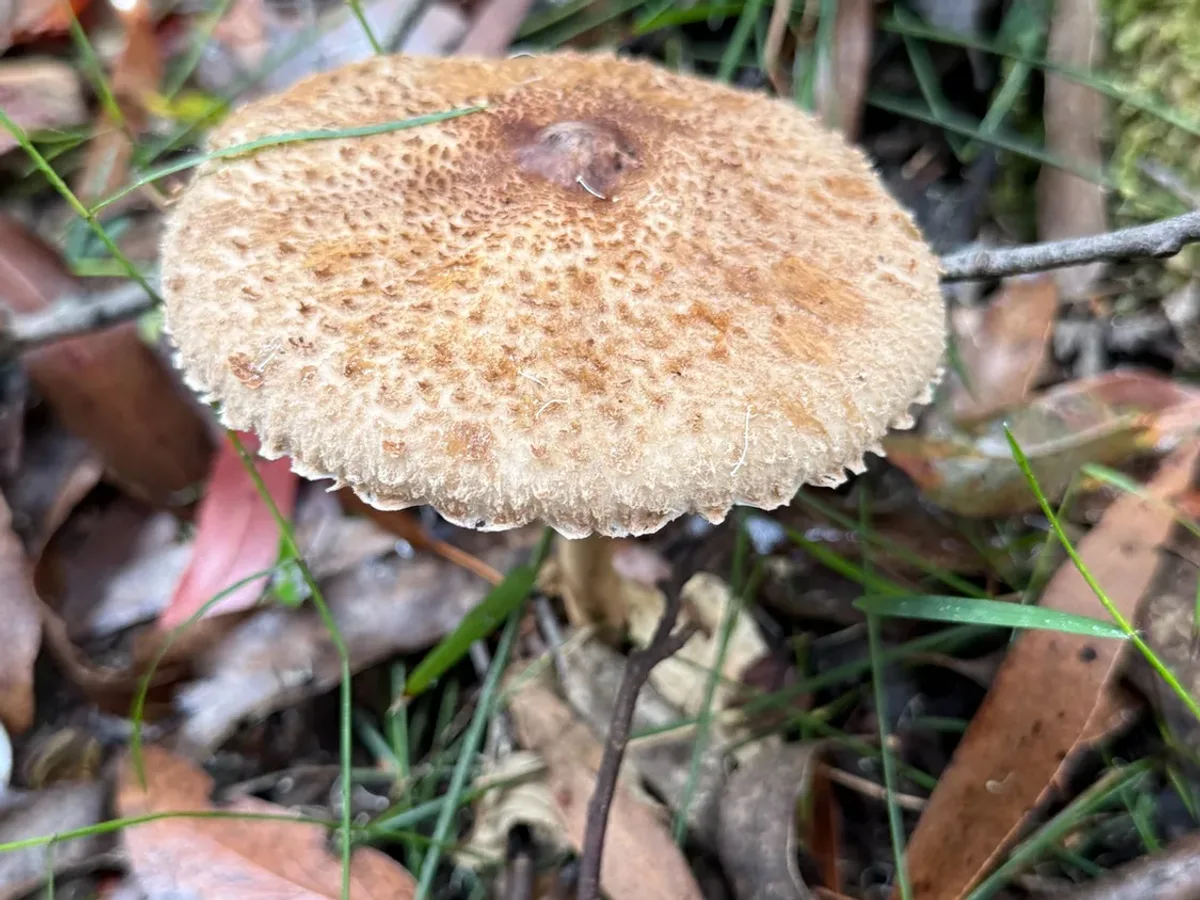 © Lukas Krug (CC BY)
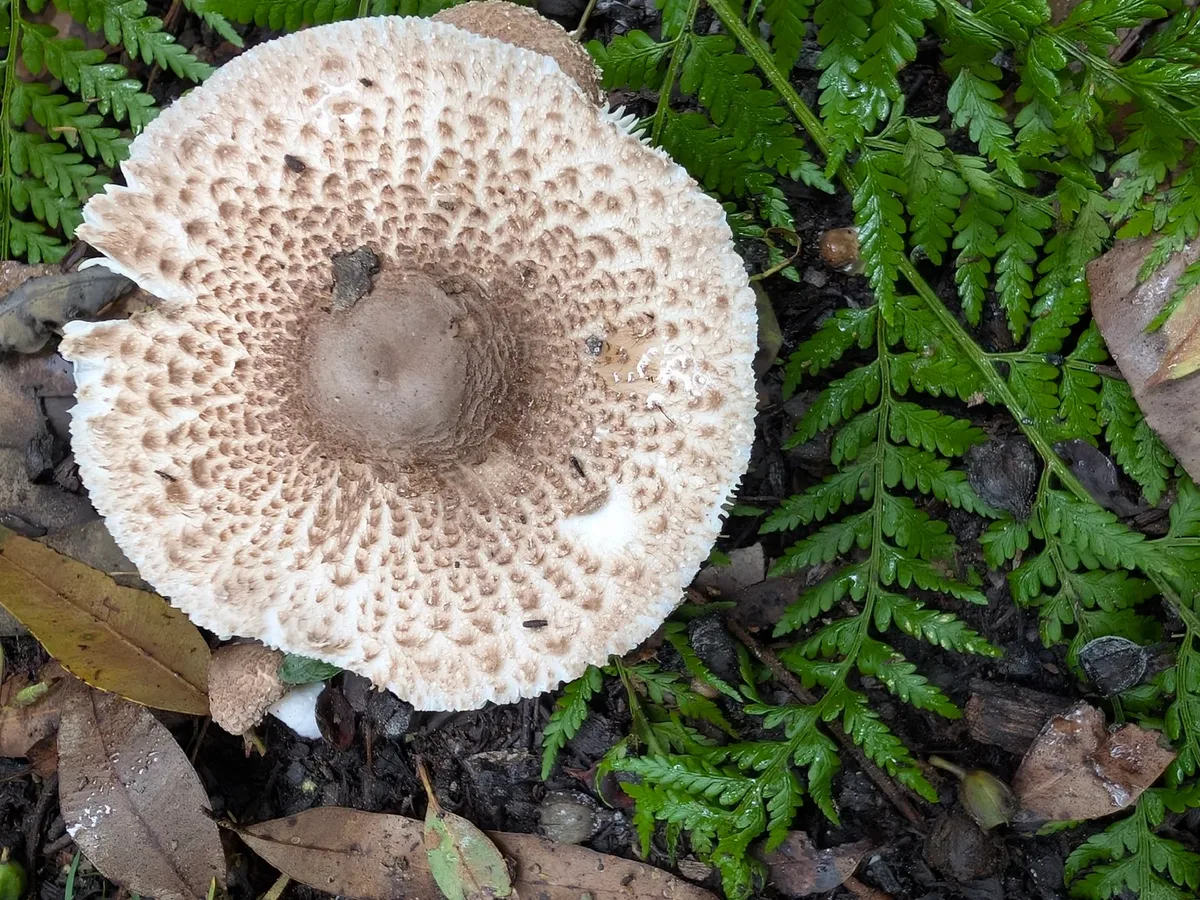 Tricia Kaye (CC0)
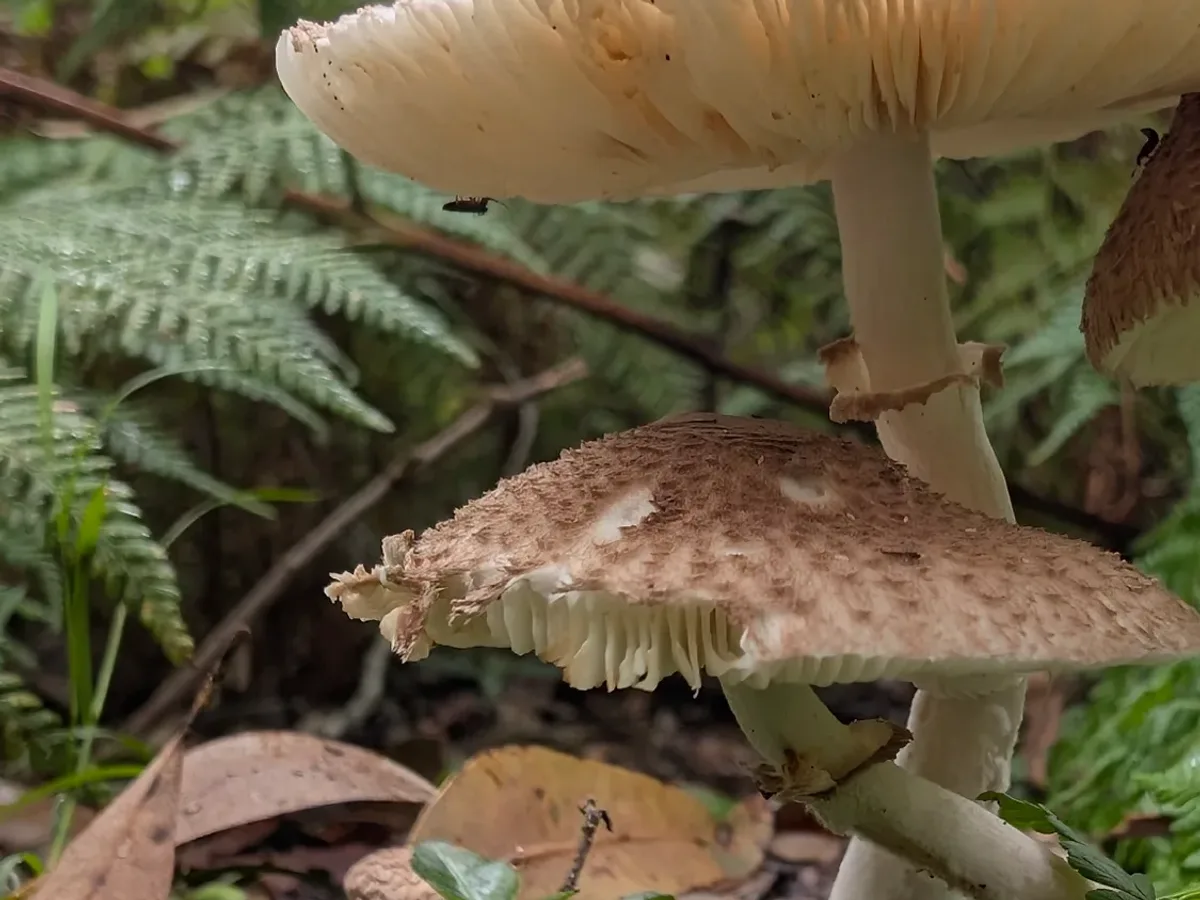 Tricia Kaye (CC0)
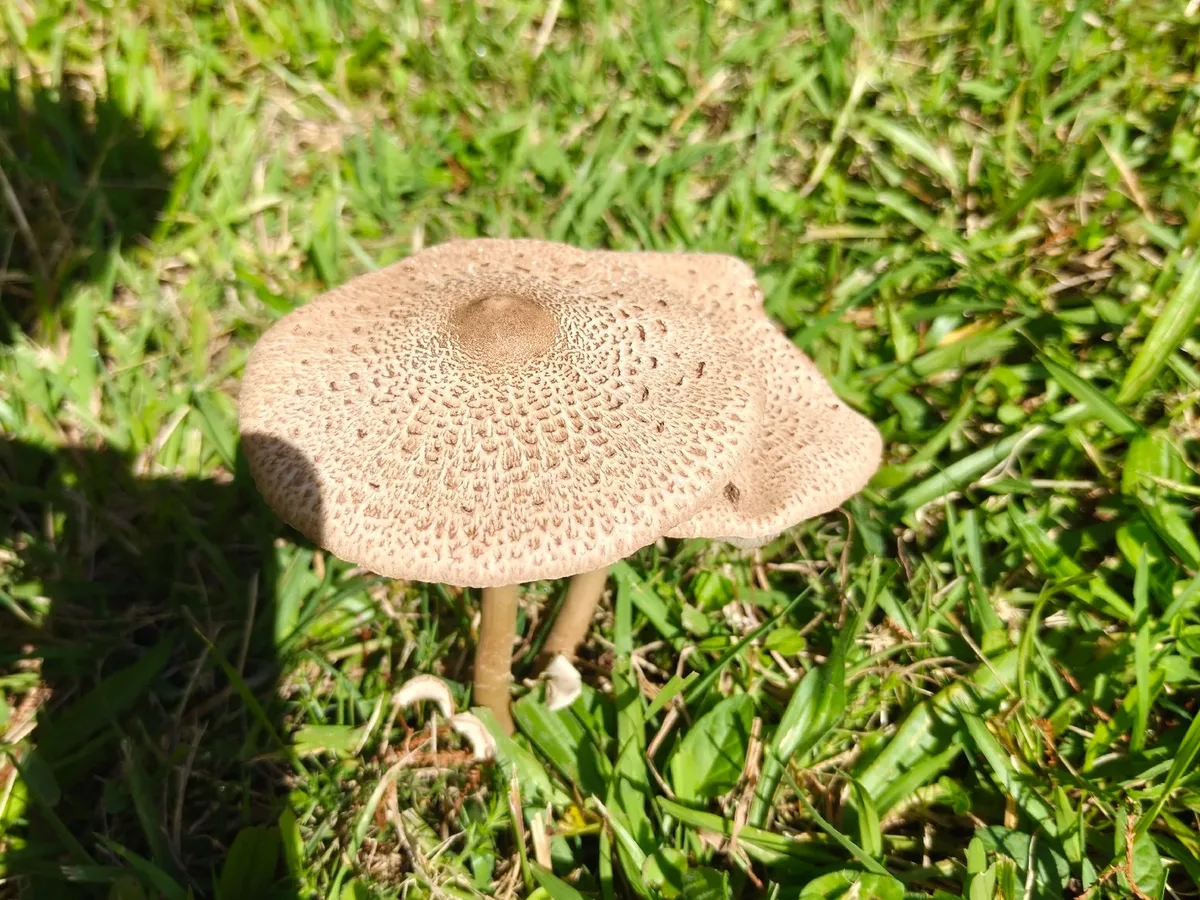 © Mark Stirling (CC BY)
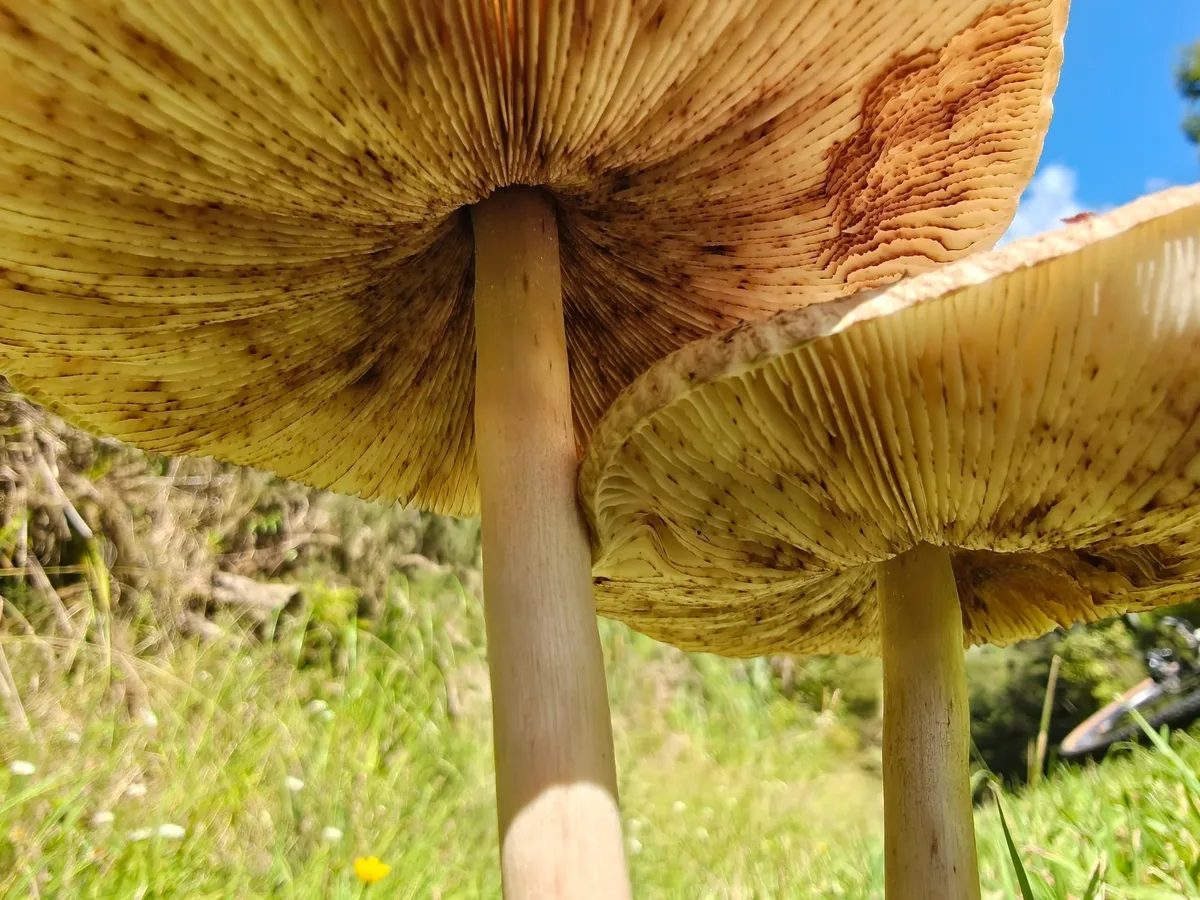 © Mark Stirling (CC BY)
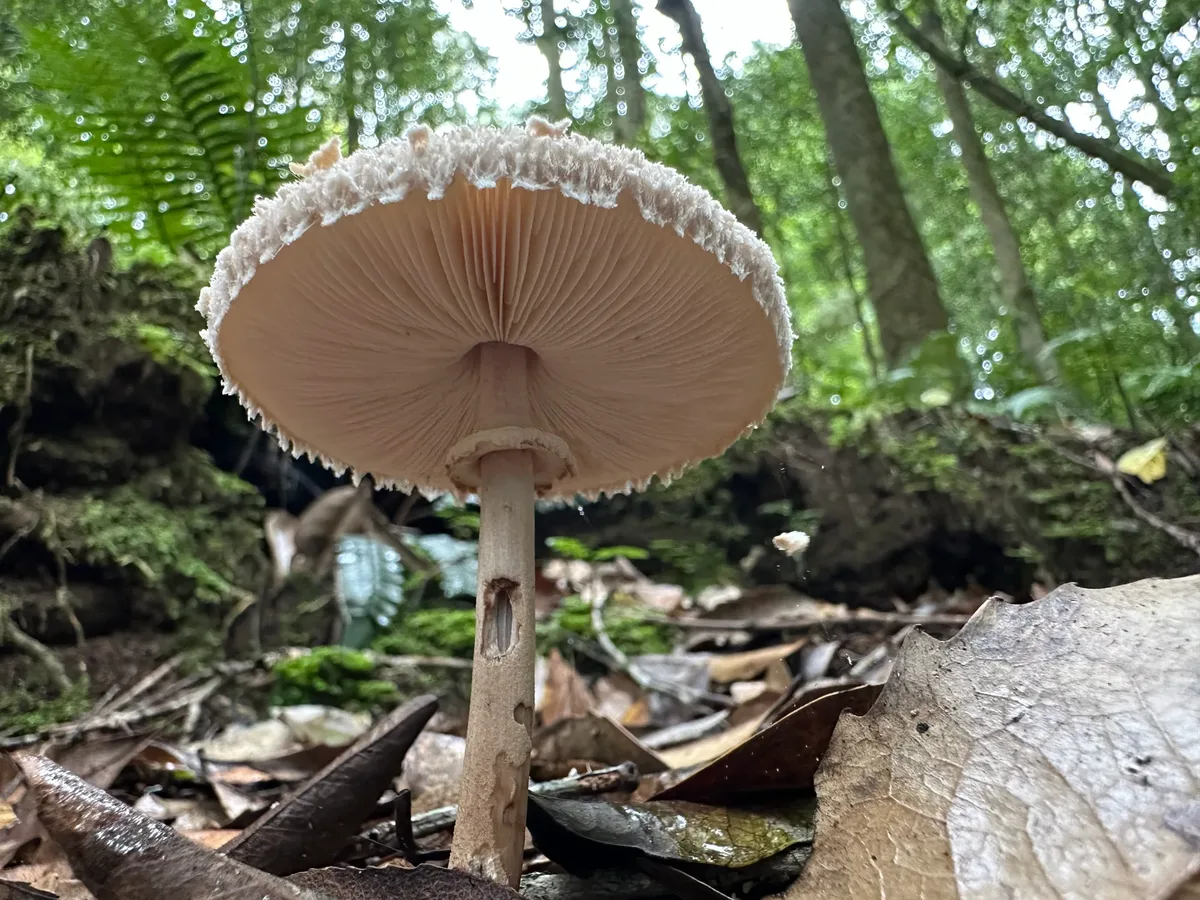 © Geoff Shuetrim (CC BY)
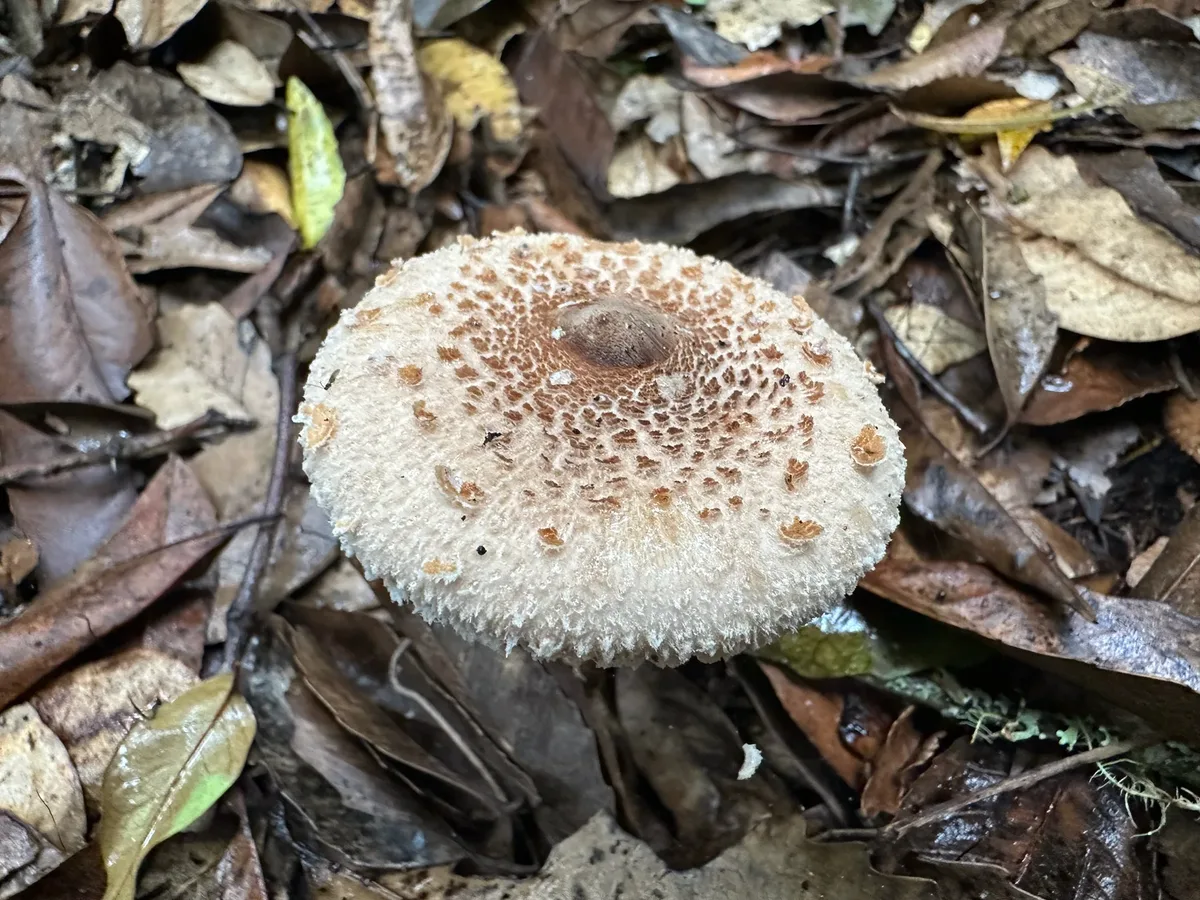 © Geoff Shuetrim (CC BY)
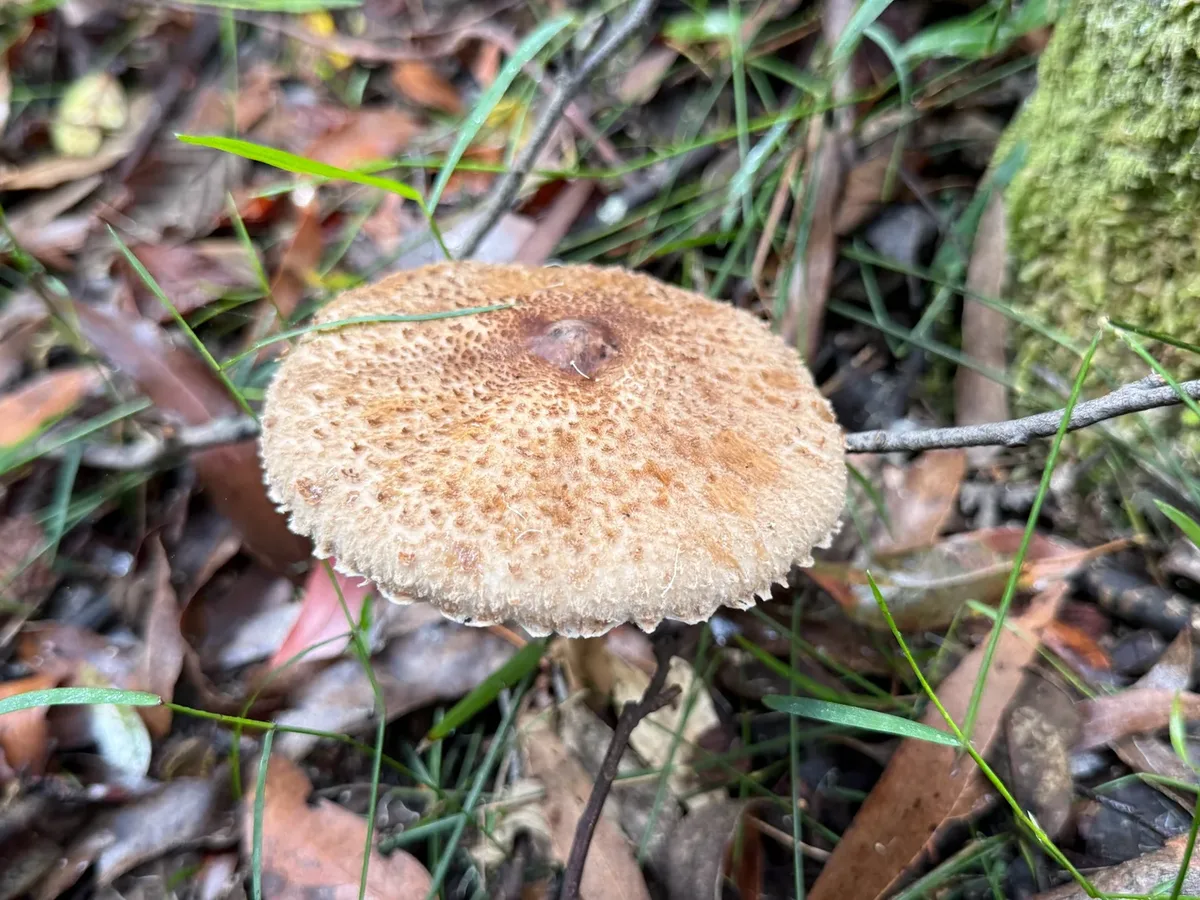 © Lukas Krug (CC BY)© Lukas Krug (CC BY)Tricia Kaye (CC0)
Good to eat, once you have identified it with certainty and cooked it through.
Never eat a mushroom you are not 100% sure of - check the look-alikes below, and always cook wild mushrooms.
How to recognise it
Macrolepiota clelandii is the archetypal large Australian parasol mushroom: stately, elegantly proportioned, with a broad, scaly cap raised on a slender pale stem and crowned by a large, sliding ring.
Cap
The cap begins as a soft buff-brown egg and opens to 8-18 cm across, its surface breaking into neat, concentric dark-brown scales against a pale background as it expands. A raised darker central knob (umbo) persists throughout maturity.
The scales are somewhat more delicately arranged than those of the European M. procera, a feature mycologists have noted in giving this species its common name.
Gills / Pores
The gills underneath are free from the stem, white to cream, and stay that colour right through the life of the mushroom.
Stem
The stem is tall and slender - 10-22 cm - pale, hollow, and lightly decorated with a faint fibrous banding below the ring, though this is less boldly marked than in M. procera.
The ring is wide, fleshy, double-layered, and the definitive feature of the Macrolepiota genus: grip it between thumb and forefinger and you can slide it up and down the stem - a freely moveable double ring separates the whole Macrolepiota group from the deadly small Lepiota dapperlings, where the ring is thin, fragile, or absent.
Flesh
Cut through the cap or stem flesh at any point and it stays white: there is no reddening, no orange staining, no colour change of any kind.
The spore print is white.
Where & when it grows
Habitat
This is a mushroom of the open Australian landscape rather than the forest interior. It grows on soil rich in organic matter and is most reliably found in grassy paddock margins, roadside verges, parkland, lawns, golf courses, and the grassy edges and clearings of open eucalyptus woodland - wherever the soil contains a good store of buried humus and decomposing plant material.
It is saprotrophic, quietly breaking down that organic matter, and because it does not depend on a specific mycorrhizal tree partner it can appear in quite varied settings: from suburban parks to rural pastures, and from sea-level coastal sites to foothill woodland.
It is native to Australia and absent from New Zealand, where no native Macrolepiota is established.
In Queensland and subtropical parts of NSW it may be encountered in the later part of the wet season; in Victoria, SA, and the ACT the classic timing is post-Easter through the cooler autumn months.
When
Autumn is the season for this mushroom throughout its south-eastern Australian range - March through July in the Southern Hemisphere, with the most reliable fruiting from April to June.
The trigger, as with most saprotrophic grassland fungi, is the combination of cooling soil temperatures and rainfall after the dry summer. Once soils cool to around 10-15 °C and a sustained period of autumn rain delivers 20-30 mm or more over 10-14 days, fruiting bodies begin to emerge within a week or so.
In dry or late-breaking autumns, fruiting may be sparse, delayed, or absent entirely in a given location. A productive site can produce multiple successive flushes through the season if conditions remain moist and mild.
How it grows
Saprotrophic; decomposes buried organic matter, root debris, and humus-rich soil. Fruiting bodies emerge singly or in loose scattered groups, occasionally in partial arcs or irregular rings where the mycelium has spread outward through uniform substrate beneath the surface.
Under warm, moist autumn conditions the fruitbody can develop quickly - from a button to a fully expanded cap within 3-5 days. This rapid development means that visiting known sites every few days is rewarding during peak season.
Older specimens deteriorate fast, especially in warmer early-autumn conditions, and are prone to insect infestation; harvest promptly when the cap has just opened or is still convex.
Fruiting conditions
Autumn saprotroph in the Southern Hemisphere; flushes follow onset of significant autumn rains (≥20 mm over a 10-14 day window) as soil temperatures cool below approximately 18 °C. First substantial fruiting bodies typically appear 5-12 days after triggering rainfall. Peak fruiting April-June across south-eastern Australia. Dry or late-breaking autumns substantially reduce fruiting.
Look-alikes
Macrolepiota clelandii shares Australian grasslands and woodland edges with several important lookalikes that range from mildly toxic to lethally dangerous:
- 1Chlorophyllum molybdites (Green-spored parasol) - the single most important confusion risk for any forager of large parasol mushrooms in Australia. This species is very common across Australian lawns, parks, paddocks, and grassy open ground and has caused numerous poisoning incidents nationally. It is closely similar in size, overall form, cap colouration and scale pattern, habitat, and season to M. clelandii. The decisive differences are: as the spores of C. molybdites mature, the gills turn a characteristic dull grey-green to olive-green colour - but this may not be obvious until the cap is quite old - and the spore print is distinctly olive-green to grey-green, never white. An overnight spore print from a full-sized cap is the single most reliable way to exclude C. molybdites: white = Macrolepiota; any green, olive, or grey tinge = Chlorophyllum molybdites, discard and do not eat. C. molybdites causes severe gastrointestinal poisoning - violent, protracted vomiting and diarrhoea within 1-3 hours of ingestion - and is particularly dangerous for children, who can become seriously unwell very quickly.
- 2Deadly Lepiota dapperlings (Lepiota brunneoincarnata, L. subincarnata, L. josserandii, and related taxa) - these are lethal. Several Lepiota species known or suspected to contain amatoxins (alpha-amanitin, the same toxin responsible for Amanita phalloides deaths) have been recorded in Australia. They are dramatically smaller than M. clelandii, with caps typically 2-5 cm and never reaching 8 cm, and they have a thin, fragile ring that is fixed or barely developed - never the large, double, freely-sliding ring of Macrolepiota. The size threshold is the primary safety gate: never collect any parasol-type mushroom whose cap does not clearly and unambiguously exceed 7 cm. If in doubt about size, do not take it.
- 3Chlorophyllum brunneum / C. rhacodes (Shaggy parasol) - these species occur in Australia, primarily in garden, compost, and disturbed-soil habitats rather than natural grassland. They are a similar size to M. clelandii but their flesh immediately reddens to saffron-orange or brick-red when cut - M. clelandii flesh stays white. Cutting and observing the flesh is the quick field test. Both cause gastrointestinal illness in a significant proportion of consumers.
- 4Macrolepiota procera (Parasol mushroom) - the European species has been introduced and naturalised in parts of south-eastern Australia and New Zealand. It is closely similar to M. clelandii in form and edibility. M. procera is generally larger and more robustly built, with a more pronounced and dramatic snakeskin stem pattern and a somewhat more shaggy, coarser cap surface; M. clelandii tends to be more gracefully proportioned and slightly more delicately scaled. Both are edible and the distinction is of academic rather than safety interest - apply the same identification and spore print checks regardless of which species is suspected.
- 5Amanita species (button and egg stage) - young, unexpanded Amanita fruitbodies enclosed in the universal veil can superficially resemble parasol eggs. Always excavate the base carefully: any Amanita has a sack-like volva (bag or cup) at the stem base, which M. clelandii entirely lacks. Deadly native Australian Amanita species (A. marmorata, A. austrophalloides) and the introduced death cap (A. phalloides) all share their range with M. clelandii.
Multiple Lepiota species known or suspected to contain lethal amatoxins (alpha-amanitin) occur in Australia. They are dramatically smaller than M. clelandii - cap typically 2-5 cm, never approaching 8 cm - and have a thin, fragile ring that does not slide freely, or no ring at all. The size rule is the primary safety gate: never collect any parasol-type mushroom whose cap does not clearly exceed 7-8 cm. The large, double, freely-sliding ring of M. clelandii is a further confirmation.
Young Amanita fruitbodies enclosed in the universal veil can resemble parasol eggs. Always excavate the base: Amanita phalloides has a persistent bag-like volva (sack) around the bulbous stem base - M. clelandii has no volva whatsoever. The death cap occurs in south-eastern Australia under introduced oaks and chestnuts and is lethally toxic; it does not share the grassy open habitats preferred by M. clelandii but may occur at habitat margins.
Several native Australian Amanita species (including A. marmorata and A. austrophalloides) are suspected or confirmed to contain amatoxins and grow in native eucalyptus woodland, which borders many M. clelandii habitats. All have a sack-like volva at the stem base and a membranous ring; M. clelandii has no volva. Excavate the base of every specimen and discard anything with a volva or a thin, non-moveable ring.
Very common in Australian lawns, pastures, and parkland; visually similar in size, cap scaling, habitat, and season. Critically, C. molybdites produces a distinctly olive-green to grey-green spore print (never white), and mature gills turn dull grey-green to olive. An overnight spore print is the most reliable separator: white = M. clelandii; any green or olive tinge = C. molybdites, do not eat. C. molybdites causes severe gastrointestinal poisoning - violent vomiting and diarrhoea - within 1-3 hours of ingestion.
The introduced European M. procera occurs in south-eastern Australia and is also edible. It tends to be larger (cap to 30 cm), more robustly built, with a more dramatic and boldly marked snakeskin stem pattern, coarser and more shaggy cap scales, and taller stature. M. clelandii is more slenderly proportioned and has somewhat finer, neater scales. Both have white non-reddening flesh and a white spore print; the distinction is of academic rather than safety importance, as both species require the same identification checks before eating.
Similar size and overall form, but C. brunneum flesh immediately turns vivid orange to saffron-red within seconds of being cut. M. clelandii flesh stays white throughout - cutting the flesh and watching for colour change is the fastest field separator. C. brunneum grows mainly in compost-enriched garden and park soil. It causes gastrointestinal illness in a significant proportion of consumers.
In the kitchen
Picking & cleaning
Collect only fully developed, clearly large specimens: the cap should exceed 8 cm in diameter before you consider taking it. This size threshold is a meaningful safety gate - the deadly small Lepiota dapperlings that share Australian grasslands rarely exceed 5-6 cm in cap diameter and are never large enough to be mistaken for a well-grown M. clelandii.
For every specimen, confirm the following before placing it in your basket:
- 1The ring is large, double-layered, and slides freely along the stem - grip it between thumb and forefinger and move it up and down; if the ring is thin, fragile, fixed, or absent, discard the mushroom immediately and do not eat it;
- 2Cut through the cap or stem flesh with a clean knife and observe for 30 seconds - the flesh must remain white with absolutely no reddening, orange staining, or other colour change;
- 3The gills are white to cream and free from the stem;
- 4Take a spore print overnight before eating any new collection - the print must be clean white, not olive, grey, or green.
A green or olive spore print indicates Chlorophyllum molybdites (the green-spored parasol), a severely toxic species that is very common in Australian lawns and grassland.
- Cut the stem at the base with a knife and place caps upright and separately in a basket.
- Photograph the underside, the ring, and the cut flesh of each specimen before setting out for home.
Cooking
The cap is the edible part; the stem is fibrous and tough and best discarded or reserved for stock. Brush the cap to remove debris and slide off or cut away the ring before cooking.
The classic preparation is to pan-fry the whole cap or large pieces in butter or olive oil over medium-high heat until golden - about 3-5 minutes per side - which develops a pleasant, mildly nutty flavour. Larger caps make excellent 'steaks' for grilling or barbecuing.
The flesh can also be sliced and added to pasta, risotto, soups, or stir-fries, and the dried cap holds its structure well enough for baking.
Flavour is mild, pleasantly mushroomy, and slightly nutty with a firm but yielding texture when cooked.
Cook thoroughly - do not eat raw or undercooked. Refrigerate unused portions and consume within 24 hours; warm, humid weather accelerates deterioration.
Good to know
Macrolepiota clelandii is regarded as a genuinely edible species by Australian mycologists and experienced foragers, with no known toxins in properly identified, well-cooked specimens. However, identification must be rigorous, because the species occurs alongside several lookalikes that range from severely toxic to lethal.
The non-negotiable safety rules before any consumption are:
- 1Cap must clearly exceed 8 cm in diameter - the hard threshold below which deadly small Lepiota species cannot be excluded by size alone;
- 2The ring must be large, double-layered, and freely moveable along the stem - a thin, fragile, fixed, or absent ring means the mushroom must be discarded without exception;
- 3Cut through the flesh of both cap and stem with a clean knife and observe for at least 30 seconds - flesh must remain white with absolutely no colour change of any kind;
- 4Take an overnight spore print and confirm it is clean white - any olive, grey, or greenish tinge indicates Chlorophyllum molybdites and the specimen must not be eaten;
- 5Excavate the base fully and confirm there is no volva, sack, or basal cup, which would indicate Amanita.
Raw consumption is not recommended; thorough cooking is standard practice for all large Lepiota-group fungi.
Individuals trying this species for the first time should eat only a small amount and wait at least three hours before eating more. If any gastrointestinal symptoms occur, seek medical advice and retain a specimen or photograph for identification.
If symptoms are delayed (more than 6 hours after eating), suspect amatoxin poisoning from a misidentified Lepiota or Amanita and seek emergency care immediately - delayed-onset symptoms require urgent hospital assessment.
A reference guide - never an edibility guarantee. When in doubt, leave it out.