Giant cream mushroom
Macrocybe crassasyn. Tricholoma crassum, Gyrophila crassa, Tricholoma giganteum var. crassum
 © Patrick Leonard (CC BY)
 © Tara Severns (CC BY)
 © Tara Severns (CC BY)
 © Patrick Leonard (CC BY)© Patrick Leonard (CC BY)© Tara Severns (CC BY)
Good to eat, once you have identified it with certainty and cooked it through.
Never eat a mushroom you are not 100% sure of - check the look-alikes below, and always cook wild mushrooms.
How to recognise it
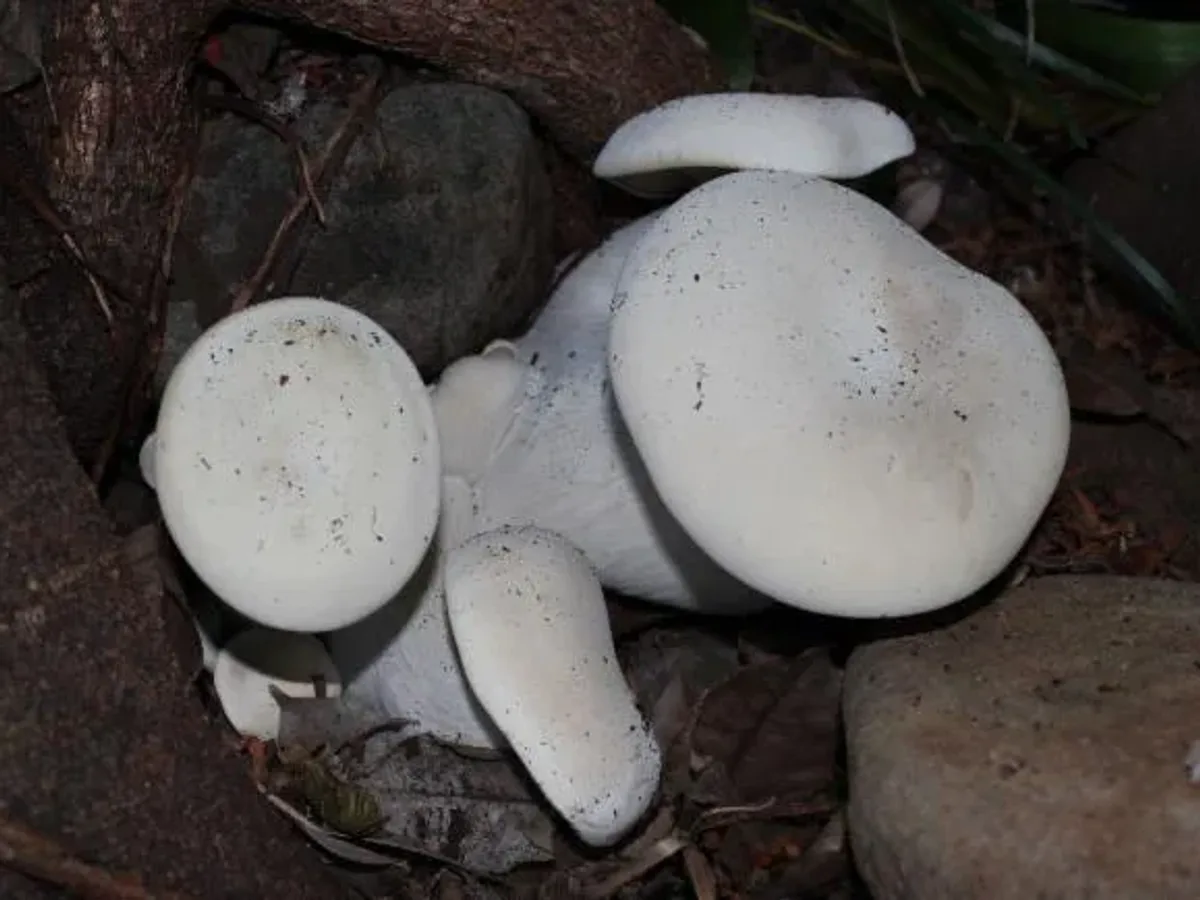
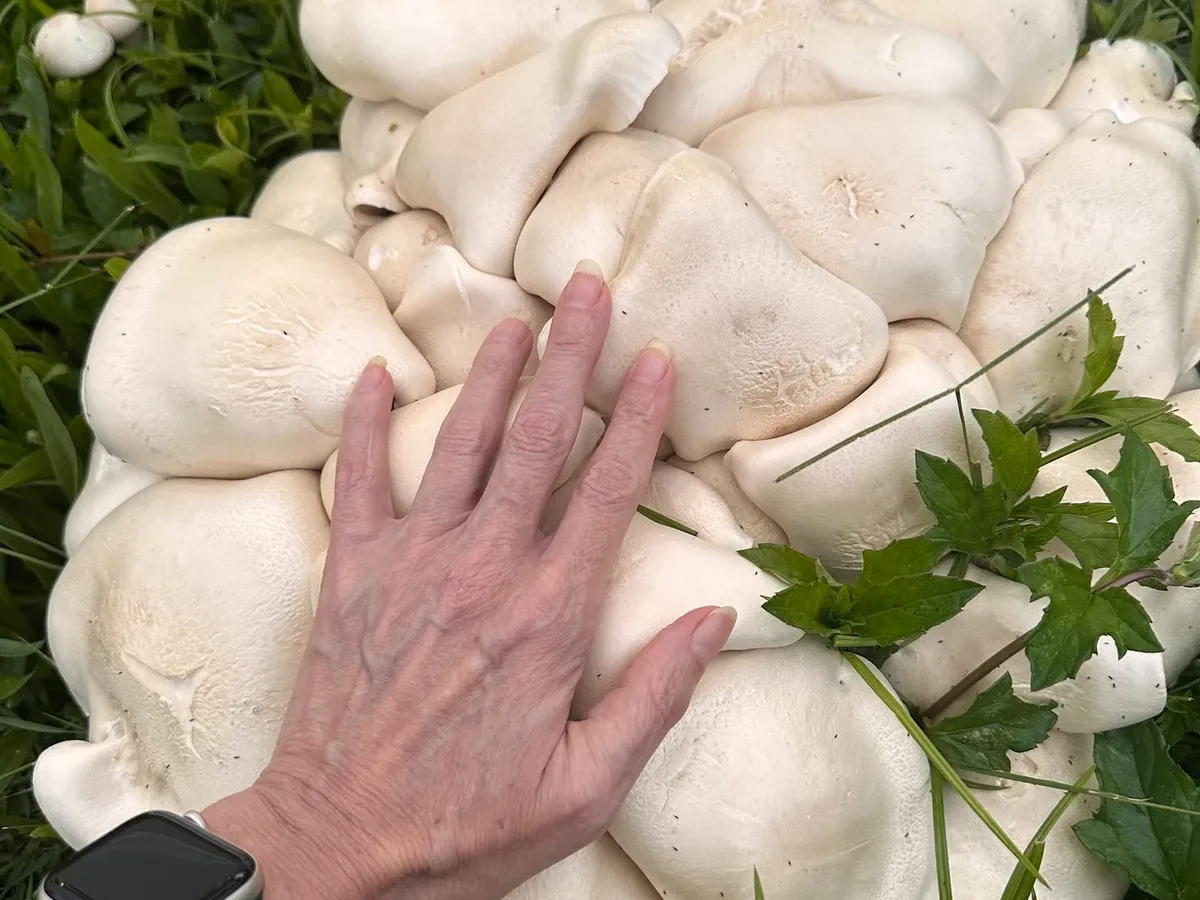
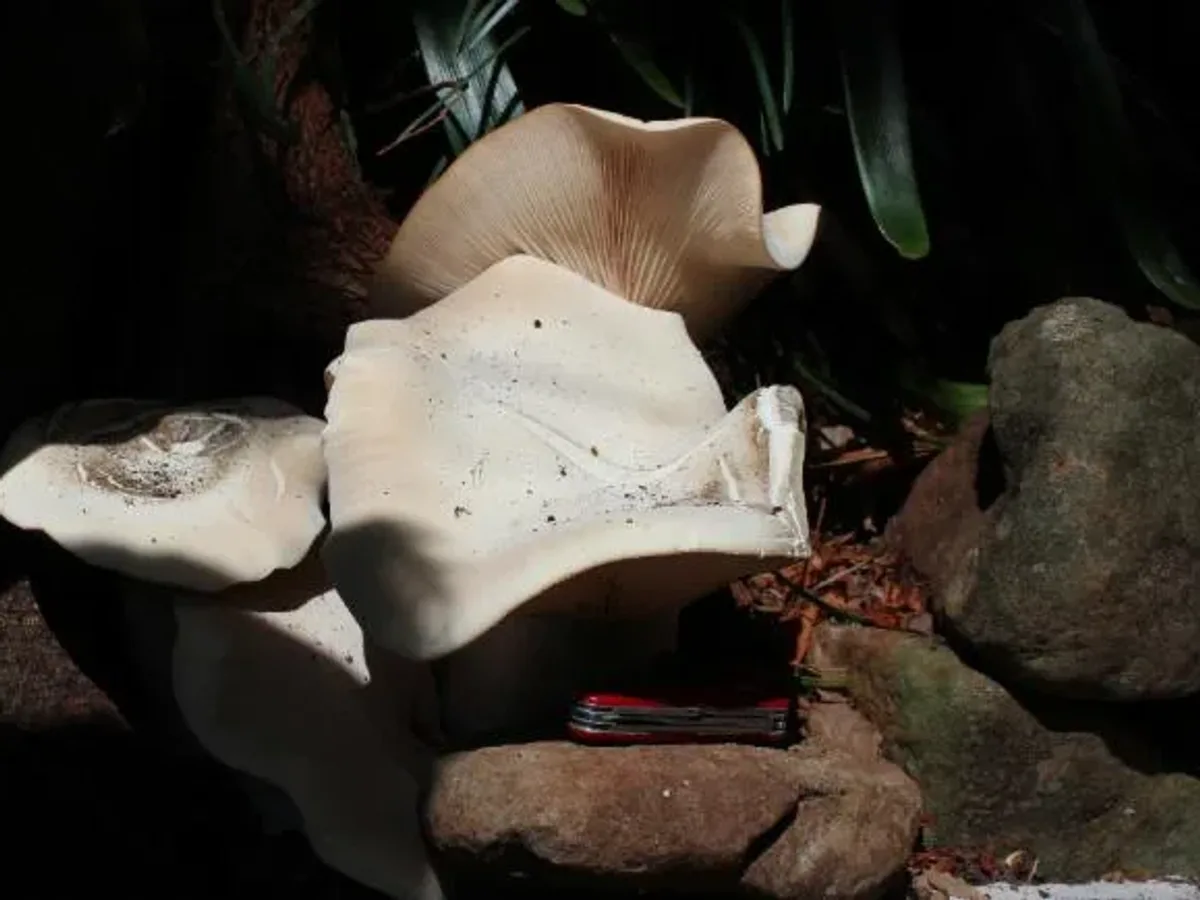
Macrocybe crassa is one of the largest agarics in tropical Asia - a massive, entirely white to cream mushroom whose size alone can stop you in your tracks.
Cap
The cap starts as a broad dome, 8-30 cm across (occasionally wider), and gradually flattens with a slight downward-turned edge, never forming a central depression or striate margin. The surface is dry, smooth, and clean-looking, without any scales, warts, or sticky coating.
Gills
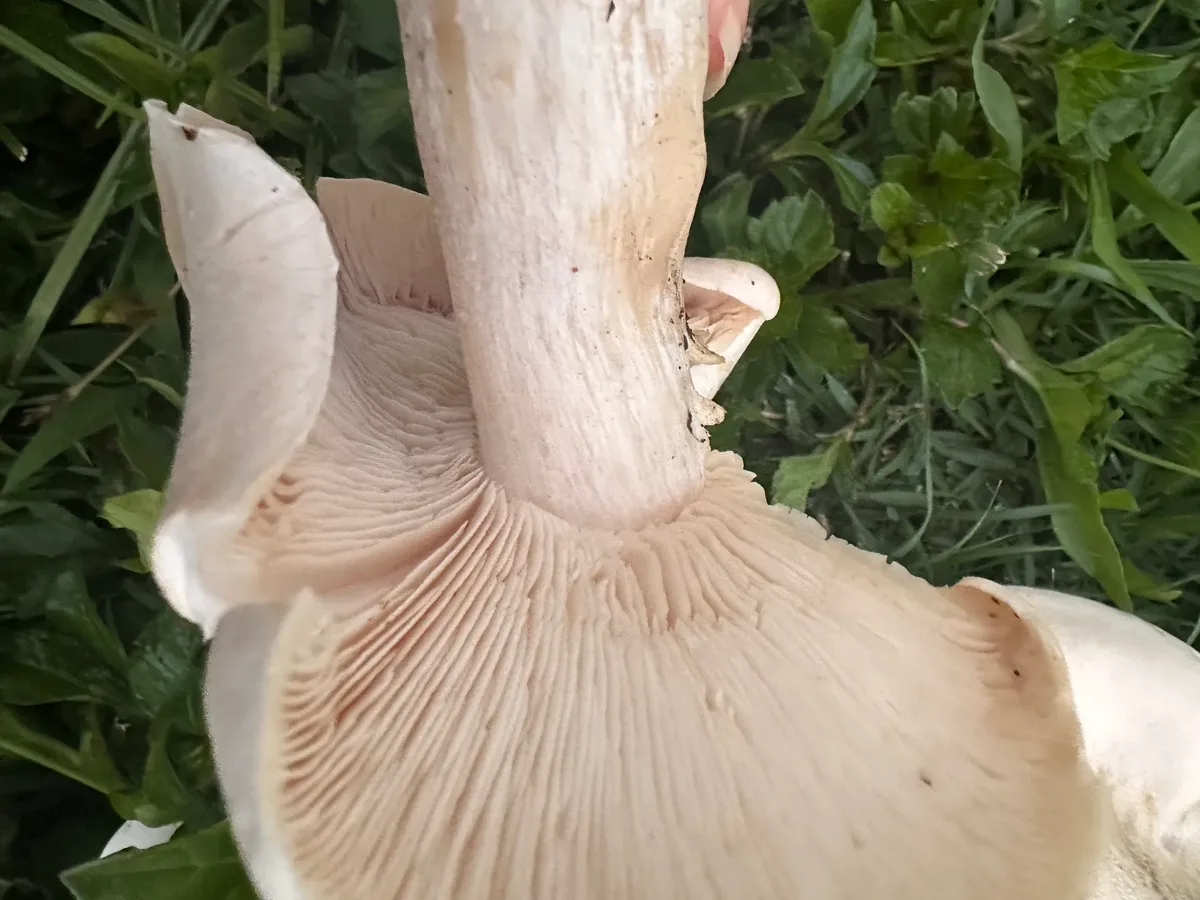
Below it, the gills are closely packed, white to cream, and attach to the stem cleanly.
Stem
The stem is thick and solid - sometimes as wide as a wine bottle at the base - and entirely lacks both a ring (annulus) and a sac-like volva at the base. This absence is the single most important safety observation you can make in the field: if your large white mushroom has a ring and a volva, you are not looking at Macrocybe crassa.
Flesh
The flesh is dense, white, and firm, with a mild mealy-fungal aroma. Spore print is white.
Where & when it grows
Habitat
Unlike many prized edible fungi, Macrocybe crassa is not a tree partner - it is a soil decomposer with a taste for organically enriched open ground.
It thrives in:
- Grassy clearings
- Roadsides lined with leaf litter
- Bamboo grove margins
- Scrub land
- Coconut and rubber plantations
- The borders of disturbed tropical forest
It grows in troops, arcs, or loose fairy-ring patterns, sometimes with dozens of fruiting bodies emerging from the same site after heavy rain.
This gregarious, open-ground habit helps separate it from the volva-bearing Amanita species that typically fruit as solitary individuals in closed forest rather than in sunny grassy margins.
In Thailand, where it is a favourite village market mushroom, it is most familiar to locals as the large white mushroom that appears in rice-field margins and roadsides after the first heavy monsoon rains.
When
Macrocybe crassa is a warm wet-season fungus. Its fruiting is driven by the tropical monsoon: it appears reliably after the first substantial rains of the season when soil temperatures are high, peaking June-September across most of South and Southeast Asia.
Regional timing:
- In Thailand, the main flush is July-August.
- In southern India, it follows the southwest monsoon from June onward, with a secondary flush after the northeast monsoon in October.
It does not fruit in cool or dry conditions.
Because rain events trigger flushes, experienced foragers return to known spots within a few days of significant rainfall and typically find multiple fruit bodies emerging together.
How it grows
A saprotrophic decomposer, Macrocybe crassa breaks down accumulated organic matter in soil - grass roots, plant debris, and leaf litter.
The mycelium ramifies through the upper soil horizons and can persist at a site for many years, explaining why productive spots recur reliably season after season.
Fruiting bodies emerge rapidly after triggering rains, expanding from small buttons to full-sized caps in 3-6 days.
Growth is often gregarious, with many fruit bodies appearing simultaneously in arcs or rings that expand outward as the underground mycelium depletes resources nearest its centre - the classic fairy-ring dynamic.
Individual fruit bodies are large and meaty from the start, reflecting the dense, energy-rich flesh that makes this species so worthwhile to collect.
Fruiting conditions
Fruiting is triggered by sustained monsoon rainfall after soil temperatures have risen above 24 °C. A significant rain event (40+ mm over 14 days) initiates the flush; fruiting bodies typically appear 3-8 days after the triggering rains. The saprotrophic habit means the flush is driven by surface moisture rather than deep soil conditions, so response to rainfall is faster than in mycorrhizal species. Multiple flushes from the same site are common if further rain events follow.
Look-alikes
The most dangerous lookalike scenario is confusion with white or pale Amanita species that share tropical Asian habitats. Amanita species always have both a ring on the stem and a volva (sac or sheath) at the base - their absence confirms you are not looking at a dangerous Amanita.
The other relevant lookalike is Chlorophyllum molybdites, which causes severe gastrointestinal poisoning and is widespread in tropical Asia. It has a ring on the stem, scales on the cap, and - critically - a distinctive green to grey-green spore print.
Macrocybe gigantea (Giant mushroom) is a close relative that is larger, more robust, and also edible; the two species are sometimes confused even in the scientific literature, and both are consumed.
Leucoagaricus species on disturbed tropical soil can be similar but are generally smaller, and some produce a ring.
Any large white mushroom with a ring, a volva, or a non-white spore print must not be consumed as Macrocybe crassa.
Amanita phalloides has both a membranous ring on the stem and a sac-like volva buried at the base - the two structures that Macrocybe crassa completely lacks. The cap of A. phalloides is typically greenish-yellow to olive-brown with faint radiating fibres, not pure white. Any large mushroom with a ring and a volva must not be collected as Macrocybe crassa. Amanita buttons (early stage, before expansion) are especially dangerous: slice longitudinally to confirm uniform white flesh without an internal egg-like structure.
White Amanita species (including A. virosa, A. bisporigera, and related destroying angel taxa found in Asia) are entirely white and could superficially resemble Macrocybe crassa at a glance. They possess both a ring (skirt-like, pendant) and a volva (cupped sheath at the base), a shaggy-cottony to smooth white stem, and gills that are white and free. Macrocybe crassa has neither a ring nor a volva; its stem is smooth and solid and its gills are sinuate to adnate. Both species share tropical and subtropical Asian forests during the monsoon season. Confirming the absence of ring and volva is essential before any collection.
Macrocybe gigantea is the closest relative and can be extremely difficult to distinguish in the field. It is generally even larger (cap to 40+ cm), more robust, and white to cream; spore print white; also lacks ring and volva; also edible and consumed in Asia. The two are sometimes treated as synonyms or near-synonyms in older literature. Confusion between them is not toxicologically significant as both are edible. Microscopically, M. gigantea tends to have slightly larger spores. For field purposes these two species can be treated interchangeably as safe edibles.
Chlorophyllum molybdites grows in grassy open areas throughout tropical Asia and is one of the most common causes of mushroom poisoning in the tropics. Its cap is white with brownish scales (especially at centre), and it bears a prominent, thick, moveable ring on the stem - absent in Macrocybe crassa. The definitive diagnostic is the spore print: Chlorophyllum molybdites produces a distinctive grey-green to bright green spore print, while Macrocybe crassa produces a pure white print. Taking a spore print on white paper (compare both green and white sections) is a simple and conclusive test when any uncertainty remains. Not deadly but causes severe vomiting and diarrhoea.
Leucoagaricus species on disturbed tropical soil are generally smaller (cap rarely exceeding 12 cm), have a persistent membranous ring on the stem, and often show brownish to pinkish tones on the cap surface or scale-like fibres. Some Leucoagaricus species cause gastrointestinal irritation and should not be eaten. The presence of a ring distinguishes them from Macrocybe crassa. Spore print in Leucoagaricus is typically white.
In the kitchen
Picking & cleaning
Select firm, fresh, fully developed specimens with intact caps and no signs of insect tunnelling or decay.
Check the stem base carefully. Confirm the complete absence of a volva (no sac, sheath, or membranous cup at or below soil level) and the absence of a ring on the stem. These two negatives are your primary safety characters. If either feature is present, do not collect.
Cut the stem rather than pulling to preserve the base for examination and to verify absence of volva tissue in the soil.
Carry specimens in an open basket rather than a sealed bag, keeping each specimen visible and separate. Re-examine the base of every specimen when you return home, particularly after washing.
Because this species often grows near Amanita button stages in the same warm-season flush, exercise extra vigilance when collecting young immature specimens. At the button stage, the absence of ring and volva must be verified by slicing the button longitudinally:
- Macrocybe crassa buttons show uniformly white, structurally homogeneous flesh.
- Amanita buttons show a differentiated internal structure, with the developing cap, gills, and ring all visible inside the universal veil.
Cooking
In Thailand and southern India, Macrocybe crassa is appreciated as a substantial, meaty edible that holds up beautifully to heat. The thick, firm flesh makes it ideal for curries, stir-fries, grilling, and soups where smaller mushrooms would fall apart.
Thai preparations often involve grilling or stir-frying with garlic, fish sauce, and chilli. In South Indian cooking it appears in coconut milk curries and dry-sautéed preparations with mustard seeds and curry leaves.
The flavour is mild, slightly mealy, and savoury, deepening with cooking - not intensely complex, but a satisfying neutral canvas for spices and aromatics.
Slice the caps and stems thickly to preserve texture, and cook until fully cooked through (the dense flesh requires adequate heat throughout). Do not eat raw.
The mushroom pairs well with bold tropical flavours: lemongrass, galangal, kaffir lime, tamarind, and coconut milk all complement it well.
Good to know
Macrocybe crassa has a long history of safe consumption in Thailand, India, Sri Lanka, and across Southeast Asia, and is not known to contain toxins in its own right.
However, it grows in the same warm-season, open-habitat flushes as dangerous species - most critically Amanita species (which contain deadly amatoxins) and Chlorophyllum molybdites (a common cause of severe gastrointestinal poisoning across tropical Asia).
The field safety protocol has two non-negotiable steps:
- 1Confirm the complete absence of a ring and a volva on every single specimen, at the time of picking and again at home.
- 2Take a spore print of any doubtful specimen - the spore print of Macrocybe crassa is white, while Chlorophyllum molybdites produces a diagnostic green spore print.
Cook all specimens thoroughly before eating.
As with any wild mushroom, first-time tasters should eat a moderate portion and wait several hours to assess individual tolerance.
A reference guide - never an edibility guarantee. When in doubt, leave it out.