Stump puffball
Lycoperdon pyriformesyn. Apioperdon pyriforme, Morganella pyriformis, Lycoperdon pyriforme var. tessellatum, Bovista pyriformis
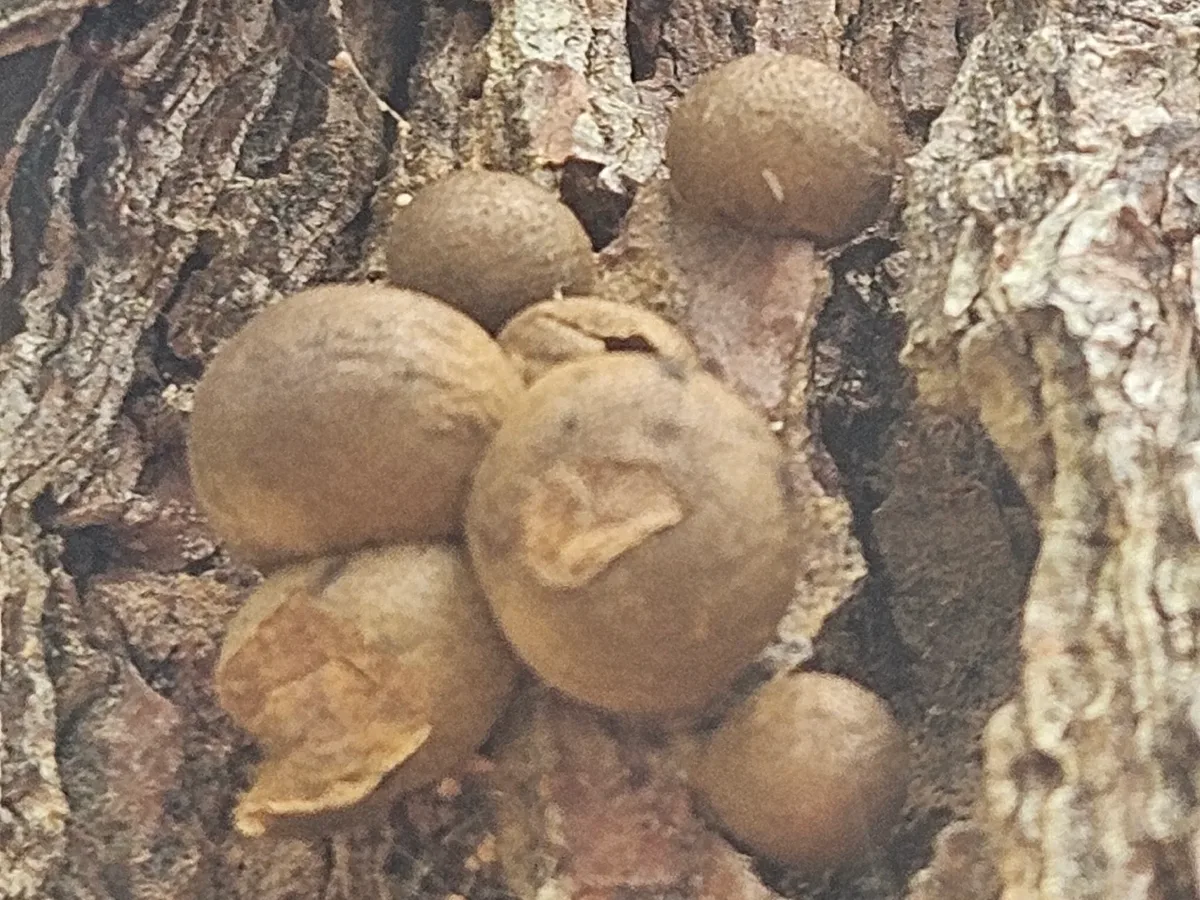 © willingarden (CC BY)
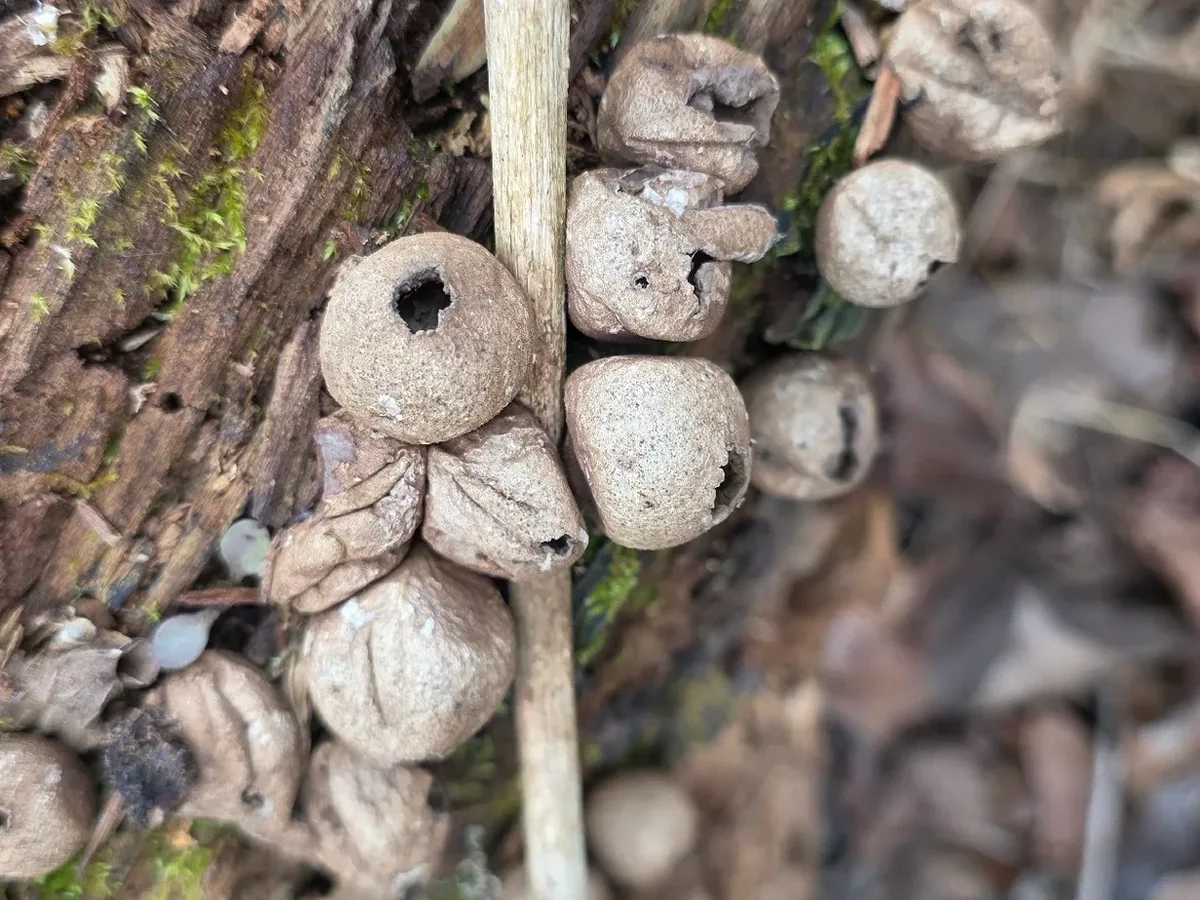 nickajacket (CC0)
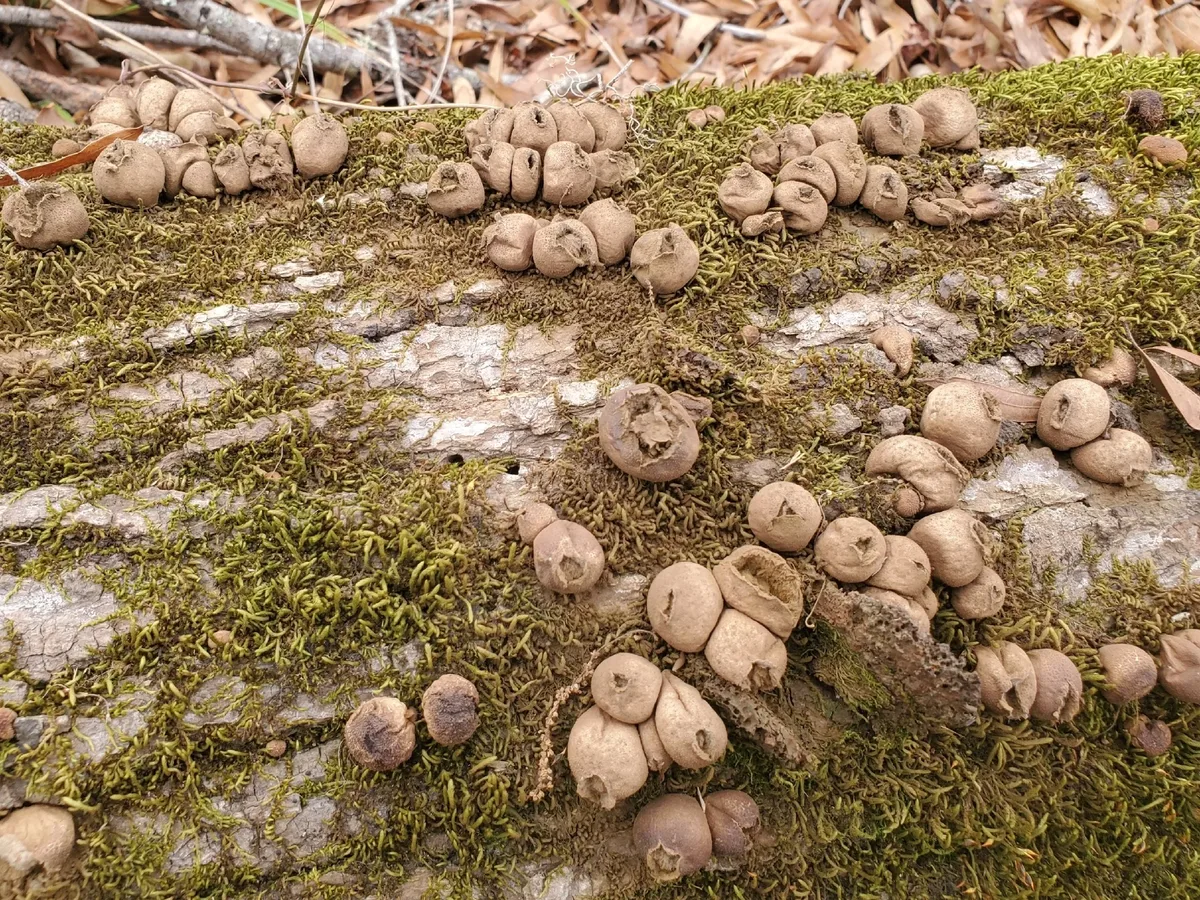 © hr_dragonfly (CC BY)
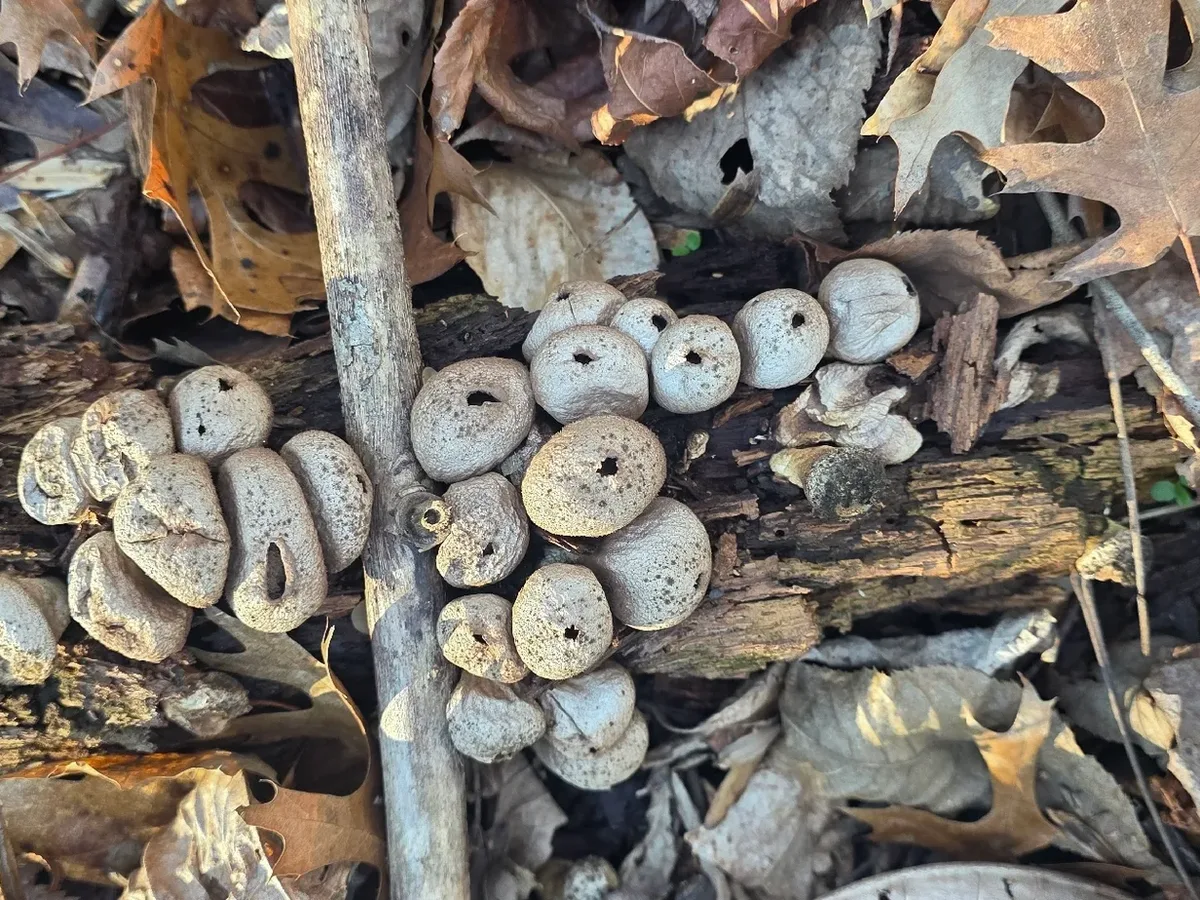 nickajacket (CC0)
 Jason Thompson (CC0)
 Jason Thompson (CC0)
 © Jenn E. (CC BY)
 © Conway Hawn (CC BY)
 © John Lyden (CC BY)© willingarden (CC BY)nickajacket (CC0)
Good to eat, once you have identified it with certainty and cooked it through.
Never eat a mushroom you are not 100% sure of - check the look-alikes below, and always cook wild mushrooms.
How to recognise it
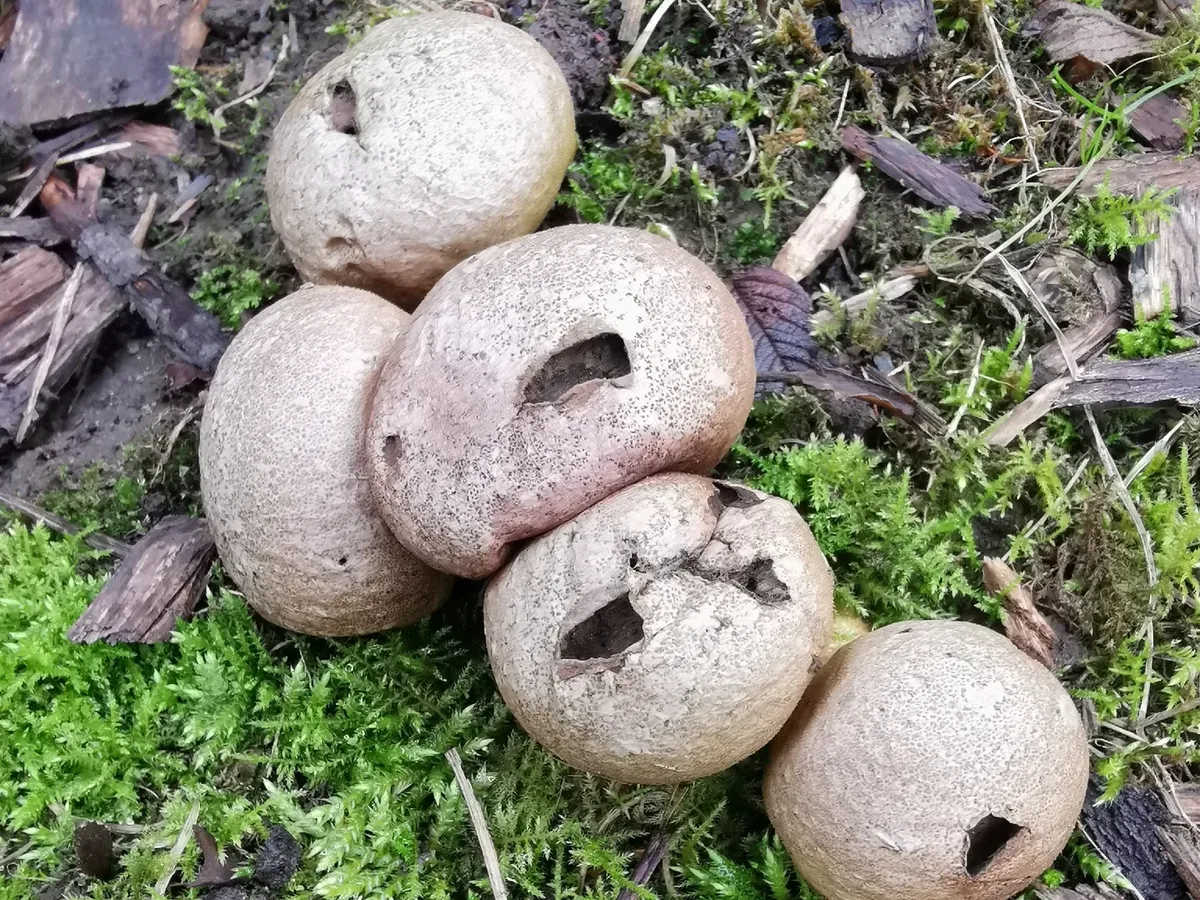
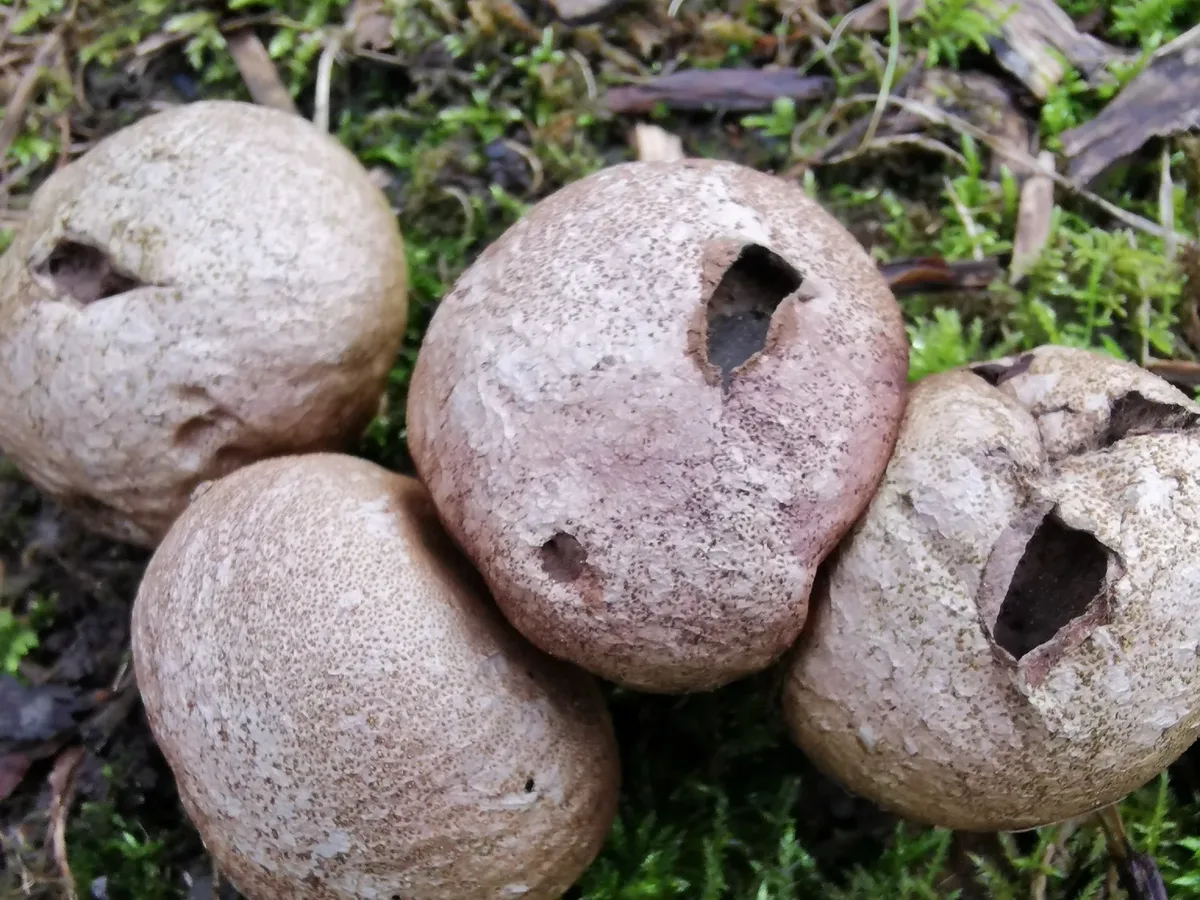
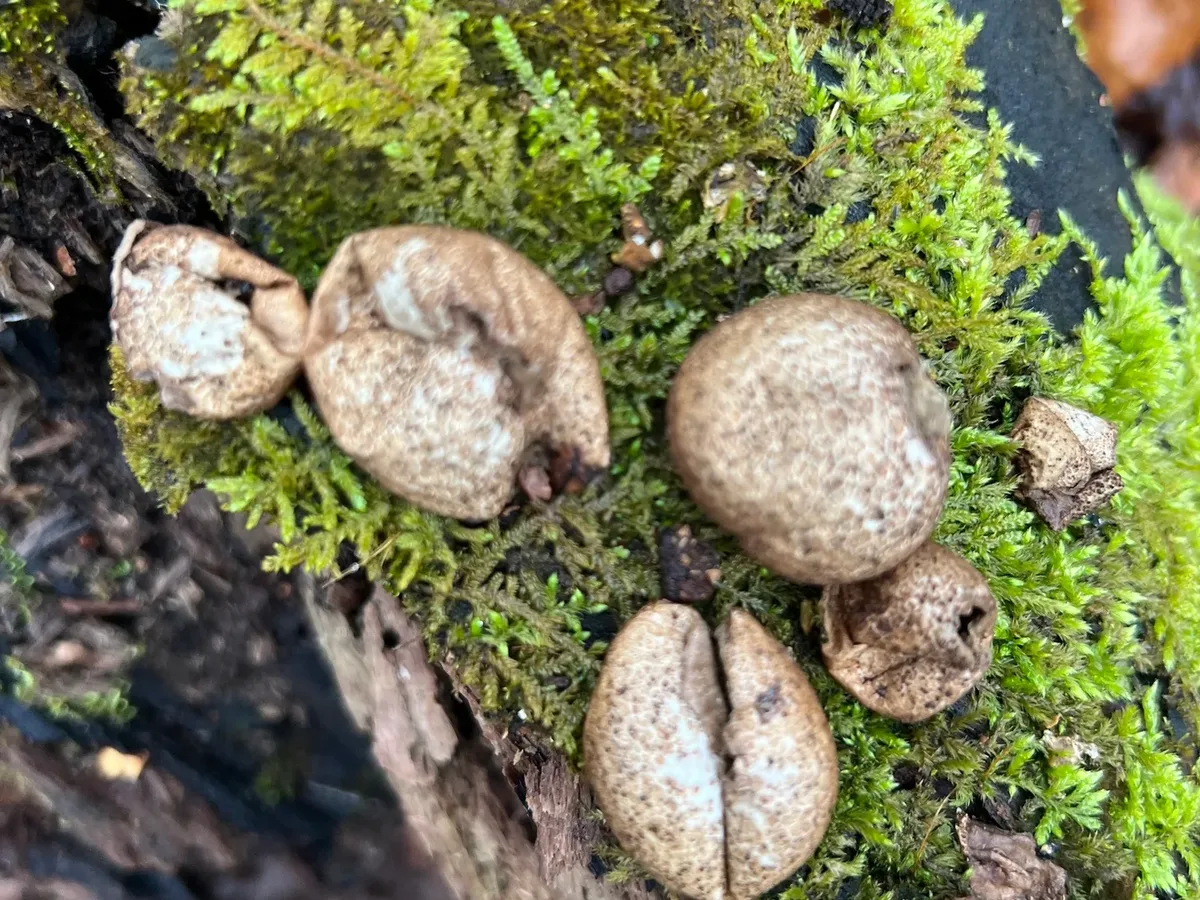
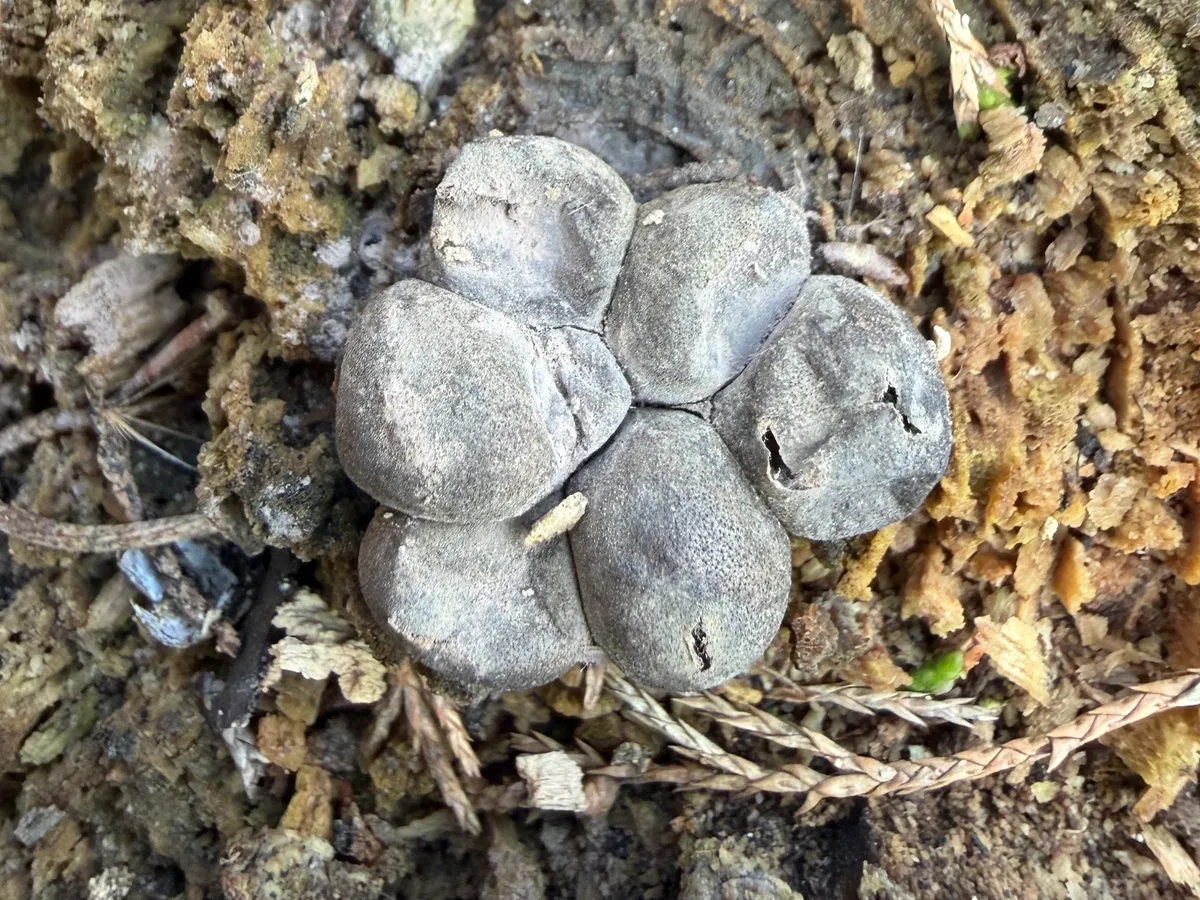
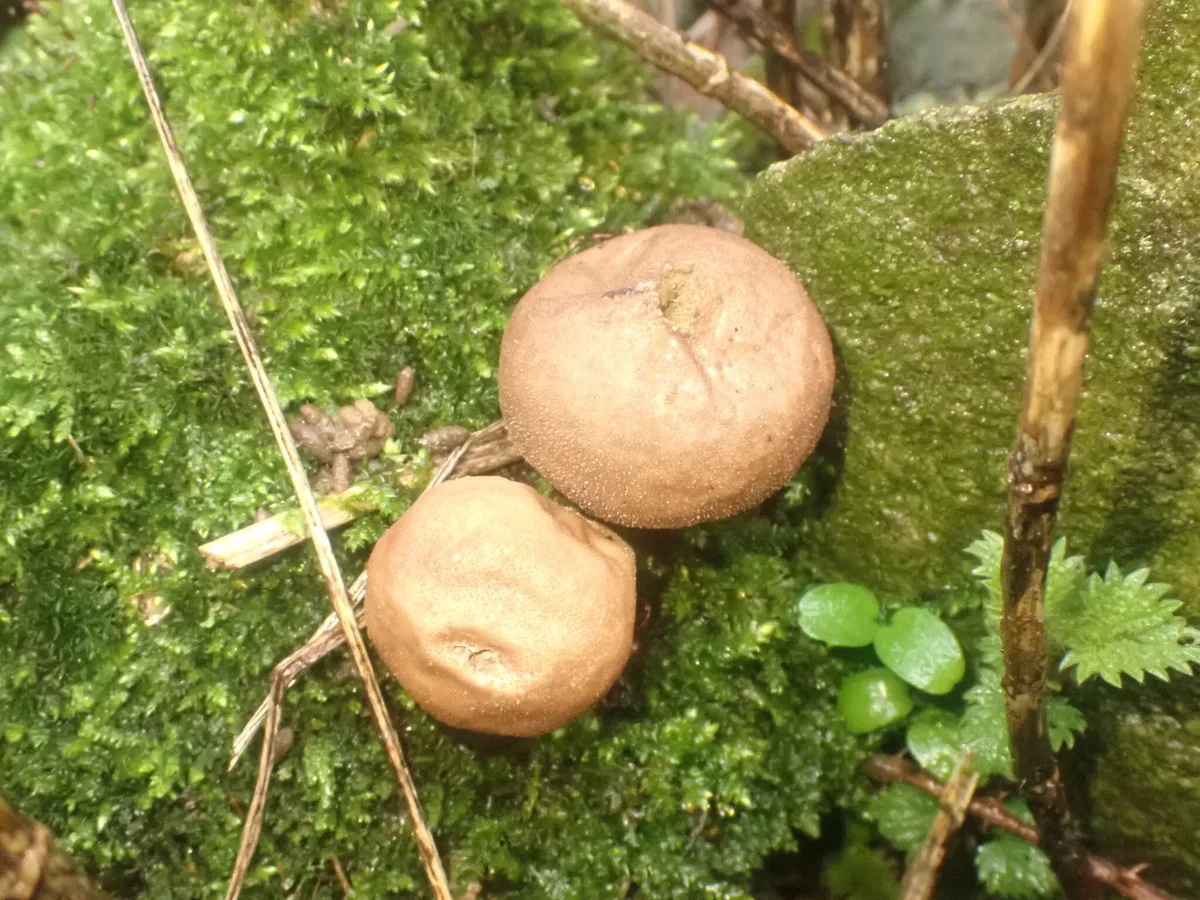
The stump puffball (also accepted as Apioperdon pyriforme in current taxonomy) has a neat pear- or club-shaped fruiting body, 2-4.5 cm tall and 1.5-4 cm wide. It almost always appears in tight, often striking clusters on rotting stumps and logs.
Fresh specimens are clean white; the outer skin is dusted with fine granular warts or minute spines that rub off readily, revealing a smooth or subtly wrinkled pale-brown surface beneath.
As it matures it moves through a predictable colour sequence - creamy white, then pale ochre-tan, then warm mid-brown - and eventually grey-brown.
Base
The base narrows into a short pseudostipe (false stalk) anchored firmly to the substrate by conspicuous white rhizomorphic cords: strands of mycelium threaded through the rotting wood, visible when the base is carefully detached.
This rhizomorphic base is the single most reliable field character separating L. pyriforme from all other edible puffballs.
Interior
Always slice any specimen vertically before eating. A young, safe-to-eat specimen is uniformly white and firm throughout - like dense marshmallow - with no internal structure visible.
As it ages, the gleba yellows, then turns greenish-yellow, olive, and finally a powdery dark brown as the spores complete their development; at this stage it is no longer edible.
Eventually a small apical pore forms, and passing air or a touch of wind puffs spores out in a visible cloud.
The sterile base (subgleba) is a slightly spongy white tissue, distinct from the gleba above, but there is no prominent columella extending up into the spore mass.
Spores
Spore print: purple-brown to olive-brown.
Spores: globose to subglobose, 3-4.5 µm, finely ornamented.
Smell
Mild, pleasant, slightly nutty when fresh and young.
Where & when it grows
Habitat
Lycoperdon pyriforme is the only common puffball in Europe and North America that grows in clusters directly on wood rather than from soil.
It colonizes stumps, fallen logs, buried root systems, and heavily decayed woody debris, almost exclusively of broadleaf trees - beech, oak, birch, alder, willow, sycamore, and ash are all favored substrates. It occasionally appears on well-rotted conifer stumps.
Look for it in deciduous and mixed woodland, old hedgerow timber, shaded parks, churchyards, garden compost heaps near woody material, and managed forestry coupes where stumps are left to decay.
In urban environments it sometimes fruits on buried root systems beneath lawns and footpaths, apparently growing 'from soil' but actually attached to buried wood. It is a saprotrophic decomposer that breaks down dead hardwood.
The clusters can be enormous - dozens to several hundred individual fruitbodies on a single large beech stump are not uncommon during peak season.
When
Fruitbody season varies by region:
- Central and western Europe: July through November, with the strongest flushes in August-October - warm, wet conditions following summer heat trigger the largest crops.
- Scandinavia: slightly later and shorter (August-October).
- Eastern North America and the Pacific Northwest: from late spring (May-June in mild years) through November.
One of the pleasures of finding a productive stump is that the relationship is a lasting one: a single colonized stump can flush multiple times in a season and continue to fruit year after year as long as the wood persists. It is worth marking good spots and returning to them.
How it grows
Lycoperdon pyriforme is saprotrophic, drawing all its nutrition from the cellulose and lignin of dead hardwood. Its mycelium threads through the rotting wood as an extensive network of white rhizomorphs - and this network is perennial.
While the fruitbodies vanish after autumn, the fungus itself lives on inside the stump, quietly dismantling the wood year after year, returning to fruit whenever conditions are right.
After warm, humid weather, fruitbodies develop rapidly from tiny white pinheads emerging at the wood surface, expanding into full-grown puffballs in just a few days. The dense, gregarious clusters that result are one of the most characteristic autumn sights on a well-colonized beech or birch stump.
Fruiting conditions
Flushes respond strongly to late-summer and autumn rainfall after warm dry periods. Because the mycelium inhabits wood rather than mineral soil, substrate moisture (wood moisture content) is more critical than rain totals alone. Established colonies on large stumps are resilient to moderate drought and reflush rapidly after rain.
Look-alikes
The most critical lookalike confusion is with the egg stages of deadly Amanita species (Amanita phalloides, A. virosa, A. bisporigera, A. ocreata). When Amanita buttons are still fully enclosed in their white volval membrane underground or just breaking the surface, they can superficially resemble a puffball.
The absolutely reliable distinction is the vertical slice: any true puffball in the edible stage will show a uniformly white, unstructured interior; an Amanita egg will clearly reveal the outline of a developing cap, gills, and stem within the white tissue - a miniature mushroom in cross-section. NEVER eat any puffball without performing this cut.
Other puffball lookalikes:
- Lycoperdon perlatum (common puffball) is closely related and also edible; it has more prominent, pointed spines and grows from soil rather than on wood, and is more solitary.
- Bovista plumbea (lead puffball) grows on soil in grassland, is smaller (1-3 cm), lacks rhizomorphs, and has a leathery outer skin that detaches completely.
- Calvatia gigantea (giant puffball) is edible and unmistakable at full size, but small, incompletely developed specimens can look vaguely puffball-like; again the vertical slice distinguishes.
Scleroderma citrinum (common earthball) is the most dangerous edible puffball lookalike among non-Amanita species. It has a thick, firm, yellowish-brown and scaly outer skin, white interior that quickly develops a marbled grey-purple pattern with black spore mass, and a strong disagreeable smell. It grows on soil or in thin grass over roots and lacks rhizomorphic cords. Scleroderma species can cause severe gastrointestinal poisoning.
Lycoperdon pyriforme var. tessellatum has a more clearly cracked or tessellated outer surface but is the same species.
Slice every puffball vertically: an Amanita egg shows a miniature cap, gills, and stem visible in cross-section inside the white tissue. A true puffball is uniformly white and structureless throughout. This one test is completely reliable.
Same vertical slice test as A. phalloides. The developing mushroom outline is always visible inside the egg before the volva ruptures. Amanita eggs also typically grow from soil and have a prominent white volval bag at the base, not rhizomorphic cords.
The principal deadly white Amanita of eastern North America. Its veiled button can be mistaken for a small puffball; a vertical cut immediately reveals an embryonic cap, gills, and stem within a membranous veil, whereas a true puffball is pure white and undifferentiated inside. Contains lethal amatoxins in the same quantity as A. phalloides.
Scleroderma has a thick, tough, yellow-brown scaly skin; interior quickly turns grey-purple to black (not pure white) even in young specimens; strong unpleasant smell; grows from soil without rhizomorphic cords; not clustered on wood. Causes severe GI poisoning.
Also edible. Distinguished by prominent, pointed conical spines that leave a characteristic star-pattern of scars when rubbed off; typically grows from soil rather than on wood; rarely clustered as densely; lacks rhizomorphic base cords.
Grows in short grassland on soil, not on wood; rounder in shape; outer skin separates and peels away as a distinct layer; no rhizomorphic cords; smaller (1-3 cm). Also edible when pure white inside.
Grassland species, not found on wood; has a distinct membranous diaphragm internally separating gleba from sterile base; edible when young and white inside.
In the kitchen
Picking & cleaning
Collect only white-fleshed, firm specimens. Always slice each fruitbody in half vertically in the field to confirm the interior is uniformly white and unstructured - this is the non-negotiable safety check for all puffball harvesting.
Discard any specimen that shows yellow, green, or brown discoloration, or that reveals any internal structure (gills, a cap outline, or a small mushroom-within-a-ball shape - the latter would indicate a deadly Amanita egg).
Collect by cleanly cutting the pseudostipe at its base, preserving the diagnostic rhizomorphic cords for later reference.
Because specimens are small, collecting enough for a meal requires a generous cluster; harvest the younger, firmer fruitbodies and leave the oldest for spore dispersal.
Store unwashed in a paper bag or open container in the refrigerator; use within 2-3 days as the interior deteriorates rapidly.
Cooking
Stump puffball has a mild, pleasant flavour with a firm, slightly spongy texture that absorbs other flavours well - similar in culinary behaviour to firm tofu or young Calvatia.
Peel the thin outer skin if it is tough or granular. Slice into rounds or cubes and sauté in butter with garlic and fresh thyme; the interior becomes creamy and golden at the edges.
- Excellent in omelettes, pasta, risotto, cream sauces, and as a pizza topping.
- Can be dipped in beaten egg and breadcrumbs and pan-fried as 'puffball schnitzel.'
Avoid boiling or overcooking, which makes the texture rubbery and dull. Drying is possible but the texture suffers; fresh or lightly dried works best. Do not eat raw in quantity.
Pairs well with fatty meats, cream, aged cheese, and aromatic herbs.
Good to know
Lycoperdon pyriforme is a safe and popular edible when harvested correctly. The critical rule is to verify the white, uniform interior by slicing every single specimen before cooking. This one step eliminates the risk of accidentally collecting an Amanita egg, which can contain a lethal dose of amatoxins even in the button stage.
- Never eat puffballs that are yellowing, brown, or soft.
- Do not collect without positive identification of the rhizomorphic base on wood.
- Children and pregnant women should exercise normal caution with any wild mushroom.
- First-time eaters should sample only a small amount to test for individual sensitivity, as rare allergic reactions to Lycoperdon species have been documented.
Spore inhalation (lycoperdonosis) is a rare but documented cause of hypersensitivity pneumonitis in people who have inhaled large quantities of mature puffball spores - do not deliberately compress or inhale from overripe specimens.
A reference guide - never an edibility guarantee. When in doubt, leave it out.