Common Puffball
Lycoperdon perlatumsyn. Lycoperdon gemmatum, Lycoperdon bonordenii, Lycoperdon perlatum var. perlatum
 © Michel Langeveld (CC BY)
 Eduard Martínez (CC0)
 Christopher Lainson (CC0)
 Eduard Martínez (CC0)
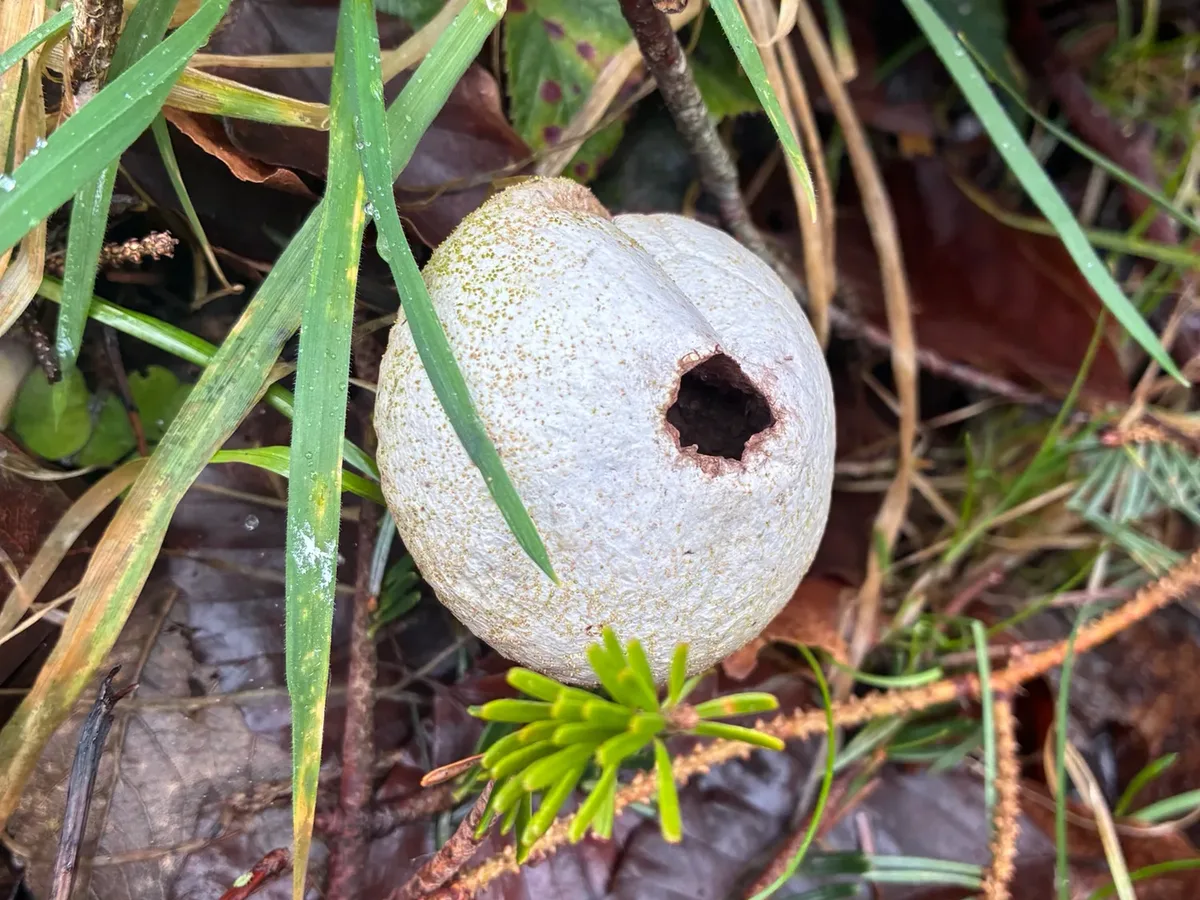 © Rocco Lieghio (CC BY)
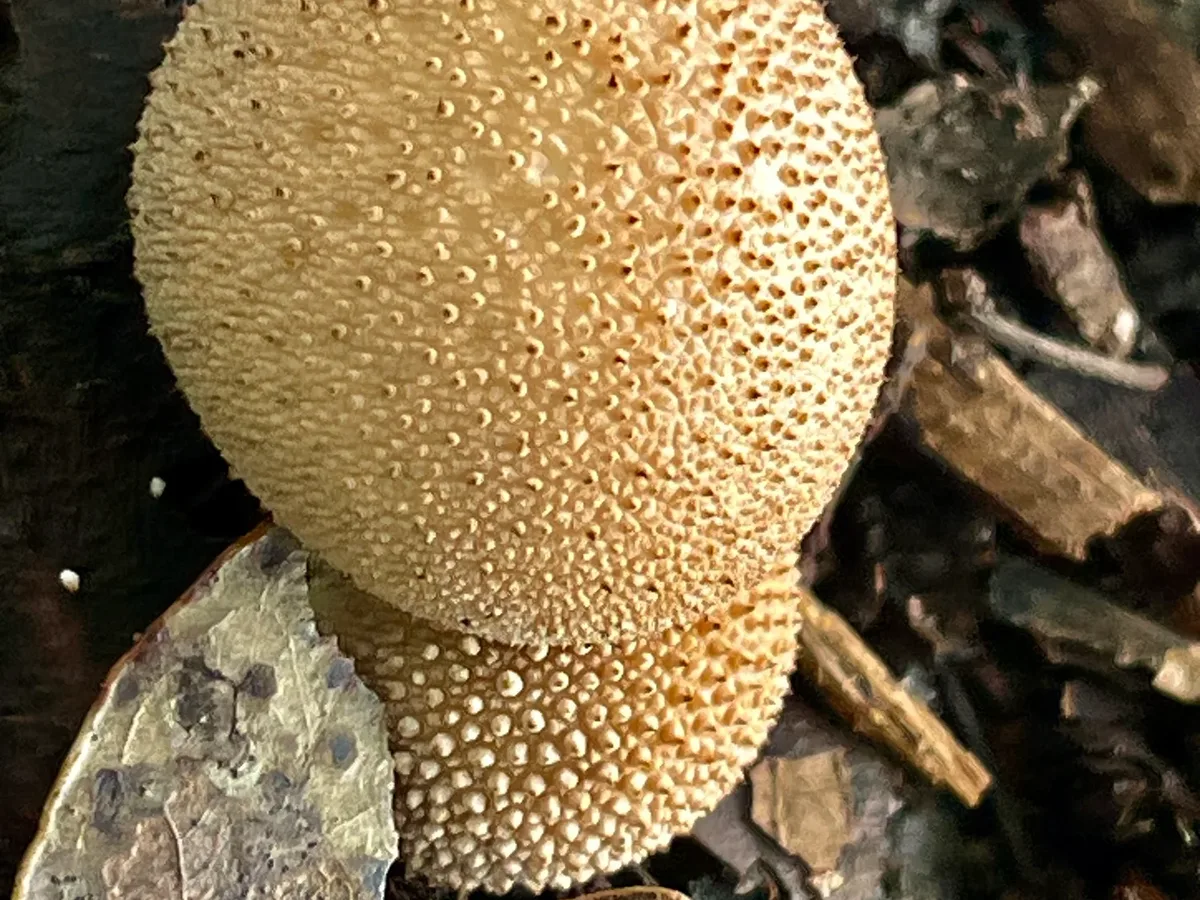 © joqatana (CC BY)
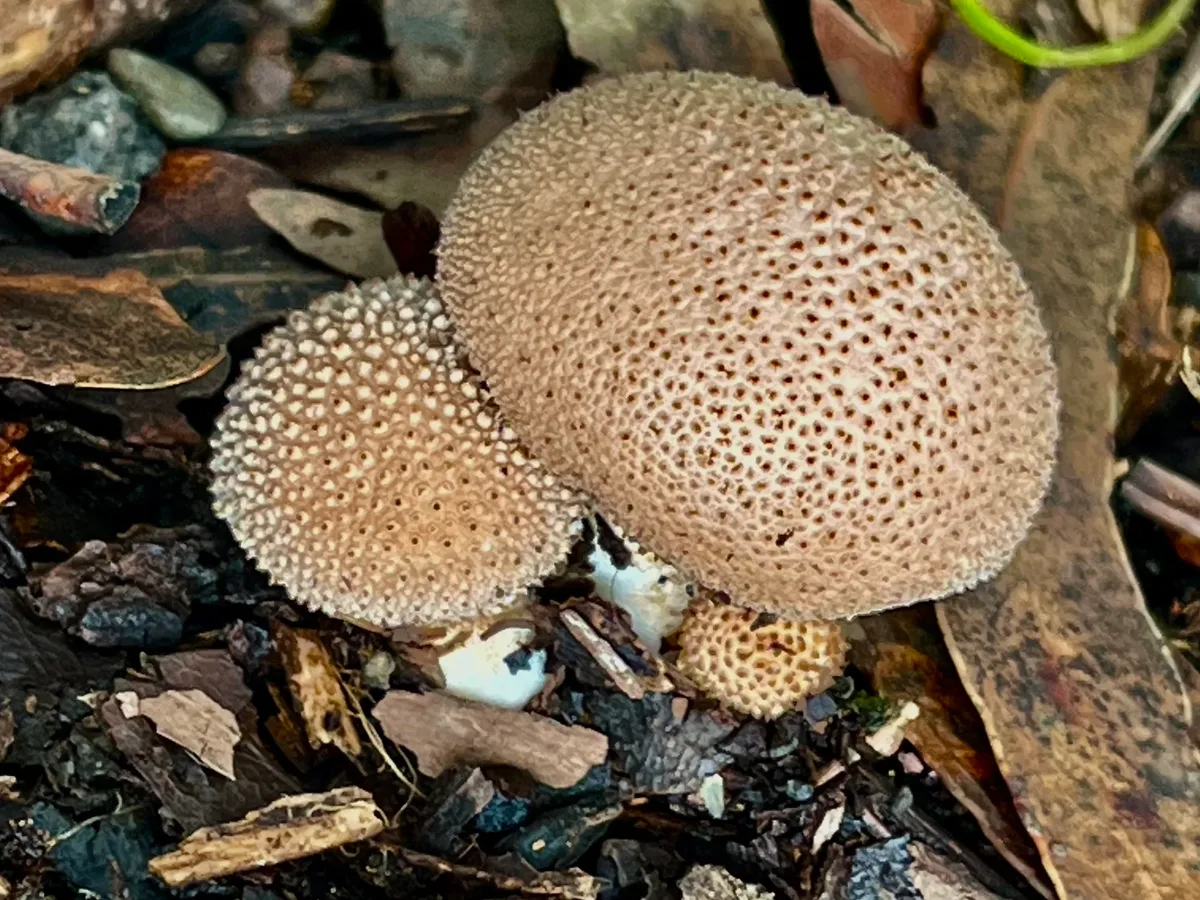 © joqatana (CC BY)
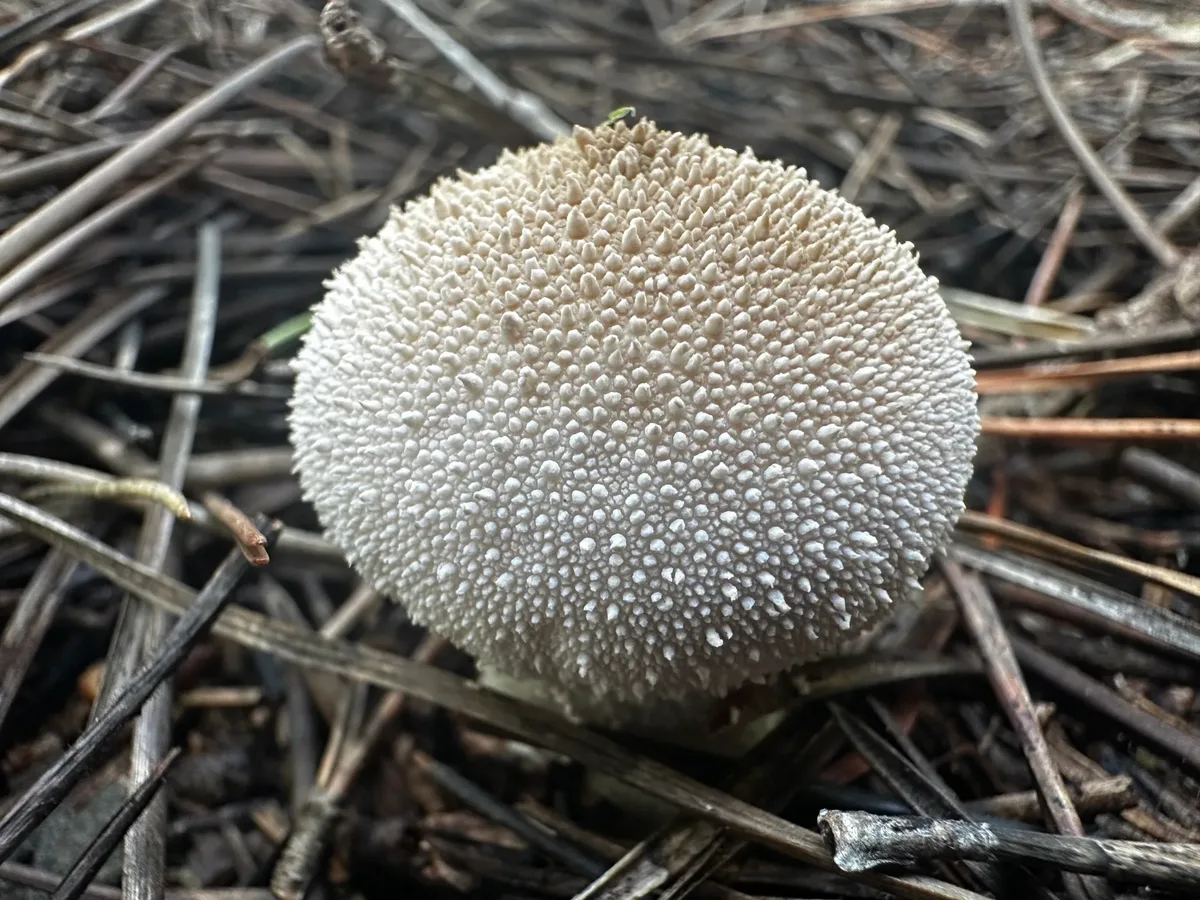 Eduard Martínez (CC0)
 © Michel Langeveld (CC BY)
 © Michel Langeveld (CC BY)© Michel Langeveld (CC BY)Eduard Martínez (CC0)
Good to eat, once you have identified it with certainty and cooked it through.
Never eat a mushroom you are not 100% sure of - check the look-alikes below, and always cook wild mushrooms.
How to recognise it
The Common Puffball is one of the most recognisable small woodland fungi.
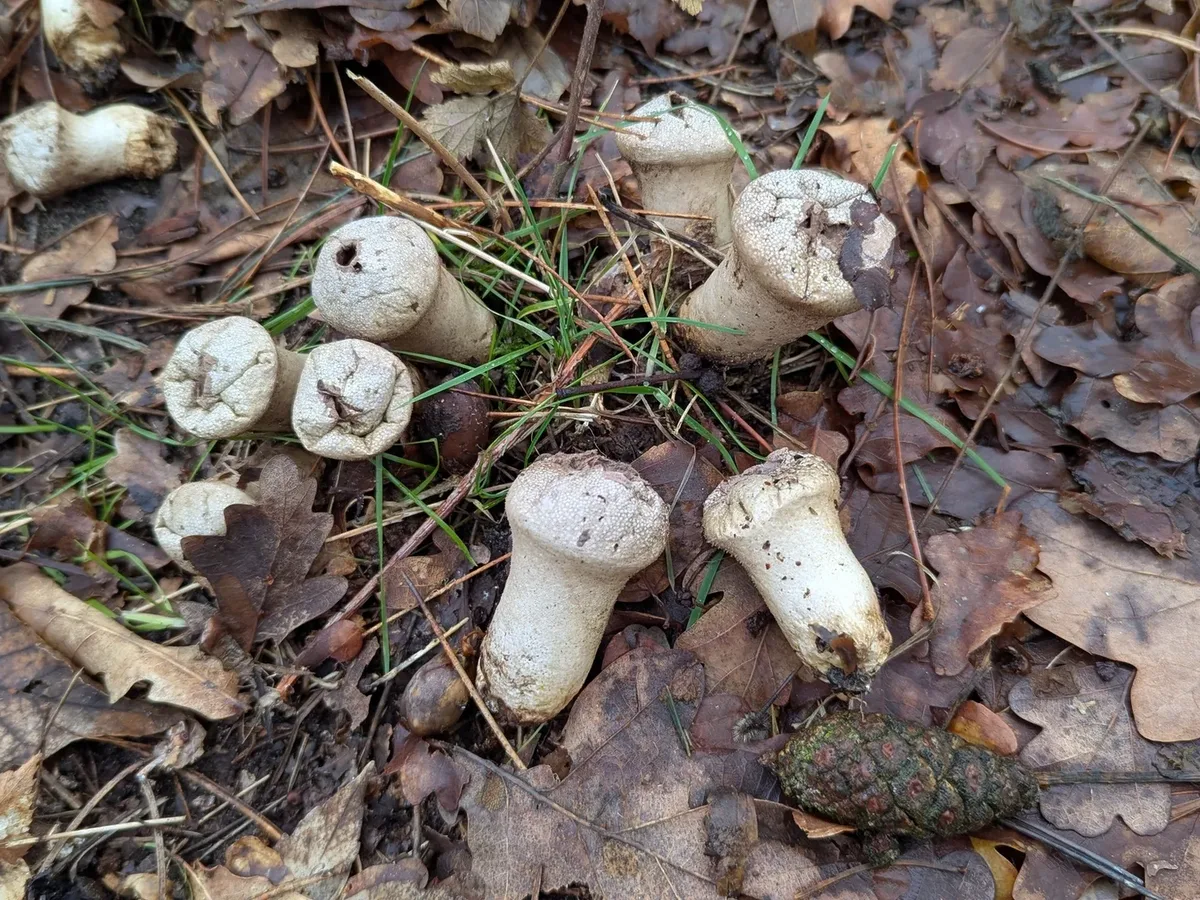
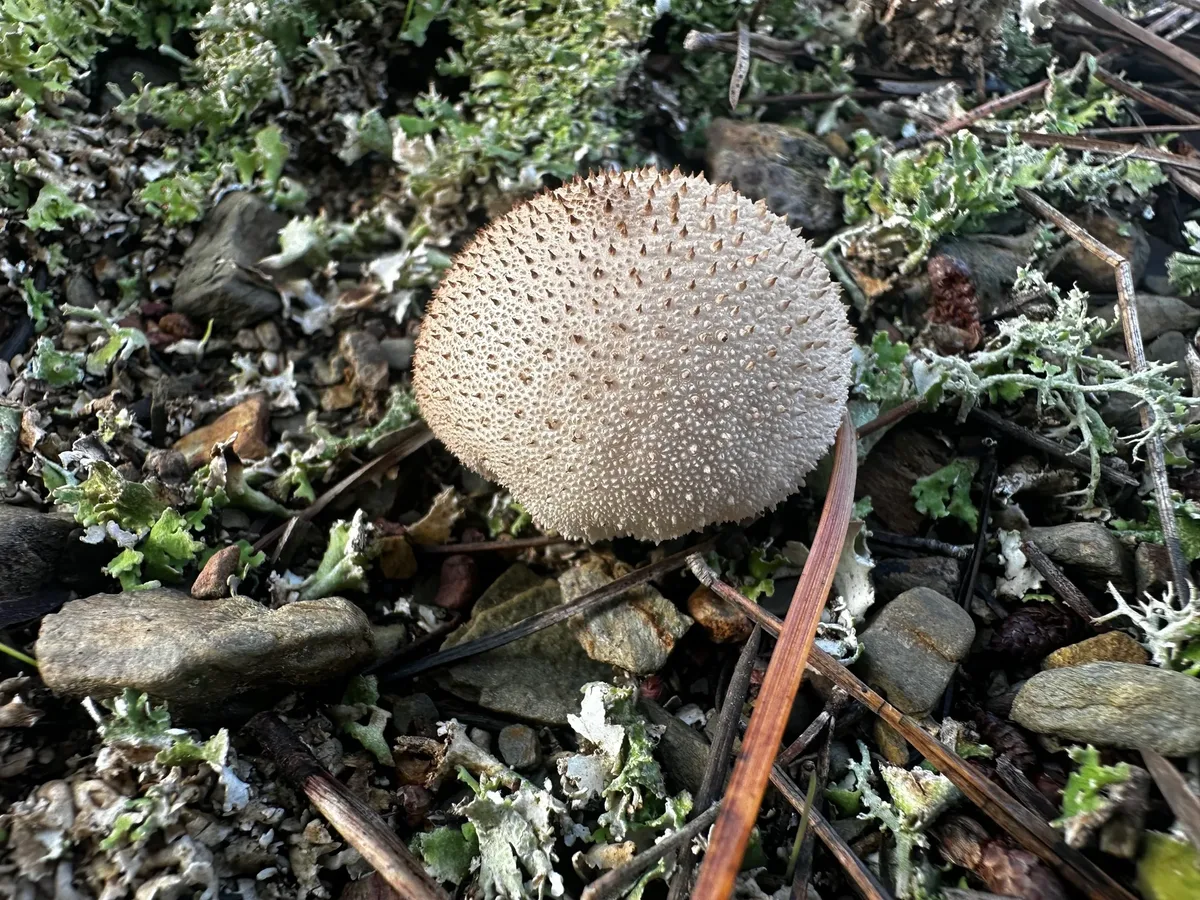
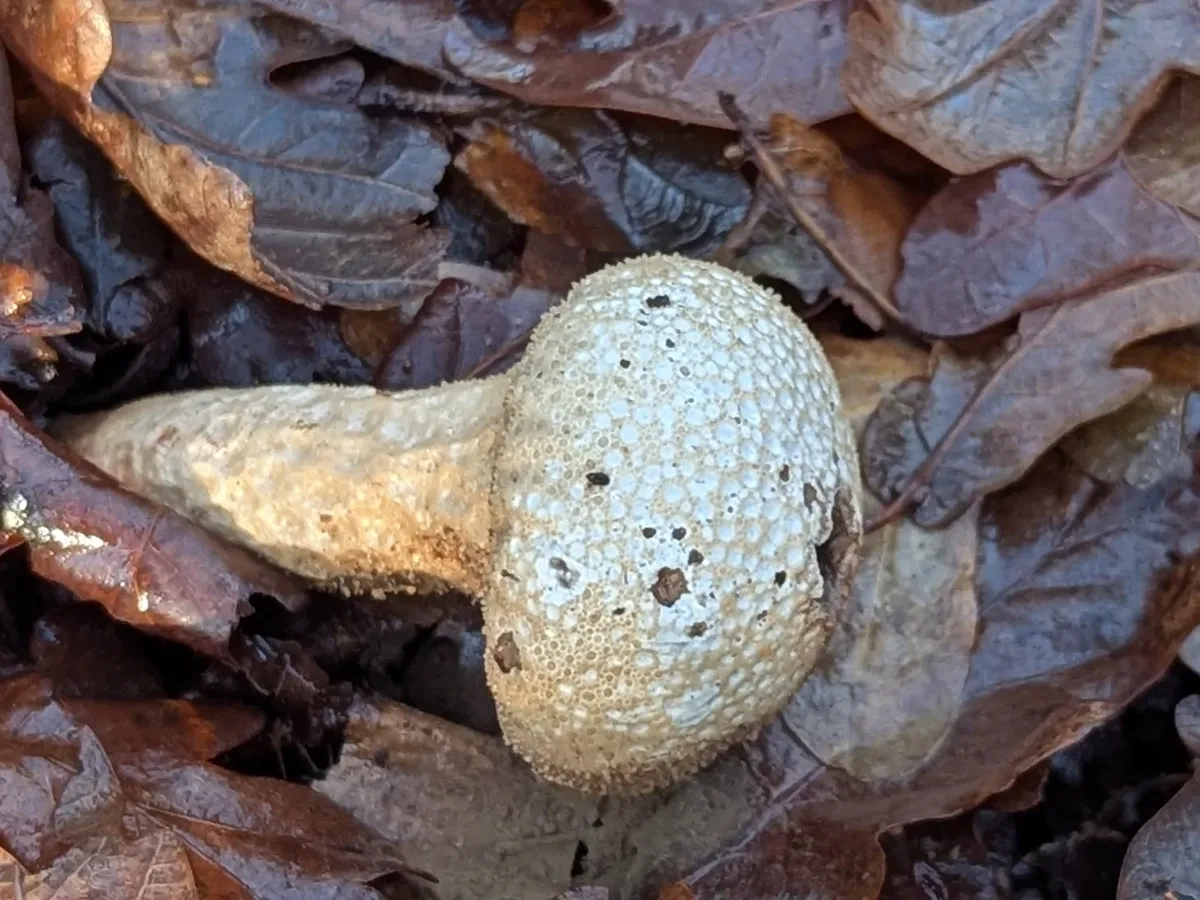
Each fruitbody is a stalked, pestle- or pear-shaped body, typically 2-9 cm tall and 1.5-6 cm across, with a rounded fertile head sitting on a narrower, spongy sterile base so that the whole resembles an inverted club or an old-fashioned powder puff.
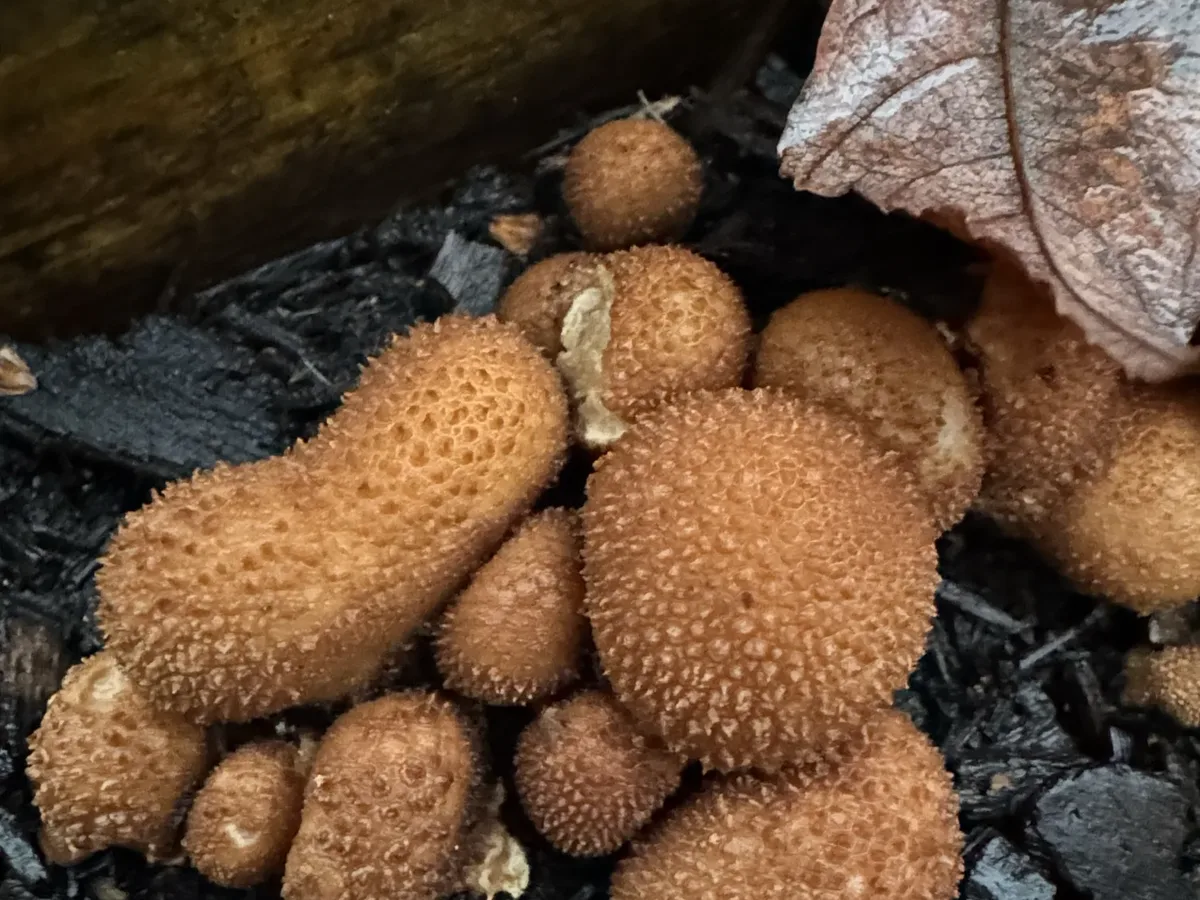
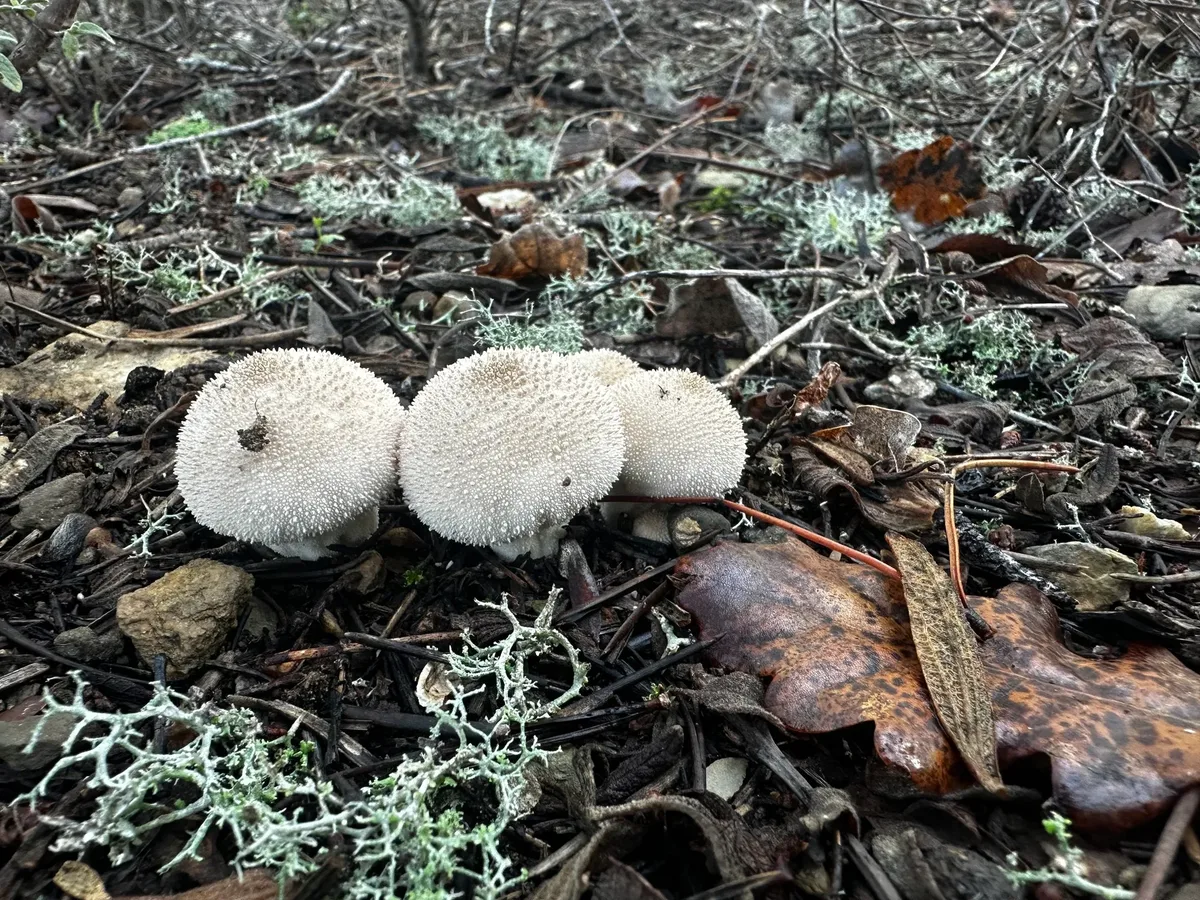
The most diagnostic feature is the surface ornamentation: the white to pale grey or buff outer skin is studded all over with detachable conical spines and warts, the larger pyramidal spines each ringed by a halo of finer granular warts (the 'gem-studded' look that gives the gem-studded puffball its name).
When these spines rub or fall off, they leave behind a delicate net-like pattern of pale circular scars over the smoother, often slightly darker inner wall.
There are no gills, pores, cap or true stem in the conventional sense.
Cut vertically, a young specimen is solid throughout, with a firm, pure white interior (the gleba) above and a slightly more chambered, spongy sterile base below.
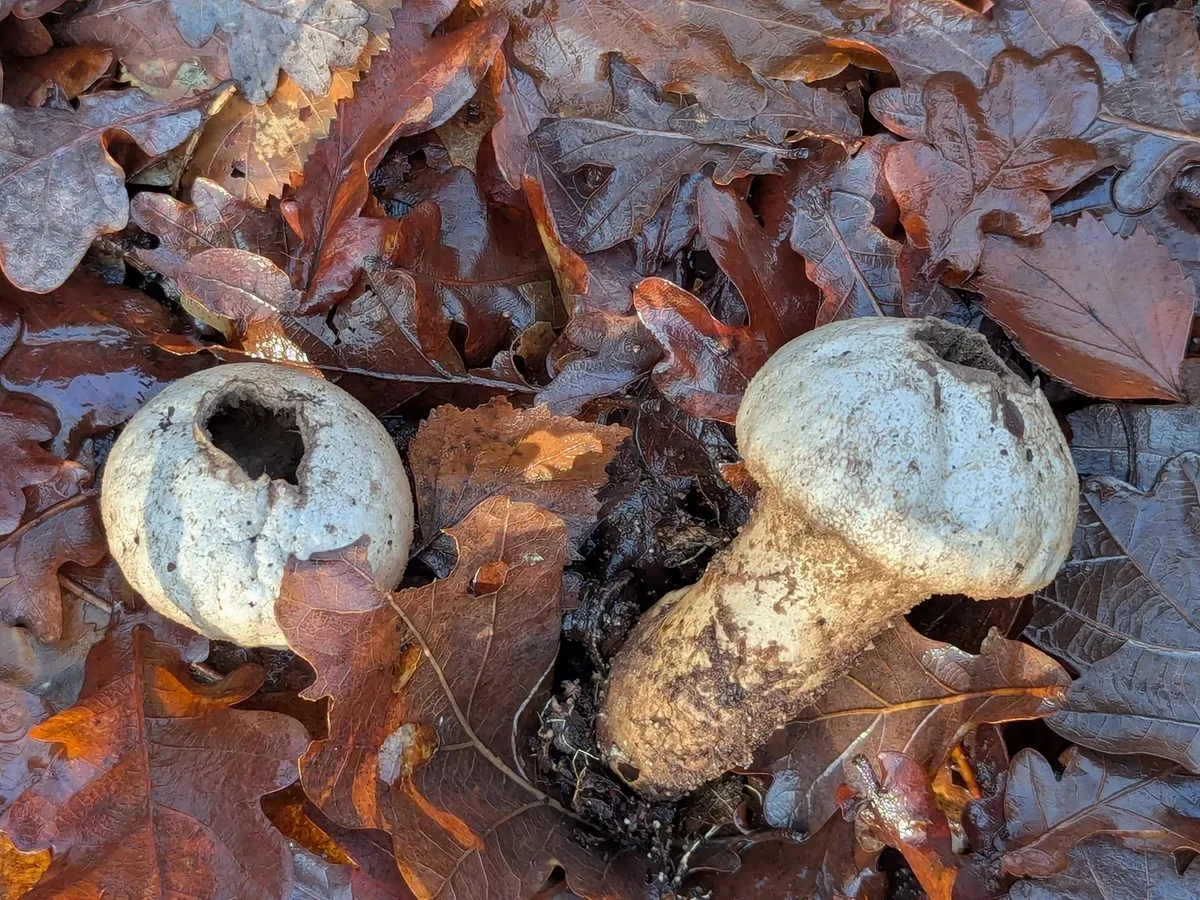
With age the white flesh discolours to cream, then yellow, then olive and finally to a dry, dusty cloud of olive-brown spores, at which point a neat circular mouth (ostiole) opens at the apex to puff the spores out.
Where & when it grows
Habitat
Unlike most woodland fungi, the Common Puffball owes nothing to the trees above it - it lives by breaking down dead leaves and buried wood, feeding the forest floor rather than tapping tree roots.
It grows directly from the ground in humus-rich soil, deep leaf litter and along mossy banks and trodden path edges.
It is broad-minded in its choice of woodland, turning up under conifers (spruce, pine, fir) and broadleaves (beech, oak, birch, hazel) alike, as well as in mixed stands, plantations, parkland and the grassy fringes of forest tracks.
It prefers free-draining, fertile soils and is usually found gregariously, in scattered troops, short rows or crowded tufts of many individuals.
When
This is a long-season species.
The first fruitbodies usually appear in mid-summer (July) once warm soil meets adequate rain, but the great majority emerge during the main autumn flush from late August through October, peaking in September.
Cooler temperate and Nordic regions tend to fruit a little later and finish earlier than milder maritime climates.
Because the tough, woody-walled old fruitbodies decay very slowly, weathered, hollow, spore-shedding remains can be found persisting on the woodland floor well into winter.
How it grows
Lycoperdon perlatum is a litter and humus saprotroph. Its mycelium spreads through decaying leaf litter and rotting wood, often binding the substrate with visible white cords (rhizomorphs) attached to the base of the fruitbody.
Fruitbodies arise singly but typically in considerable numbers together, frequently in lines and clusters where the mycelium has run through a band of suitable litter.
Each fruitbody matures over one to two weeks, swelling, ripening its internal spore mass, and then drying out so the apical pore can open.
Spore dispersal is by the 'bellows' mechanism: falling raindrops, animal contact or a finger-tap compress the papery wall and puff a smoke-like cloud of spores out through the ostiole.
Fruiting conditions
Fruits a few days to two weeks after significant autumn rainfall on warm, humus-rich woodland soil; main flushes follow late-summer and early-autumn rain once soil temperatures sit in the low-to-mid teens Celsius.
Handle with care
Toxin
Lycoperdon perlatum itself contains no significant toxins when young and white.
The safety concern is entirely one of misidentification: the danger lies in mistaking a deadly Amanita button (containing lethal amatoxins) or a poisonous Scleroderma earthball for a puffball.
A separate, minor hazard is mechanical/allergic rather than chemical - heavy inhalation of the dry mature spores can cause lycoperdonosis, an irritant pneumonitis.
Symptoms
There are no symptoms from correctly identified, properly prepared young puffballs.
If an Amanita button is eaten in error, expect deadly amatoxin poisoning:
- 1a deceptive 6-24 hour delay
- 2then violent vomiting and diarrhoea
- 3an apparent recovery
- 4progression to fatal liver and kidney failure
If an earthball (Scleroderma) is eaten, expect rapid-onset (often under 1-2 hours) nausea, vomiting, cramps and diarrhoea.
Inhaled ripe spores (lycoperdonosis) can cause cough, fever and breathlessness hours to days later.
Look-alikes
Other true puffballs (Lycoperdon, Apioperdon, Bovista and the giant Calvatia) are all edible when young and white-fleshed, and need only be distinguished by the same white-interior test. The closely similar pestle puffball Apioperdon pyriforme grows in clusters directly on wood and has a smoother surface.
The genuinely dangerous confusions are with two unrelated groups.
- 1Most important: the egg-stage (button) of deadly Amanita species such as the Death Cap (Amanita phalloides) and the Destroying Angels (Amanita virosa in Europe, Amanita bisporigera in North America) can superficially resemble a small puffball. When sliced lengthways, however, an Amanita 'egg' shows the clear silhouette of an embryonic mushroom (cap, gills and stem inside a gelatinous layer), whereas a true puffball is undifferentiated white throughout.
- 2The earthballs (Scleroderma citrinum and relatives) are firm, rounded, ochre, scaly-skinned and almost stalkless, and crucially their interior turns purplish-black to almost solid black very early, often while the outside still looks immature; they cause gastrointestinal poisoning and must be rejected.
The cut-in-half white-flesh test reliably separates an edible puffball from all of these.
Why it matters
The Common Puffball is safe, but the genus invites a potentially lethal mistake.
A young Death Cap or Destroying Angel still enclosed in its universal veil 'egg' can be taken for a small puffball; eating one is frequently fatal. Earthballs are a less severe but real poisoning risk.
The discipline of cutting every fruitbody in half and rejecting anything not pure white inside is what keeps puffball foraging safe - treat it as mandatory, not optional.
Slice top-to-bottom: an Amanita 'egg' reveals the silhouette of an embryonic mushroom (cap, gills, stem) inside a gelatinous veil; a true puffball is uniformly white and structureless throughout. Amanita eggs also have a tough outer sac (volva).
As with the Death Cap, a lengthwise cut shows a developing white mushroom with cap and gills inside a membranous egg; the puffball shows no internal structure. Always halve every specimen.
The principal deadly white Amanita of eastern North America. Its veiled 'egg' button can be mistaken for a small puffball; a vertical cut reveals an embryonic cap, gills and stem within a membranous veil, whereas a true puffball is pure white and undifferentiated inside. Contains lethal amatoxins.
Earthballs are firm, almost stalkless, ochre with a thick scaly/cracked rind, and their interior turns purplish-black very early (often while the outside still looks young). True puffballs are white inside and have a soft spongy sterile base. Earthballs cause gastrointestinal poisoning.
Edible lookalike of grassland; differs in having an internal papery membrane (diaphragm) separating the sterile base from the gleba and a less spiny surface. Safe when white inside.
Edible but larger; surface breaks into a mosaic of polygonal scales rather than discrete spines. Same white-flesh rule applies.
Edible lookalike, harmless. Grows in dense clusters directly on rotten wood/stumps, is smoother (granular rather than spiny) and has white rhizomorphs at the base; same white-interior edibility test applies.
In the kitchen
Picking & cleaning
Only collect young, firm specimens whose interior is pure, uniform, snow-white right through.
Pick the whole fruitbody by gently pulling or cutting it free at the base, brush off litter, and always slice each one cleanly in half from top to bottom before it goes in the basket.
This single habit is the most important rule in the genus: the inside must be completely white and homogeneous, with no outline of a developing cap, gills or stem.
Discard any specimen whose flesh has begun to turn cream, yellow or olive (it is then over-mature and bitter, not poisonous but unpalatable), and discard any showing any internal structure.
Keep them dry and cook the same day, as they spoil and discolour quickly.
Cooking
Young, firm, white puffballs have a mild, pleasant flavour and a marshmallow-like to tofu-like texture that readily absorbs other flavours.
Peel off the warty outer skin if it is tough, slice the flesh, and fry in butter or oil until golden. They are excellent:
- sautéed with garlic and herbs
- added to omelettes, soups and stews
- breaded and pan-fried
- used as a meat extender
They contain a lot of water and should be cooked fairly briskly to avoid sogginess. They do not dry well but freeze acceptably once cooked.
Always cook thoroughly; never eat them raw.
Good to know
Lycoperdon perlatum is widely regarded as a good, safe edible when, and only when, the interior is pure white and homogeneous.
The non-negotiable safety procedure is to cut every single specimen in half from top to bottom: edible puffballs are uniformly white inside with no internal structure.
Stop and discard immediately if you see:
- any cap-gill-stem outline inside, which signals a potentially lethal Amanita button
- any yellow, olive, purplish or black discoloration, which signals either an over-mature puffball or a poisonous earthball
Over-ripe puffballs are not deadly but are bitter and can cause stomach upset, and inhaling the mature spore dust can in rare cases provoke a respiratory irritation (lycoperdonosis) - never sniff or sleep near ripe specimens.
As with any wild fungus, eat only a small amount when trying it for the first time and never rely on a single field character.
A reference guide - never an edibility guarantee. When in doubt, leave it out.