Yellow Houseplant Parasol
Leucocoprinus birnbaumiisyn. Lepiota lutea, Agaricus birnbaumii, Lepiota birnbaumii, Leucocoprinus luteus, Agaricus luteus (non Huds.)
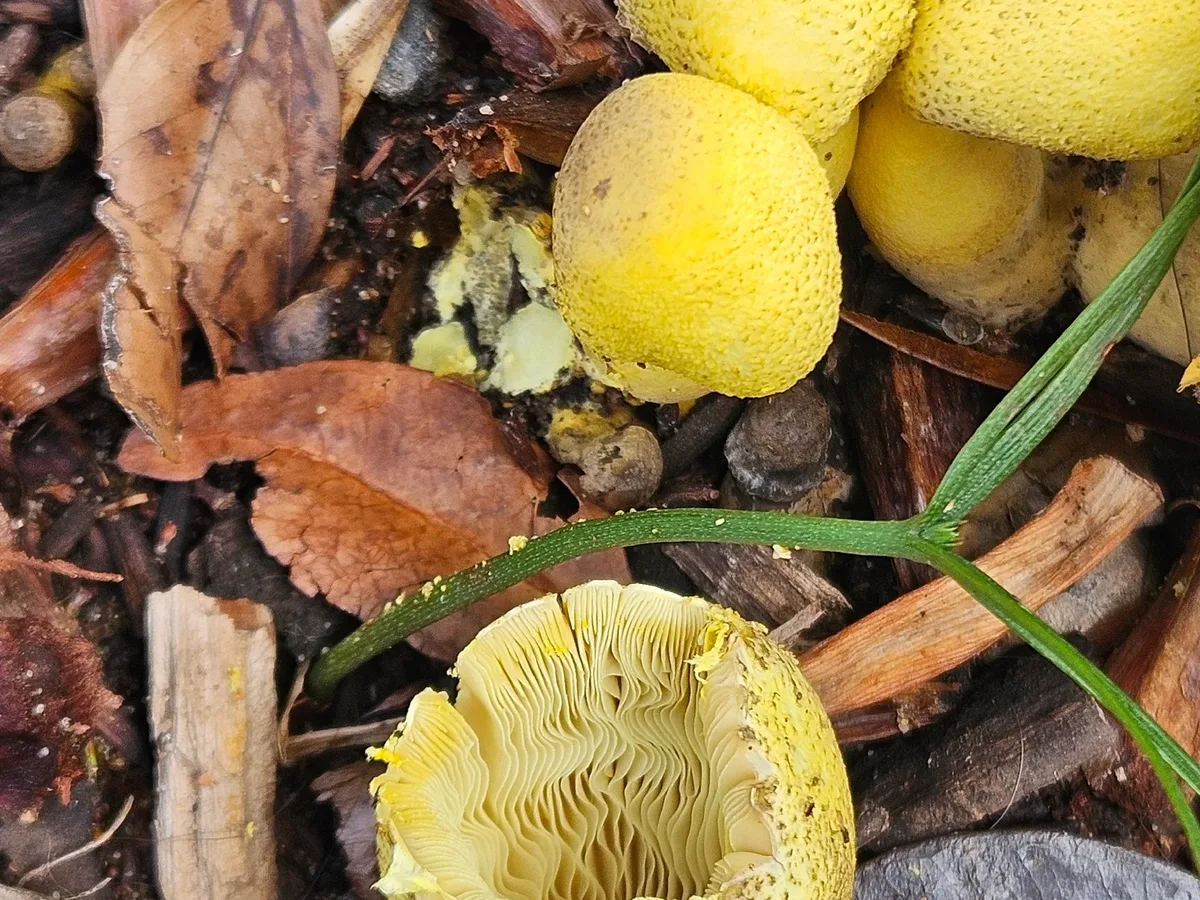 marsyd (CC0)
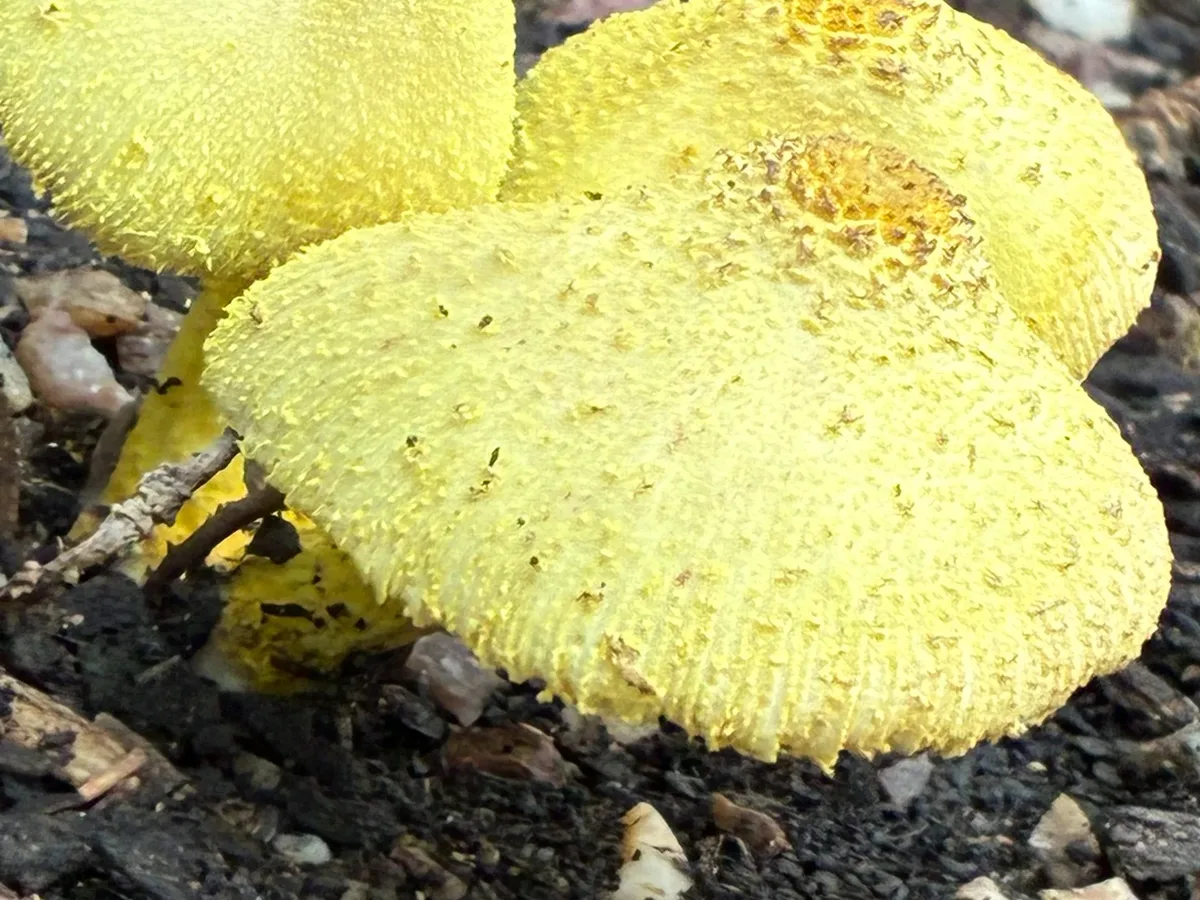 © Wendy Herniman (CC BY)
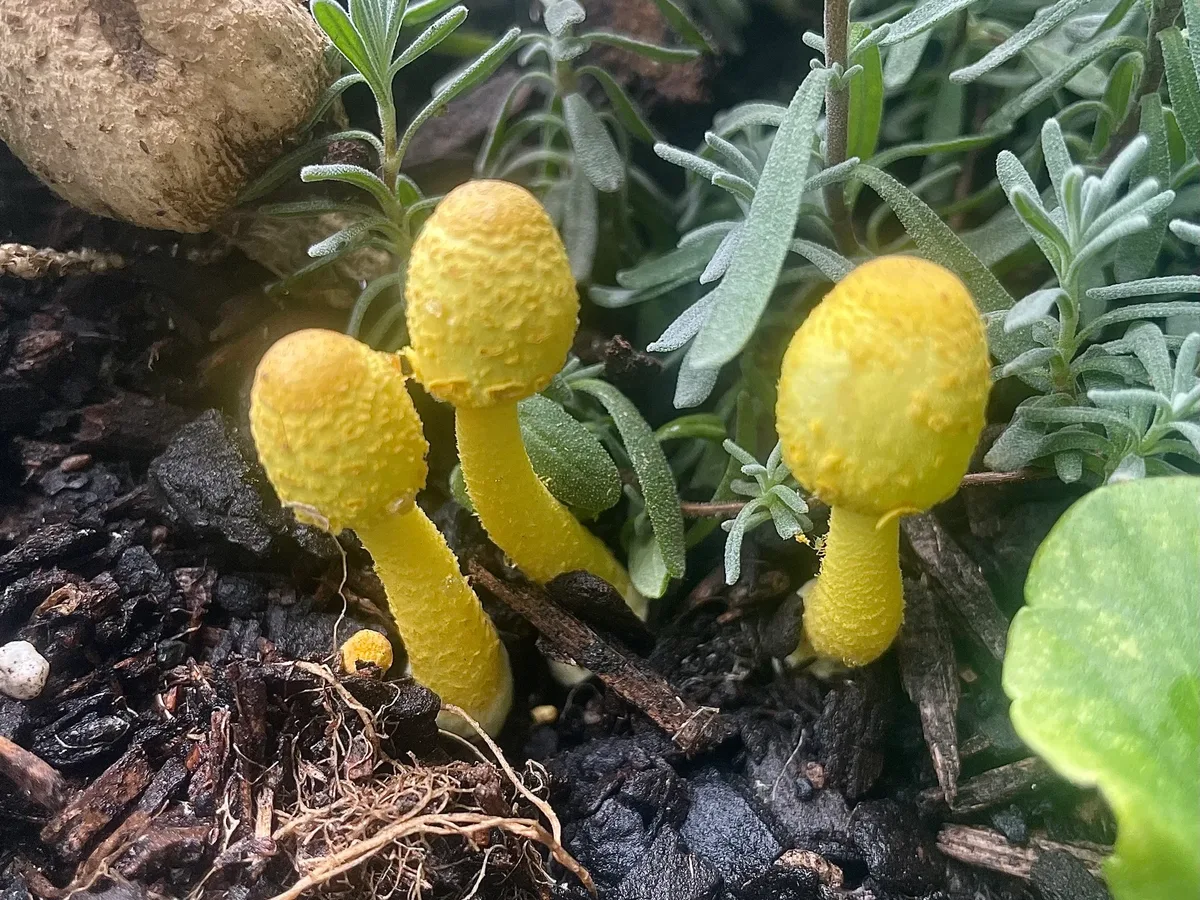 © noelw (CC BY)
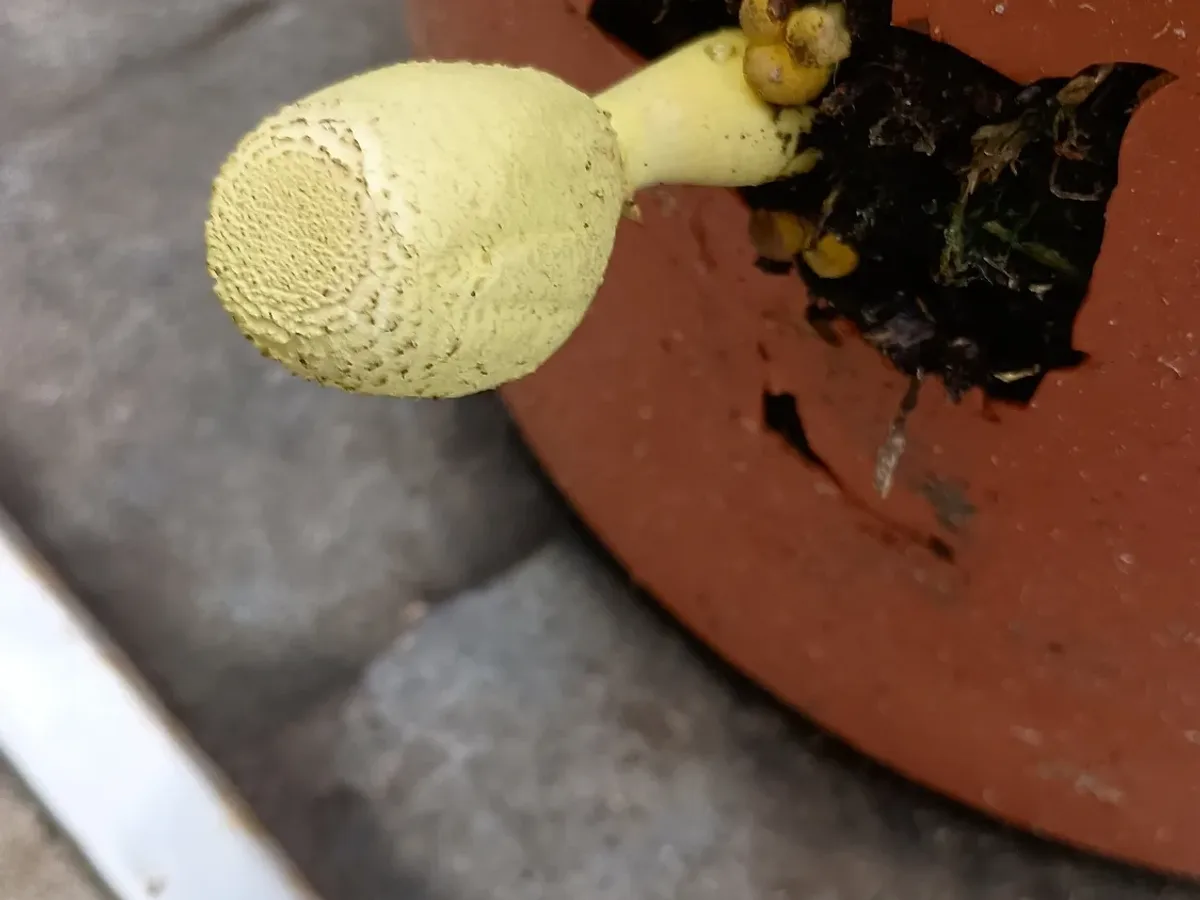 © Marien Béguelin (CC BY)
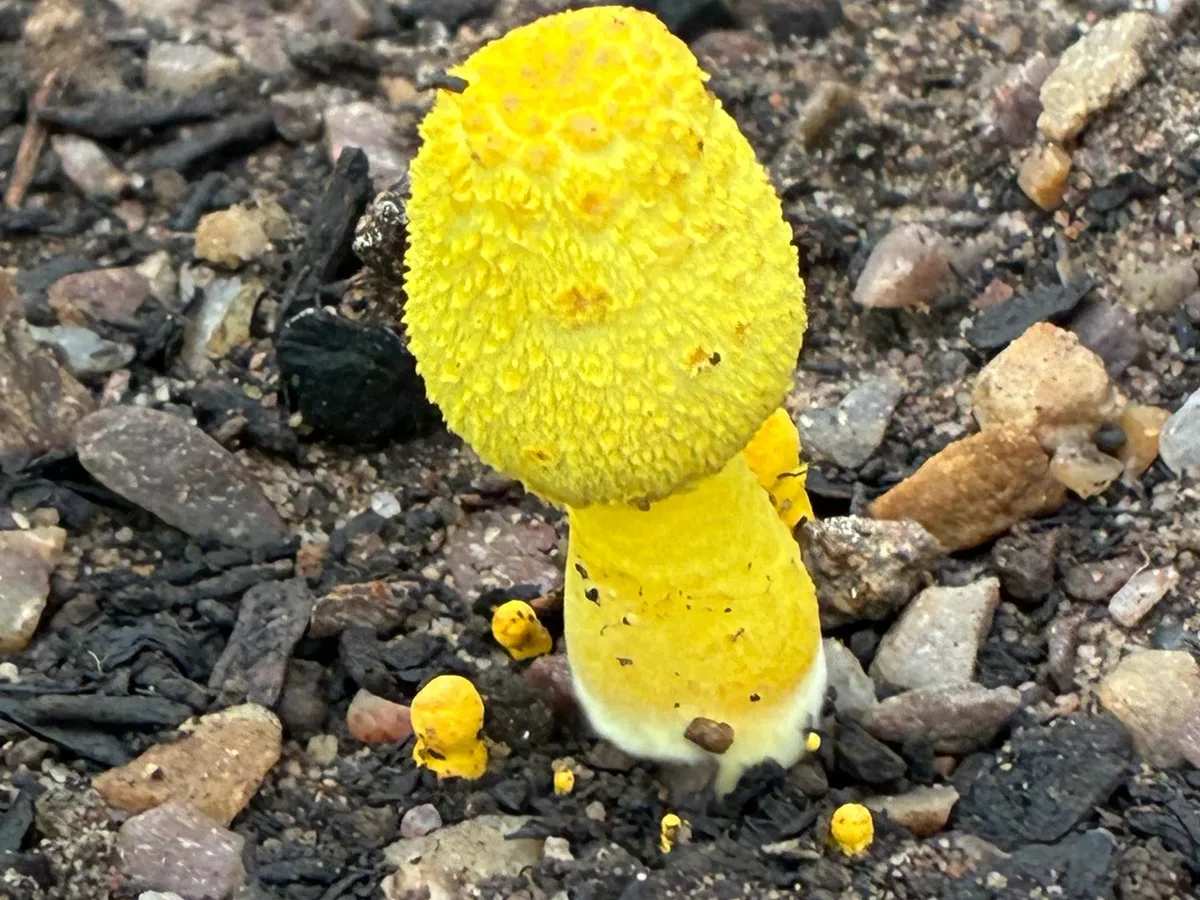 © Wendy Herniman (CC BY)
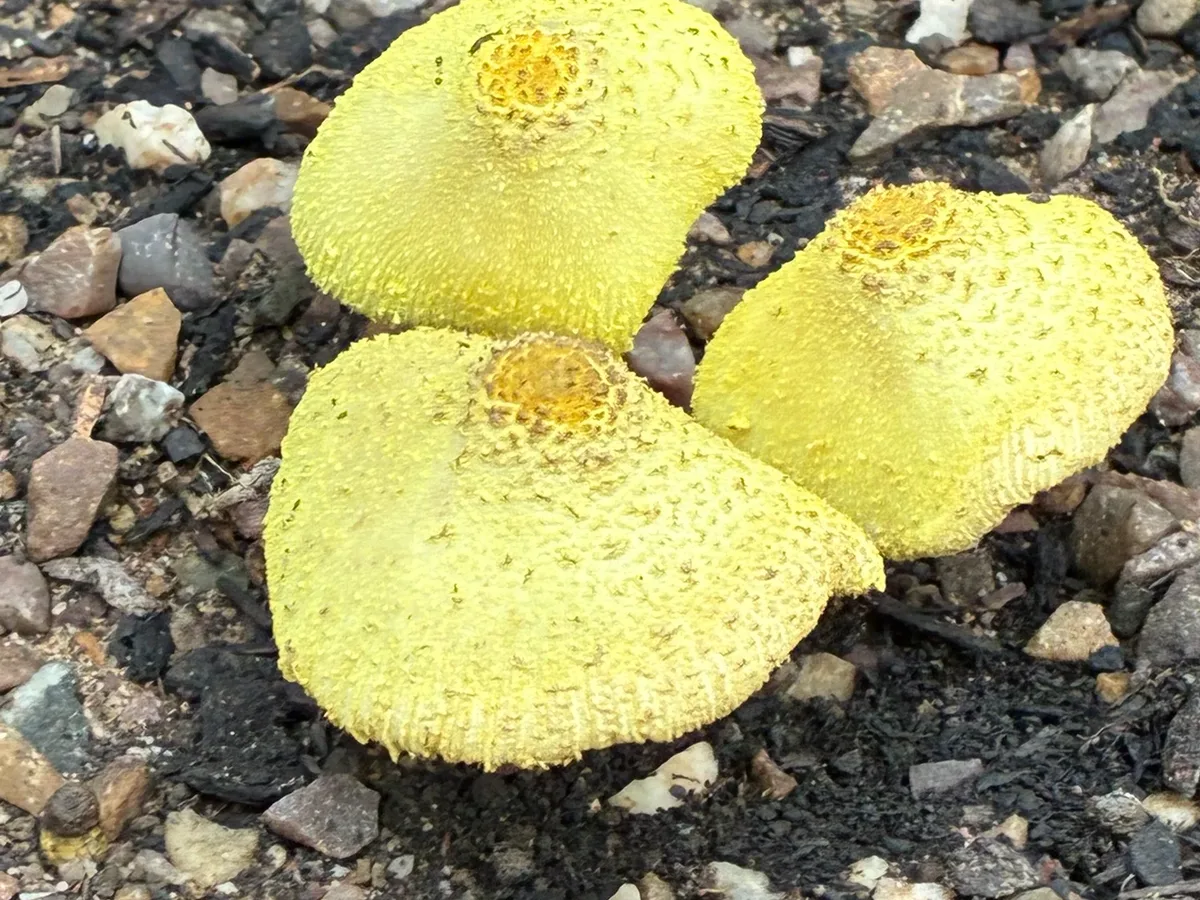 © Wendy Herniman (CC BY)
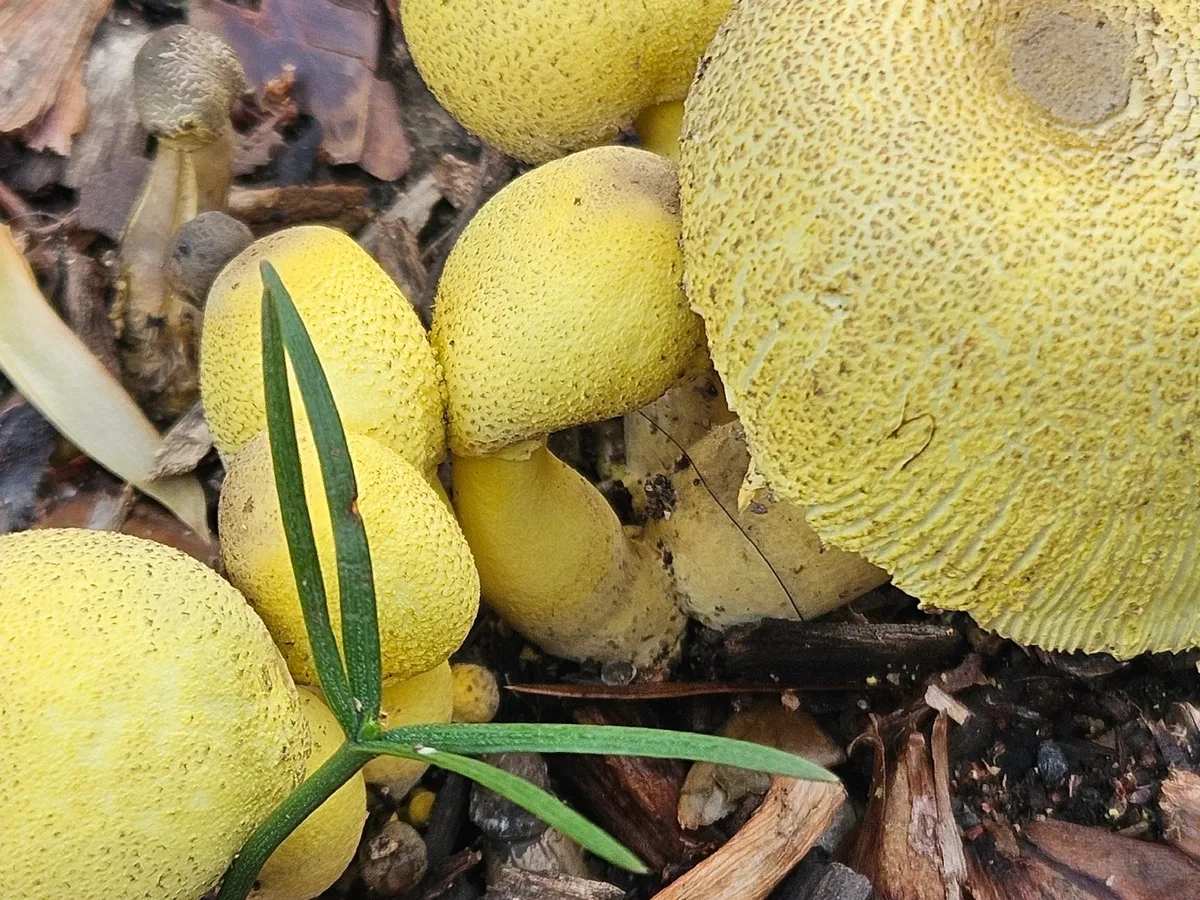 marsyd (CC0)
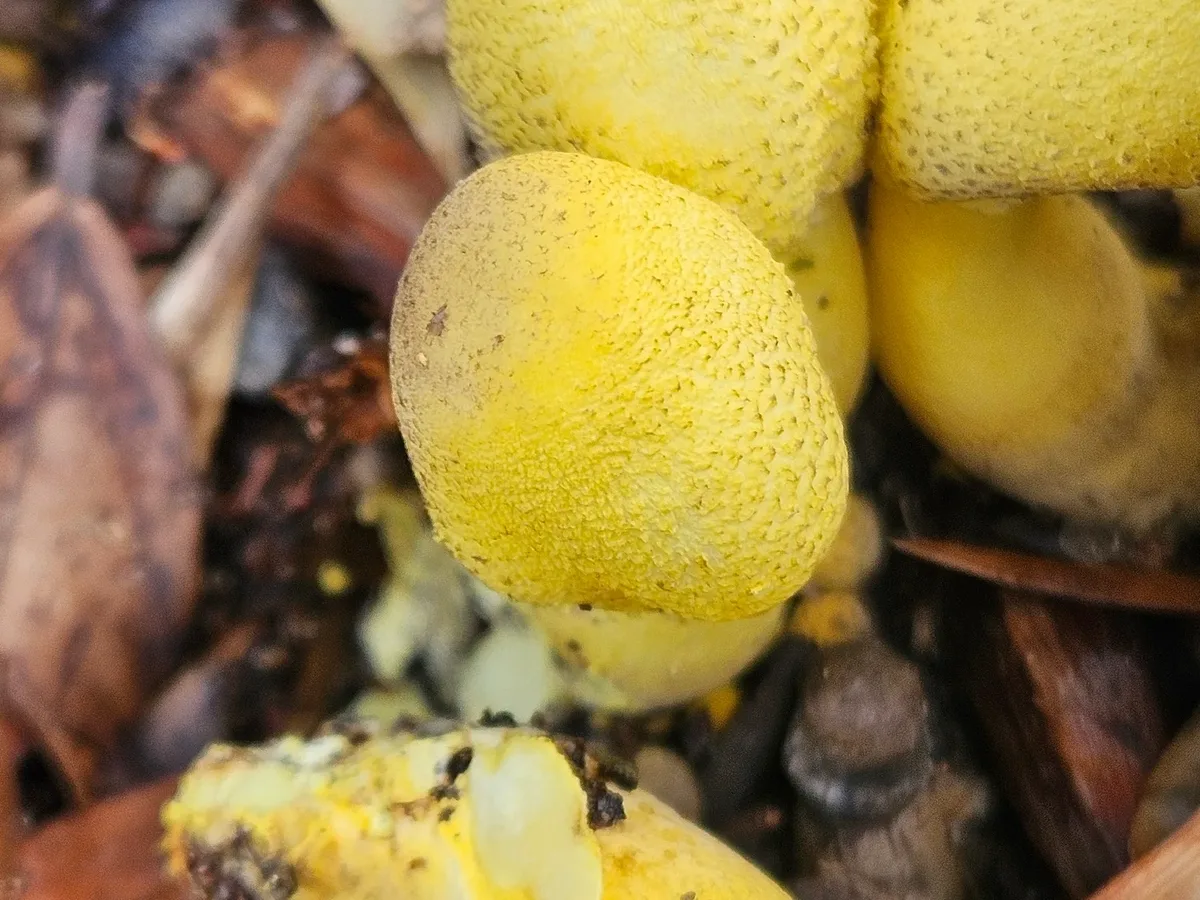 marsyd (CC0)marsyd (CC0)© Wendy Herniman (CC BY)
Edible only with the right preparation - or safe for some people but not others. Learn the caveats first.
Never eat a mushroom you are not 100% sure of - check the look-alikes below, and always cook wild mushrooms.
How to recognise it
Leucocoprinus birnbaumii is unmistakable when fresh: the entire fruitbody - cap, gills, stem, and flesh - is brilliant sulphur-yellow to lemon-yellow, making it look almost artificial against a dark potting soil.
Cap
The cap (2-7 cm, rarely to 10 cm) passes through egg-shaped, then bell-shaped, then broadly convex with a persistent central bump (umbo).
The surface is powdery-granular or finely scaly, the scales yellower and denser at the centre and becoming sparser toward the striate (grooved) margin.
The striated cap margin is one of the most reliable features: fine radial grooves run from well inside the cap edge toward the margin, reflecting the gill placement below.
Gills
The free, crowded gills are also yellow. The spore print, however, is white or barely off-white - the yellow gills are pigmented tissue, not pigmented spores.
Stem
The thin, hollow, yellow stem carries a fragile ring (annulus) that collapses with age.
Flesh
Flesh is yellow, thin, and does not change colour when cut.
The overall impression is of a delicate, luminously yellow toy umbrella - nothing in the temperate mycological world looks quite like it in a houseplant pot.
Fading specimens lose their intensity and may become paler, creamy-yellow or buff, which can increase the (already low) risk of confusion with pale Lepiota species.
Why it's dangerous
The principal danger is domestic accessibility. It grows in indoor houseplant pots in homes where young children and pets are present, and its vivid yellow colour makes it visually appealing to toddlers.
Its toxicity is real but not in the life-threatening category of amatoxin-bearing species. However, ingestion by a small child or a small-breed dog warrants immediate medical or veterinary consultation.
The second danger is complacency: because it is 'only' a gastrointestinal irritant, adults sometimes underestimate the importance of removing it promptly from child-accessible or pet-accessible environments.
Toxin
The toxin responsible for poisoning has not been definitively identified. The clinical pattern - rapid-onset gastrointestinal illness without delayed organ involvement - is consistent with thermostable or thermolabile gastrointestinal irritants.
Aranotin, a diketopiperazine-type compound, has been reported in the closely related Leucocoprinus species group and may contribute.
The toxin profile is clearly distinct from amatoxins (no delayed hepatorenal syndrome) and from muscarine (no cholinergic symptoms).
Some older sources listed L. birnbaumii as possibly edible in small amounts, but these claims have been contradicted by documented poisoning cases and should be disregarded.
Symptoms
Poisoning typically presents within 30 minutes to 3 hours of ingestion with nausea, vomiting, abdominal cramping, and diarrhoea.
Symptoms are generally self-limiting and resolve within 12-24 hours with supportive care. In children, dehydration from repeated vomiting and diarrhoea is the principal concern.
No delayed liver or kidney involvement has been reliably reported following ingestion of L. birnbaumii alone.
In pets (dogs, cats), symptoms mirror the human pattern: salivation, vomiting, diarrhoea, and lethargy.
Any case involving an extended symptom period (beyond 24 hours) or signs of liver involvement should be re-evaluated for possible misidentification with an amatoxin-bearing species.
Staying safe
Leucocoprinus birnbaumii is toxic and must not be eaten by humans or pets.
Documented human poisoning cases, especially in children, present with nausea, vomiting, and abdominal pain, consistent with gastrointestinal irritant syndrome. In dogs and cats, ingestion of houseplant mushrooms has produced similar gastrointestinal signs.
The precise toxin is not fully characterised but is not an amatoxin, and the poisoning profile does not include the delayed (6-24 hour) onset of symptoms or the organ-failure pattern seen with deadly dapperlings.
Nevertheless, any suspected ingestion - especially by a child or pet - warrants prompt consultation with poison control or a veterinarian.
Because this species grows in houseplant pots accessible to toddlers and curious pets, households with young children or animals should remove fruitbodies promptly and consider replacing the potting soil to prevent reflushing.
The fungus is harmless to touch; simple hand washing after handling is sufficient precaution for adults.
Where & when it grows
Habitat
Found almost anywhere warm, moist organic matter is available. Indoors it colonises the potting mix of houseplants, especially plants in peat- or compost-rich media at room temperature or above.
It is a pure saprotroph, decomposing organic material in the soil - it does not harm the plant it grows beside.
In its native tropical and subtropical range (Southeast Asia, Central America, sub-Saharan Africa) it grows outdoors in enriched garden soils, compost heaps, mulched beds, and disturbed forest margins.
In temperate climates it survives outdoors only in warm summer months, and then only in warmed, enriched soil. Its global spread into temperate homes is entirely due to international trade in tropical potting soil and houseplants.
When
Indoors, this species has no fixed season - it will fruit whenever the substrate is warm (above about 18 °C) and moist. A household plant that is suddenly watered after being allowed to dry can produce fruitbodies within a week.
In tropical outdoor habitats it fruits year-round with peaks during rainy seasons. In temperate gardens, outdoor occurrence is restricted to summer.
The fruitbodies are short-lived - they typically emerge, expand, and collapse within 3-5 days.
How it grows
Saprotrophic; breaks down organic matter in potting mix, compost, or enriched soil. Not mycorrhizal and not a plant parasite.
Fruitbodies emerge singly or in small clusters of 2-10 from the substrate surface, often all at once following watering or increased humidity.
They are fragile and short-lived: the cap expands quickly, the ring collapses, and the whole fruitbody withers and turns yellowish-brown within a few days.
Mycelium is present in the substrate between fruitings and may produce multiple flushes over weeks or months as long as conditions remain warm and moist.
Fruiting conditions
A warm-substrate saprotroph that fruits rapidly after the substrate is moistened at temperatures above approximately 18 °C. Indoors (houseplants) the trigger is watering - fruitbodies can emerge within 3-7 days of the potting soil being thoroughly wetted after a dry period. In tropical outdoor habitats, onset of rainy season or significant rainfall events after dry spells reliably triggers flush. Optimal substrate temperature appears to be 22-28 °C. The lag from watering to visible pins is very short (3-5 days), making it one of the fastest-responding common saprotrophs. No cold-stratification requirement; no frost tolerance.
Look-alikes
In the context in which this species is usually encountered - indoors in a houseplant pot - the uniformly brilliant yellow colour is so distinctive that no other commonly encountered fungus is genuinely likely to be confused with it.
In tropical outdoor settings, other yellow or yellow-tinged Leucocoprinus or Lepiota species occasionally co-occur and are similarly toxic. Any small, scaly, yellow dapperling-type mushroom in a tropical garden should be treated as potentially poisonous.
Very pale or fading specimens of L. birnbaumii might superficially suggest pale Lepiota or Leucoagaricus species, but these share the same caution tier. Amanita species are not realistic confusions in houseplant contexts.
The main practical lookalike risk in tropical or subtropical outdoor conditions is with other small yellow Leucocoprinus species such as Leucocoprinus fragilissimus, which is similarly yellow but more fragile and even more delicate; it shares the same toxic status.
In subtropical and tropical regions, pale or yellowish Lepiota josserandii or other small amatoxin-bearing Lepiota species could theoretically occur in the same outdoor mulched garden bed habitats - these are deadly and merit a full warning. However, they do not typically share the houseplant pot niche and are not brilliantly yellow throughout.
Lepiota brunneoincarnata is a small (2-5 cm cap), pale-background dapperling with pinkish-brown to brownish-flesh cap scales - it is never uniformly bright yellow. It prefers grassland, garden lawns, and woodland edges rather than houseplant pots. The risk of confusion is low in indoor settings but rises in outdoor tropical and subtropical gardens where both might appear in enriched beds. Any small dapperling that is NOT convincingly and uniformly yellow throughout - especially one with pinkish or brownish tones - must be treated as potentially deadly. Lepiota brunneoincarnata contains amatoxins and has caused fatal poisonings. Never harvest any small dapperling from an outdoor garden bed under the assumption that it is a yellow houseplant parasol.
Lepiota subincarnata is similarly sized to L. birnbaumii but has a pale ochre-buff to pinkish-ochre cap with a warm, fleshy background colour - never the intense sulphur-yellow of L. birnbaumii. It grows in woodland, gardens, and occasionally enriched soil beds in warm climates. It is one of the most dangerous European dapperlings due to confirmed high amatoxin content and multiple fatalities. Confusion with L. birnbaumii is only realistic in tropical outdoor settings with faded or atypically coloured specimens; the rule is simple - if a small dapperling in an outdoor garden is not uniformly, vividly yellow throughout including gills and flesh, do not assume it is the houseplant parasol.
Leucocoprinus fragilissimus is similarly yellow throughout and shares the same tropical-to-houseplant habitat, but is dramatically more fragile and delicate - the cap is thinner, more translucent, more deeply striate, and typically smaller (1-4 cm). The overall impression is of a flimsier, more watery-looking version of L. birnbaumii. The two species share equivalent toxic status and both must be avoided; for practical safety purposes the distinction between them is irrelevant - treat any vivid yellow dapperling-type mushroom in a houseplant pot as toxic.
Agaricus xanthodermus can appear superficially yellowish and shares garden/enriched-soil habitats in outdoor settings, but it is a much larger, more robustly built mushroom with chocolate-brown (not yellow) free gills at maturity and a distinctive, unpleasant inky or chemical smell when the flesh is cut. The cap background is white to pale grey, not yellow. It stains bright chrome-yellow when cut at the stem base - the 'yellow stain' is a reaction, not the baseline colour. Not a realistic confusion in houseplant pots.
A reference guide - never an edibility guarantee. When in doubt, leave it out.