Reddening Lepiota
Leucoagaricus americanussyn. Lepiota americana Pk., Leucoagaricus bresadolae, Leucocoprinus americanus, Agaricus americanus
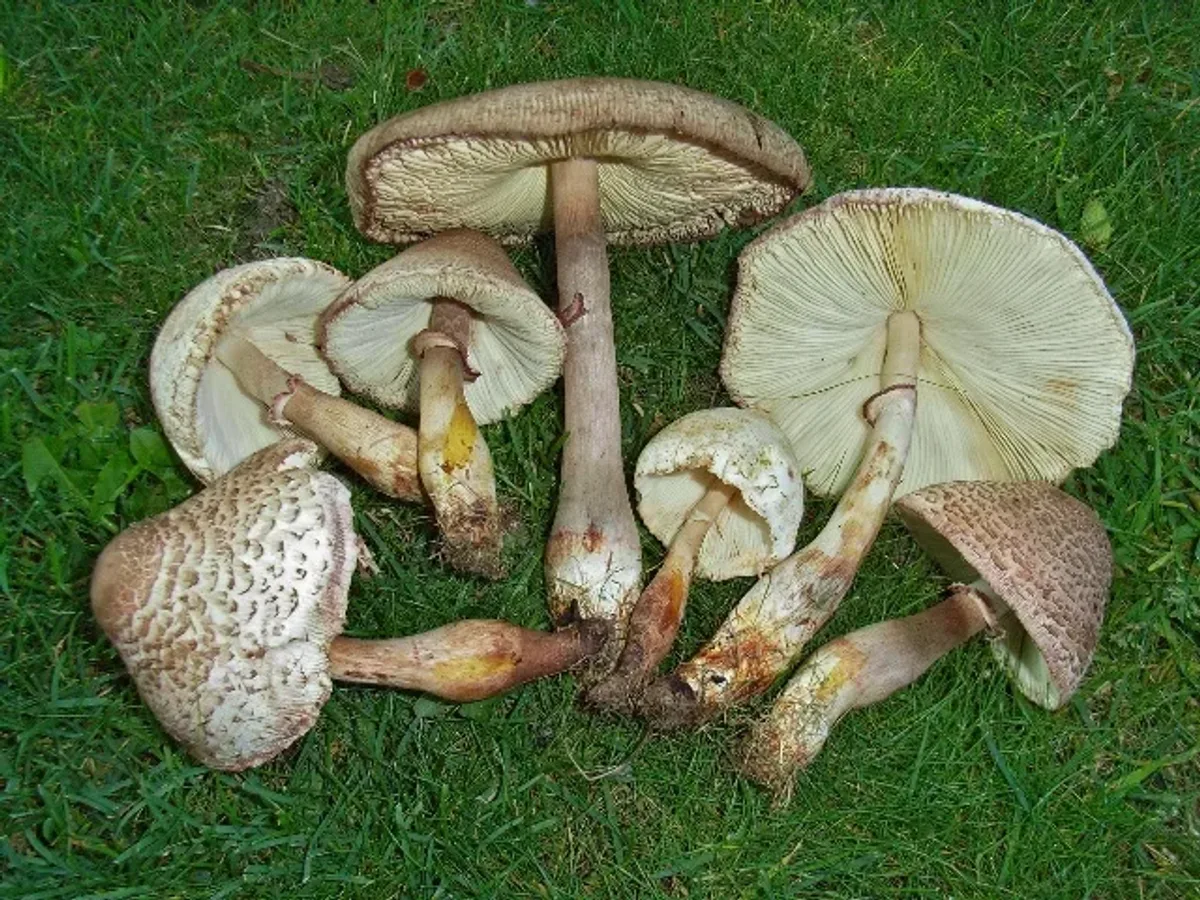 © Inger-Lise Fonneland (CC BY)
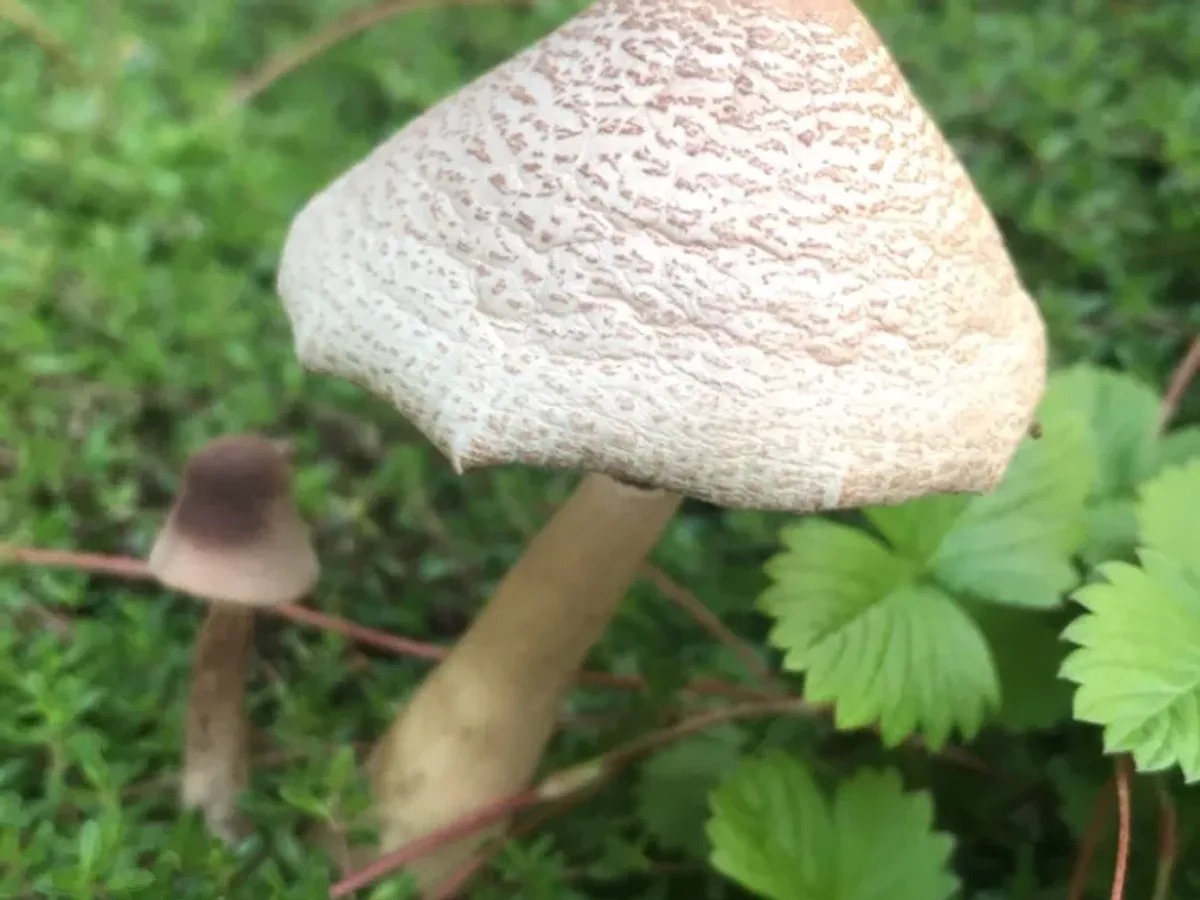 © Helene L Løvold (CC BY-SA)
 Duke University Herbarium Fungal Collection (DUKE-) (CC0)
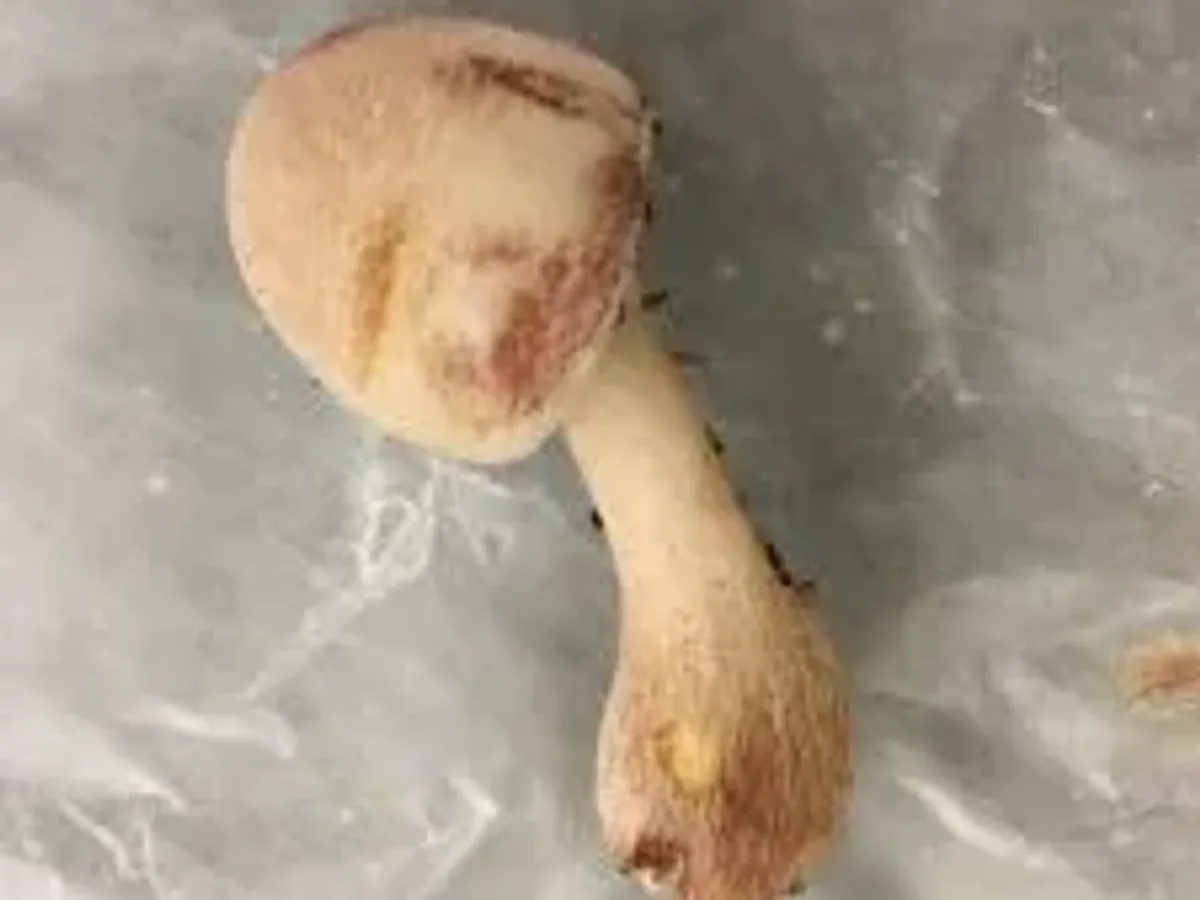 Duke University Herbarium Fungal Collection (DUKE-) (CC0)© Inger-Lise Fonneland (CC BY)© Helene L Løvold (CC BY-SA)
Edible only with the right preparation - or safe for some people but not others. Learn the caveats first.
Never eat a mushroom you are not 100% sure of - check the look-alikes below, and always cook wild mushrooms.
How to recognise it
Leucoagaricus americanus is a medium-to-large ring-bearing mushroom whose most striking and diagnostic feature is the speed and intensity of its reddening reaction. Cut any part of a fresh specimen - cap, stem, or gill - and within minutes the white flesh turns a vivid orange-red to brick-red, a colour shift so distinct and rapid that it becomes the first thing an experienced forager checks.
Cap
The cap starts as a rounded dome or egg-shape, 5-15 cm across, and opens to broadly convex or nearly flat, often retaining a low central bump.
The surface is white to pale cream, breaking into fine to moderately coarse brownish or ochraceous fibrous scales as it expands, with a darker central disc and a paler, often smoother margin - an appearance reminiscent of a modest parasol mushroom, though less extravagantly scaly than the large Macrolepiota species.
Gills
The gills are free from the stem, crowded, and white; they, too, stain reddish where bruised.
Stem
The stem is white, cylindrical, 6-15 cm tall, with a persistent membranous ring set high.
Crucially, the base has no volva - no enclosing bag or cup of tissue - and this absence is the single most important safety character separating it from the deadly Amanita destroying-angel complex.
Spores
The spore print is white.
Under the microscope, spores measure 9-12 × 6-7.5 µm, are broadly ellipsoidal with a germ pore, thick-walled, and dextrinoid - features typical of Leucoagaricus.
Why it's dangerous
The primary danger is misidentification. Amanita bisporigera (Destroying Angel) shares the same habitats and appearance profile, and is responsible for most fatal mushroom poisonings in North America. The shared profile:
- white cap
- white gills
- white spore print
- ring-bearing
- no basal cup visible from above ground
Its amatoxins cause liver and kidney failure with a 10-30% mortality rate even with modern intensive care.
The flesh of A. bisporigera does not redden when cut, and it always has a buried volva at the base. Both the absence of a volva and the reddening reaction must be positively confirmed on every specimen before any consideration of eating.
The secondary danger is intrinsic GI toxicity of the species itself, which is documented but incompletely understood.
Toxin
No specific toxin has been conclusively isolated from Leucoagaricus americanus. Gastrointestinal irritants of uncharacterised nature are suspected.
The rapid reddening reaction is caused by enzymatic oxidation of phenolic compounds, producing quinone pigments - a reaction analogous to that in other reddening or browning Leucoagaricus species. Whether these or related compounds directly cause GI irritation has not been established.
By analogy with other GI-irritant Leucoagaricus species and given the documented poisoning cases, the species is conservatively classed as a GI irritant pending fuller toxicological characterisation.
Symptoms
Gastrointestinal illness after ingestion: nausea, vomiting, abdominal cramping, and diarrhoea, typically with onset 30 minutes to 3 hours after eating. Symptoms are generally self-limiting within 24 hours in documented cases.
IMPORTANT SAFETY NOTE: seek emergency medical care immediately if:
- onset is delayed beyond 6 hours
- symptoms are severe
- there is any sign of liver involvement (jaundice, dark urine, extreme fatigue, upper-right abdominal pain)
Delayed onset after eating any white, ring-bearing mushroom from the lawn or woodland must be treated as potential amatoxin poisoning (Amanita destroying-angel misidentification) until excluded - this is a medical emergency requiring hospitalisation, monitoring, and possible early intervention.
Always retain a photograph or specimen of any mushroom eaten in case medical identification is needed.
Staying safe
CAUTION: Leucoagaricus americanus has a documented history of causing gastrointestinal illness in a proportion of people who have eaten it, even after cooking.
Some sources describe it as edible and have consumed it without ill effects; others report nausea, vomiting, and abdominal cramps, particularly from larger servings.
Because the specific toxin responsible has not been isolated or characterised, there is no reliable threshold or preparation method guaranteed to neutralise it. This species is accordingly classified as caution - not as freely edible.
The far greater hazard, however, is misidentification. The North American Destroying Angel (Amanita bisporigera) shares the same suburban lawns, parks, and woodland-edge habitats and appears as a white, ring-bearing mushroom with white gills. A single cap of A. bisporigera contains enough amatoxins to kill an adult.
The reddening of the flesh when cut and the confirmed absence of a volva at the stem base are the two most important differentiators, but both require deliberate confirmation on every individual specimen.
Novice foragers and all non-expert collectors should not eat Leucoagaricus americanus. If in any doubt - do not eat it.
Where & when it grows
Habitat
This species is a creature of disturbed and organically enriched soils across the eastern United States and adjacent Canada.
It has a notably ruderal character, thriving in disturbed, fertilised, and mulched ground:
- suburban gardens
- compost-enriched flower beds
- roadside banks
- mulched plantings in parks
- woodland margins and clearings where buried organic matter accumulates
It is frequently seen in city parks and around landscaped plantings as much as in natural woodland edges - a habitat profile shared with several of its most dangerous lookalikes, including the North American destroying angel (Amanita bisporigera).
The species is an active decomposer, quietly breaking down organic matter in the soil, and produces its fruitbodies singly or scattered rather than in large gregarious troops. This scattered habit and its preference for disturbed ground means it is easily encountered in ordinary domestic and urban settings.
When
The principal fruiting window in eastern North America runs from July through October, with peak abundance in July through September during the warm, humid heart of the summer growing season.
Fruiting is rain-triggered: flushes push up 5-10 days after soaking rains when the soil is warm (above 15 °C).
The species does not wait for the cooling temperatures of autumn that many forest mushrooms require, which makes it an early and reliable summer saprotroph.
Dry summer spells suppress fruiting sharply, but successive rain events can generate multiple flushes from established mycelium through the same season.
How it grows
Saprotrophic, living entirely on decomposing organic matter in the soil. Fruitbodies emerge singly or in small, scattered groups - occasionally in partial arcs tracing the underground advance of the mycelium.
Development is rapid under warm, moist summer conditions: buttons can expand from small rounded domes to full-sized mushrooms in 2-4 days.
The ring is most clearly developed on young to mid-aged specimens and may become ragged or fall away as the cap fully expands, so always examine younger material when possible.
The reddening reaction is most pronounced in fresh, recently harvested material; aged, desiccated, or cooked specimens may show it less dramatically.
Fruiting conditions
A warm-season saprotroph fruiting in summer and early autumn. Flushes appear 5-10 days after soaking rains when soil temperature is warm (15-26 °C). Unlike many autumn forest mushrooms, this species does not require cooling temperatures - it is a true summer fruiter that peaks during the hot, humid months of July and August in eastern North America. Dry spells shut down fruiting quickly; successive rain events in the same season can produce multiple flushes.
Look-alikes
Several confusions deserve careful attention, and one is deadly.
The most dangerous and realistic confusion in eastern North America is with the Destroying Angel (Amanita bisporigera), which shares the same habitats - lawns, gardens, suburban parks, and woodland edges - and appears as a pure white, ring-bearing mushroom with free white gills and a white spore print.
The critical difference is the volva: A. bisporigera has a prominent, bag-like white volva at the base of a bulbous stem, always buried in the soil. Leucoagaricus americanus has no volva whatsoever.
Additionally, the flesh of L. americanus stains vivid orange-red when cut - A. bisporigera flesh does not change colour. The same reasoning applies to other white Amanita species (A. virosa, A. ocreata).
Other confusions to weigh:
- Leucoagaricus leucothites: a paler, smoother species with an almost unicolorous white to faintly greyish cap, finer scaling, and flesh that does NOT significantly redden or brown on cutting - the reddening reaction is the clearest separator.
- Chlorophyllum brunneum (Shaggy Parasol): also stains reddish when cut, but is usually larger, more coarsely scaly with upturned dark-brown scales, and the colour change is more vivid scarlet and faster; its spore print is white.
- Chlorophyllum molybdites (Green-spored Parasol): the most common cause of severe mushroom poisoning in North America, sharing the lawn and garden habitat with L. americanus. It has a scaly cap and gills that turn dull greenish-grey at maturity, and its spore print is distinctly greenish - never white. A spore print is the simplest way to exclude C. molybdites.
- Macrolepiota procera (Parasol Mushroom): significantly larger at maturity (cap 15-30 cm), with a distinctly banded snakeskin stem pattern, a double-edged ring that slides freely, and flesh that does not stain reddish.
Deadly; introduced and spreading in North America, mainly in the west but increasingly in eastern regions near European tree plantings. Typically has a greenish-yellow to olive cap, but all-white button forms can occur. Always has a bag-like white volva at the base and bulbous stem base; flesh does not redden. White spore print. Responsible for the majority of fatal mushroom poisonings worldwide.
Deadly. Shares suburban lawns, gardens, parkland, and woodland-edge habitats throughout eastern North America. Appears as a white to off-white mushroom with free white gills, a white ring, and a white spore print - superficially similar at a glance. The critical separators: (1) Amanita bisporigera always has a prominent, bag-like white VOLVA enclosing the bulbous stem base, buried in the soil - always dig out the base completely; L. americanus has no volva whatsoever. (2) The flesh of L. americanus turns vivid orange-red within minutes of cutting; A. bisporigera flesh does not change colour. One cap of A. bisporigera can deliver a fatal dose of amatoxins.
Deadly; less common in North America than A. bisporigera but present. Same separation applies: volva at the base (L. americanus has none), white gills that stay white (L. americanus flesh reddens when cut). Responsible for fatal mushroom poisonings; never eat a white, ring-bearing mushroom without physically confirming the absence of a volva.
The most common cause of severe mushroom poisoning in North America, sharing the exact same lawn and garden habitat. Distinguished by gills that become dull greenish-grey at maturity and a distinctly greenish spore print. L. americanus always gives a white spore print. Take a spore print whenever in doubt - it takes a few hours but is definitive.
A choice edible, but a possible confusion for inexperienced foragers. Distinguished by its substantially larger size at maturity (cap 15-30 cm), the distinctive zigzag snakeskin-banding on the stem, a double-edged ring that slides freely up and down the stem, and coarser plate-like scales on the cap. Flesh does not stain reddish when cut.
Also stains reddish when cut, but is usually larger (cap 8-20 cm or more), with more coarsely upturned dark-brown scales on the cap, an abruptly swollen basal bulb, and flesh that turns a more vivid scarlet very rapidly. C. brunneum is a GI irritant but not deadly - still, confirm by noting the darker, coarser scales and the absence of a volva in this species too.
A GI-irritant caution species, not deadly itself (but shares the problem of resemblance to deadly Amanitas). L. leucothites is paler and more uniformly whitish to greyish-white, with a smoother, less scaly cap surface and - crucially - flesh that does NOT redden or stain orange on cutting. The reddening reaction is the clearest field separator from L. americanus.
A reference guide - never an edibility guarantee. When in doubt, leave it out.