Pale lilac blewit
Lepista sublilaceasyn. Clitocybe sublilacea, Tricholoma sublilaceum, Rhodopaxillus sublilaceus
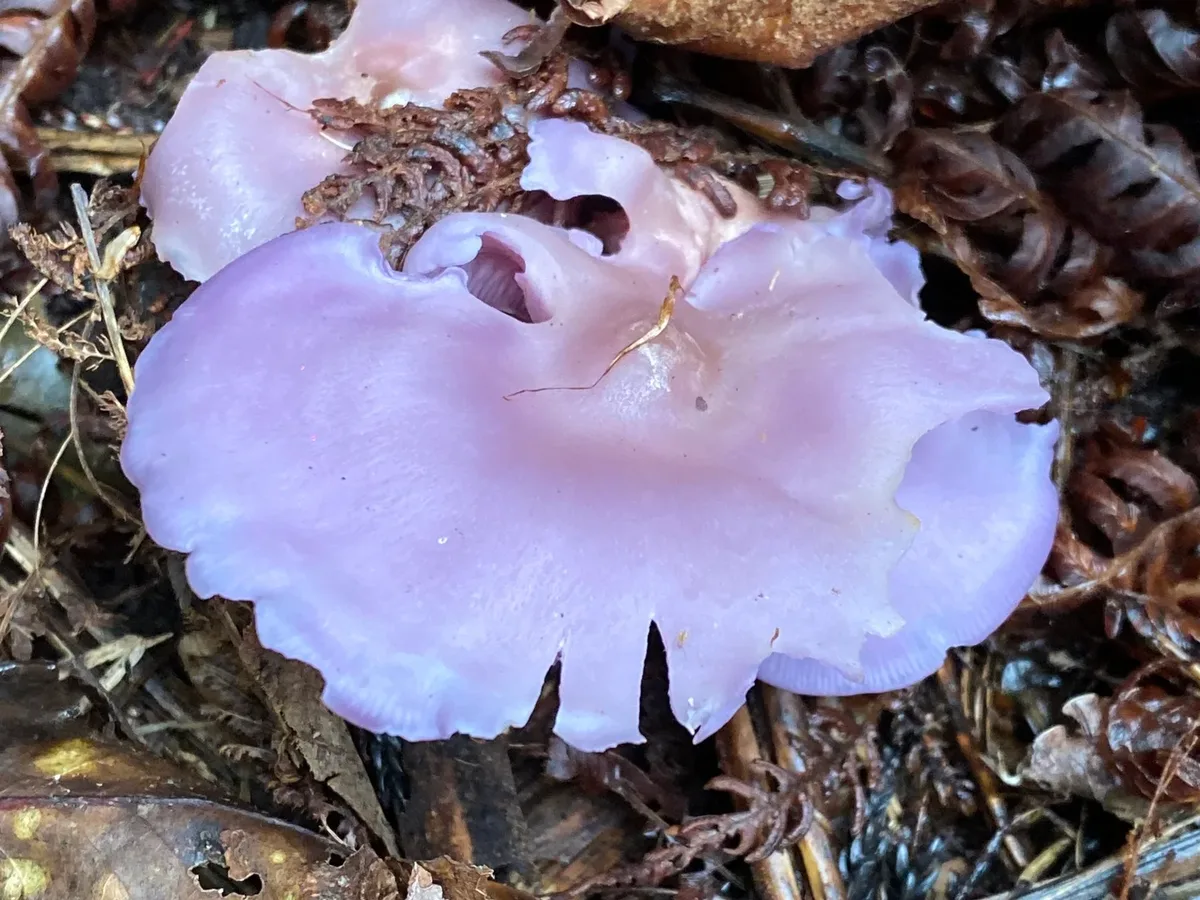 Atlas of Living Australia (CC0)
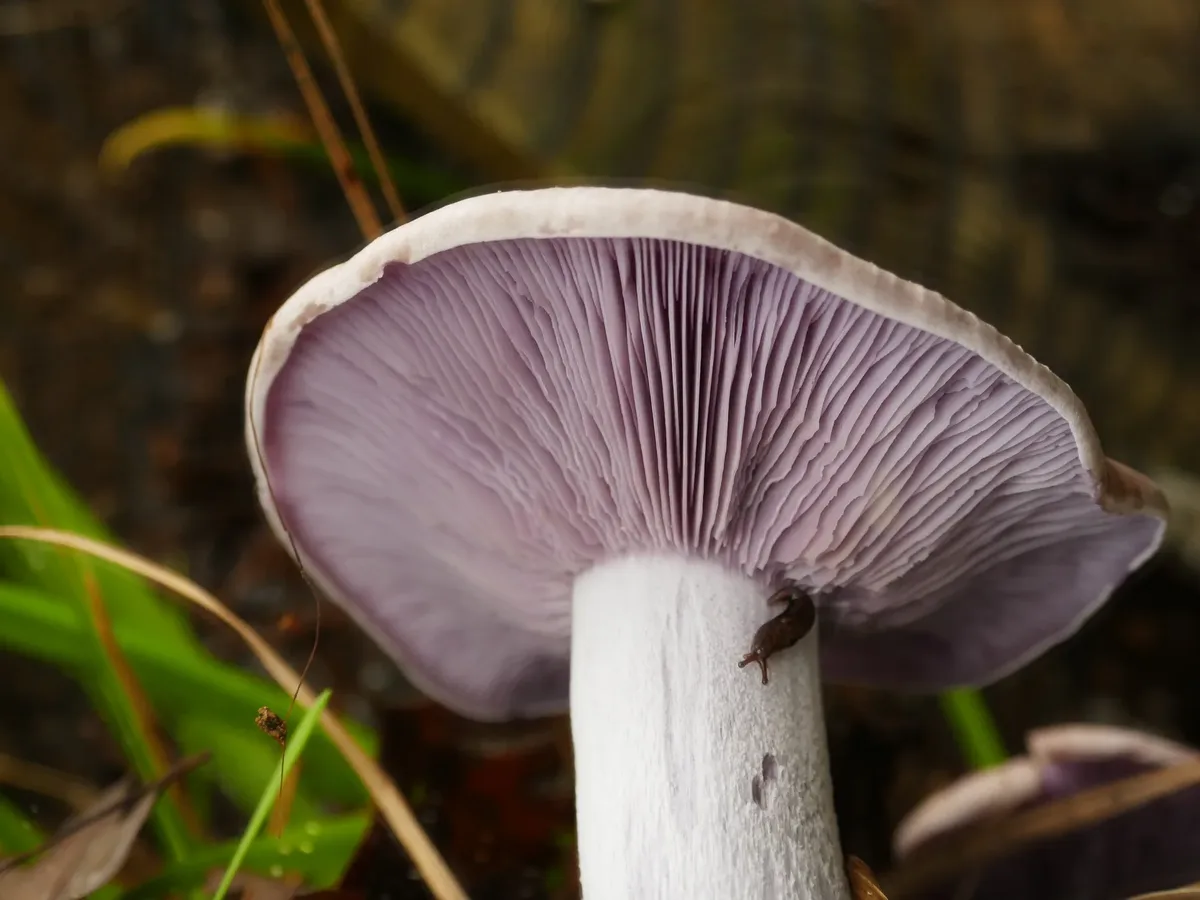 Atlas of Living Australia (CC0)
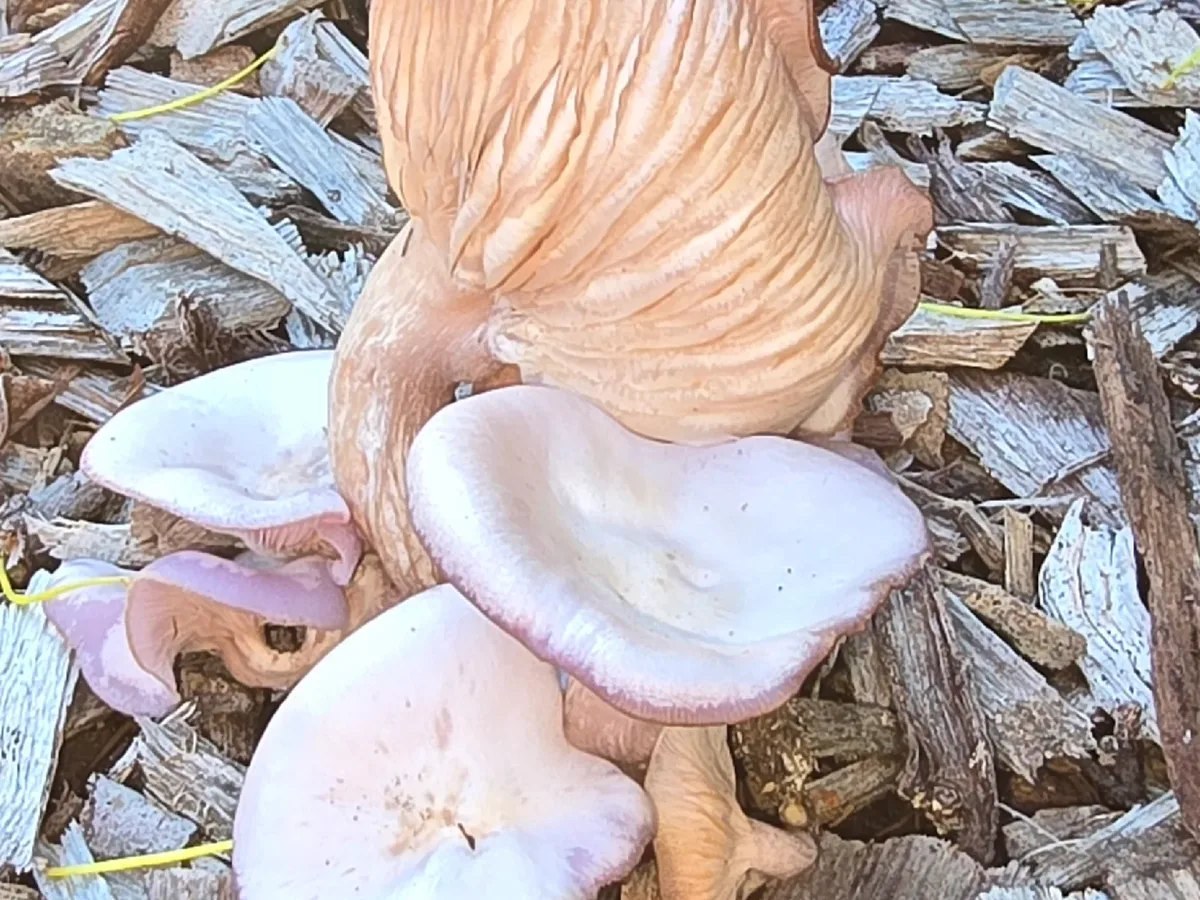 Atlas of Living Australia (CC0)
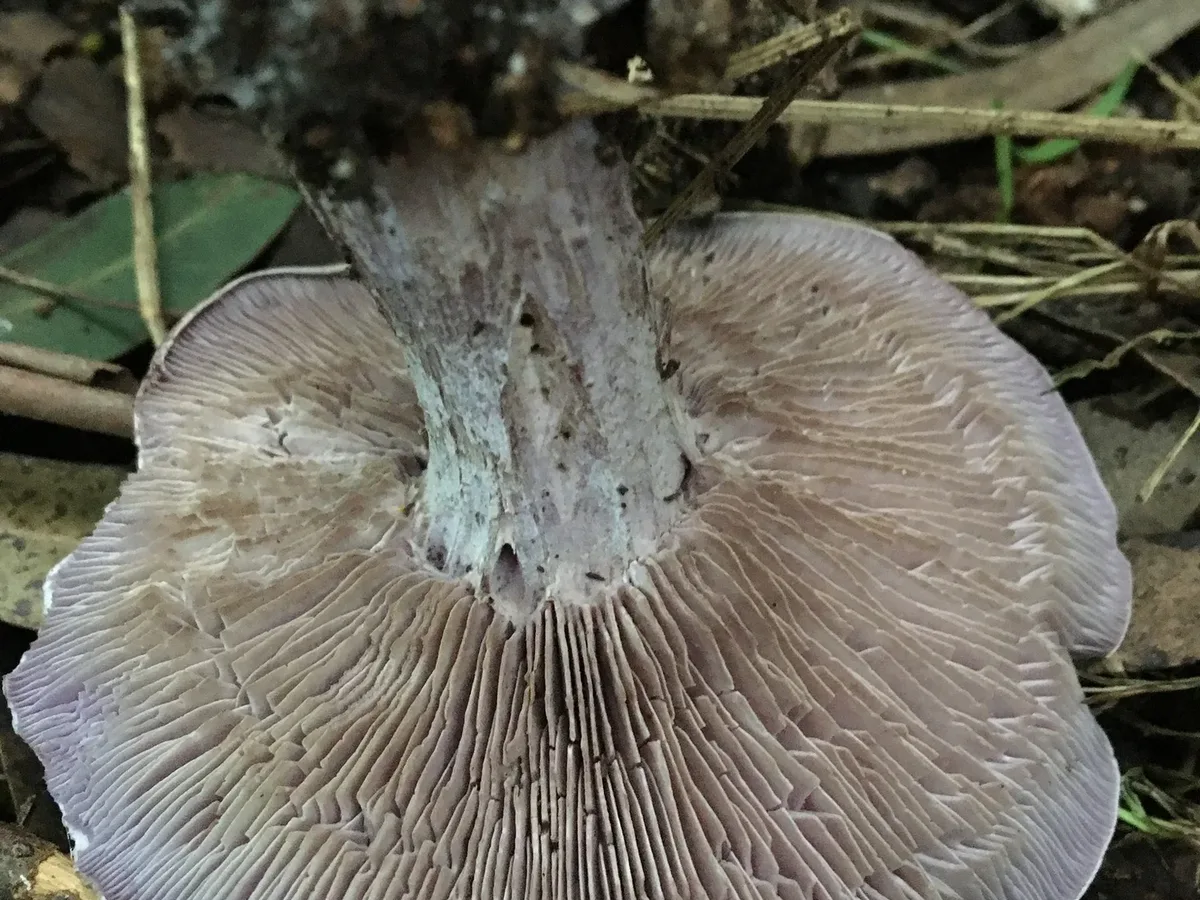 Atlas of Living Australia (CC0)
 Atlas of Living Australia (CC0)Atlas of Living Australia (CC0)Atlas of Living Australia (CC0)
Edible only with the right preparation - or safe for some people but not others. Learn the caveats first.
Never eat a mushroom you are not 100% sure of - check the look-alikes below, and always cook wild mushrooms.
How to recognise it
Lepista sublilacea is a medium-sized blewit of the southern forests - a softer, paler cousin of the wood blewit (Lepista nuda) familiar to Northern Hemisphere foragers.
Cap
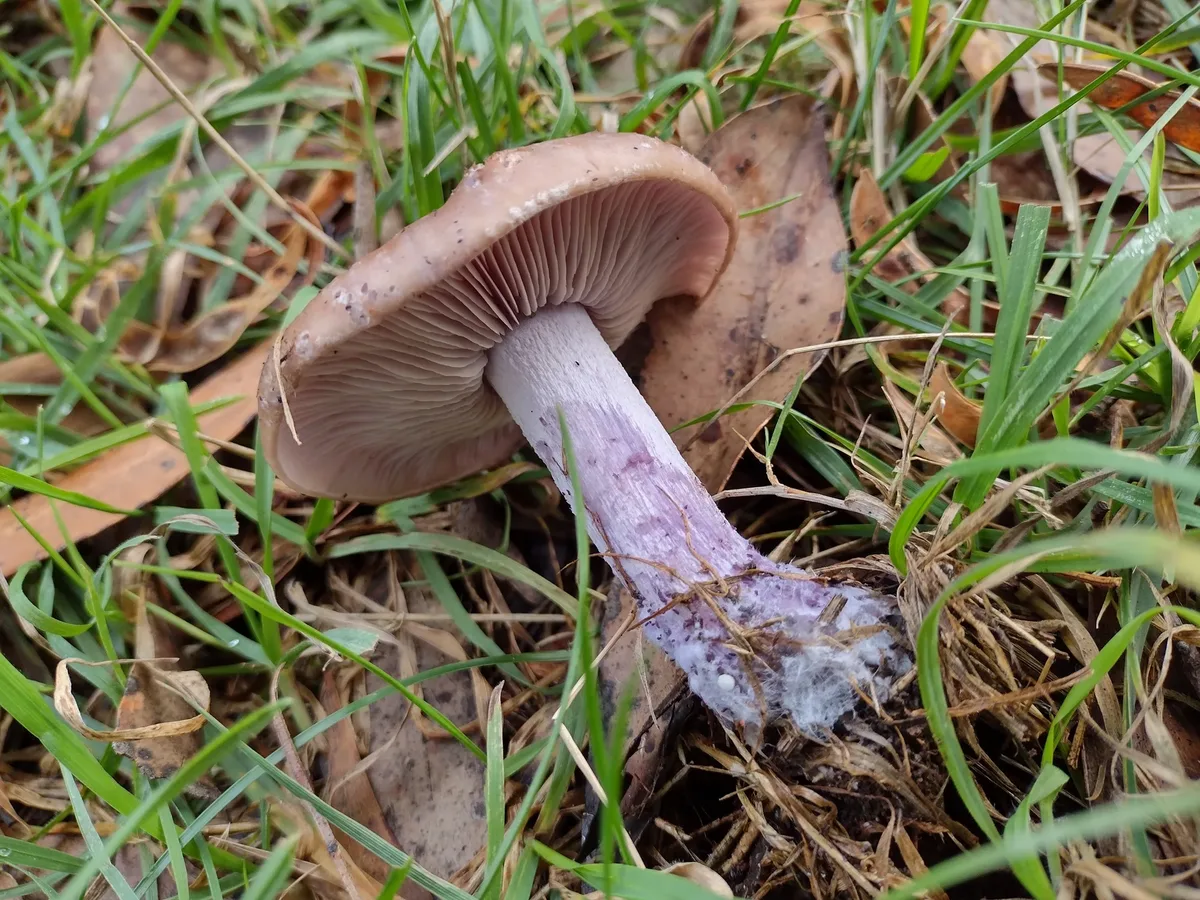
Its cap spans 4-10 cm, convex and inrolled when young, gradually flattening and sometimes turning gently wavy at the edges. The surface is smooth, slightly greasy to the touch when wet, and carries that characteristic blewit wash of pale lilac-grey to lilac-buff, with the centre tending just a little darker than the paler margin.
One habit of this mushroom is worth burning into memory: the lilac fades. As specimens age or dry out, the colour retreats to a plain buff or pale ochre-tan that would pass for any number of unremarkable saprotrophic caps. Fresh, young material showing its full lilac tone is what you need for reliable identification - faded old specimens are simply not safe to assess.
Gills
The gills are crowded, adnexed or shallowly sinuate, whitish-cream to very pale lilac-cream; there is no strong violet pigmentation here at any stage, which is one thing that sets it apart from more intensely coloured lookalikes.
Stem
The stem is 3-6 cm tall and relatively slender for a Lepista, cylindrical, solid, pale lilac-grey to greyish-white with faint fibrous streaking and a tuft of white mycelium at the base.
Flesh
The flesh is firm, whitish with a slight lilac tinge near the surface, and holds that colour when cut.
Smell & taste
The most reliable feature is the smell: close your eyes and it is fresh flour or cucumber - the distinctly mealy-farinaceous scent that runs through the whole Lepista genus and sets it apart from most of its dangerous neighbours. Spore print pale pinkish-cream.
Why it's dangerous
The intrinsic danger level of Lepista sublilacea itself is low: the heat-labile GI toxins are destroyed by thorough cooking, and raw-ingestion symptoms are unpleasant but transient and self-limiting with no organ damage expected.
The overriding danger is misidentification, and it is severe enough to warrant treating this species with the same caution as any deadly mushroom until positive identification has been confirmed by multiple characters.
The primary misidentification risk is confusion with South American Cortinarius species containing orellanine. South America harbours extensive endemic Cortinarius diversity, including numerous violet, lilac, and greyish-blue species that share the Nothofagus forest floor with Lepista sublilacea.
Orellanine causes delayed nephrotoxic syndrome:
- 1only mild nausea in the first days after ingestion,
- 2a deceptive symptom-free interval,
- 3irreversible kidney failure presenting 1 to 3 weeks after the meal.
By the time the diagnosis is made, permanent renal damage is often already established and dialysis or transplantation may be required.
This latency is the defining feature that makes orellanine poisoning so dangerous - victims do not feel acutely ill after eating, do not associate their later kidney crisis with the mushroom meal, and may wait far too long before seeking treatment.
This species should not be eaten by anyone unable to take a spore print and confirm it is pale pinkish-cream (not rusty brown), and who cannot confirm the absence of a cobweb cortina on young specimens.
The secondary misidentification risk is Clitocybe dealbata and related small white Clitocybe species containing muscarine. These cause cholinergic poisoning - excessive salivation, sweating, tears, slow heart rate, and in severe cases bronchospasm - with rapid onset and potentially serious consequences in vulnerable individuals. While morphologically less similar to Lepista sublilacea than Cortinarius, they may grow in overlapping edge habitats.
Given the combination of a lethal lookalike with a weeks-long latency and the incompleteness of South American Cortinarius taxonomy (new orellanin-producing species continue to be described), the precautionary standard for this species must remain high: spore print and cortina check are non-negotiable, not optional.
Toxin
Lepista species as a group contain one or more heat-labile compounds that cause gastrointestinal upset when eaten raw or insufficiently cooked. The exact chemical identity of these compounds has not been fully characterised; they are thought to be glycoproteins or saponin-like substances rather than the stable, small-molecule toxins seen in the most dangerous species.
This matters practically because it determines both the risk profile and the mitigation. Unlike orellanine (the nephrotoxin of Cortinarius species), which is heat-stable and accumulates irreversibly in kidney tissue regardless of cooking, or the heat-stable muscarine of Clitocybe dealbata, the toxic compounds of Lepista denature at the temperatures reached during normal sautéing or boiling - typically well above 70 °C sustained for several minutes.
A brief flash in a hot pan is not sufficient; the mushroom must be cooked through to its centre.
The practical consequence is that thoroughly cooked Lepista sublilacea has a long track record of safe consumption among South American foragers who know the species well, while raw or undercooked specimens reliably produce gastrointestinal symptoms.
The incompleteness of the toxin characterisation means that the 'safe when cooked' conclusion rests on empirical tradition rather than fully resolved chemistry - a distinction worth noting for a species growing in the same habitat as some of the world's most dangerous mushrooms.
Symptoms
Consumption of raw or insufficiently cooked Lepista sublilacea causes gastrointestinal syndrome: nausea, vomiting, abdominal cramping, and diarrhoea, with onset typically within 30 minutes to 2 hours of ingestion.
Symptoms are dose-related - a large quantity of undercooked mushroom will produce more severe effects than a small amount - and are self-limiting in nature, resolving within 6 to 12 hours with supportive care (rest, hydration, and avoidance of further food intake until symptoms pass).
No organ-level toxicity is expected from properly identified L. sublilacea itself; there is no documented renal, hepatic, or neurological involvement in confirmed cases.
This sharply distinguishes L. sublilacea poisoning from the orellanine syndrome caused by Cortinarius lookalikes, in which the kidneys are the primary target organ and gastrointestinal symptoms during the first week may be deceptively mild before catastrophic kidney failure emerges 1-3 weeks after ingestion.
Any patient presenting with delayed or worsening symptoms beyond the 12-hour window after consuming a violet mushroom from South American forest should be assessed urgently for orellanine poisoning, not assumed to have simple Lepista GI upset.
Staying safe
Must be cooked thoroughly - Lepista species as a group contain heat-labile compounds that cause gastrointestinal upset when eaten raw, and Lepista sublilacea is no exception. Never eat raw.
The most serious identification risk is confusion with South American Cortinarius species containing orellanine, which causes fatal nephrotoxic syndrome with a deceptive delay of 1-3 weeks between ingestion and onset of symptoms; by the time kidney failure is apparent, irreversible damage may have occurred.
Always check for a cobweb cortina on young specimens (absent in Lepista) and take a spore print - Lepista gives a pale pinkish-cream print, while Cortinarius gives a rusty-brown print. The mealy-farinaceous smell is a strong supporting character for Lepista.
Because South American Cortinarius diversity is incompletely documented and new orellanin-producing species continue to be described, the precautionary standard for this species must be high. Only harvest if you can confirm:
- the pale pink spore print,
- absence of cortina,
- mealy smell,
- pale-coloured (not rusty) gills.
When in doubt, do not eat.
Where & when it grows
Habitat
Lepista sublilacea lives as a saprotrophic decomposer of leaf litter and humus, doing the quiet work of breaking down the forest floor.
Its heartland is the temperate broadleaf and mixed forests of Chile and Argentina - particularly beneath Nothofagus (southern beech) from the central Chilean valleys south through Patagonia - though it also turns up at forest margins, in parks and gardens with old, undisturbed turf, and occasionally in open grassland near woodland.
It prefers moist, humus-rich soils in sheltered spots that hold their moisture after rain.
In ecological terms it fills the same niche as Lepista nuda does in European forests and Lepista saeva in open grassland - the 'blewit slot' in the Southern Hemisphere temperate community.
When
The fruiting season follows the Southern Hemisphere autumn calendar. Fruit bodies emerge in April and May across most of the range, with the season stretching from March through June in good years.
At cooler, higher-elevation Patagonian sites - southern Chile, Tierra del Fuego - it may compress into May-June.
What sets the clock running is the same trigger as for blewits everywhere:
- cooling air,
- dropping soil temperatures,
- the first meaningful autumn rains breaking a dry summer.
The species is frost-tolerant and can keep fruiting into June even after night frosts have arrived.
How it grows
Saprotrophic, pushing up from buried leaf litter, decomposing roots, and accumulated humus in the forest floor.
Fruit bodies come singly or in small groups of 2-6, occasionally arranged in partial arcs - the visible trace of an underground mycelial network that can thread through the same patch of soil for years, returning to the same productive spots each autumn.
It does not build the large, showy fairy rings that field blewit (Lepista saeva) is known for in European meadows, but experienced foragers in southern Chile quietly note which sites fruit reliably, returning year after year to find them.
Fruiting conditions
Fruiting stimulated by first significant autumn rains (March-May in Southern Hemisphere) combined with cooling soil temperatures dropping below 15 °C. Requires at least 25 mm rainfall in the preceding two weeks. Frost-tolerant; productive flushes can occur at soil temperatures as low as 4 °C. Dry autumn conditions strongly suppress fruiting.
Look-alikes
The most dangerous lookalikes are Cortinarius species, of which South America hosts a large endemic diversity including many deeply coloured violet, lilac, and blue-toned species.
Several South American Cortinarius species produce orellanin, a nephrotoxin that causes delayed kidney failure with a latency of one to three weeks, making poisoning events particularly lethal because treatment is often sought too late.
These Cortinarius species are distinguished from Lepista sublilacea by:
- their rusty-brown spore print,
- the presence of a cobweb-like cortina (the fine veil strands connecting the cap margin to the stem) in young specimens,
- often a more intensely violet or reddish-brown colouration that does not fade toward buff.
Small white or greyish Clitocybe species with decurrent gills and muscarine content are a secondary concern in more open habitats.
The wood blewit (Lepista nuda), if present in the same region as an introduced or adventive species under Eucalyptus or in garden settings, is closely similar but has more uniformly violet cap and gills - both are edible when well cooked, but the wood blewit's deeper, more saturated violet is a useful comparison point.
Any lilac or violet mushroom on the Nothofagus forest floor in Chile or Argentina must have its spore print and cortina status checked before eating.
White to greyish-white, much smaller (cap 2-5 cm), with no trace of lilac or violet at any stage; gills crowded and slightly decurrent (running down the stem); grows in grassland and open areas. Contains muscarine, which causes cholinergic poisoning with profuse sweating, salivation, slow heartbeat. Distinguished from Lepista sublilacea by the complete absence of lilac-violet colouration and the decurrent gills. Concern mainly in open habitat at woodland margins rather than deep forest.
South America hosts numerous endemic Cortinarius species with violet, lilac, or greyish-blue tones that are superficially similar to Lepista sublilacea in colour and forest habitat. Several South American Cortinarius species contain orellanine, a nephrotoxin causing delayed and often fatal kidney failure 1-3 weeks after ingestion. Distinguish by: cobweb-like cortina (fine veil threads) present in young specimens connecting cap margin to stem (absent in Lepista); rusty-brown spore print (vs pale pinkish-cream in Lepista); gills that may be violet-grey turning rusty brown with age (vs pale cream to buff in Lepista); absence of the strong mealy-farinaceous smell. Take a spore print before consuming any violet-toned mushroom from Nothofagus forest.
Brilliant amethyst-violet throughout when fresh, cap distinctly thin and convex with widely spaced, thick, deep-violet gills - very different from the crowded pale gills of Lepista sublilacea. Much smaller (cap 1-5 cm). Hygrophanous, fading dramatically when dry to pale buff. Found in similar forest habitats. Edible but can bioaccumulate arsenic from contaminated soils, so should not be collected from industrially impacted sites.
Closely related and also edible when cooked. Distinguished by more intensely and uniformly violet colouration on cap, gills, and stem; the cap of Lepista nuda remains strongly violet-purple rather than fading to lilac-buff. Grows under introduced Eucalyptus and Pinus plantations, or in garden compost in southern South America. Both species are edible when cooked but must be positively identified before consumption.
A reference guide - never an edibility guarantee. When in doubt, leave it out.